Systematic review of acute physically
active learning and classroom
movement breaks on children’s
physical activity, cognition, academic
performance and classroom behaviour:
understanding critical design features
Andy J Daly-Smith,1 Stephen Zwolinsky,1 Jim McKenna,1 Phillip D Tomporowski,2 Margaret Anne Defeyter,3 Andrew Manley1
To cite: Daly-Smith A J, Zwolinsky S, McKenna J, et al. Systematic review of acute physically active learning and classroom movement breaks on children’s physical activity, cognition, academic performance and classroom behaviour: understanding critical design features. BMJ Open Sport & Exercise Medicine 2018;4:e000341. doi:10.1136/ bmjsem-2018-000341
►Additional material is published online only. To view please visit the journal online (http:// dx. doi. org/ 10. 1136/ bmjsem- 2018- 000341).
Accepted 22 February 2018
1School of Sport, Leeds Beckett
University, Leeds, UK
2Department of Kinesiology,
University of Georgia, Athens, Georgia, USA
3Department of Psychology,
Northumbria University, Newcastle upon Tyne, UK
Correspondence to Andy J Daly-Smith; a. daly- smith@ leedsbeckett. ac. uk
AbsTrACT
Objective To examine the impact of acute classroom movement break (CMB) and physically active learning (PAL) interventions on physical activity (PA), cognition, academic performance and classroom behaviour. Design Systematic review.
Data sources PubMed, EBSCO, Academic Search Complete, Education Resources Information Center, PsycINFO, SPORTDiscus, SCOPUS and Web of Science.
Eligibility criteria for selecting studies Studies investigating school-based acute bouts of CMB or PAL on (PA), cognition, academic performance and classroom behaviour. The Downs and Black checklist assessed risk of bias.
results Ten PAL and eight CMB studies were identified from 2929 potentially relevant articles. Risk of bias scores ranged from 33% to 64.3%. Variation in study designs drove specific, but differing, outcomes. Three studies assessed PA using objective measures. Interventions replaced sedentary time with either light PA or moderate-to-vigorous PA dependent on design characteristics (mode, duration and intensity). Only one study factored individual PA outcomes into analyses. Classroom behaviour improved after longer moderate-to-vigorous (>10 min), or shorter more intense (5 min), CMB/PAL bouts (9 out of 11 interventions). There was no support for enhanced cognition or academic performance due to limited repeated studies.
Conclusion Low-to-medium quality designs predominate in investigations of the acute impacts of CMB and PAL on PA, cognition, academic
performance and classroom behaviour. Variable quality in experimental designs, outcome measures and intervention characteristics impact outcomes making conclusions problematic. CMB and PAL increased PA and enhanced time on task. To improve confidence in study outcomes, future investigations should combine examples of good practice observed in current studies.
PrOsPErO registration number CRD42017070981.
InTrODuCTIOn
Segmented day physical activity (PA) research consistently identifies classroom lessons as the most sedentary and least active segment of a young person’s day.1 2 For pupils, class-room lessons are teacher directed and, therefore, non-discretionary, providing
What is already known on this topic?
► Acute bouts of exercise have small positive effects
on cognition.
► Previous studies combining acute and chronic
designs have found variable effects of classroom movement breaks (CMBs) and physically active learning (PAL) on physical activity (PA), cognition, academic performance and classroom behaviour.
► Individuals’ PA is highly variable within translational
PA interventions.
What are the new findings?
► Low-to-medium quality designs dominate the
investigations of acute impact of CMB and PAL on PA, cognition, academic performance and classroom behaviour.
► At the individual level few studies confirm treatment
fidelity using objective PA measures.
► Interventions displace sedentary time with either
light PA or moderate-to-vigorous PA dependent on initial design characteristics (mode, duration and intensity).
► Classroom behaviour improves after longer
moderate-to-vigorous (>10 min), or shorter more intense (5 min), CMB/PAL bouts (9 out of 11 interventions).
► There was no support for enhanced cognition or
academic performance due to limited repeated studies.
copyright.
on May 7, 2020 by guest. Protected by
an ideal opportunity for increasing PA levels.3 With governments requiring that schools provide 30 min of in-school moderate-to-vigorous physical activity (MVPA),4 introducing activity into the most sedentary part of the day offers attractive opportunities for inter-vention.5 Classroom movement breaks (CMBs) and physically active learning (PAL) represent class-time movement strategies receiving substantial contempo-rary attention.6 CMB involves short bursts of activity, often moderate to vigorous in nature, between periods of academic instruction.7 PAL promotes PA by teaching (new) information through PA games or drill and prac-tice of factual information.3
Recent systematic reviews and meta-analyses have investigated the impact of CMB or PAL interventions on PA,7–9 cognition,7 academic performance7 9 and class-room behaviour.7 10 Focused on generating singular outcomes, reviews of CMB and PAL combine acute and chronic study results7 8 10 or exclusively focus on chronic studies.9 This is problematic due to different underlying mechanisms of change. Acute effects are premised on the physical arousal hypothesis where PA of a certain duration and intensity causes an increase in blood flow, brain-derived neurotrophic factor and plasma catechol-amines.11 12 Chronic PA has been shown to alter brain structure and function through synaptogenesis, neuro-genesis and angioneuro-genesis.13 Therefore reviews should treat these interventions independently. To date, no review has solely reviewed acute PAL or CMB studies.
Previous systematic reviews on acute exercise, not exclusive to the school environment, have found mixed results. Some find small positive effects on cognition, academic achievement or classroom behaviour,14–16 others find limited or no effect.17 18 Differing results have been attributed to varying study quality and differences in important design characteristics.16–18 To generate trustworthy singular outcomes requires robust experi-mental methods and outcome assessments. In addition, due to the variability in PA responsiveness in real-world settings, treatment fidelity must be confirmed at the individual level.19 This paper will systematically review studies on the acute effects of CMBs and PAL in children on PA, cognition, academic performance and classroom behaviour; focusing on intervention outcomes and crit-ical design features.
METhODs
The systematic review protocol was registered with Inter-national Prospective Register of Systematic Reviews on 1 July 2017 (CRD42017070981) and adheres to the Preferred Reporting Items for Systematic Review and Meta-Analysis Protocols (PRISMA-P).20
search strategy
First, a keyword search was conducted within the PubMed database (online supplementary file 1). Searches were then amended for EBSCO, Academic Search
Complete, Education Resources Information Centre, PsycINFO, SPORTDiscus, SCOPUS and Web of Science.
Eligibility criteria
The keyword search strategy was informed by Donnelly
et al,14 and refined to meet the specific requirements for the current study. Key search terms and their deriva-tives were pooled in five separate themes prior to being combined for the final searches. The final search was conducted on 5 July 2017.
Search themes
1. Population: children, young people and adolescents (ages 4–17)
2. Environment: school and/or classroom 3. Intervention type: acute CMB or acute PAL
4. Activity outcome measure: PA, MVPA or time spent sedentary
5. Cognition, executive function, academic performance, classroom behaviour or time-on-task (ToT) outcome measures.
A sixth criterion excluded irrelevant studies on disease, illness, participants with learning and/or develop-mental disorders, animals and nutritional interventions. Following searches, reference lists of identified articles and previous systematic reviews were reviewed to identify further relevant studies.
The review considered studies published in English; no date limits were set. To confirm translational impact, CMBs had to take place in classrooms, whereas PAL was required to take place in the school environment. Both randomised controlled trials (RCTs) and non-RCTs were included. Studies were excluded when they did not meet key inclusion criteria. Grey literature was not consulted using the idea that most rigorous studies will include peer-reviewed consideration.
study selection
After downloading citations into EndNote, duplicates were removed. The final results were independently reviewed by two authors (AD-S and SZ), first by title, then by abstract. At each stage, studies were recorded as include, exclude or maybe. Studies progressed if either reviewer recorded include or maybe; ensuring no papers were accidentally excluded. Next, full papers were reviewed independently prior to a discussion between the two reviewers to agree inclusion/exclusion. Where ambiguity arose over key study details (eg, location of the CMB), authors were contacted. A list of the inclusion/ exclusion outcomes of each study was recorded.
Data extraction
Key study details were recorded in Google Sheets including participant characteristics, study design, assess-ment methods and outcomes for PA, cognitive function, academic performance and classroom behaviour. The lead author (AD-S) extracted information from the full papers. Tables were then independently reviewed by SZ, resolving discrepancies through face-to-face discussions.
copyright.
on May 7, 2020 by guest. Protected by
study quality and risk of bias
Consistent with PRISMA-P guidelines, two independent reviewers (AD-S and SZ) assessed overall and subdo-main risk of bias using the Downs and Black21 checklist for the assessment of the methodological quality of both randomised and non-randomised studies of healthcare interventions. Interpretations of the checklist criteria were informed by a refined understanding for acute translational studies.18 Study authors developed the criteria to address specific issues discussed in previous reviews (online supplementary file 2).11 19 The following questions were amended:
► Question 13: a trained teacher was required to deliver the intervention;
► Question 17: required a specific post-test time for cognitive outcomes;
► Question 19; extended to include direct observation, accelerometers and pedometers as suitable PA measurement tools22;
► Question 23: randomisation, the authors graded this criteria conservatively, requiring details of the randomisation process;
► Question 25: a two-point scale was introduced that required studies to include the amount of PA accumulated within the CMB or PAL session in analyses.
The strength of the body of evidence was assessed using the risk of bias outcome. Overall scores deter-mined the planned analysis approach. A low–medium outcome resulting in a review of methodological process. A meta-analysis would be conducted if there were suffi-cient high-quality studies (>4 per primary outcome) so not to compound the risk of bias.23
rEsulTs
Overview of study characteristics
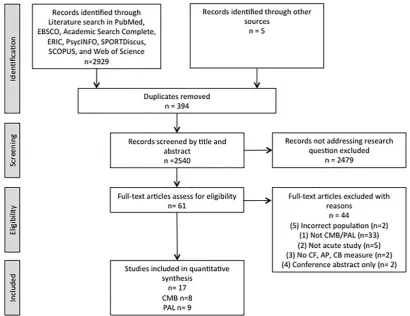
Initial searches returned 2929 papers, plus 5 papers iden-tified through manual searches (figure 1). After removing duplicates, 2540 papers were reviewed by title and abstract. Sixty-one full-text articles were then retrieved. Seventeen articles—featuring 18 experimental studies— met the inclusion criteria. To aid understanding, two independent studies were conducted within one paper24; these are cited as A and B. Figure 1 shows reasons for rejection at full paper stage. Of the 18 included studies, 10 featured PAL interventions, 8 implemented CMB.
Physically active learning
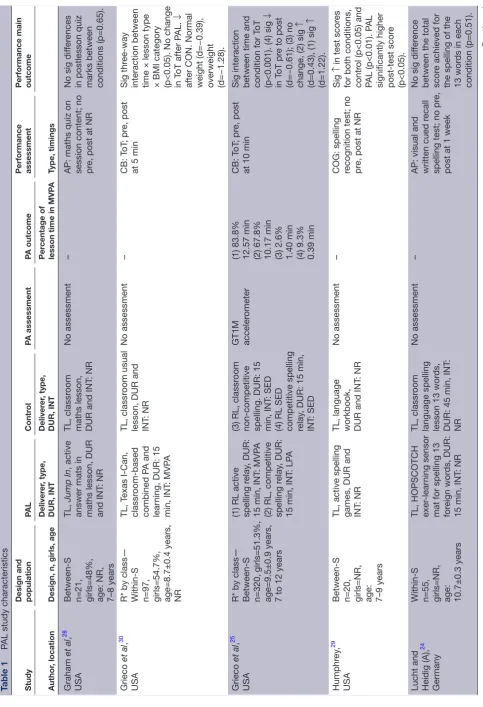
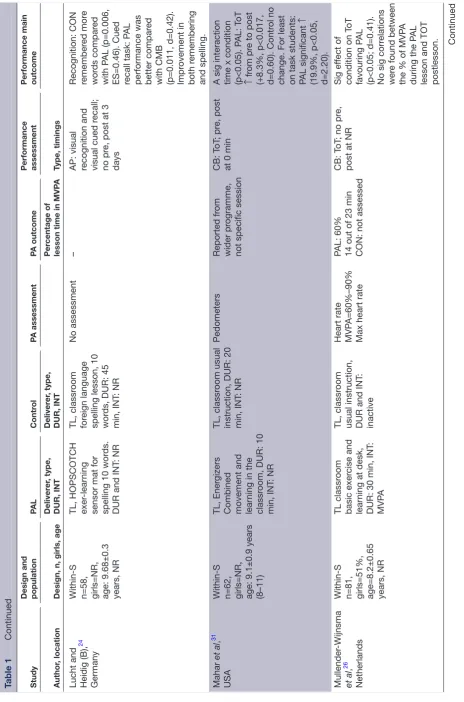
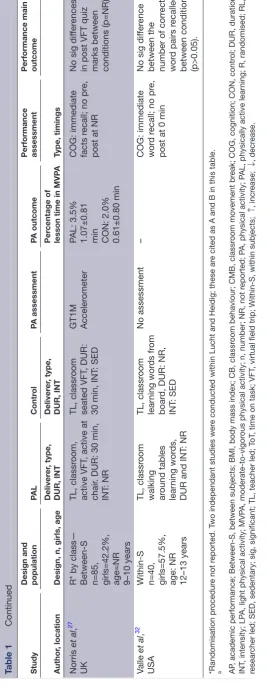
Most included PAL studies (60%) were published in the last 4 years24–28 with the first published in 196529
(table 1). Six studies were conducted in the USA,25 28–32
[image:3.595.92.503.388.704.2]two in Germany,24 and one each in the UK27 and the
Figure 1 PRISMA flow chart illustrating study inclusions through the stages of the systematic review. AP, academic performance; CB, classroom behaviour; CF, cognitive function; CMB, classroom movement break; PAL, physically activie learning ; PRISMA, Preferred Reporting Items for Systematic Reviews and Meta-Analyses.
copyright.
on May 7, 2020 by guest. Protected by
Table 1
P
AL study characteristics
Study
Design and population
PA L Contr ol PA assessment PA outcome
Performance assessment Performance main outcome
Author
, location
Design, n, girls, age
Deliver er , type, DUR, INT Deliver er , type, DUR, INT Per centage of
lesson time in MVP
A Type, timings Graham et al , 28 USA
Between-S n=21, girls=48%, age: NR, 7–8 years
TL,
Jump In
, active
answer mats in maths lesson, DUR and INT
: NR
TL, classr
oom
maths lesson, DUR and INT
: NR
No assessment
–
AP: maths quiz on session content; no pre, post at NR
No sig dif
fer
ences
in postlesson quiz marks between conditions (p=0.65).
Grieco
et al
,
30
USA
R* by class— Within-S n=97, girls=54.7%, age=8.7±0.4 years, NR
TL, T exas I-Can, classr oom-based combined P A and lear
ning, DUR: 15
min, INT
: MVP
A
TL, classr
oom usual
lesson, DUR and INT
: NR No assessment – CB: T oT ; pr e, post
at 5 min
Sig thr
ee-way
interaction between time × lesson type × BMI category (p<0.05). No change in T
oT after P
AL.
↓
after CON. Normal weight (d=−0.39), overweight (d=−1.28).
Grieco
et al
,
25
USA
R* by class— Between-S n=320, girls=51.3%, age=9.5±0.9 years, 7 to 12 years (1) RL active spelling r
elay
, DUR:
15 min, INT
: MVP
A
(2) RL, competitive spelling r
elay
, DUR:
15 min, INT
: LP
A
(3) RL, classr
oom
non-competitive spelling. DUR: 15 min, INT
: SED
(4) RL SED competitive spelling relay
, DUR: 15 min,
INT
: SED
GT1M acceler
ometer
(1) 83.8% 12.57 min (2) 67.8% 10.17 min (3) 2.6% 1.40 min (4) 9.3% 0.39 min
CB: T
oT
; pr
e, post
at 10 min
Sig interaction between time and condition for T
oT
(p<0.001). (4) sig
↓
in T
oT pr
e to post
(d=−0.61); (3) no change, (2) sig
↑
(d=0.43), (1) sig
↑ (d=1.22). Humphr ey , 29 USA
Between-S n=20, girls=NR, age: 7–9 years
TL, active spelling games, DUR and INT
: NR
TL, language workbook, DUR and INT
: NR
No assessment
–
COG: spelling recognition test; no pre, post at NR
Sig
↑
in test scor
es
for both conditions, contr
ol (p<0.05) and
PAL (p<0.01). P
AL
significantly higher post-test scor
e
(p<0.05).
Lucht and Heidig (A),
24
Germany
Within-S n=55, girls=NR, age: 10.7±0.3 years TL, HOPSCOTCH exer
-lear
ning sensor
mat for spelling 13 foreign wor
ds, DUR:
15 min, INT
: NR
TL, classr
oom
language spelling lesson 13 wor
ds,
DUR: 45 min, INT
:
NR
No assessment
–
AP: visual and written cued r
ecall
spelling test; no pr
e,
post at 1 week
No sig dif
fer
ence
between the total scor
e achieved for
the spelling of the 13 wor
ds in each
condition (p=0.51).
Continued
copyright.
on May 7, 2020 by guest. Protected by
Study Design and population
PA
L
Contr
ol
PA assessment
PA outcome
Performance assessment Performance main outcome
Author
, location
Design, n, girls, age
Deliver
er
, type,
DUR, INT
Deliver
er
, type,
DUR, INT
Per
centage of
lesson time in MVP
A
Type, timings
Lucht and Heidig (B),
24
Germany
Within-S n=58, girls=NR, age: 9.68±0.3 years, NR TL, HOPSCOTCH exer
-lear
ning
sensor mat for spelling 10 wor
ds.
DUR and INT
: NR
TL, classr
oom
for
eign language
spelling lesson, 10 wor
ds, DUR: 45
min, INT
: NR
No assessment
–
AP: visual recognition and visual cued r
ecall;
no pr
e, post at 3
days
Recognition: CON remember
ed mor
e
wor
ds compar
ed
with P
AL (p=0.006,
ES=0.46). Cued recall task: P
AL
performance was better compar
ed
with CMB (p=0.011, d=0.42). Impr
ovement in
both r
emembering
and spelling.
Mahar
et al
,
31
USA
Within-S n=62, girls=NR, age: 9.1±0.9 years (8–11)
TL, Ener
gizers
Combined movement and lear
ning in the
classr
oom, DUR: 10
min, INT
: NR
TL, classr
oom usual
instruction, DUR: 20 min, INT
: NR
Pedometers
Reported fr
om
wider pr
ogramme,
not specific session
CB: T
oT
; pr
e, post
at 0 min
A sig interaction time x condition (p<0.05). P
AL: T
oT
↑
fr
om pr
e to post
(+8.3%, p<0.017, d=0.60). Contr
ol no
change. For least on task students: PAL significant
↑
(19.9%, p<0.05, d=2.20).
Mullender
-Wijnsma
et al
,
26
Netherlands
Within-S n=81, girls=51%, age=8.2±0.65 years, NR
TL classr
oom
basic exer
cise and
lear
ning at desk,
DUR: 30 min, INT
:
MVP
A
TL, classr
oom
usual instruction, DUR and INT
:
inactive
Heart rate MVP
A=60%–90%
Max heart rate
PAL: 60% 14 out of 23 min CON: not assessed
CB: T
oT
; no pr
e,
post at NR
Sig ef
fect of
condition on T
oT
favouring P
AL
(p<0.05; d=0.41). No sig corr
elations
wer
e found between
the % of MVP
A
during the P
AL
[image:5.595.70.535.46.749.2]lesson and TOT postlesson.
Table 1
Continued
Continued
copyright.
on May 7, 2020 by guest. Protected by
Study Design and population
PA
L
Contr
ol
PA assessment
PA outcome
Performance assessment Performance main outcome
Author
, location
Design, n, girls, age
Deliver
er
, type,
DUR, INT
Deliver
er
, type,
DUR, INT
Per
centage of
lesson time in MVP
A
Type, timings
Norris
et al
,
27
UK
R* by class— Between-S n=85, girls=42.2%, age=NR 9–10 years
TL, classr
oom,
active VFT
, active at
chair
. DUR: 30 min,
INT
: NR
TL, classr
oom
seated VFT
, DUR:
30 min, INT
: SED
GT1M Acceler
ometer
PAL: 3.5% 1.07±0.81 min CON: 2.0% 0.61±0.80 min COG: immediate facts r
ecall; no pr
e,
post at NR
No sig dif
fer
ences
in post VFT quiz marks between conditions (p=NR).
Valle
et al
,
32
USA
Within-S n=40, girls=57.5%, age: NR 12–13 years
TL, classr
oom
walking around tables lear
ning wor
ds,
DUR and INT
: NR
TL, classr
oom
lear
ning wor
ds fr
om
boar
d, DUR: NR,
INT
: SED
No assessment
–
COG: immediate wor
d r
ecall; no pr
e,
post at 0 min
No sig dif
fer
ence
between the number of corr
ect
wor
d pairs r
ecalled
between conditions (p>0.05).
*Randomisation pr
ocedur
e not r
eported. T
wo independant studies wer
e conducted within Lucht and Heidig; these ar
e cited as A and B in this table.
a AP
, academic performance; Between-S, between subjects; BMI, body mass index; CB, classr
oom behaviour; CMB, classr
oom movement br
eak; COG, cognition; CON, contr
ol; DUR, duration;
INT
, intensity; LP
A, light physical activity; MVP
A, moderate-to-vigor
ous physical activity; n, number; NR, not r
eported; P
A, physical activity; P
AL, physically active lear
ning; R, randomised; RL,
resear
cher led; SED, sedentary; sig, significant; TL, teacher led; T
oT
, time on task; VFT
, virtual field trip; Within-S, within subjects;
↑
, incr
ease;
↓
, decr
[image:6.595.170.450.59.751.2]ease.
Table 1
Continued
copyright.
on May 7, 2020 by guest. Protected by
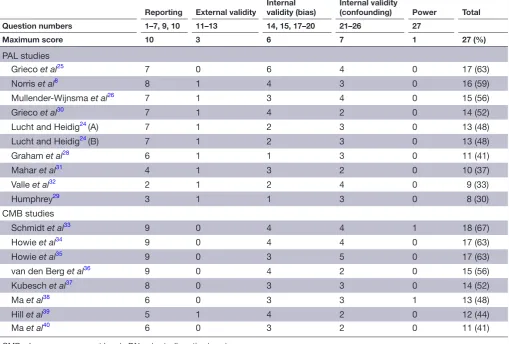
Netherlands.26 Study quality ranged from 30%29 to 63%25 with an average of 47% (table 2). Within the three most recent studies, quality averaged 59.3%, suggesting improving quality.25–27 Sample sizes ranged from 2029 to 32025 with an average of 84. All 10 trials focused on pre-adolescent children aged between 7 and 13.
Three studies randomised participants at the class level; two used within-subject designs25 30 and one used a between-subject design27; no study reported the rando-misation process. Of the remaining non-randomised studies, five used within-subject designs24 26 31 32 with two remaining studies using a between-subject design.28 29 Blinding is rare; two blinded the evaluators25 30 and one blinded the participants.27 Only Mahar et al31 reported pretesting familiarisation sessions for both intervention and assessments. Other studies used outcome assess-ments familiar to the participants but offered no test familiarisation.24 27
Classroom movement break
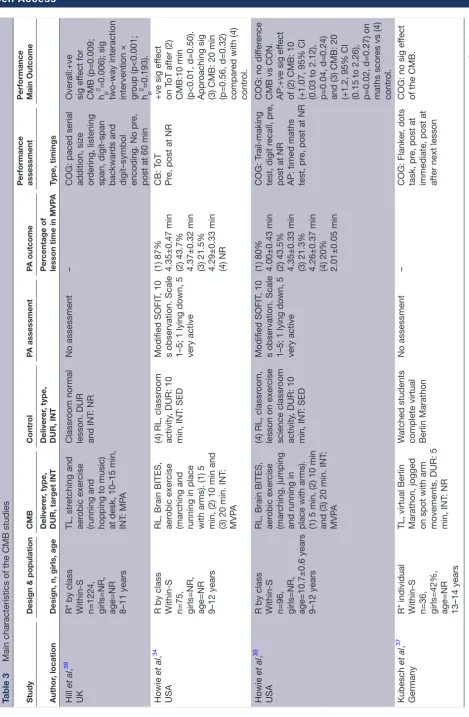
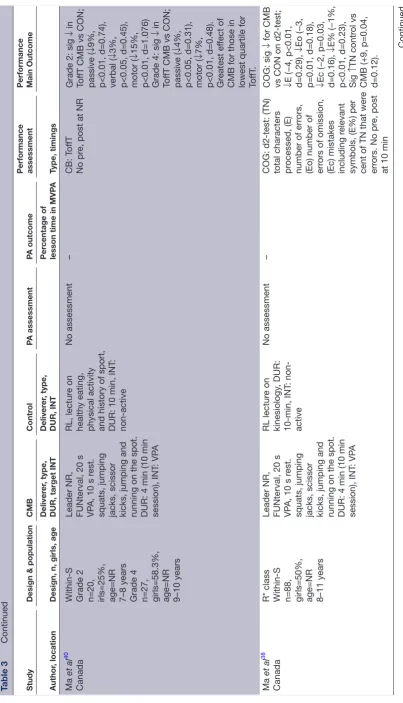
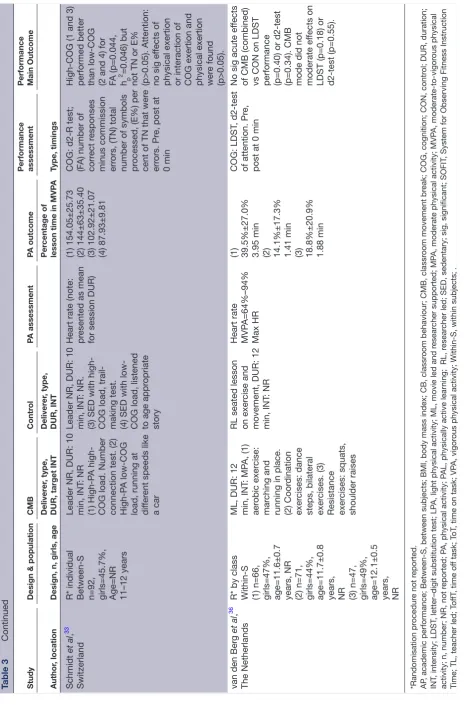
Most CMB studies (75%) were published in the last 3 years33–38 with the first published in 200939 (table 3). Two studies were conducted in Canada35 36 and the USA33 34 with one study in the following countries: Germany,39 Netherlands,38 Switzerland37 and the UK.40 Study quality ranged from 41%35 to 67%37 with an average of 54%.
Study quality within the three most recent studies aver-aged 64.3%; suggesting improving quality. Sample sizes ranged from 3639 to 122440 with an average of 230. All but one trial focused on children aged 8 to 12; the exception recruited participants aged 13 to 14 years.39
Two studies randomised at the individual level, one using a within-subjects design39 and the other a between-sub-jects design.37 Of the five studies reporting class-level randomisation, all used within-subject designs.33 34 36 38 40 Only Howie et al,33 34 reported the randomisation process. The final study used a non-randomised between-subject design.35 Two studies deployed blinding procedures; Hill
et al,40 blinded participants to the purpose, while Howie
et al,33 videotaped the classroom observations blinding evaluators to the condition. Familiarisation featured in most studies although only Ma et al,35 36 familiarised participants with both the intervention and outcome measures. Three further studies familiarised participants to the assessment tools.37–39 One study familiarised the participants to the intervention.33 Two studies used no familiarisation.34 40
Intervention design and delivery (ecological validity)
Physically active learning
[image:7.595.44.554.69.413.2]Three studies involved classroom-based aerobic exercises combined with learning,26 30 31 two used active spelling
Table 2 Results of the Downs and Black21 methodological quality assessment ranked by overall quality percentage score
Reporting External validity Internal validity (bias) Internal validity (confounding) Power Total
Question numbers 1–7, 9, 10 11–13 14, 15, 17–20 21–26 27
Maximum score 10 3 6 7 1 27 (%)
PAL studies
Grieco et al25 7 0 6 4 0 17 (63)
Norris et al8 8 1 4 3 0 16 (59)
Mullender-Wijnsma et al26 7 1 3 4 0 15 (56)
Grieco et al30 7 1 4 2 0 14 (52)
Lucht and Heidig24 (A) 7 1 2 3 0 13 (48)
Lucht and Heidig24 (B) 7 1 2 3 0 13 (48)
Graham et al28 6 1 1 3 0 11 (41)
Mahar et al31 4 1 3 2 0 10 (37)
Valle et al32 2 1 2 4 0 9 (33)
Humphrey29 3 1 1 3 0 8 (30)
CMB studies
Schmidt et al33 9 0 4 4 1 18 (67)
Howie et al34 9 0 4 4 0 17 (63)
Howie et al35 9 0 3 5 0 17 (63)
van den Berg et al36 9 0 4 2 0 15 (56)
Kubesch et al37 8 0 3 3 0 14 (52)
Ma et al38 6 0 3 3 1 13 (48)
Hill et al39 5 1 4 2 0 12 (44)
Ma et al40 6 0 3 2 0 11 (41)
CMB, classroom movement break; PAL, physically active learning.
copyright.
on May 7, 2020 by guest. Protected by
Table 3
Main characteristics of the CMB studies
Study
Design & population
CMB
Contr
ol
PA assessment
PA outcome
Performance assessment Performance Main Outcome
Author
, location
Design, n, girls, age
Deliver
er
, type,
DUR, target INT
Deliver
er
, type,
DUR, INT
Per
centage of
lesson time in MVP
A
Type, timings
Hill
et al
,
39
UK
R* by class Within-S n=1224, girls=NR, age=NR 8–11 years
TL, str
etching and
aer
obic exer
cise
(running and hopping to music) at desk, 10–15 min, INT
: MP
A
Classr
oom normal
lesson. DUR and INT
: NR
No assessment
–
COG: paced serial addition, size ordering, listening span, digit-span backwar
ds and
digit–symbol encoding. No pr
e,
post at 60 min
Overall:+ve sig ef
fect for
CMB (p=0.009; 2 h=0.006); sig p
two-way interaction intervention × group (p<0.001; 2 h p
=0.193).
Howie
et al
,
34
USA
R by class Within-S n=75, girls=NR, age=NR 9–12 years RL, Brain BITES, aer
obic exer
cise
(mar
ching and
running in place with arms). (1) 5 min, (2) 10 min and (3) 20 min. INT
:
MVP
A
(4) RL, classr
oom
activity
, DUR: 10
min, INT
: SED
Modified SOFIT
, 10
s observation. Scale 1–5; 1 lying down, 5 very active (1) 87% 4.35±0.47 min (2) 43.7% 4.37±0.32 min (3) 21.5% 4.29±0.33 min (4) NR
CB: T
oT
Pr
e, post at NR
+ve sig ef
fect
on T
oT after (2)
CMB:10 min (p<0.01, d=0.50). Appr
oaching sig
(3) CMB: 20 min (p=0.56, d=0.32) compar
ed with (4)
contr
ol.
Howie
et al
,
35
USA
R by class Within-S n=96, girls=NR, age=10.7±0.6 years 9–12 years RL, Brain BITES, aer
obic exer
cise
(mar
ching, jumping
and running in place with arms). (1) 5 min, (2) 10 min and (3) 20 min. INT
:
MVP
A
(4) RL, classr
oom,
lesson on exer
cise
science classr
oom
activity
, DUR: 10
min, INT
: SED
Modified SOFIT
, 10
s observation. Scale 1–5; 1 lying down, 5 very active
(1) 80% 4.00±0.43 min (2) 43.5% 4.35±0.33 min (3) 21.3% 4.26±0.37 min (4) 20% 2.01±0.05 min
COG: T
rail-making
test, digit r
ecall, pr
e,
post at NR AP: timed maths test, pr
e, post at NR
COG: no dif
fer
ence
CMB vs CON. AP:+ve sig ef
fect
of (2) CMB: 10 (+1.07, 95% CI (0.03 to 2.12), p=0.04, d=0.24) and (3) CMB: 20 (+1.2, 95% CI (0.15 to 2.26), p=0.02, d=0.27) on maths scor
es vs (4)
contr
ol.
Kubesch
et al
,
37
Germany
R* individual Within-S n=36, girls=42%, age=NR 13–14 years TL, virtual Berlin Marathon, jogged on spot with arm movements, DUR: 5 min, INT
: NR
W
atched students
complete virtual Berlin Marathon
No assessment
–
COG: Flanker
, dots
task, pr
e, post at
immediate, post at after next lesson
COG: no sig ef
fect
of the CMB.
Continued
copyright.
on May 7, 2020 by guest. Protected by
Study
Design & population
CMB
Contr
ol
PA assessment
PA outcome
Performance assessment Performance Main Outcome
Author
, location
Design, n, girls, age
Deliver
er
, type,
DUR, target INT
Deliver
er
, type,
DUR, INT
Per
centage of
lesson time in MVP
A
Type, timings
Ma
et al
40
Canada
Within-S Grade 2 n=20, irls=25%, age=NR 7–8 years Grade 4 n=27, girls=58.3%, age=NR 9–10 years
Leader NR, FUNterval, 20 s VPA, 10 s r
est.
squats, jumping jacks, scissor kicks, jumping and running on the spot. DUR: 4 min (10 min session), INT
: VP
A
RL, lectur
e on
healthy eating, physical activity and history of sport, DUR: 10 min, INT
:
non-active
No assessment
–
CB: T
of
fT
No pr
e, post at NR
Grade 2: sig
↓
in
Tof
fT CMB vs CON;
passive (
↓
9%,
p<0.01, d=0.74), verbal (
↓
3%,
p<0.05, d=0.45), motor (
↓
15%,
p<0.01, d=1.076) Grade 4: sig
↓
in
Tof
fT CMB vs CON;
passive (
↓
4%,
p<0.05, d=0.31), motor (
↓
7%,
p<0.01, d=0.48). Greatest ef
fect of
CMB for those in lowest quartile for ToffT.
Ma
et al
38
Canada
R* class Within-S n=88, girls=50%, age=NR 8–11 years
Leader NR, FUNterval, 20 s VPA, 10 s r
est.
squats, jumping jacks, scissor kicks, jumping and running on the spot. DUR: 4 min (10 min session), INT
: VP
A
RL lectur
e on
kinesiology
, DUR:
10-min, INT
:
non-active
No assessment
–
COG: d2-test: (TN) total characters processed, (E) number of err
ors,
(Eo) number of errors of omission, (Ec) mistakes including r
elevant
symbols, (E%) per cent of TN that wer
e
err
ors. No pr
e, post
at 10 min
COG: sig
↓
for CMB
vs CON on d2-test; ↓E (−4, p<0.01, d=0.29),
↓
Eo (−3,
p=0.01, d=0.18), ↓Ec (−2, p=0.03, d=0.16),
↓
E% (−1%,
p<0.01, d=0.23), Sig
↑
TN contr
ol vs
[image:9.595.97.501.43.747.2]CMB (+9, p=0.04, d=0.12).
Table 3
Continued
Continued
copyright.
on May 7, 2020 by guest. Protected by
Study
Design & population
CMB
Contr
ol
PA assessment
PA outcome
Performance assessment Performance Main Outcome
Author
, location
Design, n, girls, age
Deliver
er
, type,
DUR, target INT
Deliver
er
, type,
DUR, INT
Per
centage of
lesson time in MVP
A
Type, timings
Schmidt
et al
,
33
Switzerland
R* individual Between-S n=92, girls=45.7%, Age=NR 11–12 years Leader NR, DUR: 10 min, INT
: NR
(1) High-P
A
high-COG load. Number connection test. (2) High-P
A low-COG
load, running at differ
ent speeds like
a car
Leader NR, DUR: 10 min, INT
: NR.
(3) SED with high- COG load, trail- making test. (4) SED with low- COG load, listened to age appr
opriate
story
Heart rate (note: presented as mean for session DUR) (1) 154.05±25.73 (2) 144±63±35.40 (3) 102.92±21.07 (4) 87.93±9.81 COG: d2-R test; (FA) number of corr
ect r
esponses
minus commission errors, (TN) total number of symbols processed, (E%)
per
cent of TN that wer
e
err
ors. Pr
e, post at
0 min
High-COG (1 and 3) performed better than low-COG (2 and 4) for FA (p=0.044, 2 h=0.046) but p
not TN or E% (p>0.05). Attention: no sig ef
fects of
physical exertion or interaction of COG exertion and physical exertion wer
e found
(p>0.05).
van den Ber
g
et al
,
36
The Netherlands
R* by class Within-S (1) n=66, girls=47%, age=11.6±0.7 years, NR (2) n=71, girls=44%, age=11.7±0.8 years, NR (3) n=47, girls=49%, age=12.1±0.5 years, NR
ML, DUR: 12 min, INT
: MP
A, (1)
aer
obic exer
cise:
mar
ching and
running in place. (2) Coor
dination
exer
cises: dance
steps, bilateral exer
cises. (3)
Resistance exer
cises: squats,
shoulder raises
RL seated lesson on exer
cise and
movement, DUR: 12 min, INT
: NR
Heart rate MVP
A=64%–94%
Max HR
(1) 39.5%±27.0% 3.95 min (2) 14.1%±17.3% 1.41 min (3) 18.8%±20.9% 1.88 min
COG: LDST
, d2-test
of attention. Pr
e,
post at 0 min
No sig acute ef
fects
of CMB (combined) vs CON on LDST performance (p=0.40) or d2-test (p=0.34). CMB mode did not moderate ef
fects on
LDST (p=0.18) or d2-test (p=0.55).
*Randomisation pr
ocedur
e not r
eported.
AP
, academic performance; Between-S, between subjects; BMI, body mass index; CB, classr
oom behaviour; CMB, classr
oom movement br
eak; COG, cognition; CON, contr
ol; DUR, duration;
INT
, intensity; LDST
, letter–digit substitution test; LP
A, light physical activity; ML, movie led and r
esear
cher supported; MP
A, moderate physical activity; MVP
A, moderate-to-vigor
ous physical
activity; n, number; NR, not r
eported; P
A, physical activity; P
AL, physically active lear
ning; RL, r
esear
cher led; SED, sedentary; sig, significant; SOFIT
, System for Observing Fitness Instruction
Time; TL, teacher led; T
of
fT
, time of
f task; T
oT
, time on task; VP
A, vigor
[image:10.595.71.543.45.751.2]ous physical activity; Within-S, within subjects; .
Table 3
Continued
copyright.
on May 7, 2020 by guest. Protected by
games,25 29 two used a digitally active HOPSCOTCH spelling game with sensor mat,24 one used a Jump In! answer mat,28 one engaged students through a class-room-based virtual active field trip,27 while the final study used an active memory game which involved walking around the classroom and remembering words.32 All interventions, except Grieco et al,25 were delivered by teachers. Interventions varied in duration and intensity
(table 2). The protocols of two studies by Grieco and
colleagues lasted 15 min with one targeting MVPA30 and the other with two experimental conditions comparing moderate PA and light PA.25 Two studies stated 30 min durations, one targeting MVPA26 and the other not stating an intensity.27 The study by Mahar et al31 reported the shortest intervention duration of 10 min, while both Lucht and Heidig24 studies reported the longest duration of 45 min; neither stated a target intensity. Three studies reported neither duration nor intensity.28 29 32
Classroom movement break
All interventions were based in classrooms. Six studies involved basic, whole-body movements such as running and jumping with arm movements on the spot.33–36 39 40 Schmidt et al,37 compared a high-active high-cognitive load group who performed a running number connec-tion test with a high-active low-cognitive load group who ran at different speeds simulating a car changing gear. Van den Berg38 compared three conditions, (i) Whole-body aerobic exercise movements, and (ii) coordination exercises involving bilateral movements and movements crossing the body midline, and (iii) strength-based dynamic and static exercises like squats. Two interven-tions were delivered by teachers39 40 with two led by researchers33 34 and one where students followed a movie, encouraged by researchers.38 Three did not identify the session deliverer.35–37
Duration of the CMB interventions ranged from 435 36 to 20 min.33 34 Two studies investigated a variety of CMB durations: 5, 10 and 20 min.33 34 All but two studies37 39 reported a target intensity; moderate PA,38 40 MVPA33 34 and vigorous PA.35 36
PA assessment and outcomes
Physically active learning
Of the 10 PAL interventions, three assessed the dura-tion and intensity of the intervendura-tion using objective measures; two utilised GT1M accelerometers25 27 and one heart rate monitor.26 Of these, only two assessed the control condition.25 27 All presented results at the group level. Only Mullender-Wijnsma et al26 addressed individual engagement in the PAL condition in the analysis. Results at the group level revealed variation in the duration and intensity of the different trials. The researcher-led MVPA competitive relay elicited the highest proportion—83.8% (12.57 min)—of lesson time in MVPA.25 Desk-based exercise and learning resulted in the most minutes of MVPA; 14 min of 23 min, 60% of PAL time.26 Norris et al27 achieved a marginal increase
in MVPA in the active virtual field trip with only 3.5% of the lesson time in MVPA compared with 2% in the seated control condition. Greater differences (>5 min) were observed in the accumulation of light activity (14.97±6.18 min vs 9.92±6.11 min, p<0.001).
Classroom movement break
Two studies assessed and presented PA in the control and CMB conditions34 37 and two in the intervention conditions only.33 38 Howie et al33 34 used the System for Observing Fitness Instruction Time (SOFIT) tool to assess group-level MVPA. Heart rate, presented at group level, was used in the remaining two studies.37 38 No studies reported results at the individual level or factored these into analyses.
In Howie et al,33 34 the MVPA accumulated in the 5, 10 and 20 min conditions was similar (~4.3 min), despite the increasing duration of the CMB. The 5 min CMB resulted in the highest proportion of MVPA in both studies (80%–87%). The control condition within Howie
et al34 resulted in 20% of the 10 min spent in MVPA. In Schmidt et al,37 heart rates during the two high PA condi-tions were significantly greater than the two sedentary conditions (p<0.0005, hp2=0.800). No statistical compar-ison was made between the two high PA conditions. In the final study, aerobic exercise elicited at least twice the MVPA time (39.5%±27.0%) compared with the coordi-nation (14.1%±17.3%) and resistance (18.8%±20.9%) groups.38
Cognition, academic achievement and classroom behaviour assessment and outcomes
Physically active learning
Four PAL trials assessed ToT performance within 10 min of the end of the bout.25 26 30 31 All found a positive outcome in favour of the PAL condition. These differ-ences were driven by varied responses to the intervention and control conditions. In Grieco et al,30 the difference was driven by a reduction in ToT in the control condi-tion, pre to post; obese children (d=−1.28) compared with normal weight children (d=−0.39). In Mahar et al.31 controls showed no change compared with a significant improvement in the PAL condition (+8.3%, p<0.017, d=0.60). Grieco et al25 showed a reduction in ToT for the control condition with improvements in the two PAL conditions, the largest effect size being observed in the moderate spelling relay (d=1.22) compared with the light PA spelling relay (d=0.43). In Mullender-Wijnsma et al,26 only a post-test, which immediately followed the lesson, was used. Students in the PAL condition had a higher ToT compared with controls (p<0.05, d=0.41).
Five trials assessed cognition; immediate visual recogni-tion,29 32 immediate fact recall,27 and delayed recognition and delayed cued recall24 (table 4). Comparing PAL with control, studies investigating immediate visual recogni-tion identified one positive (effect size not reported)29 and one no difference32 result. For immediate fact recall, no difference was observed between conditions.27 For
copyright.
on May 7, 2020 by guest. Protected by
delayed cued recall, 1 week postintervention, no differ-ence was observed between groups,24 yet in the second study, 3 days postintervention revealed higher scores for the PAL group in delayed cued recall and a lower score in delayed recognition compared with the control condi-tion.24 Overall, the cognition outcomes revealed two positive results, three no difference results and one nega-tive result when comparing the performance of the PAL with control conditions. One study assessed academic performance using a post-test maths quiz, finding no difference between PAL and control conditions.28
Classroom movement break
Two CMB studies assessed time on/off task,34 40 six assessed cognition33 35–39 and one assessed academic performance.35 For time on/off task, the study by Ma
et al40 found improvements after the 4 min High-inten-sity interval intervention (d=0.31 to 1.076). Howie et al34 found varying results with improvements after 10 min (d=0.50) but no differences after 5 or 20 min; although the results for the latter were approaching significance. In the only study assessing academic performance, Howie
et al35 found an improvement in the number of maths problems answered correctly after the 10 and 20 min
conditions (d=0.24 and d=0.27), but not the 5 min condi-tion, suggesting a possible threshold effect.
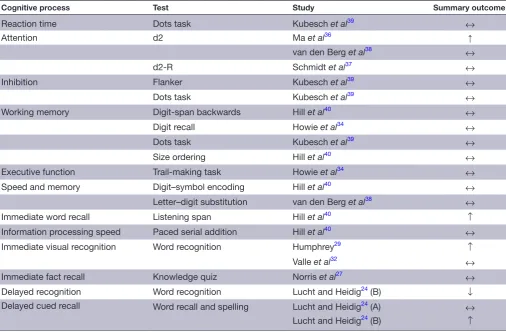
Eight cognitive processes were assessed across six studies; reaction time, attention, inhibition, working memory, executive function, speed and memory, word recall and processing speed. Table 4 outlines the tests and associated processes. Overall, results suggest no change in cognition due to engagement in the CMB with only two positive results at the independent test level (atten-tion, d=0.16–0.2936; word recall, hp2=0.00640), and one positive result when the tests were combined as a battery (hp2=0.006).40 In 13 of 15 results, no differences were found between conditions.
DIsCussIOn
[image:12.595.45.552.64.396.2]A systematic search of the literature identified 10 acute PAL and eight acute CMB studies. Overall, quality was low-to-medium (33%–67%). The three most recent PAL and CMB studies achieved 59.3% and 64.3%, respectively, indicating improving study quality. Depen-dent on intervention characteristics—mode, duration and intensity—CMB and PAL interventions displaced sedentary time with light PA or MVPA. Consistent with previous acute school-based systematic reviews of PAL/
Table 4 Cognitive processes and corresponding tests drawn from the included studies
Cognitive process Test Study Summary outcome
Reaction time Dots task Kubesch et al39 ↔
Attention d2 Ma et al36 ↑
van den Berg et al38
↔
d2-R Schmidt et al37 ↔
Inhibition Flanker Kubesch et al39
↔
Dots task Kubesch et al39 ↔
Working memory Digit-span backwards Hill et al40
↔
Digit recall Howie et al34 ↔
Dots task Kubesch et al39
↔
Size ordering Hill et al40
↔
Executive function Trail-making task Howie et al34
↔
Speed and memory Digit–symbol encoding Hill et al40
↔
Letter–digit substitution van den Berg et al38
↔
Immediate word recall Listening span Hill et al40
↑
Information processing speed Paced serial addition Hill et al40
↔
Immediate visual recognition Word recognition Humphrey29
↑
Valle et al32
↔
Immediate fact recall Knowledge quiz Norris et al27
↔
Delayed recognition Word recognition Lucht and Heidig24 (B) ↓
Delayed cued recall Word recall and spelling Lucht and Heidig24 (A)
↔
Lucht and Heidig24 (B)
↑
↑, statistically significant improvement in physically active learning (PAL)/ classroom movement break (CMB) compared with control; ↔, no statistically significant difference between PAL/CMB and control; ↓, statistically significant improvement in control compared with PAL/CMB. CMB, classroom movement break; PAL, .
copyright.
on May 7, 2020 by guest. Protected by
CMB studies, classroom behaviour improved following exercise.7 10 Contrary to previous reviews reporting small effects,11 14–16 evidence did not indicate enhanced cogni-tion. Academic performance, assessed in two studies, resulted in two positive and two no difference outcomes.
The outcomes of the current review, relative to the small positive effects (g=0.097,11 effect size=0.3715) seen in previous meta-analyses, raise interesting issues. Previous meta-analyses included studies combining labo-ratory-based and field-based studies. In labolabo-ratory-based studies, the acute exercise bout and testing battery are typically tightly controlled,41 which limit the external influence on test outcomes . Exerting such control in school-based studies is not only problematic, but also defeats the purpose of translational research—to test the application of basic science in the real world. Therefore, it is likely that the variations in design features, and their deployment within the school environment, explain the differing cognitive outcomes.
While it may be tempting to conclude that acute CMB and PAL studies have limited or no impact on academic performance and cognition, outcomes must be consid-ered in tandem with study quality. While improving, studies have yet to combine the key design features that would result in high-quality designs. Combining the strongest facets from current studies, a Downs and Black risk of bias score of 85% could be achieved; a substantial increase on the highest reported score of 67%.33 Study designs are now discusssed with reference to critical design features, highlighting examples of good practice within the current field.
Design features likely to have influenced study outcomes included lack of randomisation at the indi-vidual level, not reporting the randomisation process, limited blinding of participants and the research team, and intervention and testing battery familiarisation. Regarding acute bouts, the mode, duration and intensity varied greatly, making it difficult to confirm a universal effect, especially within PAL studies. Objective assess-ment of the PA (ie, the treatassess-ment dose) only occurred in one study at the individual level, and in 39% of studies at the group level. Therefore, the majority of these studies lacked confirmation of treatment fidelity.
randomisation, blinding and familiarisation
Randomisation reduces outcome bias by controlling all known and unknown factors.42 43 The majority of studies randomised by class. While more feasible within transla-tional research, this presents issues with the distribution of potential confounding variables.44 While it may be argued that the treatment is a class-level intervention, variability in the individual experience of an intervention and the application of individual-level statistical analysis questions this approach. Only two studies reported the randomisation process.33 34 Reporting is key to ensure true randomisation has occurred. Within medical research, 25% of studies reporting randomisation demonstrated faulty procedures.45
Blinding prevents differential treatment of particpants that may result in bias .46 It is challenging to deploy blinding with school-based translational research. Strategies used to blind participants included not informing participants of the experimental hypothesis or masking the intervention within the week-to-week vari-ability of curriculum delivery.39 Another viable strategy is to match intervention and control conditions while ensuring they differ only by the active component.27 Blinding the research team and/or independent researchers to the treatment condition was deployed to conduct outcome assessments.25 30 34 To further reduce study bias, future studies may combine these strategies to achieve double blinding.
Familiarisation with the intervention, prior to data collection, is essential to maximise movement time and reduce novelty effects. Familiarising participants with testing batteries and procedures reduces learning effects.47 48 Typically, familiarisation sessions are conducted 1 week prior to the experimental day.36 Famil-iarisation with ToT assessments, to reduce teacher and pupil reactivity, involved observers practising within the classroom for 1 week before data collection.31 40
Intervention design and delivery
PAL interventions varied from light-intensity movements within the classroom32 to moderate-to-vigorous active spelling relays.25 Such diversity in the mode, duration and intensity of the intervention makes it difficult to deduce universal PA outcomes. Establishing universal outcomes void of critical design features risks misinforming prac-titioners. PAL is currently defined as teaching (new) information through PA games or the drill and prac-tice of factual information.3 7 From the current review, it appears that while this covers the majority of current studies, more nuanced classifications are warranted. Such classifications may combine the pedagogical approach with the delivery environment; both impact PA outcomes. The majority of CMB interventions involved whole-body movements behind a desk enabling comparison of the quantitative characteristics. Recent studies have inves-tigated the qualitative characteristics of CMB.49 These included interventions comparing bilateral movements36 and cognitively enhanced exercise using a running number connection test.33
Confirmation of treatment fidelity: PA
Recent studies objectively assessed PA levels in control and intervention participants, confirming treatment fidelity at the cohort level.25 27 34 37 Only one study factored individual PA accumulation into the analysis.26 Not confirming the treatment dose at the individual level is problematic, given the high degree of variability reported in a previous narrative review.19 Given acute exercise is hypothesised to affect cognition through increased physiological arousal, it is also important to ascertain the duration and intensity at the individual level to confirm the dose(s) impacting arousal. A recent
copyright.
on May 7, 2020 by guest. Protected by
meta-analysis found an activity threshold of ≥20 min of MVPA was required for enhanced cognition.11 There-fore, future studies may deploy relationship analyses26 or use a minimum required level of PA accumulation seen in previous school-based studies.50
PA outcomes highlighted the intermittent nature of PAL and CMB. When CMB interventions were assessed over 5, 10 and 20 min, the same MVPA accumulation was achieved despite increased session duration. This may indicate a threshold limit for activity accumulation from CMB, or a limitation of the intervention to engage individuals for extended periods of time. The most active CMB activities appeared to be whole-body aerobic exer-cises when compared with coordination and resistance exercises.38 PAL studies elicited highly varied levels of PA. Virtual field trips led to increases in light PA rather than enhancing MVPA. Competitive spelling relays were the most active PAL intervention, with 84% of the session in MVPA. Such insights are essential to informing future intervention design and the practical application of PAL. Where the primary outcome is to reduce sedentary time, virtual field trips and similar pedagogical strategies may be deployed. Conversely, if the primary outcome is to increase MVPA, activities combining relay-type activities and learning content are more appropriate.
Cognition, academic performance and classroom behaviour Consistent with previous reviews,7 10 time on/off task improved in 9 out of 11 PAL/CMB interventions. Specif-ically, results revealed the importance of exercise volume (duration × intensity). Short-duration interventions of 5 min were successful if vigorous in nature but not moderate to vigorous.33 35 Ten to 15 min bouts demon-strated consistent improvements; larger effects were observed in more intense interventions,25 33 whereas longer durations found mixed effects. Based on these outcomes, to improve acute time on/off task, teachers should implement 5 min vigorous CMB interventions or longer interventions of moderate-to-vigorous intensity. The largest effect size was observed in the 15 min MVPA PAL spelling relay.25
While CMB and PAL interventions improve ToT, this evidence should be interpreted cautiously. While studies consistently demonstrated high inter-rater reliability of ToT measures, their discriminant validity is rarely reported.51 The method appears to originate from a study that assessed academic performance in children with special educational needs,52 questioning its relevance to modern classrooms. Prior to future use, ToT assessments require confirmation of construct and discriminant validity. Without this, it is questionable if assessment outcomes truly reflect ToT. As much as gazing away from work—a definition used in most studies— may represent distraction, it may equally indicate mentally processing information, an essential component of academic performance.
Evidence on the effect of acute PAL/CMB on academic performance is weak. Two studies, both assessing maths performance, found mixed results.28 34 Ten and 20 min
MVPA CMB had small positive effects on math fluency. Given 5 min bouts caused no change, this suggests a possible threshold effect. Yet, no difference was observed in the MVPA accumulated across the different bout lengths using the SOFIT tool. SOFIT, like most observa-tional tools, assesses PA by monitoring select participants, which may lead to inaccurate outcomes for the whole class. To improve accuracy, future studies should assess PA dose through individual measures such as accelerom-etry.22
Assessing math performance is complex. Math fluency may be best identified by assessing recall and application of facts and methods, because fluency relies on improved processing speed and accuracy.34 Tests requiring increas-ingly complex procedural knowledge, knowing action sequences, and conceptual knowledge, the explicit or implicit understanding of the principles, are less likely to detect change unless content is taught within a PAL session.53 Assessing acute math fluency is problematic because of the lack of psychometric evidence for contem-porary multiple version tests. Within both studies, no validity figures were reported for math assessments; one reported reliability.34 Where pre–post assessments were conducted, it was not clear if different versions were utilised,34 meaning that outcome scores may be suscep-tible to learning effects. Future studies will be improved by using multiple version tests of math fluency with estab-lished validity and reliability. Studies assessing the effect of acute bouts of exercise on other curriculum areas, beyond maths, are also required.
As previously identified, moving beyond a universal cognitive outcome is essential due to varied responses to exercise of each underlying process.19 Only two processes, attention and working memory, were assessed across three or more studies. Surprisingly, attention was shown to improve with 5 min vigorous-intensity CMB but not with longer bouts of 10–12 min of moderate-to-vig-orous intensity. Working memory, assessed through four different tests, showed no improvement—compared with controls—across a range of intervention durations (5–20 min) and intensities.
In summary, cognitive outcomes indicate small non-sig-nificant effect sizes, which may be explained by substantial variations in experimental design. Fifty per cent of studies failed to use pre–post test designs; essential to account for intraindividual variation in daily cognition.37 Except for delayed recall assessments, post-test timing varied from 0 to 60 min across studies, with three studies not reporting exact test timings. Only one study attempted to investigate duration effects by deploying post-tests immediately after the acute bout and following the next lesson.39 With cognitive improvements highest within 10 min of the acute bouts and reducing after,11 future studies should clearly state and justify timings within the methodology. While there may be a temptation to select more fruitful post-test timings, these should be justified in relation to practical implications within the classroom learning context.
copyright.
on May 7, 2020 by guest. Protected by
limitations
While the current study did not include a meta-analysis of key outcome measures, the large variability in critical design features warranted a focus on methodological design as opposed to establishing singular outcomes. Forming outcomes based on highly varied intervention designs and outcome assessments risks misinforming practice. While we did not consult the grey literature, it is possible that there are studies that have been overlooked.
COnClusIOn
Studies on the acute effects of PAL and CMB on PA, cognition, academic performance and classroom behaviour are of low-to-medium quality. Recent studies use higher-quality designs. Due to high variability in critical design features, intervention mode, duration and intensity, and outcome measures, results should be interpreted with caution. Few studies confirmed treat-ment fidelity at the group level, with only one confirming treatment fidelity at the individual level. PA outcomes varied greatly dependent on intervention design, dura-tion and expected intensity. CMB and PAL of ≥10 min MVPA showed greatest consistency of effect on ToT; shorter timeframes required vigorous-intensity activi-ties. At present, cognition and academic performance outcomes are inconclusive. We recommend that future studies should assess the PA dose at the individual level and factor this within the outcome analysis for cognition, academic performance and classroom behaviour.
Contributors AD-S is the guarantor. AD-S drafted the manuscript. All authors contributed to the selection criteria, the risk of bias assessment strategy and data extraction criteria prior to registration. AD-S developed the search strategy, which was approved by all authors. AD-S and SZ performed the study selection. AD-S extracted study details which were confirmed by SZ. All authors read, provided feedback and approved the final manuscript.
Funding The authors have not declared a specific grant for this research from any funding agency in the public, commercial or not-for-profit sectors.
Competing interests None declared.
Provenance and peer review Not commissioned; internally peer reviewed. Open Access This is an Open Access article distributed in accordance with the Creative Commons Attribution Non Commercial (CC BY-NC 4.0) license, which permits others to distribute, remix, adapt, build upon this work non-commercially, and license their derivative works on different terms, provided the original work is properly cited and the use is non-commercial. See: http:// creativecommons. org/ licenses/ by- nc/ 4. 0/
© Article author(s) (or their employer(s) unless otherwise stated in the text of the article) 2018. All rights reserved. No commercial use is permitted unless otherwise expressly granted.
rEFErEnCEs
1. Nettlefold L, McKay HA, Warburton DE, et al. The challenge of
low physical activity during the school day: at recess, lunch and in
physical education. Br J Sports Med 2011;45:813–9.
2. Bailey DP, Fairclough SJ, Savory LA, et al. Accelerometry-assessed
sedentary behaviour and physical activity levels during the segmented school day in 10-14-year-old children: the HAPPY study.
Eur J Pediatr 2012;171:1805–13.
3. Bartholomew JB, Jowers EM. Physically active academic lessons in
elementary children. Prev Med 2011;52(Suppl 1):S51–4.
4. HM Government. 2016. Childhood Obesity: A Plan for Action. https://www. gov. uk/ government/ uploads/ system/ uploads/ attachment_ data/ file/ 546588/ Childhood_ obesity_ 2016__ 2__ acc. pdf
5. Martin R, Murtagh EM. An intervention to improve the physical activity levels of children: design and rationale of the ‘Active
Classrooms’ cluster randomised controlled trial. Contemp Clin Trials
2015;41:180–91.
6. Routen AC, Chalkley AE, Sherar LB. Getting a GRIP (getting research into practice) on movement integration in the school
classroom. Phys Ther Rev 2017;22:139–46.
7. Watson A, Timperio A, Brown H, et al. Effect of classroom-based
physical activity interventions on academic and physical activity
outcomes: a systematic review and meta-analysis. Int J Behav Nutr
Phys Act 2017;14:114.
8. Norris E, Shelton N, Dunsmuir S, et al. Physically active lessons as
physical activity and educational interventions: a systematic review
of methods and results. Prev Med 2015;72:116–25.
9. Martin R, Murtagh EM. Effect of active lessons on physical activity,
academic, and health outcomes: a systematic review. Res Q Exerc
Sport 2017:1–20.
10. Owen KB, Parker PD, Van Zanden B, et al. Physical activity and
school engagement in youth: a systematic review and meta-analysis.
Educ Psychol 2016;51:129–45.
11. Chang YK, Labban JD, Gapin JI, et al. The effects of acute
exercise on cognitive performance: a meta-analysis. Brain Res
2012;1453:87–101.
12. McMorris T (ed). Exercise-Cognition Interaction. Academic Press,
2015.
13. Hillman CH, Erickson KI, Kramer AF. Be smart, exercise your
heart: exercise effects on brain and cognition. Nat Rev Neurosci
2008;9:58–65.
14. Donnelly JE, Hillman CH, Castelli D, et al. Physical activity, fitness,
cognitive function, and academic achievement in children: a
systematic review. Med Sci Sports Exerc 2016;48:1223–4.
15. Sibley BA, Etnier JL. The relationship between physical activity
and cognition in children: a meta-analysis. Pediatr Exerc Sci
2003;15:243–56.
16. Tomporowski PD, McCullick B, Pendleton DM, et al. Exercise and
children’s cognition: The role of exercise characteristics and a place
for metacognition. J Sport Health Sci 2015;4:47–55.
17. Li JW, O'Connor H, O'Dwyer N, , O’Connor H, O’Dwyer N, et al.
The effect of acute and chronic exercise on cognitive function and
academic performance in adolescents: a systematic review. J Sci
Med Sport 2017;20:841-848.
18. Janssen M, Toussaint HM, van Mechelen W, et al. Effects of acute
bouts of physical activity on children’s attention: a systematic review
of the literature. Springerplus 2014;3:410.
19. Daly-Smith A, McKenna J, Defeyter G. A review of school-based studies on the effect of acute physical activity on cognitive function in children and young people. In: Meeusen R, Schaefer S,
Tomporowski P, Physical activity and educational achievements:
insights from Exercise Neuroscience. Routledge, 2018:277–302.
20. Moher D, Shamseer L, Clarke M, et al. Preferred reporting items for
systematic review and meta-analysis protocols (PRISMA-P) 2015
statement. Syst Rev 2015;4:1.
21. Downs SH, Black N. The feasibility of creating a checklist for the assessment of the methodological quality both of randomised and
non-randomised studies of health care interventions. J Epidemiol
Community Health 1998;52:377–84.
22. Trost SG. State of the art reviews: measurement of physical activity
in children and adolescents. Am J Lifestyle Med 2007;1:299–314.
23. Weir A, Rabia S, Ardern C. Trusting systematic reviews and
meta-analyses: all that glitters is not gold! Br J Sports Med
2016;50:1100–1.
24. Lucht M, Heidig S. Applying HOPSCOTCH as an exer-learning game
in English lessons: two exploratory studies. Educational Technology
Research and Development 2013;61:767–92.
25. Grieco LA, Jowers EM, Errisuriz VL, et al. Physically active vs.
sedentary academic lessons: a dose response study for elementary
student time on task. Prev Med 2016;89:98–103.
26. Mullender-Wijnsma MJ, Hartman E, de Greeff JW, et al.
Moderate-to-vigorous physically active academic lessons and academic engagement in children with and without a social disadvantage:
a within subject experimental design. BMC Public Health
2015;15:1–9.
27. Norris E, Shelton N, Dunsmuir S, et al. Virtual field trips as physically
active lessons for children: a pilot study. BMC Public Health
2015;15:366.
28. Graham DJ, Lucas-Thompson RG, O’Donnell MB. Jump In! an investigation of school physical activity climate, and a pilot study assessing the acceptability and feasibility of a novel tool to increase
activity during learning. Front Public Health 2014;2:58.
29. Humphrey JH. Comparison of the use of active games and language workbook exercises as learning media in the development of
copyright.
on May 7, 2020 by guest. Protected by