Active learning for HPSG parse selection
Jason Baldridge and Miles Osborne
School of Informatics
University of Edinburgh
Edinburgh EH8 9LW, UK
jmb,osborne
@cogsci.ed.ac.uk
Abstract
We describe new features and algorithms for HPSG parse selection models and address the task of creating annotated material to train them. We evaluate the ability of several sam-ple selection methods to reduce the number of annotated sentences necessary to achieve a given level of performance. Our best method achieves a 60% reduction in the amount of training material without any loss in accuracy.
1
Introduction
Even with significant resources such as the Penn Tree-bank, a major bottleneck for improving statistical parsers has been the lack of sufficient annotated material from which to estimate their parameters. Most statistical pars-ing research, such as Collins (1997), has centered on training probabilistic context-free grammars using the Penn Treebank. For richer linguistic frameworks, such as Head-Driven Phrase Structure Grammar (HPSG), there is even less annotated material available for training stochastic parsing models. There is thus a pressing need to create significant volumes of annotated material in a logistically efficient manner. Even if it were possible to bootstrap from the Penn Treebank, it is still unlikely that there would be sufficient quantities of high quality mate-rial.
There has been a strong focus in recent years on us-ing the active learnus-ing technique of selective samplus-ing to reduce the amount of human-annotated training material needed to train models for various natural language pro-cessing tasks. The aim of selective sampling is to iden-tify the most informative examples, according to some se-lection method, from a large pool of unlabelled material. Such selected examples are then manually labelled. Se-lective sampling has typically been applied to classifica-tion tasks, but has also been shown to reduce the number
of examples needed for inducing Lexicalized Tree Inser-tion Grammars from the Penn Treebank (Hwa, 2000).
The suitability of active learning for HPSG-type gram-mars has as yet not been explored. This paper addresses the problem of minimizing the human effort expended in creating annotated training material for HPSG parse se-lection by using selective sampling. We do so in the con-text of Redwoods (Oepen et al., 2002), a treebank that contains HPSG analyses for sentences from the Verbmo-bil appointment scheduling and travel planning domains. We show that sample selection metrics based on tree en-tropy (Hwa, 2000) and disagreement between two differ-ent parse selection models significantly reduce the num-ber of annotated sentences necessary to match a given level of performance according to random selection. Fur-thermore, by combining these two methods as an ensem-ble selection method, we require even fewer examples — achieving a 60% reduction in the amount of annotated training material needed to outperform a model trained on randomly selected material. These results suggest that significant reductions in human effort can be real-ized through selective sampling when creating annotated material for linguistically rich grammar formalisms.
As the basis of our active learning approach, we create both log-linear and perceptron models, the latter of which has not previously been used for feature-based grammars. We show that the different biases of the two types of mod-els is sufficient to create diverse members for a commit-tee, even when they use exactly the same features. With respect to the features used to train models, we demon-strate that a very simple feature selection demon-strategy that ig-nores the proper structure of trees is competitive with one that fully respects tree configurations.
for active learning and explicate the setup in which the experiments were conducted. Finally, the results of the experiments are presented and discussed in section 7.
2
Active Learning
Active learning attempts to reduce the number of exam-ples needed for training statistical models by allowing the machine learner to directly participate in creating the corpus it uses. There are a several approaches to active learning; here, we focus on selective sampling (Cohn et al., 1994), which involves identifying the most informa-tive examples from a pool of unlabelled data and pre-senting only these examples to a human expert for an-notation. The two main flavors of selective sampling are
certainty-based methods and committee-based methods
(Thompson et al., 1999). For certainty-based selection, the examples chosen for annotation are those for which a single learner is least confident, as determined by some criterion. Committee-based selection involves groups of learners that each maintain different hypotheses about the problem; examples on which the learners disagree in some respect are typically regarded as the most informa-tive.
Active learning has been successfully applied to a number of natural language oriented tasks, including text categorization (Lewis and Gale, 1994) and part-of-speech tagging (Engelson and Dagan, 1996). Hwa (2000) shows that certainty-based selective sampling can reduce the amount of training material needed for inducing Prob-abilistic Lexicalized Tree Insertion Grammars by 36% without degrading the quality of the grammars. Like Hwa, we investigate active learning for parsing and thus seek informative sentences; however, rather than induc-ing grammars, our task is to select the best parse from the output of an existing hand-crafted grammar by using the Redwoods treebank.
3
The Redwoods Treebank
The English Resource Grammar (ERG, Flickinger (2000)) is a broad coverage HPSG grammar that provides deep semantic analyses of sentences but has no means to prefer some analyses over others because of its purely symbolic nature. To address this limitation, the Red-woods treebank has been created to provide annotated training material to permit statistical models for ambigu-ity resolution to be combined with the precise interpreta-tions produced by the ERG (Oepen et al., 2002).
Whereas the Penn Treebank has an implicit grammar underlying its parse trees, Redwoods uses the ERG ex-plicitly. For each utterance, Redwoods enumerates the set of analyses, represented as derivation trees, licensed by the ERG and identifies which analysis is the preferred one. For example, Figure 1 shows the preferred
deriva-fillhead wh r
noptcomp
what1
what
hcomp
hcomp
sailr
can aux pos
can
i
i
hadj i uns
extracomp
bse verb infl rule
do2
do
hcomp
for
for
you
[image:2.612.318.536.72.201.2]you
Figure 1: Redwoods derivation tree for the sentence what
can I do for you? The node labels are the names of the
ERG rules used to build the analysis.
tion tree, out of three ERG analyses, for what can I do
for you?. From such derivation trees, the parse trees and
semantic interpretations can be recovered using an HPSG parser.
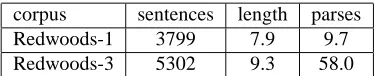
Redwoods is (semi-automatically) updated after changes have been made to the ERG, and it has thus far gone through three growths. Some salient characteris-tics of the first and third growths are given in Table 1 for utterances for which a unique preferred parse has been identified and for which there are at least two analyses.1 The ambiguity increased considerably between the first and third growths, reflecting the increased coverage of the ERG for more difficult sentences.
corpus sentences length parses Redwoods-1 3799 7.9 9.7 Redwoods-3 5302 9.3 58.0
Table 1: Characteristics of subsets of Redwoods versions used for the parse selection task. The columns indi-cate the number of sentences in the subset, their average length, and their average number of parses.
The small size of the treebank makes it essential to explore the possibility of using methods such as active learning to speed the creation of more annotated material for training parse selection models.
4
Parse Selection
Committee-based active learning requires multiple learn-ers which have different biases that cause them to make different predictions sometimes. As in co-training, one
1
[image:2.612.333.520.432.470.2]uni hcomp
bi what1 hcomp
tri noptcomp what1 hcomp
Figure 2: Three example ngram features based on the derivation tree in Figure 1.
way such diverse learners can be created is by using in-dependent or partially inin-dependent feature sets to reduce the error correlation between the learners. Another way is to use different machine learning algorithms trained on the same feature set. In this section, we discuss two fea-ture sets and two machine learning algorithms that are used to produce four distinct models and we give their overall performance on the parse selection task.
4.1 Features
Our two feature sets are created by using only the deriva-tion trees made available in Redwoods. The configura-tional set is loosely based on the derivation tree features given by Toutanova and Manning (2002), and thus en-codes standard relations such as grandparent-of and left-sibling for the nodes in the tree. The ngram set is created by flattening derivation trees and treating them as strings of rule names over which ngrams are extracted, taking up to four rule names at a time and including the number of intervening parentheses between them. We ignore ortho-graphic values for both feature sets.
As examples of typical ngram features, the derivation tree given in Figure 1 generates features such as those de-picted in Figure 2. Such features provide a reasonable ap-proximation of trees that implicitly encodes many of the interesting relationships that are typically gathered from them, such as grandparent and sibling relations. They also capture further relationships that cross the brackets of the actual tree, providing some more long-distance re-lationships than the configurational features.
4.2 Algorithms
We use both log-linear and perceptron algorithms to cre-ate parse selection models. Both frameworks use iter-ative procedures to determine the weights
of a corresponding set of features
produced
from annotated training material. Though they are oth-erwise quite different, this commonality facilitates their use in a committee since they can work with the same training material. When preparing the training material, we record observations about the distribution of analyses with a binary distinction that simply identifies the pre-ferred parse, rather than using a full regression approach that recognizes similarities between the preferred parse and some of the dispreferred ones.
Log-linear models have previously been used for stochastic unification-based grammars by Johnson et
al. (1999) and Osborne (2000). Using Redwoods-1, Toutanova and Manning (2002) have shown that log-linear models for parse selection considerably outper-form PCFG models trained on the same features. By using features based on both derivation trees and seman-tic dependency trees, they achieved 83.32% exact match whole-sentence parse selection with an an ensemble of log-linear models that used different subsets of the fea-ture space.
As standard for parse selection using log-linear mod-elling, we model the probability of an analysis given a sentence with a set of analyses!#"$
&% as follows:
'
( )* +" ,.-/
0
1 2
1
(
1
3
*
where
1
(& returns the number of times feature4 occurs
in analysis and
3
* is a normalization factor for the
sentence. The parse with the highest probability is taken as the preferred parse for the model.2 We use the lim-ited memory variable metric algorithm (Malouf, 2002) to determine the weights.
Perceptrons have been used by Collins and Duffy (2002) to re-rank the output of a PCFG, but have not pre-viously been applied to feature-based grammars. Stan-dard perceptrons assign a score rather than probability to each analysis. Scores are computed by taking the inner product of the analysis’ feature vector with the parameter vector:
*.5768
,
9"
:
1 2
1
(
1
The preferred parse is that with the highest score out of all analyses of a sentence.
4.3 Performance
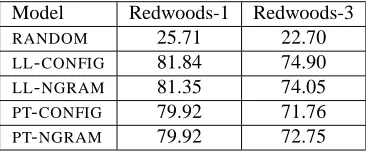
Using the two feature sets (configurational and ngram) with both log-linear and perceptron algorithms, we create the four models shown in Table 2. To test their overall accuracy, we measured performance using exact match. This means we award a model a point if it picks some parse for a sentence and that parse happens to be the best analysis. We averaged performance over ten runs using a cross-validation strategy. For each run, we randomly split the corpus into ten roughly equally-sized subsets and tested the accuracy for each subset after training a model on the other nine. The accuracy when a model ranks;
parses highest is given as<=; .
ac-Model Algorithm Feature set
LL-CONFIG log-linear configurational LL-NGRAM log-linear ngram
PT-CONFIG perceptron configurational
[image:4.612.91.280.70.136.2]PT-NGRAM perceptron ngram
Table 2: Parse selection models.
Model Redwoods-1 Redwoods-3
RANDOM 25.71 22.70
LL-CONFIG 81.84 74.90
LL-NGRAM 81.35 74.05
PT-CONFIG 79.92 71.76
PT-NGRAM 79.92 72.75
Table 3: Parse selection accuracy.
curacy heavily.
The performance of LL-CONFIG on Redwoods-1 matches the accuracy of the best stand-alone log-linear model reported by Toutanova and Manning (2002), which uses essentially the same features. The log-linear model that utilizes the ngram features is not far behind, indicat-ing that these simple features do indeed capture important generalizations about the derivation trees.
The perceptrons both perform worse than the log-linear models. However, what is more important is that each model disagrees with all of the others on roughly 20% of the examples, indicating that differentiation by using either a different feature set or a different machine learn-ing algorithm is sufficient to produce models with dif-ferent biases. This is essential for setting up committee-based active learning and could also make them informa-tive members in an ensemble for parse selection.
5
Selecting Examples for Annotation
In applying active learning to parse selection, we in-vestigate two primary sample selection methods, one certainty-based and the other committee-based, and com-pare them to several baseline methods.
The single-learner method uses tree entropy (Hwa, 2000), which measures the uncertainty of a learner based on the conditional distribution it assigns to the parses of a given sentence. Following Hwa, we use the following evaluation function to quantify uncertainty based on tree entropy:
*
! "
0
/
( )* 6
/
( )*
*
where! denotes the set of analyses produced by the ERG
2
When only an absolute ranking of analyses is required, it is unnecessary to exponentiate and compute.
for the sentence. Higher values of *
! indicate
ex-amples on which the learner is most uncertain and thus presumably are more informative. The intuition behind tree entropy is that sentences should have a skewed dis-tribution over their parses and that deviation from this signals learner uncertainty. Calculating tree entropy is trivial with the conditional log-linear models described in section 4. Of course, tree entropy cannot be straight-forwardly used with standard perceptrons since they do not determine a distribution over the parses of a sentence. The second sample selection method is inspired by the Query by Committee algorithm (Freund et al., 1997; Argamon-Engelson and Dagan, 1999) and co-testing (Muslea et al., 2000). Using a fixed committee consisting of two distinct models, the examples we select for anno-tation are those for which the two models disagree on the preferred parse. We will refer to this method as preferred parse disagreement. The intuition behind this method is that the different biases of each of the learners will lead to different predictions on some examples and thus identify examples for which at least one of them is uncertain.
We compare tree entropy and disagreement with the following three baseline selection methods to ensure the significance of the results:
random: randomly select sentences
ambiguity: select sentences with a higher number of parses
length: select longer sentences
6
Experimental Setup
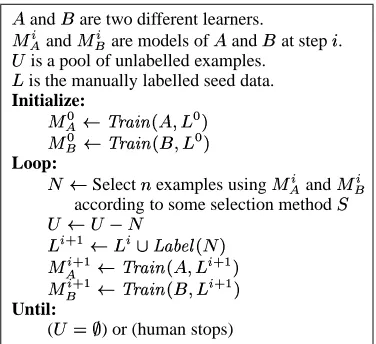
The pseudo-code for committee-based active learning with two members is given in Figure 3.3 Starting with a small amount of initial annotated training material, the learners on the committee are used to select examples, based on the method being used. These examples are subsequently manually annotated and added to the set of labelled training material and the learners are retrained on the extended set. This loop continues until all available unannotated examples are exhausted, or until some other pre-determined condition is met.
As is standard for active learning experiments, we quantify the effect of different selection techniques by using them to select subsets of the material already an-notated in Redwoods-3. For the experiments, we used tenfold cross-validation by moving a fixed window of 500 sentences through Redwoods-3 for the test set and select-ing samples from the remainselect-ing 4802 sentences. Each run of active learning begins with 50 randomly chosen, annotated seed sentences. At each round, new examples
3
[image:4.612.94.277.168.244.2]and are two different learners.
and
are models of and
at step.
is a pool of unlabelled examples. is the manually labelled seed data. Initialize:
Loop:
Select examples using !
and
!
according to some selection method"
$#
&%('
*),+ .-0/21
&%('
3
4 &%('
&%('
3
&%('
Until: (576
[image:5.612.92.280.70.242.2]) or (human stops)
Figure 3: Pseudo-code for committee-based active learn-ing.
are selected for annotation from a randomly chosen sub-set according to the operative selection method until the total amount of annotated training material made avail-able to the learners reaches 3000. We select 25 examples at time until the training set contains 1000 examples, then 50 at a time until it has 2000, and finally 100 at a time un-til it has 3000. The results for each selection method are averaged over four tenfold cross-validation runs.
Whereas Hwa (Hwa, 2000) evaluated the effectiveness of selective sampling according to the number of brack-ets which were needed to create the parse trees for se-lected sentences, we compare selection methods based on the absolute number of sentences they select. This is realistic in the Redwoods setting since the derivation trees are created automatically from the ERG, and the task of the human annotator is to select the best from all licensed parses. Annotation in Redwoods uses an inter-face that presents local discriminants which disambiguate large portions of the parse forest, so options are narrowed down quickly even for sentences with a large number of parses.
7
Results
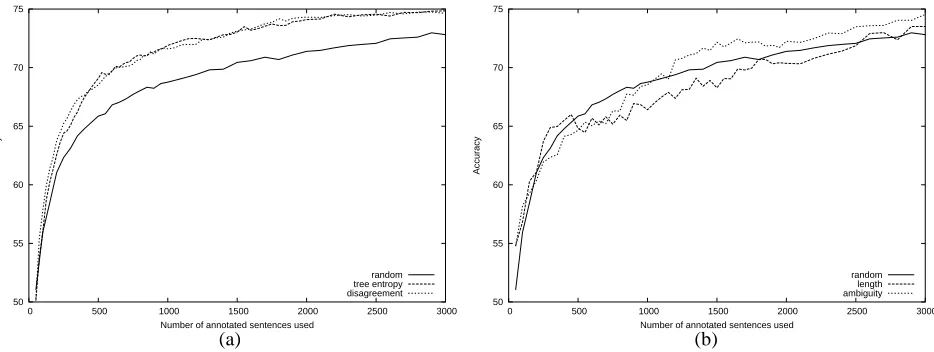
Figure 4 shows the performance of theLL-CONFIGmodel as more examples are chosen according to the different selection methods. As can be seen, both tree entropy and disagreement are equally effective and significantly im-prove on random selection.4Selection by sentence length is worse than random until 2100 examples have been an-notated. Selecting more ambiguous sentences does even-tually perform significantly better than random, but its ac-curacy does not rise nearly as steeply as tree entropy and
4
LL-CONFIGwas paired withLL-NGRAMfor preferred parse disagreement in Figure 4(a).
disagreement selection. Table 4 shows the precise values for all methods using different amounts of annotated sen-tences. The accuracies for entropy and disagreement are statistically significant improvements over random selec-tion. Using a pair-wise t-test, the values for 500, 1000, and 2000 are significant at 99% confidence, and those for 3000 are significant at 95% confidence.5
500 1000 2000 3000 random 65.87 68.76 71.39 72.82 disagree 68.52 71.60 74.31 74.63 entropy 69.01 71.90 74.10 74.85 ambiguity 64.65 68.54 72.25 74.54 length 64.82 66.41 70.37 73.51
Table 4: Accuracy for different selection methods with different amounts of training data.
Table 5 shows that when compared to random selec-tion using 3000 examples, tree entropy and disagreement achieve higher accuracy while reducing the number of training examples needed by more than one half. Though selection by ambiguity does provide a reduction over ran-dom selection, it does not enjoy the same rapid increase as tree entropy and disagreement, and it performs roughly equal to or worse than random until 1100 examples, as is evident in Figure 4(b).
# examples avg. score reduction
random 3000 72.82 N/A
disagree 1450 72.95 51.7 entropy 1450 72.84 51.7 ambiguity 2300 72.95 23.3
length 2600 73.70 12.0
Table 5: Number of examples needed for different selec-tion methods to outperform random selecselec-tion with 3000 examples. The final column gives the percentage reduc-tion in the number of examples used.
We also tested preferred parse disagreement by pair-ingLL-CONFIG with the perceptrons. The performance in these cases was nearly identical to that given for selec-tion by disagreement in Figure 4, which usedLL-CONFIG
andLL-NGRAM for the committee. This indicates that differences either in terms of the algorithm or the feature set used are enough to bias the learners sufficiently for them to disagree on informative examples. This provides flexibility for applying selection by disagreement in dif-ferent contexts where it may be easier to employ difdif-ferent
5
[image:5.612.330.522.164.243.2]50 55 60 65 70 75
0 500 1000 1500 2000 2500 3000
Accuracy
Number of annotated sentences used
random tree entropy disagreement
50 55 60 65 70 75
0 500 1000 1500 2000 2500 3000
Accuracy
Number of annotated sentences used
random length ambiguity
[image:6.612.76.543.73.249.2](a) (b)
Figure 4: Accuracy as more examples are selected according to (a) random, tree entropy, and disagreement, and (b) random, ambiguity, and sentence length.
feature sets than different algorithms, or vice versa. The fact that using the same feature set with different algo-rithms is effective for active learning is interesting and is echoed by similar findings for co-training (Goldman and Zhou, 2000).
Given the similar performance of tree entropy and pre-ferred parse disagreement, it is interesting to see whether they select essentially the same examples. One case where they might not overlap is a distribution with two sharp spikes, which would be likely to provide excellent discriminating information. Though such a distribution has low entropy, each model might be biased toward a different spike and they would select the example by dis-agreement.
To test this, we ran a further experiment with a com-bined selection method that takes the intersection of tree entropy and disagreement. At each round, we randomly choose examples from the pool of unannotated sentences and sort them according to tree entropy, from highest to lowest. From the first 100 of these examples, we take the first examples that are also selected by disagreement, varying the number selected in the same manner as for the previous experiments. When the size of the intersec-tion is less than the number to be selected, we select the remainder according to tree entropy.
The performance for combined selection is compared with entropy and random selection in Figure 5 and Ta-ble 6. There is an slight, though not significant improve-ment over entropy on its own. The improveimprove-ment over random is significant for all values, using a pair-wise t-test at 99% confidence. The combined approach re-quires 1200 examples on average to outperform random selection with 3000 examples, a 60.0% reduction that im-proves on either method on its own.
Tracking the examples chosen by tree entropy and
dis-500 1000 2000 3000 random 65.87 68.76 71.39 72.82 entropy 69.01 71.90 74.10 74.85 combined 69.56 71.98 74.43 75.26
Table 6: Accuracy for random, tree entropy and com-bined selection selection with different amounts of train-ing data.
agreement at each round verifies that they do not se-lect precisely the same examples. It thus appears that disagreement-based selection helps tease out examples that contain better discriminating information than other examples with higher entropy. This may in effect be ap-proximating a more general method that could directly identify such examples.
The accuracy ofLL-CONFIGwhen using all 4802 avail-able training examples for the tenfold cross-validation is 74.80%, and combined selection improves on this by reaching 75.26% (on average) with 3000 training exam-ples. Furthermore, though active learning was halted at 3000 examples, the accuracy for all the selection methods was still increasing at this point, and it is likely than even higher accuracy would be achieved by allowing more ex-amples to be selected. Sample selection thus appears to identify highly informative subsets as well as reduce the number of examples needed.
50 55 60 65 70 75 80
0 500 1000 1500 2000 2500 3000
Accuracy
Number of annotated sentences used
[image:7.612.76.300.466.629.2]random tree entropy combined
Figure 5: Accuracy as more examples are selected based on tree entropy alone and tree entropy combined with pre-ferred parse disagreement.
to better models? To test this, we created a log-linear model that uses only bigrams, used it to select examples by tree entropy, and simultaneously trained and tested
LL-CONFIGon those examples. Utilizing all training ma-terial, the bigram model performs much worse thanLL
-CONFIGoverall: 71.43% versus 74.80%.
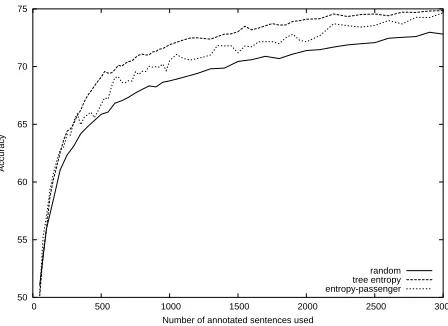
LL-CONFIGis thus a sort of passenger of the weaker bi-gram model, which drives the selection process. Figure 6 compares the accuracy ofLL-CONFIG under this condi-tion (which only involved one tenfold cross-validacondi-tion run) with the accuracy whenLL-CONFIG itself chooses examples according to tree entropy. Random selection is also included for reference.
50 55 60 65 70 75
0 500 1000 1500 2000 2500 3000
Accuracy
Number of annotated sentences used
random tree entropy entropy-passenger
Figure 6: Accuracy as more examples are selected based tree entropy according toLL-CONFIGitself and whenLL
-CONFIGis the passenger of an impoverished model.
This experiment demonstrates that although accuracy does not rise as quickly as whenLL-CONFIGitself selects examples, it is still significantly better than random (at
95% confidence) despite the bigram model’s poorer per-formance. We can thus expect samples chosen by the cur-rent best model to be informative, though not necessarily optimal, for improved models in the future.
8
Conclusion
We have shown that sample selection according to both tree entropy and preferred parse disagreement signifi-cantly reduce the number of examples needed to train models for HPSG parse selection, when compared to several baseline selection metrics. Furthermore, perfor-mance improves further when these these two methods are combined, resulting in a 60% reduction in the amount of training material without any degradation in parse se-lection accuracy. Another interesting result is that, for this data set, higher accuracy is attainable by not using all of the available training material. We have also shown that an impoverished learner can effectively choose sam-ples that are informative for a better model.
Because tree entropy requires only one learner, it is simpler and more efficient than preferred parse disagree-ment. However, it requires the learner to be probabilis-tic, and thus cannot be straightforwardly used with ma-chine learning algorithms such as standard perceptrons and support vector machines.
A more important difference between tree entropy and disagreement is that the latter leads naturally to a combined approach using both active learning and co-training. Rather than comparing the two learners on whether they categorically select the same preferred parse on a number of examples, we can view active learning as the inverse of agreement-based co-training (Abney, 2002). We can then explore thresholds for which we can determine that certain examples need to be human anno-tated and others can be confidently machine labelled.
In future work, we will explore the effect of using fur-ther models that utilize the semantic information in Red-woods for sample selection, and we will apply active learning to both expand Redwoods and add discourse-level annotations.
Acknowledgements. We would like to thank Markus
Becker, Chris Callison-Burch, Dan Flickinger, Alex Lascarides, Chris Manning, Stephan Oepen, Kristina Toutanova, and the anonymous reviewers. This work was supported by Edinburgh-Stanford Link R36763, ROSIE project.
References
Steven Abney. 2002. Bootstrapping. In Proceedings of
the 40th Annual Meeting of the ACL, pages 360–367,
Shlomo Argamon-Engelson and Ido Dagan. 1999. Committee-based sample selection for probabilistic classifiers. Journal of Artificial Intelligence Research, 11:335–360.
David Cohn, Les Atlas, and Richard Ladner. 1994. Im-proving generalization with active learning. Machine
Learning, 15(2):201–221.
Michael Collins and Nigel Duffy. 2002. New ranking al-gorithms for parsing and tagging: Kernels over discrete structures and the voted perceptron. In Proceedings of
the 40th Annual Meeting of the ACL, pages 263–270,
Philadelphia, Pennsylvania.
Michael Collins. 1997. Three generative, lexicalised models for statistical parsing. In Proceedings of the
35th Annual Meeting of the ACL, pages 16–23, Madrid,
Spain.
Sean P. Engelson and Ido Dagan. 1996. Minimizing manual annotation cost in supervised training from co-pora. In Proceedings of the 34th Annual Meeting of
the ACL, pages 319–326.
Dan Flickinger. 2000. On building a more efficient grammar by exploiting types. Natural Language
En-gineering, 6(1):15–28. Special Issue on Efficient
Pro-cessing with HPSG.
Yoav Freund, H. Sebastian Seung, Eli Shamir, and Naf-tali Tishby. 1997. Selective sampling using the query by committee algorithm. Machine Learning,
28(2-3):133–168.
Sally Goldman and Yan Zhou. 2000. Enhancing super-vised learning with unlabeled data. In Proceedings of
the 17th International Conference on Machine Learn-ing, Stanford, CA.
Rebecca Hwa. 2000. Sample selection for statistical grammar induction. In Proceedings of the 2000 Joint
SIGDAT Conference on EMNLP and VLC, pages 45–
52, Hong Kong, China, October.
Mark Johnson, Stuart Geman, Stephen Cannon, Zhiyi Chi, and Stephan Riezler. 1999. Estimators for Stochastic “Unification-Based” Grammars. In 37th
Annual Meeting of the ACL.
David D. Lewis and William A. Gale. 1994. A sequential algorithm for training text classifiers. In Proceedings
of the 17th Annual International ACM SIGIR Confer-ence on Research and Development in Information Re-trieval, pages 3–12.
Robert Malouf. 2002. A comparison of algorithms for maximum entropy parameter estimation. In
Pro-ceedings of the Sixth Workshop on Natural Language Learning, pages 49–55, Taipei, Taiwan.
Ion Muslea, Steven Minton, and Craig Knoblock. 2000. Selective sampling with redundant views. In
Proceed-ings of National Conference on Artificial Intelligence (AAAI-2000), pages 621–626.
Stephan Oepen, Kristina Toutanova, Stuart Shieber, Christopher Manning, Dan Flickinger, and Thorsten Brants. 2002. The LinGO Redwoods Treebank: Moti-vation and preliminary applications. In Proceedings of
the 19th International Conference on Computational Linguistics, Taipei, Taiwan.
Miles Osborne. 2000. Estimation of Stochastic Attribute-Value Grammars using an Informative Sam-ple. In The<
International Conference on Compu-tational Linguistics, Saarbr¨ucken.
Cynthia A. Thompson, Mary Elaine Califf, and Ray-mond J. Mooney. 1999. Active learning for natural language parsing and information extraction. In Proc.
16th International Conf. on Machine Learning, pages
406–414. Morgan Kaufmann, San Francisco, CA.
Kristina Toutanova and Chris Manning. 2002. Fea-ture selection for a rich HPSG grammar using decision trees. In Proceedings of the 6th Conference on Natural