The ContrastMedium Algorithm: Taxonomy Induction From
Noisy Knowledge Graphs With Just a Few Links
Stefano Faralli1, Alexander Panchenko2, Chris Biemann2and Simone Paolo Ponzetto1 1Data and Web Science Group, University of Mannheim, Germany
2Language Technology Group, University of Hamburg, Germany
{stefano,simone}@informatik.uni-mannheim.de
{panchenko,biemann}@informatik.uni-hamburg.de
Abstract
In this paper, we present ContrastMedium, an algorithm that transforms noisy se-mantic networks into full-fledged, clean taxonomies. ContrastMedium is able to identify the embedded taxonomy structure from a noisy knowledge graph without ex-plicit human supervision such as, for in-stance, a set of manually selected input root and leaf concepts. This is achieved by leveraging structural information from a companion reference taxonomy, to which the input knowledge graph is linked (either automatically or manually). When used in conjunction with methods for hypernym acquisition and knowledge base linking, our methodology provides a complete so-lution for end-to-end taxonomy induction. We conduct experiments using automati-cally acquired knowledge graphs, as well as a SemEval benchmark, and show that our method is able to achieve high perfor-mance on the task of taxonomy induction.
1 Introduction
Recent years have witnessed an impressive amount of work on automatic construction of wide-coverage knowledge resources. Web-scale open information extraction systems like NELL (Carlson et al., 2010) or ReVerb (Fader et al., 2011) have been successful in acquiring massive amounts of machine-readable knowledge by ef-fectively tapping large amounts of text from Web pages. However, the output of these systems does not consist of a clean, fully-semantified output. Such output, on the other hand, could be pro-vided by the vocabulary of large-scale ontologies like DBpedia (Bizer et al., 2009) or YAGO (Hof-fart et al., 2013) and the integration of open and
closed information extraction approaches (Dutta et al., 2014). The use of an encyclopedia-centric (e.g., Wikipedia-based) dictionary of entities leads to poor coverage of domain-specific terminologies (Faralli and Navigli, 2013). This can be allevi-ated by constructing knowledge bases of ever in-creasing coverage and complexity from the Web (Wu et al., 2012; Gupta et al., 2014; Dong et al., 2014) or by community efforts (Bollacker et al., 2008). However, the focus on large size and wide coverage at entity level has led all these resources to avoid the complementary problem of curat-ing and maintaincurat-ing a clean taxonomic backbone with as minimal supervision as possible. That is, no resource, to date, integrates structured infor-mation from existing wide-coverage knowledge graphs with empirical evidence from text for the explicit goal of building full-fledged taxonomies consisting of a clean and fully-connected directed acyclic graph (DAG). This is despite the fact that taxonomies have been known for a long time to provide valid tools to represent domain-specific knowledge with dozens of scientific, industrial and social applications (Glass and Vessey, 1995).
In taxonomy induction, the required domain knowledge can be acquired with many differ-ent methods for hypernym extraction, ranging from simple lexical patterns (Hearst, 1992; Oakes, 2005; Kozareva and Hovy, 2010) to statistical and machine learning techniques (Caraballo, 1999; Agirre et al., 2000; Ritter et al., 2009; Velardi et al., 2013). Recent efforts, such as Microsoft’s Probase (Wu et al., 2012) or the WebIsaDB (Seit-ner et al., 2016) similarly focus on ‘local’ extrac-tion of single hypernym relaextrac-tions, and do not ad-dress the problem of how to combine these sin-gle relations into a coherent taxonomy. When tax-onomies are automatically acquired, their cleaning (also called “pruning”) becomes a mandatory step (Velardi et al., 2013).
The contributions of this paper are two-fold:
1. We introduce a new algorithm, named Con-trastMedium, which, given a noisy knowledge graph and its (possibly automatically gener-ated) links to a companion taxonomy, is able to output a full-fledged taxonomy. Information from the reference taxonomy is projected onto the input noisy graph to automatically acquire topological clues, which are then used to drive the cleaning process. The reference taxonomy provides us with ground-truth taxonomic rela-tions that make our knowledge-based method not truly unsupervisedsensu stricto. However, the availability of resources like, for instance, WordNet (Fellbaum, 1998) or BabelNet (Nav-igli and Ponzetto, 2012) implies that these re-quirements are trivially satisfied;
2. We combine our approach with an unsupervised framework for knowledge acquisition from text (Faralli et al., 2016) to provide a full end-to-end pipeline for taxonomy induction from scratch.
2 Related Work
Knowledge Bases (KBs) can be created in many different ways depending on the availability of external resources and specific application needs. Recently, much work in Natural Language Pro-cessing focused on Knowledge Base Completion (Nickel et al., 2016a, KBC), the task of enrich-ing and refinenrich-ing existenrich-ing KBs. Many different methods have been explored for KBC, includ-ing exploitation of resources such as text corpora (Snow et al., 2006; Mintz et al., 2009; Aprosio et al., 2013) or other KBs (Wang et al., 2012; Bryl and Bizer, 2014) for acquiring additional knowl-edge. Alternative approaches, in contrast, primar-ily rely on existing information from the KB it-self (Socher et al., 2013; Nickel et al., 2016b) used as ground-truth to simultaneously learn con-tinuous representations of KB concepts and tions, which are used to infer additional KB rela-tions. Finally, Open Information Extraction meth-ods looked at ways to extract large amounts of facts from Web-scale corpora in order to acquire open-domain KBs (Etzioni et al., 2011; Faruqui and Kumar, 2015,inter alia);
In this paper, we focus on a different, yet complementary task, which is a necessary step when inducing novel KBs from scratch, namely extracting clean taxonomies from noisy
knowl-edge graphs. State-of-the-art algorithms differ by the amount of human supervision required and their ability to respect some topological properties while pruning. Approaches like those of Kozareva and Hovy (2010), Velardi et al. (2013) and Kapa-nipathi et al. (2014), for instance, apply different topological pruning strategies that require to spec-ify the root and leaf concept nodes of the KB in advance – i.e., a predefined set of abstract top-level concepts and lower terminological nodes, re-spectively. The approach of Faralli et al. (2015) avoids such supervision on the basis of an itera-tive method that uses an efficient variant of topo-logical sorting (Tarjan, 1972) for cycle pruning. Such lack of supervision, however, comes at the cost of not being able to preserve the original con-nectivity between the top (abstract) and the bottom (instance) concepts. Random edge removal (Far-alli et al., 2015), in fact, can lead to disconnected components, a problem shared with the OntoLearn Reloaded approach (Velardi et al., 2013), which cannot ensure such property when used to approx-imate the solution for a large noisy graph.
Our work goes one step beyond the previous contributions by presenting a new efficient algo-rithm that is able to extract a clean taxonomy from a noisy knowledge graph without needing to know in advance – that is, having to manually specify – the top-level and leaf concepts of the taxonomy, while preserving the overall connectivity of the graph. We achieve this by projecting the infor-mation from a reference KB such as, for instance, WordNet (Fellbaum, 1998), onto the input noisy KB on the basis of pre-existing KB links – which in turn can be automatically generated with high precision using any of the existing solutions for KB mapping (Navigli and Ponzetto, 2012; Faralli et al., 2016, inter alia) or by relying on ground truth information from the Linguistic Linked Open Data cloud (Chiarcos et al., 2012).
More-over, in contrast to random walks on graphs our method is deterministic in nature. Here, we ar-gue for the choice of a deterministic approach, like ours, that does not require tuning of parameters: its termination is guaranteed by the number of it-erations, which we bind by the maximal diameter
|E|for a graphG = (V, E). Generally, random walk algorithms would provide an approximation that may lead to a less precise estimation of the order induced by the contrast medium level.
3 The ContrastMedium Algorithm 3.1 Problem Statement
Our work builds upon the notion of anoisy knowl-edge graph(NKG), which consists of a directed graph G = (V, E) whereV is a set of concepts andEthe set of labelled binary semantic relations – e.g., those found between synsets like, for in-stance, hypernymy or meronymy within a seman-tic network like WordNet. In a NKG we assume bothV andEto have been acquired automatically, e.g., in order to induce a domain-aware or a gen-eral purpose knowledge base. Additionally, we consider for our purposes thehypernymy graph
T = (TV, TE)ofG, the subgraph made up of the
hypernymy (i.e.,isa-labeled) edges ofE. SinceT is a subgraph ofG, we can expect that the former inherits a certain amount of noise from the latter.
Noise within hypernymy graphs can be further classified into: i) noisy nodes, the concepts that do not belong to a specific target vocabulary, e.g., domain concepts for domain-specific KBs, such asJaguar Carswithin a zoological taxonomy; ii)noisy edges, the wrongly-acquired relations be-tween unrelated concepts or out-of-domain rela-tions, e.g., Jaguar Cars isaFeline; iii) cy-cles of hypernymy relations, such as those derived from counts over very large corpora (Seitner et al., 2016), e.g.,jaguar(Panthera onca)→
feline → animal → jaguar (Panthera onca). We accordingly define the task of ex-tracting a clean taxonomy from a NKG as that of pruning the cycles, as well as the noisy edges and nodes, from the hypernymy subgraphT ofG.
3.2 Resources Used
In order to enable end-to-end taxonomy induc-tion from scratch, we combine our general ap-proach with existing KBs that have been automat-ically induced from text and linked to reference lexical knowledge bases on the basis of
unsuper-vised methods. To this end, we use the linked dis-ambiguated distributional KBs from Faralli et al. (2016)1, which are built in three steps:
1) Learning a JoBimText model. Initially, a sense inventory is created from a large text collection using the pipeline of the JoBimText project (Biemann and Riedl, 2013).2 The re-sulting structure contains disambiguated proto-concepts (i.e., senses), their similar and related terms, as well as aggregated contextual clues per proto-concept.
2) Disambiguation of related terms. Similar terms and hypernyms associated with a proto-concept are fully disambiguated based on the partial disambiguation from step (1). The re-sult is a proto-conceptualization (PCZ), where all terms have a sense identifier.
3) Linking to a lexical resource. The PCZ is automatically aligned with an existing lexical resource (LR) such as WordNet or BabelNet. For example, bridge:NN:3 is linked to the Babel synsetbn:00013077n(the ‘infrastruc-ture’ sense). That is, a mapping between the two sense inventories is created to combine them into a new extended sense inventory, a hy-brid aligned resource.
Table 1 shows the proto-conceptualization entries for the polysemous termsbridgeandlink, namely their figurative (“bridge:NN:2” and “link:NN:1”) and concrete ‘infrastructure’ (“bridge:NN:3” and “link:NN:0”) senses, respectively. JoBimText models provide sense distinctions that are only partially disambiguated: the list of similar and hy-pernyms terms of each sense, in fact, does not carry sense information. Consequently, a seman-tic closure procedure is applied in order to obtain a PCZ and arrive at sense representation in which all terms get assigned a unique, best-fitting sense identifier (see Faralli et al. (2016) for details).
PCZs consist of a rich, yet noisy, disam-biguated semantic network automatically induced from large amounts of text: links to existing lex-ical resources provide us a source of external su-pervision that can be leveraged to clean them and turn them into full-fledged taxonomies. Steps 1–3 are unsupervised by nature. Consequently, when
entry similar terms hypernyms
bridge:NN:2 gap:NN:2, divide:NN:2, link:NN:1, ... issue:NN:2, topic:NN:3, ...
bridge:NN:3 road:NN:0, highway:NN:1, overpass:NN:3 ... infrastructure:NN:1, project:NN:1, ...
link:NN:0 connection:NN:3, correlation:NN:1, linkage:NN:1 ... service:NN:6, feature:NN:0, ...
[image:4.595.311.514.166.440.2]link:NN:1 relationship:NN:1, interaction:NN:1, divide:NN:0 ... problem:NN:1, topic:NN:3 ...
Table 1: Excerpt of a proto-conceptualization (PCZ) for the words “bridge:NN” and “link:NN”.
combined with our algorithm they provide a com-plete framework for fully unsupervised taxonomy induction from scratch. Note, however, that our approach offers a general solution to the problem of taxonomy cleaning. In an additional set of ex-periments, we apply it to different automatically generated taxonomies from a SemEval task in a more controlled setting where we rely on a few manually created KB links only.
3.3 The ContrastMedium Algorithm
At its core, our algorithm relies on the notion of a linked noisy knowledge graph (LNKG). This consists of a quintuple (G, KB, KBroot, λ, M)
where: i) G = (VG, EG) is a noisy knowledge
graph; ii) KB = (VKB, EKB) is a companion
knowledge base providing a ground-truth taxon-omy; iii)KBrootis the root node of the reference
knowledge base KB (if several top-level nodes exist, an artificial root can be created by con-necting them all); iv) λ is a conventional sym-bol to represent the “undefined concept”, i.e., a place-holder for empty mappings; v)M :VG →
VKB∪ {λ}is the function, which maps nodes of
VGinto nodes of VKB or into the undefined
con-ceptλ. The key ideas behind ContrastMedium are:
• Identification of important topological clues from the companion knowledge baseKBin or-der to hierarchically sort the concepts inG. For our purposes,KBis expected to be able to pro-vide ground-truth taxonomic relations that can be safely projected ontoG to guide the clean-ing process: that is, we assume it to be rea-sonably clean. In contrast, we do not make any assumption on howKB has been created: our approach can be used with either manu-ally created taxonomies like WordNet or (semi-)automatically induced ones, provided they are of sufficient quality. Hence, our method is knowledge-based without the need of further supervision other than that contained inKB;
• Projection of topological clues fromKB back onto the LNKG G on the basis of the links
Pruning of T
clean taxonomy
T’ (G, KB, KBroot, λ, M)
A contrast medium drop enters the KB through the root node
KBroot
CKB
The drop flows through the common/linked node of T
2
initial CT
final CT
Shaking T by turning it up, down and up.
3
4 1
KB
KB
T
T
T’ M
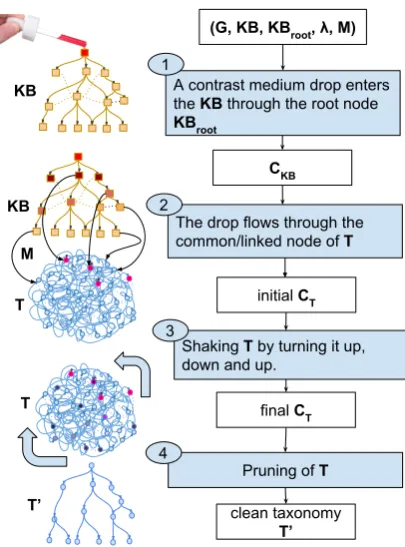
Figure 1: ContrastMedium: algorithm workflow.
found in the mappingM. Similarly to the case of the reference knowledge base, we do not make any assumption on how the links between GandKBhave been created: while there exists different methods to automatically link (lexical) knowledge bases (Navigli and Ponzetto, 2012; Faralli et al., 2016), we later show that it is also possible to achieve state-of-the-art performance with a few manually given links;
• Propagation of the topological clues across the entire NKGG. That is, to cope with the partial coverage of automatic mappings, as well as the need to reduce the number of manually created KB links, we apply a signal propagation tech-nique that solely relies on the structure ofG;
ALGORITHM 1:The ContrastMedium algorithm.
Input:(G= (V, E), KB= (VKB, EKB), KBroot, λ, M)
Output:hypernymy graphT0ofG, s.t.T0has no cycles.
// Estimating clues from KB (Fig. 1, step 1)
1 ∀x∈VKB:CKB(x) = 0;
2 injectContrastMedium(KB,KBroot);
// Transferring clues from KB to G (Fig. 1, step 2)
3 T = (VT, ET)←−hypernymyGraph(G);
4 ∀x∈VT :CT(x) = 0;
5 transferClues(M,KB,T,CKB,CT);
// Shaking the graph T (Fig. 1, step 3)
6 shake(UP,T,CT);// propagate through in-edges
7 shake(DOWN,T,CT);// propagate through out-edges 8 shake(UP,T,CT);// propagate through in-edges
// Pruning the graph T (Fig. 1, step 4)
9 T0= prune(T,CT);
10 returnT0;
results in a proper taxonomic structure.
We rely on the metaphor of a contrast medium (CM) to describe our approach, which is summa-rized in Figure 1. In the context of clinical analy-sis, a CM is injected into the human body to high-light specific complex internal body structures (in general, the venuous system). In a similar fash-ion, we detect the topological structure of a graph by propagating a certain amount of CM that we initially inject through the node KBroot of the
companion knowledge baseKB. The highlighted structure indicates the distance of a node with re-spect to the nodeKBroot. Then the lowest values
of contrast medium indicate the leaf terminologi-cal nodes. The observed quantities are then trans-ferred to corresponding nodes of the noisy graph by the mapping M. Next, the medium is prop-agated by ’shaking’ the noisy graph. We let the fluid reach all the components G by alternating two phases of propagation: letting the CM to flow through both incoming (‘shake up’); and outgoing (‘shake down’) edges. At the end, we use the par-tial order induced by the observed node level of CM to drive the pruning phase, and ‘stretch’ the original NKGGinto a proper DAG.
Our approach is presented in Algorithms 1 and 2.3 It consists of the following main steps:
1) CM injection Cf. Figure 1, block 1 and Al-gorithm 1, lines 1-2. We initially define the func-tionCKB :VKB → [0.0−1.0]and assign a zero
contrast medium level to all the nodes of theKB graph CKB(x) = 0, x ∈ VKB (line 1). Next, 3A demo is available at http://web.informatik.
uni-mannheim.de/faralli/cm.html with examples of the application of ContrastMedium to a few simple LNKGs.
ALGORITHM 2:The Shake routine.
Input: directionmay be UP or DOWN, graph= (Vgraph, Egraph), Cgraph
Output:the updatedCgraph
1 foreachx∈Vgraphdo
2 Currentgraph(x) =Cgraph(x);F lowngraph= 0.0;
// iteratively propagates the CM
3 fori= 0to|Egraph| −1do 4 foreachx∈Vgraphdo
5 InOutgraph(x) = 0.0;
6 foreachxs.t.Currentgraph(x)>0.0do
7 CMlevel=Currentgraph(x);
8 ifdirection==DOWNthen
9 O=outgoingEdges(x, graph); 10 foreach(x, y)∈Ido
11 InOutgraph(y)+ =maxCMlevel(|O|,1);
12 else
13 I=incomingEdges(x, graph); 14 foreach(y, x)∈Ido
15 InOutgraph(y)+ =maxCMlevel(|I|,1);
16 F lowngraph(x)+ =CMlevel;
17 foreachx∈Vgraphdo
18 Currentgraph(x) =InOutgraph(x);
19 foreachx∈Vgraphdo
20 Cgraph(x) =F lowngraph(x);
we call the routine ‘injectContrastMedium’ which: 1) assigns an initial contrast level equals to 1.0
to the node KBroot of the KB graph; ii) uses
the routine “Shake” with the direction parameter equals to “DOWN” (see Algorithm 2 and Step 3 “Graph shaking” for more details) to let the CM drop throughKB. In practice, the shaking routine implements a node contrast medium level propa-gation algorithm following the outgoing (‘down’) or the incoming (‘up’) edges of the graph.
2) CM transfer Cf. Figure 1, block 2 and Al-gorithm 1, lines 3-5. In the next phase, we first extract the hypernymy subgraph T = (VT, ET)
of G(see Section 3.1) and then follow the links in the mappingMto transfer the contrast medium levels, i.e.,CT(y) = CKB(x)(s.t.x ∈VKB, y ∈
VT,(y→x)∈M).
the value of the parameter direction(line 8 and line 12): i) we observe a CM level for the nodex (line 7); ii) ifdirection == DOWN (lines 9-11) we traverse all the outgoing edges(x, y)ofxand propagate the observed CM level ofx, otherwise (direction == UP, lines 13-15) we traverse the incoming edges(y, x)and propagate the CM level to the nodesy; iii) the value ofF lowngraph(x)is
incremented by the observed CM level (line 16); iv) for each nodex we reset the current observed value of the CM level with the portion of the liquid which has flown from the incoming or the outgo-ing edges duroutgo-ing the propagation (lines 17-18).
Depending on the propagation direction, we have two different behaviours for the CM. When exiting a node x through out the outgoing edges (direction == DOWN) we increment the level of contrast medium of the reached nodes by the observed value of x divided by number of out-going edges of x. By converse, when we climb (direction==UP) across the incoming edges of a nodexwe increment the CM level of the reached node by the observed CM quantity ofxdivided by the number of incoming edges ofx.
Note that the sequence UP/DOWN/UP and the specular DOWN/UP/DOWN are the only ones from the 8 possible combinations which can guar-antee the contrast medium to flow on the entire graph. We simply selected the first sequence since the final rank places candidate root nodes on the top (and candidate leaf nodes on the bottom).
4) Pruning Cf. Figure 1, block 4 and Algorithm 1, lines 9. Finally, we create a clean taxonomyT0
by pruning the graph T on the basis of the con-trast levels found inCT. CM levels inCT can be
used to induce a order of the nodes that, intuitively, captures the level of conceptual abstraction for the nodes inT. We use them to produce a clean tax-onomy as follows. We first sort the nodesv ∈VT
in a listS =s0, s1, . . . , s|VT|−1by the decreasing
resulting CM level value in CT. The nodes with
a higher level of contrast medium are candidates to be at the top level while the ones at the end of the list are candidates to be leaf nodes of the output taxonomy. Next, the pruning routine starts from a graphT0 = (VT0 =VT, ET0 = ∅)and for
each nodes ∈ S (from the last node to the first) add to ET0 all the edges of the kind e = (y, s)
where a path fromytosdoes not exists inT and with y belonging to one of the following: i) the set of peers{x ∈ Ss.t.CT(x) =CT(s)}; ii) the
ascending ordered list of preceding (x ∈ S s.t. CT(x) > CT(s)); iii) the ascending ordered list
of following(x∈Ss.t.CT(x)< CT(s))
Complexity analysis. The propagation step (Figure 1, blocks 1 and 3; Algorithm 2) costs O(|E| ∗ |V|) since we iteratively analyze all the nodes of V for a number |E| of iterations. The final step of pruning (Figure 1, block 4), instead, can have a time costO(|V|2∗(|E|+|V|)), since,
in the worst case, the algorithm must analyse all the possible pairs of vertices, and then test the ex-istence of a directed path between the candidate pairs of nodes.
4 Experiments
We perform two sets of experiments. We first eval-uate our approach when applied to large, automat-ically induced noisy knowledge graphs (Section 4.1) and then quantify the impact it can have to fur-ther improve the quality of the output of state-of-the-art taxonomy induction systems (Section 4.2).
4.1 Experiment 1: Pruning existing LNKG
We first apply ContrastMedium to a variety of knowledge graphs that have been automatically acquired and linked to reference KBs like Word-Net and BabelWord-Net using unsupervised methods (Section 3.2). Our research questions (RQs) are:
RQ1 Can we use ContrastMedium as component of a complete framework for fully unsuper-vised taxonomy induction from scratch?
RQ2 What is the quality of the resulting tax-onomies?
4.1.1 Experimental Setting
senses polysemy hypernyms links hypernymy graph dataset # avg. max # avg. # |VT| |ET|
[image:7.595.127.473.64.146.2]news-p1.6 332k 1.6 18 15k 6.9 60k 170k 1.538k news-p2.3 461k 2.3 17 15k 5.8 95k 225k 1.871k wiki-p1.8 368k 1.8 15 15k 4.4 67k 185k 1.167k wiki-p6.0 1.5M 6.0 36 52k 1.7 279k 394k 1.901k
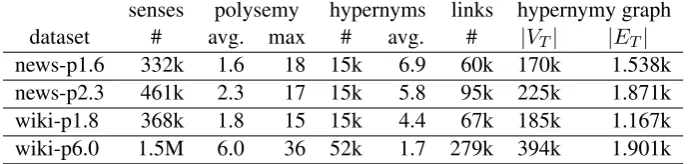
Table 2: Dimensions of the four datasets adopted as linked noisy knowledge graphs (Faralli et al., 2016).
the dimensions for each of the four NKGs – num-ber of senses, average and maximum sense poly-semy, number and average hypernyms per sense, the number of linked senses to WordNet con-cepts (i.e., “links”), and the number of nodes and edges for the corresponding hypernymy graph. Since our algorithm primarily focuses on concep-tual hierarchical (taxonomic) structures – referred to as the TBox in Knowledge Representation – we use the WordNet mappings only, since the manual inspection of the BabelNet mappings re-vealed that they are focused primarily on instances (that is, ABox statements). In order to have a complete quintuple for each NKG, we selected, for the companion KB, the top KBroot concept
entity of the WordNet taxonomy (SynsetID SID-00001740-N).
4.1.2 Measures
We benchmark ContrastMedium using a variety of metrics that are meant to capture structural proper-ties of the output taxonomies (to describe the im-pact of pruning on the original NKGs), as well as an estimation of their overall quality.
Edge compression: the ratio of the number of pruned edges over the total number of edges:
CEG,G0 =
|EG| − |EG0| |EG|
whereEGandEG0 represent the number of edges
found within the input (G) and pruned (G0)
taxon-omy, respectively.
Pruning accuracy: the performance on a 3-way classification task to automatically detect the level of granularity of a concept as a proxy to quan-tify the overall quality of the output taxonomies. Pruning accuracy is estimated using gold-standard annotations that are created from a random sam-ple of 1,000 nodes for each NKG. Two annotators with previous experience in knowledge acquisition and engineering were asked to provide for each
concept whether it can be classified as: i) a root, top-level abstract concept – i.e., any ofentity, object, etc. and more in general nodes that cor-respond to abstract concepts that we can expect to be part of a core ontology such as, for instance, DOLCE (Gangemi et al., 2002); ii) a leaf termino-logical node (i.e., instances such asLady Gaga orPorsche 911); iii) or a middle-level concept (e.g., celebrityorcars, concepts not fitting into any of the previous classes). An adjudication procedure was used to resolve any discrepancy between the two annotators: the inter-annotator agreement after adjudication isκ= 0.657(Fleiss, 1971), with most disagreement occurring on the identification of abstract, core ontology concepts.
A local 3-way classification task provides a rather crude way to estimate the performance on inducing hierarchical structures like taxonomies. Here, we use it primarily to benchmark how well ContrastMedium compares against other, structure-agnostic algorithms used within state-of-the-art solutions such as, for instance, Tarjan’s topological sorting (Section 2), which only break cycles in a random fashion.
Given ground-truth concept granularity judge-ments, we compute standard accuracy for each of the three classes. That is, we compare the system outputs against the gold standards and obtain three accuracy measures: one for the root nodes (AR),
one for the nodes ‘in the middle’ (AM) and finally
one for the leaf nodes (AL). For example a true
positive root node is a node annotated as a root node in the gold standard and having no incoming edges in the pruned graph.
Error Reduction (ER): finally, we compute the relative error reduction of ContrastMedium against other, baseline approaches as:
Baselineerrors/|sample| −CMerrors/|sample|
Baselineerrors/|sample|
Pruned Knowledge Graph Pruning accuracy ER
ContrastMedium Tarjan (baseline) ContrastMedium Tarjan (baseline)
dataset |VG0| |EG0| CE
G,G0 |VG0| |EG0| CEG,G0 AR AM AL AR AM AL
news-p1.6 170k 1.536k 0.15% 170k 1.535k 0.18% 98.9 98.3 99.3 93.3 94.6 95.3 0.62
news-p2.3 225k 1.867k 0.19% 225k 1.866k 0.23% 98.7 98.7 99.9 95.7 94.7 95.6 0.50
wiki-p1.8 183k 1.165k 0.18% 183k 1.164k 0.22% 97.6 94.7 97.3 93.1 87.3 94.1 0.41
[image:8.595.72.528.63.150.2]wiki-p6.0 394k 1.897k 0.18% 394k 1.896k 0.21% 95.9 94.3 98.3 89.5 90.1 92.8 0.50
Table 3: Structural analysis, pruning accuracies and error reduction (ER) for the four LNKGs.
animal
great
apes feline
lion
animal
great
apes feline
lion
animal
great
apes feline
lion
1
2 3
animal
great
apes feline
lion
X X
X X
Baseline ContrastMedium
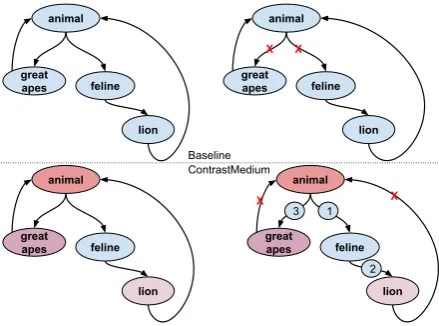
Figure 2: An example noisy graph and the differ-ent solutions provided by ContrastMedium and the baseline.
(2015) based on Tarjan’s topological sorting (Sec-tion 2), which iteratively searches for a cycle (until no cycle can be found) and randomly removes an edge from it. To the best of our knowledge, this is the only algorithm that we can fairly compare with, since alternative solutions all need to know the sets of root and leaf nodes in advance.
4.1.3 Results and discussion
Table 3 summarizes the performance of Con-trastMedium on the four automatically acquired NKGs. The results show that the pruning impact of our approach is lower than that of the baseline (an average of 1K edges of difference, cf. columns 3 and 6), which also determines higher edge com-pression CEG,G0 values for the baseline method.
Despite being less aggressive in terms of the number of edges pruned, ContrastMedium outper-forms the Tarjan-based algorithm on all datasets in terms of accuracy. Thanks to our method, in fact, we are able to achieve, even despite the base-line already reaching very high performance lev-els (well above 90% accuracy), improvements of up to 6 points, with an overall error reduction between around 40% and 60%. To provide an
intuition of why ContrastMedium clearly outper-forms the baseline approach, we provide in Fig-ure 2 an exemplified depiction of a typical case on which the baseline fails (based on a manually in-spected random sample). In our example, the Tar-jan baseline first detects the cycleC1 =(lion→
animal→feline→lion) and randomly de-cides to break it by removing the edge (animal
→ feline). Next, it detects the cycle C2 =
(animal → great apes → animal) and randomly decides to break it by removing the edge (animal → great apes). ContrastMedium, instead, after the shaking of the graph can leverage the partial ordering of the nodes (based on the con-cept granularity of the corresponding concon-cepts) to select the edges (animal, feline), (feline, lion) and (animal, great apes), while re-moving all remaining wrong and redundant edges.
4.2 Experiment 2: SemEval-15 task 17
We next evaluate the overall impact of our ap-proach within an existing benchmark for the tax-onomy induction task. Intuitively, most of the ben-efits from our method derive from the “gold stan-dard” information of the companion KB, and its linking to the NKG, which act as a source of su-pervision. Consequently, we address the research question of how much (pseudo-)supervision our method needs in terms of KB links, and whether it can be used to improve the state-of-the-art on the task of taxonomy induction.
4.2.1 Experimental Setting
We use the benchmark data from the SemEval-15 task 17 “Taxonomy Extraction Evaluation: TExE-val” (Bordea et al., 2015), since it provides us with gold-standard datasets and system outputs within a standard, easy-to-reproduce setting. Initially, we select from the participating systems4the two best performing taxonomies based on the
Cumula-4Cf. Table “Comparative Evaluation” at http://alt.
[image:8.595.72.292.192.355.2]0.48 0.5 0.52 0.54 0.56 0.58 0.6
1 2 3 4 5 10
Cumulative Fowlkes and Mallows
number of links
Equipments
baseline SemEval15-17 ContrastMedium
0.48 0.5 0.52 0.54 0.56 0.58 0.6
1 2 3 4 5 10
Cumulative Fowlkes and Mallows
number of links
Sciences
[image:9.595.82.512.70.214.2]baseline SemEval15-17 ContrastMedium
Figure 3: Performance on the SemEval-15 TExEval dataset (Cumulative Fowlkes&Mallows measure).
tive Fowlkes&Mallows (CF&M) measure (Velardi et al., 2012), the Equipments and Sciences tax-onomies from the INRIASAC and the LT3 teams respectively. We next apply our approach to these taxonomies, in order to clean them in a post-processing fashion. By selecting the top-systems we can see how far we can advance the state-of-the-art overall. Besides, these two taxonomies are also the ones containing the highest number of cy-cles, giving the application of our cleaning algo-rithm a more challenging (and meaningful) set-ting. To remove the effects of automatic linking and quantify the amount of manual efforts needed by our approach, 10 random concepts from each of these resources are manually linked to Word-Net, and the taxonomies subsequently pruned us-ing ContrastMedium and the baseline. We then evaluate performance following the task’s exper-imental setting and compute the CF&M measure for different levels of manually-created KB links.
4.2.2 Results and discussion
In Table 3, we report the performance on the Sem-Eval task for the two selected input taxonomies. Results on the structural similarities of the pruned taxonomies with the gold standard ones, computed using the CF&M measure, indicate that, thanks to ContrastMedium and with a minimal human ef-fort – the creation of just a few KB links (up to 10), which are needed only when automatic link-ing is not available – it is possible to boost the quality of taxonomies using state-of-art methods by a large margin. For instance, in the case of the
Equipmentstaxonomy, we improve up to 7 points. The baseline, which only breaks cycles, is not able to reassess the graph structure and only provides very small improvements to the submitted NKGs.
Overall, the results show that ContrastMedium leads to competitive performance on a hard, real-istic benchmark such as TExEval, achieving the best overall results for both taxonomies. That is, our algorithm is able to improve the state-of-the-art on taxonomy induction by additionally boost-ing the quality of existboost-ing top-performboost-ing systems for this task: this is achieved on the basis of a min-imally supervised approach that only requires a few links to a reference KB, which is used to pro-vide ground-truth taxonomic relations and guide the cleaning process.
5 Conclusions
In this paper, we presented ContrastMedium, a novel algorithm that can be applied to automat-ically linked noisy knowledge graphs to provide an end-to-end solution for fully unsupervised tax-onomy induction from scratch, i.e., without any human effort. Our results indicate that Con-trastMedium can be successfully applied to a wide range of automatically acquired KBs, ranging from large linked noisy knowledge graphs all the way to small-scale induced taxonomies to produce high-quality isahierarchies that achieve state-of-the-art results on SemEval benchmarks. As fu-ture work, we plan to improve the scalability of the algorithm, in particular its time complexity or-der, and apply it to Web-scale resources like the WebIsaDB (Seitner et al., 2016) or state-of-the-art approaches like TAXI (Panchenko et al., 2016), as well as to publicly release the created resources.
Acknowledgments
References
Eneko Agirre, Olatz Ansa, Eduard H. Hovy, and David Mart´ınez. 2000. Enriching very large ontologies
using the WWW. InProceedings of the ECAI 2000
Workshop on Ontology Learning.
Alessio P. Aprosio, Claudio Giuliano, and Alberto Lavelli. 2013. Extending the coverage of DBpedia properties using distant supervision over Wikipedia. InProceedings of the NLP & DBpedia workshop co-located with the 12th International Semantic Web Conference (ISWC 2013), pages 20–31.
Chris Biemann and Martin Riedl. 2013. Text: Now in 2D! A Framework for Lexical Expansion with Con-textual Similarity. Journal of Language Modelling, 1(1):55–95.
Christian Bizer, Jens Lehmann, Georgi Kobilarov, S¨oren Auer, Christian Becker, Richard Cyganiak, and Sebastian Hellmann. 2009. DBpedia – A crys-tallization point for the web of data. Journal Web Semantics, 7(3):154–165.
Kurt D. Bollacker, Colin Evans, Praveen Paritosh, Tim Sturge, and Jamie Taylor. 2008. Freebase: a col-laboratively created graph database for structuring
human knowledge. InProceedings of the ACM
SIG-MOD International Conference on Management of Data, pages 1247–1250.
Georgeta Bordea, Paul Buitelaar, Stefano Faralli, and Roberto Navigli. 2015. Semeval-2015 task 17:
Tax-onomy extraction evaluation (TExEval). In
Pro-ceedings of the 9th International Workshop on Se-mantic Evaluation (SemEval 2015), pages 902–910.
Volha Bryl and Christian Bizer. 2014.
Learn-ing conflict resolution strategies for cross-language wikipedia data fusion. In Proceedings of the 23rd International World Wide Web Conference, pages 1129–1134.
Sharon A. Caraballo. 1999. Automatic construction of a hypernym-labeled noun hierarchy from text. In Proceedings of the 37th Annual Meeting of the As-sociation for Computational Linguistics, pages 120– 126.
Andrew Carlson, Justin Betteridge, Bryan Kisiel, Burr Settles, Estevam R. Hruschka, and Tom M. Mitchell. 2010. Toward an architecture for never-ending
lan-guage learning. In Proceedings of the 24th AAAI
Conference on Artificial Intelligence, pages 1306– 1313.
Christian Chiarcos, Sebastian Hellmann, and Sebastian Nordhoff. 2012. Linking linguistic resources: Ex-amples from the Open Linguistics Working Group. In Christian Chiarcos, Sebastian Nordhoff, and Se-bastian Hellmann, editors, Linked Data in Linguis-tics - Representing and Connecting Language Data and Language Metadata, pages 201–216. Springer.
Allan M. Collins and Elizabeth F. Loftus. 1975. A spreading-activation theory of semantic processing. Psychological Review, 82(6):407 – 428.
Xin Dong, Evgeniy Gabrilovich, Geremy Heitz, Wilko Horn, Ni Lao, Kevin Murphy, Thomas Strohmann, Shaohua Sun, and Wei Zhang. 2014. Knowl-edge vault: a web-scale approach to probabilistic
knowledge fusion. InProceedings of the 20th ACM
SIGKDD International Conference on Knowledge Discovery and Data Mining, pages 601–610. Arnab Dutta, Christian Meilicke, and Simone Paolo
Ponzetto. 2014. A probabilistic approach for in-tegrating heterogeneous knowledge sources. In Pro-ceedings of the 11th Extended Semantic Web Con-ference, pages 286–301.
Oren Etzioni, Anthony Fader, Janara Christensen, Stephen Soderland, and Mausam. 2011. Open in-formation extraction: The second generation. In Proceedings of the 22nd International Joint Confer-ence on Artificial IntelligConfer-ence, pages 3–10.
Anthony Fader, Stephen Soderland, and Oren Etzioni. 2011. Identifying relations for open information ex-traction. InProceedings of the 2011 Conference on Empirical Methods in Natural Language Process-ing, pages 1535–1545.
Stefano Faralli and Roberto Navigli. 2013. Growing Multi-Domain Glossaries from a Few Seeds using Probabilistic Topic Models. InProceedings of the 2013 Conference on Empirical Methods in Natural Language Processing, pages 170–181.
Stefano Faralli, Giovanni Stilo, and Paola Velardi. 2015. Large scale homophily analysis in twitter us-ing a twixonomy. InProceedings of the 24th Inter-national Joint Conference on Artificial Intelligence, pages 2334–2340.
Stefano Faralli, Alexander Panchenko, Chris Biemann, and Simone P. Ponzetto. 2016. Linked disam-biguated distributional semantic networks. In The Semantic Web – ISWC 2016: 15th International Se-mantic Web Conference, pages 56–64.
Manaal Faruqui and Shankar Kumar. 2015. Multi-lingual open relation extraction using cross-Multi-lingual
projection. In Proceedings of the Conference of
the North American Chapter of the Association for Computational Linguistics: Human Language Tech-nologies, pages 1351–1356.
Christiane Fellbaum, editor. 1998. WordNet: An Elec-tronic Database. MIT Press, Cambridge, MA. Joseph L Fleiss. 1971. Measuring nominal scale
agreement among many raters. Psychological
bul-letin, 76(5):378.
Aldo Gangemi, Nicola Guarino, Claudio Masolo, Alessandro Oltramari, and Luc Schneider. 2002.
Sweetening ontologies with DOLCE. In
Knowledge Engineering and Knowledge Manage-ment, pages 166–181.
Robert L. Glass and Iris Vessey. 1995.
Contempo-rary application-domain taxonomies. IEEE
Soft-ware, 12(4):63–76.
Rahul Gupta, Alon Y. Halevy, Xuezhi Wang, Steven Euijong Whang, and Fei Wu. 2014. Biper-pedia: An ontology for search applications. In Pro-ceedings of the 40th International Conference on Very Large Data Bases, pages 505–516.
Marti A. Hearst. 1992. Automatic acquisition of hy-ponyms from large text corpora. InProceedings of the 14th Conference on Computational Linguistics -Volume 2, pages 539–545.
Johannes Hoffart, Fabian Suchanek, Klaus Berberich, and Gerhard Weikum. 2013. YAGO2: A spa-tially and temporally enhanced knowledge base from Wikipedia. Artificial Intelligence, 194(28):28– 61.
Pavan Kapanipathi, Prateek Jain, Chitra Venkatara-mani, and Amit Sheth. 2014. User interests iden-tification on Twitter using a hierarchical knowledge base. InThe Semantic Web: Trends and Challenges, pages 99–113. Springer.
Zornitsa Kozareva and Eduard Hovy. 2010. A
semi-supervised method to learn and construct tax-onomies using the web. InProceedings of the 2010 Conference on Empirical Methods in Natural Lan-guage Processing, pages 1110–1118.
L´aszl´o Lov´asz. 1993. Random walks on graphs: A survey. Combinatorics, 2:146.
Mike Mintz, Steven Bills, Rion Snow, and Dan Ju-rafsky. 2009. Distant supervision for relation ex-traction without labeled data. InProceedings of the Joint Conference of the 47th Annual Meeting of the ACL and the 4th International Joint Conference on Natural Language Processing of the AFNLP, pages 1003–1011.
Roberto Navigli and Simone Paolo Ponzetto. 2012. Babelnet: The automatic construction, evaluation and application of a wide-coverage multilingual se-mantic network. Artificial Intelligence, 193:217– 250.
Maximilian Nickel, Kevin Murphy, Volker Tresp, and Evgeniy Gabrilovich. 2016a. A review of relational
machine learning for knowledge graphs.
Proceed-ings of the IEEE, 104(1):11–33.
Maximilian Nickel, Lorenzo Rosasco, and Tomaso A. Poggio. 2016b. Holographic embeddings of knowl-edge graphs. InProceedings of the 30th AAAI Con-ference on Artificial Intelligence, pages 1955–1961. Michael P. Oakes. 2005. Using Hearst’s rules for the automatic acquisition of hyponyms for mining
a pharmaceutical corpus. In Proceedings of the
RANLP 2005 Text Mining Workshop, pages 63–67.
Alexander Panchenko, Stefano Faralli, Eugen Ruppert, Steffen Remus, Hubert Naets, C´edrick Fairon, Si-mone Paolo Ponzetto, and Chris Biemann. 2016. TAXI at SemEval-2016 Task 13: A taxonomy in-duction method based on lexico-syntactic patterns, substrings and focused crawling. InProceedings of the 10th International Workshop on Semantic Eval-uation (SemEval 2016), pages 1320–1327.
Alan Ritter, Stephen Soderland, and Oren Etzioni. 2009. What is this, anyway: Automatic hypernym discovery. InProceedings of the AAAI Spring Sym-posium on Learning by Reading and Learning to Read, pages 88–93.
Julian Seitner, Christian Bizer, Kai Eckert, Stefano Faralli, Robert Meusel, Heiko Paulheim, and Si-mone Paolo Ponzetto. 2016. A large database of hypernymy relations extracted from the web. In Proceedings of the 10th International Conference on Language Resources and Evaluation, pages 360– 367.
Rion Snow, Daniel Jurafsky, and Andrew Y. Ng. 2006. Semantic taxonomy induction from heterogenous evidence. In Proceedings of the 21st International Conference on Computational Linguistics and the 44th Annual Meeting of the Association for Compu-tational Linguistics, pages 801–808.
Richard Socher, Danqi Chen, Christopher D Manning, and Andrew Ng. 2013. Reasoning with neural ten-sor networks for knowledge base completion. In Ad-vances in Neural Information Processing Systems, pages 926–934.
Robert Tarjan. 1972. Depth-first search and linear
graph algorithms. SIAM Journal on Computing,
1:146–160.
Paola Velardi, Roberto Navigli, Stefano Faralli, and Juana Mar´ıa Ruiz-Mart´ınez. 2012. A new method for evaluating automatically learned terminological taxonomies. InProceedings of the 8th International Conference on Language Resources and Evaluation, pages 1498–1504.
Paola Velardi, Stefano Faralli, and Roberto Navigli. 2013. OntoLearn Reloaded: A Graph-Based
Algo-rithm for Taxonomy Induction. Computational
Lin-guistics, 39(3):665–707.
Zhichun Wang, Juanzi Li, Zhigang Wang, and Jie Tang. 2012. Cross-lingual knowledge linking across wiki knowledge bases. InProceedings of the 21st Inter-national World Wide Web Conference, pages 459– 468.