3955
Jointly Extracting and Compressing Documents
with Summary State Representations
Afonso Mendes♠ Shashi Narayan♢∗ Sebasti˜ao Miranda♠ Zita Marinho♡♠ Andr´e F. T. Martins†♣ Shay B. Cohen♢
♠
Priberam Labs, Alameda D. Afonso Henriques, 41, 2o, 1000-123 Lisboa, Portugal
♢
School of Informatics, University of Edinburgh, Edinburgh EH8 9AB, UK
♡
Instituto de Sistemas e Rob´otica, Instituto Superior T´ecnico, 1049-001 Lisboa, Portugal †
Instituto de Telecomunicac¸˜oes, Instituto Superior T´ecnico, 1049-001 Lisboa, Portugal
♣
Unbabel Lda, Rua Visconde de Santar´em, 67-B, 1000-286 Lisboa, Portugal [email protected],[email protected],[email protected], [email protected],[email protected],[email protected]
Abstract
We present a new neural model for text sum-marization that first extracts sentences from a document and then compresses them. The pro-posed model offers a balance that sidesteps the difficulties in abstractive methods while gener-ating more concise summaries than extractive methods. In addition, our model dynamically determines the length of the output summary based on the gold summaries it observes dur-ing traindur-ing, and does not require length con-straints typical to extractive summarization. The model achieves state-of-the-art results on the CNN/DailyMail and Newsroom datasets, improving over current extractive and abstrac-tive methods. Human evaluations demonstrate that our model generates concise and informa-tive summaries. We also make available a new dataset of oracle compressive summaries de-rived automatically from the CNN/DailyMail reference summaries.1
1 Introduction
Text summarization is an important NLP problem with a wide range of applications in data-driven industries (e.g., news, health, and defense). Sin-gle document summarization—the task of gener-ating a short summary of a document preserving its informative content (Sp¨arck Jones,2007)—has been a highly studied research topic in recent years (Nallapati et al.,2016b;See et al.,2017;Fan et al.,
2018;Pasunuru and Bansal,2018).
Modern approaches to single document sum-marization using neural network architectures
1
Our dataset and code is available at https:// github.com/Priberam/exconsumm.
∗
Now at Google London.
(EXCONSUMMExtractive) • (CNN) A top al Qaeda in the Arabian Peninsula leader–who a few years ago was in a U.S. detention facility–was among five killed in an airstrike in Yemen, the terror group said, showing the organization is vulnerable even as Yemen appears close to civil war. • Ibrahim al-Rubaish died Monday night in what AQAP’s media wing, Al-Malahem Media, called a “crusader airstrike.”
(EXCONSUMMCompressive)• (CNN)A top al Qaeda in the Arabian Peninsula leader–who a few years ago was in a U.S. detention facility–was among five killed in an airstrike in Yemen, the terror group said, showing the organization is vulnerable even as Yemen appears close to civil war. • Ibrahim al-Rubaish diedMonday nightin what AQAP’s media wing, Al-Malahem Media, called a “crusader airstrike.”
Figure 1: Summaries produced by our model. For illus-tration, the compressive summary shows the removed spans strike-through.
have primarily focused on two strategies: extrac-tive andabstractive. The former select a subset of the sentences to assemble a summary (Cheng and Lapata,2016;Nallapati et al.,2017;Narayan et al.,2018a,c). The latter generates sentences that do not appear in the original document (See et al.,
2017;Narayan et al.,2018b;Paulus et al.,2018). Both methods suffer from significant drawbacks: extractive systems are wasteful since they cannot trim the original sentences to fit into the summary, and they lack a mechanism to ensure overall co-herence. In contrast, abstractive systems require natural language generation and semantic repre-sentation, problems that are inherently harder to solve than just extracting sentences from the orig-inal document.
compresses them by removing unnecessary words, while keeping the summaries informative, con-cise and grammatical. We achieve this by dynam-ically modeling the generated summary using a Long Short Term Memory (LSTM;Hochreiter and Schmidhuber, 1997) to produce summary state representations. This state provides crucial infor-mation to iteratively increment summaries based on previously extracted information. It also facil-itates the generation of variable length summaries as opposed to fixed lengths, in previous extrac-tive systems (Cheng and Lapata,2016;Nallapati et al., 2017; Narayan et al., 2018c;Zhang et al.,
2018). Our model can be trained in both extrac-tive (labeling sentences for extraction) or com-pressive (labeling words for extraction) settings. Figure1shows a summary example generated by our model.
Our contributions in this paper are three-fold:
• we present the first end-to-end neural archi-tecture for EXtractive and COmpressive Neu-ral SUMMarization (dubbed EXCONSUMM, see §3),
• we validate this architecture on the CNN/DailyMail and the Newsroom datasets (Hermann et al., 2015;Grusky et al.,2018), showing that our model generates variable-length summaries which correlate well with gold summaries in length and are concise and informative (see §5), and
• we provide a new CNN/DailyMail dataset annotated with automatic compressions for each sentence, and a set of compressed ora-cle summaries (see §4).
Experimental results show that when evaluated au-tomatically, both the extractive and compressive variants of our model provide state-of-the-art re-sults. Human evaluation further shows that our model is better than previous state-of-the-art sys-tems at generating informative and concise sum-maries.
2 Related Work
Recent work on neural summarization has mainly focused on sequence-to-sequence (seq2seq) archi-tectures (Sutskever et al., 2014), a formulation particularly suited and initially employed for ab-stractive summarization (Rush et al.,2015). How-ever, state-of-the-art results have been achieved by RNN-based methods which are extractive. They
select sentences based on an LSTM classifier that predicts a binary label for each sentence (Cheng and Lapata, 2016), based on ranking using re-inforcement learning (Narayan et al., 2018c), or even by training an extractive latent model (Zhang et al.,2018). Other methods rely on an abstractive approach with strongly conditioned generation on the source document (See et al., 2017). In fact, the best results for abstractive summarization have been achieved with models that are more extrac-tive in nature than abstracextrac-tive, since most of the words in the summary are copied from the docu-ment (Gehrmann et al.,2018).
Due to the lack of training corpora, there is almost no work on neural architectures for compressive summarization. Most compres-sive summarization work has been applied to smaller datasets (Martins and Smith,2009; Berg-Kirkpatrick et al., 2011; Almeida and Martins,
2013). Other non-neural summarization systems apply this idea to select and compress the sum-mary. Dorr et al. (2003) introduced a method to first extract the first sentence of a news article and then use linguistically-motivated heuristics to iter-atively trim parts of it. Durrett et al.(2016) also learns a system that selects textual units to include in the summary and compresses them by deleting word spans guided by anaphoric constraints to im-prove coherence. Recently, Zhang et al. (2018) trained an abstractive sentence compression model using attention-based sequence-to-sequence archi-tecture (Rush et al., 2015) to map a sentence in the document selected by the extractive model to a sentence in the summary. However, as the sen-tences in the document and in the summary are not aligned for compression, their compression model is significantly inferior to the extractive model.
In this paper, we propose a novel seq2seq architecture for compressive summarization and demonstrate that it avoids the over-extraction of existing extractive approaches (Cheng and Lapata,
2016; Dlikman and Last, 2016; Nallapati et al.,
2016a).
Our model builds on recent approaches to neu-ral extractive summarization as a sequence label-ing problem, where sentences in the document are labeled to specify whether or not they should be included in the summary (Cheng and Lapata,
= 1
...
... ... –––
... As expected , Saudi Arabia ended today
Operation Decisive Storm , a monthlong air campaign
As expected , Saudi Arabia ended today Operation Decisive Storm , a monthlong air campaign
As expected , Saudi Arabia ended today Operation Decisive Storm , a monthlong air campaign
As expected , Saudi Arabia ended today Operation Decisive Storm , a monthlong air campaign
Compressive Decoder
Military action will be taken if needed
As Saudi forces pounded southern Yemen with a fresh series of airstrikes Wednesday , Houthi rebels called for peace talks As Saudi forces pounded southern Yemen with a fresh series of airstrikes Wednesday , Houthi rebels called for peace talks As Saudi forces pounded southern Yemen with a fresh series of airstrikes Wednesday , Houthi rebels called for peace talks As Saudi forces pounded southern Yemen with a fresh series of airstrikes Wednesday , Houthi rebels called for peace talks
= 1 Compressive
Decoder
= 0 skip
SentEncoder SentEncoder
WordEncoder WordEncoder
D
oc
um
en
t E
nc
od
er
D
ec
is
io
n
D
ec
od
er
[image:3.595.89.504.60.307.2]SentStates SentStates
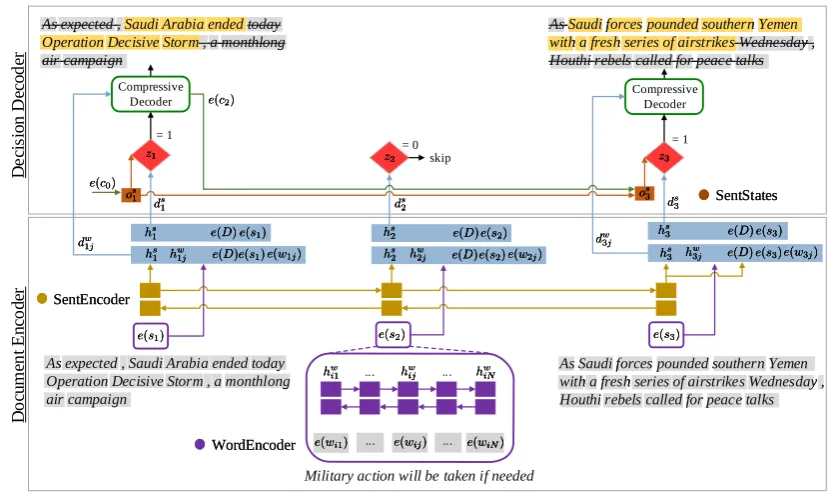
Figure 2: Illustration of our summarization system. The model extracts the most relevant sentences from the document by taking into account theWordEncoderrepresentation of the current sentencee(si), theSentEncoder
representation of the previous sentencehsi, the current summary state representationo s
i, and the representation of
the documente(D). If a sentence is selected (zi=1), its representation is fed toSentStates, and we move to the
next sentence. Here, sentencess1ands3were selected. If the model is also compressing, the compressive layer
selects words for the final summary (Compressive Decoder). See Figure3for details on the decoders.
of the positively labeled sentences. However, as we show later, this strategy is not the most ade-quate to ensure summary coherence, as it does not take the order of the selected sentences into ac-count. Our approach addresses this problem by maintaining an LSTM cell to dynamically model the generated summary. To the best of our knowl-edge, our work is the first to use a model that keeps a state of already generated summary to effectively model variable-length summaries in an extractive setting, and the first to learn a compressive sum-marizer with an end-to end approach.
3 Summarization with Summary State Representation
Our model extracts sentences from a given doc-ument and further compresses these sentences by deleting words. More formally, we denote a
docu-mentD =(s1, . . . , sM)as a sequence ofM
sen-tences, and a sentence si = (wi1, . . . , wiN) as a sequence ofNwords. We denote bye(wij),e(si) ande(D)the embedding of words, sentences and document in a continuous space. We model docu-ment summarization as a sequence labeling prob-lem where the labeler transitions between inter-nal states. Each state is dynamically computed
based on the context, and it combines an extrac-tive summarizer followed by a compressive one. First, we encode a document in a multi-level ap-proach, to extract the embeddings of words and sentences (“Document Encoder”). Second, we de-code these embeddings using a hierarchical “De-cision Decoder.” The extractive summarizer labels each sentencesi with a labelzi ∈ {0,1}where1 indicates that the sentence should be included in the final summary and 0 otherwise. An extrac-tive summary is then assembled by selecting all sentences with the label1. Analogously, the com-pressive summarizer labels each wordwij with a labelyij ∈{0,1}, denoting whether the wordjin sentenceiis included in the summary or not. The final summary is then assembled as the sequence of words wij for each zi = 1 andyij = 1. See Figures2and3for an overview of our model. We next describe each of its components in more de-tail.
3.1 Document Encoder
representa-SentStates Compressive decoder
Extractive decoder
[image:4.595.76.293.64.283.2]WordStates
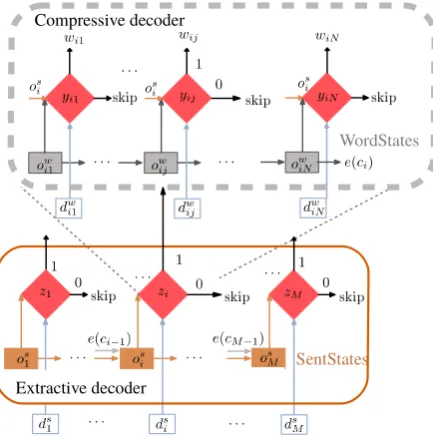
Figure 3: Decision decoder architecture. Decoder con-tains an extractive level for sentences (orange box) and a compressive level for words (dashed gray box), us-ing an LSTM to model the summary state. Red di-amond shapes represent decision variableszi = 1 if
p(zi ∣ pi) > 0.5 for selecting the sentence si, and
zi =0ifp(zi ∣ pi) ≤0.5for skipping this sentence.
The same foryij andp(yij ∣ qij)> 0.5for deciding
over wordswijto keep in the summary.
tion of each wordhwij. The hidden representation
consist of the concatenation of a forward→−hwijand a
backward←h−wij LSTM (WordEncoder in Figure2). This layer eventually outputs a representation for each sentence e(si) = [
−
→
hwiN, ←−
hwi1] that corre-sponds to the concatenation of the last forward and first backward LSTMs. The second layer encodes information about the document and is also a biL-STM that runs at the sentence-level. This biLbiL-STM takes as input the sentence representation from the previous layer e(si) and outputs the hidden rep-resentation for each sentence si in the document ashsi (SentEncoder in Figure2). We consider the output of the last forward LSTM over M sentences and first backward LSTM to be the final represen-tation of the documente(D)=[−
→
hsM, ←−
hs1]. The encoder returns two output vectors, dsi = [e(D),e(si),hsi] associated with each sentence si, and dwij = [e(D),e(si),e(wij),hsi,h
w ij] for each wordjat the specific state of the encoderi.
3.2 Decision Decoder
Given that our model operates both at the sentence-level and at the word-level, the decision decoder maintains two state LSTMs denoted by SentStates andWordStatesas in Figure3. For
the sentence-level decoder sentences are selected and the state of the summary gets updated by SentStates. For the word-level, all compressed word representations in a sentence are pushed to the word-level layer. In the compressive de-coder, words that get selected are pushed onto the WordStates, and once the decoder has reached the end of the sentence, it pushes the output rep-resentation of the last state onto the sentence-level layer for the next sentence.
Extractive Decoder The extractive decoder se-lects the sentences that should go to the summary. For each sentence si at time step i, the decoder takes a decision based on the encoder representa-tiondsi and the state of the summaryosi, computed as follows:
osi =SentStates({e(ck)}k<i,zk=1).
where theosi is modeled by an LSTM taking as in-put the already selected and compressed sentences comprising the summary so far {e(ck)}k<i,zk=1.
This way, at each point in time, we have a repre-sentation of the summary given by theSentStates LSTM that encodes the state of summary gener-ated so far, based on the past sentences already processed by the compressive decodere(ci−1)(in
WordStates).2 The summary representation at step i (osi) is then used to determine whether to keep or not the current sentence in the summary (zi = 1 or0 respectively). The summarizer state subsumes information about the document, sen-tence and summary as:
pi =tanh(WE[d s i;o
s i]+b
s ),
whereWEis a model parameter,osiis the dynamic LSTM state, andbsis a bias term.
This modeling decision is crucial in order to generate variable length summaries. It captures information about the sentences or words already present in the summary, helping in better under-standing the “true” length of the summary given the document.
Finally, the summarizer statepiis used to com-pute the probability of the action at timeias:
p(zi ∣pi)=
exp(Wzipi+xzi)
∑z′∈{0,1}exp(Wz′pi+xz′)
,
2
When using only the extractive model the summary state
osi is generated from an LSTM whose inputs correspond
whereWz is a model parameter and xz is a bias term for the summarizer actionz.
We minimize the negative log-likelihood of the observed labels at training time (Dimitroff et al.,
2013), whereλs0 andλs1 represent the distribution of each class for the given sentences:3
L(θs)=− ∑
c∈{0,1}
λsc
M ∑ i=1
1zi=c
∑ i,zi=0
logp(zi∣pi),
where 1zi=c is the indicator function of class c
andθsrepresents all the training parameters of the sentence encode/decoder. At test time, the model emits probabilityp(zi ∣ pi), which is used as the soft prediction sequentially extracting the sentence
i. We admit sentences whenp(zi =1∣pi)>0.5.
Compressive Decoder Our compressive de-coder shares its architecture with the extractive decoder. The compressive layer is triggered ev-ery time a sentence is selected in the summary and is responsible for selecting the words within each selected sentence. In practice, WordStates LSTM (see Figure3) is applied hierarchically af-ter the sentence-level decoder, using as input the collected word embeddings so far:
owij =WordStates({e(wik)}k≤j,yik=1).
After making the selection decision for all words pertaining to a sentence, the final state of the WordStates, e(ci) = owiN is fed back to
SentStatesof the extractive level decoder for the consecutive sentence, as depicted in Figure3.
The word-level summarizer state representa-tion depends on the encoding of words, document and sentence dwij, on the dynamic LSTM encod-ing for the summary based on the selected words (WordStates)owij and sentences (SentStates)o
s i:
qij =tanh(WC[d w ij;o
s i;o
w ij]+b
w) ,
whereWC is a model parameter andbw is a bias term. Each action at time stepjis computed by
p(yij ∣qij)=
exp(Wyijqij+xyij)
∑y′∈{0,1}exp(Wy′qij +xy′)
,
3
IfM−∑Mi=1zi=0or∑ M
i=1zi=0, we simply consider the
whole term to be zero. HereM represents the number of sentences in the document.
with parameterWyij and biasxyij. The final loss
for the compressive layer is
L(θw)=
M ∑ i=1
ziφ(i∣θ
w ),
whereθw represents the set of all the training pa-rameters of the word-level encoder/decoder, φ(i) is the compressive layer loss over N words:
φ(i∣θw)=− ∑
c∈{0,1}
λwc
M ∑ i=1
1yij=c
∑ i,zi=0
logp(yij∣qij).
The total final loss is then given by the sum of the extractive and compressive counterparts, L(θ) =
L(θs)+L(θw).
4 Experimental Setup
We mainly used the CNN/DailyMail corpus (Hermann et al., 2015) to evaluate our mod-els. We used the standard splits of Hermann et al. (2015) for training, validation, and test-ing (90,266/1,220/1,093 documents for CNN and 196,961/12,148/10,397 for DailyMail). To eval-uate the flexibility of our model, we also evalu-ated our models on the Newsroom dataset (Grusky et al.,2018), which includes articles form a diverse collection of sources (38 publishers) with different summary style subsets: extractive (Ext.), mixed (Mixed) and abstractive (Abs.). We used the stan-dard splits ofGrusky et al.(2018) for training, val-idation, and testing (331,778/36,332/36,122 docu-ments for Ext., 328,634/35,879/36,006 for Mixed and 332,554/36,380/36,522 for Abs.). We did not anonymize entities or lower case tokens.
4.1 Estimating Oracles
Datasets for training extractive summarization systems do not naturally contain sentence/word-level labels. Instead, they are typically accompa-nied by abstractive summaries from which extrac-tion labels are extrapolated. We create extractive and compressive summaries prior to training using two types oforacles.
We used anextractive oracleto identify the set of sentences which collectively gives the highest ROUGE (Lin and Hovy,2003) with respect to the gold summary (Narayan et al.,2018c).
Oracle R1 R2 RL Extractive Oracle 54.67 30.37 50.81 Compressive Oracle 57.12 32.59 53.27
Table 1: Oracle scores obtained for the CNN and Dai-lyMail testsets. We report ROUGE-1 (R1), ROUGE-2 (R2) and ROUGE-L (RL) F1 scores.
the Transition-Based Chunking Model (Lample et al., 2016), to annotate spans in every sentence that can be dropped in the final summary. We used the publicly released set of 10,000 sentence-compression pairs from the Google sentence com-pression dataset (Filippova and Altun, 2013; Fil-ippova et al.,2015) for training. After tagging all sentences in the CNN and DailyMail corpora us-ing this compression model, we generated oracle compressive summaries based on the best average of ROUGE-1 (R1) and ROUGE-2 (R2) F1 scores from the combination of all possible sentences and all removals of the marked compression chunks.
To verify the adequacy of our proposed ora-cles, we show in Table 1 a comparison of their scores. Our compressive oracle achieves much better scores than the extractive oracle, because of its capability to make summaries concise. More-over, the linguistic quality of these oracles was preserved due to the tagging of the entire span by the sentence compressor trained on the sentence compression dataset.4 We believe that our dataset with oracle compression labels will be of signifi-cant interest to the sentence compression and sum-marization community.
4.2 Training Parameters
The parameters for the loss at the sentence-level wereλs0=2andλ
s
1=1and at the word-level,λ w 0=1 andλw1=0.5. We used LSTMs withd=512for all hidden layers. We performed mini-batch negative log-likelihood training with a batch size of 2 docu-ments for 5 training epochs.We observed the con-vergence of the model between the 2nd and the 3rd epochs. It took around 12 hrs on a single GTX 1080 GPU to train. We evaluated our model on the validation set after every 5,000 batches. We trained with Adam (Kingma and Ba, 2015) with an initial learning rate of0.001. Our system was implemented using DyNet (Neubig et al.,2017).
4.3 Model Evaluation
We evaluated summarization quality using F1 ROUGE (Lin and Hovy,2003). We report results
4
We show examples of both oracles in Appendix §A.1.
in terms of unigram and bigram overlap (R1) and (R2) as a means of assessing informativeness, and the longest common subsequence (RL) as a means of assessing fluency.5 In addition to ROUGE, which can be misleading when used as the only means to assess summaries (Schluter, 2017), we also conducted a question-answering based human evaluation to assess the informativeness of our summaries in their ability to preserve key informa-tion from the document (Narayan et al.,2018c).6 First, questions are written using the gold sum-mary, we then examined how many questions par-ticipants were able to answer by reading system summaries alone, without access to the article.7 Figure5shows a set of candidate summaries along with questions used for this evaluation.
4.4 Model and Baselines
We evaluated our model EXCONSUMMin two set-tings: Extractive (selects sentences to assemble the summary) and Compressive (selects sentences and compresses them by removing unnecessary spans of words). We compared our models against a baseline (LEAD) that selects the first m lead-ing sentences from each document,8 three neural extractive models, and various abstractive models. For the extractive models, we used SUMMARU N-NER(Nallapati et al.,2017), since it shares some similarity to our model, REFRESH(Narayan et al.,
2018c) trained with reinforcement learning and LATENT(Zhang et al.,2018) a neural architecture that makes use of latent variable to avoid creat-ing oracle summaries. We further compare against LATENT+COMPRESS (Zhang et al.,2018), an ex-tension of the LATENTmodel that learns to map extracted sentences to final summaries using an attention-based seq2seq model (Rush et al.,2015). All models, unlike ours, extract a fixed number of sentences to assemble their summaries. For ab-stractive models, we compare against the state-of-the art models of POINTER+COVERAGE (See et al.,2017), ML+RL (Paulus et al., 2018), and
Tan et al.(2017) among others.
5
We usedpyrougeto compute the ROUGE scores. The parameters we used were “-a -c 95 -m -n 4 -w 1.2.”
6
We used the CNN/DailyMail QA test set of Narayan
et al.(2018c) for evaluation. It includes 20 documents with a
total of 71 manually written question-answer pairs.
7
See Appendix §A.2for more details.
8
Models CNN DailyMail Newsroom Ext. Newsroom Mixed Newsroom Abs.
R1 R2 RL R1 R2 RL R1 R2 RL R1 R2 RL R1 R2 RL
LEAD 29.1 11.1 25.9 40.7 18.3 37.2 53.1 49.0 52.4 — — — 13.7 2.4 11.2
REFRESH 30.0 11.7 26.9 41.0 18.8 37.7 — — — — — — — — — EXCONSUMMExtractive 32.5 12.6 28.5 42.8 19.3 38.9 69.4 64.3 68.3 31.9 16.3 26.9 17.2 3.1 13.6 EXCONSUMMCompressive 32.5 12.7 29.2 41.7 18.5 38.4 68.4 62.9 67.3 31.7 16.1 27.0 17.1 3.1 14.1
Pointer+Coverage⋄ — — — — — — 39.1 28.0 36.2 25.5 11.0 21.1 14.7 2.3 11.4
[image:7.595.70.526.64.153.2]Tan et al.(2017)∗ 30.3 9.8 20.0 — — — — — — — — — — — —
Table 2: Results on the CNN, DailyMail and Newsroom test sets. We report ROUGE R1, R2 and RL F1scores.
Extractive systems are in the first block, compressive in the second and abstractive in the third. We use — whenever results are not available. Models marked with∗ are not directly comparable to ours as they are based on an anonymized version of the dataset. The model marked with⋄show here the results for the best configuration of See et al.(2017), referred to as Pointer-N inGrusky et al.(2018), which is trained on the whole Newsroom dataset.
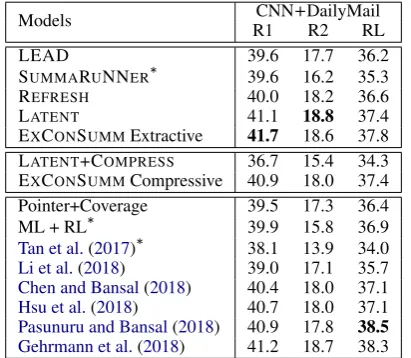
Models CNN+DailyMail
R1 R2 RL
LEAD 39.6 17.7 36.2
SUMMARUNNER∗ 39.6 16.2 35.3
REFRESH 40.0 18.2 36.6 LATENT 41.1 18.8 37.4 EXCONSUMMExtractive 41.7 18.6 37.8 LATENT+COMPRESS 36.7 15.4 34.3 EXCONSUMMCompressive 40.9 18.0 37.4
Pointer+Coverage 39.5 17.3 36.4
ML + RL∗ 39.9 15.8 36.9
Tan et al.(2017)∗ 38.1 13.9 34.0
Li et al.(2018) 39.0 17.1 35.7
Chen and Bansal(2018) 40.4 18.0 37.1
Hsu et al.(2018) 40.7 18.0 37.1
Pasunuru and Bansal(2018) 40.9 17.8 38.5
Gehrmann et al.(2018) 41.2 18.7 38.3
Table 3: Results for combined CNN/DailyMail test set.
5 Results
5.1 Automatic Evaluation
Table2and3show results for the evaluations on the CNN/DailyMail and Newsroom test sets.
Comparison with Extractive Systems. EX -CONSUMM Compressive performs best on the CNN dataset and EXCONSUMMExtractive on the DailyMail dataset, probably due to the fact that the CNN dataset is less biased towards extrac-tive methods than the DailyMail dataset (Narayan et al., 2018b). We report similar results on the Newsroom dataset. EXCONSUMM Compressive tends to perform better for mixed (Mixed) and ab-stractive (Abs.) subsets, while EXCONSUMM Ex-tractive performs better for the exEx-tractive (Ext.) subset. Our experiments demonstrate that our compressive model tends to perform better on the dataset which promotes abstractive summaries.
We find that EXCONSUMM Extractive consis-tently performs better on all metrics when com-pared to any of the other extractive models, except for the single case where it is narrowly behind LA
-TENTon R2 (18.6 vs 18.8) for the CNN/DailyMail combined test set. It even outperforms REFRESH, which is trained with reinforcement learning. We hypothesize that its superior performance stems from the ability to generate variable length sum-maries. REFRESHor LATENT, on the other hand, always produces a fixed length summary.
Comparison with Compressive System. EX -CONSUMM Compressive reports superior perfor-mance compared to LATENT+COMPRESS (+4.2 for R1, +2.6 for R2 and +3.1 for RL). Our re-sults demonstrate that our compressive system is more suitable for document summarization. It first selects sentences and then compresses them by removing irrelevant spans of words. It makes use of an advance oracle sentence pressor trained on a dedicated sentence com-pression dataset (Sec. 4.1). In contrast, LA -TENT+COMPRESS naively trains a sequence-to-sequence compressor to map a sentence in the doc-ument to a sentence in the summary.
Comparison with Abstractive Systems. Both EXCONSUMM Extractive and Compressive out-perform most of the abstractive systems including Pointer+Coverage (See et al., 2017). When com-paring with more recent methods (Pasunuru and Bansal, 2018;Gehrmann et al.,2018), our model has comparable performance.
Summary Versatility. We evaluate the ability of our model to generate variable length sum-maries. Table4 show the Pearson correlation co-efficient between the lengths of the human gen-erated summaries against each unbounded model. Our compressive approach obtains the best re-sults, with a Pearson correlation coefficient of 0.72 (p<0.001).
[image:7.595.78.284.241.420.2]Models
Bounded Unbounded
Human QA ROUGE Human QA ROUGE Pearson
score rank R1 R2 RL score rank R1 R2 RL r
LEAD 25.50 4rd 30.9 11.9 29.1 36.33 5th 31.6 13.5 29.3 0.40
REFRESH 20.88 6th 37.4 17.3 34.8 66.34 1st 43.8 25.8 41.6 0.60 LATENT 38.45 2nd 38.9 19.6 36.4 53.38 4th 40.7 22.0 38.1 -0.02
EXCONSUMMExtractive 36.34 3rd 38.4 18.5 35.9 54.93 3rd 40.8 21.0 38.2 0.68
EXCONSUMMCompressive 39.44 1ST 38.8 19.0 37.0 57.32 2nd 41.4 22.6 39.1 0.72
[image:8.595.75.521.61.163.2]Pointer+Coverage 24.51 5th 38.4 19.7 36.7 28.73 6th 40.2 21.4 38.0 0.30
Table 4: QA evaluations: limited length (Bounded) and full length (Unbounded) summaries. We also show ROUGE scores for the summaries being evaluated. We report the Pearson correlation coefficient between the human and predicted summary lengths
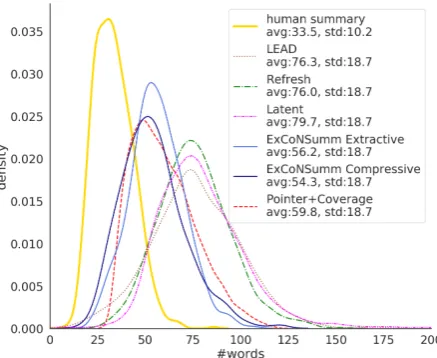
Figure 4: Word distribution in comparison with the hu-man summaries for CNN dataset. Density curves show the length distributions of human authored and system produced summaries.
per summary for the models where predictions were available. Interestingly, both EXCON -SUMMExtractive and Compressive follow the hu-man distribution much better than other extractive systems (LEAD, REFRESH and LATENT), since they are able to generate variable-length sum-maries depending on the input text. Our com-pressive model generates a word distribution much closer to the abstractive Pointer+Coverage model but achieves better compression ratio; the sum-maries generated by Pointer+Coverage contain 59.8 words, while those generated by EXCON -SUMMCompressive have 54.3 words on average.
5.2 QA Evaluation
Table 4shows results from our question answer-ing based human evaluation. We elicited human judgements in two settings: the “Unbounded”, where participants were shown the full system produced summaries; and the “Bounded”, where participants were shown summaries that were lim-ited to the same size as the gold summaries.
For the “Unbounded” setting, the output sum-maries produced by REFRESH were able to an-swer most of the questions correctly, our Com-pressive and Extractive systems were placed at the 2nd and 3rd places respectively.9
We observed that our systems were able to pro-duce more concise summaries than those propro-duced by REFRESH (avg. length in words: 76.0 for REFRESH, 56.2 for EXCONSUMMExtractive and 54.3 for EXCONSUMM Compressive; see Fig-ure 4). REFRESH is prone to generating ver-bose summaries, consequently it has an advan-tage of accumulating more information. In the “Bounded” setting, we aim to reduce this unfair advantage. Scores are overall lower since the sum-mary sizes are truncated to gold size. The EX -CONSUMMCompressive summaries rank first and can answer 39.44% of questions correctly. EX -CONSUMM Extractive retains its 3rd place an-swering 36.34% of questions correctly.10 These results demonstrate that our models generate con-cise and informative summaries that correlate well with the human summary lengths.11
5.3 Summary State Representation
Next, we performed an ablation study to investi-gate the importance of the summary state repre-sentationosi w.r.t. the quality of the overall
sum-9
We carried out pairwise comparisons between all mod-els to assess whether system differences are statistically sig-nificant. We found that there is no statistically signifi-cant difference between REFRESHand EXCONSUMM Com-pressive. We use a one-way ANOVA with posthoc Tukey HSD tests with p < 0.01. The differences among LA -TENTand both variants of EXCONSUMM, and betweenLEAD and Pointer+Coverage are also statistically insignificant. All other differences are statistically significant.
10
The differences among both variants of EXCON -SUMM and LATENT, and among LEAD, REFRESH and Pointer+Coverage are statistically insignificant. All other differences are statistically significant. We use a one-way ANOVA with posthoc Tukey HSD tests withp<0.01.
11
[image:8.595.73.292.223.402.2]LEAD
• (CNN) A top al Qaeda in the Arabian Peninsula leader–who a few years ago was in a U.S. detention facility–was among five killed in an airstrike in Yemen, the terror group said, showing the organization is vulnerable even as Yemen appears close to civil war.
• Ibrahim al-Rubaish died Monday night in whatAQAP’s me-dia wing, Al-Malahem Meme-dia, called a “crusader airstrike.” • The Al-Malahem Media obituary characterized al-Rubaish as a religious scholar and combat commander.
REFRESH
• (CNN) A top al Qaeda in the Arabian Peninsula leader–who a few years ago was in a U.S. detention facility–was among five killed in an airstrike in Yemen, the terror group said, showing the organization is vulnerable even as Yemen appears close to civil war.
• Ibrahim al-Rubaish died Monday night in whatAQAP’s me-dia wing, Al-Malahem Meme-dia, called a “crusader airstrike.” • Al-Rubaish was once held by the U.S. government at its de-tention facility inGuantanamo Bay, Cuba.
LATENT
• (CNN) A top al Qaeda in the Arabian Peninsula leader–who a few years ago was in a U.S. detention facility–was among five killed in an airstrike in Yemen, the terror group said, showing the organization is vulnerable even as Yemen appears close to civil war.
• Ibrahim al-Rubaish died Monday night in whatAQAP’s me-dia wing, Al-Malahem Meme-dia, called a “crusader airstrike.” The Al-Malahem Media obituary characterized al-Rubaish as a religious scholar and combat commander.
• A Yemeni Defense Ministry official and two Yemeni national security officials not authorized to speak on record confirmed that al-Rubaish had been killed, but could not specify how he died.
EXCONSUMMExtractive
• (CNN) A top al Qaeda in the Arabian Peninsula leader–who a few years ago was in a U.S. detention facility–was among five killed in an airstrike in Yemen, the terror group said, showing the organization is vulnerable even as Yemen appears close to civil war.
• Ibrahim al-Rubaish died Monday night in whatAQAP’s me-dia wing, Al-Malahem Meme-dia, called a “crusader airstrike.”
EXCONSUMMCompressive
• A top al Qaeda in the Arabian Peninsula leader–who a few years ago was in a U.S. detention facility–was among five killed in an airstrike in Yemen. • Ibrahim al-Rubaish died in what AQAP’s media wing, Al-Malahem Media, called a “crusader airstrike.”
Pointer+Coverage
• Ibrahim al-Rubaish was among a number of detainees who sued the administration of then-president George W. Bush to challenge the legality of their confinement in Gitmo. • al-Rubaish was once held by the U.S. government at its detention facility inGuantanamo bay, Cuba.
GOLD
• AQAPsays a “crusader airstrike” killed Ibrahim al-Rubaish • Al-Rubaish was once detained by the United States in Guan-tanamo
Question-Answer Pairs
• Who said that an airstrike killed Ibrahim al-Rubaish? (AQAP) • What was the airstrike called? (crusader airstrike) • Where was Ibrahim al-Rubaish once detained? (Guantanamo)
Figure 5: Example output summaries on the CNN/DailyMail dataset, gold standard summary, and corresponding questions. The questions are manually written using theGOLDsummary. The same EXCON-SUMMsummaries are shown in Figure1, but the strike-through spans are now removed.
mary. We tested against a STATE AVERAGING variant, where we replaceosi by a weighted aver-age, analogous toNallapati et al.(2017),oavg si = ∑j−1i=1 e(si)p(zi ∣p
avg
i ), wherep avg
i has the same
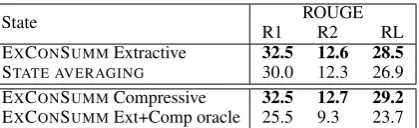
State ROUGE
R1 R2 RL
EXCONSUMMExtractive 32.5 12.6 28.5
STATE AVERAGING 30.0 12.3 26.9 EXCONSUMMCompressive 32.5 12.7 29.2
[image:9.595.313.523.61.125.2]EXCONSUMMExt+Comp oracle 25.5 9.3 23.7
Table 5: Summary state ablation for the CNN dataset.
form aspibut depends recursively on the previous summary state oavg si−1 . Table 5 shows that using an LSTM stateosi to model the current sentences in the summary is very important. The other ab-lation study shows how learning to extract and compress in a disjoint approach (EXCONSUMM Ext+Comp oracle) performs against a joint learn-ing approach (EXCONSUMM Compressive). We compared summaries generated from our best ex-tractive model and compressed them with a com-pressive oracle. Our joint learning model achieves the best performance in all metrics compared with the other ablations, suggesting that joint learning and using a summary state representation is bene-ficial for summarization.
6 Conclusions
We developed EXCONSUMM, a novel summariza-tion model to generate variable length extractive and compressive summaries. Experimental re-sults show that the ability of our model to learn a dynamic representation of the summary pro-duces summaries that are informative, concise, and correlate well with human generated summary lengths. Our model outperforms state-of-the-art extractive and most of abstractive systems on the CNN and DailyMail datasets, when evaluated au-tomatically, and through human evaluation for the bounded scenario. We further obtain state-of-the-art results on Newsroom, a more abstractive sum-mary dataset.
Acknowledgments
References
Miguel Almeida and Andre Martins. 2013. Fast and ro-bust compressive summarization with dual decom-position and multi-task learning. InProceedings of the 51st Annual Meeting of the Association for Com-putational Linguistics (Volume 1: Long Papers), volume 1, pages 196–206.
Taylor Berg-Kirkpatrick, Dan Gillick, and Dan Klein. 2011. Jointly learning to extract and compress. In
Proceedings of the 49th Annual Meeting of the Asso-ciation for Computational Linguistics: Human Lan-guage Technologies, pages 481–490, Portland, Ore-gon, USA. Association for Computational Linguis-tics.
Ciprian Chelba, Tomas Mikolov, Mike Schuster, Qi Ge, Thorsten Brants, and Phillipp Koehn. 2013. One bil-lion word benchmark for measuring progress in sta-tistical language modeling. CoRR, abs/1312.3005.
Yen-Chun Chen and Mohit Bansal. 2018. Fast abstrac-tive summarization with reinforce-selected sentence rewriting. InProceedings of the 56th Annual Meet-ing of the Association for Computational LMeet-inguistics (Volume 1: Long Papers), pages 675–686. Associa-tion for ComputaAssocia-tional Linguistics.
Jianpeng Cheng and Mirella Lapata. 2016. Neural summarization by extracting sentences and words. In Proceedings of the 54th Annual Meeting of the Association for Computational Linguistics (Volume 1: Long Papers), pages 484–494, Berlin, Germany. Association for Computational Linguistics.
James Clarke and Mirella Lapata. 2008. Global in-ference for sentence compression: An integer linear programming approach. Journal of Artificial Intelli-gence Research (JAIR), 31:399–429.
Georgi Dimitroff, Laura Tolosi, Borislav Popov, and Georgi Georgiev. 2013. Weighted maximum like-lihood loss as a convenient shortcut to optimizing the f-measure of maximum entropy classifiers. In
Proceedings of the International Conference Recent Advances in Natural Language Processing RANLP 2013, pages 207–214, Hissar, Bulgaria. INCOMA Ltd. Shoumen, BULGARIA.
Alexander Dlikman and Mark Last. 2016. Using machine learning methods and linguistic features in single-document extractive summarization. In
DMNLP@PKDD/ECML.
Bonnie Dorr, David Zajic, and Richard Schwartz. 2003. Hedge trimmer: A parse-and-trim approach to head-line generation. InProceedings of the HLT-NAACL 03 on Text Summarization Workshop - Volume 5, HLT-NAACL-DUC 2003, pages 1–8, Stroudsburg, PA, USA. Association for Computational Linguis-tics.
Greg Durrett, Taylor Berg-Kirkpatrick, and Dan Klein. 2016. Learning-based single-document summariza-tion with compression and anaphoricity constraints.
In Proceedings of the 54th Annual Meeting of the Association for Computational Linguistics, pages 1998–2008, Berlin, Germany.
Angela Fan, David Grangier, and Michael Auli. 2018. Controllable abstractive summarization. In Pro-ceedings of the 2nd Workshop on Neural Machine Translation and Generation, pages 45–54, Mel-bourne, Australia.
Katja Filippova, Enrique Alfonseca, Carlos A. Col-menares, Lukasz Kaiser, and Oriol Vinyals. 2015. Sentence compression by deletion with lstms. In
Proceedings of the 2015 Conference on Empirical Methods in Natural Language Processing, pages 360–368. Association for Computational Linguis-tics.
Katja Filippova and Yasemin Altun. 2013. Overcom-ing the lack of parallel data in sentence compression. In Proceedings of the 2013 Conference on Empiri-cal Methods in Natural Language Processing, pages 1481–1491, Seattle, Washington, USA. Association for Computational Linguistics.
Sebastian Gehrmann, Yuntian Deng, and Alexander Rush. 2018. Bottom-up abstractive summarization. In Proceedings of the 2018 Conference on Empiri-cal Methods in Natural Language Processing, pages 4098–4109, Brussels, Belgium.
Max Grusky, Mor Naaman, and Yoav Artzi. 2018. Newsroom: A dataset of 1.3 million summaries with diverse extractive strategies. InProceedings of the 2018 Conference of the North American Chapter of the Association for Computational Linguistics: Hu-man Language Technologies, Volume 1 (Long Pa-pers), pages 708–719. Association for Computa-tional Linguistics.
Karl Moritz Hermann, Tomas Kocisky, Edward Grefenstette, Lasse Espeholt, Will Kay, Mustafa Su-leyman, and Phil Blunsom. 2015. Teaching ma-chines to read and comprehend. In C. Cortes, N. D. Lawrence, D. D. Lee, M. Sugiyama, and R. Garnett, editors,Advances in Neural Information Processing Systems 28, pages 1693–1701. Curran Associates, Inc.
Sepp Hochreiter and J¨urgen Schmidhuber. 1997. Long short-term memory. Neural computation, 9(8):1735–1780.
Wan Ting Hsu, Chieh-Kai Lin, Ming-Ying Lee, Kerui Min, Jing Tang, and Min Sun. 2018. A unified model for extractive and abstractive summarization using inconsistency loss. CoRR, abs/1805.06266.
Diederick P Kingma and Jimmy Ba. 2015. Adam: A method for stochastic optimization. InInternational Conference on Learning Representations (ICLR).
American Chapter of the Association for Computa-tional Linguistics: Human Language Technologies, pages 260–270. Association for Computational Lin-guistics.
Chenliang Li, Weiran Xu, Si Li, and Sheng Gao. 2018. Guiding generation for abstractive text summariza-tion based on key informasummariza-tion guide network. In
Proceedings of the 2018 Conference of the North American Chapter of the Association for Computa-tional Linguistics: Human Language Technologies, Volume 2 (Short Papers), volume 2, pages 55–60.
Chin-Yew Lin and Eduard Hovy. 2003. Auto-matic evaluation of summaries using n-gram co-occurrence statistics. In Proceedings of the 2003 Human Language Technology Conference of the North American Chapter of the Association for Computational Linguistics.
Andre F. T. Martins and Noah A. Smith. 2009. Sum-marization with a joint model for sentence extraction and compression. InNorth American Chapter of the Association for Computational Linguistics: Work-shop on Integer Linear Programming for NLP.
Ryan McDonald. 2006. Discriminative sentence com-pression with soft syntactic evidence. In11th Con-ference of the European Chapter of the Association for Computational Linguistics, pages 297–304.
Tomas Mikolov, Ilya Sutskever, Kai Chen, Greg S Cor-rado, and Jeff Dean. 2013. Distributed representa-tions of words and phrases and their composition-ality. In C. J. C. Burges, L. Bottou, M. Welling, Z. Ghahramani, and K. Q. Weinberger, editors, Ad-vances in Neural Information Processing Systems 26, pages 3111–3119. Curran Associates, Inc.
Ramesh Nallapati, Feifei Zhai, and Bowen Zhou. 2017. SummaRuNNer: a recurrent neural network based sequence model for extractive summarization of documents. In Proceedings of the Thirty-First AAAI Conference on Artificial Intelligence (AAAI-17), pages 3075–3081.
Ramesh Nallapati, Bowen Zhou, and Mingbo Ma. 2016a. Classify or select: Neural architectures for extractive document summarization. CoRR, abs/1611.04244.
Ramesh Nallapati, Bowen Zhou, Cicero dos San-tos, Caglar Gulcehre, and Bing Xiang. 2016b. Abstractive text summarization using sequence-to-sequence rnns and beyond. In Proceedings of The 20th SIGNLL Conference on Computational Natural Language Learning, pages 280–290, Berlin, Ger-many. Association for Computational Linguistics.
Shashi Narayan, Ronald Cardenas, Nikos Papasaran-topoulos, Shay B. Cohen, Mirella Lapata, Jiang-sheng Yu, and Yi Chang. 2018a. Document mod-eling with external attention for sentence extraction. In Proceedings of the 56st Annual Meeting of the Association for Computational Linguistics, pages 2020–2030, Melbourne, Australia.
Shashi Narayan, Shay B. Cohen, and Mirella Lapata. 2018b. Don’t give me the details, just the summary! Topic-aware convolutional neural networks for ex-treme summarization. In Proceedings of the 2018 Conference on Empirical Methods in Natural Lan-guage Processing, pages 1797–1807, Brussels, Bel-gium.
Shashi Narayan, Shay B. Cohen, and Mirella Lapata. 2018c. Ranking sentences for extractive summa-rization with reinforcement learning. In Proceed-ings of the 2018 Conference of the North Ameri-can Chapter of the Association for Computational Linguistics: Human Language Technologies, pages 1747–1759, New Orleans, Louisiana.
Graham Neubig, Chris Dyer, Yoav Goldberg, Austin Matthews, Waleed Ammar, Antonios Anastasopou-los, Miguel Ballesteros, David Chiang, Daniel Clothiaux, Trevor Cohn, Kevin Duh, Manaal Faruqui, Cynthia Gan, Dan Garrette, Yangfeng Ji, Lingpeng Kong, Adhiguna Kuncoro, Gaurav Ku-mar, Chaitanya Malaviya, Paul Michel, Yusuke Oda, Matthew Richardson, Naomi Saphra, Swabha Swayamdipta, and Pengcheng Yin. 2017. Dynet: The dynamic neural network toolkit. arXiv preprint arXiv:1701.03980.
Ramakanth Pasunuru and Mohit Bansal. 2018. Multi-reward reinforced summarization with saliency and entailment. InProceedings of the 2018 Conference of the North American Chapter of the Association for Computational Linguistics: Human Language Technologies, Volume 2 (Short Papers), pages 646– 653. Association for Computational Linguistics.
Romain Paulus, Caiming Xiong, and Richard Socher. 2018. A deep reinforced model for abstractive sum-marization. InInternational Conference on Learn-ing Representations.
Alexander M. Rush, Sumit Chopra, and Jason Weston. 2015. A neural attention model for abstractive sen-tence summarization. In Proceedings of the 2015 Conference on Empirical Methods in Natural Lan-guage Processing, pages 379–389, Lisbon, Portugal. Association for Computational Linguistics.
Natalie Schluter. 2017. The limits of automatic sum-marisation according to rouge. InProceedings of the 15th Conference of the European Chapter of the As-sociation for Computational Linguistics: Short Pa-pers, pages 41–45, Valencia, Spain.
Abigail See, Peter J. Liu, and Christopher D. Manning. 2017. Get to the point: Summarization with pointer-generator networks. InProceedings of the 55th An-nual Meeting of the Association for Computational Linguistics (Volume 1: Long Papers), pages 1073– 1083, Vancouver, Canada. Association for Compu-tational Linguistics.
Ilya Sutskever, Oriol Vinyals, and Quoc V. Le. 2014. Sequence to sequence learning with neural net-works. InNIPS, page 9.
Jiwei Tan, Xiaojun Wan, and Jianguo Xiao. 2017. Abstractive document summarization with a graph-based attentional neural model. InProceedings of the 55th Annual Meeting of the Association for Com-putational Linguistics (Volume 1: Long Papers), pages 1171–1181, Vancouver, Canada. Association for Computational Linguistics.