Proceedings of NAACL-HLT 2019, pages 3845–3856 3845
Low-Resource Syntactic Transfer with Unsupervised Source Reordering
Mohammad Sadegh Rasooli Facebook AI
Menlo Park, CA, USA [email protected]
Michael Collins
Department of Computer Science Columbia University
Abstract
We describe a cross-lingual transfer method for dependency parsing that takes into account the problem of word order differences between source and target languages. Our model only relies on the Bible, a considerably smaller par-allel data than the commonly used parpar-allel data in transfer methods. We use the concate-nation of projected trees from the Bible cor-pus, and the gold-standard treebanks in multi-ple source languages along with cross-lingual word representations. We demonstrate that re-ordering the source treebanks before training on them for a target language improves the ac-curacy of languages outside the European lan-guage family. Our experiments on 68 tree-banks (38 languages) in the Universal Depen-dencies corpus achieve a high accuracy for all languages. Among them, our experiments on 16 treebanks of 12 non-European languages achieve an average UAS absolute improve-ment of3.3%over a state-of-the-art method.
1 Introduction
There has recently been a great deal of interest in cross-lingual transfer of dependency parsers, for which a parser is trained for a target language of interest using treebanks in other languages. Cross-lingual transfer can eliminate the need for the ex-pensive and time-consuming task of treebank an-notation for low-resource languages. Approaches include annotation projection using parallel data sets (Hwa et al.,2005;Ganchev et al.,2009), direct model transfer through learning of a delexicalized model from other treebanks (Zeman and Resnik,
2008; T¨ackstr¨om et al., 2013), treebank transla-tion (Tiedemann et al.,2014), using synthetic tree-banks (Tiedemann and Agi´c,2016;Wang and Eis-ner, 2016), using cross-lingual word representa-tions (T¨ackstr¨om et al., 2012; Guo et al., 2016;
Rasooli and Collins,2017) and using cross-lingual dictionaries (Durrett et al.,2012).
Recent results fromRasooli and Collins(2017) have shown accuracies exceeding 80% on unla-beled attachment accuracy (UAS) for several Eu-ropean languages.1 However non-European lan-guages remain a significant challenge for cross-lingual transfer. One hypothesis, which we inves-tigate in this paper, is that word-order differences between languages are a significant challenge for cross-lingual transfer methods. The main goal of our work is therefore to reorder gold-standard source treebanks to make those treebanks syntac-tically more similar to the target language of in-terest. We use two different approaches for source treebank reordering: 1) reordering based on dom-inant dependency directions according to the pro-jected dependencies, 2) learning a classifier on the alignment data. We show that an ensemble of these methods with the baseline method leads to higher performance for the majority of datasets in our experiments. We show particularly significant improvements for non-European languages.2
The main contributions of this work are as fol-lows:
• We propose two different syntactic reorder-ing methods based on the dependencies pro-jected using translation alignments. The first model is based on the dominant dependency direction in the target language according to the projected dependencies. The second model learns a reordering classifier from the small set of aligned sentences in the Bible parallel data.
1Specifically, Table 9 ofRasooli and Collins(2017) shows
13 datasets, and 11 languages, with UAS scores of over 80%; all of these datasets are in European languages.
2
• We run an extensive set of experiments on 68 treebanks for 38 languages. We show that by just using the Bible data, we are able to achieve significant improvements in non-European languages. Our ensemble method is able to maintain a high accuracy in Euro-pean languages.
• We show that syntactic transfer methods can outperform a supervised model for cases in which the gold-standard treebank is very small. This indicates the strength of these models when the language is truly low-resource.
Unlike most previous work for which a sim-ple delexicalized model with gold part-of-speech tags are used, we use lexical features and auto-matic part-of-speech tags. Our final model im-proves over two strong baselines, one with anno-tation projection and the other one inspired by the non-neural state-of-the-art model of Rasooli and Collins(2017). Our final results improve the per-formance on non-European languages by an aver-age UAS absolute improvement of3.3%and LAS absolute improvement of2.4%.
2 Related Work
There has recently been a great deal of research on dependency parser transfer. Early work on direct model transfer (Zeman and Resnik, 2008;
McDonald et al.,2011;Cohen et al., 2011;Rosa and Zabokrtsky, 2015;Wang and Eisner, 2018a) considered learning a delexicalized parser from one or many source treebanks. A number of pa-pers (Naseem et al.,2012;T¨ackstr¨om et al.,2013;
Zhang and Barzilay, 2015; Ammar et al., 2016;
Wang and Eisner, 2017) have considered mak-ing use of topological features to overcome the problem of syntactic differences across languages. Our work instead reorders the source treebanks to make them similar to the target language before training on the source treebanks.
Agi´c(2017) use part-of-speech sequence simi-larity between the source and target language for selecting the source sentences in a direct trans-fer approach. Ponti et al. (2018) preprocess source trees to increase the isomorphy between the source and the target language dependency trees. They apply their method on a simple delexicalized model and their accuracy on the small set of lan-guages that they have tried is significantly worse
than ours in all languages. The recent work by
Wang and Eisner (2018b) reorders delexicalized treebanks of part-of-speech sequences in order to make it more similar to the target language of in-terest. The latter work is similar to our work in terms of using reordering. Our work is more so-phisticated by using a full-fledged parsing model with automatic part-of-speech tags and every ac-cessible dataset such as projected trees and multi-ple source treebanks as well as cross-lingual word embeddings for all languages.
Previous work (T¨ackstr¨om et al.,2012;Duong et al.,2015;Guo et al.,2015,2016;Ammar et al.,
2016) has considered using cross-lingual word representations. A number of authors (Durrett et al.,2012;Rasooli and Collins,2017) have used cross-lingual dictionaries. We also make use of cross-lingual word representations and dictionar-ies in this paper. We use the automatically ex-tracted dictionaries from the Bible to translate words in the source treebanks to the target lan-guage. One other line of research in the delex-icalized transfer approach is creating a synthetic treebank (Tiedemann and Agi´c,2016;Wang and Eisner,2016,2018b).
Annotation projection (Hwa et al., 2005;
Ganchev et al.,2009;McDonald et al.,2011;Ma and Xia,2014;Rasooli and Collins,2015;Lacroix et al.,2016;Agi´c et al.,2016) is another approach in parser transfer. In this approach, supervised de-pendencies are projected through word alignments and then used as training data. Similar to previ-ous work (Rasooli and Collins, 2017), we make use of a combination of projected dependencies from annotation projection in addition to partially translated source treebanks. One other approach is treebank translation (Tiedemann et al., 2014) for which a statistical machine translation system is used to translate source treebanks to the target lan-guage. These models need a large amount of par-allel data for having an accurate translation sys-tem.
Using the Bible data goes back to the work of
translation model. Previous work in the context of machine translation (Bisazza and Federico,2016;
Daiber et al., 2016) presumes the availability of a parallel data that is often much larger than the Bible data.
3 Baseline Model
Our model trains on the concatenation of projected dependencies P and all of the source treebanks T1. . .Tk. The projected data is from the set of
projected dependencies for which at least 80%
of words have projected dependencies or there is a span of length l ≥ 5 such that all words in that span achieve a projected dependency. This is the same as the definition of dense structures P80∪ P≥5byRasooli and Collins(2015).
We use our reimplementation of the state-of-the-art neural biaffine graph-based parser ofDozat and Manning (2016)3. Because many words in the projected dependencies do not have a head as-signment, the parser ignores words without heads during training. Inspired by Rasooli and Collins
(2017), we replace every word in the source tree-banks with its most frequent aligned translation word from the Bible data in the target language. If that word does not appear in the Bible, we use the original word. That way, we have a code-switched data for which some of the words are being trans-lated. In addition to fine-tuning the word embed-dings, we use the fixed pre-trained cross-lingual word embeddings using the training approach of
Rasooli and Collins (2017) using the Wikipedia data and the Bible dictionaries.
4 Approach
Before making use of the source treebanks T1. . .Tk in the training data, we reorder each
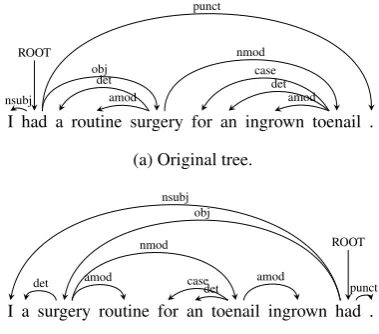
tree in the source treebanks to be syntactically more similar to the word order of the target lan-guage. In general, for a headh that has c modi-fiers m1. . . mc, we decide to put each of the de-pendentsmion the left or right of the headh. Af-ter placing them in the correct side of the head, the order in the original source sentence is preserved. Figure1shows a real example of an English tree that is reordered for the sake of Persian as the tar-get language. Here we see that we have a verb-final sentence, with nominal modifiers following
3https://github.com/rasoolims/ universal-parser
I had a routine surgery for an ingrown toenail .
nsubj ROOT
det amod
obj case
det amod nmod punct
(a) Original tree.
I a surgery routine for an toenail ingrown had .
nsubj
ROOT
det amod
obj
case det
amod nmod
punct
[image:3.595.324.514.72.239.2](b) Persian-specific reordered tree.
Figure 1: An example of a gold-standard English tree that is reordered to look similar to the Persian syntactic order.
the head noun. If one aims to translate this En-glish sentence word by word, the reordered sen-tence gives a very good translation without any change in the sentence.
As mentioned earlier, we use two different ap-proaches for source treebank reordering: 1) re-ordering based on dominant dependency direc-tions according to the projected dependencies, 2) learning a classifier on the alignment data. We next describe these two methods.
4.1 Model 1: Reordering Based on Dominant Dependency Direction
The main goal of this model is to reorder source dependencies based on dominant dependency di-rections in the target language. We extract domi-nant dependency directions according to the pro-jected dependencies P from the alignment data, and use the information for reordering source tree-banks.
Let the tuple hi, m, h, rishow the dependency of them’th word in thei’th projected sentence for which theh’th word is the parent with the depen-dency label r. hi, m,NULL,NULLi shows an un-known dependency for them’th word: this occurs when some of the words in the target sentence do not achieve a projected dependency. We use the notationsh(i, m)andr(i, m)to show the head in-dex and dependency label of them’th word in the
i’th sentence.
Definition 1 Dependency direction: d(i, m)
modifier word in thei’th sentence:
d(i, m) =
(
1 if h(i, m)> m −1 otherwise
Definition 2 Dependency direction proportion: Dependency direction proportion of each
depen-dency labellwith directiond∈ {−1,1}is defined
as:
α(P)(l, d) =
P|P| i=1
P|P(i)|
m=1 I(r(i, m) =l&d(i, m) =d)
P|P| i=1
P|P(i)|
m=1 I(r(i, m) =l)
Definition 3 Dominant dependency direction:
For each dependency label l, we define the
dominant dependency direction λ(P)(l) = d if
α(P)(l, d) > 0.75. In cases where there is no
dominant dependency direction,λ(P)(l) = 0.
We consider the following dependency labels for extracting dominant dependency direction in-formation: nsubj, obj, iobj, csubj, ccomp, xcomp, obl, vocative, expl, dislocated, advcl, advmod, aux, cop, nmod, appos, nummod, acl, amod. We find the direction of other dependency relations, such as most of the function word dependencies and other non-core dependencies such as conjunc-tion, not following a fixed pattern in the Universal Dependencies corpus.
Reordering condition Given a set of projec-tionsP, we calculate the dominant dependency di-rection information for the projectionsλ(P). Sim-ilar to the projected dependencies, we extract
su-pervised dominant dependency directions from
the gold-standard source treebankD:λ(D). When we encounter a gold-standard dependency relation hi, m, h, riin a source treebankD, we change the direction if the following condition holds:
λ(D)(r)6=λ(P)(r) and λ(P)(r) =−d(i, m)
In other words, if the source and target lan-guages do not have the same dominant depen-dency direction for r and the dominant direction of the target language is the reverse of the cur-rent direction, we change the direction of that de-pendency. Reordering multiple dependencies in a gold standard tree then results in a reordering of the full tree, as for example in the transformation from Figure1ato Figure1b.
4.2 Model 2: Reordering Classifier
We now describe our approach for learning a reordering classifier for a target language using the alignment data. Unlike the first model for which we learn concrete rules, this model learns a reordering classifier from automatically aligned data. This model has two steps; the first step prepares the training data from the automatically aligned parallel data, and the second step learns a classifier from the training data.
4.2.1 Preparing Training Data from Alignments
The goal of this step is to create training data for the reordering classifier. This data is extracted from the concatenation of parallel data from all source languages translated to the target language. Given a parallel dataset(e(i), f(i))fori= 1. . . n
that contains pairs of source and target sentences
e(i)andf(i), the following steps are applied to cre-ate training data:
1. Extracting reordering mappings from alignments:We first extract intersected word alignments for each source-target sentence pair. This is done by running the Giza++ alignments (Och and Ney,2003) in both di-rections. We ignore sentence pairs that more than half of the source words do not get align-ment. We create a new mapping µ(i) = µ(1i). . . µs(ii)that maps each index1≤j ≤si
in the original source sentence to a unique in-dex1≤µ(ji)≤si in the reordered sentence.
2. Parsing source sentences: We parse each source sentence using the supervised parser of the source language. We use the mapping
µ(i)to come up with a reordered tree for each sentence. In cases for which the number of non-projective arcs in the projected tree in-crease compared to the original tree, we do not use the sentence in the final training data.
3. Extracting classifier instances: We create a training instance for every modifier word hi, m, h, ri. The decision about the direction of each dependency can be made based on the following condition:
d∗(i, m) =
(
The LORD is a man of war : the LORD is his name .
← ← → ← → ← → → ← → → ← → →
Y Kð@Y g XQÓ úÆ Jk. I@ ÐA K ð@ èñîE I@ .
God man war is name his Jehovah is .
det nsubj
cop det
root
case nmod
punct
det
nsubj
cop nmod parataxis
[image:5.595.310.533.63.259.2]punct
Figure 2: A reordering example from the Bible for English-Persian language pair. The Persian words are written from left to right for the ease of presentation. The arrows below the English words show the new de-pendency direction with respect to the word alignments to the Persian side. The reordered sentence would be “The LORD a man of war is : his name the LORD is .”.
In other words, we decide about the new or-der of a dependency according to the map-pingµ(i).
Figure2shows an example for the data prepa-ration step. As shown in the figure, the new direc-tions for the English words are decided according to the Persian alignments.
4.2.2 Classifier
The reordering classifier decides about the new direction of each dependency according to the recurrent representation of the head and depen-dent words. For a source sentence e(i) = e(1i). . . e(sii) that belongs to a source language
L, we first obtain its recurrent representation
η(i) = η1(i). . . ηs(ii) by running a deep (3 layers)
bi-directional LSTM (Hochreiter and Schmidhu-ber, 1997), where η(ji) ∈ Rdh. For every
de-pendency tuple hi, m, h, ri, we use a multi-layer Perceptron (MLP) to decide about the new order
dir∈ {−1,1}of them’th word with respect to its headh:
p(dir|i, m, h, r) =softmaxdir(W φ(i, m, h, r))
whereW ∈ R2×dφ andφ(i, m, h, r) ∈ Rdφ is as
follows:
φ(i, m, h, r) =relu(Hq(i, m, h, r) +B)
where relu is the rectified linear unit activa-tion (Nair and Hinton,2010),H ∈ Rdφ×dq,B ∈ Rdφ, andq(i, m, h, r)∈Rdq is as follows:
q(i, m, h, r) = [ηm(i);ηh(i);R[r]; Λ[I(h > m)];L[L]]
I had a routine surgery for an ingrown nail .
η1 η2 η3 η4 η5 η6 η7 η8 η9 η10
L[en]
λ[−1] R[obj]
concat
H ×
+ B W
relu
dir= 1 arg max
obj
λ(Den)
(obj) =−1 λ(Pf a)
(obj) = 1
[image:5.595.80.292.76.169.2]dir= 1
Figure 3: Two different approaches for reordering the dependency order for the example in Figure1. The re-ordering classifier is shown on top, for the dependency relation between the words “had” and “surgery” with an “obj” relation. At the bottom, the reordering model based on dominant dependency direction information is shown.
where ηm(i) and η(hi) are the recurrent represen-tations for the modifier and head words respec-tively, R is the dependency relation embedding dictionary that embeds every dependency relation to a Rdr vector, Λ is the direction embedding
for the original position of the head with respect to its head and embeds each direction to a 2-dimensional vector, andLis the language embed-ding dictionary that embeds the source language idLto aRdLvector.
The input to the recurrent layer is the concate-nation of two input vectors. The first vector is the sum of the fixed pre-trained cross-lingual em-beddings, and randomly initialized word vector. The second vector is the part-of-speech tag em-beddings.
Figure3shows a graphical depiction of the two reordering models that we use in this work.
5 Experiments
(hu), Indonesian (id), Italian (it), Japanese (ja), Korean (ko), Latin (la), Lithuanian (lt), Latvian (lv), Dutch (nl), Norwegian (no), Polish (pl), Por-tuguese (pt), Romanian (ro), Russian (ru), Slo-vak (sk), Slovene (sl), Swedish (sv), Turkish (tr), Ukrainian (uk), Vietnamese (vi), and Chinese (zh). We use the Bible data from Christodouloupou-los and Steedman (2014) for the 38 languages. We extract word alignments using Giza++ de-fault model (Och and Ney, 2003). Follow-ing Rasooli and Collins (2015), we obtain in-tersected alignments and apply soft POS consis-tency to filter potentially incorrect alignments. We use the Wikipedia dump data to extract mono-lingual data for the languages in order to train monolingual embeddings. We follow the method of Rasooli and Collins (2017) to use the ex-tracted dictionaries from the Bible and monolin-gual text from Wikipedia to create cross-linmonolin-gual word embeddings. We use the UDPipe pretrained models (Straka and Strakov´a, 2017) to tokenize Wikipedia, and a reimplementation of the Per-ceptron tagger of Collins (2002)4 to achieve au-tomatic POS tags trained on the training data of the Universal Dependencies corpus (Nivre et al.,
2017). We use word2vec (Mikolov et al., 2013)5 to achieve embedding vectors both in monolingual and cross-lingual settings.
Supervised Parsing Models We trained our su-pervised models on the union of all datasets in a language to obtain a supervised model for each language. It is worth noting that there are two major changes that we make to the neural parser of Dozat and Manning (2016) in our implemen-tation6 using the Dynet library (Neubig et al.,
2017): first, we add a one-layer character BiL-STM to represent the character information for each word. The final character representation is obtained by concatenating the forward representa-tion of the last character and the backward repre-sentation of the first character. The concatenated vector is summed with the randomly initialized as well as fixed pre-trained cross-lingual word em-bedding vectors. Second, inspired byWeiss et al.
(2015), we maintain the moving average parame-ters to obtain more robust parameparame-ters at decoding time.
4
https://github.com/rasoolims/ SemiSupervisedPosTagger
5
https://github.com/dav/word2vec 6https://github.com/rasoolims/ universal-parser
We excluded the following languages from the set of source languages forannotation projection due to their low supervised accuracy: Estonian, Hungarian, Korean, Latin, Lithuanian, Latvian, Turkish, Ukrainian, Vietnamese, and Chinese.
Baseline Transfer Models We use two baseline models: 1) Annotation projection: This model only trains on the projected dependencies. 2) An-notation projection + direct transfer: To speed up training, we sample at most thousand sentences from each treebank, comprising a training data of about 37K sentences.
5.1 Reordering Ensemble Model
We noticed that our reordering models perform better in non-European languages, and perform slightly worse in European languages. We use the following ensemble model to make use of all of the three models (annotation projection + direct trans-fer, and the two reordering models), to make sure that we always obtain an accurate parser.
The ensemble model is as follows: given three output trees for thei’th sentencehij, m, hj, rjifor j = 1,2,3 in the target language L, where the first tuple (j = 1) belongs to the baseline model, the second (j = 2) and third (j = 3) belong to the two reordering models, we weight each depen-dency edge with respect to the following condi-tions:
ω(m, h, r) =z(m, h, r)·
3
X
j=1
c(j,L)·I(hij, m, h, ri)
where c(j,L) is a coefficient that puts more weight on the first or the other two outputs depend-ing on the target language family:
c(j,L) =
2 if j = 1 &Lis European
2 if j >1 &
Lis not European
1 otherwise
andz(m, h, r)is a simple weighting depending on the dominant order information:
z(m, h, r) =
Variable Notation Size
Word embedding dw 100
POS embedding dp 100
Bi-LSTM dh 400
Dep. relation embedding dr 50 Language ID embedding dL 50
Hidden layer dφ 200
[image:7.595.78.287.63.191.2]Number of BiLSTM layers – 3 Mini-batch size (tokens) – ∼1000
Table 1: Parameter values in the reordering classifier model.
The above coefficients are modestly tuned on the Persian language as our development lan-guage. We have not seen any significant change in modifying the numbers: instead, the fact that an arc with a dominant dependency direction is re-garded as a more valuable arc, and the baseline should have more effect in the European languages suffices for the ensemble model.
We run the Eisner first-order graph-based algo-rithm (Eisner,1996) on top of the edge weightsω
to extract the best possible tree.
5.2 Parameters
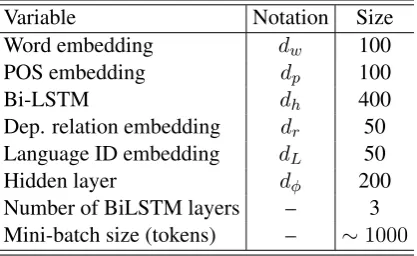
We run all of the transfer models with 4000 mini-batches, in which each mini-batch contains ap-proximately 5000 tokens. We follow the same pa-rameters as inDozat and Manning(2016) and use a dimension of 100 for character embeddings. For the reordering classifier, we use the Adam algo-rithm (Kingma and Ba,2014) with default param-eters to optimize the log-likelihood objective. We filter the alignment data to keep only those sen-tences for which at least half of the source words have an alignment. We randomly choose 1% of the reordering data as our heldout data for decid-ing when to stop traindecid-ing the reorderdecid-ing models. Table1shows the parameter values that we use in the reordering classifier.
5.3 Results
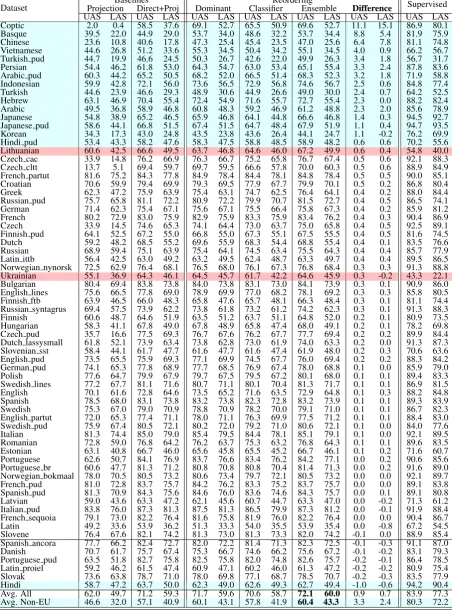
Table2shows the results on the Universal Depen-dencies corpus (Nivre et al.,2017). As shown in the table, the algorithm based on dominant depen-dency directions improves the accuracy on most of the non-European languages and performs slightly worse than the baseline model in the European languages. The ensemble model, in spite of its simplicity, improves over the baseline in most of
the languages, leading to an average UAS im-provement of 0.9 for all languages and 3.3 for non-European languages. This improvement is very significant in many of the non-European lan-guages; for example, from an LAS of37.6to52.7
in Coptic, from a UAS of44.9to53.7in Basque, from a UAS of 40.6 to 47.0 in Chinese. Our model also outperforms the supervised models in Ukrainian and Latvian. That is an interesting in-dicator that for cases that the training data is very small for a language (37 sentences for Ukrainian, and 153 sentences for Latvian), our transfer ap-proach outperforms the supervised model.
6 Analysis
In this section, we briefly describe our analysis based on the results in the ensemble model and the baseline. For some languages such as Coptic, the number of dense projected dependencies is too small (two trees) such that the parser gives a worse learned model than a random baseline. For some other languages, such as Norwegian and Spanish, this number is too high (more than twenty thou-sand trees), such that the baseline model performs very well.
The dominant dependency direction model gen-erally performs better than the classifier. Our manual investigation shows that the classifier kept many of the dependency directions unchanged, while the dominant dependency direction model changed more directions. Therefore, the dominant direction model gives a higher recall with the ex-pense of losing some precision. The training data for the reordering classifier is very noisy due to wrong alignments. We believe that the dominant direction model, besides its simplicity, is a more robust classifier for reordering, though the classi-fier is helpful in an ensemble setting.
Dataset ProjectionBaselinesDirect+Proj Dominant ClassifierReorderingEnsemble Difference Supervised
UAS LAS UAS LAS UAS LAS UAS LAS UAS LAS UAS LAS UAS LAS
Coptic 2.0 0.4 58.5 37.6 69.1 52.7 65.5 50.9 69.6 52.7 11.1 15.1 86.9 80.1
Basque 39.5 22.0 44.9 29.0 53.7 34.0 48.6 32.2 53.7 34.4 8.8 5.4 81.9 75.9
Chinese 23.6 10.8 40.6 17.8 47.3 25.4 45.4 23.5 47.0 25.6 6.4 7.8 81.1 74.8
Vietnamese 44.6 26.8 51.2 33.6 55.3 34.5 50.4 34.2 55.1 34.5 4.0 0.9 66.2 56.7
Turkish pud 44.7 19.9 46.6 24.5 50.3 26.7 42.6 22.0 49.9 26.3 3.4 1.8 56.7 31.7
Persian 54.4 46.2 61.8 53.0 64.3 54.7 63.0 53.4 65.1 55.4 3.3 2.4 87.8 83.6
Arabic pud 60.3 44.2 65.2 50.5 68.2 52.0 66.5 51.4 68.3 52.3 3.2 1.8 71.9 58.8
Indonesian 59.9 42.8 72.1 56.0 73.6 56.5 72.9 56.8 74.6 56.7 2.5 0.6 84.8 77.4
Turkish 44.6 23.9 46.6 29.3 48.9 30.6 44.9 26.6 49.0 30.0 2.4 0.7 64.2 52.5
Hebrew 63.1 46.9 70.4 55.4 72.4 54.9 71.6 55.7 72.7 55.4 2.3 0.0 88.2 82.4
Arabic 49.5 36.8 58.9 46.8 60.8 48.3 59.2 46.9 61.2 48.8 2.3 2.0 85.6 78.9
Japanese 54.8 38.9 65.2 46.5 65.9 46.8 64.1 44.8 66.6 46.8 1.4 0.3 94.5 92.7
Japanese pud 58.6 44.1 66.8 51.5 67.4 51.5 64.7 48.4 67.9 51.9 1.1 0.4 94.7 93.5
Korean 34.3 17.3 43.0 24.8 43.5 23.8 43.6 26.4 44.1 24.7 1.1 -0.2 76.2 69.9
Hindi pud 53.4 43.3 58.2 47.6 58.3 47.5 58.8 48.5 58.9 48.2 0.6 0.6 70.2 55.6
Lithuanian 60.6 42.5 66.6 49.5 63.7 46.8 64.6 46.0 67.2 49.9 0.6 0.4 54.8 40.0
Czech cac 33.9 14.8 76.2 66.9 76.3 66.7 75.2 65.8 76.7 67.4 0.5 0.6 92.1 88.3
Czech cltt 13.7 5.1 69.4 59.7 69.7 59.5 66.6 57.8 70.0 60.3 0.5 0.6 88.9 84.9
French partut 81.6 75.2 84.3 77.8 84.9 78.4 84.4 78.1 84.8 78.4 0.5 0.5 90.0 85.1
Croatian 70.6 59.9 79.4 69.9 79.3 69.5 77.9 67.7 79.9 70.1 0.5 0.2 86.8 80.4
Greek 62.3 47.2 75.9 63.9 75.4 63.1 74.7 62.5 76.4 64.1 0.4 0.2 88.0 84.4
Russian pud 75.7 65.8 81.1 72.2 80.9 72.2 79.9 70.7 81.5 72.7 0.4 0.5 86.5 74.1
German 71.4 62.3 75.4 67.1 75.6 67.1 75.5 66.4 75.8 67.3 0.4 0.2 85.9 81.2
French 80.2 72.9 83.0 75.9 82.9 75.9 83.3 75.9 83.4 76.2 0.4 0.3 90.4 86.9
Czech 33.9 14.5 74.6 65.3 74.1 64.4 73.0 63.7 75.0 65.8 0.4 0.5 92.5 89.1
Finnish pud 64.1 52.5 67.2 55.0 66.8 55.0 67.3 55.1 67.5 55.5 0.4 0.5 81.6 74.5
Dutch 59.2 48.2 68.5 55.2 69.6 55.9 68.3 54.4 68.8 55.4 0.4 0.1 83.5 76.6
Russian 68.9 59.4 75.1 63.9 75.4 64.1 74.5 63.4 75.5 64.3 0.4 0.4 85.7 77.9
Latin ittb 56.4 42.5 63.0 49.2 63.2 49.5 62.4 48.7 63.3 49.7 0.4 0.4 89.5 86.5
Norwegian nynorsk 72.5 62.9 76.4 68.1 76.5 68.0 76.1 67.3 76.8 68.4 0.3 0.3 91.3 88.8
Ukrainian 55.1 36.9 64.3 46.1 64.5 45.7 61.7 42.2 64.6 45.9 0.3 -0.2 43.3 22.1
Bulgarian 80.4 69.4 83.8 73.8 84.0 73.8 83.1 73.0 84.1 73.9 0.3 0.1 90.9 86.0
English lines 75.6 66.5 77.8 69.0 78.9 69.9 77.0 68.2 78.1 69.2 0.3 0.3 85.8 80.5
Finnish ftb 63.9 46.5 66.0 48.3 65.8 47.6 65.7 48.1 66.3 48.4 0.3 0.1 81.1 74.4
Russian syntagrus 69.4 57.5 73.9 62.2 73.8 61.8 73.2 61.2 74.2 62.3 0.3 0.1 91.3 88.3
Finnish 60.6 48.7 64.6 51.9 63.5 51.2 63.7 51.1 64.8 52.0 0.2 0.1 80.9 73.5
Hungarian 58.3 41.1 67.8 49.0 67.8 48.9 65.8 47.4 68.0 49.1 0.2 0.1 78.2 69.8
Czech pud 35.7 16.6 77.5 69.3 76.7 67.6 76.2 67.7 77.7 69.4 0.2 0.2 89.9 84.4
Dutch lassysmall 61.8 52.1 73.9 63.4 73.8 62.8 73.0 61.9 74.0 63.3 0.2 0.0 91.3 87.3
Slovenian sst 58.4 44.1 61.7 47.7 61.6 47.7 61.6 47.4 61.9 48.0 0.2 0.3 70.6 63.6
English pud 73.5 65.5 75.9 69.3 77.1 69.9 74.5 67.7 76.0 69.4 0.2 0.2 88.3 84.2
German pud 74.1 65.3 77.8 68.9 77.7 68.5 76.9 67.4 78.0 68.8 0.1 0.0 85.9 79.0
Polish 77.6 64.7 79.9 67.9 79.7 67.5 79.5 67.2 80.1 68.0 0.1 0.1 89.4 83.3
Swedish lines 77.2 67.7 81.1 71.6 80.7 71.1 80.1 70.4 81.3 71.7 0.1 0.1 86.9 81.5
English 70.1 61.6 72.8 64.6 73.5 65.2 71.6 63.5 72.9 64.8 0.1 0.3 88.2 84.8
Spanish 78.5 68.0 83.1 73.8 83.2 73.8 82.3 72.8 83.2 73.9 0.1 0.1 89.3 83.9
Swedish 75.3 67.0 79.0 70.9 78.8 70.9 78.2 70.0 79.1 71.0 0.1 0.1 86.7 82.3
English partut 72.0 65.3 77.4 71.1 78.0 71.1 76.3 69.9 77.5 71.2 0.1 0.1 88.4 83.0
Swedish pud 75.9 67.4 80.5 72.1 80.2 72.0 79.2 71.0 80.6 72.1 0.1 0.0 84.0 77.6
Italian 81.3 74.4 85.0 79.0 85.4 79.5 84.4 78.1 85.1 79.1 0.1 0.0 92.1 89.5
Romanian 72.8 59.0 76.8 64.2 76.2 63.7 75.3 63.2 76.8 64.3 0.1 0.1 89.6 83.5
Estonian 63.1 40.8 66.7 46.0 65.6 45.8 65.5 45.2 66.7 46.1 0.1 0.2 71.6 60.7
Portuguese 62.6 50.7 84.1 76.9 83.7 76.6 83.4 76.2 84.2 77.1 0.0 0.2 90.6 85.6
Portuguese br 60.6 47.7 81.3 71.2 80.8 70.8 80.8 70.4 81.4 71.3 0.0 0.2 91.6 89.0
Norwegian bokmaal 78.0 70.5 80.5 73.2 80.6 73.4 79.7 72.1 80.5 73.2 0.0 0.0 92.1 89.7
French pud 81.0 72.8 83.7 75.7 84.2 76.2 83.3 75.2 83.7 75.7 0.0 0.0 89.1 83.8
Spanish pud 81.3 70.9 84.3 75.6 84.6 76.0 83.6 74.6 84.3 75.7 0.0 0.1 89.1 80.8
Latvian 59.0 43.6 63.3 47.2 62.1 45.6 60.7 44.7 63.3 47.0 0.0 -0.2 71.3 61.2
Italian pud 83.8 76.0 87.3 81.3 87.5 81.3 86.5 79.9 87.3 81.2 0.0 -0.1 91.9 88.4
French sequoia 79.1 73.0 82.2 76.4 81.6 75.8 81.9 76.0 82.2 76.4 0.0 0.0 90.4 86.7
Latin 49.2 33.6 53.9 36.2 51.3 33.3 54.0 35.5 53.9 35.4 0.0 -0.8 67.2 54.5
Slovene 76.4 67.6 82.1 74.2 81.3 73.0 81.3 73.3 82.0 74.2 -0.1 0.0 88.9 85.4
Spanish ancora 77.7 66.2 82.4 72.7 82.0 72.2 81.4 71.3 82.3 72.5 -0.1 -0.3 91.1 87.0
Danish 70.7 61.7 75.7 67.4 75.3 66.7 74.6 66.2 75.6 67.2 -0.1 -0.2 83.1 79.3
Portuguese pud 63.5 51.8 82.7 75.8 82.5 75.8 82.0 74.8 82.6 75.7 -0.2 -0.1 86.4 78.5
Latin proiel 59.2 46.2 61.5 47.4 60.9 47.1 60.2 46.0 61.3 47.2 -0.2 -0.2 80.9 75.4
Slovak 73.6 63.8 78.7 71.0 78.0 69.8 77.1 68.7 78.5 70.7 -0.2 -0.3 83.5 77.9
Hindi 58.7 47.2 63.7 50.0 62.3 49.0 62.6 49.3 62.7 49.4 -1.0 -0.6 94.2 90.4
Avg. All 62.0 49.7 71.2 59.3 71.7 59.6 70.6 58.7 72.1 60.0 0.9 0.7 83.9 77.3
[image:8.595.76.529.69.684.2]Avg. Non-EU 46.6 32.0 57.1 40.9 60.1 43.1 57.8 41.9 60.4 43.3 3.3 2.4 80.3 72.2
data ADJ NOUN VERB
Base Ens. Base Ens. Base Ens.
[image:9.595.77.288.71.625.2]ar 40.4 46.7 70.6 72.5 55.3 58.8 ar pud 32.3 39.7 73.2 75.9 67.2 70.1 bg 70.6 71.1 85.8 86.2 86.2 86.5 cop 0.0 0.0 63.4 75.7 64.6 76.4 cs 64.8 64.9 77.9 78.5 76.5 76.7 cs cac 66.0 65.7 79.7 80.5 77.3 77.6 cs cltt 55.9 56.5 76.9 77.7 68.3 68.9 cs pud 71.2 70.9 79.4 80 80.2 80.3 da 70.9 71.2 79.5 79.3 79.5 79.6 de 65.7 66.7 81.3 81.5 75.8 76.3 de pud 61.3 62.4 81.5 81.5 81.0 81.2 el 64.3 64.8 79.8 80.5 75.6 75.8 en 77.7 78.8 70.6 70.4 81.0 81.3 en lines 74.4 74.7 78.3 78.5 82.2 82.8 en partut 71.9 72.1 76.6 76.7 82.6 82.7 en pud 69.5 70.6 75.4 75.5 81.2 81.6 es 75.6 74.6 88.0 88.4 80.6 80.9 es ancora 71.3 71.4 87.4 87.4 83.0 82.9 es pud 66.5 66.3 89.0 89.1 83.2 83.2 et 59.5 59.6 59.6 59.5 75.4 75.5 eu 31.1 35.4 37.6 47.9 52.4 61.2 fa 46.2 51.6 68.7 70.7 53.7 59.7 fi 65.8 66.3 61.8 62.5 70.5 70.5 fi ftb 64.7 65.5 64.7 65.1 69.2 69.5 fi pud 58.1 59.4 63.8 64.1 74.6 74.8 fr 74.1 74.6 87.3 87.5 81.9 82.7 fr partut 72.2 72.9 88.4 88.8 83.1 83.8 fr pud 71.3 71.1 88.7 88.8 81.0 81.1 fr sequoia 72.0 72.0 86.5 86.6 82.2 82.0 he 64.7 69.1 75.6 77.8 68.1 70.6 hi 22.3 23.5 75.9 74.9 57.5 57.9 hi pud 48.1 49.3 67.8 67.9 56.6 58.7 hr 72.3 71.8 82.2 82.4 83.1 83.8 hu 42.5 43.3 71.8 72.5 73.6 73.7 id 63.2 67.3 70.7 74.5 78.0 79.7 it 61.4 63.3 89.1 89.1 85.2 85.4 it pud 71.7 72.0 90.7 90.7 87.1 87.2 ja 52.8 59.5 73.1 74.6 65.1 66.5 ja pud 60.4 65.4 71.5 72.6 66.7 68.3 ko 55.7 52.9 23.5 24.3 52.4 54.3 la 35.1 35.6 43.8 44.4 58.8 58.5 la ittb 57.9 57.4 65.5 66.5 63.5 63.6 la proiel 55.2 55.4 61.8 61.6 64.3 64.1 lt 54.0 57.1 70.8 72.2 69.7 69.7 lv 58.7 60.2 57.0 57.2 70.3 70.6 nl 57.7 61.3 81.9 81.7 66.4 67.2 nl lassysmall 46.4 47.6 79.8 80.0 75.4 75.3 no bokmaal 76.0 75.9 83.4 83.4 84.2 84.4 no nynorsk 69.7 70.5 81.4 81.8 79.6 79.9 pl 66.1 67.2 79.2 79.4 85.2 85.2 pt 72.1 73.3 88.7 88.8 82.9 82.7 pt br 39.5 39.5 88.2 88.2 77.8 77.7 pt pud 61.4 60.5 89.0 88.8 81.2 81.2 ro 55.6 56.4 79.3 79.5 80.3 80.3 ru 52.3 53.1 77.9 78.5 79.8 80.0 ru pud 64.4 64.5 83.1 83.7 81.9 82.4 ru syntagrus 57.3 56.9 78.7 79.2 74.3 74.6 sk 69.5 69.5 80.5 80.3 84.0 83.5 sl 73.6 72.6 83.3 83.4 85.2 85.2 sl sst 60.6 61.6 69.4 69.6 67.4 67.1 sv 77.0 76.9 82.8 82.9 81.1 81.4 sv lines 78.7 78.9 85.1 85.1 83.1 83.3 sv pud 77.2 77.3 83.4 83.4 83.8 84.1 tr 42.3 46.8 49.4 47.9 48.0 51.5 tr pud 43.2 46.7 50.0 52.0 49.5 53.5 uk 49.3 48.8 64.1 64.6 71.9 72.3 vi 31.5 35.7 50.6 56.5 55.1 58.3 zh 47.7 52.1 47.5 56.4 43.0 45.7
Table 3: Unlabeled attachment f-score of POS tags as heads for the baseline and the reordering ensemble model. As shown in the table, our model improves over the baseline in most cases.
limitations. More thorough analysis can be found in (Rasooli,2019, Chapter 6).
For a few number of languages such as Viet-namese, the best model, even though improves
over a strong baseline, still lacks enough accu-racy to be considered as a reliable parser in place of a supervised model. We believe that more re-search on those language will address the men-tioned problem. Our current model relies on su-pervised part-of-speech tags. Future work should study using transferred part-of-speech tags instead of supervised tags, leading to a much more realis-tic scenario for low-resource languages.
We have also calculated the POS trigram co-sine similarity between the target language gold standard treeebanks, and the three source training datasets (original, and the two reordered datasets). In all of the non-European languages, the co-sine similarity of the reordered datasets improved with different values in the range of(0.002,0.02). For Czech, Portuguese, German, Greek, English, Romanian, Russian, and Slovak, both of the re-ordered datasets slightly decreased the trigram co-sine similarity. For other languages, the coco-sine similarity was roughly the same.
7 Conclusion
We have described a cross-lingual dependency transfer method that takes into account the prob-lem of word order differences between the source and target languages. We have shown that ap-plying projection-driven reordering improves the accuracy of non-European languages while main-taining the high accuracies in European languages. The focus of this paper is primarily of dependency parsing. Future work should investigate the effect of our proposed reordering methods on truly low-resource machine translation.
Acknowledgements
We deeply thank the anonymous reviewers for their useful feedback and comments.
References ˇ
Zeljko Agi´c. 2017. Cross-lingual parser selection for low-resource languages. InProceedings of the NoDaLiDa 2017 Workshop on Universal Dependen-cies (UDW 2017), pages 1–10. Association for Com-putational Linguistics.
ˇ
Pro-cessing (Volume 2: Short Papers), volume 2, pages 268–272.
ˇ
Zeljko Agi´c, Anders Johannsen, Barbara Plank, H´ector Alonso Mart´ınez, Natalie Schluter, and An-ders Søgaard. 2016. Multilingual projection for parsing truly low-resource languages. Transactions of the Association for Computational Linguistics, 4:301–312.
Waleed Ammar, George Mulcaire, Miguel Ballesteros, Chris Dyer, and Noah Smith. 2016. Many lan-guages, one parser. Transactions of the Association for Computational Linguistics, 4:431–444.
Arianna Bisazza and Marcello Federico. 2016. A sur-vey of word reordering in statistical machine transla-tion: Computational models and language phenom-ena. Computational linguistics, 42(2):163–205.
Christos Christodouloupoulos and Mark Steedman. 2014. A massively parallel corpus: The Bible in 100 languages. Language Resources and Evalua-tion, pages 1–21.
Shay B. Cohen, Dipanjan Das, and Noah A. Smith. 2011. Unsupervised structure prediction with non-parallel multilingual guidance. In Proceedings of the 2011 Conference on Empirical Methods in Natu-ral Language Processing, pages 50–61, Edinburgh, Scotland, UK. Association for Computational Lin-guistics.
Michael Collins. 2002. Discriminative training meth-ods for hidden Markov models: Theory and experi-ments with perceptron algorithms. InProceedings of the 2002 Conference on Empirical Methods in Natural Language Processing, pages 1–8. Associ-ation for ComputAssoci-ational Linguistics.
Joachim Daiber, Miloˇs Stanojevi´c, and Khalil Sima’an. 2016. Universal reordering via linguistic typology. In Proceedings of COLING 2016, the 26th Inter-national Conference on Computational Linguistics: Technical Papers, pages 3167–3176.
Mona Diab and Steve Finch. 2000. A statisti-cal word-level translation model for comparable corpora. In Content-Based Multimedia Informa-tion Access-Volume 2, pages 1500–1508. LE CEN-TRE DE HAUTES ETUDES INTERNATIONALES D’INFORMATIQUE DOCUMENTAIRE.
Timothy Dozat and Christopher D Manning. 2016. Deep biaffine attention for neural dependency pars-ing. arXiv preprint arXiv:1611.01734.
Long Duong, Trevor Cohn, Steven Bird, and Paul Cook. 2015. Cross-lingual transfer for unsupervised dependency parsing without parallel data. In Pro-ceedings of the Nineteenth Conference on Computa-tional Natural Language Learning, pages 113–122, Beijing, China. Association for Computational Lin-guistics.
Greg Durrett, Adam Pauls, and Dan Klein. 2012. Syn-tactic transfer using a bilingual lexicon. In Pro-ceedings of the 2012 Joint Conference on Empirical Methods in Natural Language Processing and Com-putational Natural Language Learning, pages 1–11, Jeju Island, Korea. Association for Computational Linguistics.
Jason M. Eisner. 1996. Three new probabilistic models for dependency parsing: An exploration. In Pro-ceedings of the 16th conference on Computational linguistics-Volume 1, pages 340–345. Association for Computational Linguistics.
Kuzman Ganchev, Jennifer Gillenwater, and Ben Taskar. 2009. Dependency grammar induction via bitext projection constraints. InProceedings of the Joint Conference of the 47th Annual Meeting of the ACL and the 4th International Joint Conference on Natural Language Processing of the AFNLP, pages 369–377, Suntec, Singapore. Association for Com-putational Linguistics.
Jiang Guo, Wanxiang Che, David Yarowsky, Haifeng Wang, and Ting Liu. 2015. Cross-lingual depen-dency parsing based on distributed representations. In Proceedings of the 53rd Annual Meeting of the Association for Computational Linguistics and the 7th International Joint Conference on Natural Lan-guage Processing (Volume 1: Long Papers), pages 1234–1244, Beijing, China. Association for Com-putational Linguistics.
Jiang Guo, Wanxiang Che, David Yarowsky, Haifeng Wang, and Ting Liu. 2016. A representation learn-ing framework for multi-source transfer parslearn-ing. In
The Thirtieth AAAI Conference on Artificial Intelli-gence (AAAI-16), Phoenix, Arizona, USA.
Sepp Hochreiter and J¨urgen Schmidhuber. 1997. Long short-term memory. Neural computation, 9(8):1735–1780.
Rebecca Hwa, Philip Resnik, Amy Weinberg, Clara Cabezas, and Okan Kolak. 2005. Bootstrapping parsers via syntactic projection across parallel texts.
Natural language engineering, 11(03):311–325.
Diederik P. Kingma and Jimmy Ba. 2014. Adam: A method for stochastic optimization. CoRR, abs/1412.6980.
Oph´elie Lacroix, Lauriane Aufrant, Guillaume Wis-niewski, and Franc¸ois Yvon. 2016. Frustratingly easy cross-lingual transfer for transition-based de-pendency parsing. InProceedings of the 2016 Con-ference of the North American Chapter of the Asso-ciation for Computational Linguistics: Human Lan-guage Technologies, pages 1058–1063, San Diego, California. Association for Computational Linguis-tics.
Long Papers), pages 1337–1348, Baltimore, Mary-land. Association for Computational Linguistics.
Ryan McDonald, Slav Petrov, and Keith Hall. 2011.
Multi-source transfer of delexicalized dependency parsers. InProceedings of the 2011 Conference on Empirical Methods in Natural Language Process-ing, pages 62–72, Edinburgh, Scotland, UK. Asso-ciation for Computational Linguistics.
Tomas Mikolov, Kai Chen, Greg Corrado, and Jef-frey Dean. 2013. Efficient estimation of word representations in vector space. arXiv preprint arXiv:1301.3781.
Vinod Nair and Geoffrey E. Hinton. 2010. Rectified linear units improve restricted boltzmann machines. InProceedings of the 27th international conference on machine learning (ICML-10), pages 807–814.
Tahira Naseem, Regina Barzilay, and Amir Globerson. 2012. Selective sharing for multilingual dependency parsing. InProceedings of the 50th Annual Meet-ing of the Association for Computational LMeet-inguis- Linguis-tics: Long Papers-Volume 1, pages 629–637. Asso-ciation for Computational Linguistics.
Graham Neubig, Chris Dyer, Yoav Goldberg, Austin Matthews, Waleed Ammar, Antonios Anastasopou-los, Miguel Ballesteros, David Chiang, Daniel Clothiaux, Trevor Cohn, et al. 2017. Dynet: The dynamic neural network toolkit. arXiv preprint arXiv:1701.03980.
Joakim Nivre, ˇZeljko Agi´c, Lars Ahrenberg, Maria Je-sus Aranzabe, Masayuki Asahara, et al. 2017. Uni-versal Dependencies 2. LINDAT/CLARIN digital library at Institute of Formal and Applied Linguis-tics, Charles University in Prague.
Franz Josef Och and Hermann Ney. 2003. A systematic comparison of various statistical alignment models.
Computational Linguistics, 29(1):19–51.
Robert ¨Ostling and J¨org Tiedemann. 2017. Neural ma-chine translation for low-resource languages. arXiv preprint arXiv:1708.05729.
Edoardo Maria Ponti, Roi Reichart, Anna Korhonen, and Ivan Vuli´c. 2018. Isomorphic transfer of syn-tactic structures in cross-lingual NLP. In Proceed-ings of ACL, Melbourne, Australia. Association for Computational Linguistics.
Mohammad Sadegh Rasooli. 2019. Cross-Lingual Transfer of Natural Language Processing Systems. Ph.D. thesis, Columbia University.
Mohammad Sadegh Rasooli and Michael Collins. 2015. Density-driven cross-lingual transfer of de-pendency parsers. InProceedings of the 2015 Con-ference on Empirical Methods in Natural Language Processing, pages 328–338, Lisbon, Portugal. Asso-ciation for Computational Linguistics.
Mohammad Sadegh Rasooli and Michael Collins. 2017. Cross-lingual syntactic transfer with limited resources. Transactions of the Association of Com-putational Linguistics, 5(1):279–293.
Rudolf Rosa and Zdenek Zabokrtsky. 2015. Klcpos3 - a language similarity measure for delexicalized parser transfer. InProceedings of the 53rd Annual Meeting of the Association for Computational Lin-guistics and the 7th International Joint Conference on Natural Language Processing (Volume 2: Short Papers), pages 243–249, Beijing, China. Associa-tion for ComputaAssocia-tional Linguistics.
Milan Straka and Jana Strakov´a. 2017. Tokenizing, POS tagging, lemmatizing and parsing UD 2.0 with UDPipe. InProceedings of the CoNLL 2017 Shared Task: Multilingual Parsing from Raw Text to Univer-sal Dependencies, pages 88–99, Vancouver, Canada. Association for Computational Linguistics.
Oscar T¨ackstr¨om, Ryan McDonald, and Joakim Nivre. 2013. Target language adaptation of discrimina-tive transfer parsers. In Proceedings of the 2013 Conference of the North American Chapter of the Association for Computational Linguistics: Human Language Technologies, pages 1061–1071, Atlanta, Georgia. Association for Computational Linguistics.
Oscar T¨ackstr¨om, Ryan McDonald, and Jakob Uszko-reit. 2012. Cross-lingual word clusters for direct transfer of linguistic structure. In Proceedings of the 2012 conference of the North American chap-ter of the association for computational linguistics: Human language technologies, pages 477–487. As-sociation for Computational Linguistics.
J¨org Tiedemann, ˇZeljko Agi´c, and Joakim Nivre. 2014.
Treebank translation for cross-lingual parser induc-tion. In Proceedings of the Eighteenth Confer-ence on Computational Natural Language Learning, pages 130–140, Ann Arbor, Michigan. Association for Computational Linguistics.
J¨org Tiedemann and ˇZeljko Agi´c. 2016. Synthetic tree-banking for cross-lingual dependency parsing. Jour-nal of Artificial Intelligence Research, 55:209–248.
Dingquan Wang and Jason Eisner. 2016. The galactic dependencies treebanks: Getting more data by syn-thesizing new languages. Transactions of the Asso-ciation for Computational Linguistics, 4:491–505.
Dingquan Wang and Jason Eisner. 2017. Fine-grained prediction of syntactic typology: Discovering la-tent structure with supervised learning. Transac-tions of the Association for Computational Linguis-tics, 5:147–161.
Dingquan Wang and Jason Eisner. 2018b. Synthetic data made to order: The case of parsing. In Pro-ceedings of the 2018 Conference on Empirical Meth-ods in Natural Language Processing. Association for Computational Linguistics.
David Weiss, Chris Alberti, Michael Collins, and Slav Petrov. 2015. Structured training for neural net-work transition-based parsing. In Proceedings of the 53rd Annual Meeting of the Association for Computational Linguistics and the 7th International Joint Conference on Natural Language Processing (Volume 1: Long Papers), pages 323–333, Beijing, China. Association for Computational Linguistics.
David Yarowsky, Grace Ngai, and Richard Wicen-towski. 2001. Inducing multilingual text analysis tools via robust projection across aligned corpora. InProceedings of the First International Conference on Human Language Technology Research, HLT ’01, pages 1–8, Stroudsburg, PA, USA. Association for Computational Linguistics.
Daniel Zeman and Philip Resnik. 2008. Cross-language parser adaptation between related lan-guages. InProceedings of the IJCNLP-08 Workshop on NLP for Less Privileged Languages, pages 35– 42.