Proceedings of NAACL-HLT 2019, pages 3734–3743 3734
Affect-Driven Dialog Generation
Pierre Colombo1∗, Wojciech Witon1∗, Ashutosh Modi1, James Kennedy1, Mubbasir Kapadia1,2 1Disney Research, 2Rutgers University
{pierre.colombo, wojtek.witon}@disneyresearch.com [email protected]
[email protected] [email protected]
Abstract
The majority of current systems for end-to-end dialog generation focus on response qual-ity without an explicit control over the affec-tive content of the responses. In this paper, we present an affect-driven dialog system, which generates emotional responses in a controlled manner using a continuous representation of emotions. The system achieves this by mod-eling emotions at a word and sequence level using: (1) a vector representation of the de-sired emotion, (2) an affect regularizer, which penalizes neutral words, and (3) an affect sam-pling method, which forces the neural network to generate diverse words that are emotion-ally relevant. During inference, we use a re-ranking procedure that aims to extract the most emotionally relevant responses using a
human-in-the-loop optimization process. We study
the performance of our system in terms of both quantitative (BLEU score and response diver-sity), and qualitative (emotional appropriate-ness) measures.
1 Introduction
Recent breakthroughs in deep learning techniques have had an impact on end-to-end conversational systems (Chen et al.,2017). Current research is mainly focused on functional aspects of conver-sational systems: keyword extraction, natural lan-guage understanding, and pertinence of generated responses (Ilievski et al.,2018). Although these aspects are indeed key features for building a com-mercial system, most existing solutions lack social intelligence. Conversational systems could bene-fit from incorporating social intelligence by: (1) avoiding interaction problems that may arise when the system does not understand the user’s request (e.g., inappropriate responses that cause user anger) (Maslowski et al.,2017), and (2) building rapport
∗
Both authors contributed equally to this work.
with the user (Strohkorb et al.,2016). Our method makes such conversational systems more social by outputting responses expressing emotion in a controlled manner, without sacrificing grammatical correctness, coherence, or relevance.
Existing sequence-to-sequence (seq2seq) archi-tectures, either recurrent- (Sordoni et al.,2015; Ser-ban et al.,2015), attention- (Vaswani et al.,2017) or convolutional neural network (CNN)-based (Fan et al.,2018), do not provide a straightforward way to generate emotionally relevant output in a con-trolled manner. We introduce EMOTIonal CONver-sational System (EMOTICONS), which generates emotion-specific responses. It is based on novel contributions presented in this paper which fall in two main categories: explicit models which allow a controlled emotion-based response generation (e.g., methods based on emotion embeddings, af-fective sampling, and afaf-fective re-ranking), and implicit models with no direct control over the de-sired emotion (i.e., affective regularizer). We show that EMOTICONS outperforms both the system proposed byZhou et al.(2018) (current state of the art for our task) and the vanilla seq2seq in terms of BLEU score (Papineni et al., 2002) (improve-ment up to7.7%) and response diversity (improve-ment up to52%). Additionally, we qualitatively evaluate the emotional content of the generated text (see example responses in Table1). The user study (22 people) demonstrates that EMOTICONS is able to generate grammatically correct, coherent, emotionally-rich text in a controlled manner.
2 Related Work
Input Good to see you again. Be careful, I have a knife. You’re the only one who can help us.
Baseline It’s good to see you. Don’t worry about it. There’s a lot of people here.
EMO
TICONS
Fear What are you doing here? I’m just trying to get out of here. What are you going to do with me? Anger I’m not here. I’m going to kill you. You’re not the only one who can help me.
Joy Good to see you. I’m going to marry you. I can protect you.
[image:2.595.374.456.529.611.2]Surprise You want to talk to me? I’m just going to the party. You’ve got to be kidding me.
Table 1: Example responses from the baseline (seq2seq) model and the four EMOTICONS models with different emotions.
2015). Prior work has focused on designing ar-chitectures that lead to the best performance in terms of BLEU (Papineni et al., 2002) and Per-plexity scores. Most seq2seq models are based on gated recurrent neural networks, either Long Short Term Memory (LSTM) (Hochreiter and Schmidhu-ber,1997) or Gated Recurrent Unit (GRU) (Serban et al.,2015), but in general it is difficult to conclude which gating mechanism performs better (Chung et al.,2014). In our model, we use GRU because it has fewer parameters to optimize, and it is faster to train.
In order to overcome the problem of generat-ing trivial or mundane responses, there have been developments in inference techniques for encoder-decoder systems. Use of beam search has been shown to improve the general quality of gener-ated answers, while Maximum Mutual Informa-tion (MMI) (Li et al.,2016) has improved the diver-sity of generated answers, leading to more mean-ingful output. We build on these techniques during affective inference.
Emotion-based (affective) dialog generation sys-tems have received increasing attention in the past few years.Huang et al.(2018) use emotion tokens (special “words” in a dictionary representing spe-cific emotions) at either the encoder or decoder side, forcing the decoder to output a sentence with one specific emotion. Zhou et al. (2018) build their system using external and internal memory, where the former forces the network to generate emotional words, and the latter measures how emo-tional a generated sequence is compared to a target sequence. Lubis et al.(2018) modeled emotions in Valence-Arousal (VA) space for response gen-eration. We extend this idea by using a Valence-Arousal-Dominance (VAD) Lexicon (Mohammad, 2018), as it has been shown byBroekens(2012) that the third dimension (Dominance) is useful for modeling affect.Asghar et al.(2017) used the VAD Lexicon, but they let the neural network choose the emotion to generate (by maximizing or minimizing
the affective dissonance) and their system cannot generate different emotional outputs for the same input, nor generate a specified emotion.
3 System Architecture
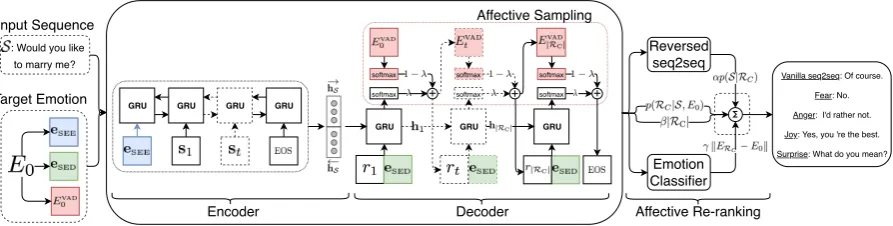
Our system (see overview in Figure1) is divided into three main components: (1) Emotion Label-ing – automatic labelLabel-ing of sentences accordLabel-ing to the emotional content they express, using an emotion classifier (§3.2.1); labeling of words with VAD Lexicon values (§4.2), (2) Affective Train-ing – trainTrain-ing of two seq2seq networks, which use an encoder-decoder setting. The first network is trained with prompt-response pairs (S-T), whereas the second (used during Affective Inference) is trained with reversed pairs (T-S), (3) Affective In-ference – generation of many plausible responses, which are re-ranked based on emotional content.
3.1 Preliminaries
LetV ={w1, w2, . . . , w|V|}be a vocabulary, and X = (x1, x2, . . . , x|X |)a sequence of words (e.g.
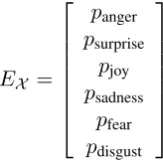
a sentence). We denoteEX ∈R6 as an emotion
vector representing a probability distribution over six emotions associated with the sequenceX:
EX =
panger psurprise
pjoy psadness
pfear pdisgust
Note that in this work we focus on six basic emo-tions proposed by Paul Ekman (Ekman et al.,1983) but the techniques we develop are general and can be extended to a more fine grained list of emotions.
X can be an input sequence, candidate response, final response, or target response (denoted respec-tively as S, RC, Rfinal, R0). We introduce E0,
which during training, is the representation of the emotion of the target response (R0). During
test-ing,E0 indicates a desired emotion for the final
Reversed seq2seq
Affective Re-ranking
Vanilla seq2seq: Of course.
Fear: No.
Anger: I'd rather not.
Joy: Yes, you 're the best.
Surprise: What do you mean?
Emotion Classifier Target Emotion
Input Sequence
: Would you like to marry me?
Encoder Decoder
GRU GRU GRU
GRU
softmax
GRU
softmax
softmax
GRU
softmax
softmax
GRU
softmax
[image:3.595.79.526.63.176.2]Affective Sampling
Figure 1: System overview: The input sequence and the target emotion (automatically extracted from the target response using the emotion classifier during training, and set by the user during inference) are fed into the seq2seq. The generated candidate responses are re-ranked based on the output of the reversed seq2seq, the length, and the emotional content.
example, in the case of ‘anger’, E0 would be a
one-hot vector with1 at the first position, and 0
elsewhere.
In our work, we extend the standard seq2seq model (Sutskever et al., 2014), that predicts the final responseRfinal = argmaxRCp(RC|S). The
proposed affective system aims to extend the in-ference mechanism by incorporating emotions en-coded inE0:
Rfinal = argmax RC
p(RC|S, E0) (1)
3.2 Affect Modeling
We extend the standard seq2seq architecture by in-cluding emotion-specific information during the training and the inference. A critical challenge in both generating and evaluating responses is a reliable assessment of emotional state. We use two representations of emotion: (1) a categorical representation with six emotions (anger, surprise, joy, sadness, fear, disgust), and (2) a continuous representation in a VAD space. The latter uses a VAD Lexicon introduced byMohammad(2018), where each of 20k words is mapped to a 3D vec-tor of VAD values, ranging from 0 (lowest) to 1 (highest) (v∈[0,1]3). Valence measures the posi-tivity/negativity, Arousal the excitement/calmness, and Dominance the powerfulness/weakness of the emotion expressed by a word. This expands the work ofLubis et al.(2018), who modeled emotions only in VA space. In the following sections we describe different versions of the proposed model.
3.2.1 Emotion Classifier
Affective training requiresE0, the emotion
repre-sentation of the target sequence. In order to label all sentences of the corpus with E0, we use an
Emotion Classifier by Witon et al. (2018). The
classifier predicts a probability distribution over class of six emotions. The classifier predictions for Cornell Movie-Dialogs Corpus (Cornell) have been shown to be highly correlated with human predictions (Witon et al.,2018).
3.2.2 Sequence-Level Explicit Encoder
Model (SEE)
To explicitly generate responses with emotion, this version of the model includes an emotion embed-ding at the encoder side. We feed the encoder withS0 = (e
SEE, s1, s2, . . . , s|S|), where eSEE =
ASEEE0is an Emotion Embedding (eSEE ∈R3),
and ASEE ∈ R3×6 is a mapping (learned
dur-ing traindur-ing) fromE0into an emotion embedding
space.
3.2.3 Sequence-Level Explicit Decoder
Model (SED)
Another way of forcing an emotional output is to explicitly indicate the target emotion at every step in decoding along with other inputs. Formally, the GRU hidden state at time t is calculated as
ht = f(ht−1, rt0) with rt0 = [rt−1;eSED], where
eSEDis defined similarly aseSEE. It is worth noting
thatASEEandASEDare different, which implies that the emotion embedding spaces they map to are also different. Compared to a similar approach introduced by Huang et al.(2018), our solution enables the desired emotional content, E0, to be
provided in a continuous space.
3.2.4 Word-Level Implicit Model (WI)
To model the word-level emotion carried by each sequence, we introduce an Affective Regularizer (AR), which expresses the affective distance be-tweenRfinal andR0, in the VAD space. It forces
Math-ematically, we extend the regular Negative Log Likelihood (NLL) loss with an affective regular-izer,LAR:
L=LNLL+LAR
=−logp(Rfinal|S) +µLVAD(Rfinal,R0)
LVAD(Rfinal,R0) =
|Rfinal|
X
t=1
EVADst
|Rfinal| − |R0|
X
t=1
eVAD
r0t
|R0|
,
where st = softmax(ht) (st ∈ R|V|) is a
confidence of the system of generating words
w1, . . . , w|V|at timetandµ∈ R. eVADx ∈ R3 is a 3D vector representing emotion associated with a wordxin VAD space (note thateVADx is constant with respect tot), andEVAD ∈R3×|V|is a matrix
containing eVAD
wv for all |V|words in the
vocabu-lary:
EVAD =heVADw1 ; . . . ; eVADw|
V|
i
Intuitively, the regularizer penalizes the deviation of the emotional content of the generated response,
Rfinal, from the desired response, R0. The
emo-tional information carried byRfinalis the weighted sum of emotion representationseVADwi for all words
wiin the vocabulary, where the weights are deter-mined by the confidencest.
3.2.5 Word-Level Explicit Model (WE)
Sequential word generation allows sampling of the next word, based on the emotional content of the current incomplete sequence. If some words in a sequence do not express the target emotionE0,
other words can compensate for this by changing the final affective content, e.g., in a sentence “I think that the cat really loves me!”, the first 6 words are neutral, whereas the end of the sentence make it clearly express joy. We incorporate this observation by explicitly generating the next word using an Adaptive Affective Sampling Method:
logp(RC|S, E0) =
|RC|
X
t=1
logp(rt|r<t,er<t,hS, E0),
p(rt|r<t,er<t,hS, E0) =λsoftmaxg(ht) + (1−λ) softmaxv(EtVAD),
whereg(ht)is a linear mapping from GRU hid-den statehtto an output vector of size |V|, and
0 ≤ λ ≤ 1 is learned during training. The first term in Equation3.2.5is responsible for generating words according to a language model preserving grammatical correctness of the sequence, whereas the second term forces generation of words car-rying emotionally relevant content. EtVAD ∈ R3
is a vector representing the remaining emotional content needed to match a goal (E0VAD) after gener-ating all words up to timet. It is updated every time a new wordrtwith an associated emotion vector
eVADrt is generated:
EtVAD=EtVAD−1 −eVADrt−1
E0VAD=
|R0|
P
t=1
eVADr0t , training
MVADE0·maxlength, inference
whereeVADr0t is an emotion vector associated with words r0t in the target sequence, maxlength is a
maximum length set for the seq2seq model, and
MVAD∈R3×6is a mapping from six-dimensional
emotion space into VAD space (every emotion has a VAD vector as introduced by Hoffmann et al. (2012), scaled to a range [0, 1]):
anger surprise joy sadness fear disgust
" 0 1 1 0 0 0 # V
MVAD= 1 1 1 0 1 0.5 A
1 0 1 0 0 0.5 D
v(EtVAD)is a vector, whose i-th component mea-sures the potential remaining emotional content of the sequence in the case of choosing the i-th word
wi:
v(EtVAD) =−
EtVAD−ew0 . . .
E
VAD
t −ew|V|
In the following, we set a constant λ = 1 af-ter generating the first maxlength/2words, as this
setting ensures that the first generated words carry the right emotional content, while not sacrificing the grammatical correctness of the whole response. This leads to an improvement in performance.
3.3 Affective Inference
traditional objective functions, i.e., likelihood of a response given an input, can be improved by using an N-best list and MMI during inference. We build upon this idea; our hypothesis is that by generatingB diverse sequences and re-ranking the responses, we are more likely to infer one best emotion-specific response. TheB-best list is found using Beam Search of sizeBwith length normal-ization.
In the MMI-bidi setting,Li et al.(2016) rank all responses found during beam search based on a score calculated as:
Rfinal= argmax RC
p(RC|S) +αp(S|RC) +β|RC|, (2) where p(S|RC) is a model with the same archi-tecture as p(RC|S) trained on reversed prompt-response pairs (T-S), and|RC|is the length of the candidate response,RC. We modify this objective in the following form:
Rfinal = argmax RC
p(RC|S, E0) +αp(S|RC)
+β|RC| −γkERC −E0k,
(3)
where the last term penalizes the deviation of the emotional content,ERC, of the candidate response,
RC, from the desired emotional content,E0. The
task is to find optimal values of parametersα,β
andγ, which give the best responses in terms of grammatical correctness, diversity (α,β) and emo-tional content (γ) (see §5and §6).
4 Model Training
In this section, we describe corpora used for train-ing, the baseline models and the training procedure for the models presented in §3.
4.1 Corpora
Cornellcontains around 10K movie characters and
around 220K dialogues (Danescu-Niculescu-Mizil and Lee,2011).
OpenSubtitles2018 is a collection of translated
movie subtitles with 3.35G sentence fragments (Tiedemann,2009). It has been filtered to get pairs of consecutive sequences (containing between 5 and 30 words), with respective timestamps within an interval of 5 seconds, that are part of a conversa-tion of at least 4 turns. The filtered dataset contains 2.5M utterances.
PreprocessingEach dataset is tokenized using the
spaCy1tokenizer, converted to lowercase, and
non-1https://spacy.io
ASCII symbols are removed. To restrain the vocab-ulary size and correct the typos, we use a default vocabulary of fixed size 42K words from spaCy. Each word in the dataset is then compared with the vocabulary using the difflib library2in Python (algorithm based on the Levenshtein distance), and mapped to the most similar word in the vocabu-lary. If no word with more than 90% of similarity is found, the word is considered a rare word or a typo, and is mapped to the out-of-vocabulary (OOV) word. For Cornell, less than1%of the uni-grams are OOV.
4.2 Affective Dictionary
The VAD lexicon may not have all the words in the vocabulary. Based on the word similarity (us-ing difflib library), each word of the vocabulary is assigned a VAD value of the most similar word in the VAD lexicon. If no word with more than 90% of similarity is found, a “neutral” VAD value (v= [0.5,0.5,0.5]) is assigned.
4.3 Baselines
We compare our work to two different baselines: a vanilla seq2seq and the ECM introduced byZhou et al.(2018). For the external memory we use our affective dictionary and train the model using the default parameters provided by authors.
4.4 Training Details
All the hyper-parameters have been optimized on the validation set using BLEU score (Papineni et al., 2002). For the encoder, we use two-layer bidirec-tional GRUs (hidden size of256). The final hidden states from both directions are concatenated and fed as an input to the decoder of one-layer uni-directional GRUs (hidden size of512). The embed-ding layer is initialized with pre-trained word vec-tors of size300(Mikolov et al.,2018), trained with subword information (on Wikipedia 2017, UMBC web-base corpus and statmt.org news dataset), and updated during training. We use ADAM optimizer (Kingma and Ba, 2014) with a learning rate of
0.001for learning p(RC|S, E0) (resp. 0.01 for
p(S|RC)), which is updated by using a scheduler with a patience of20epochs and a decreasing rate of0.5. The gradient norm is clipped to5.0, weight decay is set to1e−5, and dropout (Srivastava et al., 2014) is set to0.2. The maximum sequence length is set to20for Cornell and to30for OpenSubtitles. The models have been trained on94%, validated on1%, and tested on5%of the data.
Model C distinct-1 C distinct-2 OS distinct-1 OS distinct-2 C BLEU OS BLEU
No
re-rank
Baseline 0.0305 0.1402 0.0175 0.1205 0.0096 0.094
ECM 0.0310 0.1412 0.0180 0.1263 0.0099 0.099
SEE 0.0272 0.1331 0.0170 0.1100 0.0110 0.093
SED 0.0303 0.1502 0.0189 0.1231 0.0128 0.103
WI 0.0316 0.1480 0.0175 0.1235 0.0129 0.100
WE 0.0310 0.1400 0.0195 0.1302 0.0098 0.095
WI + WE 0.0342 0.1530 0.0198 0.1300 0.0108 0.105
(+12.1%) (+9.1%) (+13.1%) (+7.9%) (+12.5%) (+11.7%)
Re-rank
MMIbaseline 0.0379 0.1473 0.0200 0.1403 0.0130 0.105
EMOTICONSγ=0 0.0406 0.2030 0.0305 0.1431 0.0140 0.110
[image:6.595.79.519.67.242.2](+7.1%) (+37.8%) (+52.5%) (+2.0%) (+7.7%) (+4.8%)
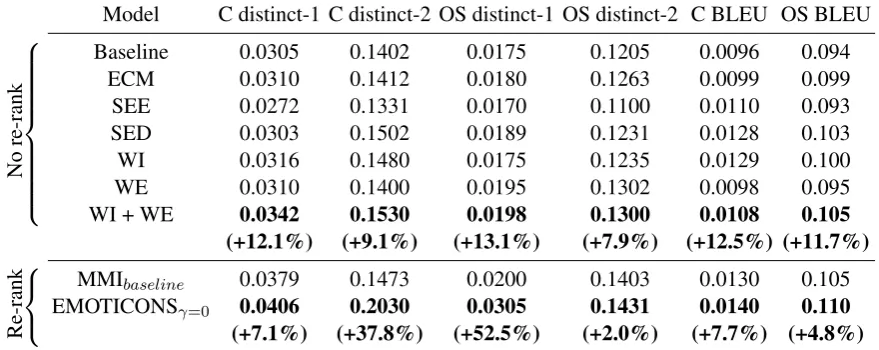
Table 2: Quantitative results: Results for all proposed models trained on Cornell (C) and OpenSubtitles (OS). distinct-1 and distinct-2 count the number of distinct unigrams and bigrams, respectively, normalized by the total number of generated tokens in 200 candidate responses. The performance boost is computed with respect to the vanilla seq2seq model.
5 Quantitative Evaluation for Model Selection
To evaluate language models, we use BLEU score (computed using 1- to 4-grams), as it has been shown to correlate well with human judgment (Agarwal and Lavie,2008). Perplexity does not provide a fair comparison across the models: dur-ing the traindur-ing of the baseline seq2seq model, we minimize the cross entropy loss (logarithm of per-plexity), whereas in other models (e.g., WI) we aim to minimize a different loss not directly related to perplexity (cross entropy extended with the affec-tive regularizer). Having more diverse responses makes the affective re-ranking more efficient, to evaluate diversity we count the number of distinct unigrams (distinct-1) and bigrams (distinct-2), nor-malized by the total number of generated tokens.
The performance of different models introduced in §3are presented in Table2. MMIbas.refers to a
system that re-ranks responses based on Equation2, where both p(RC|S) and p(S|RC) are baseline seq2seq models. EMOTICONS is a system based on Equation 3, wherep(RC|S, E0) is computed using a composition of Word-Level Implicit Model (WI) and Word-Level Explicit Model (WE), and
p(S|RC) is computed using WI (as we are not interested in explicitly using the input emotion). We optimize αandβ on the validation set using BLEU score, since Li et al. (2016) have shown that adding MMI during inference improves the BLEU score. We setγ = 0and find optimal values
αopt = 50.0andβopt = 0.001using grid search. Improving BLEU score and diversity was not the
goal of our work, but the observed improvement (after adding emotions) shows that the different sys-tems are able to extract and use emotional patterns to improve the general language model.
5.1 Response Diversity
From Table2, we observe that for both Cornell and OpenSubtitles datasets, SED, WI, and WE models outperform the vanilla seq2seq and the ECM for at least one of the two distinct measures. SEE has the worst performance overall and does not compete with either the baseline, nor with SED. This is ex-pected according to the results reported byHuang et al.(2018). It seems that the model is not able to capture the information carried by the additional emotion embedding token – it is treated as just one additional word among 20 others. SED makes bet-ter use of the emotion information, as it is used at each time step during decoding. In addition, it is more natural to use these features during the decod-ing, since the emotion embedding represents the desired emotion of the response. The combination of WI and WE performs best in terms of distinct-1 and distinct-2 measures among all models with-out re-ranking, yielding an improvement of up to
13.1%. It suggests that the word level emotion models suit the seq2seq architecture better. During training, both models are encouraged not only to match the target words, but also to promote less frequent words that are close to the target words in terms of VAD values (affective regularizer and affective sampling), fostering the model to generate more diverse responses.
improvement in diversity, but the relative im-provement for OpenSubtitles (MMIbas.) is smaller
than the one reported by Li et al. (2016). This could originate from the different data filtering and beam search strategy, and the fact the hyper-parameter optimization has been performed on Cornell. EMOTICONS is a combination of WI+
WE (best performing model) forp(RC|S, E0)and WI for p(S|RC), it is better than MMIbas.(up to 52.5%gain in distinct-1).
It is worth noting that we observe higher scores in terms of diversity for the reversed model p(S|RC) compared to the normal model
p(RC|S, E0), while training on Cornell. We can explain this using the data distribution: distinct-2 is higher for the questions than for the answers (0.167
and0.154for Cornell, respectively).
5.2 Response Quality
Table2 shows that, in general, introducing emo-tional features into the process of generating sponses does not reduce the BLEU score. To re-duce the potential negative impact of choosing in-appropriate first words in the sequence, we com-pute the BLEU score on the result of beam search of size 200. For example, if the first word is “I”, the seq2seq models tend to generate a response “I don’t know” with high probability, due to the high number of appearances of such terms in the training set. In certain cases, like WI and SED, we observe an improvement. Such an improvement is expected, since our model takes into account additional (affective) information from the target sequence during response generation.
6 Human-in-the-Loop Hyper-Parameter
Estimation
The quantitative evaluation shows that EMOTICONS outperforms the baseline while adding the emotional features during response generation. The re-ranking phase did not take into account the affective term (γ = 0in Equation3). Setting a different value would not necessarily improve any of the available metrics (e.g., BLEU score, diversity), as they do not explicitly take into account affective content in their definition. In this section, we describe an optimization procedure, relying on human judgment, for finding the optimal value ofγ.
6.1 Experiment Description
We asked annotators to evaluate (using an Button) the generated responses. We use
Affect-0 2 4 6 8 10
γ
01 2 3 4 5 6
Emotional
difference
∆
E
average joy anger surprise fear
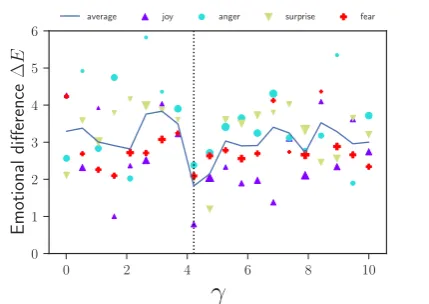
Figure 2: Hyper-parameter optimization: For different
values ofγ, users assign a face to the generated
re-sponse. Each point represents an average∆E of
an-notations for each emotion. ∆E is the difference
be-tween the VAD representation of the face assigned by the user and the desired emotion for the response. The size is proportional to the number of collected
annota-tions.∆Eis at a minimum forγopt= 4.2.
Button (Broekens and Brinkman,2013), a reliable affective tool for assigning emotions, which, to our knowledge, has never been used for estimating the emotional content of the generated responses. In our experiment, the AffectButton lets users choose a facial expression from a continuous space (see Figure3), that best matches the emotional state as-sociated with the sequence, which is then mapped into the VAD space. In order to conduct the ex-periment, we chose a pool of12annotators, who annotated a total of400sequences. The prompts were randomly chosen from the test set of Cornell, among the200sequences that create the most di-verse responses in terms of distinct-2. The more diverse the responses are, the more likely we are to select a response carrying a desired emotion. The responses for the prompts were generated using EMOTICONS where the target emotion was either fear, anger, joy, or surprise; the four corners of the AffectButton. γ was randomly chosen among20
uniformly sampled values in[0,10].
6.2 Experiment Results
In Figure 2, we present the difference between the VAD value according to the face assigned by the user, and the desired emotion for the response. The average curve presents a global minimum at
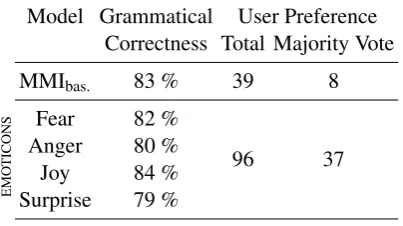
[image:7.595.310.525.67.219.2]Model Grammatical User Preference Correctness Total Majority Vote
MMIbas. 83 % 39 8
EMO
TICONS
Fear 82 %
96 37
Anger 80 %
Joy 84 %
[image:8.595.309.524.60.120.2]Surprise 79 %
Table 3: User study results: Grammatical
Correct-nessshows the ratio of grammatically correct sentences
among all generated responses, whereas User
Prefer-enceshows the number of times each model was
pre-ferred by the users.
processERC is estimated using the emotion clas-sifier (Witon et al.,2018) which detects joy more accurately than anger (77%versus57%), surprise (62%) and fear (69%).
7 Qualitative Evaluation
In this section, we qualitatively evaluate the emo-tional content and correctness of the responses gen-erated by EMOTICONSγ=γopt compared to the
ones from MMIbas.through a user study. It consists
of three different experiments which measure gram-matical correctness, user preference, and emotional appropriateness. For all experiments, we chose prompts from the test set of Cornell, for which the most diverse responses were created by MMIbas.
in terms of distinct-2. We test EMOTICONS by generating responses according to four emotions: fear, anger, joy, and surprise (beam size of 200).
7.1 Grammatical Correctness
In this experiment, we used 40 prompts. For each prompt, we generated 5 sentences (4 for EMOTICONS, and 1 for MMIbas.) that were
pre-sented in a random order to 3 native English speak-ers. They assigned either 0 (sentence grammati-cally incorrect), or 1 (sentence grammatigrammati-cally cor-rect) for all sentences. To measure the agreement across annotators, we calculate Fleiss’κ= 0.4128, which corresponds to “moderate agreement”. Our model does not substantially sacrifice the gram-matical correctness of the responses (see Table3).
7.2 User Preference
In this setting, we quantify how likely the user is going to prefer the response generated by EMOTICONS compared to the one generated by MMIbas.. We asked18annotators to choose their
[image:8.595.82.284.66.179.2]fa-(a) Bas. (b) Fear (c) Anger (d) Joy (e) Surprise
Figure 3: Emotional faces: AffectButton presents faces according to average VAD vectors (in parentheses)
obtained for the (a) MMIbas. ([0.47,0.98,0.36]), and
for the four EMOTICONS models with different
tar-get emotions: (b) Fear ([0.2,0.95,0.38]), (c) Anger
([0.54,0.92,0.65]), (d) Joy ([0.68,0.97,0.66]), and
(e) Surprise([0.37,0.97,0.52]).
vorite response to the input query among eight pro-posed answers (top four responses coming from the MMIbas and 4 coming from EMOTICONS with the four different target emotions). Each of 45 sen-tences were annotated by three different annotators. Results of the experiment (Table3) indicate that users strongly prefer EMOTICONS over MMIbas..
7.3 Emotional Appropriateness
In this experiment, we show that our model is able to generate emotions in a controlled manner. For each of the 5 models, 22users assign a face via the AffectButton. We generate responses for 120 different prompts. We keep the responses that were annotated with a VAD vector with the norm greater than2, corresponding to those expressing strong emotions. We compute the average VAD vectors for the annotated sequences for each model, with corresponding AffectButton faces (Figure3). The majority of user-assigned faces have a high arousal value, which can be explained by the fact that users tend to click in one of the four corners of the Af-fectButton. The majority of the faces represent an accurate portrayal of the desired emotion. The poor performance of EMOTICONS at expressing surprise comes from the fact that (1) users often mismatch surprise with joy, leading to a neutral dominance value, and (2) surprise is one of the most difficult emotions to judge (see §6).
8 Conclusion
Acknowledgments
We would like to thank anonymous reviewers for their insightful comments. Mubbasir Kapadia has been funded in part by NSF IIS-1703883, NSF S&AS-1723869, and DARPA SocialSim-W911NF-17-C-0098.
References
Abhaya Agarwal and Alon Lavie. 2008. Meteor,
m-bleu and m-ter: Evaluation metrics for
high-correlation with human rankings of machine
trans-lation output. In Proc. of the Third Workshop on
Statistical Machine Translation, pages 115–118.
Nabiha Asghar, Pascal Poupart, Jesse Hoey, Xin Jiang,
and Lili Mou. 2017. Affective neural response
gen-eration.CoRR, abs/1709.03968.
Dzmitry Bahdanau, Kyunghyun Cho, and Yoshua
Bengio. 2014. Neural machine translation by
jointly learning to align and translate. CoRR, abs/1409.0473.
Joost Broekens. 2012. In defense of dominance: PAD
usage in computational representations of affect.
In-ternational Journal of Synthetic Emotions, 3(1):33– 42.
Joost Broekens and Willem-Paul Brinkman. 2013. Af-fectbutton: A method for reliable and valid
affec-tive self-report. International Journal of
Human-Computer Studies, 71(6):641–667.
Hongshen Chen, Xiaorui Liu, Dawei Yin, and Jiliang Tang. 2017. A survey on dialogue systems: Recent
advances and new frontiers. ACM SIGKDD
Explo-rations Newsletter, 19(2):25–35.
Junyoung Chung, C¸ aglar G¨ulc¸ehre, KyungHyun Cho,
and Yoshua Bengio. 2014. Empirical evaluation of
gated recurrent neural networks on sequence
model-ing. CoRR, abs/1412.3555.
Cristian Danescu-Niculescu-Mizil and Lillian Lee. 2011. Chameleons in imagined conversations: A new approach to understanding coordination of
lin-guistic style in dialogs. InProc. of the Workshop on
Cognitive Modeling and Computational Linguistics, ACL.
Paul Ekman, Robert W Levenson, and Wallace V
Friesen. 1983. Autonomic nervous system
ac-tivity distinguishes among emotions. Science,
221(4616):1208–1210.
Angela Fan, Mike Lewis, and Yann Dauphin. 2018.
Hierarchical neural story generation. CoRR, abs/1805.04833.
Sepp Hochreiter and Jrgen Schmidhuber. 1997.
Long short-term memory. Neural Computation, 9(8):1735–1780.
Holger Hoffmann, Andreas Scheck, Timo Schuster, Steffen Walter, Kerstin Limbrecht, Harald C Traue, and Henrik Kessler. 2012. Mapping discrete emo-tions into the dimensional space: An empirical
ap-proach. InProc. of IEEE International Conference
on Systems, Man, and Cybernetics (SMC), pages 3316–3320. IEEE.
Chenyang Huang, Osmar Zaiane, Amine Trabelsi, and Nouha Dziri. 2018. Automatic dialogue generation
with expressed emotions. In Proc. of the
Confer-ence of the North American Chapter of the Associ-ation for ComputAssoci-ational Linguistics: Human Lan-guage Technologies, volume 2 (Short Papers), pages 49–54.
Vladimir Ilievski, Claudiu Musat, Andreea Hossmann, and Michael Baeriswyl. 2018. Goal-oriented chat-bot dialog management bootstrapping with transfer
learning. InProc. of IJCAI.
Diederik P. Kingma and Jimmy Ba. 2014. Adam:
A method for stochastic optimization. CoRR, abs/1412.6980.
Jiwei Li, Michel Galley, Chris Brockett, Jianfeng Gao,
and Bill Dolan. 2016. A diversity-promoting
ob-jective function for neural conversation models. In Proc. of NAACL-HLT, pages 110–119.
Nurul Lubis, Sakriani Sakti, Koichiro Yoshino, and
Satoshi Nakamura. 2018. Eliciting positive
emo-tion through affect-sensitive dialogue response gen-eration: A neural network approach. In Proc. of AAAI Conference on Artificial Intelligence.
Irina Maslowski, Delphine Lagarde, and Chlo´e Clavel.
2017. In-the-wild chatbot corpus: from opinion
analysis to interaction problem detection. In Proc.
of ICNLSP.
Tomas Mikolov, Edouard Grave, Piotr Bojanowski, Christian Puhrsch, and Armand Joulin. 2018. Ad-vances in pre-training distributed word
representa-tions. In Proc. of the International Conference on
Language Resources and Evaluation.
Saif M. Mohammad. 2018. Obtaining reliable
hu-man ratings of valence, arousal, and dominance for
20,000 English words. InProc. of the 56th Annual
Meeting of the Association for Computational Lin-guistics, Melbourne, Australia.
Kishore Papineni, Salim Roukos, Todd Ward, and
Wei-Jing Zhu. 2002. Bleu: A method for automatic
eval-uation of machine translation. InProc. of the 40th Annual Meeting on Association for Computational Linguistics, pages 311–318.
Iulian Vlad Serban, Alessandro Sordoni, Yoshua Ben-gio, Aaron C. Courville, and Joelle Pineau. 2015.
Alessandro Sordoni, Michel Galley, Michael Auli, Chris Brockett, Yangfeng Ji, Margaret Mitchell, Jian-Yun Nie, Jianfeng Gao, and Bill Dolan. 2015.
A neural network approach to context-sensitive generation of conversational responses. CoRR, abs/1506.06714.
Nitish Srivastava, Geoffrey Hinton, Alex Krizhevsky, Ilya Sutskever, and Ruslan Salakhutdinov. 2014. Dropout: a simple way to prevent neural networks
from overfitting. Journal of Machine Learning
Re-search, 15(1):1929–1958.
Sarah Strohkorb, Chien-Ming Huang, Aditi Ramachan-dran, and Brian Scassellati. 2016. Establishing sus-tained, supportive human-robot relationships:
Build-ing blocks and open challenges. In AAAI Spring
Symposium on Enabling Computing Research in So-cially Intelligent Human-Robot Interaction, volume 2123, page 2016.
Ilya Sutskever, Oriol Vinyals, and Quoc V Le. 2014. Sequence to sequence learning with neural networks. InProc. of Advances in neural information process-ing systems, pages 3104–3112.
J¨org Tiedemann. 2009. News from OPUS - A collec-tion of multilingual parallel corpora with tools and
interfaces. InRecent Advances in Natural Language
Processing, volume 5, pages 237–248.
Ashish Vaswani, Noam Shazeer, Niki Parmar, Jakob Uszkoreit, Llion Jones, Aidan N. Gomez, Lukasz Kaiser, and Illia Polosukhin. 2017. Attention is all
you need. InProc. of Advances in neural
informa-tion processing systems.
Oriol Vinyals and Quoc V. Le. 2015. A neural
conver-sational model.CoRR, abs/1506.05869.
Wojciech Witon, Pierre Colombo, Ashutosh Modi, and Mubbasir Kapadia. 2018. Disney at IEST 2018:
Pre-dicting emotions using an ensemble. InProceedings
of the 9th Workshop on Computational Approaches to Subjectivity, Sentiment and Social Media
Analy-sis, pages 248–253.
Hao Zhou, Minlie Huang, Tianyang Zhang, Xiaoyan Zhu, and Bing Liu. 2018. Emotional chatting ma-chine: Emotional conversation generation with
inter-nal and exterinter-nal memory. InProc. of The AAAI