3291
Corpora Generation for Grammatical Error Correction
Jared Lichtarge∗, Chris Alberti∗, Shankar Kumar∗, Noam Shazeer∗, Niki Parmar∗, Simon Tong∗
Google Research
{lichtarge,chrisalberti,shankarkumar,noam,nikip,simon}@google.com
Abstract
Grammatical Error Correction (GEC) has been recently modeled using the sequence-to-sequence framework. However, unlike se-quence transduction problems such as ma-chine translation, GEC suffers from the lack of plentiful parallel data. We describe two ap-proaches for generating large parallel datasets for GEC using publicly available Wikipedia data. The first method extracts source-target pairs from Wikipedia edit histories with minimal filtration heuristics, while the sec-ond method introduces noise into Wikipedia sentences via round-trip translation through bridge languages. Both strategies yield sim-ilar sized parallel corpora containing around 4B tokens. We employ an iterative decoding strategy that is tailored to the loosely super-vised nature of our constructed corpora. We demonstrate that neural GEC models trained using either type of corpora give similar per-formance. Fine-tuning these models on the Lang-8 corpus and ensembling allows us to surpass the state of the art on both the CoNLL-2014 benchmark and the JFLEG task. We pro-vide systematic analysis that compares the two approaches to data generation and highlights the effectiveness of ensembling.
∗
∗Equal contribution. Listing order is random. Jared
conducted systematic experiments to determine useful vari-ants of the Wikipedia revisions corpus, pre-training and fine-tuning strategies, and iterative decoding. Chris implemented the ensemble and provided background knowledge and re-sources related to GEC. Shankar ran training and decoding experiments using round-trip translated data. Jared, Chris and Shankar wrote the paper. Noam identified Wikipedia revisions as a source of training data. Noam developed the heuristics for using the full Wikipedia revisions at scale and conducted initial experiments to train Transformer models for GEC. Noam and Niki provided guidance on training Trans-former models using theTensor2Tensortoolkit. Simon pro-posed using round-trip translations as a source for training data, and corrupting them with common errors extracted from Wikipedia revisions. Simon generated such data for this pa-per.
1 Introduction
Much progress in the Grammatical Error Correc-tion (GEC) task can be credited to approaching
the problem as a translation task (Brockett et al.,
2006) from an ungrammatical source language to
a grammatical target language. This has enabled Neural Machine Translation (NMT) sequence-to-sequence (S2S) models and techniques to be
ap-plied to the GEC task (Tao et al., 2018b;
Chol-lampatt and Ng, 2018; Junczys-Dowmunt et al.,
2018). However, the efficacy of NMT techniques
is degraded for low-resource tasks (Koehn and
Knowles, 2017). This poses difficulties for S2S
approaches to GEC, as Lang-8, the largest publicly
available parallel corpus, contains only ∼25M
words (Mizumoto et al., 2011). Motivated by
this data scarcity, we present two contrasting ap-proaches to generating parallel data for GEC that make use of publicly available English language
Wikipedia revision histories12.
Our first strategy is to mine real-world er-rors. We attempt to accumulate source–target pairs from grammatical errors and their human-curated corrections gleaned from the Wikipedia revision
histories. Unlike previous work (Grundkiewicz
and Junczys-Dowmunt,2014), we apply minimal
filtering so as to generate a large and noisy
cor-pus of∼4B tokens (Table 1). As a consequence
of such permissive filtering, the generated corpus contains a large number of real grammatical cor-rections, but also noise from a variety of sources, including edits with drastic semantic changes, im-perfect corrections, ignored errors, and Wikipedia spam.
Our second strategy is to synthesize data by
corrupting clean sentences. We extract target
sentences from Wikipedia, and generate
corre-1
https://dumps.wikimedia.org/enwiki/latest/
sponding source sentences by translating the tar-get into another language and back. This round-trip translation introduces relatively clean errors, so the generated corpus is much less noisy than the human-derived Wikipedia corpus. However, these synthetic corruptions, unlike human errors, are limited to the domain of errors that the
trans-lation models are prone to making. Both
ap-proaches benefit from the broad scope of topics in Wikipedia.
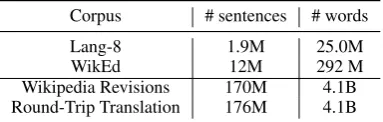
Corpus # sentences # words
Lang-8 1.9M 25.0M
WikEd 12M 292 M
[image:2.595.86.278.211.272.2]Wikipedia Revisions 170M 4.1B Round-Trip Translation 176M 4.1B
Table 1: Statistics computed over extant training sets for GEC (top) and corpora generated from Wikipedia in this work (bottom).
We train the Transformer sequence-to-sequence
model (Vaswani et al., 2017) on data generated
from the two schemes. Fine-tuning the models on the Lang-8 corpus gives us additional improve-ments which allow a single model to surpass the state-of-art on both the CoNLL-2014 and the JF-LEG tasks. Finally, we explore how to combine the two data sources by comparing a single model trained on all the data to an ensemble of models.
2 Data Generation from Wikipedia Revision Histories
Wikipedia provides a dump of the revision histo-ries of all Wikipedia pages. For each Wikipedia page, the dump contains chronological snapshots of the entire content of the page before and after every submitted edit; thus two consecutive snap-shots characterize a single revision to the page. Because a small number of popular pages see dis-proportionate traffic, some pages grow very large. As we are interested in the edits between snap-shots, and not identical content that is typically in higher proportion in the revision histories for the largest pages, we discard pages larger than 64Mb. To prevent remaining large pages from skewing the dataset towards their topics with their many revisions, we downsample consecutive revisions
from individual pages, selecting only log1.5(n)
pairs for a page with a total ofn revisions. This
reduces the total amount of data 20-fold. Each remaining pair of consecutive snapshots forms a source–target pair. The process for extracting ex-amples from a page’s revision history is illustrated
in Figure1.
From the XML of each page in a source–target pair, we extract and align the text, removing non-text elements. We then probabilistically cut the aligned text, skipping over non-aligned sequences. Two cuts bound an example pair, for which the source sequence is provided by the older snapshot, and the target sequence by the newer snapshot.
Following extraction of the examples, we do a small amount of corruption and filtration in or-der to train a model proficient at both spelling and grammar correction. We probabilistically in-troduce spelling errors in the source sequences at
a rate of0.003per character, randomly selecting
deletion, insertion, replacement, or transposition of adjacent characters for each introduced error.
We throw out examples exceeding a maximum length of 256 word-pieces. The majority of exam-ples extracted by this process have identical source and target. Since this is not ideal for a GEC par-allel corpus, we downsample identity examples by 99% to achieve 3.8% identical examples in the fi-nal dataset. The data generation scripts we use
have been opensourced3.
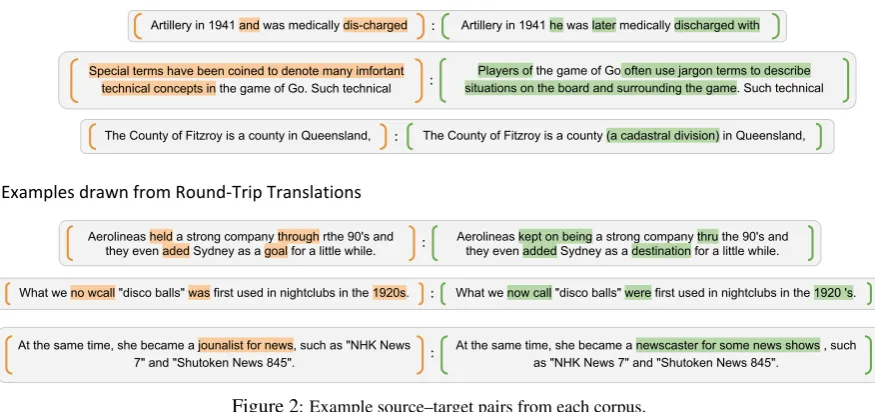
In Figure 2, we show examples of extracted
source–target pairs. While some of the edits are grammatical error corrections, the vast majority are not.
3 Data Generation from Round-trip Translations
As an alternative approach to extracting the ed-its from Wikipedia revisions, we extract sentences from the identity examples that were discarded during edit extraction, and generate a separate par-allel corpus by introducing noise into those sen-tences using round-trip translation via a bridge language. Therefore, the original sentence from Wikipedia is the target sentence and output of the round-trip translation is the corresponding source sentence. The round trip translations in-troduce noise according to both the weaknesses of the translation models and the various inher-ent ambiguities of translation. We create a cor-rupted dataset using each bridge language. We use French (Fr), German (De), Japanese (Ja) and Russian (Ru) as bridge languages because they are high-resource languages and relatively
dissim-3
source : target Revision downsampling
log1.5(n) sampled revisions live page
oldest
newest
Single page history
n revisions live page
Example pair extraction
diffs
align cut
cuts
extract <text>
target
source :
:
:
: :
[image:3.595.78.521.64.208.2]:
Figure 1: Process for extracting source–target pairs from revision history of a Wikipedia page. See Figure 2for actual examples.
Special terms have been coined to denote many imfortant technical concepts in the game of Go. Such technical
Players of the game of Go often use jargon terms to describe situations on the board and surrounding the game. Such technical
:
What we no wcall "disco balls" was first used in nightclubs in the 1920s. : What we now call "disco balls" were first used in nightclubs in the 1920 's. Artillery in 1941 and was medically dis-charged : Artillery in 1941 he was later medically discharged with
Examples drawn from Revisions
Examples drawn from Round-Trip Translations
The County of Fitzroy is a county in Queensland, : The County of Fitzroy is a county (a cadastral division) in Queensland,
At the same time, she became a jounalist for news, such as "NHK News 7" and "Shutoken News 845".
At the same time, she became a newscaster for some news shows , such as "NHK News 7" and "Shutoken News 845".
:
Aerolineas held a strong company through rthe 90's and
they even aded Sydney as a goal for a little while. : Aerolineas kept on being a strong company thru the 90's and they even added Sydney as a destination for a little while.
Figure 2: Example source–target pairs from each corpus.
ilar from each other. Thus, we compute a total of four corrupted datasets. The translations are obtained using a competitive machine translation system (Wu et al.,2016).
These round trip translated sentence-pairs con-tained only a small fraction of identity transla-tions compared to those that are present in real-world GEC corpora. To address this deficiency, we augment this corpus with 2.5% identity
trans-lations. Analogous to Section2, we want the
mod-els to learn both spelling and grammar correction. Thus, we randomly corrupt single characters via insertion, deletion, and transposition, each with
a probability of 0.005/3. Round-trip translations
do not contain some types of word and phrase er-rors (e.g., your/you’re, should of/should have) and so we additionally corrupt the translated text by stochastically introducing common errors identi-fied in Wikipedia. We first examine the Wikipedia revision histories to extract edits of up to three
words whose source and target phrases are close in edit distance, and which do not contain num-bers or capitalization. For each of the remaining edits (original, revised), we compute the
probabil-ity that the user typedoriginalwhen they intended
to typerevised:
P(original|revised) = C(original,revised)
C(revised) ,
where C(x) refers to the counts of x in the
cor-pus. We then probabilistically apply these rules to corrupt the translated text.
[image:3.595.79.517.267.473.2]● ●
● ● ● ●
● ●
● ● ● ●
● ● ● ● ● ●
●
● ● ● ● ●
Round−trip: pretrained Edits: pretrained
Edits: Fine−tuned Round−trip: Fine−tuned
40 45 50 55 60
1 2 3 4 5 6
Iteration
[image:4.595.307.526.183.423.2]F0.5
Figure 3:F0.5with iterative decoding on the CoNLL dev set. Triangles indicate performance with single-shot decoding.
Also, the errors introduced by round-trip trans-lation are relatively clean, but they represent only a subset of the domain of real-world errors. In contrast, the Wikipedia data likely has good cov-erage of the domain of real-world grammatical er-rors, but is polluted by significant noise. Examples
from both corpora are shown in Figure2.
Exam-ples of round-trip translations for each bridge
lan-guage are shown in Table2.
4 Iterative Decoding
Many sentences that require grammatical correc-tion contain multiple errors. As a result, it can be difficult to correct all errors in a single de-coding pass. This is specifically a problem when using models trained on noisy parallel data such as Lang-8 where the target sentences still con-tain grammatical errors. Following other work
on the GEC task (Dahlmeier and Ng, 2012a;
Tao et al., 2018a), we employ an iterative
de-coding algorithm that allows the model to make
multiple incremental corrections. This allows
the model multiple chances to suggest individu-ally high-confidence changes, accruing incremen-tal improvements until it cannot find any more ed-its to make.
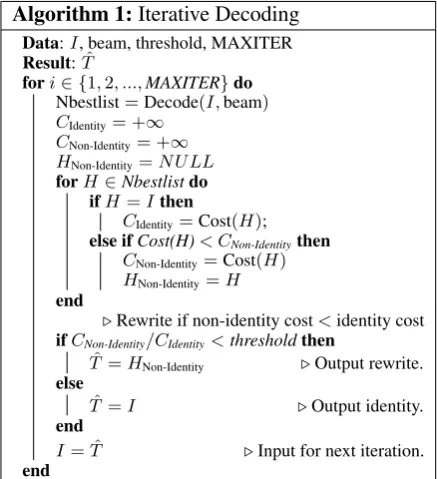
Our iterative decoding algorithm is presented in
Algorithm 1. Given the source sentenceS and a
hypothesisH, Cost(H)refers to the negative log
probability −logP(H|S) using the
sequence-to-sequence model. In each iteration, the algorithm performs a conventional beam search but is only allowed to output a rewrite (non-identity transla-tion) if it has high confidence i.e., its cost is less than the cost of the identity translation times a pre-specified threshold. Using iterative decoding al-lows a stricter threshold value than what is opti-mal for single-shot decoding, as a change ignored for being low confidence in one decoding iteration may be selected in the next.
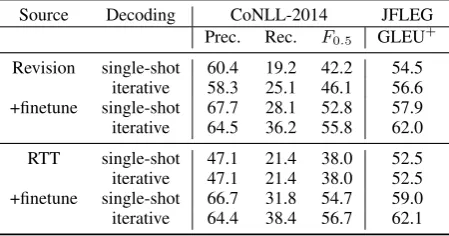
Using incremental edits produces a significant improvement in performance over single-shot de-coding for models trained on the Wikipedia re-vision data, a highly noisy corpus, while models trained on the relatively clean round-trip transla-tion data see no improvment. All models finetuned on Lang-8 see improvement with iterative decod-ing (Figure3, Table3).
Algorithm 1:Iterative Decoding
Data:I, beam, threshold, MAXITER Result:Tˆ
fori∈ {1,2, ...,MAXITER}do
Nbestlist=Decode(I,beam)
CIdentity= +∞
CNon-Identity= +∞
HNon-Identity=N U LL
forH∈Nbestlistdo ifH=Ithen
CIdentity=Cost(H);
else ifCost(H)< CNon-Identitythen
CNon-Identity=Cost(H)
HNon-Identity=H
end
⊲Rewrite if non-identity cost<identity cost
ifCNon-Identity/CIdentity<thresholdthen
ˆ
T=HNon-Identity ⊲Output rewrite.
else ˆ
T=I ⊲Output identity.
end
I= ˆT ⊲Input for next iteration. end
In Table4, we show an example of iterative
de-coding in action. The model continues to refine the input until it reaches a sentence that does not require any edits. We generally see fewer edits be-ing applied as the model gets closer to the final result.
5 Model
In this work, we use theTransformer
sequence-to-sequence model (Vaswani et al.,2017), using the
Tensor2Tensor opensource implementation.4 We use 6 layers for both the encoder and the decoder, 8
attention heads, embedding sizedmodel = 1024, a
position-wise feed forward network at every layer
of inner size df f = 4096, and Adafactor as
op-timizer with inverse squared root decay (Shazeer
and Stern,2018)5. The word tokens are split into
subwords using a variant of the byte-pair
encod-ing technique (Sennrich et al., 2016b), described
in Schuster and Nakajima(2012).
We train the Transformer model for 5 epochs
4
https://github.com/tensorflow/tensor2tensor
Original “The Adventures of Patchhead“ makes its second and final appearance.
Bridge Language
French “The Adventures of Patchhead “ makeshis secnodand final appearance. German “The Adventures of Patchhead” makes its second andlastappearance. Russian “The Adventures of Patchhead” makes its second andlast apparance. Japanese “Patchhead Adventure” is thefinal appearanceof the second time.
Original He is not so tolerant of the shortcomings of those outside his family.
Bridge Language
[image:5.595.73.298.243.361.2]French He is not so tolerant of theweaknessesof those outside his family. German He is not so toleranttothedefectsoftheoutsideofhis family. Russian He is not so tolerant of the shortcomings of those outside his family,. Japanese He is not so tolerant of the shortcomings of those outside his family.
Table 2: Example sentences generated via round-trip translation with introduced spelling errors.
Source Decoding CoNLL-2014 JFLEG
Prec. Rec. F0.5 GLEU+
Revision single-shot 60.4 19.2 42.2 54.5 iterative 58.3 25.1 46.1 56.6 +finetune single-shot 67.7 28.1 52.8 57.9 iterative 64.5 36.2 55.8 62.0
RTT single-shot 47.1 21.4 38.0 52.5 iterative 47.1 21.4 38.0 52.5 +finetune single-shot 66.7 31.8 54.7 59.0 iterative 64.4 38.4 56.7 62.1
Table 3: Comparing iterative decoding to single-shot decod-ing for two models, trained on all Wikipedia revisions data and on all round-trip translation (RTT) data.
Original this is nto the pizzza that i ordering 1st this isnotthepizzathatIordering 2nd This is not the pizza that I ordering 3nd This is not the pizza that Iordered 4th This is not the pizza that I ordered. Final This is not the pizza that I ordered.
Table 4: Iterative decoding on a sample sentence.
with a batch size of approximately 64,000 word pieces. While training on the Wikipedia corpora, we set the learning rate to 0.01 for the first 10,000 steps, then decrease it proportionally to the inverse square root of the number of steps after that.
We then finetune our models on Lang-8 for 50
epochs and use a constant learning rate of 3 ×
10−5. We stop the fine-tuning before the models
start to overfit on a development set drawn from Lang-8.
6 Experiments
6.1 Evaluation
We report results on the CoNLL-2014 test set (Ng
et al.,2014) and the JFLEG test set (Napoles et al.,
2017; Heilman et al., 2014). Our initial
experi-ments with iterative decoding showed that increas-ing beam sizes beyond 4 did not yield improve-ments in performance. Thus, we report all results
using a beam size of 4. Our ensemble models are
obtained by decoding with 4 identical
Transform-ers trained and finetuned separately. Ensembles
of neural translation systems are typically con-structed by computing the logits from each indi-vidual system and combining them using either an
arithmetic average (Sutskever et al.,2014) or a
ge-ometric average (Cromieres et al.,2016). Similar
to Cromieres et al. (2016), we find that a
geo-metric average outperforms an arithmetic average. Hence, we report results using only this scheme.
Following (Grundkiewicz and
Junczys-Dowmunt,2018;Junczys-Dowmunt et al.,2018),
we preprocess JFLEG development and test sets with a spell-checking component but do not
apply spelling correction to CoNLL sets. For
CoNLL sets, we pick the best iterative decoding threshold and number of iterations on a subset of the CoNLL-2014 training set, sampled to have the same ratio of modified to unmodified sentences as the CoNLL-2014 dev set. For JFLEG, we pick the best decoding threshold on the JFLEG dev set.We report performance of our models by measuring
F0.5 with the M2 scorer (Dahlmeier and Ng,
2012b) on the CoNLL-2014 dev and test sets, and
the GLEU+ metric (Napoles et al., 2016) on the
JFLEG dev and test sets. Table5reports statistics
computed over the development and test sets.
Test/Dev Set # sentences # annotators Metric
CoNLL-2014 dev 1345 1 M2
CoNLL-2014 test 1312 2 M2
JFLEG dev 754 4 GLEU
JFLEG test 747 4 GLEU
Table 5: Statistics for test/dev data.
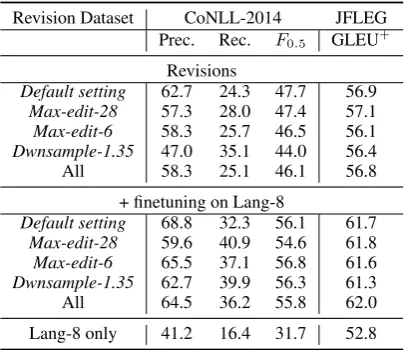
6.2 Data from Wikipedia Revisions
Revision Dataset CoNLL-2014 JFLEG Prec. Rec. F0.5 GLEU
+
Revisions
Default setting 62.7 24.3 47.7 56.9
Max-edit-28 57.3 28.0 47.4 57.1
Max-edit-6 58.3 25.7 46.5 56.1
Dwnsample-1.35 47.0 35.1 44.0 56.4
All 58.3 25.1 46.1 56.8
+ finetuning on Lang-8
Default setting 68.8 32.3 56.1 61.7
Max-edit-28 59.6 40.9 54.6 61.8
Max-edit-6 65.5 37.1 56.8 61.6
Dwnsample-1.35 62.7 39.9 56.3 61.3
All 64.5 36.2 55.8 62.0
[image:6.595.80.285.62.237.2]Lang-8 only 41.2 16.4 31.7 52.8
Table 6: Performance of the models trained on variants of data extracted from Wikipedia revision histories (top panel) and then fine-tuned on Lang-8 (bottom panel), and of a model trained only on Lang-8 with the same architecture.
rate of revision downsampling, and maximum edit distance. We generate four data sets using
vari-ations of these values: Default setting uses the
default values described in Section 2,
Max-edit-28 and Max-edit-6 correspond to maximum edit distance of 28 and 6 wordpieces respectively, and
Dwnsample-1.35corresponds to a revision down-sampling rate of log1.35(n)for a page with a total
ofnrevisions (whereas the default setting uses a
rate of log1.5(n)). We train a fifth model on the
union of the datasets. Table6shows that varying
the data generation parameters led to modest vari-ation in performance, but training on the union of the diverse datasets did not yield any benefit. Fine-tuning yields large improvements for all models. As a sanity check, we also trained a model only on Lang-8 with the same architecture. All pre-trained and fine-tuned models substantially out-perform this Lang-8 only model, confirming the usefulness of pre-training.
6.3 Round Trip Translations
As for the Revision data, we train a model on each of the round-trip translation datasets, and a fifth model on the union of their data, then fine-tune all
models. The results are shown in Table7. Using
Japanese as the bridge language gives the best per-formance on CoNLL-2014, even when compared to the model trained on all round-trip data. This is likely because the error patterns generated us-ing Japanese round-trip translations are very sim-ilar to those in CoNLL-2014 set, created from
non-native speakers of English (Ng et al.,2014).
Pooling all round-trip translations dilutes this sim-ilarity and lowers performance on CoNLL-2014.
However, the model trained on all data performs best on the JFLEG set, which has a different
distri-bution of errors relative to CoNLL-2014 (Napoles
et al.,2017). After fine-tuning, all round-trip
mod-els perform considerably better than the Lang-8 model.
Bridge Language CoNLL-2014 JFLEG
Precision Recall F0.5 GLEU +
Round-Trip Translations
French 33.6 21.9 30.3 50.6
German 36.4 21.2 31.8 51.3
Russian 33.5 21.1 30.0 50.5
Japanese 35.7 51.3 38.1 46.2
All 38.1 27.1 35.2 52.1
+ finetuning on Lang-8
French 57.9 39.9 53.1 60.9
German 56.4 42.1 52.8 61.5
Russian 60.8 32.5 51.7 59.9
Japanese 60.9 38.6 54.6 61.5
All 62.1 40.0 56.0 61.6
[image:6.595.308.533.154.335.2]Lang-8 only 41.2 16.4 31.7 52.8
Table 7: Performance of the models trained on the round-trip translations (top panel) and fine-tuned on Lang8 (bottom panel) and of a model trained only on Lang-8 with the same architecture.
6.4 Combining Data Sources
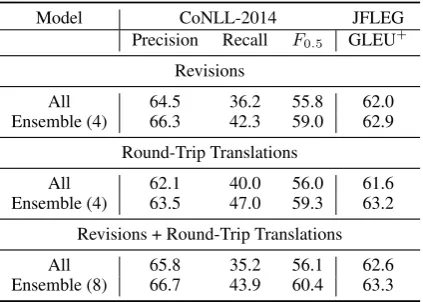
Having generated multiple diverse datasets, we in-vestigate strategies for utilizing combinations of data from multiple sources. For each corpus, we train a single model on all data and compare its performance to an ensemble of the 4
individually-trained models (Table 8). The ensemble clearly
outperforms the single model for both types of data. We additionally train a single model on the union of all Revisions and Round-Trip Translated
datasets reported on in Tables6 and7, which we
compare to an ensemble of the 8 models trained individually on those datasets.
When Wikipedia edits are combined with the round-trip translations, the single-model perfor-mance remains unchanged on CoNLL-2014, while the ensemble shows an improvement. This sug-gests that when utilizing disparate sources of data, an ensemble is preferable to combining the data.
6.5 Comparison with Other systems
We compare the performance of our best individ-ual system, trained on all revisions, the best en-semble of 8 models trained from both revisions and roundtrip translations on the CoNLL-2014
and JFLEG datasets (Table 9). We only report
Model CoNLL-2014 JFLEG Precision Recall F0.5 GLEU
+
Revisions
All 64.5 36.2 55.8 62.0
Ensemble (4) 66.3 42.3 59.0 62.9
Round-Trip Translations
All 62.1 40.0 56.0 61.6
Ensemble (4) 63.5 47.0 59.3 63.2
Revisions + Round-Trip Translations
All 65.8 35.2 56.1 62.6
[image:7.595.76.288.62.213.2]Ensemble (8) 66.7 43.9 60.4 63.3
Table 8: Combining datasets using either a single model trained on all data versus an ensemble of models. All models are fine-tuned on Lang-8.
Lang-8 and CoNLL datasets. Our single system trained on all revisions outperforms all previous systems on both datasets, and our ensemble
im-proves upon the single system result6.
7 Error Analysis
All models trained on Wikipedia-derived data are demonstrated to benefit significantly from
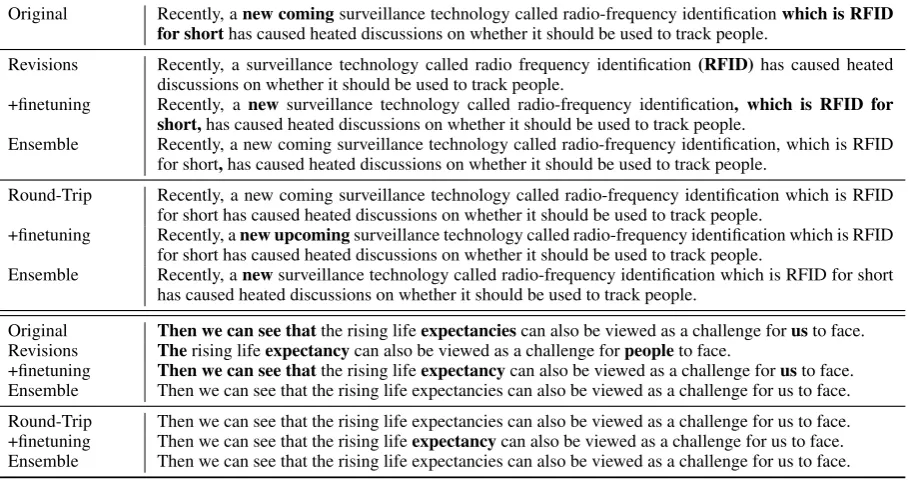
fine-tuning on Lang-8 (Tables 6and 7). In Table 10,
we compare example corrections proposed by two Wikipedia-derived models to the corrections proposed by their fine-tuned counterparts. The changes proposed by the revisions-trained model often appear to be improvements to the original sentence, but fall outside the scope of GEC. Mod-els finetuned on Lang-8 learn to make more con-servative corrections.
The finetuning on Lang-8 can be viewed as an adaptation technique that shifts the model from the Wikipedia-editing task to the GEC task. On Wikipedia, it is common to see substantial ed-its that make the text more concise and readable, e.g. replacing “which is RFID for short” with “(RFID)”, or removing less important clauses like “Then we can see that”. But these are not ap-propriate for GEC as they are editorial style fixes rather than grammatical fixes. The models trained on round-trip translation seem to be make fewer drastic changes.
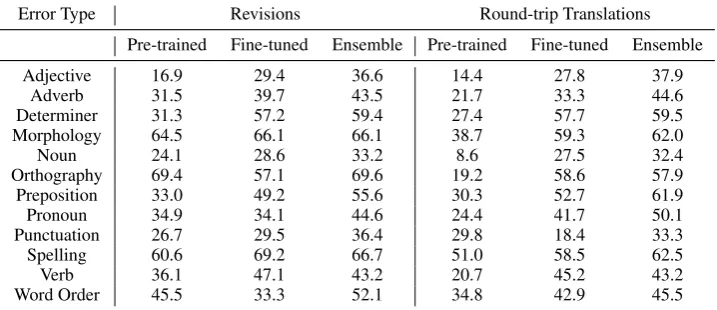
Table 11 reports F0.5 across broad error
cat-egories for models trained from revisions and round-trip translations on the CoNLL-2014 test
6Using non-public sentences beyond the regular Lang-8
and CoNLL datasets, Tao et al.(2018b) recently obtained anF0.5of 61.3 on CoNLL-2014 and a GLEU of 62.4 on JF-LEG. Using finetuning data beyond the standard datasets, we obtain anF0.5of 62.8 on CoNLL-2014 and a GLEU of 65.0 on JFLEG.
set. The error categories were tagged using the
approach in Bryant et al. (2017). Although the
overallF0.5 of the 2 ensembles are similar, there
are notable differences on specific categories. The ensemble using round-trip translation performs considerably better on prepositions and pronouns while the revision ensemble is better on morphol-ogy and orthography. Thus, each system may have advantages on specific domains.
8 Related Work
Progress in GEC has accelerated rapidly since
the CoNLL-2014 Shared Task (Ng et al.,
2014). Rozovskaya and Roth(2016) combined a
Phrase Based Machine Translation (PBMT) model
trained on the Lang-8 dataset (Mizumoto et al.,
2011) with error specific classifiers.
Junczys-Dowmunt and Grundkiewicz (2016) combined a
PBMT model with bitext features and a larger lan-guage model. The first Neural Machine Transla-tion (NMT) model to reach the state of the art on
CoNLL-2014 (Chollampatt and Ng, 2018) used
an ensemble of four convolutional sequence-to-sequence models followed by rescoring. The
cur-rent state of the art (F0.5 of 56.25 on
CoNLL-2014) using publicly available Lang-8 and CoNLL
data was achieved byGrundkiewicz and
Junczys-Dowmunt(2018) with a hybrid PBMT-NMT
sys-tem. A neural-only result with anF0.5 of 56.1 on
CoNLL-2014 was reported byJunczys-Dowmunt
et al.(2018) using an ensemble of neural
Trans-formermodels (Vaswani et al., 2017), where the decoder side of each model is pretrained as a lan-guage model. From a modeling perspective, our approach can be viewed as a direct extension of this last work. Rather than pretraining only the de-coder as a language model, we pretrain on a large amount of parallel data from either Wikipedia re-vision histories or from round-trip translations. While pretraining on out-of-domain data has been employed previously for neural machine
transla-tion (Luong and Manning,2015), it has not been
presented in GEC thus far, perhaps due to the
ab-sence of such large datasets. Tao et al. (2018b)
apply iterative decoding, where two neural mod-els, trained in left-to-right and right-to-left direc-tions, are applied in an interleaved manner. Sim-ilar to their study, we find that iterative decoding can improve the performance of GEC.
Prior work (Brockett et al., 2006; Foster
Model CoNLL-2014 JFLEG Precision Recall F0.5 GLEU+
Chollampatt and Ng(2018) MLConvembed 60.9 23.7 46.4 51.3
Ensemble (4) +EO +LM +SpellCheck 65.5 33.1 54.8 57.5
Junczys-Dowmunt et al.(2018) Single Transformer 53.0 57.9
Ensemble (4) 63.0 38.9 56.1 58.5
Ensemble (4) +LM 61.9 40.2 55.8 59.9
Grundkiewicz and Junczys-Dowmunt(2018) Hybrid PBMT +NMT +LM 66.8 34.5 56.3 61.5
Best Single Model 65.5 37.1 56.8 61.6
[image:8.595.81.521.64.194.2]Best Ensemble 66.7 43.9 60.4 63.3
Table 9: Comparison of recent state-of-the-art models (top) and our best single-system and ensemble models (bottom) on the CoNLL-2014 and JFLEG datsets. Only systems trained with publicly available Lang-8 and CoNLL datasets are reported.
Original Recently, anew comingsurveillance technology called radio-frequency identificationwhich is RFID for shorthas caused heated discussions on whether it should be used to track people.
Revisions Recently, a surveillance technology called radio frequency identification(RFID)has caused heated discussions on whether it should be used to track people.
+finetuning Recently, anew surveillance technology called radio-frequency identification, which is RFID for short,has caused heated discussions on whether it should be used to track people.
Ensemble Recently, a new coming surveillance technology called radio-frequency identification, which is RFID for short,has caused heated discussions on whether it should be used to track people.
Round-Trip Recently, a new coming surveillance technology called radio-frequency identification which is RFID for short has caused heated discussions on whether it should be used to track people.
+finetuning Recently, anew upcomingsurveillance technology called radio-frequency identification which is RFID for short has caused heated discussions on whether it should be used to track people.
Ensemble Recently, anewsurveillance technology called radio-frequency identification which is RFID for short has caused heated discussions on whether it should be used to track people.
Original Then we can see thatthe rising lifeexpectanciescan also be viewed as a challenge forusto face. Revisions Therising lifeexpectancycan also be viewed as a challenge forpeopleto face.
+finetuning Then we can see thatthe rising lifeexpectancycan also be viewed as a challenge forusto face. Ensemble Then we can see that the rising life expectancies can also be viewed as a challenge for us to face.
Round-Trip Then we can see that the rising life expectancies can also be viewed as a challenge for us to face. +finetuning Then we can see that the rising lifeexpectancycan also be viewed as a challenge for us to face. Ensemble Then we can see that the rising life expectancies can also be viewed as a challenge for us to face.
Table 10: Corrections from models trained on (a) Wikipedia revisions and (b) round-trip translations using Japanese as a bridge language, along with suggestions from their Lang-8 finetuned counterparts. Also shown are the corrections from the ensembles of 4 wikipedia models as well as 4 models trained on round trip translations. Example sentences are from the CoNLL-2014 dev set.
2010), (Felice et al., 2014;Xie et al., 2016; Rei
et al., 2017) has investigated multiple strategies
for generating artificial errors in GEC. Cahill
et al. (2013) show that preposition corrections
extracted from Wikipedia revisions improve the quality of a GEC model for correcting preposition
errors. Back-translation (Sennrich et al., 2016a;
Xie et al., 2018) addresses data sparsity by
intro-ducing noise into a clean corpus using a trans-lation model trained in the clean to noisy direc-tion. However, training such a reverse translation model also requires access to parallel data which is scarce for GEC. In contrast, round-trip transla-tion attempts to introduce noise via bridge trans-lations. Round-trip translations have been
inves-tigated for GEC. Madnani et al. Madnani et al.
(2012) combine round-trip translations to generate
a lattice from which the best correction is extracted
using a language model. D´esilets et al. (2009) use
round-trip translations for correcting preposition errors. In contrast to these approaches, we em-ploy round-trip translations for generating a large parallel training corpus for neural GEC models.
9 Discussion
Motivated by data scarcity for the GEC task, we present two contrasting approaches for generat-ing large parallel corpora from the same publicly available data source. We believe both techniques offer promising research avenues for further devel-opment on the task.
[image:8.595.74.531.224.467.2]Error Type Revisions Round-trip Translations
Pre-trained Fine-tuned Ensemble Pre-trained Fine-tuned Ensemble
Adjective 16.9 29.4 36.6 14.4 27.8 37.9
Adverb 31.5 39.7 43.5 21.7 33.3 44.6
Determiner 31.3 57.2 59.4 27.4 57.7 59.5
Morphology 64.5 66.1 66.1 38.7 59.3 62.0
Noun 24.1 28.6 33.2 8.6 27.5 32.4
Orthography 69.4 57.1 69.6 19.2 58.6 57.9
Preposition 33.0 49.2 55.6 30.3 52.7 61.9
Pronoun 34.9 34.1 44.6 24.4 41.7 50.1
Punctuation 26.7 29.5 36.4 29.8 18.4 33.3
Spelling 60.6 69.2 66.7 51.0 58.5 62.5
Verb 36.1 47.1 43.2 20.7 45.2 43.2
[image:9.595.120.479.64.219.2]Word Order 45.5 33.3 52.1 34.8 42.9 45.5
Table 11:F0.5across error categories on the CoNLL-2014 test set.
opportunity to extend GEC into languages that may have no extant GEC corpora. While we ex-pect pre-training on Wikipedia to give us a rea-sonable model, it may be crucial to fine-tune this model on small amounts of clean, in-domain cor-pora to achieve good performance.
When extracting examples from the Wikipedia revisions, we implemented minimal filtration in pursuit of simplicity, and to produce a sufficiently large dataset. Implementing more complex fil-tration in order to reduce the noise in the gen-erated dataset will likely be a productive av-enue to increase the value of this approach. The performance achieved by the reported Wikipedia revisions-trained models, both with and without finetuning, may be used as a baseline by which to evaluate smaller, cleaner datasets drawn from Wikipedia revisions.
Round-trip translation takes advantage of the advanced state of the task of Machine Transla-tion relative to GEC by leveraging extant trans-lation models as a source of grammatical-style data corruption. In this work, we only experiment with producing English-language GEC corpora, but this technique can be extended to any of the many languages for which translation models ex-ist. It would be useful to assess how the translation quality influences the performance of the resulting GEC model. In our experiments with round-trip translation, we used target sentences drawn from Wikipedia to maintain a reasonable comparabil-ity between the two techniques. However, there is no constraint preventing the application of round-trip translation to diverse data sources; any source of clean text can be turned into a parallel GEC corpus. This can be used to increase diversity in the generated data, or to generate domain-specific GEC corpora (e.g. patents).
We observe that pooling two diverse data sources used to train competitively performing models on the same task can degrade performance. This suggests that within datasets useful for a spe-cific task, there may be greater value to be discov-ered in finding optimal partitions of the data for training models which can then be combined using ensembles. Prior work in combining diverse data
sources includes addition of special tokens (
John-son et al., 2017) and meta-learning (Finn et al.,
2017). We intend to compare ensembling with
these alternatives.
We have opensourced the scripts used to extract example pairs from Wikipedia, which we hope will become a resource in the further development of models for GEC as well as other NLP tasks that rely on edit histories, such as
sentence re-writing (Botha et al., 2018) and text
simplification (Tonelli et al.,2016).
Acknowledgements
We thank Jayakumar Hoskere, Emily Pitler, Slav Petrov, Daniel Andor, Alla Rozovskaya and Antonis Anastasopoulos for helpful suggestions. We also thank Jayakumar Hoskere, Shruti Gupta and Anmol Gulati for providing various GEC resources that were used in this paper.
References
Jan Botha, Manaal Faruqui, John Alex, Jason Baldridge, and Dipanjan Das. 2018. Learning to split and rephrase from wikipedia edit history. In Proceedings of EMNLP.
44th annual meeting of the Association for Compu-tational Linguistics, pages 249–256. Association for Computational Linguistics.
Christopher Bryant, Mariano Felice, and Ted Briscoe. 2017. Automatic annotation and evaluation of error types for grammatical error correction. In Proceed-ings of ACL.
Aoife Cahill, Nitin Madnani, Joel Tetreault, and Diane Napolitano. 2013. Robust systems for preposition error correction using wikipedia revisions. In Pro-ceedings of NAACL, pages 507–517. Association for Computational Linguistics.
Shamil Chollampatt and Hwee Tou Ng. 2018. A multilayer convolutional encoder-decoder neu-ral network for grammatical error correction. arXiv:1801.08831.
Fabian Cromieres, Chenhui Chu, Toshiaki Nakazawa, and Sadao Kurohashi. 2016. Kyoto university par-ticipation to wat 2016. In Proceedings of the 3rd Workshop on Asian Translation (WAT2016).
Daniel Dahlmeier and Hwee Tou Ng. 2012a. A beam-search decoder for grammatical error correction. In Joint Conference on Empirical Methods in Natural Language Processing and Computational Natural Language Learning.
Daniel Dahlmeier and Hwee Tou Ng. 2012b. Better evaluation for grammatical error correction. In Pro-ceedings of NAACL.
A. D´esilets and Hermet M. 2009. Using automatic roundtrip translation to repair general errors in sec-ond language writing. InProceedings of MT Summit XII.
Mariano Felice, Zheng Yuan, Øistein E. Andersen, He-len Yannakoudakis, and Ekaterina Kochmar. 2014. Grammatical error correction using hybrid systems and type filtering. In Proceedings of the Eigh-teenth Conference on Computational Natural Lan-guage Learning: Shared Task, pages 15–24. Associ-ation for ComputAssoci-ational Linguistics.
Chelsea Finn, Pieter Abbeel, and Sergey Levine. 2017. Model-agnostic meta-learning for fast adaptation of deep networks.CoRR, abs/1703.03400.
Jennifer Foster and Øistein E. Andersen. 2009. Gen-errate: Generating errors for use in grammatical er-ror detection. In Proceedings of the Fourth Work-shop on Innovative Use of NLP for Building Edu-cational Applications, EdAppsNLP ’09, pages 82– 90, Stroudsburg, PA, USA. Association for Compu-tational Linguistics.
Roman Grundkiewicz and Marcin Junczys-Dowmunt. 2014. The wiked error corpus: A corpus of correc-tive wikipedia edits and its application to grammat-ical error correction. In International Conference on Natural Language Processing, pages 478–490. Springer.
Roman Grundkiewicz and Marcin Junczys-Dowmunt. 2018. Near human-level performance in grammati-cal error correction with hybrid machine translation. arXiv:1804.05945.
Michael Heilman, Aoife Cahill, Nitin Madnani, Melissa Lopez, Matthew Mulholland, and Joel Tetreault. 2014. Predicting grammaticality on an or-dinal scale. InProceeedings of ACL.
Melvin Johnson, Mike Schuster, Quoc V. Le, Maxim Krikun, Yonghui Wu, Zhifeng Chen, Nikhil Thorat, Fernanda Vi´egas, Martin Wattenberg, Greg Corrado, Macduff Hughes, and Jeffrey Dean. 2017. Google’s multilingual neural machine translation system: En-abling zero-shot translation. Transactions of the As-sociation for Computational Linguistics, 5(1):339– 351.
Marcin Junczys-Dowmunt and Roman Grundkiewicz. 2016. Phrase-based machine translation is state-of-the-art for automatic grammatical error correction. InProceedings of EMNLP.
Marcin Junczys-Dowmunt, Roman Grundkiewicz, Shubha Guha, and Kenneth Heafield. 2018. Approaching neural grammatical error correc-tion as a low-resource machine translacorrec-tion task. arXiv:1804.05940.
Philipp Koehn and Rebecca Knowles. 2017. Six challenges for neural machine translation. CoRR, abs/1706.03872.
Minh-Thang Luong and Christopher D. Manning. 2015. Stanford neural machine translation systems for spoken language domain. InInternational Work-shop on Spoken Language Translation.
Nitin Madnani, Joel Tetreault, and Martin Chodorow. 2012. Exploring grammatical error correction with not-so-crummy machine translation. In Proceed-ings of the Seventh Workshop on Building Educa-tional Applications Using NLP, NAACL HLT ’12, pages 44–53, Stroudsburg, PA, USA. Association for Computational Linguistics.
Tomoya Mizumoto, Mamoru Komachi, Masaaki Na-gata, and Yuji Matsumoto. 2011. Mining revi-sion log of language learning SNS for automated japanese error correction of second language learn-ers. InProceedings of IJCNLP, pages 147–155.
Courtney Napoles, Keisuke Sakaguchi, Matt Post, and Joel Tetreault. 2016. GLEU without tuning. arXiv:1605.02592.
Courtney Napoles, Keisuke Sakaguchi, and Joel Tetreault. 2017. JFLEG: A fluency corpus and benchmark for grammatical error correction. In Pro-ceedings of EACL.
Marek Rei, Mariano Felice, Zheng Yuan, and Ted Briscoe. 2017. Artificial error generation with ma-chine translation and syntactic patterns. In Proceed-ings of the 12th Workshop on Innovative Use of NLP for Building Educational Applications.
Alla Rozovskaya and Dan Roth. 2010. Generating con-fusion sets for context-sensitive error correction. In Proceedings of EMNLP.
Alla Rozovskaya and Dan Roth. 2016. Grammatical error correction: Machine translation and classifiers. InProceedings of ACL.
Michael Schuster and Kaisuke Nakajima. 2012. Japanese and korean voice search. InProceedings of ICASSP.
Rico Sennrich, Barry Haddow, and Alexandra Birch. 2016a. Improving neural machine translation mod-els with monolingual data. InProceedings of ACL.
Rico Sennrich, Barry Haddow, and Alexandra Birch. 2016b. Neural machine translation of rare words with subword units. InProceedings of ACL.
Noam Shazeer and Mitchell Stern. 2018. Adafactor: Adaptive learning rates with sublinear memory cost. arXiv:1804.04235.
Ilya Sutskever, Oriol Vinyals, and Quoc V Le. 2014. Sequence to sequence learning with neural net-works. InAdvances in Neural Information Process-ing Systems.
Ge Tao, Furu Wei, and Ming Zhou. 2018a. Fluency boost learning and inference for neural grammatical error correction. InProceedings of ACL.
Ge Tao, Furu Wei, and Ming Zhou. 2018b. Reaching human-level performance in automatic grammar error correction: An empirical study. arXiv:1807.01270.
Sara Tonelli, Alessio Palmero Aprosio, and Francesca Saltori. 2016. Simpitiki: a simplification corpus for italian. InProceedings of CLiC-it.
Ashish Vaswani, Noam Shazeer, Niki Parmar, Jakob Uszkoreit, Llion Jones, Aidan N Gomez, Łukasz Kaiser, and Illia Polosukhin. 2017. Attention is all you need. InAdvances in Neural Information Pro-cessing Systems, pages 6000–6010.
Yonghui Wu, Mike Schuster, Zhifeng Chen, Quoc V. Le, Mohammad Norouzi, Wolfgang Macherey, Maxim Krikun, Yuan Cao, Qin Gao, Klaus Macherey, Jeff Klingner, Apurva Shah, Melvin Johnson, Xiaobing Liu, Łukasz Kaiser, Stephan Gouws, Yoshikiyo Kato, Taku Kudo, Hideto Kazawa, Keith Stevens, George Kurian, Nishant Patil, Wei Wang, Cliff Young, Jason Smith, Jason Riesa, Alex Rudnick, Oriol Vinyals, Greg Corrado, Macduff Hughes, and Jeffrey Dean. 2016. Google’s neural machine translation system: Bridging the gap between human and machine translation.
Ziang Xie, Anand Avati, Naveen Arivazhagan, Dan Jurafsky, and Andrew Y Ng. 2016. Neural lan-guage correction with character-based attention. arXiv:1603.09727.