Proceedings of NAACL-HLT 2019, pages 2190–2200 2190
Partial Or Complete, That Is The Question
Qiang Ning,1 Hangfeng He,2Chuchu Fan,1 Dan Roth1,2
1Department of Electrical and Computer Engineering, University of Illinois at Urbana-Champaign 2Department of Computer and Information Science, University of Pennsylvania
{qning2,cfan10}@illinois.edu,{hangfeng,danroth}@seas.upenn.edu
Abstract
For many structured learning tasks, the data annotation process is complex and costly. Ex-isting annotation schemes usually aim at ac-quiringcompletelyannotated structures, under the common perception thatpartialstructures are of low quality and could hurt the learn-ing process. This paper questions this common perception, motivated by the fact that struc-tures consist of interdependent sets of vari-ables. Thus, given a fixed budget, partly an-notating each structure may provide the same level of supervision, while allowing for more structures to be annotated. We provide an in-formation theoretic formulation for this per-spective and use it, in the context of three di-verse structured learning tasks, to show that learning from partial structures cansometimes
outperform learning from complete ones. Our findings may provide important insights into structured data annotation schemes and could support progress in learning protocols for structured tasks.
1 Introduction
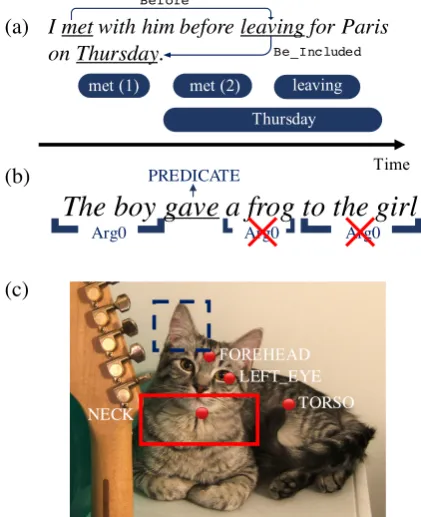
Many machine learning tasks require structured outputs, and the goal is to assign values to a set of variables coherently. Specifically, the variables in a structure need to satisfy some global properties required by the task. An important implication is that once some variables are determined, the val-ues taken by other variables are constrained. For instance, in the temporal relation extraction prob-lem in Fig.1a, ifmethappened beforeleavingand
leavinghappened onThursday, then we know that
metmust either be beforeThursday(“met (1)”) or has to happen onThursday, too (“met (2)”) (Ning et al.,2018a). Similarly, in the semantic frame of the predicategave(Kingsbury and Palmer,2002) in Fig. 1b, if the boy is ARG0 (short for
argu-ment 0), then it rules out the possibility ofa frog
met (2) leaving met (1)
Thursday
Time
I met with him before leaving for Paris on Thursday.
(a)
The boy gave a frog to the girl.
Arg0 Arg0 Arg0
PREDICATE
(b)
!FOREHEAD !LEFT_EYE
!TORSO
!
(c)
NECK Before
[image:1.595.312.523.229.488.2]Be_Included
Figure 1: Due to the inherent structural constraints of each task, individual instances therein put restric-tions on others. (a) The temporal relation between
met andThursday has to be BEFORE (“met (1)”) or
BE INCLUDED (“met (2)”). (b) The argument roles
of a frog and to the girl cannot be ARG0 anymore. (c) Given the position of the cat’s FOREHEAD and LEFT EYE, a rough estimate of its NECK can be the red solid box rather than the blue dashed box.
orto the girltaking the same role. Figure 1c fur-ther shows an example of part-labeling of images (Choi et al., 2018); given the position of FORE-HEAD and LEFT EYE of the cat in the picture, we roughly know that its NECK should be some-where in the red solid box, while the blue dashed box is likely to be wrong.
investigated for decades from the perspective of active learning for classification tasks (Angluin,
1988; Atlas et al., 1990; Lewis and Gale, 1994) and for structured tasks (Roth and Small,2006a,b,
2008;Hu et al.,2019). While active learning aims at selecting the next structure to label, we try to investigate, from a different perspective, whether we should annotate each structure completely or partially. Conventional annotation schemes typi-cally require completestructures, under the com-mon perception that partial annotation could ad-versely affect the performance of the learning al-gorithm. But note that partial annotations will allow for more structures to be annotated (see Fig. 2). Therefore, a fair comparison should be done while maintaining a fixed annotation bud-get, which was not done before. Moreover, even if partial annotation leads to comparable learning performance to conventional complete schemes, it provides more flexibility in data annotation.
Another potential benefit of partial annotation is that it imposes constraints on the remaining parts of a structure. As illustrated by Fig.1, with par-tial annotations, we already have some knowledge about the unannotated parts. Therefore, further an-notations of these variables may use the available budget less efficiently; this effect was first dis-cussed in Ning et al. (2018c). Motivated by the observations in Figs. 1-2, we think it is impor-tant to study partialness systematically, before we hastily assume thatcompletenessshould always be favored in data collection.
To study whether the above benefits of par-tialness can offset its weakness for learning, our first contribution is the proposal of early stop-ping partial annotation (ESPA) scheme, which randomly picks up instances to label in the be-ginning, and stops before a structure is completed. We do not claim that ESPA shouldalwaysbe pre-ferred; instead, it serves as analternativeto con-ventional, complete annotation schemes that we should keep in mind, because, as we show later, it can be comparable to (and sometimes even bet-ter than) complete annotation schemes. ESPA is straightforward to implement even in crowdsourc-ing; instances to annotate can be selected offline
and distributed to crowdsourcers; this can be con-trasted with the difficulties of implementing active learning protocols in these settings (Ambati et al.,
2010;Laws et al.,2011). We think that ESPA is a good representative for a systematic study of
par-tialness.
[image:2.595.319.520.87.160.2](a) Complete (b) Partial
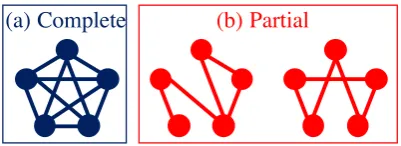
Figure 2: If we need training data for a graph labeling task (assuming the gold values for the nodes are given) and our annotation budget allows us to annotate, for instance, 10 edges in total, we could (a) completely an-notate one graph (and then we run out of budget), or (b) partially annotate two graphs.
Our second contributionis the development of an information theoretic formulation to explain the benefit of ESPA (Sec.2), which we further demon-strate via three structured learning tasks in Sec.4: temporal relation (TempRel) extraction (UzZaman et al.,2013), semantic role classification (SRC),1 and shallow parsing (Tjong Kim Sang and Buch-holz,2000). These tasks are chosen because they each represent a wide spectrum of structures that we will detail later. As a byproduct, we extend constraint-driven learning (CoDL) (Chang et al.,
2007) to cope with partially annotated structures (Sec. 3); we call the algorithm Structured Self-learning with Partial ANnotations(SSPAN) to dis-tinguish it from CoDL.2
We believe in the importance of work in this direction. First, partialness is inevitable in prac-tice, either by mistake or by choice, so our the-oretical analysis can provide unique insight into understanding partialness.Second, it opens up op-portunities for new annotation schemes.Instead of considering partial annotations as a compromise, we can in fact annotate partial dataintentionally, allowing us to design favorable guidelines and collect more important annotations at a cheaper price. Many recent datasets that were collected via crowdsourcing are already partial, and this paper provides some theoretical foundations for them. Furthermore, the setting described here addresses natural scenarios where only partial, indirect su-pervision is available, as inIncidental Supervision
1A subtask of semantic role labeling (SRL) (Palmer et al., 2010) that only classifies the role of an argument.
2There has been many works on learning from partial
(Roth,2017), and this paper begins to provide the-oretical understanding for this paradigm, too. Fur-ther discussions can be found in Sec.5.
It is important to clarify that we assume uniform cost over individual annotations (that is, all edges in Fig.2cost equally), often the default setting in crowdsourcing. We realize that the annotation dif-ficulty can vary a lot in practice, sometimes incur-ring different costs. To address this issue, we ran-domly select instances to label so that on average, the cost is uniform. We agree that, even with this randomness, there could still be situations where the assumption does not hold, but we leave it for future studies, possibly in the context of active learning schemes.
2 ESPA: Early Stopping Partial Annotation
In this section, we study whether the effect demon-strated by the examples in Fig.1exists in general. First, we formally definestructureandannotation.
Definition 1. A structure of size d is a vector
of random variables (RV) Y = [Y1, . . . , Yd] 2
C(Ld), whereL = {`
1, . . . ,`|L|}is the label set for each variable andC(Ld)✓Ldrepresents the constraints imposed by this type of structure.
It is necessary to model a structure as a set ofrandomvariables because when it is not com-pletely annotated, there is still uncertainty in the annotation assignment. To study partial annota-tions, we introduce the following:
Definition 2. Ak-step annotation (0kd) is a
vector of RVsAk = [Ak,1, . . . , Ak,d]2 (L[ u)d whereuis a special character for null, such that
d X
i=1
1(Ak,i6=u) =k, (1)
P(Y|Ak=ak) =P(Y|Yj =ak,j, j 2J), (2)
whereJ is the set of indices thatak,j6=u.
Eq. (1) means that, in total,k variables are
al-ready annotated at step k. Obviously, A0 means
that no variables are labeled, andAdmeans that
all variables inY are determined.Ak is what we
call ak-step ESPA, so hereafter we usek/dto
rep-resent annotation completeness. Eq. (2) assumes no annotation mistakes, so if the i-th variable is
labeled, thenYimust be the same asAk,i.
To measure the theoretical benefit of Ak, we
propose the following quantity
Ik= log|C(Ld)| E[logf(ak)] (3)
fork = 0, . . . , d, wheref(ak) =|{y 2 C(Ld) :
P(y|ak)>0}|is the total number of structures in
C(Ld) that are still valid givenA
k = ak. Since
we assume that the labeled variables inAkare
se-lected uniformly randomly,E[·]is simply the av-erage oflogf(ak). Whenk= 0,f(ak)⌘C(Ld)
andI0 ⌘ 0; askincreases,Ikincreases since the
structure has more and more variables labeled; fi-nally, when k = d, the structure is fully
deter-mined andId⌘log|C(Ld)|. The first-order finite
difference,Ik Ik 1, is the benefit brought by
an-notating an additional variable at step k; if Ik is
concave (i.e., a decaying Ik Ik 1), the benefit
from a new annotation attenuates, suggesting the potential benefit of the ESPA strategy.
In an extreme case where the structure is so strong that it requires all individual variables to share the same label, then labeling any variable is sufficient for determining the entire structure. Intuitively, we do not need to annotate more than one variable. OurIk quantity can support this
in-tuition: The structural constraint,C(Ld), contains
only|L|elements:{[`i,`i, . . . ,`i]}|L|i=1, soI0 = 0,
andI1 =· · ·=Id= log|L|. SinceIkdoes not
in-crease at all whenk >= 1, we should adopt first-step annotationA1. Another extreme case is that
of a trivial structure that has no constraints (i.e.,
C(Yd) =Yd). The annotation of all variables are
independent and we gain no advantage from skip-ping any variables. This intuition can be supported by ourIk analysis as well: Since Ik = klog|L|,
8k = 0,1, . . . , d, Ik is linear and all steps
con-tribute equally to improvingIk by log|L|;
there-fore ESPA is not necessary.
Real-world structures are often not as trivial as the two extreme cases above, butIkcan still serve
as a guideline to help determine whether it is ben-eficial to use ESPA. We next discuss three diverse types of structures and how to obtainIkfor them.
Example 1. The ranking problem is an impor-tant machine learning task and often depends on pairwise comparisons, for which the label set is
L={<, >}. For a ranking problem withnitems,
there ared=n(n 1)/2pairwise comparisons in
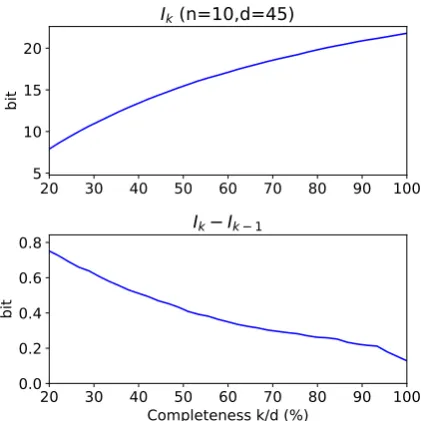
Figure 3: The mutual information between the chain structure and itsk-step ESPA,Ik, is concave,
suggest-ing possible benefit of ussuggest-ing ESPA. In the simulation, there aren = 10items in the chain and thusd = 45 pairs,kof which are labeled. The values ofIk’s, as
de-fined by Eq. (3), were obtained through averaging 1000 experiments. We use base-2 logarithm and the unit on y-axis is thus “bit”.
Ak-step ESPAAk for a chain means that only
k (out of d) pairs are compared and labeled,
re-sulting in a directed acyclic graph (DAG). In this case,f(ak)is actually counting the number of
lin-ear extensions of the DAG, which is known to be #P-complete (Brightwell and Winkler, 1991), so we do not have a closed-form solution to Ik. In
practice, however, we can use the Kahn’s algo-rithm and backtracking to simulate with a rela-tively smalln, as shown by Fig.3, wheren= 10 andIkwas obtained through averaging 1000
ran-dom simulations.Ikis concave, as reflected by the
downward shape ofIk Ik 1. Therefore, new
an-notations are less and less efficient for the chain structure, suggesting the usage of ESPA.
Example 2. The general assignment problem re-quires assigningdagents tod0 tasks such that the
agent nodes and the task nodes form a bipartite graph (without loss of generality, assumedd0). That is, an agent can handle exactly one task, and each task can only be handled by at most one agent. Then from the agents’ point of view, the la-bel set for each of them isL ={1,2, . . . , d0}, de-noting the task assigned to the agent.
A k-step ESPA Ak for this problem means
that k agents are already assigned with tasks, and f(ak) is to count the valid assignments
of the remaining tasks to the remaining d k
agents, to which we have closed-form solutions:
f(ak) = (d
0 k)!
(d0 d)!,8ak. According to Eq. (3),Ik =
log(d0d0!k)! regardless of d or the distribution of
Ak, and is concave (Fig.4 shows an example of
it whend= 4, d0 = 10).
Example 3. Sequence tagging is an important NLP problem, where the tags of tokens are inter-dependent. Take chunking as an example. A basic scheme is for each token to choose from three la-bels, B(egin), I(nside), and O(utside), to represent text chunks in a sentence. That is,L={B, I, O}.
Obviously, O cannot be immediately followed by I.
Letdbe the number of tokens in a sentence. A k-step ESPAAkfor chunking means thatktokens
are already labeled by B/I/O, andf(ak)counts the
valid BIO sequences that do not violate those ex-isting annotations. Again, as far as we know, there is no closed-form solution to f(ak) and Ik, but
in practice, we can use dynamic programming to obtain f(ak) and then Ik using Eq. (3). We set
d= 10and showIk Ik 1for this task in Fig.4,
where we observe the same effect we see in previ-ous examples: The benefit provided by labeling a new token in the structure attenuates.
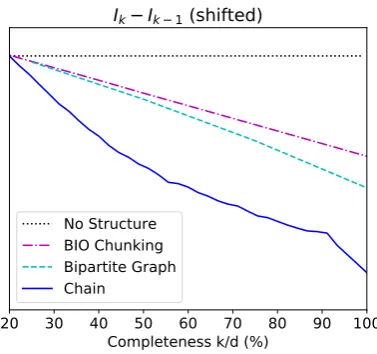
Interestingly, based on Fig. 4, we find that the slope ofIk Ik 1may be a good measure of the
“tightness” or “strength” of a structure. When there is no structure at all, the curve is flat (black). The BIO structure is intuitively simple, and it in-deed has the flattest slope among the three struc-tured tasks (purple). When the structure is a chain, the level of uncertainty goes down rapidly with ev-ery single annotation (think of standard sorting al-gorithms); the constraint is intuitively strong and in Fig.4, it indeed has a steep slope (blue).
Finally, we want to emphasize that the defi-nition of Ik in Eq.(3) is in fact backed by
in-formation theory.When we do not have prior in-formation aboutY, we can assume thatYfollows a uniform distribution overC(Ld). Then,I
kis
es-sentially the mutual information between structure Yand annotationAk,I(Y;Ak):
I(Y;Ak) =H(Y) H(Y|Ak)
= log|C(Ld)| E[H(Y|Ak=ak)]
= log|C(Ld)| E[logf(ak)],
im-portant discovery, since it points out a new way to view a structure and its annotations. It may be use-ful for studying active learning methods for struc-tured tasks, and other annotation phenomena such as noisy annotations. The usage of mutual infor-mation also aligns well with the inforinfor-mation bot-tleneck framework (Shamir et al.,2010; Shwartz-Ziv and Tishby,2017;Yu and Principe,2018), al-though a more recent paper challenges the inter-pretation of information bottleneck (Saxe et al.,
[image:5.595.100.289.228.405.2]2018).
Figure 4: TheIk Ik 1curves from several different
structures. The curves are shifted to almost the same starting point for better visualization, so the Y-Axis grid is not shown. The curve for “Chain” was obtained via simulations, and the other curves all have closed-form closed-formulations.
3 Learning from Partial Structures So far, we have been advocating the ESPA strat-egy to maximize the information we can get from a fixed budget. Since early stopping leads to par-tial annotations, one missing component before we can benefit from it is an approach to learn-ing from partial structures. In this study, we as-sume the existence of a relatively small but com-plete dataset that can provide a good initializa-tion for learning from a partial dataset, which is very similar to semi-supervised learning (SSL). SSL, in its most standard form, studies the com-bined usage of a labeled set T = {(xi, yi)}i
and an unlabeled set U = {xj}j, where the x’s
are instances and y’s are the corresponding
la-bels. SSL gains information aboutp(x)throughU, which may improve the estimation ofp(y|x). Spe-cific algorithms range from self-training (
Scud-der, 1965; Yarowsky, 1995), co-training (Blum and Mitchell, 1998), generative models (Nigam et al., 2000), to transductive SVM (Joachims,
1999) etc., among which one of the most ba-sic algorithms is Expectation-Maximization (EM) (Dempster et al., 1977). By treating them as hid-den variables, EM “marginalizes” out the missing labels ofUvia expectation (i.e., soft EM) or maxi-mization (i.e., hard EM). For structured ML tasks, soft and hard EMs turn into posterior regulariza-tion (PR) (Ganchev et al., 2010) and constraint-driven learning (CoDL) (Chang et al., 2007), re-spectively.
Unlike unlabeled data, the partially annotated structures caused by early stopping urge us to gain information not only about p(x), but also from their labeled parts. There have been many existing work along this line (Tsuboi et al.,2008; Fernan-des and Brefeld,2011;Hovy and Hovy,2012;Lou and Hamprecht, 2012), but in this paper, we de-cide to extend CoDL to cope with partial annota-tions due to two reasons. First, CoDL, which itself can be viewed as an extension of self-training to
structuredlearning, is a wrapper algorithm having wide applications. Second, as its name suggests, CoDL learns from U by guidance of constraints, so partial annotations inU are technically easy to be added as extra equality constraints.
Algorithm 1 describes our Structured Self-learning with Partial ANnotations (SSPAN) al-gorithm that learns a model H. The same as CoDL, SSPAN is a wrapper algorithm requir-ing two components: LEARN and INFERENCE.
LEARN attempts to estimate the local decision
function for each individual instance regardless of theglobalconstraints, while INFERENCEtakes
those local decisions and performs aglobal infer-ence. Lines3-9are the procedure of self-training, which iteratively completes the missing annota-tions in P and learns from both T and the com-pleted version ofP (i.e.,P˜).3Line6requires that the inference follows the structural constraints in-herently in the task, turning the algorithm into CoDL; Line7enforces those partial annotations in ai, further turning it into SSPAN. In practice, IN -FERENCE can be realized by the Viterbi or beam
search algorithm in sequence tagging, or more generally, by Integer Linear Programming (ILP)
3Line9can be interpreted in different ways, either asT[
˜
(Punyakanok et al.,2005); either way, the partial constraints of Line7can be easily incorporated.
Algorithm 1: Structured Self-learning with Partial Annotations (SSPAN)
Input:T ={(xi,yi)}Ni=1,P={(xi,ai)}Ni=+NM+1 1 InitializeH=LEARN(T)
2 whileconvergence criteria not satisfieddo
3 P˜ =;
4 foreach(xi,ai)2P do
5 yˆi= INFERENCE(xi;H), such that
6 ⇧ yˆi 2C(Yd)
7 ⇧ yˆi,j =ai,j,8ai,j 6=u
8 P˜ = ˜P [{(xi,yˆi)}
9 H=LEARN(T + ˜P)
10 returnH
4 Experiment
In Sec.2, we argued from an information theoretic view that ESPA is beneficial for structured tasks if we have a fixed annotation resource. We then pro-posed SSPAN in Sec.3to learn from the resulting partial structures.However, on one hand, there is still a gap between theIk analysis and the actual
system performance; on the other hand, whether the benefit can be realized in practice also depends on how effective the algorithm exploits partial an-notations. Therefore, it remains to be seen how ESPA works in practice. Here we use three NLP tasks: temporal relation (TempRel) extraction, se-mantic role classification (SRC), and shallow pars-ing, analogous to the chain, assignment, and BIO structures, respectively.
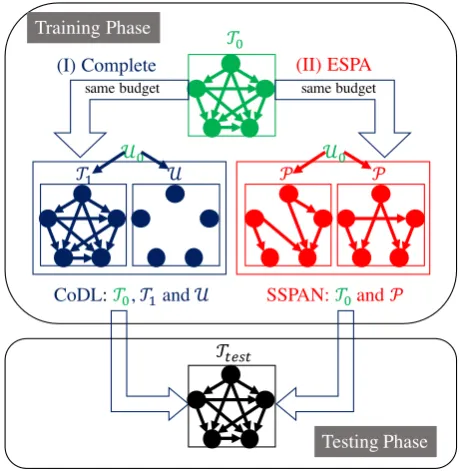
For all tasks, we compare the following two schemes in Fig. 5, where we use graph struc-tures for demonstration. Initially, we have a rel-atively small but complete dataset T0, an
unan-notated dataset U0, and some budget to annotate U0. The conventional scheme I, also our baseline
here, is to annotate each structure completely be-fore randomly picking up the next one. Due to the limited budget, some U0 remain untouched
(denoted by U). The proposed scheme II adopts ESPA so that all structures at hand are annotated but only partially. For fair comparisons, we use CoDL to incorporate U into scheme I as well. Finally, the systems trained on the dataset from I/II via CoDL/SSPAN are evaluated on unseen but complete testsetTtest. Note that because ESPA is
a new annotation scheme, there exists no dataset collected this way. We use existing complete datasets and randomly throw out some annotations to mimic ESPA in the following. Due to the ran-domness in selecting which structures/instances to keep in scheme I/II, we repeat the whole process multiple times and report the meanF1. The
bud-get, defined as the total number of individual in-stances that can be annotated, ranges from 10% to 100% with a stepsize of 10%, where x% means x% of all instances inU0can be annotated.
(I) Complete (II) ESPA !"
same budget same budget
!# $ % %
Training Phase
!&'(&
Testing Phase
CoDL: !", !#and $ SSPAN: !"and %
[image:6.595.305.535.222.458.2]$" $"
Figure 5: The two annotation schemes we compare in Sec. 4.T,P, andU denote complete, partial, and empty structures, respectively. Both schemes start with a complete and relatively small dataset and an untated dataset (green). (I) Conventional complete anno-tation scheme (blue). (II) The proposed ESPA scheme (red). Finally, they are tested on an unseen and com-plete dataset (black).
4.1 Temporal Relation Extraction
Temporal relations (TempRel) are a type of im-portant relations representing the temporal order-ing of events described by natural language text. That is to answer questions like which event hap-pens earlier or later in time (see Fig. 1a). Since time is physically one-dimensional, ifAis before
B andB is also before C, thenA must be before
C. In practice, the label set for TempRels can be more complex, e.g., with labels such as SIMULTA -NEOUS and VAGUE, but the structure can still be
an analogy of the chain structure in Example1. To avoid missing relations, annotators are re-quired to exhaustively label every pair of events in a document (i.e., the complete annotation scheme), so it is necessary to study ESPA in this context. Here we adopt the MATRES dataset (Ning et al., 2018b) for its better inter-annotator agreement and relatively large size.
Specifically, we use 35 documents as T0 (the
TimeBank-Dense section,4 147 documents asU
0
(the TimeBank section minus those documents in T0), and the Platinum section (a benchmark testset
of 20 documents with 1K TempRels) asTtest. Note
that both schemes I and II are mimicked by down-sampling the original annotations in MATRES, where the budget is defined as the total number of TempRels that are kept. Following CogComp-Time (Ning et al.,2018d), we choose the same fea-tures and sparse-averaged perceptron algorithm as the LEARNcomponent and ILP as INFERENCEfor
SSPAN.
4.2 Semantic Role Classification (SRC)
Semantic role labeling (SRL) is to represent the semantic meanings of language and answer ques-tions like Who did What to Whom and When, Where, How(Palmer et al.,2010). Semantic Role Classification (SRC) is a subtask of SRL, which assumes gold predicates and argument chunks and only classifies the semantic role of each argument. We use the Verb SRL dataset provided by the CoNLL-2005 shared task (Carreras and M`arquez,
2005), where the semantic roles include num-bered arguments, e.g., ARG0 and ARG1, and
argu-ment modifiers, e.g., location (AM-LOC),
tempo-ral (AM-TMP), and manner (AM-MNR) (see
Prop-Bank (Kingsbury and Palmer, 2002)). The struc-tural constraints for SRC is that each argument can be assigned to exactly one semantic role, and the same role cannot appear twice for a single verb, so SRC is an assignment problem as in Example2.
Specifically, we use the Wall Street Journal (WSJ) part of Penn TreeBank III (Marcus et al.,
1993). We randomly select 700 sentences from the Sec. 24 of WSJ, among which 100 sentences asT0
and 600 sentences as U0. Our Ttest is 5700
sen-tences (about 40K arguments) from Secs. 00, 01, 23. The budget here is defined as the total num-4The original TimeBank-Dense section contains 36
docu-ments, but in collecting MATRES, one of the documents was filtered out because it contained no TempRels between main-axis events.
ber of the arguments. We adopt the SRL system in CogCompNLP (Khashabi et al.,2018) and uses the sparse averaged perceptron as LEARNand ILP
as INFERENCE.
4.3 Shallow Parsing
Shallow parsing, also referred as chunking, is a fundamental NLP task to identify constituents in a sentence, such as noun phrases (NP), verb phrases (VP), and adjective phrases (ADJP), which can be viewed as extending the standard BIO structure in Example3with different chunk types: B-NP, I-NP, B-VP, I-VP, B-ADJP, I-ADJP, . . . , O.
We use the chunking dataset provided by the CoNLL-2000 shared task (Tjong Kim Sang and Buchholz,2000). Specifically, we use 2K tokens’ annotations as T0, 14K tokens as U0, and the
benchmark testset (25K tokens) asTtest. The
bud-get here is defined as the total number of tokens’ BIO labels. The algorithm we use here is the chun-ker provided in CogCompNLP, where the LEARN
component is the sparse averaged perceptron and the INFERENCE is described in (Punyakanok and Roth,2001).
4.4 Results
We compare theF1performances of all three tasks
in Fig.6, averaged from 50 experiments with dif-ferent randomizations. As the budget increases, the systemF1 increases for both schemes I and II
in all three tasks, which confirms the capability of the proposed SSPAN framework to learn from par-tial structures. When the budget is 100% (i.e., the entireU0is annotated), schemes I and II have
neg-ligible differences; when the budget is not large enough to cover the entireU0, scheme II is
consis-tently better than I in all tasks, which follows our expectations based on theIk analysis. The strict
improvement for all budget ratios indicates that the observation is definitely not by chance.
++ ++ ++ ++ ++ ++ ++ ++ +
(a) Temporal Relation Extraction
+ + ++ ++ ++ ++ ++
(b) SRC
+ + ++ +
[image:8.595.92.512.65.175.2](c) Shallow Parsing
Figure 6: Comparison of the baseline, complete annotation scheme and the proposed ESPA scheme (See I & II in Fig.5) under three structured learning tasks (note the scale difference). EachF1 value is the average of 50
experiments, and each curve is based on correspondingF1values smoothed by Savitzky-Golay filters. We can see
that scheme II is consistently better than scheme I. Per the Wilcoxon rank-sum test, the significance levels at each given budget are shown on the x-axes, where+and++meanp <5%andp <1%, respectively.
Admittedly, the improvement, albeit statisti-cally significant, is small, but it does not dimin-ish the contribution of this paper: Our goal is to remind people that the ESPA scheme (or more generally, partialness) is, at the least, comparable to (or sometimes even better than) complete an-notation schemes. Also, the comparison here is in fact unfair to the partial scheme II, because we as-sume equal cost for both schemes, although it of-ten costs less in a partial scheme as a large prob-lem is decomposed into smaller parts. Therefore, the results shown here implies that the informa-tion theoretical benefit of partialness can possibly offset its disadvantages for learning.
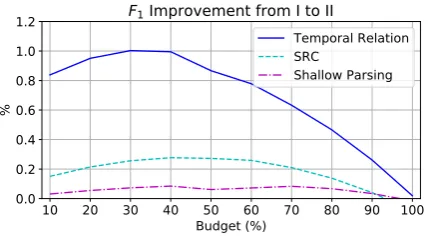
Figure 7: The improvement ofF1brought by ESPA for
each task in Fig. 6. Note that we conjectured earlier in Fig.4that the BIO structure is the weakest among the three, which is consistent with the fact that shallow parsing benefits the least from ESPA.
5 Dicussion and Conclusion
In this paper, we investigate a less studied, yet important question for structured learning: Given a limited annotation budget (either in time or money), which strategy is better, completely
an-notating each structure until the budget runs out, or annotating more structures at the cost of leav-ing some of them partially annotated? Neubig and Mori (2010) investigated this issue specifi-cally in annotating word boundaries and pronunci-ations for Japanese. Instead of annotating full sen-tences, they proposed to annotate only some words in a sentence (i.e., partially) that can be chosen heuristically (e.g., skip those that we have seen or those low frequency words). Conceptually, Neu-big and Mori (2010) is an active learning work, with the understanding that if the order of annota-tion is deliberately designed, better learning can be achieved. The current paper addresses the problem from a different angle: Even without active learn-ing, can we still answer the question above?
The observation driving our questions is that when annotating a particular structure, the labels of the yet to be labeled variables may already be constrained by previous annotations and carry less information than those in a totally new struc-ture. Therefore, we systematically study the ESPA scheme – stop annotating a given structure before it is completed and continue annotating another new structure.
[image:8.595.62.281.473.591.2]annotating easy cases. Second, even if we only require labeling partial structures, it is likely that the annotator still needs to comprehend the entire structure, incurring additional cost (usually in terms of time). This issue, however, is not addressed in this paper.
Using this definition of cost, we provide a the-oretical analysis for ESPA based on the mutual information between target structures and anno-tation processes. We show that for structures like chains, bipartite graphs, and BIO chunks, the in-formation brought by an extra annotation atten-uates as the annotation of the structure is more complete, suggesting to stop early and move to a new structure (although it still remains unclear when it is optimal to stop). This analysis is further supported by experiments on temporal relation ex-traction, semantic role classification, and shallow parsing, three tasks analogous to the three struc-tures analyzed earlier, respectively. The ratio of the attenuation curve as in Fig. 4 is also shown to be an actionable metric to quantify the strength of a type of structure, which can be useful in var-ious analysis, including judging whether ESPA is worthwhile for a particular task. For example, a more detailed Ik-based analysis for SRC shows
that predicates with more arguments are stronger structures than those with fewer arguments; we have investigated ESPA on those with more than 6 arguments and indeed, observed much larger im-provement in SRC. More details on this analysis are put in the appendix.
We think that the findings in this paper are very important. First, as far as we know, we are the first to propose the mutual information analysis that provides a unique view of structured annotation, that of the reduction in the uncertainty of a target of interestYby another random variable/process. From this perspective, signals that have non-zero mutual information withYcan be viewed as “an-notations”. These can be partially labeled struc-tures (studied here), partial labels (restricting the possible labels rather than determining a single one as in e.g.,Hu et al.(2019), noisy labels (e.g., generated by crowdsourcing or heuristic rules) or, generally, other indirect supervision signals that are correlated withY. As we proposed, these can be studied within our mutual information frame-work as well. This paper thus provides a way to an-alyze the benefit of generalincidental supervision signals (Roth,2017)) and possibly even provides
guidance in selecting good incidental supervision signals.
Second, the findings here open up opportunities for new annotation schemes for structured learn-ing. In the past, partially annotated training data have been either a compromise when complete-ness is infeasible (e.g., when ranking entries in gi-gantic databases), or collected freely without hu-man annotators (e.g., based on heuristic rules). If we intentionally ask human annotators for partial annotations, the annotation tasks can be more flex-ible and potentially, cost even less. This is be-cause annotating complex structures typically re-quire certain expertise, and smaller tasks are of-ten easier (Fernandes and Brefeld, 2011). It is very likely that some complex annotation tasks re-quire people to read dozens of pages of annota-tion guidelines, but once decomposed into smaller subtasks, even laymen can handle them. Annota-tion schemes driven by crowdsourced quesAnnota-tion- question-answering, known to provide only partial cover-age are successful examples of this idea (He et al.,
2015;Michael et al.,2017). Therefore, this paper is hopefully interesting to a broad audience.
Acknowledgements
This research is supported in part by a grant from the Allen Institute for Artificial Intelligence (al-lenai.org); the IBM-ILLINOIS Center for Cog-nitive Computing Systems Research (C3SR) - a research collaboration as part of the IBM AI Horizons Network; Contract HR0011-15-2-0025 with the US Defense Advanced Research Projects Agency (DARPA); and by the Army Research Laboratory (ARL) and was accomplished under Cooperative Agreement Number W911NF-09-2-0053 (the ARL Network Science CTA). The views and conclusions contained in this document are those of the authors and should not be inter-preted as representing the official policies, either expressed or implied, of the Army Research Lab-oratory or the U.S. Government. The U.S. Gov-ernment is authorized to reproduce and distribute reprints for Government purposes notwithstanding any copyright notation here on.
References
Conference on Language Resources and Evaluation (LREC), volume 1, page 2. Citeseer.
Dana Angluin. 1988. Queries and concept learning.
Machine Learning, 2(4):319–342.
Les E Atlas, David A Cohn, and Richard E Ladner. 1990. Training connectionist networks with queries and selective sampling. InThe Conference on Ad-vances in Neural Information Processing Systems (NIPS), pages 566–573.
Avrim Blum and Tom Mitchell. 1998. Combining la-beled and unlala-beled data with co-training. InProc. of the Annual ACM Workshop on Computational Learning Theory (COLT).
Graham Brightwell and Peter Winkler. 1991. Counting linear extensions is #p-complete. InProceedings of the Twenty-third Annual ACM Symposium on Theory of Computing, pages 175–181.
Xavier Carreras and Lluis M`arquez. 2005. Introduction to the CoNLL-2005 shared task: Semantic role la-beling. InProc. of the Annual Conference on Com-putational Natural Language Learning (CoNLL), pages 152–164.
Ming-Wei Chang, Lev Ratinov, and Dan Roth. 2007. Guiding semi-supervision with constraint-driven learning. InProc. of the Annual Meeting of the Asso-ciation for Computational Linguistics (ACL), pages 280–287.
Jonghyun Choi, Jayant Krishnamurthy, Aniruddha Kembhavi, and Ali Farhadi. 2018. Structured set matching networks for one-shot part labeling. The IEEE Conference on Computer Vision and Pattern Recognition (CVPR).
Arthur P Dempster, Nan M Laird, and Donald B Ru-bin. 1977. Maximum likelihood from incomplete data via the em algorithm. Journal of the Royal Sta-tistical Society, Series B, 39(1):1–38.
Eraldo R Fernandes and Ulf Brefeld. 2011. Learning from partially annotated sequences. InProc. of the Joint European Conference on Machine Learning and Principles and Practice of Knowledge Discov-ery in Databases (ECML-PKDD).
Kuzman Ganchev, Jennifer Gillenwater, and Ben Taskar. 2010. Posterior regularization for structured latent variable models. Journal of Machine Learn-ing Research.
Luheng He, Mike Lewis, and Luke Zettlemoyer. 2015. Question-answer driven semantic role labeling: Us-ing natural language to annotate natural language. In Proc. of the Conference on Empirical Methods for Natural Language Processing (EMNLP), pages 643–653.
Dirk Hovy and Eduard Hovy. 2012. Exploiting partial annotations with em training. InProc. of the Annual Meeting of the North American Association of Com-putational Linguistics (NAACL), pages 31–38.
Peiyun Hu, Zack Lipton, Anima Anandkumar, and Deva Ramanan. 2019. Active learning with partial feedback. InProc. of the International Conference on Learning Representations (ICLR).
Thorsten Joachims. 1999. Transductive inference for text classification using support vector machines. In
Proc. of the International Conference on Machine Learning (ICML).
Daniel Khashabi, Mark Sammons, Ben Zhou, Tom Redman, Christos Christodoulopoulos, Vivek Sriku-mar, Nicholas Rizzolo, Lev Ratinov, Guanheng Luo, Quang Do, Chen-Tse Tsai, Subhro Roy, Stephen Mayhew, Zhili Feng, John Wieting, Xiaodong Yu, Yangqiu Song, Shashank Gupta, Shyam Upadhyay, Naveen Arivazhagan, Qiang Ning, Shaoshi Ling, and Dan Roth. 2018. Cogcompnlp: Your swiss army knife for nlp. In11th Language Resources and Eval-uation Conference.
Paul Kingsbury and Martha Palmer. 2002. From Tree-bank to PropBank. InProceedings of LREC-2002.
Florian Laws, Christian Scheible, and Hinrich Sch¨utze. 2011. Active learning with amazon mechanical turk. In Proc. of the Conference on Empirical Methods for Natural Language Processing (EMNLP), pages 1546–1556.
David D Lewis and William A Gale. 1994. A sequen-tial algorithm for training text classifiers. InProc. of International Conference on Research and Develop-ment in Information Retrieval, SIGIR, pages 3–12.
Xinghua Lou and Fred A Hamprecht. 2012. Struc-tured learning from partial annotations. InProc. of the International Conference on Machine Learning (ICML), pages 371–378.
Mitchell P Marcus, Mary Marcinkiewicz, and Beatrice Santorini. 1993. Building a large annotated corpus of English: The Penn Treebank. Computational Lin-guistics, 19(2):313–330.
Julian Michael, Gabriel Stanovsky, Luheng He, Ido Dagan, and Luke Zettlemoyer. 2017. Crowdsourc-ing question-answer meanCrowdsourc-ing representations. arXiv preprint arXiv:1711.05885.
Graham Neubig and Shinsuke Mori. 2010. Word-based partial annotation for efficient corpus construction. In Proc. of the International Conference on Lan-guage Resources and Evaluation (LREC). Citeseer.
Kamal Nigam, Andrew Kachites Mccallum, Sebastian Thrun, and Tom Mitchell. 2000. Text classification from labeled and unlabeled documents using EM.
Machine Learning, 39(2/3):103–134.
Qiang Ning, Hao Wu, and Dan Roth. 2018b. A multi-axis annotation scheme for event temporal relations. In Proc. of the Annual Meeting of the Association of Computational Linguistics (ACL), pages 1318– 1328.
Qiang Ning, Zhongzhi Yu, Chuchu Fan, and Dan Roth. 2018c. Exploiting partially annotated data for tem-poral relation extraction. In The Joint Conference on Lexical and Computational Semantics (*Proc. of the Joint Conference on Lexical and Computational Sematics), pages 148–153.
Qiang Ning, Ben Zhou, Zhili Feng, Haoruo Peng, and Dan Roth. 2018d. CogCompTime: A tool for under-standing time in natural language. In Proc. of the Conference on Empirical Methods for Natural Lan-guage Processing (EMNLP).
Martha Palmer, Daniel Gildea, and Nianwen Xue. 2010.Semantic role labeling, volume 3.
Vasin Punyakanok and Dan Roth. 2001. The use of classifiers in sequential inference. In Proc. of the Conference on Neural Information Processing Sys-tems (NIPS), pages 995–1001.
Vasin Punyakanok, Dan Roth, Wen tau Yih, and Dav Zimak. 2005. Learning and inference over con-strained output. InProc. of the International Joint Conference on Artificial Intelligence (IJCAI), pages 1124–1129.
Dan Roth. 2017. Incidental supervision: Moving be-yond supervised learning. In Proc. of the Confer-ence on Artificial IntelligConfer-ence (AAAI).
Dan Roth and Kevin Small. 2006a. Active learning with perceptron for structured output. In Proc. of the International Conference on Machine Learning (ICML).
Dan Roth and Kevin Small. 2006b. Margin-based ac-tive learning for structured output spaces. InProc. of the European Conference on Machine Learning (ECML).
Dan Roth and Kevin Small. 2008. Active learning for pipeline models. InProc. of the National Confer-ence on Artificial IntelligConfer-ence (AAAI).
Andrew M Saxe, Yamini Bansal, Joel Dapello, Madhu Advani, Artemy Kolchinsky, Brendan D Tracey, and David D Cox. 2018. On the information bottleneck theory of deep learning. InProc. of the International Conference on Learning Representations (ICLR).
H Scudder. 1965. Probability of error of some adap-tive pattern-recognition machines. IEEE Transac-tions on Information Theory, 11(3):363–371.
Ohad Shamir, Sivan Sabato, and Naftali Tishby. 2010. Learning and generalization with the information bottleneck. Theoretical Computer Science, 411(29-30):2696–2711.
Ravid Shwartz-Ziv and Naftali Tishby. 2017. Opening the black box of deep neural networks via informa-tion. arXiv preprint arXiv:1703.00810.
Erik F. Tjong Kim Sang and Sabine Buchholz. 2000. Introduction to the CoNLL-2000 shared task: Chunking. InProceedings of the CoNLL-2000 and LLL-2000, pages 127–132.
Yuta Tsuboi, Hisashi Kashima, Hiroki Oda, Shinsuke Mori, and Yuji Matsumoto. 2008. Training condi-tional random fields using incomplete annotations. InProc. the International Conference on Computa-tional Linguistics (COLING), pages 897–904. Naushad UzZaman, Hector Llorens, James Allen, Leon
Derczynski, Marc Verhagen, and James Pustejovsky. 2013. Sem2013 Task 1: TEMPEVAL-3: Eval-uating time expressions, events, and temporal rela-tions.*SEM, 2:1–9.
David Yarowsky. 1995. Unsupervised word sense dis-ambiguation rivaling supervied methods. InProc. of the Annual Meeting of the Association of Computa-tional Linguistics (ACL).
Shujian Yu and Jose C Principe. 2018. Understanding autoencoders with information theoretic concepts.