2347
Be Consistent! Improving Procedural Text Comprehension
using Label Consistency
Xinya Du1∗ Bhavana Dalvi Mishra2 Niket Tandon2 Antoine Bosselut2 Wen-tau Yih2 Peter Clark2 Claire Cardie1
1Department of Computer Science, Cornell University, Ithaca, NY
{xdu, cardie}@cs.cornell.edu
2Allen Institute for Artificial Intelligence, Seattle, WA
{bhavanad, nikett, antoineb, scottyih, peterc}@allenai.org
Abstract
Our goal is procedural text comprehension, namely tracking how the properties of entities (e.g., their location) change with time given a procedural text (e.g., a paragraph about pho-tosynthesis, a recipe). This task is challeng-ing as the world is changchalleng-ing throughout the text, and despite recent advances, current sys-tems still struggle with this task. Our approach is to leverage the fact that, for many proce-dural texts, multiple independent descriptions are readily available, and that predictions from them should be consistent (label consistency). We present a new learning framework that leverages label consistency during training, al-lowing consistency bias to be built into the model. Evaluation on a standard benchmark dataset for procedural text, ProPara (Dalvi et al.,2018), shows that our approach signif-icantly improves prediction performance (F1) over prior state-of-the-art systems.
1 Introduction
We address the task of procedural text comprehen-sion, namely tracking how the properties of enti-ties (e.g., their location) change with time through-out the procedure (e.g., photosynthesis, a cook-ing recipe). This ability is an important part of text understanding, allowing the reader to infer un-stated facts such as how ingredients change during a recipe, what the inputs and outputs of a scientific process are, or who met whom in a news article about a political meeting. Although several proce-dural text comprehension systems have emerged recently (e.g., EntNet (Henaffet al.,2017), NPN (Bosselut et al.,2018), and ProStruct (Tandon et al., 2018)), they still make numerous prediction errors. A major challenge is that fully annotated training data for this task is expensive to collect, because
*Work done while at the Allen Institute for Artificial In-telligence.
(1) ...oxygenis given off... (2) ...the plant producesoxygen...
(3) ...is used to create sugar andoxygen...
Figure 1: Fragments from three independent texts about photosynthesis. Although (1) is ambiguous as to whether oxygen is being created or merely moved, evidence from (2) and (3) suggests it is being created, helping to correctly interpret (1). More generally, en-couraging consistency between predictions from diff er-ent paragraphs about the same process/procedure can improve performance.
many state changes by multiple entities may occur in a single text, requiring complex annotation.
To address this challenge, and thus improve per-formance, our goals are two-fold: first, to better leverage the training data for procedural text com-prehension that is available, and second, to uti-lize additional unlabeled data for the task (semi-supervised learning). Our approach in each case is to exploitlabel consistency, the property that two distinct texts covering the same procedure should be generally consistent in terms of the state changes that they describe, which constitute the labels to be predicted for the text. For example, in different texts describing photosynthesis, we expect them to be generally consistent about what happens to oxy-gen (e.g., that it is created), even if the wordings differ (Figure1).
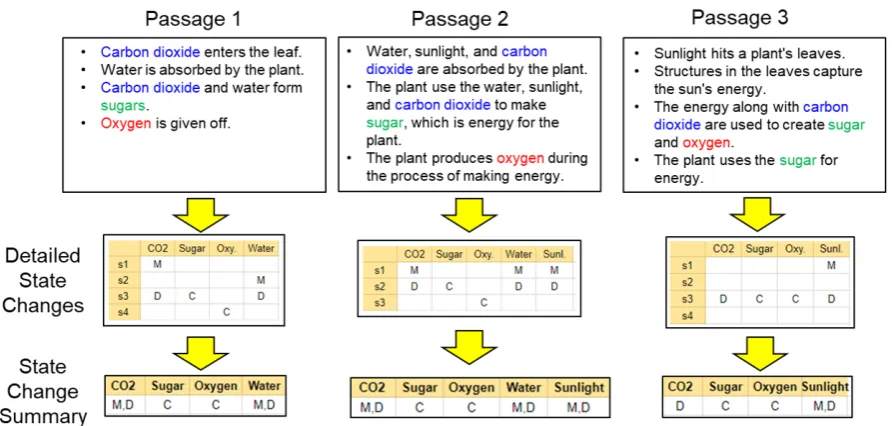
Figure 2: Three (simplified) passages from ProPara describing photosynthesis, the (gold) state changes each entity undergoes at each steps1,s2, . . . ,sT, and the summary of state changes that each entity undergoes (an aggregation of the step-by-step changes), whereM = MOVED, D = DESTROYED, C = CREATED. Although the language and detailed changes for each passage differ considerably, theoverall summaries are largely consistent(e.g., sugar
isCREATEDin all three). We exploit this consistency when training a model to make these predictions, by biasing
the model to prefer predictions whose summary is consistent with the (predicted) summaries of other passages about the same topic. Note that in the summary, we do not care about the order in which state changes happen, so summaryM, D for participantCO2 in passage 1 denotes a set of state changes rather than a sequence of state
changes.
describe the types of state change that each entity undergoes, will be mostly consistent. For example, although independent texts describing photosyn-thesis vary tremendously, we expect them to be consistent about what generally happens to sugar, e.g., that it is created (Figure2).
In this paper, we introduce a new training frame-work, called LaCE (Label Consistency Explorer),
that leverages label consistency among paragraph summaries. In particular, it encourages label consis-tency during end-to-end training of a neural model, allowing consistency bias to improve the model itself, rather than be enforced in a post-processing step, e.g., posterior regularization (Ganchev et al., 2010). We evaluate on a standard benchmark for procedural text comprehension, called ProPara (Dalvi et al., 2018). We show that this approach achieves a new state-of-the-art performance in the fully supervised setting (when all paragraphs are annotated), and also demonstrate that it improves performance in the semi-supervised setting (us-ing additional, unlabeled paragraphs) with limited training data. In the latter case, summary predic-tions from labeled data act as noisy gold labels for
the unlabeled data, allowing additional learning to occur. Our contributions are thus:
1. A new learning framework, LaCE, applied to
procedural text comprehension that improves the label consistency among different para-graphs on the same topic.
2. Experimental results demonstrating that LaCE achieves state-of-the-art performance
on a standard benchmark dataset, ProPara, for procedural text.
2 Related Work
Our work is related to several important branches of work in both NLP and ML, as we now summarize.
Hangya et al.(2018) adapt the similar idea to ex-ploit unlabeled data for the cross-lingual classifica-tion. We extend this line of research in two ways: by developing a framework allowing it to be ap-plied to the task of structure prediction; and by incorporating label consistency into the model it-self via end-to-end training, rather than enforcing consistency as a post-processing step.
Semi-supervised Learning ApproachesBesides utilizing the label consistency knowledge, our learning framework is also able to use unlabeled paragraphs, which fits in the literature of semi-supervised learning approaches (for NLP).Zhou et al. (2003) propose an iterative label propaga-tion algorithm similar to spectral clustering. Zhu et al. (2003) propose a semi-supervised learning framework via harmonic energy minimization for data graph.Talukdar et al.(2008) propose a graph-based semi-supervised label propagation algorithm for acquiring open-domain labeled classes and their instances from a combination of unstructured and structured text sources. Our framework extends these ideas by introducing the notion of groups (examples that are expected to be similar) and sum-maries (what similarities are expected), applied in an end-to-end-framework.
Procedural Text Understanding and Reading ComprehensionThere has been a growing interest in procedural text understanding/QA recently. The ProcessBank dataset (Berant et al.,2014) asks ques-tions about event ordering and event arguments for biology processes. bAbI (Weston et al.,2015) in-cludes questions about movement of entities, how-ever it’s synthetically generated and with a small lexicon. Kiddon et al.(2015)’s RECIPES dataset introduces the task of predicting the locations of cooking ingredients, andKiddon et al.(2016) for recipe generation. In this paper, we continue this line of exploration using ProPara, and illustrate how the previous two lines of work (label consistency and semi-supervised learning) can be integrated.
3 Problem Definition
3.1 Input and Output
A general condition for applying our method is having multiple examples where, forsome proper-ties, we expect to see similar values. For example, for procedural text, we expect paragraphs about the same process to be similar in terms of which entities move, are created, and destroyed; for
dif-ferent news stories about a political meeting, we expect top-level features (e.g., where the meeting took place, who attended) to be similar; for diff er-ent recipes for the same item, we expect loosely similar ingredients and steps; and for different im-ages of the same person, we expect some high-level characteristics (e.g., height, face shape) to be simi-lar. Note that this condition does not apply to every learning situation; it only applies when training examples can be grouped, where all group mem-bers are expected to share some characteristics that we can identify (besides the label used to form the groups in the first place).
More formally, for training, the input is a set of labeled examples (xgi,ygi) (whereygiare the labels
forxgi), partitioned intoGgroups, where theg
sub-script denotes which group each example belongs to. Groups are defined such that examples of the same groupgare expected to have similar labels for a subset of labelsygi. We call this subset the
summary labels. We assume that both the group-ings and the identity of the summary labels are provided. The output of training is a modelMfor labeling new examples. For testing, the input is the modelMand a set of unlabeled (and ungrouped) examplesxt, and the output are their predicted
la-bels ˆyt. Note that this formulation is agnostic to the
learning algorithm used. Later, we will consider both the fully supervised setting (all training exam-ples are labeled) and semi-supervised setting (only a subset are labeled).
3.2 Instantiation
We instantiate this framework for procedural text comprehension, using the ProPara task (Dalvi et al., 2018). In this task, xgi are paragraphs of text
de-scribing a process (e.g., photosynthesis), the labels ygidescribe the state changes that each entity in the
paragraph undergoes at each step (sentence) (e.g., that oxygen is created in step 2), and the groups are paragraphs about the same topic (ProPara tags each paragraph with a topic, e.g., there are three paragraphs in ProPara describing photosynthesis). More precisely, eachxgiconsists of:
• the name (topic) of a process, e.g., photosyn-thesis
• a sequence (paragraph) of sentences S = [s1, ...,sT] that describes that process
• the set of entities E mentioned in that text, e.g., oxygen, sugar
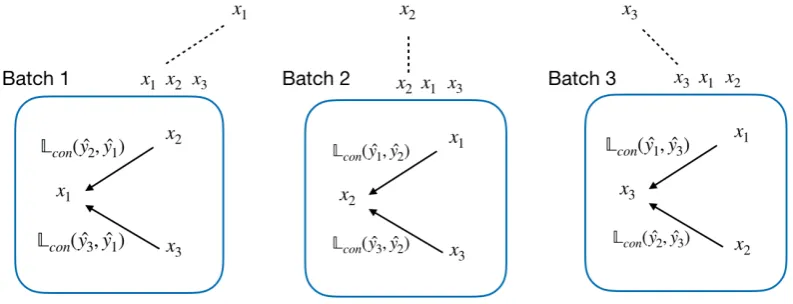
Figure 3: Example of batches constructed from a group (here, the group contains three labeled examplesx1,x2,x3).
From three examples, three batches are constructed. Taking the predicted labels for the first element in the batch as reference we compute the consistency loss for the remaining elements.
• the state changes that each entity in E undergoes at each step (sentence) of the process, where a state change is one of {Moved,Created,Destroyed,None}.
These state changes can be conveniently expressed using a|S| × |E|matrix (Figure2). State changes also include arguments, e.g., the source and destination of a move. We omit these in this paper to simplify the description.
Finally, we define the summary labels as the set of state changes that each entity undergoes atsome point in the process, without concern for when. For example, in Passage 1 in Figure2, CO2isMoved (M) andDestroyed (D), while sugar isCreated (C). These summary labels can be computed from the state-change matrix by aggregating the state changes for each entity over all steps. Our assump-tion here is that these summaries will generally be the same (i.e., consistent) for different paragraphs about the same topic. LaCE then exploits this
as-sumption by encouraging this inter-paragraph con-sistency during training, as we now describe.
4 Label Consistency Explorer: LaCE
4.1 The LaCE Learning Framework
While a traditional supervised learning model op-erates on individual examples, LaCE operates on
batchesof grouped examplesXg. Given a group
gcontaining N labeled examples{x1, ...,xN}(we
drop thegsubscript for clarity), LaCE creates N
batches, each containing all the examples but with a differentxilabeled as “primary”, along with the
gold labelsyifor (only) the primary example. (We
informally refer to the primary example as the “first
example” in each batch). Then for each batch, LaCE jointly optimizes the usual supervised loss
Lsup( ˆyi,yi) for the primary example, along with a
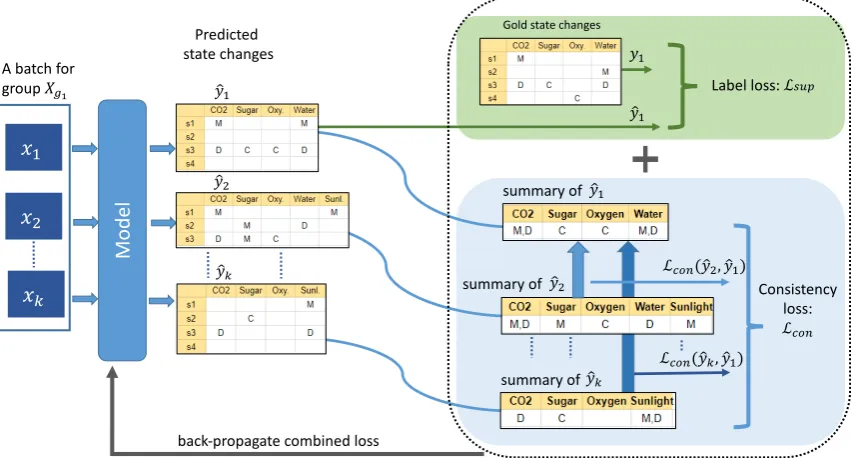
consistency loss between (summary) predictions for all other members of the group and the primary example,Lcon( ˆyj,yˆi) for all j,i. This is illustrated in Figures4and3. This is repeated for all batches.
For example, for the three paragraphs about pho-tosynthesis (Figure2), batch 1 compares the first paragraph’s predictions with its gold labels, and also compares the summary predictions of para-graphs 2 and 3 with those of the first paragraph (Figure3). This is then repeated using paragraph 2, then paragraph 3 as primary.
The result is that LaCE jointly optimizes the
supervised lossLsupand consistency lossLconto
train a model that is both accurate for the given task as well as consistent in its predictions across examples that belong to the same group.
This process is approximately equivalent to jointly optimizing the usual supervised loss Lsup( ˆyi,yi) for all examples in the group, and the
pairwise consistency lossLcon( ˆyj,yˆi) for all pairs
(xj,xi), j,iin the group. However, there is an important difference, namely the relative contri-butions ofLsupandLcon is varied among batches,
depending on how accurate the predictions for the primary example are (i.e., how smallLsupis), as
we describe later in Section4.3. This has the effect of paying more attention to consistency loss when predictions on the primary are more accurate.
We also extend LaCE to the semi-supervised
𝑥"
Mod
el
𝑥#
𝑥$
Predicted state changes
Gold state changes
Label loss: ℒ'()
back-propagate combined loss A batch for
group 𝑋+,
Consistency loss:
ℒ-./
𝑦"
ℒ-./(𝑦2#, 𝑦2")
ℒ-./(𝑦2$, 𝑦2") 𝑦2"
𝑦2#
𝑦2$
summary of
summary of
summary of
𝑦2" 𝑦2"
𝑦2#
[image:5.595.89.515.72.301.2]𝑦2$
Figure 4: Overview of the LaCE training framework, illustrated for the procedural comprehension task ProPara. During training, LaCE processesbatchesof examples {x1,...,xk} for each group Xg, where predictions for one example (here ˆy1) are compared against its gold (producing lossLsup), and its summary against summaries of all other examples to encourage consistency of predictions (producingLcon), repeating for each example in the batch.
a different labeled example as primary. We later report experiments results for both the fully and semi-supervised settings.
4.2 Base Model for Procedural Text
We now describe how LaCE is applied to our
goal of comprehending procedural text. Note that LaCE is agnostic to the learner used within the
framework. For this application, we use a simpli-fied version of ProStruct (Tandon et al.,2018), a publicly available system designed for the ProPara task. Our implementation simplifies ProStruct by reusing its encoder, but then predicting (a distribu-tion over) each state change label independently during decoding for every cell in the|S| × |E|grid (Figure2). We briefly summarize this here.
4.2.1 Encoder
ProStruct uses an encoder-decoder architecture that takes procedural text as input and predicts the state changes of entitiesEin the text as output. During encoding, each stepstis encoded using|E|
embed-dings, one for each entityej ∈E. Each embedding
represents the action that st describes, applied to
ek. The model thus allows the same action to have
different effects on different entities (e.g., a trans-formation destroys one entity, and creates another). For each (st,ej)∈S×Epair, the step is fed into
a BiLSTM (Hochreiter and Schmidhuber,1997), using pretrained GloVe (Pennington et al.,2014) vectorsvwfor each wordwiconcatenated with two
indicator variables, one indicating whetherwiis a
word referring toej, and one indicating whetherwi
is a verb. A bilinear attention layer then computes attention over the contextualized vectorshioutput
by the BiLSTM:ai=hi∗B∗hev+b, whereBandb
are learned parameters, andhevis the concatenation
ofhe(the averaged contextualized embedding for
the entity wordswe) andhv(the averaged
contextu-alized embedding for the verb wordswv).
Finally, the output vector ct j is the
attention-weighted sum of thehi: ct j =PiI=1ai∗hi . Here,
ct jcan be thought of as representing the actionst
applied to entityej. This is repeated for all steps
and entities.
4.2.2 Decoder
To decode the action vectorsct jinto their resulting
state changes they imply, each is passed through a feedforward layer to generatelogit(πt j), a set of
lo-gistic activations over theKpossible state changes πt j for entityejin step st. For ProPara, there are
entity and step in the text. We then compute loss, described next, using these distributions directly rather than discretizing them into exact predictions at this stage, so as not to lose information.
4.3 Applying LaCE
4.3.1 Batching
We start by creating training batches for eachXgi ∈
Xg. From a groupXgi comprising ofnexamples,
we createntraining batches. A batch consists of all nexamples (x1,x2, ...,xn), but the loss computation
is different in each batch. Figure3illustrates this.
4.3.2 Loss Computation
The loss computation in a batch is based on the usual supervised loss and additionally the consis-tency loss, as follows:
Lbatch=λLsup( ˆy1,y1)
| {z } supervised loss
+(1−λ)
n X
i=2
Lcon( ˆyi,yˆ1)
| {z } consistency loss
(1) Here,Lsup( ˆy1,y1) is the negative log likelihood loss*against the gold labelsy1, andλis a
hyperpa-rameter tuned on the dev set.
To compute the consistency lossLcon( ˆyi,yˆ1), we
compare the summaries computed from ˆyiand ˆy1.
In our particular application, a summary lists all the state changes each entity undergoes, formed by aggregating its step-by-step state changes. For example, for paragraphx1in Figure4, asCO2first moves (M), then later is destroyed (D), we summa-rize its state changes as s(CO2,yˆ1)= {M,D}. In practice, as our decoder outputs distributions over the four possible values {M,C,D,N} rather than a single value, we summarize by adding and nor-malizing these distributions, producing a summary distributions(e,yˆj) over the four values rather than
a discrete set of values.
To compute the consistency lossLcon( ˆyi,yˆ1)
it-self, we compare summaries for each entityethat occurs in both paragraphx1and paragraphxi
(re-ferred to as Ent(x1) and Ent(xi) respectively), and
compute the average mean squared error (MSE) between their summary distributions. We also tried other alternatives (e.g., Kullback-Leibler di-vergence) for calculating the distance between sum-mary distributions, but mean squared error
per-*Loss functionL
supis exactly same as the loss function
used in the base model so that we can measure the effect of adding consistency loss.
forms best. Equation2shows the details for com-puting the consistency loss.
Lcon( ˆyi,yˆ1)= P
e∈Ent(xi)∩Ent(x1)MSE(s(e,yˆi),s(e,yˆ1)) |Ent(xi)∩Ent(x1)|
(2) Note that each paragraph contains varying num-ber of entities and sentences. It is possible that some paragraphs do not mention exactly the same entities as the labeled paragraph (first element in the batch). In such cases, we penalize the model only for predictions for co-occurring entities. Un-matched entities are not penalized.
4.3.3 Adaptive Loss
The supervised lossLsup( ˆy1,y1) is large in the early epochs when the model is not sufficiently trained. At this point, it is beneficial for the model to pay no attention to the consistency lossLcon( ˆyj,yˆ1) as
the predicted action distributions are inaccurate. To implement this, ifLsupis above a defined threshold
then the consistency loss term in Equation 1 is ignored (i.e. λ = 1). Otherwise, Equation 1 is used as is. This can loosely be seen as a form of simulated annealing (Kirkpatrick et al.,1988), using just two temperatures. Note that the time (epoch number) when the temperature (lambda) changes will vary across batches depending on the supervised loss within that batch of data, hence we call it an “adaptive” loss.
5 Experimental Results
We now present results on ProPara, the procedural text comprehension dataset introduced in (Dalvi et al.,2018). There are 187 topics in this dataset and a total of 488 labeled paragraphs (around 3 labeled paragraphs per topic). The task is to track how entities change state through the paragraph (as described in Section3.2) and answer 4 classes of questions about those changes (7043/913/1095 questions in each of the train/dev/test partitions re-spectively). We compare LaCE with the baselines
and prior state-of-the-art model ProStruct (Tandon et al.,2018) in two settings: (1) Fully supervised learning (using all the training data). (2) Semi-supervised learning (using some or all of the train-ing data, plus additional unlabeled data).
5.1 Fully Supervised Learning
We evaluated LaCE by comparing its
Models P R F1
EntNet (Henaffet al.,2017) 54.7 30.7 39.4 QRN (Seo et al.,2017) 60.9 31.1 41.1 ProLocal (Dalvi et al.,2018) 81.7 36.8 50.7 ProGlobal (Dalvi et al.,2018) 61.7 44.8 51.9 ProStruct(Tandon et al.,2018) 74.3 43.0 54.5
[image:7.595.71.292.62.162.2]LaCE (our model) 75.3 45.4 56.6
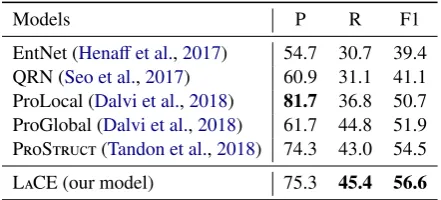
Table 1: Comparing the performance of LaCE with prior methods on the test partition of ProPara.
Models P R F1
LaCE 75.3 45.4 56.6
- consistency lossLcon 69.6 43.1 53.2
Table 2: LaCE ablation results
The results are shown in Table1. In Table1, all the baseline numbers are the results reported in (Tan-don et al.,2018). Note that all these baselines are trying to reduce the gap between predicted labels and gold labels on the training dataset. LaCE,
how-ever, also optimizes for consistency across labels
for groups of paragraphs belonging to the same
topic. As LaCE uses parts of ProStruct as its
learn-ing algorithm, the gains over ProStruct appear to be coming directly from its novel learning framework described in Section4.1. To confirm this, we also performed an ablation study, removing the consis-tency loss term and just using the base model in LaCE. The results are shown in Table2, and show
that the F1 score drops from 56.6 to 53.2, illustrat-ing that the consistency loss is responsible for the improvement. In addition, Table2indicates that consistency loss helps improve both precision and recall.
Also note that LaCE simplifies parts of ProStruct.
For example, unlike ProStruct, LaCE does not use
a pre-computed knowledge base during decoding. Thus LaCE is more efficient to train than ProStruct
(>15x faster at training time).
5.2 Semi-Supervised Learning
Unlike the other systems in Table1, LaCE is able
to use unlabeled data during training. As described in Section4.1, given a group containing both la-beled and unlala-beled paragraphs, we create as many batches as the number of labeled paragraphs in the group. Hence, paragraphsxiwith gold labelsyican
contribute to both supervised lossLsupand
consis-tency lossLcon. Additionally, we can use unlabeled
Models Proportion of labeled paragraphs used per training topic
33% 66% 100%
ProStruct 45.4 50.6 54.5
LaCE 47.3 51.2 56.6
LaCE+unlabeled data 49.9 52.9 56.7
Table 3: Comparing LaCE vs. ProStruct with vary-ing amount of labeled paragraphs available per trainvary-ing topic. We compare their performance in terms of F1 on ProPara test partition.
paragraphsxj (i.e., without gold labelsyj), while
computing consistency lossLcon. This way LaCE
can make use of unlabeled data during training. To evaluate this, we collected 877 additional un-labeled paragraphs for ProPara topics†. As the orig-inal ProPara dataset makes some simplifying as-sumptions, in particular that events are mentioned in chronological order, we used Mechanical Turk to collect additional paragraphs that conformed to those assumptions (rather than collecting para-graphs from Wikipedia, say). Approximately 3 extra paragraphs were collected for each topic in ProPara. Note that collecting unlabeled paragraphs is substantially less expensive than labeling para-graphs.
Train Dev Test Unlabeled
# paragraphs 391 54 43 877
Table 4: ProPara Paragraphs Statistics
We then trained the ProStructand LaCE
mod-els varying two different parameters: (1) the per-centage of the labeled (ProPara) training data used to train the system (2) for LaCE only, whether
the additional unlabeled data was also used. This allows us to see performance under different con-ditions of sparsity of labeled data, and (for LaCE)
also assess how much unlabeled data can help un-der those conditions. During training, the unused labeled data was ignored (not used as unlabeled data). We keep the dev and test partitions the same as original dataset, picking a model based on dev performance and report results on test partition. The results are shown in Table3. In the first two rows, ProStructand LaCE are both trained with
x% of labeled data, while the last row reports
Figure 5: Comparing LaCE vs. ProStructbased on Recall on the test partition, by varying amount of la-beled paragraphs available per training topic
formance of LaCE when it also has access to new
unlabeled paragraphs.
Table3demonstrates that LaCE results in even
larger improvements over ProStruct when the
amount of labeled data is limited. In addition, unlabeled data adds an additional boost to this performance, in particular when labeled data is sparse. Further examination suggests that the gains in F1 are resulting mainly from improved recall, as shown in Figure5. We believe that having access to unlabeled paragraphs and optimizing consistency across paragraphs for training topics, helps LaCE
generalize better to unseen topics.
5.3 Implementation Details for LaCE
We implement our proposed model LaCE in
Py-Torch (Paszke et al., 2017) using the AllenNLP (Gardner et al., 2018) toolkit. We added a new data iterator that creates multiple batches per topic (Figure3) which enables easy computation of con-sistency loss. We use 100D Glove embeddings (Pennington et al., 2014), trained on Wikipedia 2014 and Gigaword 5 corpora (6B tokens, 400K vocab, uncased). Starting from glove embeddings appended by entity and verb indicators, we use bidirectional LSTM layer to create contextual rep-resentation for every word in a sentence. We use 100D hidden representations for the bidirectional LSTM (Hochreiter and Schmidhuber,1997) shared between all inputs (each direction uses 50D hidden vectors). We use attention layer on top of BiL-STM, using a bilinear similarity function similar to (Chen et al.,2016) to compute attention weights over the contextual embedding for each word in the sentence.
To compute the likelihood of all state changes
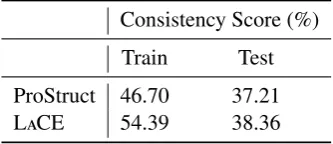
Consistency Score (%)
Train Test
[image:8.595.333.500.63.135.2]ProStruct 46.70 37.21 LaCE 54.39 38.36
Table 5: Consistency score comparison
individually, we use a single layer feedforward net-work with input dimension of 100 and output 4. In these experiments, we check if the supervised lossLsupis less than a threshold (0.2 in our case)
then we use equation1 andlambda = 0.05. All hyper-parameters are tuned on the dev data.
During training we use multiple paragraphs for a topic to optimize for both supervised and con-sistency loss. At test time, LaCE’s predictions
are based on only one given paragraph. All the performance gains are due to the base model be-ing more robust due to proposed trainbe-ing proce-dure. The code for LaCE model is published at
https://github.com/allenai/propara.
5.4 Analysis and Discussion
We first discuss the predicted label consistency across paragraphs for LaCE vs. ProStruct. We
then identify some of the limitations of LaCE.
Label Consistency
LaCE attempts to encourage consistency between
paragraphs about the same topic during training, and yield similar benefit at test time. To examine whether this happens in practice, we compute and report the consistency score between paragraphs about the same topic (Table5). Specifically, for an entity that appears in two paragraphs about the same topic, we compare whether the summaries of state change predictions for each match. The results are shown in Table5.
The table shows that LaCE achieves greater
[image:8.595.79.285.68.198.2]created; and created respectively. This illustrates a case where LaCE has learned to make predictions
that are more consistent and correct.
Error Analysis for LaCE
To understand LaCE’s behavior further, we
exam-ined cases where LaCE’s and ProStruct’s
predic-tions differ, and examined their agreement with gold labels. In this analysis we found three major sources of errors for LaCE:
• The label consistency assumption does not always hold: In Section 3.1, we explain that LaCE relies on summary labels being
consis-tent across examples in the same group. We found that for some of the topics in our training dataset this assumption is sometimes violated. E.g., for the topicHow does the body control its blood sugar level?, there are two different para-graphs; one of them describes the entitysugar as beingCreatedand thenDestroyedto cre-atebloodsugar, while the other paragraph de-scribes the same event in a different way by say-ing that the entitysugarisCreated and then Movedto the blood. LaCE can thus goes wrong
when trying to enforce consistency in such cases.
• Lexical variance between entities across paragraphs: Different paragraphs about the same topic may describe the procedure using different wordings, resulting in errors. For exam-ple, in paragraphs about the topicwhat happens during photosynthesis?, the same entity (carbon dioxide) is referred to by two different strings, CO2in one paragraph andcarbon dioxidein another. Currently, LaCE does not take into
ac-count entity synonyms, so it is unable to encour-age consistency here. An interesting line of fu-ture work would be to use the embedding space similarity between entity names, to help address this problem.
• LaCE can make incorrect predictions to im-prove consistency:For the topicDescribe how to make a cakeat training time, when presented with two paragraphs, LaCE tries to be consistent
and incorrectly predicts thatcakeisDestroyed in both paragraphs. ProStruct does not attempt to improve prediction consistency, here resulting in less consistent but in this case more accurate predictions for this topic.
5.5 Directions For Enhancing LaCE
• Improve LaCE for ProPara: LaCE’s
perfor-mance on ProPara can be improved further by a) soft matching of entities across paragraphs instead of current exact string match b) ex-ploring more systematic ways (e.g., simulated annealing) to define adaptive loss c) using ad-ditional sources of unlabeled data (e.g., web, textbooks) weighed by their reliability.
• Apply LaCE on other tasks: Architecturally,
LaCE is a way to train any existing
struc-tured prediction model for a given task to produce consistent labels across similar data-points. Hence it can be easily applied to other tasks where parallel data is available (group-ing function) and there is a way to efficiently compare predictions (summary labels) across parallel datapoints, e.g. event extraction from parallel news articles (Chinchor,2002).
Further, summary labels need not be action categories (e.g.,Created,Destroyed). Con-sistency can also be computed for QA task where multiple parallel text is available for reading comprehension. We plan to explore this direction in the future.
6 Conclusion
Our goal is procedural text comprehension, a task that current systems still struggle with. Our ap-proach has been to exploit the fact that, for many procedures, multiple independent descriptions ex-ist, and that we expect some consistency between those descriptions. To do this, we have presented a task- and model-general learning framework, LaCE, that can leverage this expectation,
allow-ing consistency bias to be built into the learned model. Applying this framework to procedural text, the resulting system obtains new state-of-the-art results on the ProPara dataset, an existing bench-mark for procedural text comprehension. It also demonstrates the ability to benefit from unlabeled paragraphs (semi-supervised learning), something that prior systems for this task were unable to do. We have also identified several avenues for further improvement (Section5.4), and are optimistic that further gains can be achieved.
Acknowledgements
References
Jonathan Berant, Vivek Srikumar, Pei-Chun Chen, Abby Vander Linden, Brittany Harding, Brad Huang, Peter Clark, and Christopher D Manning. 2014. Modeling biological processes for reading compre-hension. InProc. EMNLP’14.
Antoine Bosselut, Omer Levy, Ari Holtzman, Corin Ennis, Dieter Fox, and Yejin Choi. 2018. Simulat-ing action dynamics with neural process networks.
6th International Conference on Learning
Represen-tations (ICLR).
Danqi Chen, Jason Bolton, and Christopher D. Man-ning. 2016. A thorough examination of the cnn/daily mail reading comprehension task. CoRR, abs/1606.02858.
Kevin Chen, Christopher B. Choy, Manolis Savva, An-gel X. Chang, Thomas A. Funkhouser, and Silvio Savarese. 2018. Text2shape: Generating shapes from natural language by learning joint embeddings.
CoRR, abs/1803.08495.
Nancy A. Chinchor. 2002. Message understanding con-ference ( muc ) tests of discourse processing.
Charles LA Clarke, Gordon V Cormack, and Thomas R Lynam. 2001. Exploiting redundancy in question an-swering. InProceedings of the 24th annual interna-tional ACM SIGIR conference on Research and
de-velopment in information retrieval. ACM.
Bhavana Dalvi, Lifu Huang, Niket Tandon, Wen-tau Yih, and Peter Clark. 2018. Tracking state changes in procedural text: A challenge dataset and mod-els for process paragraph comprehension.
NAACL-HLT’18, arXiv preprint arXiv:1805.06975.
Susan T. Dumais, Michele Banko, Eric Brill, Jimmy J. Lin, and Andrew Y. Ng. 2002. Web question answer-ing: is more always better? InSIGIR.
Kuzman Ganchev, João Graça, Jennifer Gillenwater, and Ben Taskar. 2010. Posterior regularization for structured latent variable models. Journal of
Ma-chine Learning Research, 11:2001–2049.
Matt Gardner, Joel Grus, Mark Neumann, Oyvind Tafjord, Pradeep Dasigi, Nelson Liu, Matthew Pe-ters, Michael Schmitz, and Luke Zettlemoyer. 2018. Allennlp: A deep semantic natural language process-ing platform. arXiv preprint arXiv:1803.07640.
Philip Haeusser, Alexander Mordvintsev, and Daniel Cremers. 2017. Learning by association-a versa-tile semi-supervised training method for neural net-works. InIEEE Conference on Computer Vision and
Pattern Recognition (CVPR), volume 3, page 6.
Viktor Hangya, Fabienne Braune, Alexander Fraser, and Hinrich Schütze. 2018. Two methods for do-main adaptation of bilingual tasks: Delightfully sim-ple and broadly applicable. InProceedings of the 56th Annual Meeting of the Association for
Compu-tational Linguistics (Volume 1: Long Papers).
Mikael Henaff, Jason Weston, Arthur Szlam, Antoine Bordes, and Yann LeCun. 2017. Tracking the world state with recurrent entity networks. InICLR.
Sepp Hochreiter and Jürgen Schmidhuber. 1997. Long short-term memory. Neural computation, 9(8):1735–1780.
Chloé Kiddon, Ganesa Thandavam Ponnuraj, Luke Zettlemoyer, and Yejin Choi. 2015. Mise en place: Unsupervised interpretation of instructional recipes.
InProc. EMNLP’15.
Chloé Kiddon, Luke Zettlemoyer, and Yejin Choi. 2016. Globally coherent text generation with neural checklist models. InProc. EMNLP’16.
Scott Kirkpatrick, C. D. Gelatt, and Mario P. Vecchi. 1988. Optimization by simulated annealing.
Adam Paszke, Sam Gross, Soumith Chintala, Gregory Chanan, Edward Yang, Zachary DeVito, Zeming Lin, Alban Desmaison, Luca Antiga, and Adam Lerer. 2017. Automatic differentiation in pytorch.
Jeffrey Pennington, Richard Socher, and Christopher Manning. 2014. Glove: Global vectors for word rep-resentation. InProceedings of the 2014 conference on empirical methods in natural language
process-ing (EMNLP), pages 1532–1543.
Hinrich Schütze, Fabienne Braune, Alexander M. Fraser, and Viktor Hangya. 2018. Two methods for domain adaptation of bilingual tasks: Delightfully simple and broadly applicable. InACL.
Minjoon Seo, Sewon Min, Ali Farhadi, and Hannaneh Hajishirzi. 2017. Query-reduction networks for question answering. InICLR.
Partha Pratim Talukdar, Joseph Reisinger, Marius Pasca, Deepak Ravichandran, Rahul Bhagat, and Fernando Pereira. 2008. Weakly-supervised acqui-sition of labeled class instances using graph random walks. InEMNLP.
Niket Tandon, Bhavana Dalvi Mishra, Joel Grus, Wen-tau Yihs, Antoine Bosselut, and Peter Clark. 2018. Reasoning about actions and state changes by inject-ing commonsense knowledge. EMNLP’18, arXiv preprint arXiv:1808.10012.
Jason Weston, Antoine Bordes, Sumit Chopra, Alexan-der M Rush, Bart van Merriënboer, Armand Joulin, and Tomas Mikolov. 2015. Towards AI-complete question answering: A set of prerequisite toy tasks.
arXiv preprint arXiv:1502.05698.
Dengyong Zhou, Olivier Bousquet, Thomas Navin Lal, Jason Weston, and Bernhard Schölkopf. 2003. Learning with local and global consistency. In
NIPS.
Xiaojin Zhu, Zoubin Ghahramani, and John D Laf-ferty. 2003. Semi-supervised learning using gaus-sian fields and harmonic functions. InProceedings of the 20th International conference on Machine