197
Audio De-identification: A New Entity Recognition Task
Ido Cohn, Itay Laish, Genady Beryozkin, Gang Li, Izhak Shafran, Idan Szpektor,Tzvika Hartman,Avinatan Hassidim,Yossi Matias
Google Tel Aviv, Israel
{idoc,itaylaish,leebird,tzvika}@google.com
Abstract
Named Entity Recognition (NER) has been mostly studied in the context of written text. Specifically, NER is an important step in de-identification (de-ID) of medical records, many of which are recorded conversations be-tween a patient and a doctor. In such record-ings, audio spans with personal information should be redacted, similar to the redaction of sensitive character spans in de-ID for written text. The application of NER in the context of audio de-identification has yet to be fully in-vestigated. To this end, we define the task of audio de-ID, in which audio spans with entity mentions should be detected. We then present our pipeline for this task, which involves Auto-matic Speech Recognition (ASR), NER on the transcript text, and text-to-audio alignment. Fi-nally, we introduce a novel metric for au-dio de-ID and a new evaluation benchmark consisting of a large labeled segment of the
Switchboard and Fisher audio datasets and detail our pipeline’s results on it.
1 Introduction
Personal data in general, and clinical records data in particular, is a major driving force in today’s sci-entific research. Despite its abundance, the pres-ence of Personal Health Identifiers (PHI) hinders data availability for researchers. Therefore, data de-identification (de-ID) is a critical component in any plan to make such data available. However, the amount of data involved makes it prohibitively expensive to employ domain experts to tag and redact PHI manually, providing a good opportu-nity for automatic de-identification tools. Indeed, high performance tools for the de-identification of medical text notes have been developed ( Dernon-court et al.,2017a;Liu et al.,2017).
Due to the rise of tele-medicine (Weinstein et al.,2014), clinical records consist of many other types of data, such as audio conversations (Chiu et al., 2017), scanned documents, video, and
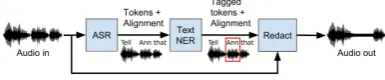
im-Figure 1: High level audio de-ID pipeline
ages. In this work, we direct our attention towards the task of de-identifying clinical audio data. This task is expected to become increasingly more im-portant, as Machine Learning applications in tele-medicine are growing in popularity. Given an input audio stream, the objective is to produce a modi-fied audio stream, where all PHI is redacted, while the rest of the stream is kept unchanged. To the best of our knowledge, de-identifying audio is a new task, requiring a new benchmark.
We define and publish1 a benchmark consist-ing of the followconsist-ing: 1. A large labeled subset of theSwitchboard(Godfrey et al.,1992) andFisher
(David et al., 2004) conversational English audio datasets, denoted as SWFI. 2. A new evaluation metric, measuring how well the PHI words in the input audio were identified and redacted, and how well the rest of the audio was preserved.
To better understand the challenges of the audio de-id task, we evaluate it both end-to-end and by breaking it down and solving it using individual components. Our pipeline (Fig.1) first produces transcripts from the audio using ASR, proceeds by running text-based NER tagging, and then redacts PHI tokens, using the aligned token boundaries determined by ASR. Our tagger relies on the state-of-the-art techniques for solving the audio NER problem of recognizing entities in audio transcripts (Lample et al., 2016; Ma and Hovy,2016). We leverage the available Automatic Speech Recognition (ASR) technology, and use its component of alignment back to audio.
1
[image:1.595.319.512.207.247.2]Finally, we evaluate our pipeline and de-scribe its performance, both end-to-end and per-component. Although results on audio are worse than NER performance on text, the pipeline achieves better results than expected despite the compounding pipeline errors. Last, we analyze our performance and provide insights for next steps.
2 Related Work
2.1 NER for Speech
Prior work addressed entity recognition for audio recordings via the audio NERtask: the detection of entities in the text transcript of the audio in-put. The majority of these works used a pipeline approach, in which ASR is first applied to the au-dio and then NER is applied on the noisy textual output of the ASR. These works include discrim-inative models (Sudoh et al.,2006), incorporating OOV word indicators (Parada et al.,2011), hierar-chical structure (Raymond,2013), and conditional random fields (Hatmi et al.,2013).
Many audio NER works learn from and mea-sure performance on French datasets, such as ES-TER(Galliano et al.,2009) andETAPE(Galibert et al.,2014). This may indirectly affect the overall quality of these systems because the ASR compo-nent, which is crucial in the pipeline approach but is typically used “off-the-shelf”, has lower perfor-mance in languages other than English.
An alternative end-to-end approach was pro-posed by Ghannay et al. (2018), in which the model accepts audio as input and outputs a tagged word sequence which consists of normal words and the NER labels in HTML-like tag encod-ing. Their model did not attain reasonable perfor-mance, perhaps due to the small training set.
We emphasize that both pipeline and end-to-end approaches output tagged word sequences, and do not propagate the recognized entity labels back for redaction on the audio itself, which is the end goal of our proposed audio de-ID task.
2.2 De-identification in the Health Domain
Previous efforts of de-ID in health care focused on redaction of textual medical records. The main ap-proach involves applying NER techniques to the text, including rule-based (Ruch et al.,2000; Nea-matullah et al.,2008) and machine learning (Guo et al.,2006;Yang and Garibaldi,2015) methods.
Adoption of neural network models boosted the performance of NER on text without requiring
hand-crafted rules and complex feature engineer-ing (Collobert et al., 2011; Huang et al., 2015;
Lample et al.,2016;Ma and Hovy,2016; Dernon-court et al.,2017a).Dernoncourt et al.(2017b) ap-plied the model proposed inLample et al.(2016) to medical de-ID, achieving state-of-the-art per-formance on the I2B2-2014 (Stubbs and Uzuner,
2015) de-ID challenge dataset. We have chosen this architecture for the NER component of our pipeline method (Section5).
3 The Audio De-identification Task
The goal of the Audio de-ID task is to convert an input audio stream into a modified audio stream where the PHI words are redacted. In essence, the goal of the task is to limit the ability of a listener to identify the entities of the conversation while leaving as much information as possible in order to keep the audio understandable.
Formally, the input audio stream is a function
A(t) of time, that can be transcribed into a se-quence of wordsW ={wj}, wherewj is mapped to the time interval in the audioTj = [tstartj , tendj ). We consider each word to be either PHI or non-PHI, and let I denote the set of PHI words {j :
wjis PHI}.
The output of an audio de-ID algorithm is a zero-one redaction function R(t), indicating which parts of the audio stream are to be redacted, where a value of zero indicates PHI information at timet. The redacted audio stream can be obtained by zeroing out the redacted part of the stream,
Aredacted(t) =R(t)A(t).
To evaluate the performance of a de-ID algo-rithm, we termwj asfully-coveredifR(t)is zero for allt∈Tj, and define a corresponding indicator functioncovered(wi). This in turn defines the fol-lowing standard NER metrics for the audio de-ID task:
T rueP ositives(T P) = X
j∈I
covered(wj),
F alseP ositives(F P) = X
j6∈I
covered(wj),
F alseN egatives(F N) = X
j∈I
1−covered(wj)
P recision= T P
T P +F P , Recall=
T P
T P +F N
Dataset Medium # Notes # Tokens % PHI
I2B2’14train Text 521 336,422 3.5 AMC’17train Audio 4,629 8,348,899 0.02 SWFItrain
[image:3.595.82.280.62.113.2]Audio 468 710,348 1.8 SWFItest 108 158,923 2.0
Table 1: Dataset statistics for train and test sets, show-ing the number of notes (written or spoken), token count, and percent of tokens which are PHI.
PHI Labels % I2B2’14 AMC’17 SWFI train / test Name 0.84% 0.12% 0.22% / 0.23% Age 0.24% 0.01% 0.12% / 0.1% Date 1.56% 0.03% 0.1% / 0.12% Hospital 0.28% 0.004%
-Pharmacy - 0.01%
[image:3.595.81.281.170.300.2]-Organization 0.025% 0.003% 0.48% / 0.59% Location (General) 0.001% 0.004% 0.24% / 0.29% State 0.07% - 0.15% / 0.16% City 0.08% 0.003% 0.25% / 0.29% Country 0.02% - 0.23% / 0.27% Profession 0.04% - 0.23% / 0.27% Holiday - - 0.12% / 0.07% Season - - 0.04% / 0.03%
Table 2: Statistics for PHI labels as percent of total tokens per dataset. Tags in bold are common to all datasets and are used in Section7
most of the intervalTj results in a similar de-ID effect as fully covering all the interval. To this end, we extend covered(wi) into the indicator
ρ−covered(wj)that is true iffR(t)is zero on at leastρproportion of intervalTj.
With this indicator function we further extend the aforementioned NER metrics to T Pρ, F Pρ, andF Nρ, and correspondingly defineRecallρand
P recisionρ. Whenρ= 1these metrics equal the
strict metrics. When ρ < 1 the new metrics de-termine the quality of the system with respect to redacting at leastρof each audio interval in PHIs. We note that the proposed metrics only evaluate the redaction functionR(t)on the word intervals.
4 Datasets
To create a benchmark for the audio de-ID task, we use three datasets from two distinct domains:
conversational English and medical records. We summarize the main dataset statistics in Table 1. Importantly, we did not perform text normaliza-tion specific to each domain.
Word
WER Well Extended Shortened Type Aligned Alignment Alignment
PHI 41.8 86% 5% 9%
non-PHI 38.3 81% 8% 12%
Table 3: ASR WER and token-audio alignment distri-bution on sample conversations from theSWFIdataset.
In the domain of medical datasets, we use
I2B2’14 (Stubbs and Uzuner,2015), which con-sists of identified textual medical notes with PHI tagging, and the Audio Medical Conversa-tions dataset from (Chiu et al., 2017), denoted
AMC’17, which contains de-identified audio of doctor-patient conversations and their correspond-ing manual transcripts. Processcorrespond-ing the AMC’17
conversations was facilitated by the fact that it is a de-identified dataset, which provides us with the locations of the PHI in the audio and the tran-scripts. Three PHI types: names, dates and ages were redacted, preserving type information, and synthetic data was generated using dictionaries and context-aware rules. First names were drawn from the US Social Security Administration ba-bies names registry2 and last names were drawn from the Frequently Occurring Surnames list from the 1990’s US Census3. Human annotators used surrounding context to resolve the other PHI types and filled in fake appropriate identifiers.
Notably, neither of the above-mentioned med-ical datasets could serve as a benchmark for the audio de-ID task, as I2B2’14 is text-based, and
AMC’17 contains only redacted audio conversa-tions and is not publicly available. Therefore, we focused on the conversational English domain, where we generated a combined dataset SWFI
from the Switchboard (Godfrey et al., 1992) and Fisher (David et al., 2004) datasets. These datasets include hundreds of conversations in En-glish about a variety of subjects, along with their transcripts. To enable proper training and evalua-tion for the audio de-ID task, we annotated all 250
Switchboardconversations, and 326 fromFisher. Annotation included named PHI labels, and the time intervalsTj = [t(jstart), t
(end)
j )matching each named PHI back into the audio. This dataset is publicly available1 to allow for standardized eval-uation of novel approaches to this task.
The annotation process began by tokenization of the transcripts provided in both datasets using white-space separators, removing special tran-script characters and keeping word capitalization in its original form. Following that, PHI word annotation was performed manually. The results can be seen in Table2.
2
https://www.ssa.gov/oact/babynames/ 3https://www.census.gov/topics/
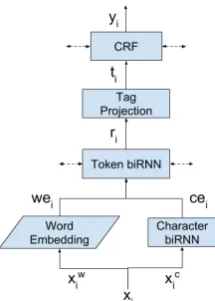
[image:3.595.88.275.695.731.2]Figure 2: Neural architecture for text de-ID
As performing temporal labeling manually is an arduous process, we opt for a semi-automatic ASR-based procedure. To this end, we determine word start and end times by aligning the manual transcripts to audio intervals. We assess the quality of this semi-automatic labeling scheme using hu-man evaluation. For a random sample of 6SWFI
conversations (3 Switchboard and 3 Fisher), we slice the audio according to the aligned interval times per transcript word, and measure both the quality of the transcription, and that of the align-ment. Table3shows the distribution of alignment errors of the tokens from the sample conversa-tions. These are denoted as good alignment, short (i.e. ASR interval is shorter than actual word) and extended (i.e. interval is longer than expected) where all alignment errors are in the scale of 30-60ms (1-2 audio frames).
5 Pipeline Models
We next describe the models we trained and eval-uated to gain insights on the types of challenges this task presents. We chose to use the pipeline approach as an audio de-ID benchmark due to the ubiquity and maturity of the ASR technology, and abundance of training data for text NER. Our pipeline models contain three main components:
1. An ASR system, which transcribes the audio into text.
2. A NER tagger, which tags the transcript with the required labels.
3. An alignment component, which maps each word in the transcript back to its time interval in the audio.
For the ASR component, we use Google
Cloud’s Speech API4 with the
com-mand and search model, which gave us the
best transcription accuracy on the data. For each conversation, which usually contains two different speakers, we send the entire audio to the service to obtain the transcript. The API also returns alter-native hypotheses for the corresponding text and their confidence. We incorporate these alternative hypotheses by taking the top-k ASR hypotheses and feeding them into the next two stages. We then take the logical OR of the detections on all of the hypotheses. Unless stated otherwise,k= 1.
For the NER tagger component, our models use the architecture described inLample et al.(2016), depicted in Fig.2. This is a neural network model using pre-trained GloVe word embeddings5 ( Pen-nington et al., 2014) and a character-based bi-directional RNN to generate token embeddings, followed by a bidirectional RNN, tag projection, and CRF layers. We define three models, where each model has a NER tagger trained on a differ-ent dataset. The models are:
MAMC – Trained using the training data from the
AMC’17dataset.
MSWFI – Trained using the training data from the
SWFIdataset.
MI2B2 – Trained using the training data from the
I2B2’14dataset.
The MAMC and MSWFI models were trained
using the conversation transcripts. We use data augmentation in order to increase robustness to ASR errors, in particular to word deletion, inser-tion, substituinser-tion, and inconsistent capitalization. Data augmentation is carried out in several stages. First we create an ASR transcript from the audio, align it back to the reference transcript by min-imizing the word-level edit distance, and trans-fer the labels to the new transcript. For each of the two transcripts, we then generate three ad-ditional transcripts by changing word capitaliza-tion to camel, lower and upper case. Finally, each of the augmented transcripts is broken down into segments of 20 speaker turns with a step of 10 turns, to resemble the utterance structure of the ASR output. We include the three variants of the
MSWFI model: MSWFIReg uses no augmentations,
4
MSWFI MixCaseuses mix-case augmentations only,
andMSWFI MixCase+Asruses all mix-case and ASR augmentations.
The MI2B2 model is tuned to achieve state-of-the-art results on textual medical notes, such as in Dernoncourt et al. (2017a); Liu et al. (2017). It should be stressed that the model was used as is, without an attempt to adapt it to the domain of ASR output.MAMCand allMSWFImodels are both
trained on conversational data, and should be bet-ter adapted to the task. MAMC is trained on data originating from the medical domain, as opposed toMSWFImodels which train on data from the
En-glish conversation target domain. This is offset by the fact that MAMC is trained on a significantly
larger training set.
Finally, for the alignment component we add a padding hyperparameter allowing a variable num-ber of mismatched frames at either side of the identified intervals. This slack in interval size is used to compensate for alignment errors.
6 Experimental Settings
To test the performance of our models on the au-dio de-ID task, we conducted a number of ex-periments, described next. Section 7 then details our results. We report Recall, P recision, and
F1 scores for all experiments, which are signif-icantly more informative than accuracy due to a low PHI/non-PHI ratio. We report results on the
SWFI test set using the tags which are shown in bold in Table 2. We evaluate our performance against the coverage threshold ρ ∈ [0,1] which is defined in Section3. Specifically, we focus on type-less metrics, as we care more about the to-kens’ redaction than their type classification.
Our first experiment evaluates the performance ofMAMC,MSWFI, andMI2B2on theSWFItest set. First, to decouple their tagging performance from the other pipeline errors, we measure their tagging performance on the manually annotated transcripts (referred to asNER score). NER errors may arise due to train-test disparity, where the train and test data are from different domains or different medi-ums (e.g. text vs. audio), which results in differ-ent discriminative models. Additionally, we mea-sure their overall end-to-end score. We analyze the complex behavior of the models’ precision by in-specting the coverage distribution of PHI and non-PHI tokens.
Our second experiment evaluates the effect
Model NER F1(ρ) Recall / Precision / F1
MI2B2 0.37 / 0.48 / 0.41 0.37 (0.4)
MAMC 0.18 / 0.98 / 0.3 0.23 (0.35)
MSWFIReg 0.82 / 0.92 / 0.87 0.41 (0.4)
MSWFI MixCase 0.87 / 0.92 / 0.89 0.46 (0.4)
[image:5.595.326.509.62.124.2]MSWFI MixCase+Asr 0.88 / 0.92 / 0.9 0.51 (0.4)
Table 4: NER score of the different NER models, and their end-to-endF1in their optimal choice ofρ.
Error type Count % of total
ASR Transcription errors 152 45.24
NER errors 168 50
Alignment errors 14 4.17 Manual Transcription errors 2 0.6
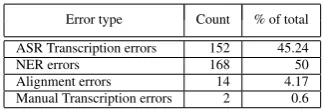
Table 5: Error analysis of a sample ofMSWFI F N er-rors, including errors from all components across the pipeline and even occasional manual transcription er-rors which contribute to bothF P andF Nerrors.
of two significant hyperparameters on pipeline performance using theSWFItest set:
• The number of alternative hypotheses passed on from the ASR to the NER tagger.
• The amount of padding added around each detection by the alignment component.
7 Results
In Table3we report the Word Error Rate (WER) of our ASR component on the SWFI dataset, which was computed by comparing the manual and ASR transcripts of the entire audio. For WER of PHI words, we removed all the non-PHI words from manual ASR transcripts before computing the WER. WER of non-PHI words was computed similarly. We see that both WERs are substantial, and can be thought of as an upper-bound on our pipeline’s end-to-end performance.
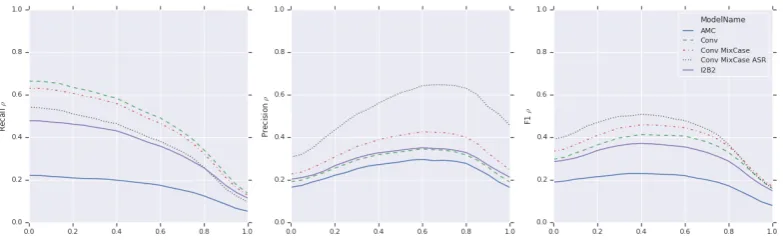
[image:5.595.335.498.167.223.2]Figure 3: End-to-end performance comparison of NER models – Recall (left), Precision (middle) and F1 (right).
Figure 4: Coverage distribution between PHI and non-PHI tokens (left) and End-to-end performance for different pipeline parameters – number of hypotheses (center) and padding (right).
the WER and alignment error rate from Table 3
and the NER from Table 4 leads to an expected
Recallof approximately 0.44, yet the end-to-end
Recall at ρ = 0.5 is 0.53. This implies a
non-trivial co-dependence between errors in the differ-ent compondiffer-ents of the pipeline.
Figure 3 presents the end-to-end evaluation of the different models with respect to the cover-age thresholdρ. As expected,Recallis monotoni-cally non-increasing with respect to the threshold. Meanwhile,P recision(and consequentlyF1) are not monotonic and have more complex behavior. This behavior is due to difference in the distribu-tion of the coverage between PHI and non-PHI, which we see in Figure4(left). An interesting in-sight is that most PHI words have more than half their length redacted by the pipeline while non-PHI words’ coverage is bi-modal, one mode close to 0, and the other close to 1. A plausable explana-tion for this behavior is that theF Ps are derived from alignment errors in low coverage, while the high coverageF Ps occur due to classification er-rors, either due to ASR transcription mistakes or due to model NER errors.
Finally, we show the end-to-end evaluation of the pipeline using MSWFI MixCase+Asr with
differ-ent choices of the pipeline parameters. In Fig-ure 4 (center) the performance of the pipeline slightly increases when using additional alter-native hypotheses, while a different experiment shows that when using alternative hypotheses with
MSWFI MixCase performance decreases. This
de-crease is consistent with the hypotheses’ decreas-ing confidence scores, which can be alleviated with ASR training data but is not addressed by the naive OR approach described in Section 5. This leads us to seek new ways to utilize the additional ASR artifacts, such as the hypotheses confidence scores and speech lattice. In Section 8 we dis-cuss possible directions to improve the pipeline’s robustness to ASR errors. Last, Figure 4 (right) shows that the choice of padding size does not im-prove performance, but rather alters the value of the optimal coverage threshold.
8 Conclusions
audio datasets. We also presented new metrics for the task, Recallρ andP recisionρ, as extensions of standard Recall andP recision where words are considered de-identified when at least a por-tion ρ of their audio signal is redacted. Finally, we detailed our algorithm for this task, a pipeline approach consisting of three components: ASR, NER on transcripts and a novel alignment from tagged transcripts to audio for the actual redaction. We showed that ASR performance is the main impedance towards achieving results comparable to text de-ID. In future work, we plan to address this through several directions, including end-to-end de-ID (Ghannay et al., 2018), lattice-based techniques (Ladhak et al., 2016), and diarization and segmentation of the audio as part of the tran-scription process (Cerva et al.,2013).
9 Acknowledgements
The authors would like to thank Oren Gilon, Shlomo Hoory, Amir Feder, Debby Cohen, Amit Markel, and Ronit Slyper for their generous help in the writing of this paper.
Deidentified clinical records used in this re-search were provided by the i2b2 National Center for Biomedical Computing funded by U54LM008748 and were originally prepared for the Shared Tasks for Challenges in NLP for Clini-cal Data organized by Dr. Ozlem Uzuner, i2b2 and SUNY.
References
Petr Cerva, Jan Silovsky, Jindrich Zdansky, Jan Nouza, and Ladislav Seps. 2013. Speaker-adaptive speech recognition using speaker diarization for improved transcription of large spoken archives. Speech Com-munication, 55(10):1033–1046.
Chung-Cheng Chiu, Anshuman Tripathi, Katherine Chou, Chris Co, Navdeep Jaitly, Diana Jaunzeikare, Anjuli Kannan, Patrick Nguyen, Hasim Sak, Ananth Sankar, et al. 2017. Speech recognition for medical conversations. arXiv preprint arXiv:1711.07274.
Ronan Collobert, Jason Weston, L´eon Bottou, Michael Karlen, Koray Kavukcuoglu, and Pavel Kuksa. 2011. Natural language processing (almost) from scratch. JMLR, 12(Aug):2493–2537.
Christopher Cieri David, David Miller, and Kevin Walker. 2004. The fisher corpus: a resource for the next generations of speech-to-text. In in Proceed-ings 4th International Conference on Language Re-sources and Evaluation, pages 69–71.
Franck Dernoncourt, Ji Young Lee, Ozlem Uzuner, and Peter Szolovits. 2017a. De-identification of patient notes with recurrent neural networks. J. Am Med Inform Assoc, 24(3):596–606.
Franck Dernoncourt, Ji Young Lee, Ozlem Uzuner, and Peter Szolovits. 2017b. De-identification of pa-tient notes with recurrent neural networks. Journal of the American Medical Informatics Association, 24(3):596–606.
Olivier Galibert, Jeremy Leixa, Gilles Adda, Khalid Choukri, and Guillaume Gravier. 2014. The etape speech processing evaluation. In LREC, pages 3995–3999. Citeseer.
Sylvain Galliano, Guillaume Gravier, and Laura Chaubard. 2009. The ester 2 evaluation campaign for the rich transcription of french radio broadcasts. In Tenth Annual Conference of the International Speech Communication Association.
Sahar Ghannay, Antoine Caubri`ere, Yannick Est`eve, Antoine Laurent, and Emmanuel Morin. 2018. End-to-end named entity extraction from speech. arXiv preprint arXiv:1805.12045.
John J. Godfrey, Edward C. Holliman, and Jane Mc-Daniel. 1992. Switchboard: Telephone speech
cor-pus for research and development. In
Proceed-ings of the 1992 IEEE International Conference on Acoustics, Speech and Signal Processing - Volume 1, ICASSP’92, pages 517–520, Washington, DC, USA. IEEE Computer Society.
Yikun Guo, Robert Gaizauskas, Ian Roberts, George Demetriou, Mark Hepple, et al. 2006. Identify-ing personal health information usIdentify-ing support vec-tor machines. In i2b2 workshop on challenges in natural language processing for clinical data, pages 10–11. Citeseer.
Mohamed Hatmi, Christine Jacquin, Emmanuel Morin, and Sylvain Meignier. 2013. Named entity recogni-tion in speech transcripts following an extended tax-onomy. InFirst Workshop on Speech, Language and Audio in Multimedia.
Zhiheng Huang, Wei Xu, and Kai Yu. 2015. Bidi-rectional lstm-crf models for sequence tagging. arXiv:1508.01991.
Faisal Ladhak, Ankur Gandhe, Markus Dreyer, Lam-bert Mathias, Ariya Rastrow, and Bjrn Hoffmeister. 2016. Latticernn: Recurrent neural networks over lattices. InInterspeech 2016, pages 695–699.
Guillaume Lample, Miguel Ballesteros, Sandeep Sub-ramanian, Kazuya Kawakami, and Chris Dyer. 2016. Neural architectures for named entity recognition. InACL.
Xuezhe Ma and Eduard Hovy. 2016. End-to-end se-quence labeling via bi-directional lstm-cnns-crf. In ACL.
Ishna Neamatullah, Margaret M Douglass, H Lehman Li-wei, Andrew Reisner, Mauricio Villarroel, William J Long, Peter Szolovits, George B Moody, Roger G Mark, and Gari D Clifford. 2008. Auto-mated de-identification of free-text medical records. BMC medical informatics and decision making, 8(1):32.
Carolina Parada, Mark Dredze, and Frederick Jelinek. 2011. Oov sensitive named-entity recognition in speech. InTwelfth Annual Conference of the Inter-national Speech Communication Association.
Jeffrey Pennington, Richard Socher, and Christopher Manning. 2014. Glove: Global vectors for word rep-resentation. InEMNLP.
Christian Raymond. 2013. Robust tree-structured named entities recognition from speech. In Acous-tics, Speech and Signal Processing (ICASSP), 2013 IEEE International Conference on, pages 8475– 8479. IEEE.
Patrick Ruch, Robert H Baud, Anne-Marie Rassinoux, Pierrette Bouillon, and Gilbert Robert. 2000. Med-ical document anonymization with a semantic lexi-con. InProceedings of the AMIA Symposium, page 729. American Medical Informatics Association.
Amber Stubbs and ¨Ozlem Uzuner. 2015. Annotating longitudinal clinical narratives for de-identification: The 2014 i2b2/uthealth corpus. J. Biomed. Inf., 58:20–29.
Katsuhito Sudoh, Hajime Tsukada, and Hideki Isozaki. 2006. Incorporating speech recognition confi-dence into discriminative named entity recognition of speech data. InProceedings of the 21st Interna-tional Conference on ComputaInterna-tional Linguistics and the 44th annual meeting of the Association for Com-putational Linguistics, pages 617–624. Association for Computational Linguistics.
Ronald S Weinstein, Ana Maria Lopez, Bellal A Joseph, Kristine A Erps, Michael Holcomb, Gail P Barker, and Elizabeth A Krupinski. 2014. Telemedicine, telehealth, and mobile health appli-cations that work: opportunities and barriers. The American journal of medicine, 127(3):183–187.