Automatic Diacritics Restoration for Hungarian
Attila Nov´ak1,2 and Borb´ala Sikl´osi2
1MTA-PPKE Hungarian Language Technology Research Group,
2P´azm´any P´eter Catholic University, Faculty of Information Technology and Bionics
50/a Pr´ater street, 1083 Budapest, Hungary
{novak.attila, siklosi.borbala}@itk.ppke.hu
Abstract
In this paper, we describe a method based on statistical machine translation (SMT) that is able to restore accents in Hungarian texts with high accuracy. Due to the ag-glutination in Hungarian, there are always plenty of word forms unknown to a sys-tem trained on a fixed vocabulary. In or-der to be able to handle such words, we integrated a morphological analyzer into the system that can suggest accented word candidates for unknown words. We evalu-ated the system in different setups, achiev-ing an accuracy above 99% at the highest.
1 Introduction
Due to clumsy mobile device interfaces and re-luctance of users to spend too much time entering their message, a great amount of text is generated in a format that lacks the diacritic marks normally used in the orthography of the language the text is written in. Whatever the causes for the missing accents are, NLP applications should be able to re-store or generate the accented version of such texts prior to any further syntactic or semantic process-ing to avoid upstream errors.
In this paper, we aim at solving the problem of restoring accents in Hungarian texts with the com-bined application of a statistical machine transla-tion system and a morphological analyzer. Our method can be applied to any other languages that have an accurate morphological analyzer.
2 Related work
For Hungarian, there have been some attempts at creating accent restoration systems. Zaink´o et al. (2000) and Mihalcea and Nastase (2002) are examples for ML approaches, where the correct places of diacritics are predicted from the immedi-ate grapheme-level context of the unaccented let-ter with an accuracy of 95%. Thus, unseen words
can also be accented, but incorrect forms may also be introduced into the text. Dictionary-based ap-proaches rely on large text corpora and the distri-bution of the different accented forms. Zaink´o et al. (2000) report to have achieved a performance of 98% of accuracy with their dictionary-based method. Nevertheless, their system cannot rec-ognize unseen wordforms quite common in Hun-garian. N´emeth et al. (2000) have implemented a complex text processing system for TTS applica-tions, applying morphological and syntactic anal-ysis. The authors report that the performance of accent restoration depends very much on the per-formance of the analyzers (achieving 95% accu-racy at best). Neither the implementations nor the resources used in these systems have been made publicly available.
A language-independent tool, Charlifter (Scan-nell, 2011), is based on statistical methods relying on a lexicon, a bigram contextual model and char-acter distributions built from a training corpus. Its performance on Hungarian with its pre-built mod-els is compared to our results in Section 5.
For other languages, similar methods are used. Yarowsky (1994) presents a comprehensive report on corpus-based techniques used for French and Spanish texts. The role of the context is empha-sized in this report, however, both word form and accent variations are relatively moderate in the investigated languages compared to Hungarian. The study of Zweigenbaum and Grabar (2002) is also aiming at French, but in the medical domain, which contains a higher ratio of unknown words than general language. In their work, a tagging method is applied in combination with transduc-ers, resulting in a tag sequence corresponding to each letter. The method is successfully (92% pre-cision) applied to single headwords of a medical thesaurus (without exploiting any context). The most similar method to ours is that of Pham et al. (2013), who also applied SMT in order to
tomatically restore accents in Vietnamese texts. In their case, the best results produced an accu-racy of 93%. However, their system is augmented with a dictionary, and the distribution of accents and grammatical behaviour are also quite different from Hungarian.
3 Hungarian
Hungarian is an agglutinating language with an orthography that represents compounds as single word forms. These may result in rather complex word forms and words are often composed of long sequences of morphemes. Thus, agglutination and compounding yield a huge number of different word forms.
In Hungarian, umlauts and acute accents are used as diacritics for vowels. Acute accents mark long vowels, while umlauts are used to indicate the frontness of rounded vowelso→¨o[o→ø]andu→¨u [u→y], like in German. A combination of acutes
and umlauts is the double acute diacritic to mark long front rounded vowels ˝o[ø:] and˝u[y:]. Long
vowels generally have essentially the same quality as their short counterpart (i-´ı, ¨u-˝u, u-´u, ¨o-˝o, o-´o). The long pairs of the low vowelsa[O]ande[E], on
the other hand, also differ in quality: ´a[a:] and´e [e:]. There are a few lexicalized cases where there
is a free variation of vowel length without distin-guishing meaning, e.g. hova∼hov´a‘where to’. In most cases, however, the meaning of differently accented variants of a word is quite different. Ta-ble 1 shows all the possiTa-ble unaccented-accented pairs of vowels in Hungarian together with their distribution in a corpus of1 804 252tokens.
a a: 70.33%; ´a: 29.66% e e: 73.40% ´e: 26.59% i i: 86.04% ´ı: 13.95%
o o: 55.41% ´o: 14.65% ¨o: 15.82% ˝o: 14.10% u u: 46.96% ´u: 12.72% ¨u: 29.98% ˝u: 10.32%
Table 1: Possible accent variations in Hungarian
4 Method
In this research, we considered the problem of ac-cent restoration as a translation task, where the source language is the unaccented version, and the target language is accented Hungarian. Since it is easy to come up with a parallel training corpus for this task, methods of SMT can be applied.
In our experiments, we used Moses (Koehn et al., 2007), a widely used SMT toolkit for build-ing the translation models and performbuild-ing decod-ing, and SRILM (Stolcke et al., 2011) to build the necessary language models. Moses was used with its default configuration settings and monotone de-coding (i.e. reordering was not allowed), and with-out the alignment step, which was not needed in our case.
4.1 The baseline setup
In the baseline setup, only the translation and lan-guage models built from the training corpus were used. The input for the decoder was Hungar-ian raw texts with all the accents removed. The translation model contained only unigram phrases (larger n-grams were also tried, but did not change the results) and the language model contained phrases up to 5 grams. Thus, the translation model was responsible for predicting the distribution of accented forms and the language model exploited contextual information.
Another baseline was also created in order to monitor the effect of the SMT system. In this sec-ond baseline, each unaccented word form was re-placed by its most frequent accented form in the training set.
4.2 Incorporating a morphological analyzer
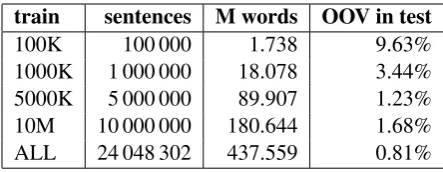
In order to be able to restore accents in unseen words as well, a Hungarian morphological an-alyzer (Pr´osz´eky and Kis, 1999; Nov´ak, 2003) was integrated. A special version of the analyzer was created that directly maps unaccented word forms to their possible accented variants while also marking morpheme boundaries and adding morphosyntactic category tags. The segmenta-tion marks (e.g. compound and derivasegmenta-tional suf-fix boundaries) and the tags are used when we as-sign a score to the accented candidates. We also reanalyze accented forms to retrieve lemmas not directly returned by the accenting analyzer. In our test set of1 804 252tokens, about 1% of the words were not found in the translation model even in the case of the largest, 440 million words, training set. Table 2 shows the ratio of unknown words (OOV) as a function of the size of the training set used for building the phrase table.
train sentences M words OOV in test
100K 100 000 1.738 9.63%
1000K 1 000 000 18.078 3.44%
5000K 5 000 000 89.907 1.23%
10M 10 000 000 180.644 1.68%
[image:3.595.71.293.62.148.2]ALL 24 048 302 437.559 0.81%
Table 2: Ratio of OOV after building a translation model from a training set of a certain size
parameter. In order to be able to use this feature of the decoder, a probability for each candidate form had to be estimated. First, we assumed uni-form distribution among the candidates. However, this approach assigned the same probability to the most common and the most nonsensical (although grammatical) candidates as well. Thus, in some cases these forms showed up in the results. In order to avoid the system to make such errors, a more sophisticated distribution was estimated for the candidate set. For this, we applied a linear regression model based on corpus frequency data determined for the lemma and other features of the candidate word (since the actual wordform was not present in the corpus). Thus, for each candi-date, its lemma frequency (LEM), the number of productively applied compounding (CMP), the number of productively applied derivational af-fixes (DER), and the frequency of the inflectional suffix sequence returned by the analysis were de-termined. Compounding and derivation were pe-nalized (i.e. they were given a negative sign), be-cause the morphological analyzer could suggest some nonsensical, though grammatical compound or derived forms. Sometimes such forms could be the correct ones, but the more productive com-pounding and derivation there is in a word, the lower score it should get. On the other hand, the frequencies of the lemma and the inflectional pat-tern should increase the score of a candidate, thus these components were given positive weights. Based on these components, a score was assigned to each candidate based on Formula (1).
score=−λc#CMP −λd#DER
+log10LEM +λilog10INF +MS (1)
, where
MS=
|minscore|+ 1 if minscore≤0 0 otherwise (2)
The MS component was used to scale up the
scores by adding |minscore|+ 1, i.e. the low-est score received for any candidate in the actual candidate set in order to evade negative scores. The λ weights were set by the mert tuning of the Moses system. We used a separate develop-ment set for this, on which we observed the distri-bution of compounds, derivational and inflectional suffixes in OOV words analyzed by the morphol-ogy and from which we sampled 1000 words ap-proximating the observed distributions. The target of the optimization in themerttuning was the ac-curacy of the system on these words, resulting in the optimal values for eachλ. Even though, in lin-ear regression, it is standard to use an additional bias weight, we did not find it necessary, because we did not need to bring our estimates in sync with estimates from other sources. And assuming one factor to have a fixed unit value was just an-other simplification that would not affect the over-all ranking, just its scaling.
Even though, following an appropriate scaling of the scores, the ranked candidates could be used the same way as the entries in the translation table, the system would never select any accented form other than the most probable one, since the lan-guage model does not include any of these forms. Thus, only the candidate with the highest relative score was made available to the system.
5 Experiments and results
In our experiments, the Hungarian webcorpus (Hal´acsy et al., 2004) was used for training and testing purposes. A set of100 000sentences were separated from the corpus as the test set, and an-other100 000 sentences were used as a develop-ment set. The rest were used for training in differ-ent settings. The size of each training set is shown in Table 2.
100K ALL
system prec rec acc prec rec acc
BL-FREQ-ALL 98.25 82.82 92.34 98.37 96.26 98.13 BL-FREQ-VOW 98.25 82.82 90.62 98.37 96.26 97.71 BL-SMT-ALL 99.03 83.88 92.91 99.09 97.36 98.72 BL-SMT-VOW 99.03 83.88 91.31 99.09 97.36 98.44
[image:4.595.297.521.69.257.2]RANK-ALL 98.81 98.08 98.99 99.01 98.56 99.23 RANK-VOW 98.82 98.08 98.77 99.02 98.56 99.06
Table 3: Performance results for each experimen-tal settings and training size
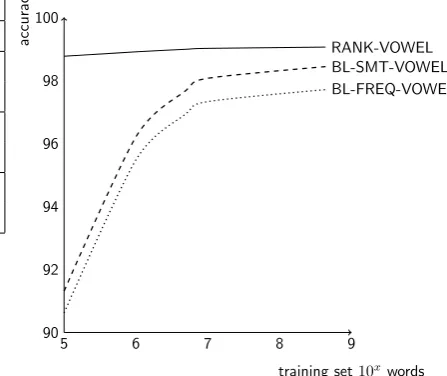
slightly improved when increasing the size of the training corpus, but the values of recall and accu-racy do dramatically improve in the case of the baseline system. However, the integration of the suggestions of the morphology can make up for the lack of information due to the small training set improving recall a great deal while only slightly affecting precision. Even for the biggest 437.6M-word training corpus, incorporating the morpho-logical analyzer with ranking yielded a relative er-ror rate reduction of 39.74%, reducing the word error rate from 1.56% to 0.94%. For the small-est 1.74M-word training corpus tsmall-ested, the relative error rate reduction was 85.85%. The system in-cluding the morphological analyzer performs bet-ter even with the smallest training corpus in bet-terms of word accuracy than the baseline Moses sys-tem with the biggest corpus. Figure 1 shows the learning curves for each system with accuracy as a function of training set size.
Comparing our results to those we obtained using Charlifter (89.75% with most frequent ac-cented form baseline, 90.00% with the lexicon-lookup+bigram contextual model and 93.31% with lookup+bigram context+character-n-gram-based model), the results reveal that both the con-textual model in the SMT system improves accu-racy better than the bigram context model of Char-lifter, and the performance boost we get by incor-porating morphology vastly exceeds the accuracy improvement yielded by the incorporation of the character-n-gram-based model used in Charlifter.
6 Error analysis
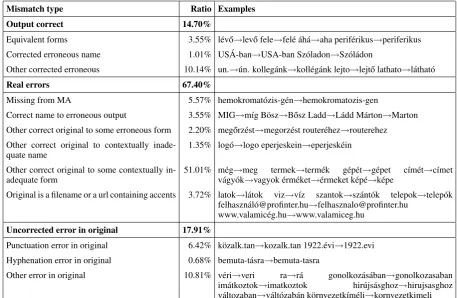
We performed a detailed error analysis on a 5000-sentence (87786-token) fragment of the test set. The results of the error analysis are presented in Table 4.
training set10xwords
accuracy
5 6 7 8 9
90 92 94 96 98 100
RANK-VOWEL BL-SMT-VOWEL BL-FREQ-VOWEL
Figure 1: Accuracy as a function of the size of the training set for each system, measured on words containing vowels.
The detailed analysis showed that 14.7% of mis-matches between the original and the system out-put is in fact not due to the latter being erroneous. 3.55% are equivalent forms , while the rest is cor-rect in the output and erroneous in the reference, i.e. the system corrected errors in the original.
Another part of the reference (17.91%) is like-wise erroneous, however, since the error in these cases was not in the accents, the system was not able to correct it. Missing or substituted letters are the most common mistakes (10.81%), and further 6.42% of the errors is due to punctuation errors in the original.
Mismatch type Ratio Examples
Output correct 14.70%
Equivalent forms 3.55% l´ev˝o→lev˝o fele→fel´e ´ah´a→aha perif´erikus→periferikus Corrected erroneous name 1.01% US ´A-ban→USA-ban Sz´oladon→Sz´ol´adon
Other corrected erroneous 10.14% un.→´un. kolleg´ank→koll´eg´ank lejto→lejt˝o lathato→l´athat´o
Real errors 67.40%
Missing from MA 5.57% hemokromat´ozis-g´en→hemokromatozis-gen
Correct name to erroneous output 3.55% MIG→m´ıg B¨osz→B˝osz Ladd→L´add M´arton→Marton Other correct original to some erroneous form 2.20% meg˝orz´est→megorz´est router´ehez→routerehez Other correct original to contextually
inade-quate name 1.35% log´o→logo eperjeskein→eperjesk´ein Other correct original to some contextually
in-adequate form 51.01% m´egv´agy´ok→meg→vagyok ´erm´ekettermek→term´ek→´ermeket k´ep´eg´ep´et→→g´epetk´epe c´ım´et→c´ımet Original is a filename or a url containing accents 3.72% latok→l´atok viz→v´ız szantok→sz´ant´ok telepok→telep´ok
felhaszn´al´[email protected]→[email protected] www.valamic´eg.hu→www.valamiceg.hu
Uncorrected error in original 17.91%
Punctuation error in original 6.42% k¨ozalk.tan→kozalk.tan 1922.´evi→1922.evi Hyphenation error in original 0.68% bemuta-t´asra→bemuta-tasra
[image:5.595.69.527.62.360.2]Other error in original 10.81% v´eri→veri ra→r´a gonolkoz´as´aban→gonolkozasaban im´atkoztok→imatkoztok hir´ujs´asghoz→hirujsasghoz v´altozaban→v´alt´ozab´an k¨ornyezetk´ım´eli→kornyezetkimeli
Table 4: Analysis of mismatches between the system output and the input on a 5000-sentence test sample
than not (this is especially true for word forms that occur only once in the training data). 3.72% of the errors in the analyzed test data was due to either transforming arbitrary unaccented letter sequences used as file names in the text being transformed to some meaningful words or to accented words be-ing used in an url in the original text.
The most common error (51.01% of all mis-matches) is the case where the system is sim-ply unable to correctly disambiguate the word in context, and this is not due to some other error or information loss. Interestingly, more than half (51%) of these errors belong to a sin-gle type where the system is unable to distin-guish a possessive and a non-possessive form of the same nominal lemma: gyereket∼gyerek´et‘the child (accusative)’ vs.‘his/her child (accusative)’,
gyereken∼gyerek´en ‘on/about the child’ vs. ‘on/about his/her child’, and gyereke∼gyerek´e
‘his/her child’ vs.‘(belongs to a) child’ (anaphoric possessive).
Another 26% of the mismatches is due to a sim-ilar problem concerning verbs. In Hungarian, tran-sitive verbs agree with their object in definiteness. Certain past, present and conditional verb forms differing in definiteness are only distinguished by
an accent: hajtottak∼hajtott´ak ‘they drove’ vs. ‘they drove it’; hajtanak∼hajtan´ak ‘they drive’ vs. ‘they would drive it’;hajtana∼hajtan´a‘he/she would drive’ vs. ‘he/she would drive it’.
A factored model could in theory improve the recognition of these structures. It is questionable however, whether the improvement would justify the costs.
7 Conclusion
References
P´eter Hal´acsy, Andr´as Kornai, L´aszl´o N´emeth, Andr´as Rung, Istv´an Szakad´at, and Viktor Tr´on. 2004. Cre-ating open language resources for hungarian. In
LREC. European Language Resources Association. P. Koehn, H. Hoang, A. Birch, C. Callison-Burch,
M. Federico, N. Bertoldi, B. Cowan, W. Shen, C. Moran, R. Zens, C. Dyer, O. Bojar, A. Constantin, and E. Herbst. 2007. Moses: Open Source Toolkit for Statistical Machine Translation. In Proceed-ings of the ACL 2007 Demo and Poster Sessions, pages 177–180, Prague. Association for Computa-tional Linguistics.
Rada Mihalcea and Vivi Nastase. 2002. Letter level learning for language independent diacritics restora-tion. InProceedings of the 6th Conference on Nat-ural Language Learning - Volume 20, COLING-02, pages 1–7, Stroudsburg, PA, USA. Association for Computational Linguistics.
G´eza N´emeth, Csaba Zaink´o, L´aszl´o Fekete, G´abor Olaszy, G´abor Endr´edi, P´eter Olaszi, G´eza Kiss, and P´eter Kis. 2000. The design, implementation, and operation of a Hungarian e-mail reader. Interna-tional Journal of Speech Technology, 3(3-4):217– 236.
Attila Nov´ak. 2003. What is good Humor like? [Mi-lyen a j´o Humor?]. In I. Magyar Sz´am´ıt´og´epes Nyelv´eszeti Konferencia, pages 138–144, Szeged. SZTE.
Luan-Nghia Pham, Viet-Hong Tran, and Vinh-Van Nguyen. 2013. Vietnamese text accent restora-tion with statistical machine translarestora-tion. In Proceed-ings of the 27th Pacific Asia Conference on Lan-guage, Information, and Computation (PACLIC 27), pages 423–429. Department of English, National Chengchi University.
G´abor Pr´osz´eky and Bal´azs Kis. 1999. A unification-based approach to morpho-syntactic parsing of ag-glutinative and other (highly) inflectional languages. In Proceedings of the 37th annual meeting of the Association for Computational Linguistics on Com-putational Linguistics, ACL ’99, pages 261–268, Stroudsburg, PA, USA. Association for Computa-tional Linguistics.
Kevin P. Scannell. 2011. Statistical unicodification of african languages. Language Resources and Evalu-ation, 45(3):375–386.
Andreas Stolcke, Jing Zheng, Wen Wang, and Victor Abrash. 2011. SRILM at sixteen: Update and out-look. InProc. IEEE Automatic Speech Recognition and Understanding Workshop, Waikoloa, Hawaii, December.
D. Yarowsky. 1994. A comparison of
corpus-based techniques for restoring accents in spanish and french text. InProceedings of the 2nd Annual Work-shop on Very Large Text Corpora, pages 19—-32, Las Cruces.
Cs. Zaink´o, G. N´emeth, G. Olaszy, and G. Gor-dos. 2000. Elj´ar´as adott nyelven ´ekezetes bet˝uk haszn´alata n´elk¨ul k´esz´ıtett sz¨ovegek ´ekezetes bet˝uinek vissza´all´ıt´as´ara.