Decomposability of Translation Metrics
for Improved Evaluation and E
ffi
cient Algorithms
David Chiang and Steve DeNeefe Information Sciences Institute University of Southern California
4676 Admiralty Way, Suite 1001 Marina del Rey, CA 90292 USA {chiang,sdeneefe}@isi.edu
Yee Seng Chan and Hwee Tou Ng Department of Computer Science National University of Singapore
Law Link Singapore 117590
{chanys,nght}@comp.nus.edu.sg
Abstract
B is the de facto standard for evaluation and development of statistical machine trans-lation systems. We describe three real-world situations involving comparisons between dif-ferent versions of the same systems where one can obtain improvements in Bscores that are questionable or even absurd. These situ-ations arise because B lacks the property of decomposability, a property which is also computationally convenient for various appli-cations. We propose a very conservative modi-fication to Band a cross between Band word error rate that address these issues while improving correlation with human judgments.
1 Introduction
B(Papineni et al., 2002) was one of the first
au-tomatic evaluation metrics for machine translation (MT), and despite being challenged by a number of alternative metrics (Melamed et al., 2003; Baner-jee and Lavie, 2005; Snover et al., 2006; Chan and Ng, 2008), it remains the standard in the statistical MT literature. Callison-Burch et al. (2006) have sub-jected Bto a searching criticism, with two
real-world case studies of significant failures of corre-lation between B and human adequacy/fluency
judgments. Both cases involve comparisons between statistical MT systems and other translation meth-ods (human post-editing and a rule-based MT sys-tem), and they recommend that the use of B be
restricted to comparisons between related systems or different versions of the same systems. In B’s
de-fense, comparisons between different versions of the same system were exactly what Bwas designed
for.
However, we show that even in such situations, difficulties with B can arise. We illustrate three
ways that properties of B can be exploited to
yield improvements that are questionable or even absurd. All of these scenarios arose in actual prac-tice and involve comparisons between different ver-sions of the same statistical MT systems. They can be traced to the fact that Bis notdecomposable
at the sentence level: that is, it lacks the property that improving a sentence in a test set leads to an increase in overall score, and degrading a sentence leads to a decrease in the overall score. This prop-erty is not only intuitive, but also computationally convenient for various applications such as transla-tion reranking and discriminative training. We pro-pose a minimal modification to B that reduces
its nondecomposability, as well as a cross between Band word error rate (WER) that is
decompos-able down to the subsentential level (in a sense to be made more precise below). Both metrics correct the observed problems and correlate with human judg-ments better than B.
2 TheBmetric
Letgk(w) be the multiset of allk-grams of a sentence w. We are given a sequence of candidate translations cto be scored against a set of sequences of reference translations,{rj}=r1, . . . ,rR:
c=c1,c2,c3, . . . ,cN
r1=r11,r21,r13, . . . ,r1N ...
rR =rR1,r2R,r3R, . . . ,rRN
Then the Bscore ofcis defined to be
B(c,{rj})=
4
Y
k=1
prk(c,{rj})41 ×bp(c,{rj}) (1)
where1
prk(c,{rj})=
P
i
gk(ci)∩ S
jgk(r j i)
P
i|gk(ci)|
(2)
is thek-gram precision ofcwith respect to{rj}, and bp(c,r), known as the brevity penalty, is defined as follows. Let φ(x) = exp(1−1/x). In the case of a single referencer,
bp(c,r)=φ min
(
1,
P
i|ci|
P
i|ri|
)!
(3)
In the multiple-reference case, the length |ri| is re-placed with aneffective reference length, which can be calculated in several ways.
• In the original definition (Papineni et al., 2002), it is the length of the reference sentence whose length isclosestto the test sentence.
• In the NIST definition, it is the length of the shortestreference sentence.
• A third possibility would be to take theaverage length of the reference sentences.
The purpose of the brevity penalty is to prevent a system from generating very short but precise translations, and the definition of effective reference length impacts how strong the penalty is. The NIST definition is the most tolerant of short translations and becomes more tolerant with more reference sen-tences. The original definition is less tolerant but has the counterintuitive property that decreasing the length of a test sentence can eliminate the brevity penalty. Using the average reference length seems attractive but has the counterintuitive property that
1We use the following definitions about multisets: ifXis a
multiset, let #X(a) be the number of timesaoccurs inX. Then: |X| ≡X
a #X(a) #X∩Y(a)≡min{#X(a),#Y(a)} #X∪Y(a)≡max{#X(a),#Y(a)}
an exact match with one of the references may not get a 100% score. Throughout this paper we use the NIST definition, as it is currently the definition most used in the literature and in evaluations.
The brevity penalty can also be seen as a stand-in for recall. The fraction
P
i|ci|
P
i|ri| in the definition of the brevity penalty (3) indeed resembles a weak re-call score in which every guessed item counts as a match. However, with recall, the per-sentence score
|ci|
|ri| would never exceed unity, but with the brevity penalty, it can. This means that if a system generates a long translation for one sentence, it can generate a short translation for another sentence without fac-ing a penalty. This is a serious weakness in the B
metric, as we demonstrate below using three scenar-ios, encountered in actual practice.
3 Exploiting theBmetric
3.1 The sign test
We are aware of two methods that have been pro-posed for significance testing with B: bootstrap
resampling (Koehn, 2004b; Zhang et al., 2004) and the sign test (Collins et al., 2005). In bootstrap re-sampling, we sample with replacement from the test set to synthesize a large number of test sets, and then we compare the performance of two systems on those synthetic test sets to see whether one is better 95% (or 99%) of the time. But Collins et al. (2005) note that it is not clear whether the conditions re-quired by bootstrap resampling are met in the case of B, and recommend the sign test instead. Suppose
we want to determine whether a set of outputscfrom a test system is better or worse than a set of baseline outputsb. The sign test requires a function f(bi,ci) that indicates whetherci is a better, worse, or same-quality translation relative tobi. However, because Bis not defined on single sentences, Collins et
al. use an approximation: for eachi, form a compos-ite set of outputsb0 = {b1, . . . ,bi−1,ci,bi+1, . . . ,bN}, and compare the Bscores ofbandb0.
The goodness of this approximation depends on to what extent the comparison between bandb0 is dependent only onbiandci, and independent of the other sentences. However, B scores are highly
shorter thanriwithout incurring the brevity penalty. Moreover, since the ci are substituted in one at a time, we can do this for all of theci. Hence,ccould have a disastrously low Bscore (because of the
brevity penalty) yet be found by the sign test to be significantly better than the baseline.
We have encountered this situation in practice: two versions of the same system with Bscores of
29.6 (length ratio 1.02) and 29.3 (length ratio 0.97), where the sign test finds the second system to be sig-nificantly better than the first (and the first system significantly better than the second). Clearly, in or-der for a significance test to be sensible, it should not contradict the observed scores, and should certainly not contradict itself. In the rest of this paper, except where indicated, all significance tests are performed using bootstrap resampling.
3.2 Genre-specific training
For several years, much statistical MT research has focused on translating newswire documents. One likely reason is that the DARPA TIDES program used newswire documents for evaluation for several years. But more recent evaluations have included other genres such as weblogs and conversation. The conventional wisdom has been that if one uses a single statistical translation system to translate text from several different genres, it may perform poorly, and it is better to use several systems optimized sep-arately for each genre.
However, if our task is to translate documents from multiple known genres, but they are evaluated together, the Bmetric allows us to use that fact
to our advantage. To understand how, notice that our system has an optimal number of words that it should generate for the entire corpus: too few and it will be penalized by B’s brevity penalty, and too
many increases the risk of additional non-matching k-grams. But these words can be distributed among the sentences (and genres) in any way we like. In-stead of translating sentences from each genre with the best genre-specific systems possible, we can generate longer outputs for the genre we have more confidence in, while generating shorter outputs for the harder genre. This strategy will have mediocre performance on each individual genre (according to both intuition and B), yet will receive a higher
Bscore on the combined test set than the
com-bined systems optimized for each genre.
In fact, knowing which sentence is in which genre is not even always necessary. In one recent task, we translated documents from two different genres, without knowing the genre of any given sentence. The easier genre, newswire, also tended to have shorter reference sentences (relative to the source sentences) than the harder genre, weblogs. For ex-ample, in one dataset, the newswire reference sets had between 1.3 and 1.37 English words per Ara-bic word, but the weblog reference set had 1.52 En-glish words per Arabic word. Thus, a system that is uniformly verbose across both genres will appor-tion more of its output to newswire than to weblogs, serendipitously leading to a higher score. This phe-nomenon has subsequently been observed by Och (2008) as well.
We trained three Arabic-English syntax-based statistical MT systems (Galley et al., 2004; Galley et al., 2006) using max-B training (Och, 2003):
one on a newswire development set, one on a we-blog development set, and one on a combined devel-opment set containing documents from both genres. We then translated a new mixed-genre test set in two ways: (1) each document with its appropriate genre-specific system, and (2) all documents with the sys-tem trained on the combined (mixed-genre) devel-opment set. In Table 3, we report the results of both approaches on the entire test dataset as well as the portion of the test dataset in each genre, for both the genre-specific and mixed-genre trainings.
The genre-specific systems each outperform the mixed system on their own genre as expected, but when the same results are combined, the mixed sys-tem’s output is a full Bpoint higher than the
com-bination of the genre-specific systems. This is be-cause the mixed system produces outputs that have about 1.35 English words per Arabic word on av-erage: longer than the shortest newswire references, but shorter than the weblog references. The mixed system does worse on each genre but better on the combined test set, whereas, according to intuition, a system that does worse on the two subsets should also do worse on the combined test set.
3.3 Word deletion
A third way to take advantage of the B metric
in the input sentence. We can do this by introduc-ing new phrases or rules into the system that match words in the input sentence but generate no output; to these rules we attach a feature whose weight is tuned during max-B training. Such rules have
been in use for some time but were only recently discussed by Li et al. (2008).
When we add word-deletion rules to our MT sys-tem, we find that the B increases significantly
(Table 6, line 2). Figure 1 shows some examples of deletion in Chinese-English translation. The first sentence has a proper name,¦<[[/maigesaisai ‘Magsaysay’, which has been mistokenized into four tokens. The baseline system attempts to translate the first two phonetic characters as “wheat Georgia,” whereas the other system simply deletes them. On the other hand, the second sentence shows how word deletion can sacrifice adequacy for the sake of flu-ency, and the third sentence shows that sometimes word deletion removes words that could have been translated well (as seen in the baseline translation).
Does Breward word deletion fairly? We note
two reasons why word deletion might be desirable. First, some function words should truly be deleted: for example, the Chinese particle„/deand Chinese measure words often have no counterpart in English (Li et al., 2008). Second, even content word deletion might be helpful if it allows a more fluent translation to be assembled from the remnants. We observe that in the above experiment, word deletion caused the absolute number ofk-gram matches, and not justk -gram precision, to increase for all 1≤k≤4.
Human evaluation is needed to conclusively de-termine whether Brewards deletion fairly. But to
control for these potentially positive effects of dele-tion, we tested a sentence-deletion system, which is the same as the word-deletion system but con-strained to deleteall of the words in a sentence or none of them. This system (Table 6, line 3) deleted 8–10% of its input and yielded a B score with
no significant decrease (p ≥ 0.05) from the base-line system’s. Given that our model treats sentences independently, so that it cannot move information from one sentence to another, we claim that dele-tion of nearly 10% of the input is a grave transladele-tion deficiency, yet Bis insensitive to it.
What does this tell us about word deletion? While acknowledging that some word deletions can
im-prove translation quality, we suggest in addition that because word deletion provides a way for the system to translate the test set selectively, a behavior which we have shown that B is insensitive to, part of
the score increase due to word deletion is likely an artifact of B.
4 Other metrics
Are other metrics susceptible to the same problems as the Bmetric? In this section we examine
sev-eral other popular metrics for these problems, pro-pose two of our own, and discuss some desirable characteristics for any new MT evaluation metric.
4.1 Previous metrics
We ran a suite of other metrics on the above problem cases to see whether they were affected. In none of these cases did we repeat minimum-error-rate train-ing; all these systems were trained using max-B.
The metrics we tested were:
• METEOR (Banerjee and Lavie, 2005), version 0.6, using the exact, Porter-stemmer, and Word-Net synonmy stages, and the optimized param-etersα= 0.81,β= 0.83,γ = 0.28 as reported in (Lavie and Agarwal, 2007).
• GTM (Melamed et al., 2003), version 1.4, with default settings, excepte = 1.2, following the WMT 2007 shared task (Callison-Burch et al., 2007).
• MS (Chan and Ng, 2008), more
specifi-cally MSn, which skips the dependency
re-lations.
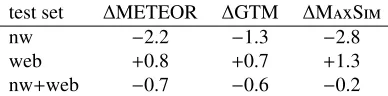
On the sign test (Table 2), all metrics found sig-nificant differences consistent with the difference in score between the two systems. The problem related to genre-specific training does not seem to affect the other metrics (see Table 4), but they still manifest the unintuitive result that genre-specific training is sometimes worse than mixed-genre training. Finally, all metrics but GTM disfavored both word deletion and sentence deletion (Table 7).
4.2 Strict brevity penalty
A very conservative way of modifying the B
im-(a) source 9] «ˆˆ¦<[ [V reference fei xiaotong awarded magsaysay prize
baseline fei xiaotong was awarded the wheat georgia xaixai prize delete fei xiaotong was awarded xaixai award
(b) source è±óc-/ EA p„-Nº qŒýHþ„þa
reference the center of the yuhua stone bears an image which very much resembles the territory of the people ’s republic of china .
baseline rain huashi center is a big clear images of chinese territory . delete rain is a clear picture of the people ’s republic of china .
(c) source Îú : F•DRw °í¹
reference urban construction becomes new hotspot for foreign investment in qinghai baseline urban construction become new hotspot for foreign investment qinghai
delete become new foreign investment hotspot
Figure 1: Examples of word deletion. Underlined Chinese words were deleted in the word-deletion system; underlined English words correspond to deleted Chinese words.
pose a stricter brevity penalty. In Section 2, we pre-sented the brevity penalty as a stand-in for recall, but noted that unlike recall, the per-sentence score
|ci|
|ri| can exceed unity. This suggests the simple fix of clipping the per-sentence recall scores in a similar fashion to the clipping of precision scores:
bp(c,r)=φ
P
imin{|ci|,|ri|}
P
i|ri|
!
(4)
Then if a translation system produces overlong translations for some sentences, it cannot use those translations to license short translations for other sentences. Call this revised metric B- (for
Bwith strict brevity penalty).
We can test this revised definition on the prob-lem cases described above. Table 2 shows that B - resolves the inconsistency observed between
B and the sign test, using the example test sets
from Section 3.1 (no max-B-training was
per-formed). Table 5 shows the new scores of the mixed-genre example from Section 3.2 after max-B-
training. These results fall in line with intuition— tuning separately for each genre leads to slightly better scores in all cases. Finally, Table 8 shows the B-scores for the word-deletion example from
Section 3.3, using both max-Btraining and
max-B-training. We see that B-reduces the
benefit of word deletion to an insignificant level on
the test set, and severely punishes sentence deletion. When we retrain using max-B-, the rate of
word deletion is reduced and sentence deletion is all but eliminated, and there are no significant diff er-ences on the test set.
4.3 4-gram recognition rate
All of the problems we have examined—except for word deletion—are traceable to the fact that B
is not a sentence-level metric. Any metric which is defined as a weighted average of sentence-level scores, where the weights are system-independent, will be immune to these problems. Note that any metric involving micro-averaged precision (in which the sentence-level counts of matches and guesses are summed separately before forming their ratio) cannot have this property. Of the metrics surveyed in the WMT 2007 evaluation-evaluation (Callison-Burch et al., 2007), at least the following metrics have this property: WER (Nießen et al., 2000), TER (Snover et al., 2006), and ParaEval-Recall (Zhou et al., 2006).
et al., 2006; Watanabe et al., 2007), and sentence-by-sentence comparisons of outputs during error analysis. A variation on B is often used for
these purposes, in which thek-gram precisions are “smoothed” by adding one to the numerator and de-nominator (Lin and Och, 2004); this addresses the problem of a zero k-gram match canceling out the entire score, but it does not address the problems il-lustrated above.
The remaining issue, word deletion, is more dif-ficult to assess. It could be argued that part of the gain due to word deletion is caused by B
allow-ing a system to selectively translate those parts of a sentence on which higher precision can be ob-tained. It would be difficult indeed to argue that an evaluation metric, in order to be fair, must be de-composable into subsentential scores, and we make no such claim. However, there is again a dovetail-ing engineerdovetail-ing concern which is quite legitimate. If one wants to select the minimum-Bayes-risk trans-lation from alattice(or shared forest) instead of an n-best list (Tromble et al., 2008), or to select an or-acle translation from a lattice (Tillmann and Zhang, 2006; Dreyer et al., 2007; Leusch et al., 2008), or to perform discriminative training on all the examples contained in a lattice (Taskar et al., 2004), one would need a metric that can be calculated on the edges of the lattice.
Of the metrics surveyed in the WMT 2007 evaluation-evaluation, only one metric, to our knowledge, has this property: word error rate (Nießen et al., 2000). Here, we deal with the related
word recognition rate(McCowan et al., 2005),
WRR=1−WER
=1−minI+D+S |r|
=max M−I
|r| (5)
whereI is the number of insertions,Dof deletions, S of substitutions, andM = |r| −D−S the number of matches. The dynamic program for WRR can be formulated as a Viterbi search through a finite-state automaton: given a candidate sentencecand a refer-ence sentrefer-encer, find the highest-scoring path match-ing c through the automaton with states 0, . . . ,|r|, initial state 0, final state|r|, and the following
transi-tions (a?matches any symbol):
For 0≤i<|r|:
i−−−−→ri+1:1 i+1 match
i−−→:0 i+1 deletion
i−−→?:0 i+1 substitution
For 0≤i≤ |r|:
i−−−−?:−→1 i insertion
This automaton can be intersected with a typical stack-based phrase-based decoder lattice (Koehn, 2004a) or CKY-style shared forest (Chiang, 2007) in much the same way that a language model can, yielding a polynomial-time algorithm for extracting the best-scoring translation from a lattice or forest (Wagner, 1974). Intuitively, the reason for this is that WRR, like most metrics, implicitly constructs a word alignment betweenc andr and only counts matches between aligned words; but unlike other metrics, this alignment is constrained to be mono-tone.
We can combine WRR with the idea of k-gram matching in Bto yield a new metric, the4-gram
recognition rate:
4-GRR=max
P4
k=1Mk−αI−βD
P4
k=1|gk(r)|
(6)
whereMkis the number ofk-gram matches,αandβ control the penalty for insertions and deletions, and gk is as defined in Section 2. We presently set α = 1, β = 0 by analogy with WRR, but explore other settings below. To calculate 4-GRR on a whole test set, we sum the numerators and denominators as in micro-averaged recall.
The 4-GRR can also be formulated as a finite-state automaton, with finite-states{(i,m) |0 ≤ i≤ |r|,0 ≤
m≤3}, initial state (0,0), final states (|r|,m), and the following transitions:
For 0≤i<|r|, 0≤m≤3:
(i,m)−−−−−−→ri+1:m+1 (i+1,min{m+1,3}) match
(i,m)−−−→:−β (i+1,0) deletion
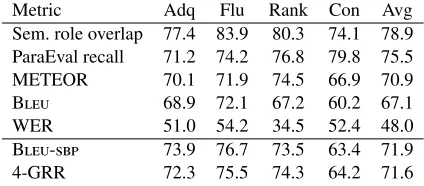
Metric Adq Flu Rank Con Avg Sem. role overlap 77.4 83.9 80.3 74.1 78.9 ParaEval recall 71.2 74.2 76.8 79.8 75.5 METEOR 70.1 71.9 74.5 66.9 70.9
B 68.9 72.1 67.2 60.2 67.1
WER 51.0 54.2 34.5 52.4 48.0
B- 73.9 76.7 73.5 63.4 71.9
[image:7.612.79.291.58.151.2]4-GRR 72.3 75.5 74.3 64.2 71.6
Table 1: Our new metrics correlate with human judg-ments better than B(case-sensitive). Adq=Adequacy, Flu=Fluency, Con=Constituent, Avg=Average.
For 0≤i≤ |r|, 0≤m≤3:
(i,m)−?−−−:−α→(i,0) insertion
Therefore 4-GRR can also be calculated efficiently on lattices or shared forests.
We did not attempt max-4-GRR training, but we evaluated the word-deletion test sets obtained by max-Band max-B-training using 4-GRR.
The results are shown in Table 7. In general, the re-sults are very similar to B-except that 4-GRR
sometimes scores word deletion slightly lower than baseline.
5 Correlation with human judgments
The shared task of the 2007 Workshop on Statistical Machine Translation (Callison-Burch et al., 2007) was conducted with several aims, one of which was to measure the correlation of several automatic MT evaluation metrics (including B) against
hu-man judgments. The task included two datasets (one drawn from the Europarl corpus and the other from the News Commentary corpus) and across three lan-guage pairs (from German, Spanish, and French to English, and back). In our experiments, we focus on the tasks where the target language is English.
For human evaluations of the MT submissions, four different criteria were used:
• Adequacy: how much of the meaning pressed in the reference translation is also ex-pressed in the hypothesis translation.
• Fluency: how well the translation reads in the target language.
• Rank: each translation is ranked from best to worst, relative to the other translations of the same sentence.
• Constituent: constituents are selected from source-side parse-trees, and human judges are asked to rank their translations.
We scored the workshop shared task submissions with B- and 4-GRR, then converted the raw
scores to rankings and calculated the Spearman cor-relations with the human judgments. Table 1 shows the results along with Band the three metrics that
achieved higher correlations than B: semantic
role overlap (Gim´enez and M´arquez, 2007), ParaE-val recall (Zhou et al., 2006), and METEOR (Baner-jee and Lavie, 2005). We find that both our proposed metrics correlate with human judgments better than Bdoes.
However, recall the parametersαandβin the def-inition of 4-GRR that control the penalty for inserted and deleted words. Experimenting with this param-eter reveals that α = −0.9, β = 1 yields a corre-lation of 78.9%. In other words, a metric that un-boundedly rewards spuriously inserted words corre-lates better with human judgments than a metric that punishes them. We assume this is because there are not enough data points (systems) in the sample and ask that all these figures be taken with a grain of salt. As a general remark, it may be beneficial for human-correlation datasets to include a few straw-man sys-tems that have very short or very long translations.
6 Conclusion
We have described three real-world scenarios in-volving comparisons between different versions of the same statistical MT systems where B
gives counterintuitive results. All these issues center around the issue of decomposability: the sign test fails because substituting translations one sentence at a time can improve the overall score yet substitut-ing them all at once can decrease it; genre-specific training fails because improving the score of two halves of a test set can decrease the overall score; and sentence deletion is not harmful because gener-ating empty translations for selected sentences does not necessarily decrease the overall score.
We proposed a minimal modification to B,
problems. We also proposed a metric, 4-GRR, that is decomposable at the sentence level and is therefore guaranteed to solve the sign test, genre-specific tun-ing, and sentence deletion problems; moreoever, it is decomposable at the subsentential level, which has potential implications for evaluating word deletion and promising applications to translation reranking and discriminative training.
Acknowledgments
Our thanks go to Daniel Marcu for suggesting modi-fying the Bbrevity penalty, and to Jonathan May
and Kevin Knight for their insightful comments. This research was supported in part by DARPA grant HR0011-06-C-0022 under BBN Technologies sub-contract 9500008412.
References
Satanjeev Banerjee and Alon Lavie. 2005. METEOR: An automatic metric for MT evaluation with improved correlation with human judgments. InProc. Workshop on Intrinsic and Extrinsic Evaluation Measures for MT and/or Summarization, pages 65–72.
Chris Callison-Burch, Miles Osborne, and Philipp Koehn. 2006. Re-evaluating the role of Bin ma-chine translation research. InProc. EACL 2006, pages 249–256.
Chris Callison-Burch, Cameron Fordyce, Philipp Koehn, Christof Monz, and Josh Schroeder. 2007. (Meta-) evaluation of machine translation. In Proc. Second Workshop on Statistical Machine Translation, pages 136–158.
Yee Seng Chan and Hwee Tou Ng. 2008. MS: A maximum similarity metric for machine translation evaluation. InProc. ACL-08: HLT, pages 55–62. David Chiang. 2007. Hierarchical phrase-based
transla-tion. Computational Linguistics, 33(2):201–228. Michael Collins, Philipp Koehn, and Ivona Kuˇcerov´a.
2005. Clause restructuring for statistical machine translation. InProc. ACL 2005, pages 531–540. Markus Dreyer, Keith Hall, and Sanjeev Khudanpur.
2007. Comparing reordering constraints for SMT us-ing efficient Boracle computation. InProc. 2007 Workshop on Syntax and Structure in Statistical Trans-lation, pages 103–110.
Michel Galley, Mark Hopkins, Kevin Knight, and Daniel Marcu. 2004. What’s in a translation rule? InProc.
HLT-NAACL 2004, pages 273–280.
Michel Galley, Jonathan Graehl, Kevin Knight, Daniel Marcu, Steve DeNeefe, Wei Wang, and Ignacio
Thayer. 2006. Scalable inference and training of context-rich syntactic translation models. In Proc.
COLING-ACL 2006, pages 961–968.
Jes´us Gim´enez and Llu´ıs M´arquez. 2007. Linguistic fea-tures for automatic evaluation of heterogeneous MT systems. InProc. Second Workshop on Statistical Ma-chine Translation, pages 256–264.
Philipp Koehn. 2004a. Pharaoh: a beam search decoder for phrase-based statistical machine translation mod-els. InProc. AMTA 2004, pages 115–124.
Philipp Koehn. 2004b. Statistical significance tests for machine translation evaluation. InProc. EMNLP 2004, pages 388–395.
Shankar Kumar and William Byrne. 2004. Minimum Bayes-risk decoding for statistical machine transla-tion. InProc. HLT-NAACL 2004, pages 169–176. Alon Lavie and Abhaya Agarwal. 2007. METEOR: An
automatic metric for MT evaluation with high levels of correlation with human judgments. InProc. Second Workshop on Statistical Machine Translation, pages 228–231.
Gregor Leusch, Evgeny Matusov, and Hermann Ney. 2008. Complexity of finding the BLEU-optimal hy-pothesis in a confusion network. In Proc. EMNLP 2008. This volume.
Chi-Ho Li, Dongdong Zhang, Ming Zhou, and Hailei Zhang. 2008. An empirical study in source word deletion for phrase-based statistical machine transla-tion. InProc. Third Workshop on Statistical Machine Translation, pages 1–8.
Percy Liang, Alexandre Bouchard-Cˆot´e, Dan Klein, and Ben Taskar. 2006. An end-to-end discriminative ap-proach to machine translation. InProc. COLING-ACL 2006, pages 761–768.
Chin-Yew Lin and Franz Josef Och. 2004. ORANGE: a method for evaluating automatic evaluation metrics for machine translation. In Proc. COLING 2004, pages 501–507.
Iaian McCowan, Darren Moore, John Dines, Daniel Gatica-Perez, Mike Flynn, Pierre Wellner, and Herv´e Bourlard. 2005. On the use of information retrieval measures for speech recognition evaluation. Research Report 04-73, IDIAP Research Institute.
I. Dan Melamed, Ryan Green, and Joseph P. Turian. 2003. Precision and recall of machine translation. In
Proc. HLT-NAACL 2003, pages 61–63. Companion
volume.
Sonia Nießen, Franz Josef Och, Gregor Leusch, and Her-mann Ney. 2000. An evaluation tool for machine translation: Fast evaluation for MT research. InProc. LREC 2000, pages 39–45.
sys B B- METEOR GTM MS 1 29.6++ 28.0 53.1++ 45.5++ 40.7++ 2 29.3++ 27.8 52.2−− 44.8−− 39.6−−
Table 2: The sign test yields inconsistent results with Bbut not with other metrics. Significances are rela-tive to other system.
mixed-genre genre-specific
[image:9.612.341.515.76.133.2]test set B length B length ∆B nw 47.9 1.14 51.1 0.98 +3.2 web 16.3 0.87 16.8 0.95 +0.5 nw+web 31.5 0.97 30.4 0.96 −1.1
Table 3: When performing two genre-specific max-B trainings instead of a single mixed-genre training, we ex-pect that improvements in the newswire (nw) and web subsets should result in a similar improvement in the combined test set (nw+web), but this is not the case. Key: length=length ratio relative to effective reference length.
[image:9.612.75.298.189.249.2]test set ∆METEOR ∆GTM ∆MS nw −2.2 −1.3 −2.8 web +0.8 +0.7 +1.3 nw+web −0.7 −0.6 −0.2
Table 4: Contradictory effects of genre-specific training were not observed with other metrics.
mixed-genre genre-specific
test set B- B- ∆B-
nw 49.6 49.9 +0.3
web 15.3 15.7 +0.4
nw+web 29.3 29.5 +0.2
Table 5: When performing two genre-specific max-B -trainings instead of a single mixed-genre training, we find as expected that improvements in the newswire (nw) and web subsets correlate with a similar improvement in the combined test set (nw+web).
dev test
deletion del% B del% B
none 0 37.7 0 39.3
[image:9.612.320.536.242.297.2]word 8.4 38.6++ 7.7 40.1++ sentence 10.2 37.7 8.6 39.1
Table 6: Use of word-deletion rules can improve the B score, and use of sentence-deletion rules shows no signif-icant degradation, even though they are used heavily. Sig-nificances are relative to baseline (no deletion); all other differences are not statistically significant.
test
deletion METEOR GTM MS 4-GRR
none 59.2 41.0 45.6 18.7
word 57.9 41.9 45.0 18.6
sentence 57.2 41.3 44.0 17.1
Table 7: Word and sentence deletion are punished by most of the other metrics. All systems used max-B training. Significance testing was not performed.
max-Btraining
deletion dev B- test B-
none 35.3 36.9
word 35.8+ 37.1
sentence 33.0−− 34.5−−
max-B-training
dev test
deletion del% B- del% B-
none 0 35.8 0 37.1
word 5.3 36.3+ 5.0 37.3
sentence 0.02 35.9 0 37.5
Table 8: B- severely punishes the max-B -trained sentence-deletion system; when we perform max-B-training, word deletion occurs less frequently and sentence deletion is nearly unused. Significances are relative to baseline (no deletion); other differences are not statistically significant.
Key: +,++ significant improvement (p<0.05 orp<0.01, respectively) −,−− significant degradation (p<0.05 orp<0.01, respectively) ∆metric change inmetricdue to genre-specific training
[image:9.612.88.282.363.411.2] [image:9.612.326.529.376.528.2] [image:9.612.82.288.477.537.2]Franz Josef Och. 2008. The Google statistical machine translation system for the 2008 NIST MT Evaluation. Presentation at the NIST Open Machine Translation 2008 Evaluation Workshop.
Kishore Papineni, Salim Roukos, Todd Ward, and Wei-Jing Zhu. 2002. B: a method for automatic evalua-tion of machine translaevalua-tion. InProc. ACL 2002, pages 311–318.
Matthew Snover, Bonnie Dorr, Richard Schwartz, Lin-nea Micciulla, and John Makhoul. 2006. A study of translation edit rate with targeted human annotation. InProc. AMTA 2006, pages 223–231.
Ben Taskar, Carlos Guestrin, and Daphne Koller. 2004. Max-margin markov networks. InProc. NIPS 2003. Christoph Tillmann and Tong Zhang. 2006. A
discrimi-native global training algorithm for statistical MT. In
Proc. COLING-ACL 2006, pages 721–728.
Roy W. Tromble, Shankar Kumar, Franz Och, and Wolf-gang Macherey. 2008. Lattice minimum Bayes-risk decoding for statistical machine translation. InProc.
EMNLP 2008. This volume.
Robert A. Wagner. 1974. Order-ncorrection for regular languages. Communications of the ACM, 17(5):265. Taro Watanabe, Jun Suzuki, Hajime Tsukuda, and Hideki
Isozaki. 2007. Online large-margin training for sta-tistical machine translation. In Proc. EMNLP 2007, pages 764–773.
Ying Zhang, Stephan Vogel, and Alex Waibel. 2004. In-terpreting BLEU/NIST scores: How much improve-ment do we need to have a better system? In Proc. LREC 2004, pages 2051–2054.