Multilingual Subjectivity Analysis Using Machine Translation
Carmen Banea and Rada Mihalcea University of North Texas [email protected], [email protected]
Janyce Wiebe University of Pittsburgh
Samer Hassan University of North Texas
Abstract
Although research in other languages is in-creasing, much of the work in subjectivity analysis has been applied to English data, mainly due to the large body of electronic re-sources and tools that are available for this lan-guage. In this paper, we propose and evalu-ate methods that can be employed to transfer a repository of subjectivity resources across lan-guages. Specifically, we attempt to leverage on the resources available for English and, by employing machine translation, generate re-sources for subjectivity analysis in other lan-guages. Through comparative evaluations on two different languages (Romanian and Span-ish), we show that automatic translation is a viable alternative for the construction of re-sources and tools for subjectivity analysis in a new target language.
1 Introduction
We have seen a surge in interest towards the ap-plication of automatic tools and techniques for the extraction of opinions, emotions, and sentiments in text (subjectivity). A large number of text process-ing applications have already employed techniques for automatic subjectivity analysis, including auto-matic expressive text-to-speech synthesis (Alm et al., 2005), text semantic analysis (Wiebe and Mihal-cea, 2006; Esuli and Sebastiani, 2006), tracking sen-timent timelines in on-line forums and news (Lloyd et al., 2005; Balog et al., 2006), mining opinions from product reviews (Hu and Liu, 2004), and ques-tion answering (Yu and Hatzivassiloglou, 2003).
A significant fraction of the research work to date in subjectivity analysis has been applied to English, which led to several resources and tools available for this language. In this paper, we explore multiple paths that employ machine translation while lever-aging on the resources and tools available for En-glish, to automatically generate resources for sub-jectivity analysis for a new target language. Through experiments carried out with automatic translation and cross-lingual projections of subjectivity annota-tions, we try to answer the following questions.
First, assuming an English corpus manually an-notated for subjectivity, can we use machine trans-lation to generate a subjectivity-annotated corpus in the target language? Second, assuming the availabil-ity of a tool for automatic subjectivavailabil-ity analysis in English, can we generate a corpus annotated for sub-jectivity in the target language by using automatic subjectivity annotations of English text and machine translation? Finally, third, can these automatically generated resources be used to effectively train tools for subjectivity analysis in the target language?
Since our methods are particularly useful for lan-guages with only a few electronic tools and re-sources, we chose to conduct our initial experiments on Romanian, a language with limited text process-ing resources developed to date. Furthermore, to validate our results, we carried a second set of ex-periments on Spanish. Note however that our meth-ods do not make use of any target language specific knowledge, and thus they are applicable to any other language as long as a machine translation engine ex-ists between the selected language and English.
2 Related Work
Research in sentiment and subjectivity analysis has received increasingly growing interest from the nat-ural language processing community, particularly motivated by the widespread need for opinion-based applications, including product and movie reviews, entity tracking and analysis, opinion summarization, and others.
Much of the work in subjectivity analysis has been applied to English data, though work on other languages is growing: e.g., Japanese data are used in (Kobayashi et al., 2004; Suzuki et al., 2006; Takamura et al., 2006; Kanayama and Nasukawa, 2006), Chinese data are used in (Hu et al., 2005), and German data are used in (Kim and Hovy, 2006). In addition, several participants in the Chinese and Japanese Opinion Extraction tasks of NTCIR-6 (Kando and Evans, 2007) performed subjectivity and sentiment analysis in languages other than En-glish.
In general, efforts on building subjectivity analy-sis tools for other languages have been hampered by the high cost involved in creating corpora and lexical resources for a new language. To address this gap, we focus on leveraging resources already developed for one language to derive subjectivity analysis tools for a new language. This motivates the direction of our research, in which we use machine translation coupled with cross-lingual annotation projections to generate the resources and tools required to perform subjectivity classification in the target language.
The work closest to ours is the one reported in (Mihalcea et al., 2007), where a bilingual lexicon and a manually translated parallel text are used to generate the resources required to build a subjectiv-ity classifier in a new language. In that work, we found that the projection of annotations across par-allel texts can be successfully used to build a cor-pus annotated for subjectivity in the target language. However, parallel texts are not always available for a given language pair. Therefore, in this paper we explore a different approach where, instead of rely-ing on manually translated parallel corpora, we use machine translation to produce a corpus in the new language.
3 Machine Translation for Subjectivity Analysis
We explore the possibility of using machine transla-tion to generate the resources required to build sub-jectivity annotation tools in a given target language. We focus on two main scenarios. First, assuming a corpus manually annotated for subjectivity exists in the source language, we can use machine translation to create a corpus annotated for subjectivity in the target language. Second, assuming a tool for auto-matic subjectivity analysis exists in the source lan-guage, we can use this tool together with machine translation to create a corpus annotated for subjec-tivity in the target language.
In order to perform a comprehensive investiga-tion, we propose three experiments as described be-low. The first scenario, based on a corpus manu-ally annotated for subjectivity, is exemplified by the first experiment. The second scenario, based on a corpus automatically annotated with a tool for sub-jectivity analysis, is subsequently divided into two experiments depending on the direction of the trans-lation and on the dataset that is translated.
In all three experiments, we use English as a source language, given that it has both a corpus man-ually annotated for subjectivity (MPQA (Wiebe et al., 2005)) and a tool for subjectivity analysis (Opin-ionFinder (Wiebe and Riloff, 2005)).
3.1 Experiment One: Machine Translation of Manually Annotated Corpora
In this experiment, we use a corpus in the source language manually annotated for subjectivity. The corpus is automatically translated into the target lan-guage, followed by a projection of the subjectivity labels from the source to the target language. The experiment is illustrated in Figure 1.
cor-Figure 1: Experiment one: machine translation of man-ually annotated training data from source language into target language
pus and the projection of the annotations, we obtain a large corpus of 9,700 subjectivity-annotated sen-tences in the target language, which can be used to train a subjectivity classifier.
3.2 Experiment Two: Machine Translation of Source Language Training Data
In the second experiment, we assume that the only resources available are a tool for subjectivity anno-tation in the source language and a collection of raw texts, also in the source language. The source lan-guage text is automatically annotated for subjectiv-ity and then translated into the target language. In this way, we produce a subjectivity annotated cor-pus that we can use to train a subjectivity annotation tool for the target language. Figure 2 illustrates this experiment.
In order to generate automatic subjectivity anno-tations, we use the OpinionFinder tool developed by (Wiebe and Riloff, 2005). OpinionFinder includes two classifiers. The first one is a rule-based high-precision classifier that labels sentences based on the presence of subjective clues obtained from a large lexicon. The second one is a high-coverage classi-fier that starts with an initial corpus annotated us-ing the high-precision classifier, followed by several bootstrapping steps that increase the size of the lex-icon and the coverage of the classifier. For most of our experiments we use the high-coverage classifier.
Figure 2: Experiment two: machine translation of raw training data from source language into target language
Table 1 shows the performance of the two Opinion-Finder classifiers as measured on the MPQA corpus (Wiebe and Riloff, 2005).
P R F
high-precision 86.7 32.6 47.4
high-coverage 79.4 70.6 74.7
Table 1: Precision (P), Recall (R) and F-measure (F) for the two OpinionFinder classifiers, as measured on the MPQA corpus
As a raw corpus, we use a subset of the SemCor corpus (Miller et al., 1993), consisting of 107 docu-ments with roughly 11,000 sentences. This is a bal-anced corpus covering a number of topics in sports, politics, fashion, education, and others. The reason for working with this collection is the fact that we also have a manual translation of the SemCor docu-ments from English into one of the target languages used in the experiments (Romanian), which enables comparative evaluations of different scenarios (see Section 4).
3.3 Experiment Three: Machine Translation of Target Language Training Data
The third experiment is similar to the second one, except that we reverse the direction of the transla-tion. We translate raw text that is available in the target language into the source language, and then use a subjectivity annotation tool to label the auto-matically translated source language text. After the annotation, the labels are projected back into the tar-get language, and the resulting annotated corpus is used to train a subjectivity classifier. Figure 3 illus-trates this experiment.
Figure 3: Experiment three: machine translation of raw training data from target language into source language
As before, we use the high-coverage classifier available in OpinionFinder, and the SemCor corpus. We use a manual translation of this corpus available in the target language.
In this experiment, the subjectivity annotations are carried out on automatically generated source text, and thus expected to be less accurate. How-ever, since the training data was originally written in the target language, it is free of translation errors, and thus training carried out on this data should be more robust.
3.4 Upper bound: Machine Translation of Target Language Test Data
For comparison purposes, we also propose an ex-periment which plays the role of an upper bound on the methods described so far. This experiment in-volves the automatic translation of the test data from
the target language into the source language. The source language text is then annotated for subjectiv-ity using OpinionFinder, followed by a projection of the resulting labels back into the target language.
Unlike the previous three experiments, in this experiment we only generate subjectivity-annotated
resources, and we do not build and evaluate a
stan-dalone subjectivity analysis tool for the target lan-guage. Further training of a machine learning algo-rithm, as in experiments two and three, is required in order to build a subjectivity analysis tool. Thus, this fourth experiment is an evaluation of the resources generated in the target language, which represents an upper bound on the performance of any machine learning algorithm that would be trained on these re-sources. Figure 4 illustrates this experiment.
Figure 4: Upper bound: machine translation of test data from target language into source language
4 Evaluation and Results
Our initial evaluations are carried out on Romanian. The performance of each of the three methods is evaluated using a dataset manually annotated for subjectivity. To evaluate our methods, we generate a Romanian training corpus annotated for subjectivity on which we train a subjectivity classifier, which is then used to label the test data.
We evaluate the results against a gold-standard corpus consisting of 504 Romanian sentences
man-ually annotated for subjectivity. These sentences
represent the manual translation into Romanian of a small subset of the SemCor corpus, which was removed from the training corpora used in experi-ments two and three. This is the same evaluation
dataset as used in (Mihalcea et al., 2007). Two
through discussions. The agreement of the two an-notators is 0.83% (κ= 0.67); when the uncertain
an-notations are removed, the agreement rises to 0.89
(κ = 0.77). The two annotators reached consensus
on all sentences for which they disagreed, resulting in a gold standard dataset with 272 (54%) subjective sentences and 232 (46%) objective sentences. More details about this dataset are available in (Mihalcea et al., 2007).
In order to learn from our annotated data, we ex-periment with two different classifiers, Na¨ıve Bayes and support vector machines (SVM), selected for their performance and diversity of learning method-ology. For Na¨ıve Bayes, we use the multinomial model (McCallum and Nigam, 1998) with a thresh-old of 0.3. For SVM (Joachims, 1998), we use the LibSVM implementation (Fan et al., 2005) with a linear kernel.
The automatic translation of the MPQA and of the SemCor corpus was performed using Language Weaver,1 a commercial statistical machine transla-tion software. The resulting text was post-processed by removing diacritics, stopwords and numbers. For training, we experimented with a series of weight-ing schemes, yet we only report the results obtained for binary weighting, as it had the most consistent behavior.
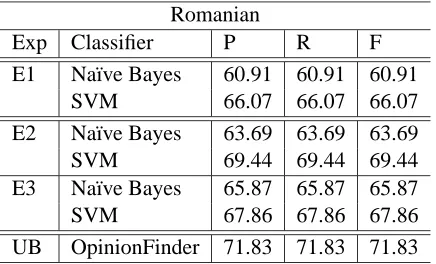
The results obtained by running the three experi-ments on Romanian are shown in Table 2. The base-line on this data set is 54.16%, represented by the percentage of sentences in the corpus that are sub-jective, and the upper bound (UB) is 71.83%, which is the accuracy obtained under the scenario where the test data is translated into the source language and then annotated using the high-coverage Opin-ionFinder tool.
Perhaps not surprisingly, the SVM classifier out-performs Na¨ıve Bayes by 2% to 6%, implying that SVM may be better fitted to lessen the amount of noise embedded in the dataset and provide more ac-curate classifications.
The first experiment, involving the automatic translation of the MPQA corpus enhanced with man-ual annotations for subjectivity at sentence level, does not seem to perform well when compared to the experiments in which automatic subjectivity
classi-1http://www.languageweaver.com/
Romanian
Exp Classifier P R F
E1 Na¨ıve Bayes 60.91 60.91 60.91
SVM 66.07 66.07 66.07
E2 Na¨ıve Bayes 63.69 63.69 63.69
SVM 69.44 69.44 69.44
E3 Na¨ıve Bayes 65.87 65.87 65.87
SVM 67.86 67.86 67.86
[image:5.612.319.537.63.195.2]UB OpinionFinder 71.83 71.83 71.83
Table 2: Precision (P), Recall (R) and F-measure (F) for Romanian experiments
fication is used. This could imply that a classifier cannot be so easily trained on the cues that humans use to express subjectivity, especially when they are not overtly expressed in the sentence and thus can be lost in the translation. Instead, the automatic annotations produced with a rule-based tool (Opin-ionFinder), relying on overt mentions of words in a subjectivity lexicon, seems to be more robust to translation, further resulting in better classification results. To exemplify, consider the following sub-jective sentence from the MPQA corpus, which does not include overt clues of subjectivity, but was an-notated as subjective by the human judges because of the structure of the sentence: It is the
Palestini-ans that are calling for the implementation of the agreements, understandings, and recommendations pertaining to the Palestinian-Israeli conflict.
We compare our results with those obtained by a previously proposed method that was based on the manual translation of the SemCor subjectivity-annotated corpus. In (Mihalcea et al., 2007), we used the manual translation of the SemCor corpus into Romanian to form an English-Romanian par-allel data set. The English side was annotated us-ing the Opinion Finder tool, and the subjectivity la-bels were projected on the Romanian text. A Na¨ıve Bayes classifier was then trained on the subjectivity annotated Romanian corpus and tested on the same gold standard as used in our experiments. Table 3 shows the results obtained in those experiments by using the high-coverage OpinionFinder classifier.
OpinionFinder classifier P R F
[image:6.612.316.533.66.223.2]high-coverage 67.85 67.85 67.85
Table 3: Precision (P), Recall (R) and F-measure (F) for subjectivity analysis in Romanian obtained by using an English-Romanian parallel corpus
English into Romanian (experiment two) or Roma-nian into English (experiment three), and annotating this dataset with the high-coverage OpinionFinder classifier, we obtain an F-measure of 63.69%, and 65.87% respectively, using Na¨ıve Bayes (the same machine learning classifier as used in (Mihalcea et
al., 2007)). This implies that at most 4% in
F-measure can be gained by using a parallel corpus as compared to an automatically translated corpus, fur-ther suggesting that machine translation is a viable alternative to devising subjectivity classification in a target language leveraged on the tools existent in a source language.
As English is a language with fewer inflections when compared to Romanian, which accommodates for gender and case as a suffix to the base form of a word, the automatic translation into English is closer to a human translation (experiment three). Therefore labeling this data using the OpinionFinder tool and projecting the labels onto a fully inflected human-generated Romanian text provides more accurate classification results, as compared to a setup where the training is carried out on machine-translated Ro-manian text (experiment two).
0.5 0.55 0.6 0.65 0.7
0.2 0.4 0.6 0.8 1
F-measure
[image:6.612.73.295.497.652.2]Percentage of corpus NB SVM
Figure 5: Experiment two: Machine learning F-measure over an incrementally larger training set
We also wanted to explore the impact that the
0.5 0.55 0.6 0.65 0.7
0.2 0.4 0.6 0.8 1
F-measure
Percentage of corpus NB SVM
Figure 6: Experiment three: Machine learning F-measure over an incrementally larger training set
pus size may have on the accuracy of the classifiers. We re-ran experiments two and three with 20% cor-pus size increments at a time (Figures 5 and 6). It is interesting to note that a corpus of approximately 6000 sentences is able to achieve a high enough F-measure (around 66% for both experiments) to be considered viable for training a subjectivity classi-fier. Also, at a corpus size over 10,000 sentences, the Na¨ıve Bayes classifier performs worse than SVM, which displays a directly proportional trend between the number of sentences in the data set and the ob-served F-measure. This trend could be explained by the fact that the SVM classifier is more robust with regard to noisy data, when compared to Na¨ıve Bayes.
5 Portability to Other Languages
To test the validity of the results on other languages, we ran a portability experiment on Spanish.
To build a test dataset, a native speaker of Span-ish translated the gold standard of 504 sentences into Spanish. We maintain the same subjectivity anno-tations as for the Romanian dataset. To create the training data required by the first two experiments, we translate both the MPQA corpus and the Sem-Cor corpus into Spanish using the Google Transla-tion service,2 a publicly available machine tion engine also based on statistical machine transla-tion. We were therefore able to implement all the ex-periments but the third, which would have required
a manually translated version of the SemCor corpus. Although we could have used a Spanish text to carry out a similar experiment, due to the fact that the dataset would have been different, the results would not have been directly comparable.
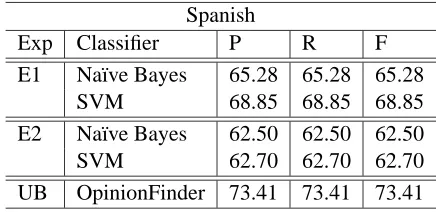
The results of the two experiments exploring the portability to Spanish are shown in Table 4. Inter-estingly, all the figures are higher than those ob-tained for Romanian. We assume this occurs be-cause Spanish is one of the six official United Na-tions languages, and the Google translation engine is using the United Nations parallel corpus to train their translation engine, therefore implying that a better quality translation is achieved as compared to the one available for Romanian. We can therefore conclude that the more accurate the translation en-gine, the more accurately the subjective content is translated, and therefore the better the results. As it was the case for Romanian, the SVM classifier pro-duces the best results, with absolute improvements over the Na¨ıve Bayes classifier ranging from 0.2% to 3.5%.
Since the Spanish automatic translation seems to be closer to a human-quality translation, we are not surprised that this time the first experiment is able to generate a more accurate training corpus as com-pared to the second experiment. The MPQA corpus, since it is manually annotated and of better quality, has a higher chance of generating a more reliable data set in the target language. As in the experiments on Romanian, when performing automatic transla-tion of the test data, we obtain the best results with an F-measure of 73.41%, which is also the upper bound on our proposed experiments.
Spanish
Exp Classifier P R F
E1 Na¨ıve Bayes 65.28 65.28 65.28
SVM 68.85 68.85 68.85
E2 Na¨ıve Bayes 62.50 62.50 62.50
SVM 62.70 62.70 62.70
[image:7.612.75.295.558.664.2]UB OpinionFinder 73.41 73.41 73.41
Table 4: Precision (P), Recall (R) and F-measure (F) for Spanish experiments
6 Discussion
Based on our experiments, we can conclude that ma-chine translation offers a viable approach to gener-ating resources for subjectivity annotation in a given target language. The results suggest that either a manually annotated dataset or an automatically an-notated one can provide sufficient leverage towards building a tool for subjectivity analysis.
Since the use of parallel corpora (Mihalcea et al., 2007) requires a large amount of manual labor, one of the reasons behind our experiments was to asses the ability of machine translation to transfer subjec-tive content into a target language with minimal ef-fort. As demonstrated by our experiments, machine translation offers a viable alternative in the construc-tion of resources and tools for subjectivity classifica-tion in a new target language, with only a small de-crease in performance as compared to the case when a parallel corpus is available and used.
To gain further insights, two additional experi-ments were performed. First, we tried to isolate the role played by the quality of the subjectivity anno-tations in the source-language for the cross-lingual projections of subjectivity. To this end, we used the high-precision OpinionFinder classifier to annotate the English datasets. As shown in Table 1, this clas-sifier has higher precision but lower recall as com-pared to the high-coverage classifier we used in our previous experiments. We re-ran the second exper-iment, this time trained on the 3,700 sentences that were classified by the OpinionFinder high-precision classifier as either subjective or objective. For Ro-manian, we obtained an F-measure of 69.05%, while for Spanish we obtained an F-measure of 66.47%.
SemCor training data set, annotated with subjectiv-ity labels projected from English. The classifier was tested on the same gold standard data set. Thus, the two classifiers used the same training data, the same test data, and the same subjectivity annotations, the only difference being the language used (English or Romanian).
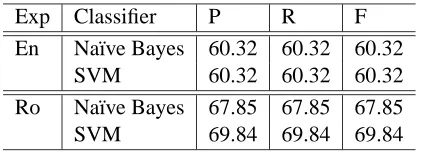
The results for these experiments are compiled in Table 5. Interestingly, the experiment conducted on Romanian shows an improvement of 3.5% to 9.5% over the results obtained on English, which indi-cates that subjective content may be easier to learn in Romanian versus English. The fact that Roma-nian verbs are inflected for mood (such as indicative, conditional, subjunctive, presumptive), enables an automatic classifier to identify additional subjective markers in text. Some moods such as conditional and presumptive entail human judgment, and there-fore allow for clear subjectivity annotation. More-over, Romanian is a highly inflected language, ac-commodating for forms of various words based on number, gender, case, and offering an explicit lex-icalization of formality and politeness. All these features may have a cumulative effect in allowing for better classification. At the same time, English entails minimal inflection when compared to other Indo-European languages, as it lacks both gender and adjective agreement (with very few notable ex-ceptions such as beautiful girl and handsome boy). Verb moods are composed with the aid of modals, while tenses and expressions are built with the aid of auxiliary verbs. For this reason, a machine learn-ing algorithm may not be able to identify the same amount of information on subjective content in an English versus a Romanian text. It is also interesting to note that the labeling of the training set was per-formed using a subjectivity classifier developed for English, which takes into account a large, human-annotated, subjectivity lexicon also developed for English. One would have presumed that any clas-sifier trained on this annotated text would therefore provide the best results in English. Yet, as explained earlier, this was not the case.
7 Conclusion
In this paper, we explored the use of machine trans-lation for creating resources and tools for
subjec-Exp Classifier P R F
En Na¨ıve Bayes 60.32 60.32 60.32
SVM 60.32 60.32 60.32
Ro Na¨ıve Bayes 67.85 67.85 67.85
[image:8.612.322.533.62.138.2]SVM 69.84 69.84 69.84
Table 5: Precision (P), Recall (R) and F-measure (F) for identifying language specific information
tivity analysis in other languages, by leveraging on the resources available in English. We introduced and evaluated three different approaches to generate subjectivity annotated corpora in a given target lan-guage, and exemplified the technique on Romanian and Spanish.
The experiments show promising results, as they are comparable to those obtained using manually translated corpora. While the quality of the trans-lation is a factor, machine transtrans-lation offers an effi-cient and effective alternative in capturing the sub-jective semantics of a text, coming within 4% F-measure as compared to the results obtained using human translated corpora.
In the future, we plan to explore additional language-specific clues, and integrate them into the subjectivity classifiers. As shown by some of our experiments, Romanian seems to entail more subjec-tivity markers compared to English, and this factor motivates us to further pursue the use of language-specific clues of subjectivity.
Our experiments have generated corpora of about 20,000 sentences annotated for subjectivity in Ro-manian and Spanish, which are available for down-load at http://lit.csci.unt.edu/index.php/Downdown-loads, along with the manually annotated data sets.
Acknowledgments
References
C. Ovesdotter Alm, D. Roth, and R. Sproat. 2005. Emotions from text: Machine learning for text-based emotion prediction. In Proceedings of the
Hu-man Language Technologies Conference/Conference on Empirical Methods in Natural Language Process-ing (HLT/EMNLP-2005), pages 347–354, Vancouver,
Canada.
K. Balog, G. Mishne, and M. de Rijke. 2006. Why are they excited? identifying and explaining spikes in blog mood levels. In Proceedings of the 11th Meeting of
the European Chapter of the Association for Compu-tational Linguistics (EACL-2006).
A. Esuli and F. Sebastiani. 2006. Determining term sub-jectivity and term orientation for opinion mining. In
Proceedings the 11th Meeting of the European Chap-ter of the Association for Computational Linguistics (EACL-2006), pages 193–200, Trento, IT.
R. Fan, P. Chen, and C. Lin. 2005. Working set selection using the second order information for training svm.
Journal of Machine Learning Research, 6:1889–1918.
M. Hu and B. Liu. 2004. Mining and summarizing customer reviews. In Proceedings of ACM SIGKDD
Conference on Knowledge Discovery and Data Min-ing 2004 (KDD 2004), pages 168–177, Seattle,
Wash-ington.
Y. Hu, J. Duan, X. Chen, B. Pei, and R. Lu. 2005. A new method for sentiment classification in text retrieval. In
IJCNLP, pages 1–9.
T. Joachims. 1998. Text categorization with Support Vector Machines: learning with mny relevant features. In Proceedings of the European Conference on
Ma-chine Learning, pages 137–142.
H. Kanayama and T. Nasukawa. 2006. Fully automatic lexicon expansion for domain-oriented sentiment anal-ysis. In Proceedings of the Conference on Empirical
Methods in Natural Language Processing (EMNLP-2006), pages 355–363, Sydney, Australia.
N. Kando and D. Kirk Evans, editors. 2007.
Proceed-ings of the Sixth NTCIR Workshop Meeting on Evalua-tion of InformaEvalua-tion Access Technologies: InformaEvalua-tion Retrieval, Question Answering, and Cross-Lingual In-formation Access, 2-1-2 Hitotsubashi, Chiyoda-ku,
Tokyo 101-8430, Japan, May. National Institute of In-formatics.
S.-M. Kim and E. Hovy. 2006. Identifying and ana-lyzing judgment opinions. In Proceedings of the
Hu-man Language Technology Conference of the NAACL,
pages 200–207, New York, New York.
N. Kobayashi, K. Inui, Y. Matsumoto, K. Tateishi, and T. Fukushima. 2004. Collecting evaluative expres-sions for opinion extraction. In Proceedings of the 1st
International Joint Conference on Natural Language Processing (IJCNLP-04).
L. Lloyd, D. Kechagias, and S. Skiena. 2005. Lydia: A system for large-scale news analysis. In String
Pro-cessing and Information Retrieval (SPIRE 2005).
A. McCallum and K. Nigam. 1998. A comparison of event models for Naive Bayes text classification. In
Proceedings of AAAI-98 Workshop on Learning for Text Categorization.
R. Mihalcea, C. Banea, and J. Wiebe. 2007. Learning multilingual subjective language via cross-lingual pro-jections. In Proceedings of the Association for
Com-putational Linguistics, Prague, Czech Republic.
G. Miller, C. Leacock, T. Randee, and R. Bunker. 1993. A semantic concordance. In Proceedings of the 3rd
DARPA Workshop on Human Language Technology,
Plainsboro, New Jersey.
Y. Suzuki, H. Takamura, and M. Okumura. 2006. Ap-plication of semi-supervised learning to evaluative ex-pression classification. In Proceedings of the 7th
In-ternational Conference on Intelligent Text Process-ing and Computational LProcess-inguistics (CICLProcess-ing-2006),
pages 502–513, Mexico City, Mexico.
H. Takamura, T. Inui, and M. Okumura. 2006. Latent variable models for semantic orientations of phrases. In Proceedings of the 11th Meeting of the European
Chapter of the Association for Computational Linguis-tics (EACL 2006), Trento, Italy.
J. Wiebe and R. Mihalcea. 2006. Word sense and subjec-tivity. In Proceedings of COLING-ACL 2006.
J. Wiebe and E. Riloff. 2005. Creating subjective and objective sentence classifiers from unannotated texts. In Proceedings of the 6th International Conference
on Intelligent Text Processing and Computational Lin-guistics (CICLing-2005) ( invited paper), Mexico City,
Mexico.
J. Wiebe, T. Wilson, and C. Cardie. 2005. Annotating ex-pressions of opinions and emotions in language.
Lan-guage Resources and Evaluation, 39(2-3):165–210.
H. Yu and V. Hatzivassiloglou. 2003. Towards answering opinion questions: Separating facts from opinions and identifying the polarity of opinion sentences. In
Pro-ceedings of the Conference on Empirical Methods in Natural Language Processing (EMNLP-2003), pages