Statistical Machine Reordering
Marta R. Costa-juss`a and Jos´e A. R. Fonollosa Department of Signal Theory and Communications
TALP Research Center (UPC) Barcelona 08034, Spain (mruiz,adrian)@gps.tsc.upc.edu
Abstract
Reordering is currently one of the most important problems in statistical machine translation systems. This paper presents a novel strategy for dealing with it: sta-tistical machine reordering (SMR). It con-sists in using the powerful techniques de-veloped for statistical machine translation (SMT) to translate the source language (S) into a reordered source language (S’), which allows for an improved translation into the target language (T). The SMT task changes fromS2TtoS’2Twhich leads to a monotonized word alignment and shorter translation units. In addition, the use of classes in SMR helps to infer new word reorderings. Experiments are reported in the EsEn WMT06 tasks and the ZhEn IWSLT05 task and show significant im-provement in translation quality.
1 Introduction
During the last few years, SMT systems have evolved from the original word-based ap-proach (Brown et al., 1993) to phrase-based trans-lation systems (Koehn et al., 2003). In parallel to the phrase-based approach, the use of bilin-gual n-grams gives comparable results, as shown by Crego et al. (2005a). Two basic issues differ-entiate the n-gram-based system from the phrase-based: training data are monotonously segmented into bilingual units; and, the model considers n-gram probabilities rather than relative frequencies. This translation approach is described in detail by Mari˜no et al. (2005). The n-gram-based system follows a maximum entropy approach, in which a log-linear combination of multiple models is
im-plemented (Och and Ney, 2002), as an alternative to the source-channel approach.
In both systems, introducing reordering capabil-ities is of crucial importance for certain language pairs. Recently, new reordering strategies have been proposed in the literature on SMT such as the reordering of each source sentence to match the word order in the corresponding target sentence, see Kanthak et al. (2005) and Crego et al. (2005b). Similarly, Matusov et al. (2006) describe a method for simultaneously aligning and monotonizing the training corpus. The main problems of these ap-proaches are: (1) the fact that the proposed mono-tonization is based on the alignment and cannot be applied to the test sets, and (2) the lack of reorder-ing generalization.
This paper presents a reordering approach called statistical machine reordering (SMR) which improves the reordering capabilities of SMT sys-tems without incurring any of the problems men-tioned above. SMR is a first-pass translation performed on the source corpus, which converts it into an intermediate representation, in which source-language words are presented in an order that more closely matches that of the target lan-guage. SMR and SMT are performed using the same modeling tools as n-gram-based systems but using different statistical log-linear models.
In order to be able to infer new reorderings we use word classes instead of words themselves as the input to the SMR system. In fact, the use of classes to help in the reordering is a key difference between our approach and standard SMT systems. This paper is organized as follows: Section 2 outlines the baseline system. Section 3 describes the reordering strategy in detail. Section 4 presents and discusses the results, and Section 5 presents our conclusions and suggestions for further work.
2 N-gram-based SMT System
This section briefly describes the n-gram-based SMT which uses a translation model based on bilingual n-grams. It is actually a language model of bilingual units, referred to as tuples, which ap-proximates the joint probability between source and target languages by using bilingual n-grams (de Gispert and Mari˜no, 2002).
Bilingual units (tuples) are extracted from any word alignment according to the following con-straints:
1. a monotonous segmentation of each bilingual sentence pairs is produced,
2. no word inside the tuple is aligned to words outside the tuple, and
3. no smaller tuples can be extracted without vi-olating the previous constraints.
[image:2.595.75.279.408.517.2]As a result of these constraints, only one seg-mentation is possible for a given sentence pair.
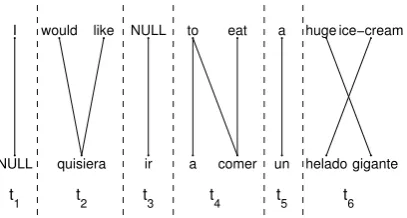
Figure 1 presents a simple example which illus-trates the tuple extraction process.
I would like NULL to eat a huge ice−cream
NULL quisiera ir a comer un helado gigante
t1 t2 t3 t4 t5 t6
Figure 1: Example of tuple extraction from an aligned bilingual sentence pair.
Two important issues regarding this translation model must be considered. First, it often occurs that large number of single-word translation prob-abilities are left out of the model. This happens for all words that are always embedded in tuples containing two or more words. Consider for ex-ample the word “ice-cream” in Figure 1. As seen from the Figure, “ice-cream” is embedded into tu-plet6. If a similar situation is encountered for all
occurrences of “ice-cream” in the training corpus, then no translation probability for an independent occurrence of this word will exist.
To overcome this problem, the tuple 4-gram model is enhanced by incorporating 1-gram
trans-lation probabilities for all the embedded words de-tected during the tuple extraction step. These 1-gram translation probabilities are computed from the intersection of both, the source-to-target and the target-to-source alignments.
The second issue has to do with the fact that some words linked to NULL end up producing tu-ples with NULL source sides. Consider for exam-ple the tuexam-plet3in Figure 1. Since no NULL is
ac-tually expected to occur in translation inputs, this type of tuple is not allowed. Any target word that is linked to NULL is attached either to the word that precedes or the word that follows it. To de-termine this, we use theIBM1probabilities, see
Crego et al. (2005a).
In addition to the bilingual n-gram transla-tion model, the baseline system implements a log-linear combination of four feature functions, which are described as follows:
• Atarget language model. This feature
con-sists of a 4-gram model of words, which is
trained from the target side of the bilingual corpus.
• Aword bonus function. This feature
intro-duces a bonus based on the number of target words contained in the partial-translation hy-pothesis. It is used to compensate for the sys-tem’s preference for short output sentences.
• Asource-to-target lexicon model. This
fea-ture, which is based on the lexical param-eters of the IBM Model 1 (Brown et al.,
1993), provides a complementary probabil-ity for each tuple in the translation table. These lexicon parameters are obtained from the source-to-target alignments.
• Atarget-to-source lexicon model. Similarly
to the previous feature, this feature is based on the lexical parameters of the IBM Model
1 but, in this case, these parameters are
ob-tained from target-to-source alignments.
• A word distance-baseddistorsion model.
P(tK1 ) =exp(−
K
X
k=1
dk)
where dk is the distance between the first
word of the kth tuple (unit), and the last
word+1 of the (k − 1)th
tuple. Distance are measured in words referring to the units source side.
To reduce the computational cost we place lim-its on the search using two parameters: the dis-tortion limit (the maximum distance measured in words that a tuple is allowed to be reordered, m)
and the reordering limit (the maximum number of reordering jumps in a sentence,j). This feature is
independent of the reordering approach presented in this paper, so they can be used simultaneously.
In order to combine the models in the decoder suitably, an optimization tool is needed to compute log-linear weights for each model.
3 Statistical Machine Reordering
As mentioned in the introduction, SMR and SMT are based on the same principles. Here, we give a detailed description of the SMR reordering ap-proach proposed.
3.1 Concept
The aim of SMR consists in using an SMT sys-tem to deal with reordering problems. Therefore, the SMR system can be seen as an SMT system which translates from an original source language (S) to a reordered source language (S’), given a target language (T). Then, the translation tasks changes from S2T to S’2T. The main difference between the two tasks is that the latter allows for: (1) monotonized word alignment, and (2) higher quality monotonized translation.
3.2 Description
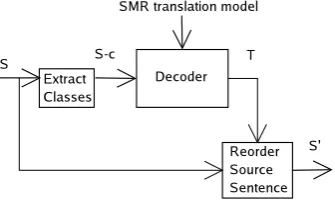
[image:3.595.309.477.65.165.2]Figure 2 shows the SMR block diagram. The in-put is the initial source sentence (S) and the output is the reordered source sentence (S’). There three blocks inside SMR: (1) class replacing ; (2) the de-coder, which requires the translation model; and, (3) the block which reorders the original sentence using the indexes given by the decoder. The fol-lowing example specifies the input and output of each block inside the SMR.
Figure 2: SMR block diagram.
1. Source sentence (S):
El compromiso s´olo podr´ıa mejorar
2. Source sentence classes (S-c):
C38 C43 C49 C42 C22
3. Decoder output (translation,T):
C38#0|C43 C49 C42#1 2 0|C22#0
where|indicates the segmentation into
trans-lation units and#divides the source and tar-get. The source part is composed of word classes and the target part is composed of the new positions of the source word classes, starting at 0.
4. SMR output (S’). The reordering information inside each translation unit of the decoder output (T) is applied to the original source
sentence (S):
El s´olo podr´ıa compromiso mejorar
3.3 Training
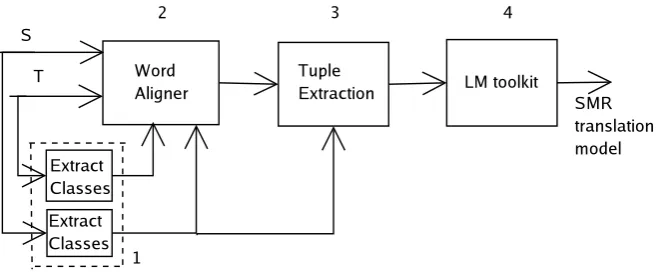
For the reordering translation, we used an n-gram-based SMT system (and considered only the trans-lation model). Figure 3 shows the block diagram of the training process of the SMR translation model, which is a bilingual n-gram-based model. The training process uses the training source and target corpora and consists of the following steps:
1. Determine source and target word classes.
2. Align parallel training sentences at the word level in both translation directions. Compute the union of the two alignments to obtain a symmetrized many-to-many word alignment.
3. Extract reordering tuples, see Figure 4. (a) From union word alignment, extract
Figure 3:Block diagram of the training process of the SMR translation model.
Figure 4: Example of the extraction of reordering tuples (step 3).
alignment inside the tuple. As an ex-ample of a bilingualS2T tuple consider:
only possible compromise # compromiso s´olo podr´ıa # 0-1 1-1 1-2 2-0, as shown in Figure 4, where the different fields are separated by # and correspond to: (1) the target fragment; (2) the source frag-ment; and (3) the word alignment (in this case, the fields that respectively cor-respond to a target and source word are separated by−).
(b) Modify the many-to-many word align-ment from each tuple to many-to-one. If one source word is aligned to two or more target words, the most probable link given IBM Model 1 is chosen, while the other are omitted (i.e. the num-ber of source words is the same before and after the reordering translation). In the above example, the tuple would be changed to: only possible compromise
# compromiso s´olo podr´ıa # 0-1 1-2 2-0, as Pibm1(only, s´olo) is higher than
Pibm1(possible, s´olo).
(c) From bilingualS2T tuples (with many-to-one inside alignment), extract bilin-gual S2S’ tuples (i.e. the source frag-ment and its reordering). As in the ex-ample:compromiso s´olo podr´ıa # 1 2 0, where the first field is the source frag-ment, and the second is the reordering of these source words.
(d) Eliminate tuples whose source fragment consists of the NULL word.
(e) Replace the words of each tuple source fragment with the classes determined in Step 1.
4. Compute the bilingual language model of the bilingual S2S’ tuple sequence composed of the source fragment (in classes) and its re-order.
Once the translation model is built, the origi-nal source corpusSis translated into the reordered source corpus S’ with the SMR system, see Fig-ure 2. The reordered training source corpus and the original training target corpus are used to train the SMT system (as explained in Section 2). Fi-nally, with this system, the reordered test source corpus is translated.
4 Evaluation Framework
EuroParl Spanish English
Training Sentences 727.1 k 727.1 k
Words 15.7 M 15.2 M
Vocabulary 108.7 k 72.3 k Development Sentences 500 500
Words 15.2 k 14.8 k
Vocabulary 3.6 k 3 k
Test Sentences 3064 3064
Words 91.9 k 85.2 k
[image:5.595.308.522.61.204.2]Vocabulary 11.1 k 9.1 k
Table 1: Spanish to English task. EuroParl cor-pus: training, development and test data sets.
4.1 Tools
• The word alignments were computed using
the GIZA++ tool (Och, 2003).
• The word classes were determined
us-ing ’mkcls’, a freely-available tool with GIZA++.
• The language model was estimated using the
SRILM toolkit (Stolcke, 2002).
• We used MARIE as a decoder (Crego et al.,
2005b).
• The optimization tool used for computing
log-linear weights (see Section 2) is based on the simplex method (Nelder and Mead, 1965).
4.2 Corpus Statistics
Experiments were carried out on the Spanish and English task of the WMT06 evaluation1(EuroParl
Corpus) and on the Chinese to English task of the IWSLT05 evaluation2 (BTEC Corpus). The
for-mer is a large corpus, whereas the latter is a small corpus translation task. Table 1 and 2 show the main statistics of the data used, namely the number of sentences, words, vocabulary, and mean sen-tence lengths for each language.
4.3 Units
In this section different statistics units of both ap-proaches (S2T and S’2T) are shown (using the ZhEn task). All the experiments in this section were carried out using 100 classes in the SMR step.
1www.statmt.org/wmt06/shared-task/ 2www.slt.atr.jp/IWSLT2005
BTEC Chinese English
Training Sentences 20 k 20 k
Words 176.2 k 182.3 k
Vocabulary 8.7 k 7.3 k
Development Sentences 506 506
Words 3.5 k 3.3 k
Vocabulary 870 799
Test Sentences 506 506
Words 4 k 3 k
Vocabulary 916 818
Table 2: Chinese to English task. BTEC corpus: training, development and test data sets. Develop-ment and test data sets have 16 references.
Table 3 shows the vocabulary of bilingual n-grams and embedded words in the translation model. Once the reordering translation has been computed, alignment becomes more monotonic. It is commonly known that non-monotonicity poses difficulties for word alignments. Therefore, when the alignment becomes more monotonic, we ex-pect an improvement in the alignment, and, there-fore in the translation. Here, we can observe a significant enlargement of the number of tion units, which leads to a growth of the transla-tion vocabulary. We also observe a decrease in the number of embedded words (around 20%). From Section 2, we know that the probability of embed-ded words is estimated independently of the trans-lation model. Reducing embedded words allows for a better estimation of the translation model.
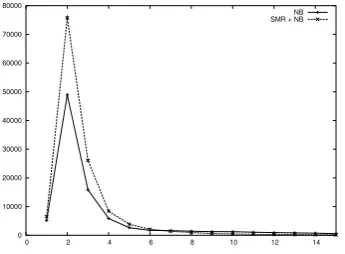
Figure 5 shows the histogram of the tuple size in the two approaches. We observe that the number of tuples is similar over length 5. However, there are a greater number of shorter units in the case of SMR+NB (shorter units lead to a reduction in data sparseness).
0 10000 20000 30000 40000 50000 60000 70000 80000
0 2 4 6 8 10 12 14
[image:5.595.77.288.61.204.2]NB SMR + NB
[image:5.595.313.486.599.726.2]System 1gr 2gr 3gr 4gr Embedded
NB 34487 57597 3536 1918 5735
[image:6.595.167.434.62.108.2]SMR + NB 35638 70947 5894 3412 4632
Table 3:Vocabulary of n-grams and embedded words in the translation model.
System Total Vocabulary
NB 4460 959
[image:6.595.102.263.152.198.2]SMR + NB 4628 1052
Table 4:Tuples used to translate the test set (total number and vocabulary).
Table 4 shows the tuples used to translate the test set (total number and vocabulary). Note that the number of tuples and vocabulary used to trans-late the test set is significantly greater after the re-ordering translation.
4.4 Results
Here, we introduce the experiments that were car-ried out in order to evaluate the influence of the SMR approach in both tasks EsEn and ZhEn. The log-linear translation model was optimized with the simplex algorithm by maximizing over the BLEU score. The evaluation was carried out us-ing references and translation in lowercase and, in the ZhEn task, without punctuation marks.
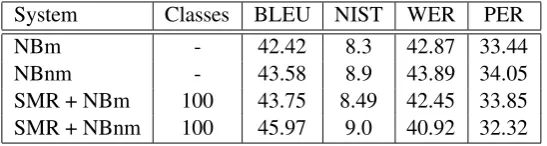
We studied the influence of the proposed SMR approach on the n-gram-based SMT system de-scribed using a monotonous search (NBm or monotonous baseline configuration) in the two tasks and a non-monotonous search (NBnm or non-monotonous baseline configuration) in the ZhEn task. In allowing for reordering in the SMT decoder, the distortion limit (m) and reordering
limit (j) (see Section 2) were empirically set to
5 and 3, as they showed a good trade-off between quality and efficiency. Both systems include the four features explained in Section 2: the language model, the word bonus, and the source-to-target and target-to-source lexicon models.
Tables 5 and 6 show the results in the test set. The former corresponds to the influence of the SMR system on the EsEn task (NBm), whereas the latter corresponds to the influence of the SMR system on the ZhEn task (NBm and NBnm).
4.5 Discussion
Both BLEU and NIST coherently increase after the inclusion of the SMR step when 100 classes are used. The improvement in translation quality can be explained as follows:
• SMR takes advantage of the use of classes
and correctly captures word reorderings that are missed in the standard SMT system. In addition, the use of classes allows new re-orderings to be inferred.
• The new task S’2T becomes more
monotonous. Therefore, the translation units tend to be shorter and SMT systems perform better.
The gain obtained in the SMR+NBnm case indi-cates that the reordering provided by SMR system and the non-monotonous search are complemen-tary. It means that the output of the SMR could still be further monotonized. Note that the ZhEn task has complex word reorderings.
These preliminary results also show that SMR itself provides further improvements to those pro-vided by the non-monotonous search.
5 Conclusions and Further Research In this paper we have mainly dealt with the re-ordering problem for an n-gram-based SMT sys-tem. However, our approach could be used sim-ilarly for a phrase-based system. We have ad-dressed the reordering problem as a translation from the source sentence to a monotonized source sentence. The proposed SMR system is applied before a standard SMT system. The SMR and SMT systems are based on the same principles and share the same type of decoder.
System Classes BLEU NIST WER PER
NBm - 27.69 7.31 61.6 45.34
[image:7.595.167.431.61.121.2]SMR + NBm - 28.60 7.53 59.89 43.53 SMR + NBm 100 30.89 7.75 55.77 42.85
Table 5:Results in the test set of the EsEn task using a monotonous search.
System Classes BLEU NIST WER PER
NBm - 42.42 8.3 42.87 33.44
NBnm - 43.58 8.9 43.89 34.05
SMR + NBm 100 43.75 8.49 42.45 33.85 SMR + NBnm 100 45.97 9.0 40.92 32.32
Table 6:Results in the test set of the ZhEn task using a monotonous and a non-monotonous search.
Performing reordering as a preprocessing step and independently from the SMT system allows for a more efficient final system implementation and a quicker translation. Additionally, using word classes helps to infer unseen reorderings. These preliminary results show consistent and sig-nificant improvements in translation quality.
As further research, we would like to add extra features to the SMR system, and study new types of classes for the reordering task.
6 Acknowledgments
This work has been partially funded by the Eu-ropean Union under the integrated project TC-STAR - Technology and Corpora for Speech to Speech Translation - (IST-2002-FP6-506738, http://www.tc-star.org) and the Spanish govern-ment under a FPU grant.
References
E. Matusov A. Mauser and H. Ney. 2006. Train-ing a statistical machine translation system without giza++. 5th Int. Conf. on Language Resources and Evaluation, LREC’06, May.
P. Brown, S. Della Pietra, V. Della Pietra, and R. Mer-cer. 1993. The mathematics of statistical machine translation. Computational Linguistics, 19(2):263– 311.
J. M. Crego, M. R. Costa-juss`a, J. Mari˜no, and J. A. Fonollosa. 2005a. Ngram-based versus phrase-based statistical machine translation. Proc. of the Int. Workshop on Spoken Language Translation, IWSLT’05, October.
J.M. Crego, J. Mari˜no, and A. de Gispert. 2005b. An Ngram-based statistical machine translation
de-coder. Proc. of the 9th Int. Conf. on Spoken Lan-guage Processing, ICSLP’05.
A. de Gispert and J. Mari˜no. 2002. Using X-grams for speech-to-speech translation. Proc. of the 7th Int. Conf. on Spoken Language Processing, ICSLP’02, September.
S. Kanthak, D. Vilar, E. Matusov, R. Zens, and H. Ney. 2005. Novel reordering approaches in phrase-based statistical machine translation. Proceedings of the ACL Workshop on Building and Using Par-allel Texts: Data-Driven Machine Translation and Beyond, pages 167–174, June.
P. Koehn, F.J. Och, and D. Marcu. 2003. Statistical phrase-based translation. Proc. of the Human Lan-guage Technology Conference, HLT-NAACL’2003, May.
J.B. Mari˜no, R.E. Banchs, J.M. Crego, A. de Gispert, P. Lambert, J.A.R. Fonollosa, and M. Ruiz. 2005. Bilingual n-gram statistical machine translation. In
Proc. of the MT Summit X, pages 275–82, Pukhet (Thailand), May.
J.A. Nelder and R. Mead. 1965. A simplex method for function minimization. The Computer Journal, 7:308–313.
F.J. Och and H. Ney. 2002. Discriminative train-ing and maximum entropy models for statistical ma-chine translation. 40th Annual Meeting of the Asso-ciation for Computational Linguistics, pages 295– 302, July.
F.J. Och. 2003. Giza++ software.
http://www-i6.informatik.rwth-aachen.de/˜och/
soft-ware/giza++.html.
[image:7.595.163.437.157.230.2]