
75
The Effects of User Features on Twitter Hate Speech Detection
Elise Fehn Unsv˚ag and Bj¨orn Gamb¨ack
Department of Computer Science
Norwegian University of Science and Technology NO-7491 Trondheim, Norway
[email protected], [email protected]
Abstract
The paper investigates the potential effects user features have on hate speech classifica-tion. A quantitative analysis of Twitter data was conducted to better understand user char-acteristics, but no correlations were found be-tween hateful text and the characteristics of the users who had posted it. However, ex-periments with a hate speech classifier based on datasets from three different languages showed that combining certain user features with textual features gave slight improvements of classification performance. While the in-corporation of user features resulted in vary-ing impact on performance for the different datasets used, user network-related features provided the most consistent improvements.
1 Introduction
Detecting hate speech has become an increasingly important task for online communities, but auto-matic hate speech detection is a challenging task, which the majority of the research in the field is targeting through textual features. However, as shown by, e.g., Gr¨ondahl et al. (2018), there is a need for further efforts to improve the qual-ity and efficiency of detection methods, motivat-ing for studies on how non-textual features can be utilised to enhance detection performance.
The goal of this research is to investigate in-formation related to users in the Twitter commu-nity that can be helpful in identifying online hate speech, and use this as features in hate speech clas-sification. Information about the users could be ei-ther known factors, such as age and gender, or fac-tors derived from behaviour. There exists research that investigates the impact of different features, and research about the personality and behaviour of users expressing hate speech. However, there is little research that combines the two topics.
Most early studies on automatic recognition of online hate speech focused on lexicon-based ap-proaches for detecting “bad” words, with Kwok and Wang (2013) finding that 83% of their data was annotated racist due to the presence of of-fensive words. However, these approaches tend to give low precision by mistakenly classifying all messages containing specific terms as hate speech, which is particularly problematic on social media sites that have a relatively high prevalence of of-fensive words (Wang et al.,2014). After all, hate speech can be much more sophisticated than that.
Finding the features that best represent the un-derlying phenomenon of hate speech is challeng-ing. Later studies have mainly focused on content-based text classification using features such as the appearance or frequency of words, spelling mis-takes or semantic meaning, but while these meth-ods perform relatively well, there is still need for improvements to increase the quality of detection. The rest of the paper is structured as follows: Section2discusses previous studies related to the authors of hate speech and Section3presents the datasets used together with an analysis of user characteristics. Section 4 describes the classifier developed, while Section5details the experiments conducted to measure the impact of user features. Section6sums up the research contributions along with suggestions for potential future work.
2 Related Work
proposed a Lexical Syntactic Feature architecture to bridge the gap between detecting offensive con-tent and pocon-tential offensive users in social media, arguing that although existing methods treat mes-sages as independent instances, the focus should be on the source of the content.Waseem and Hovy
(2016) stated that among various extra-linguistic features, only gender brought improvements to hate speech detection. Papegnies et al. (2017) mention a plan to use context-based features for abuse detection, and especially those based on the networks of user interactions. Several authors share this intention, but face the challenge that user information often is limited or unavailable.
Wulczyn et al. (2017) qualitatively analyzed personal attacks in Wikipedia comments, showing that anonymity increases the likelihood of a ment being an attack, although anonymous com-ments only contributed to less than half of the total attacks. The study also suggested that per-sonal attacks cluster in time, which may be be-cause one attack triggers another. In another qual-itative analysis,Cheng et al.(2015) characterized forms of antisocial behaviour in online discussion communities, comparing the activity of users that have been permanently banned from a community to those that are not banned. The study found the banned users to use less positive words and more profanity, and to concentrate their efforts in a small amount of threads. They also receive more replies and responses than other users.
Hardaker(2010) defined atrolleras a user who appears to sincerely wish to be part of a group, including professing, or conveying pseudo-sincere intentions, but whose real intentions are to cause disruption or to trigger conflict for the purposes of their own amusement. Buckels et al. (2014) studied the characteristic traits of Internet trolls by looking at commenting styles and personal-ity inventories, and found strong positive relations among commenting frequency, trolling enjoyment and trolling behaviour and identity. Cheng et al.
(2017) proposed that an individual’s mood and seeing troll posts by others trigger troll behaviour.
Most similar to the objectives of the present work, Chatzakou et al. (2017) investigated user features that can be utilized to enhance the de-tection and classification of bullying and aggres-sive behaviour of Twitter users. They found that network-based features (such as the number of friends and followers, reciprocity and the position
in the network) were particularly useful and effec-tive in classifying aggressive user behaviour.
3 Data Analysis
Creating datasets of hate speech is time consum-ing, as the number of hateful instances in online communities is relatively low. The datasets avail-able are also often created for different tasks, and from different types of media and languages, and therefore vary in characteristics and types of hate speech. Sources include Twitter (Waseem and Hovy, 2016; Fortuna, 2017; Ross et al., 2016), Wikipedia (Wulczyn et al., 2017), and Fox News (Gao and Huang, 2017). Furthermore, many datasets (from Yahoo, SpaceOrigin and Twitter) are not publicly available (Djuric et al.,2015; No-bata et al.,2016;Papegnies et al.,2017;Chatzakou et al.,2017), while others are available only under some restrictions (Davidson et al.,2017;Golbeck et al.,2017). This may be due to privacy issues or considering the content of the datasets: Pavlopou-los et al.(2017) made their Greek Gazzetta dataset available by using an encryptor to avoid directly publishing hate speech content.
Here, three datasets were used to investigate the characteristics of users for increased insight and to allow comparisons of the findings. All datasets have Twitter as their source, ensuring that the same information could be retrieved. However, the datasets differ in terms of annotations, size and characteristics, and come from three different lan-guages: English (Waseem and Hovy,2016), Por-tuguese (Fortuna,2017), and German (Ross et al.,
2016). The datasets contain tweet IDs that can be used to retrieve the actual text, information about the tweet or information about the user who has posted it. As user information is something that should be handled with care, it is important to mention that no attempt was made to directly iden-tify the actual users.
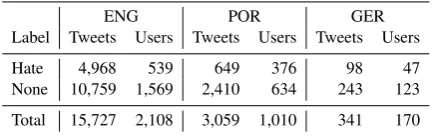
ENG POR GER Label Tweets Users Tweets Users Tweets Users
Hate 4,968 539 649 376 98 47 None 10,759 1,569 2,410 634 243 123
[image:3.595.73.290.62.130.2]Total 15,727 2,108 3,059 1,010 341 170
Table 1: Available tweets and users in the datasets
3.1 Datasets
The English dataset byWaseem and Hovy(2016) is publicly available on GitHub.1 The Twitter search API was used to collect the corpus, and in total 16,907 tweets (from 2,399 users) were anno-tated either as racist, sexist or neither. The dataset contains more instances of neutral than racist or sexist tweets. This unbalance was intended by the developers, to make the corpus more representa-tive of the real world, where hate speech is a lim-ited phenomenon. Since the dataset was devel-oped in 2016, the Python library Tweepy was used here to filter out any unavailable tweets and users. Furthermore, the original “Sexism” and “Racism” classes were merged into one “Hate speech” class. 1,180 of the original tweets were no longer avail-able, which also impacted the number of users in the dataset. The remaining tweets and users are presented in Table1, in the ‘ENG’ column.
Fortuna (2017) developed a dataset consisting of 5,668 Portuguese tweets and made it available through the INESC TEC research data repository.2 Tweets were collected through the Twitter API with searches based on keywords related to hate speech and Twitter profiles known for posting hate messages. Fortuna aimed to have a higher pro-portion of hate speech messages than other related datasets, and 22% of the tweets were annotated as hate speech. She annotated nine direct hate speech sub-classes, but in the present work those will be merged into one hate speech class. In total there are 5,668 annotated tweets by 1,156 distinct users; however, the distribution of users within the tar-get classes was not specified. Today, close to half of the tweets in both classes are unavailable; how-ever, as shown in the ‘POR’ column of Table 1, there are still 1,010 users available, meaning that the unavailability of tweets did not heavily affect the number of users. While the original dataset had a binary value for the presence of hate speech and subcategories as labels, the target classes were here changed to “Hate speech” and “None”.
1
github.com/ZeerakW/hatespeech
2rdm.inesctec.pt/dataset/cs-2017-008
To investigate the issue of reliability concerning hate speech annotation, Ross et al. (2016) com-piled a German hate speech corpus with tweets linked to the refugee crisis in Europe. By using known insulting or offensive hashtags, a total of 13,766 tweets were collected, 469 of which were annotated by two annotators for presence or ab-sence of hate speech. In Table1the column ‘GER’ shows the availability of the tweets in the dataset and the number of users in each target class. It was beneficial to transform the labels of the dataset into binary classes, to equal the labelling of the other datasets. Therefore, a tweet that was la-belled “Yes” by one or both of the annotators was assigned to the “Hate speech” class. Hence, the “Hate speech” class consists of 65 available tweets labelled as hate speech by one annotator, and 33 labelled hate speech by both annotators.
3.2 Characteristics
A quantitative analysis was conducted to better understand the characteristics of the users in the datasets, based on the proposed features in Sec-tion2and other information about the user avail-able through the Twitter API. All datasets included several tweets from the same users; tweets that then can be present in both target classes. How-ever, to better distinguish between users and avoid redundancy in the analysis, users who are present in both target classes are here only included as users within the “Hate speech” class.
(a) English (Waseem and Hovy,2016) (b) Portuguese (Fortuna,2017) (c) German (Ross et al.,2016)
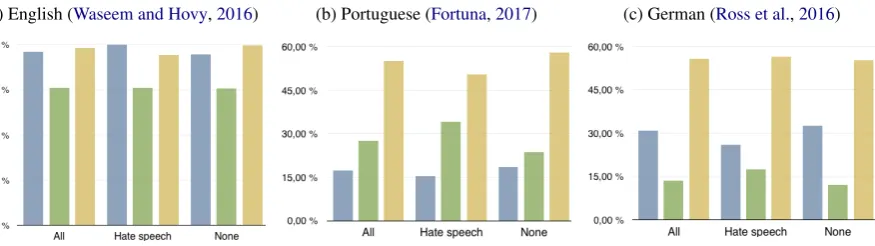
Figure 1: Gender distribution of users in the datasets:blue= male,green= female,beige= unidentified
Waseem and Hovy (2016) expressed that the gender of about half the users could not be iden-tified by their approach, and that the male gender was over-represented in all categories. Figure1a
presents the gender distribution derived here, with significant differences to their findings. In par-ticular, the female users are identified to a much larger degree, with the distribution of male, fe-male and unidentified users being more equal; the fraction of unidentified users has decreased from 50% to 36%. Still, a higher amount of male users are identified than female, which is also the case for the dataset by Ross et al.(2016). In contrast, the gender distribution derived from the dataset by
Fortuna(2017) shows a majority of the identified user genders to be female. In that dataset there is also a large number of unidentified genders (55%), which is equal to the number of unidentified users in the dataset byRoss et al.(2016).
User Network: The user networks are defined here as their social networks on Twitter, i.e., who a user follows (called ‘following’ or ‘friends’ on Twitter) and who follows that user (‘followers’).
Chatzakou et al.(2017) found network-based fea-tures to be very useful in classifying aggressive user behaviour. They investigated features such
as the ratio of followers to friends, the extent to which users reciprocate the follow connections they receive from others, and the users’ tendency to cluster with others.
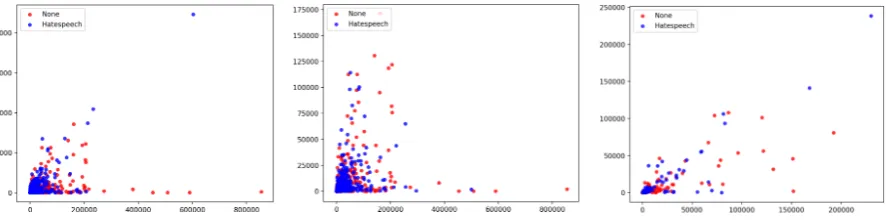
In Figure2a, the relationship between a user’s friends and followers in the dataset by Waseem and Hovy (2016) is illustrated. The majority of users form a cluster in the area below 10,000 friends and 50,000 following. Beyond this cluster, it appears as users of the “None” class are most common, with the exception of one outlier of the “Hate speech” class with about 228,00 followers and no friends. It is difficult to say whether this trend can be generalized, or is caused by the un-even number of users in the two target classes.
Figure2bshows the distribution of friends and followers for the users in the dataset by Fortuna
(2017). A general observation is that the users of this dataset often tend to have more followers than friends. Furthermore, there is little that dis-tinguishes the users of the two classes regarding the number of friends and followers. The number of users in the dataset byRoss et al.(2016) is con-siderably lower than the other datasets, and may explain the lower number of friends and follow-ers for the usfollow-ers, as shown in Figure2c. There is
[image:4.595.78.525.603.732.2](a) English (Waseem and Hovy,2016) (b) Portuguese (Fortuna,2017) (c) German (Ross et al.,2016)
Figure 3: Distribution of users based on activity (number of favourites given vs number of status updates)
an outlier in the “Hate speech” class with about 13,000 followers and 14,000 friends, but the rest of the users are somewhat evenly distributed.
Activity: Previous research suggests that both high and low activity levels can be related to post-ing hate speech content. Buckels et al. (2014) found commenting frequency to be positively as-sociated with trolling enjoyment andCheng et al.
(2015) suggested that frequently active users are often associated with anti-social behaviour online. In contrast,Wulczyn et al.(2017) found users that launched personal attacks on Wikipedia regardless of activity level. Here, activity is defined by the in-formation that can be extracted through the Twitter API. Tweepy enables the retrieval of the number of tweets a user has posted (also known as ‘status updates’ on Twitter) and the number of ‘favorites’ they have given to tweets by others (corresponding to ‘likes’ in other online media).
In Figure 3 the relationship between a user’s number of favourites given and total number of statuses is illustrated, showing that there is a gen-eral tendency to have a larger number of status updates than favourites. With the exception of one outlier in the “Hate speech” class with over 400,000 favourites and over 600,000 statuses, the majority of users in both classes of the English dataset form a cluster below 50,000 favourites and 200,000 statuses. In the Portuguese dataset, the users of both target classes are somewhat evenly distributed, and in general the users of this dataset have posted below 200,000 tweets and given be-low 25,000 favourites. The number of status up-dates and the number of favourites for the users in the German dataset are much lower than in the other datasets, and similarly to the findings inves-tigating the users’ network, there is no clear dis-tinction between the activity characteristics of the users in the target classes.
ENG POR GER
Feature Hate None Hate None Hate None
[image:5.595.306.528.211.275.2]Geotag 51.7 48.6 58.8 58.2 16.1 26.6 Profile 60.1 72.4 75.1 67.4 50.0 45.9 Image 98.1 96.2 99.6 98.2 98.4 98.2
Table 2: User profile characteristics (%)
User Profile: Twitter enables users to customize their profile pages, e.g., by changing theme colour, or by adding a profile or header picture. In addi-tion, users can add a bio descripaddi-tion, a geograph-ical location or a web page link. Wulczyn et al.
(2017) found personal attacks to be more preva-lent among anonymous users than registered users. Therefore the elements of a user’s profile that can be personalized were examined with the under-lying assumption that personalizing the profile is contradicting to remaining anonymity. The ele-ments retrieved were the number of public lists a user has joined, geotagging of tweets, the profile image, and whether or not the user has altered a default theme or background of the profile.
4 Classification Setup
The analysis of the datasets presented in the previ-ous section indicated that none of the investigated user characteristics could be clearly used to dif-ferentiate textual tweets annotated “Hate speech” and “None”. However, the impact of user features in detection may become more visible when tested through a classifier. To investigate the possible ef-fects user features have on the performance of hate speech classification, a baseline hate speech classi-fier was implemented and trained only on the tex-tual tweets from the datasets, and then compared to a classifier that also incorporated user features. Along with observing the overall effects of user feature inclusion, the impacts of the individual fea-tures and feature subsets were investigated.
A basic hate speech classifier needs to include preprocessing of the textual input, feature extrac-tion, and a choice of actual classification model. These will be addressed in turn below, while clas-sification results will be given in the next section.
Preprocessing: Text processing is a difficult task due to the noise contained in language and should be done with care, to avoid losing any im-portant features. This is particularly proliferent in social media such as Twitter, which also intro-duces domain-specific challenges: the character limit in a tweet increases the use of abbreviations, while including non-textual content (e.g., URLs, images, user mentions and retweets) is common.
The Natural Language Toolkit (Bird et al.,
2009) was used for preprocessing of the data, through: (i) removal of Twitter specific informa-tion (user meninforma-tions, emoticons, retweets, URLs, and hashtag symbols; only retaining textual con-tent), (ii) tokenization, (iii) lowercasing, and (iv) stop word removal (with different stop word lists for the datasets, due to the different languages).
Feature Extraction and Representation: Hav-ing found many tweets to be annotated racist due to the appearance of offensive words, Kwok and Wang(2013) constructed a vocabulary using uni-gram features only. However, this fails to cap-ture relationships between words, soNobata et al.
(2016) added syntactic features, while also em-ploying n-grams and distributional semantic de-rived features. They found combining all fea-tures to yield the best performance, but character n-grams made the largest individual feature con-tribution. Mehdad and Tetreault (2016)
specifi-cally investigated character-based approaches and showed them to be superior to token-based ap-proaches and other state-of-the-art methods.
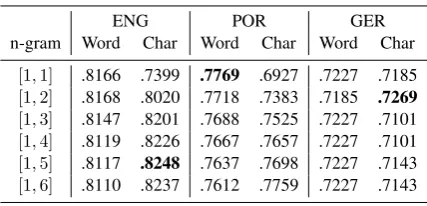
Since n-grams thus have been shown to be very useful in hate speech classification, both character n-grams and word n-grams were tested here to rep-resent the textual content of the tweets. A TF-IDF approach was used to represent the n-gram fea-tures, and ranges up ton=6 tested. Higher values ofnwere not considered due to the computational effort required. The most suitable type of n-gram and n-gram range were explored through a grid search, and finding different alternatives for rep-resenting the tweets suiting the different datasets.
Classification Model: Supervised machine learning classifiers have been the most frequently used approaches to hate speech detection, in particular Support Vector Machines (SVM) and Logistic Regression (LR).Davidson et al.(2017) found LR and linear SVM to perform better than other models, such as Na¨ıve Bayes, Decision Trees, and Random Forests. A comparative study performed byBurnap and Williams (2015) concluded that an ensemble method seemed most promising. Deep learning methods have also been investigated, both Recurrent Neural Networks (Pavlopoulos et al.,2017;Mehdad and Tetreault,2016), Convolutional Neural Networks (Gamb¨ack and Sikdar, 2017), and combinations (Zhang et al., 2018). Badjatiya et al. (2017) used various deep learning architectures to learn semantic words embeddings and showed these to outperform character and word n-grams.
Here a Logistic Regression model was chosen due to its simplicity and its common usage in lan-guage classification. This is also in line with the note by Gr¨ondahl et al. (2018) that a simple LR model performed on par with more complex mod-els in their comparison of hate speech detection classifiers. As the aim here was not to implement the best performing classifier or to compare meth-ods, but to investigate the effects of user features, no other classification models were tested.
5 Experiments and Results
ENG POR GER n-gram Word Char Word Char Word Char
[1,1] .8166 .7399 .7769 .6927 .7227 .7185
[1,2] .8168 .8020 .7718 .7383 .7185 .7269
[1,3] .8147 .8201 .7688 .7525 .7227 .7101
[1,4] .8119 .8226 .7667 .7657 .7227 .7101
[1,5] .8117 .8248 .7637 .7698 .7227 .7143
[image:7.595.74.288.60.163.2][1,6] .8110 .8237 .7612 .7759 .7227 .7143
Table 3: Grid search of n-gram parameters
ENG POR GER
Class P R F1 P R F1 P R F1
None .83 .94 .88 .79 .96 .87 .68 .99 .81 Hate .82 .58 .68 .82 .40 .54 .50 .03 .06
Avg. .83 .83 .83 .80 .79 .79 .62 .68 .65
Table 4: Baseline model performance on test data
was then evaluated on the test set. This section first presents results from baseline classification with only n-gram features, and then discusses the effects of incorporating user features.
5.1 Classifier with Text Features
The dataset provided byWaseem and Hovy(2016) contained 15,727 available English tweets, that were split into a training set of 11,008 tweets and a test set containing 4,719 tweets, of which 3,275 were classified as non-hate speech. A grid search found that character n-grams in range [1,5] pro-vided the best performance, as shown in the col-umn ‘ENG’ in Table 3. Table 4 shows the per-formance metrics of the model, where 0.83 was the macro average F1-score. Both the precision and recall values are higher for the “None” class. However, the recall value for the “Hate speech” class obtained for this dataset is higher than for the other datasets, most probably due to the larger amount of available training data.
3,059 tweets from the Portuguese dataset by
Fortuna (2017) were used, with the training set containing 2,636 tweets and the test set 423, of which 126 were annotated as hate speech. Word unigrams yielded the best performance (Table3), and the macro average F1-score obtained for the test data was 0.79 (Table 4). The precision ob-tained for “Hate speech” is slightly higher than for the “None” class, while the recall is much lower.
The German dataset by Ross et al. (2016) is considerably smaller than the other datasets, con-taining only 341 tweets, that were split into a
train-ENG POR GER
Features P R F1 P R F1 P R F1
n-grams .83 .83 .83 .80 .79 .79 .62 .68 .65
+ gender .83 .83 .83 .80 .79 .79 .69 .70 .69 + network .84 .85 .84 .81 .81 .81 .63 .68 .65 + activity .83 .84 .83 .79 .79 .79 .68 .69 .68 + profile .83 .83 .83 .80 .80 .80 .71 .71 .71
[image:7.595.308.525.61.163.2]+ all .86 .86 .86 .79 .79 .79 .63 .68 .65
Table 5: Impact of different user feature sets
ing set of 238 and a test set of 103 (33 hateful). A grid search of the n-gram parameters (‘GER’ in Table3) showed a character n-gram with the range [1,2] produced the best 10-fold cross validation re-sults on the training data. On the unseen test data, this model received a macro average F1-score of 0.65 (Table 4), with the score severely hampered by the classifier only being able to identify 3% of the instances of the “Hate speech” class. This is most likely due to small the size of the dataset, resulting in an insufficient amount of training in-stances. Notably, Ross et al. (2016) did not de-velop this dataset primarily for classification, but for investigating hate speech annotation reliabil-ity. Their study concluded that the presence of hate speech perhaps should not be considered a bi-nary yer-or-no decision; however, this is how the current classification model is operating.
5.2 Classifier with Text and User Features
In the second part of the experiments, the classi-fier was expanded to incorporate various user tures and subsets. Four types of in total ten fea-tures were experimented with:
Gender: male and female,
Network: number of followers and friends,
Activity: number of statuses and favourites,
Profile: geo enabled, default profile, default image, and number of public lists,
where the “number of” features are integer valued, while all the other features are binary (boolean).
(a) English (Waseem and Hovy,2016) (b) Portuguese (Fortuna,2017) (c) German (Ross et al.,2016)
Figure 4: F1 of individual features along with n-grams. (Red lines = average F1 using n-grams only.)
[Features: Male, Female, Friends, Followers, Statuses, Favourites, Public Lists, Geo Enabled, Default Profile, Default Image.]
n-grams, as shown in Figure 4a. Half of the fea-tures had no impact on performance; ‘Default pro-file’ and ‘Geo enabled’ increased F1by 0.1, while ‘Female’, ‘Followers’ and ‘Public lists’ had the most impact, increasing F1by 0.2.
The incorporation of all user features on the
Fortuna(2017) dataset resulted in a slightly wors-ened performance. This was also the case for inclusion of the ‘Activity’ subset, while includ-ing ‘Network’ improved performance. ‘Gender’ and ‘Profile’ made no major impact on the scores. Of the individual features, ‘Followers’ and ‘Geo enabled’ resulted in the largest F1-score increase when used in combination with n-gram features, as shown in Figure4b. In addition, the inclusion of ‘Public lists’ also slightly improved the F1-score. Interestingly, the inclusion of ‘Statuses’ actually worsened model performance.
By only using word unigrams, the baseline clas-sifier only received a recall value of 0.03 for the hate speech class of the dataset by Ross et al.
(2016), as shown in Table4. Looking at Table5, we see that the ‘Gender’, ‘Activity’ and ‘Profile’ feature subsets resulted in improvements of the av-erage F1-score. The inclusion of all the features
[image:8.595.304.526.619.734.2](a) Only n-gram features (b) Adding all user features
Figure 5: English dataset confusion matrices
and the ‘Network’ subset had no effect on the aver-age F1score. The inclusion of ‘Activity’ increased the F1 by 0.02, ‘Gender’ increased it by 0.04, and ‘Profile’ had the largest impact by increasing F1 by 0.06. These results are consistent with the test-ing of the individual features shown in Figure4c, where ‘Male’, ‘Female’ and ‘Profile’ have a large impact on performance. However, the ‘Statuses’, ‘Favourites’, and ‘Public lists’ had the largest im-provement by 0.4. Of the individual features in-cluded, only ‘Geo Enabled’ lead to a decreased F1 score over the baseline.
The results are notably affected by the uneven distribution of instances in the target classes, as shown by significantly lower F1-scores for “Hate speech” than “None” for all datasets. This was re-flected clearly by a closer comparison of classi-fier output for the English data with n-grams and with all user features (i.e., the setup which yielded the best classifier performance on this dataset): the number of correctly labelled “Hate speech” instances increased from 623 to 1,048 (of 1,444) while the correctly labelled “None” instances de-creased slightly, from 3,111 to 3,000 (of 3,275), as illustrated by the confusion matrices in Figure5.
(a) Only n-gram features (b) Adding ‘Network’ subset
[image:8.595.71.294.621.736.2]A similar pattern was observed also for the German data, for which the optimal classifier setup was to include the ‘Profile’ feature subset. However, for Portuguese where the best classifier utilised only the ‘Network’ user features, Figure6
shows that adding those features produced a de-crease of correctly labelled “Hate speech” (from 60 to 56 of 116) with marginally increased cor-rectly labelled “None” instances (from 285 to 286 of 297), possibly since data sparsity made the model interpret the added features as noise.
6 Conclusion and Future Work
There are several challenges linked to the tion of harmful online behaviour, such as detec-tion beyond simply recognising offensive words. Aiming to address this gap, the paper investigated the potential and effects of including user features in hate speech classification, focusing on Twitter. A quantitative analysis of three datasets in three different languages indicated that there were no particular characteristics distinguishing the users who have had tweets annotated as hate speech and those who have seemingly not.
However, systematically incorporating the user features into a Logistic Regression-based hate speech classifier in conjunction with word and character n-gram features allowed observations of the effects of individual features and feature sub-sets. Experimental results showed that the inclu-sion of specific user features, in addition to n-grams, caused a slight improvement of the base-line classifier performance.
Of all individually tested feature subsets, ‘Net-work’ (i.e., the number of followers and friends) caused the largest improvement of the classi-fier performance on the English and Portuguese datasets, corroborating the findings of Chatzakou et al.(2017) that network-based features are pow-erful for detecting aggressive behaviour. This sub-set improvement may have been affected by the individual feature (number of) ‘Followers’, which also increased the F1-score on the two datasets. The other features had inconsistent effects on the different datasets, suggesting that the impact is highly dependent on the data or the subtask the data was created for. The experiments also found the inclusion of some user features to be detrimen-tal to model performance, while some user fea-tures were ineffective alone, but improved model performance when combined with others.
Interestingly, the ‘Gender’ feature subset mainly failed to give any F1-score improvements, in contrast to the result by Waseem and Hovy
(2016). While other user features are easily re-trievable through the Twitter API, user gender was derived from a comparative method, classifying more users by gender than in the work byWaseem and Hovy. However, also the method used here is still unable to identify the gender of a large amount of users in all datasets, so combinations with other gender identification methods would be needed to properly investigate the impact gender has in hate speech detection. As of now, it can be argued that gender is not a useful feature to include, at least where it cannot be directly extracted.
One limitation of using several datasets is that they were developed for different subtasks and languages, with different geographical areas of the users in the datasets, and in particular with differ-ent interpretations and annotations of hate speech. However, the main difference of the datasets is the size and hence number of instances available for model training, which probably is the main reason for the different results. Still, the results combine to show a potential for incorporating user features to improve hate speech detection performance.
There is a great amount of information related to the users of Twitter that was not used in the ex-periments, but that could be retrieved or derived from user behaviour. Examples include consider-ing the time of tweetconsider-ing, investigations of relation-ships with other users, communication with other users, and what content users are exposed to. It is in general important to not only consider who the users are or what they have written, but also their context and how they are affected by surround-ing factors in their online communities, as well as combinations of those issues, since what can be considered as hate speech by one user in a specific context may be considered as non-hate speech if written by another user or in another context.
Acknowledgements
References
Pinkesh Badjatiya, Shashank Gupta, Manish Gupta, and Vasudeva Varma. 2017. Deep learning for hate speech detection in tweets. In Proceedings of the 26th International Conference on World Wide Web Companion, pages 759–760, Perth, Australia. In-ternational World Wide Web Conferences Steering Committee.
Steven Bird, Ewan Klein, and Edward Loper. 2009. Natural Language Processing with Python: An-alyzing Text with the Natural Language Toolkit. O’Reilly Media, Inc., Sebastopol, California.
Erin E. Buckels, Paul D. Trapnell, and Delroy L. Paul-hus. 2014. Trolls just want to have fun. Personality and Individual Differences, 67:97–102.
Peter Burnap and Matthew Leighton Williams. 2015. Hate speech, machine classification and statistical modelling of information flows on Twitter: Interpre-tation and communication for policy decision mak-ing. Policy and Internet, 7(2):223–242.
Despoina Chatzakou, Nicolas Kourtellis, Jeremy Blackburn, Emiliano De Cristofaro, Gianluca Stringhini, and Athena Vakali. 2017. Mean birds: Detecting aggression and bullying on Twitter. In Proceedings of the 2017 ACM on Web Science Con-ference, pages 13–22, Troy, New York, USA. ACM.
Ying Chen, Yilu Zhou, Sencun Zhu, and Heng Xu. 2012. Detecting offensive language in social me-dia to protect adolescent online safety. In Proceed-ings of the 2012 ASE/IEEE International Confer-ence on Social Computing and 2012 ASE/IEEE In-ternational Conference on Privacy, Security, Risk and Trust, pages 71–80, Amsterdam, Netherlands. IEEE.
Justin Cheng, Michael Bernstein, Cristian Danescu-Niculescu-Mizil, and Jure Leskovec. 2017. Any-one can become a troll: Causes of trolling behavior in online discussions. In Proceedings of the 2017 ACM Conference on Computer-Supported Coopera-tive Work and Social Computing, pages 1217–1230, Portland, Oregon, USA. ACM.
Justin Cheng, Christian Danescu-Niculescu-Mizil, and Jure Leskovec. 2015. Antisocial behavior in online discussion communities. InProceedings of the 9th International Conference on Web and Social Media, pages 61–70, University of Oxford, Oxford, UK. AAAI Press.
Thomas Davidson, Dana Warmsley, Michael Macy, and Ingmar Weber. 2017. Automated hate speech detection and the problem of offensive language. In Proceedings of the 11th International Conference on Web and Social Media, pages 512–516, Montr´eal, Qu´ebec, Canada. AAAI Press.
Nemanja Djuric, Jing Zhou, Robin Morris, Mihajlo Gr-bovic, Vladan Radosavljevic, and Narayan Bhamidi-pati. 2015. Hate speech detection with comment
embeddings. In Proceedings of the 24th Interna-tional Conference on World Wide Web, pages 29–30, Florence, Italy. ACM.
Paula Fortuna. 2017. Automatic detection of hate speech in text: an overview of the topic and dataset annotation with hierarchical classes. Master’s the-sis, Faculdade De Engenharia Da Universidade Do Porto, Porto, Portugal, June.
Bj¨orn Gamb¨ack and Utpal Kumar Sikdar. 2017. Us-ing convolutional neural networks to classify hate-speech. In Proceedings of the First Workshop on Abusive Language Online, pages 85–90, Vancouver, Canada. ACL.
Lei Gao and Ruihong Huang. 2017. Detecting online hate speech using context aware models. CoRR, abs/1710.07395.
Jennifer Golbeck, Zahra Ashktorab, Rashad O. Banjo, Alexandra Berlinger, Siddharth Bhagwan, Cody Buntain, Paul Cheakalos, Alicia A. Geller, Quint Gergory, Rajesh Kumar Gnanasekaran, Raja Ra-jan Gunasekaran, Kelly M. Hoffman, Jenny Hot-tle, Vichita Jienjitlert, Shivika Khare, Ryan Lau, Marianna J. Martindale, Shalmali Naik, Heather L. Nixon, Piyush Ramachandran, Kristine M. Rogers, Lisa Rogers, Meghna Sardana Sarin, Gaurav Sha-hane, Jayanee Thanki, Priyanka Vengataraman, Zi-jian Wan, and Derek Michael Wu. 2017. A large la-beled corpus for online harassment research. In Pro-ceedings of the 2017 ACM Web on Science Confer-ence, pages 229–233, Troy, New York, USA. ACM.
Tommi Gr¨ondahl, Luca Pajola, Mika Juuti, Mauro Conti, and N. Asokan. 2018. All you need is “love”: Evading hate speech detection. CoRR, abs/1808.09115.
Claire Hardaker. 2010. Trolling in asynchronous computer-mediated communication: From user dis-cussions to academic definitions. Journal of Polite-ness Research, 6(2):215–242.
Irene Kwok and Yuzhou Wang. 2013. Locate the hate: Detecting tweets against blacks. In Proceed-ings of the 27th AAAI Conference on Artificial In-telligence, pages 1621–1622, Bellevue, Washington. AAAI Press.
Yashar Mehdad and Joel R. Tetreault. 2016. Do charac-ters abuse more than words? InProceedings of the 17th Annual Meeting of the Special Interest Group on Discourse and Dialogue, pages 299–303, Los Angeles, USA. ACL/SIGDIAL.
Etienne Papegnies, Vincent Labatut, Richard Dufour, and Georges Linares. 2017. Impact of content features for automatic online abuse detection. In 18th International Conference on Computational Linguistics and Intelligent Text Processing, volume 10762 of Lecture Notes in Computer Science, Bu-dapest, Hungary. Springer.
John Pavlopoulos, Prodromos Malakasiotis, and Ion Androutsopoulos. 2017. Deeper attention to abusive user content moderation. InProceedings of the 2017 Conference on Empirical Methods in Natural Lan-guage Processing, pages 1125–1135, Copenhagen, Denmark. ACL.
Bj¨orn Ross, Michael Rist, Guillermo Carbonell, Ben-jamin Cabrera, Nils Kurowsky, and Michael Wo-jatzki. 2016. Measuring the reliability of hate speech annotations: The case of the European refugee crisis. In Proceedings of NLP4CMC III: 3rd Workshop on Natural Language Processing for Computer-Mediated Communication, volume 17 of Bochumer Linguistische Arbeitsberichte, pages 6–9, Bochum, Germany.
Wenbo Wang, Lu Chen, Krishnaprasad Thirunarayan, and Amit P. Sheth. 2014. Cursing in English on
Twitter. InProceedings of the 17th ACM Conference on Computer Supported Cooperative Work & Social Computing, pages 415–425, Baltimore, Maryland, USA. ACM.
Zeerak Waseem and Dirk Hovy. 2016. Hateful sym-bols or hateful people? Predictive features for hate speech detection on Twitter. In Proceedings of the North American Chapter of the Association for Computational Linguistics (NAACL) Student Re-search Workshop, pages 88–93, San Diego, Califor-nia, USA. ACL.
Ellery Wulczyn, Nithum Thain, and Lucas Dixon. 2017. Ex machina: Personal attacks seen at scale. InProceedings of the 26th International Conference on World Wide Web, pages 1391–1399, Perth, Aus-tralia. International World Wide Web Conferences Steering Committee.
![Figure 4: F1 of individual features along with n-grams. (Red lines = average F1 using n-grams only.)[Features: Male, Female, Friends, Followers, Statuses, Favourites, Public Lists, Geo Enabled, Default Profile, Default Image.]](https://thumb-us.123doks.com/thumbv2/123dok_us/1347362.666684/8.595.304.526.619.734/individual-features-features-friends-followers-statuses-favourites-prole.webp)