165
Analysing the potential of seq-to-seq models
for incremental interpretation in task-oriented dialogue
Dieuwke Hupkes, Sanne Bouwmeester, and Raquel Fern´andez
Institute for Logic Language and Computation University of Amsterdam
{d.hupkes,raquel.fernandez}@uva.nl [email protected]
Abstract
We investigate how encoder-decoder models trained on a synthetic dataset of task-oriented dialogues process disfluencies, such as hesita-tions and self-correchesita-tions. We find that, con-trary to earlier results, disfluencies have very little impact on the task success of seq-to-seq models with attention. Using visualisations and diagnostic classifiers, we analyse the rep-resentations that are incrementally built by the model, and discover that models develop little to no awareness of the structure of disfluen-cies. However, adding disfluencies to the data appears to help the model create clearer repre-sentations overall, as evidenced by the atten-tion patterns the different models exhibit.
1 Introduction
The use of Recurrent Neural Networks (RNNs) to tackle sequential language tasks has become stan-dard in natural language processing, after impres-sive accomplishments in speech recognition, ma-chine translation, and entailment (e.g., Sutskever et al., 2014;Bahdanau et al., 2015b; Kalchbren-ner et al., 2014). Recently, RNNs have also been exploited as tools to model dialogue sys-tems. Inspired by neural machine translation, re-searchers such asRitter et al.(2011) and Vinyals and Le (2015) pioneered an approach to open-domain chit-chat conversation based on sequence-to-sequence models (Sutskever et al., 2014). In this paper, we focus on task-oriented dialogue, where the conversation serves to fulfil an inde-pendent goal in a given domain. Current neural dialogue models for task-oriented dialogue tend to equip systems with external memory compo-nents (Bordes et al.,2017), since key information needs to be stored for potentially long time spans. One of our goals here is to analyse to what ex-tent sequence-to-sequence models without exter-nal memory can deal with this challenge.
In addition, we consider language realisations that include disfluencies common in dialogue in-teraction, such as repetitions and self-corrections (e.g., I’d like to make a reservation for six, I mean, for eight people). Disfluencies have been investigated extensively in psycholinguistics, with a range of studies showing that they affect sen-tence processing in intricate ways (Levelt, 1983;
Fox Tree, 1995; Bailey and Ferreira, 2003; Fer-reira and Bailey, 2004; Lau and Ferreira, 2005;
Brennan and Schober,2001). Most computational work on disfluencies, however, has focused on de-tection rather than on disfluency processing and interpretation (e.g., Stolcke and Shriberg, 1996;
Heeman and Allen,1999;Zwarts et al.,2010;Qian and Liu,2013;?;?). In contrast, our aim is to get a better understanding of how RNNs process dis-fluent utterances and to analyse the impact of such disfluencies on a downstream task—in this case, issuing an API request reflecting the preferences of the user in a task-oriented dialogue.
2 Data
In this section, we discuss the two datasets we use for our experiments: bAbI (Bordes et al., 2017) and bAbI+ (Shalyminov et al.,2017).
2.1 bAbI
The bAbI dataset consists of a series of syn-thetic dialogues in English, representing human-computer interactions in the context of restaurant reservations. The data is broken down into six sub-tasks that individuate different abilities that dia-logue systems should have to conduct a successful conversation with a human. We focus on Task 1, which tests the capacity of a system to ask the right questions and integrate the answers of the user to issue an API call that matches the user’s prefer-ences regarding four semantic slots: cuisine, loca-tion, price range, and party size. A sample dia-logue can be found in example(4), Section4.1.
Data The training data for Task 1 is delibera-tively kept simple and small, consisting of 1000 dialogues with on average 5 user and 7 system ut-terances. An additional 1000 dialogues based on different user queries are available for validation and testing, respectively. The overall vocabulary contains 86 distinct words. There are 7 distinct system utterances and 300 possible API calls.
Baselines Together with the dataset, Bordes et al. (2017) present several baseline models for the task. All the methods proposed are retrieval based, i.e., the models are trained to select the best system response from a set of candidate re-sponses (in contrast to the models we investigate in the present work, which are generative—see Section 3). The baseline models include classi-cal information retrieval (IR) methods such as TF-IDF and nearest neighbour approaches, as well as an end-to-end recurrent neural network. Bor-des et al. demonstrate that the end-to-end recur-rent architecture—a memory network (Sukhbaatar et al.,2015)—outperforms the classical IR meth-ods as well as supervised embeddings, obtaining a 100% accuracy on retrieving the correct API calls.
2.2 bAbI+
Shalyminov et al.(2017) observe that the original bAbI data lack naturalness and variation common in actual dialogue interaction. To introduce such variation while keeping lexical variation constant, they insert speech disfluencies, using a fixed set
of templates that are probabilistically applied to the user turns of the original bAbI Task 1 dataset. In particular, three types of disfluencies are in-troduced: hesitations (1), restarts (2), and self-corrections (3), in around 21%, 40% and 5% of the user’s turns, respectively.1
(1) We will beuhmeight
(2) Good morninguhm yeah good morning (3) I would likea French uhm sorrya Vietnamese
restaurant
Eshghi et al.(2017) use the bAbI+ dataset to show that a grammar-based semantic parser specifically designed to process incremental dialogue phenom-ena is able to handle the bAbI+ data without hav-ing been directly exposed to it, achievhav-ing 100% accuracy on API-call prediction. They then in-vestigate whether the memory network approach byBordes et al.(2017) is able to generalise to the disfluent data, finding that the model obtains very poor accuracy (28%) on API-call prediction when trained on the original bAbI dataset and tested on bAbI+. Shalyminov et al. (2017) further show that, even when the model is explicitly trained on bAbI+, its performance decreases significantly, achieving only 53% accuracy.
This result, together with the high level of con-trol on types and frequency of disfluencies offered by the bAbI+ scripts, makes the bAbI+ data an ex-cellent testbed for studying the processing of dis-fluencies by recurrent neural networks.
3 Generative bAbI+ Modelling
We start with replicating the results ofShalyminov et al.(2017) andEshghi et al.(2017) using a gen-erativerather than retrieval based model. For this replication, we use a vanilla one-layer encoder-decoder model (Sutskever et al., 2014) without any external memory. We train models with and without an attention mechanism (Bahdanau et al.,
2015b) and compare their results. We perform a modest grid search over hidden layer and embed-ding sizes and find that an embedembed-ding size of 128 and a hidden layer size of 500 appear to be mini-mally required to achieve a good performance on the task. We therefore fix the embedding and hid-den layer size to 128 and 500, respectively, for all further experiments.
seq2seq attentive seq2seq MemN2N train / test utterances API calls utterances API calls API calls
bAbI / bAbI 100 (100) 0.02 (66.4) 100 (100) 100 (100) 100
bAbI+ / bAbI+ 100 (100) 0.2 (80.6) 100 (100) 98.7 (99.7) 53 bAbI / bAbI+ 81.4 (83.3) 0.00 (58.2) 91.5 (92.8) 50.4 (90.1) 28
[image:3.595.110.492.62.146.2]bAbI+ / bAbI 100 (100) 0.2 (81.4) 100 (100) 99.2 (100) 99
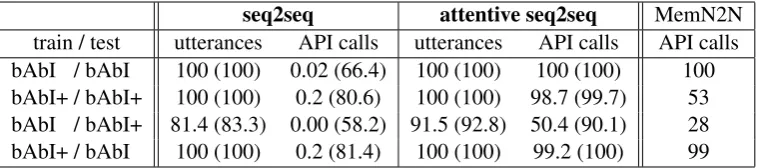
Table 1: Sequence accuracy (word accuracy in brackets) on the test set for utterances (non-API call responses) and API calls only. The last column shows accuracy on the test set for the retrieval-based memory-network system, as reported byShalyminov et al.(2017) .
3.1 Training
All models are trained to predict the system ut-terances of all of the 1000 training dialogues of the bAbI and bAbI+ dataset, respectively, includ-ing the final API call. After each user turn, mod-els are asked to generate the next system utterance in the dialogue, given the dialogue history up to that point, which consists of all human and sys-tem utterances that previously occurred in that di-alogue. The model’s parameters are updated using stochastic gradient descent on a cross-entropy loss (using mini-batch size 32), with Adam (Kingma and Ba, 2014) as optimiser (learning rate 0.001). All models are trained until convergence, which was reached after∼20 epochs.
3.2 Evaluation
FollowingShalyminov et al.(2017), we use a 2×2 paradigm in which we train models either on bAbI or bAbI+ data and evaluate their performance on the test set of the same dataset, as well as across datasets. We report both the percentage of cor-rect words in the generated responses (word accu-racy) and the percentage of responses that were entirely correct (sequence accuracy). Addition-ally, we separately report the word and sequence accuracy of the API calls generated at the end of each dialogue. Note that these metrics are more challenging than the retrieval-based ones used by
Bordes et al. (2017) and Eshghi et al.(2017), as the correct response has to be generated word by word, rather than merely being selected from a set of already available candidate utterances.
3.3 Results
Our results can be found in Table 1. The results obtained with the bAbI/bAbI and bAbI+/bAbI+ conditions indicate that an encoder-decoder model with attention can achieve near-perfect accuracy on Task 1 (predicting the right API call), whereas
a model without attention cannot (sequence accu-racy for API calls is only 0.02% on bAbI/bAbI and 0.2% on bAbI+/bAbI+). This suggests that, in line with what was posed byBordes et al.(2017), the bAbI Task 1 requires some form of memory that goes beyond what is available in a vanilla sequence-to-sequence model. To solve the task, however, using an attention mechanism suffices— a more complicated memory such as present in memory networks is not necessary.
Furthermore, our results confirm that models trained on data without disfluencies struggle to generalise when these are introduced at testing time (bAbI/bAbI+): While the overall accuracy of the dialogue is still high (91.5% of utterances are correct), API call accuracy falls back to 50.4%. Models trained on data containing disfluencies, however, show near-perfect accuracy on disfluent test data (98.7% on bAbI+/bAbI+)—a result that stands in stark contrast with the findings ofEshghi et al.(2017) andShalyminov et al.(2017).
4 Generalisation to Disfluent Data
In this section, we analyse the potential for gen-eralisation of the encoder-decoder model with at-tention by focusing on the bAbI/bAbI+ condition, where the model trained on bAbI data is tested on bAbI+. As shown in Table 1, while the model performs perfectly on the bAbI corpus, it achieves only∼50% accuracy on API call prediction when it is asked to generalised to bAbI+ data. Here we aim to shed light on these results by studying the errors made by the model and visualising the pat-terns of the attention component of the network.
4.1 Qualitative error analysis
Figure 1: Visualisation of the decoder attention when generating the API call (vertical axis) for the dis-fluent dialogue in example(4)(horizontal axis). Darker colours indicate higher attention values.
mapped to a single token<unk> for ‘unknown’. In addition, the presence of disfluencies increases the length of user utterances: The average ance length in bAbI is 4.8 tokens, while user utter-ances in bAbI+ have an average length of 7.6.
Since the inventory of system utterances is very limited (there are 7 types of system outputs), the model has no difficulty learning their surface form. The errors we find, therefore, do not concern the grammaticality of the utterances, but rather when in the course of a dialogue a particular system ut-terance is offered. We find that utut-terance errors always involve a jump ahead in the expected se-quence of system utterances. For example, around 83% of the utterance errors occur at the beginning of the dialogue. If the first user utterance is dis-fluent (e.g., Good morning <unk> <unk> good morning) and hence longer than ex-pected, the model tends to skip the system’s greet-ing and initial prompt (Hello, what can I help you with today) and instead outputs the second system prompt (I’m on it), which only makes sense once the user has already pro-vided some task-related information. Utterance errors of this kind, where the model generates an utterance that would be appropriate later on in the dialogue, occur after all disfluency types present in bAbI+: hesitations, restarts, and self-repairs.
The current evaluation setup does not allow us to test whether utterance errors by the system lead to errors in the final API call, since the input se-quence given to the encoder is the gold dialogue history and not the dialogue history with system utterances generated by the model. This, however, allows us to conclude that the errors made by the model on around 50% of all API calls are a di-rect consequence of the disfluencies present in the user utterances. Not surprisingly, API call errors are triggered by self-corrections, which in bAbI+ always involve the mention of two different val-ues for a single semantic slot (see example(4)
be-low). Indeed, the model trained on bAbI achieves near-perfect accuracy when tested on a corpus that does not contain self-correction but only hesita-tions and restarts. This indicates that the lower accuracy is specifically caused by the presence of multiple potential values for the same API slot in self-corrections.
Manual error inspection shows that the model does not follow a systematic strategy whereby the first mention of a semantic slot is selected, which would lead to all self-corrections being processed incorrectly. As illustrated in(4), the model seems to randomly select between the first and the sec-ond mention of a slot in a self-correction struc-ture, which leads to some self-corrections being processed correctly:
(4) U:good morning
S:hello what can I help you with today
U:can you make a reservation for six oh no eight in a uhm yeah can you make a reservation for eight in a moderate price range no in a cheap price range in madrid
S:i’m on it U:<silence>
S:any preference on a type of cuisine U:I love british food
S:ok let me look into some options for you
U:<silence>
S:<API call british madrid six cheap>
In Figure1, we visualise the decoder attention of the bAbI model when it generates the (partly in-correct) API call for the dialogue in(4). The plot shows that while generating the different compo-nents of the API call, the model strongly relies on its attention mechanism to select the right slot. Furthermore, it confirms the observation that the model is not consistent in its strategy to select a slot after a disfluency: While it incorrectly attends to six (rather than eight), it correctly selects
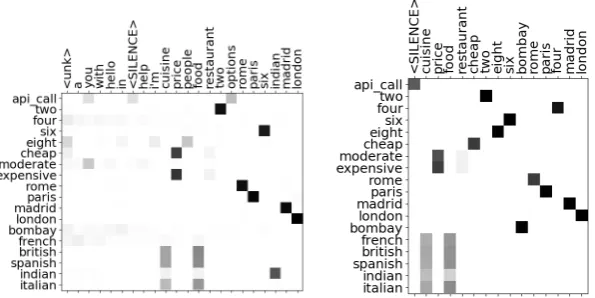
pat-Figure 2: Alignment of in- and output words via the attention for different models tested on bAbI+ data. Left: model trained on bAbI. Right: model trained on bAbI+.
terns of both the bAbI and bAbI+ trained model.
4.2 Comparing attention patterns
To evaluate the network’s attention patterns in a more quantitative way, we store all attention weights that the model computes while generat-ing the API calls in the test corpus, and we com-pute their average for each API-call word. That is, for all words in an API-call, we compute to which words in the dialogue history the decoder was on average attending while it generated that word.
We plot the results in Figure 2, removing for each API-call word (on the vertical axis in the plot) the input words (horizontal axis) whose aver-age attention score was lower 0.2. We observe that the model trained on bAbI (left) not infrequently attends to<unk>while generating API calls, in-dicating that it did not attend to the correct content word. A striking difference appears comparing the results for the bAbI model with the bAbI+ trained model (Figure 2, right), whose attention scores are much less diffuse. While the bAbI model fre-quently attends to irrelevant words such as “hello”, “a” or “in” (first columns in the plot), these words are not attended at all by the bAbI+ trained model. This difference suggests that the bAbI+ model de-veloped a more clear distinction between different types of words in the input andbenefitsfrom the presence of disfluencies in the training data rather than being hindered by it.
In the next section, we investigate the rep-resentations developed by the bAbI+ model (bAbI+/bAbI+ condition), focussing in particular on how it incrementally processes disfluencies.
5 Disfluency Processing
In contrast to previous work (Eshghi et al.,2017;
Shalyminov et al.,2017), our seq2seq model with attention trained on bAbI+ data learns to process disfluent user utterances remarkably well, achiev-ing over 98% sequence accuracy on API calls (see bAbI+/bAbI+ condition in Table 1). In this sec-tion, we investigate how the model deals with dis-fluencies, in particular self-corrections, by draw-ing inspiration from human disfluency processdraw-ing.
5.1 The structure of disfluencies
It has been often noted that disfluencies follow regular patterns (Levelt, 1983; Shriberg, 1994). Example(5)shows the structure of a prototypical self-correction, where thereparandum(RM) con-tains the problematic material to be repaired; the utterance is then interrupted, which can optionally be signalled with a filled paused and/or anediting term(ET); the final part is therepair (R) proper, after which the utterance may continue:
(5) a reservation for six {I mean}eightin a. . .
RM ET R
[image:5.595.143.441.69.218.2]5.2 Editing terms
The algorithm used to generate the bAbI+ data systematically adds editing expressions (such as
oh no or sorry) to all restarts and self-corrections inserted in the data. However, edit-ing expressions (e.g.,I mean, rather, that is, sorry, oops) are in fact rare in naturally occurring hu-man conversation. For example, Hough (2015) finds that only 18.52% of self-corrections in the Switchboard corpus contain an explicit editing term. Thus, while psycholinguistic research has shown that the presence of an explicit editing term followed by a correction makes the disfluency eas-ier to handle (Brennan and Schober, 2001), hu-mans are able to process disfluencies without the clues offered by such expressions.
Here we test whether the model relies on the systematic presence of editing expressions in the bAbI+ data. To this end, we created two new ver-sions of the dataset using the code byShalyminov et al. (2017):2 One with no editing term in any of the self-corrections or restarts, dubbed “noET”; and one where there is an editing term in 20% of self-corrections and restarts, dubbed “realET” as it reflects a more realistic presence of such ex-pressions. We refer to the original bAbI+ data, which has editing terms in all self-corrections and restarts, as “fullET”.
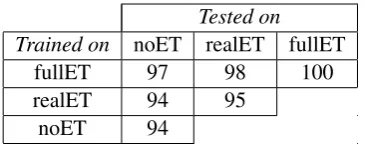
We test to what extent a model trained on ful-lET, which could rely on the systematic presence of an editing term to detect the presence of a self-correction or restart, is able to process disfluen-cies in a more natural scenario where editing ex-pressions are only sparsely available (realET). The result indicates that the editing term has very lit-tle effect on the model’s performance: as shown in Table 2, accuracy goes down slightly, but is still extremely high (98%). This finding persists when the editing terms are left out of the test data entirely (97% accuracy when testing on noET). When models are trained on data containing fewer editing terms (realET and noET) and tested on data with a comparable or smaller percentage of editing terms, we observe a slightly larger drop in accuracy (see Table 2). We conclude that, al-though editing terms may help the model to de-velop better representations during training, their presence is not required to correctly process dis-fluencies at test time.
2https://github.com/ishalyminov/babi_
tools
Tested on Trained on noET realET fullET
fullET 97 98 100
realET 94 95
[image:6.595.326.509.61.134.2]noET 94
Table 2: Sequence accuracies of all sequences with and without editing term, averaged over 5 runs.
5.3 Identification of structural components
Disfluencies have regular patterns. However, iden-tifying their components online is not trivial. The comprehender faces what Levelt(1983) calls the continuation problem: the need to identify (the beginning and end of the reparandum and the re-pair onset. Evidence shows that there are no clues (prosodic or otherwise) present during the reparandum. Thus the identification of the disflu-ency takes place at or after the moment of interrup-tion (typically during the repair). Here there may be prosodic changes, but such clues are usually absent (Levelt and Cutler, 1983). Ferreira et al.
(2004) point out that “the language comprehen-sion system is able to identify a disfluency, likely through the use of a combination of cues (in some manner that is as yet not understood).”
We test to what extent our trained encoder-decoder model distinguishes reparanda and edit-ing terms and can identify the boundaries of a repair using diagnostic classifiers(Hupkes et al.,
2018). Diagnostic classifiers were proposed as a method to qualitatively evaluate whether spe-cific information is encoded in high-dimensional representations—typically the hidden states that a trained neural network goes through while pro-cessing a sentence. The technique relies on train-ing simple neural meta-models to predict the infor-mation of interest from these representations and then uses the accuracy of the resulting classifiers as a proxy for the extent to which this information is encoded in the representations.
1 2 2 3 0 0 0 1 1 2 2 3 3 0 0 with uhm yeah with british cuisine in a moderate no sorry a cheap price range
Figure 3: A labelled example sentence to evaluate whether models have distinct representations for reparanda, repairs, and editing terms. For each label, we train a separate binary classifier to predict whether or not a word belongs to the corresponding class.
We hypothesise that while reparanda will not be detectable in the hidden layer activations, as they can only be identified as such a posteriori (Levelt,
1983;Ferreira et al., 2004), editing terms should be easy to detect, since they belong to a class of distinct words. The most interesting classifier we consider is the one identifying repairs, which re-quires a more structural understanding of the dis-fluency and the sentence as a whole.
self-corrections restarts
Reparandum 15.0 / 89.4 27.4 / 92.6 Editing term 37.3 / 99.4 55.7 / 99.2
[image:7.595.78.285.304.360.2]Repair 21.3 / 93.5 35.2 / 94.9
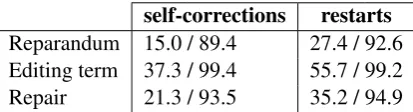
Table 3: Precision / recall of diagnostic classifiers to identify reparanda, editing terms and repairs.
The general trends in our results (see Table 3
above) are as expected: Editing terms are more easily recoverable than both reparanda and repairs, and the reparandum has the lowest scores with a precision and recall of 0.15 and 0.89, respec-tively. However, results for editing terms and re-pairs are lower than expected. The presence of editing terms is not reliably identifiable given the hidden layer activations of a model (37.3% and 55.7% precision for self-corrections and restarts, respectively), which is surprising given the fact that there is no overlap between editing terms and the rest of the model’s vocabulary. Taken together with the results of our previous experiments in Section5.2regarding the effect of editing terms on the final sequence accuracy, this indicates that the presence of an editing term causes only minimal changes in the hidden layer activations, and thus leaves only a small trace in the hidden state of the network. The performance of the repair classifier is also low: 21.3% precision on self-correction and 35.2% on restarts. These results suggest that the model has no explicit representations of the struc-ture of disfluencies and instead relies on other cues to infer the right API call.
5.4 Incremental interpretation
Next we analyse how the model processes disflu-encies by looking into the interpretation—in terms of task-related predictions—that the model builds incrementally, word by word and utterance by ut-terance.
Word by word First, we probe the representa-tions of the encoder part of the model while it processes incoming sentences, for which we use again diagnostic classifiers. In particular, we test if information that is given at a particular point in the dialogue (for instance, the user expresses she would like to eat Indian food) is remembered by the encoder throughout the rest of the conversa-tion. We label the words in a dialogue according to what slot information was already provided pre-viously in the dialogue, and test if this information can be predicted by a diagnostic classifier at later points in the dialogue. Note that while in the bAbI data the prediction for a slot changes only once when the user expresses her preference, due to the possibilities of corrections, slot information may change multiple times in the bAbI+ corpus. We train separate diagnostic classifiers for the differ-ent slots in the API call: cuisine (10 options), loca-tion (10 oploca-tions), party size (4 oploca-tions), and price range (3 options).
Our experiments show that the semantic infor-mation needed to issue an API call is not accu-rately predictable from the hidden representations that the encoder builds of the dialogue—see Ta-ble4, where accuracy scores are all relatively low.
Cuisine 31.3
[image:7.595.373.461.608.663.2]Location 25.9 Price range 57.3 Party size 43.0
Table 4: Accuracy per slot type in the word-by-word experiment.
Figure 4: Accuracy at position relative to mention in the dialogue of each type of slot.
4 words after the slot information occurred). The plot illustrates that the encoder keeps traces of se-mantic slot information for a few time steps after this information appears in the dialogue, but then rapidly ‘forgets’ it when the dialogue continues.3 These results confirm our earlier findings that most of the burden for correctly issuing API calls falls on the model’s attention mechanism, which needs to select the correct hidden states at the moment an API call should be generated.
Utterance by utterance In a second experi-ment, we study the incremental development of the API call made by the model’s generative com-ponent (the decoder) by prompting it to generate an API call after every user utterance. To trigger the API calls, we append the utterances normally preceding an API call (let me look some options for you <silence>) to the dia-logue history that is fed to the decoder. We ap-ply this trick to elicit an API call after every user utterance in the dialogue. We evaluate the gener-ated API calls by considering only the slots that can already be filled given the current dialogue history. That is, in a dialogue in which the user has requested to eat Italian food in London but has not talked about party size, we exclude the party size slot from the evaluation, and evaluate only whether the generated API call correctly predicts “Italian” and “London”.
For models trained on bAbI data, the described method reliably prompted an API call, while it
3
To exclude the possibility that the low accuracy is a con-sequence ofrelocationof information instead of it being for-gotten, we also trained diagnostic classifiers to only start pre-dicting a few words after slot information appears, but this did not result in an increase in accuracy.
bAbI / bAbI 100
bAbI+ / bAbI 100 bAbI / bAbI+ 66.6 bAbI+ / bAbI+ 99.8
Table 5: Accuracy on triggered API calls utterance by utterance.
was less successful for models trained on bAbI+, where API calls were evoked only in 86% of the time (when testing on bAbI+ data) and 54% of the time (when testing on bAbI data). For our analy-sis, we consider only cases in which the API call was prompted and ignore cases in which other sen-tences were generated
As shown in Table 5, we find that the de-coders of both the bAbI and bAbI+ models are able to generate appropriate API calls immedi-ately after slots are mentioned in the user utterance (∼100% accuracy in the bAbI/bAbI, bAbI+/bAbI, and bAbI+/bAbI+ conditions). However, when confronted with disfluencies, the model trained on the disfluency-free bAbI data is not able to do so reliably (66.6% accuracy with bAbI/bAbI+), fol-lowing the trend we also observed in Table1.
6 Conclusions
We have investigated how recurrent neural net-works trained in a synthetic dataset of task-oriented English dialogues process disfluencies. Our first conclusion is that, contrary to earlier find-ings, recurrent networks with attention can learn to correctly process disfluencies, provided they were presented to them at training time. In the current data, they do so without strongly relying on the presence of editing terms or identifying the repair component of disfluent structures. When compar-ing models trained on data with and without dis-fluencies, we observe that the attention patterns of the former models are more clear-cut, suggesting that the disfluencies contribute to a better under-standing of the input, rather than hindering it.
[image:8.595.365.471.61.118.2]neces-sary to obtain a more balanced division of labour between encoder and decoder.
Here we have exploited synthetic data, taking advantage of the control this affords regarding types and frequency of disfluency patterns, as well as the direct connection between language pro-cessing and task success present in the dataset. In the future, we aim at investigating neural models of disfluency processing applied to more natural-istic data, possibly leveraging eye-tracking infor-mation to ground language comprehension (??).
References
Dzmitry Bahdanau, Kyunghyun Cho, and Yoshua Ben-gio. 2015a. Neural machine translation by jointly learning to align and translate. In Proceedings of the 3rd International Conference on Learning Rep-resentations (ICLR).
Dzmitry Bahdanau, Kyunghyun Cho, and Yoshua Ben-gio. 2015b. Neural machine translation by jointly learning to align and translate. In Proceedings of the 3rd International Conference on Learning Rep-resentations (ICLR2015).
Karl GD Bailey and Fernanda Ferreira. 2003. Disflu-encies affect the parsing of garden-path sentences.
Journal of Memory and Language, 49(2):183–200.
Antoine Bordes, Y-Lan Boureau, and Jason Weston. 2017. Learning end-to-end goal-oriented dialog. In
Proceedings of the 5th International Conference on Learning Representations (ICLR).
Susan E Brennan and Michael F Schober. 2001. How listeners compensate for disfluencies in sponta-neous speech. Journal of Memory and Language, 44(2):274–296.
Arash Eshghi, Igor Shalyminov, and Oliver Lemon. 2017. Bootstrapping incremental dialogue systems from minimal data: the generalisation power of di-alogue grammars. InProceedings of the 2017 Con-ference on Empirical Methods in Natural Language Processing (EMNLP), pages 2220–2230. Associa-tion for ComputaAssocia-tional Linguistics.
Fernanda Ferreira and Karl G. D. Bailey. 2004. Disflu-encies and human language comprehension. Trends in Cognitive Sciences, 8(5).
Fernanda Ferreira, Ellen F. Lau, and Karl G. D. Bai-ley. 2004. Disfluencies, language comprehension, and tree adjoining grammars. Cognitive Science, 28:721–749.
Jean E. Fox Tree. 1995. The effects of false starts and repetitions on the processing of subsequent words in spontaneous speech. Journal of memory and lan-guage, 34(6):709–738.
Peter A. Heeman and James F. Allen. 1999. Speech repairs, intonational phrases, and discourse markers: modeling speakers’ utterances in spoken dialogue.
Computational Linguistics, 25(4):527–571.
Julian Hough. 2015. Modelling Incremental Self-Repair Processing in Dialogue. Ph.D. thesis, Queen Mary University of London.
Dieuwke Hupkes, Sara Veldhoen, and Willem Zuidema. 2018. Visualisation and ’diagnostic classi-fiers’ reveal how recurrent and recursive neural net-works process hierarchical structure. Journal of Ar-tificial Intelligence Research, 61:907–926.
Nal Kalchbrenner, Edward Grefenstette, and Phil Blun-som. 2014. A convolutional neural network for modelling sentences. In Proceedings of the 52nd Annual Meeting of the Association for Computa-tional Linguistics, pages 655–665.
Diederik Kingma and Jimmy Ba. 2014. Adam: A method for stochastic optimization. InProceedings of ICLR 2014, pages 1–13.
Ellen F. Lau and Fernanda Ferreira. 2005. Linger-ing effects of disfluent material on comprehension of garden path sentences. Language and Cognitive Processes, 20:633—666.
Willem J. M. Levelt. 1983. Monitoring and self-repair in speech.Cognition, 14(1):41–104.
Willem JM Levelt and Anne Cutler. 1983. Prosodic marking in speech repair. Journal of semantics, 2(2):205–218.
Xian Qian and Yang Liu. 2013. Disfluency detection using multi-step stacked learning. InProceedings of the 2013 Conference of the North American Chap-ter of the Association for Computational Linguistics: Human Language Technologies, pages 820–825.
Alan Ritter, Colin Cherry, and William B. Dolan. 2011. Data-driven response generation in social media. In
Proceedings of the 2011 Conference on Empirical Methods in Natural Language Processing, pages 583–593. Association for Computational Linguis-tics.
Igor Shalyminov, Arash Eshghi, and Oliver Lemon. 2017. Challenging neural dialogue models with nat-ural data: Memory networks fail on incremental phenomena. In Proceedings of the 21st Workshop on the Semantics and Pragmatics of Dialogue (SEM-DIAL), pages 125–133.
Elizabeth E. Shriberg. 1994. Preliminaries to a Theory of Speech Disfluencies. Ph.D. thesis, University of California at Berkeley, Berkeley, CA.
Andreas Stolcke and Elizabeth Shriberg. 1996. Statis-tical language modeling for speech disfluencies. In
Sainbayar Sukhbaatar, arthur szlam, Jason Weston, and Rob Fergus. 2015. End-to-end memory net-works. In C. Cortes, N. D. Lawrence, D. D. Lee, M. Sugiyama, and R. Garnett, editors,Advances in Neural Information Processing Systems 28, pages 2440–2448. Curran Associates, Inc.
Ilya Sutskever, Oriol Vinyals, and Quoc V Le. 2014. Sequence to sequence learning with neural net-works. InAdvances in neural information process-ing systems (NIPS), pages 3104–3112.
Oriol Vinyals and Quoc V. Le. 2015. A neural conver-sational model. InProceedings of the 31 st Interna-tional Conference on Machine Learning (ICML) – Deep Learning Workshop.