127
Robust Document Retrieval and Individual Evidence Modeling for Fact
Extraction and Verification.
Tuhin Chakrabarty and Tariq Alhindi Department of Computer Science
Columbia University
[email protected] [email protected]
Smaranda Muresan Department of Computer Science
Data Science Institute Columbia University
Abstract
This paper presents the ColumbiaNLP submis-sion for the FEVER Workshop Shared Task. Our system is an end-to-end pipeline that ex-tracts factual evidence from Wikipedia and infers a decision about the truthfulness of the claim based on the extracted evidence. Our pipeline achieves significant improvement over the baseline for all the components (Doc-ument Retrieval, Sentence Selection and Tex-tual Entailment) both on the development set and the test set. Our team finished 6th out of 24 teams on the leader-board based on the pre-liminary results with a FEVER score of 49.06 on the blind test set compared to 27.45 of the baseline system.
1 Introduction and Background
Fact checking is a type of investigative journal-ism where experts examine the claims published by others for their veracity. The claims can range from statements made by public figures to stories reported by other publishers. The end goal of a fact checking system is to provide a verdict on whether the claim is true, false, or mixed. Sev-eral organizations such asFactCheck.organd
PolitiFactare devoted to such activities. The FEVER Shared task aims to evaluate the ability of a system to verify information using ev-idence from Wikipedia. Given a claim involv-ing one or more entities (mappinvolv-ing to Wikipedia pages), the system must extract textual evidence (sets of sentences from Wikipedia pages) that sup-ports or refutes the claim and then using this evidence, it must label the claim as Supported, Refuted or NotEnoughInfo. The dataset for the shared task was introduced byThorne et al.(2018) and consists of 185,445 claims. Table 1 shows three instances from the data set with the claim, the evidence and the verdict.
Claim: Fox 2000 Pictures released the film Soul Food.
[wiki/Soul Food (film)]
Evidence: Soul Food is a 1997 American comedy-drama film produced by Kenneth ”Babyface” Edmonds , Tracey Edmonds and Robert Teitel and released by Fox 2000 Pictures .
Verdict: SUPPORTS
Claim: Murda Beatz’s real name is Marshall Mathers.
[wiki/Murda Beatz]
Evidence: Shane Lee Lindstrom (born February 11, 1994), known professionally as Murda Beatz, is a Canadian hip hop record producer and songwriter from Fort Erie, Ontario.
Verdict: REFUTES
Claim: L.A. Reid has served as the CEO of Arista Records for four years.
[wiki/L.A. Reid]
Evidence: He has served as the chairman and CEO of Epic Records, a division of Sony Music Entertainment, the president and CEO of Arista Records, and the chairman and CEO of the Island Def Jam Music Group.
Verdict:NOT ENOUGH INFO
Table 1: Examples of claims, the extracted evidence from Wikipedia and the verdicts from the shared task dataset (Thorne et al.,2018)
The baseline system described byThorne et al.
(2018) uses 3 major components:
• Document Retrieval: Given a claim, iden-tify relevant documents from Wikipedia which contain the evidence to verify the claim. Thorne et al. (2018) used the doc-ument retrieval component from the DrQA system (Chen et al.,2017), which returns the k nearest documents for a query using co-sine similarity between binned unigram and bigram TF-IDF vectors.
DrQA (Chen et al., 2017) to select the top most similar sentences w.r.t the claim, using bigram TF-IDF with binning.
• Textual Entailment: For the entailment task, training is done using labeled claims paired with evidence (labels are SUPPORTS, REFUTES, NOT ENOUGH INFO). Thorne et al. (2018) used the decomposable atten-tion model (Parikh et al.,2016) for this task. For the case where multiple sentences are re-quired as evidence, the strings were concate-nated.
Our system implements changes in all three modules (Section2), which leads to significant im-provements both on the development and test sets. On the shared task development set our document retrieval approach covers 94.4% of the claims re-quiring evidence, compared to 55.30% in the base-line. Further, on the dev set our evidence recall is improved by 33 points over the baseline. For en-tailment, our model improves the baseline by 7.5 points on dev set. Overall, our end-to-end system shows an improvement of 19.56 in FEVER score compared to the baseline (50.83 vs. 31.27) on the dev set . On the blind test set we achieve an evi-dence recall of 75.89 and an entailment accuracy of 57.45 (9 points above baseline) resulting in a FEVER score of 49.06 (Section3). Together with the results we discuss some lessons learned based on our error analysis and release our code1.
2 Methods
2.1 Document Retrieval
Document Retrieval is a crucial step when build-ing an end-to-end system for fact extraction and verification. Missing a relevant document could lead to missed evidence, while non-relevant doc-uments would add noise for the subsequent tasks of sentence selection and textual entailment. We propose a multi-step approach for retrieving docu-ments relevant to the claims.
• Google Custom Search API: Wang et al.
(2018) looked at retrieving relevant docu-ments for fact-checking articles, looking at generating candidates via search. Inspired by this, we first use the Custom Search API of Google to retrieve documents having infor-mation about the claim. We add the token
1https://github.com/tuhinjubcse/FEVER-EMNLP
wikipediato the claim and issue a query and collect the top 2 results.
• Named Entity Recognition: Second, we use the AllenNLP (Gardner et al., 2017) pre-trained bidirectional language model (Peters et al., 2017) for named entity recognition 2. After finding the named entities in the claim, we use Wikipedia python API3to collect the top wikipedia document returned by the API for each named entity.
• Dependency Parse: Third, to increase the chance of detecting relevant entities in the claim, we find the first lower case verb phrase (VP) in the dependency parse tree and query the Wikipedia API with all the tokens before the VP. The reason for emphasizing lower case verb phrase is to avoid missing entities in claims such as “Finding Dory was directed by X”, where the relevant entity is “Finding Dory”.
To deal with entity ambiguity, we also add the token film in our query where the claim contains keywords such as film,
stars, premiered anddirected by. For example in “Marnie was directed by Whoopi Goldberg.”, Marnie can refer to both wikipedia pagesMarnie (film)and
Marnie. Our point of interest here is
Marnie (film). We only experimented withfilmto capture the performance gains. One of our future goals is to build better com-putational models to handle entity ambiguity or entity linking.
• Combined: We use the union of the docu-ments returned by the three approaches as the final set of relevant documents to be used by the Sentence Selection module.
Method Avg k Coverage
Google API 2 79.5%
NER 2 77.1%
Dependency Parse 1 80.0% Combined 3 94.4%
(Thorne et al.,2018) 5 55.3%
Table 2: Coverage of claims that can be fully supported or refuted by the retrieved documents (dev set)
Table2shows the percentage of claims that can be fully supported or refuted by the retrieved
docu-2
http://demo.allennlp.org/named-entity-recognition
ments before sentence selection on the dev set. We see that our best approach (combined) achieved a high coverage 94.4% compared to the baseline (Thorne et al., 2018) of 55.3%. Because we do not have the gold evidences for the blind test set we cannot report the claim coverage using our pipeline .
2.2 Sentence Selection
For sentence selection, we used the modified doc-ument retrieval component of DrQA (Chen et al.,
2017) to select sentences using bigram TF-IDF with binning as proposed by (Thorne et al.,2018). We extract the top 5 most similar sentences from the k-most relevant documents using the TF-IDF vector similarity. Our evidence recall is 78.4 as compared to 45.05 in the development set of FEVER (Thorne et al.,2018), which demonstrates the importance of document retrieval in fact ex-traction and verification. On the blind test set our sentence selection approach achieves an evidence recall of 75.89.
However, even though TF-IDF proves to be a strong baseline for sentence selection we no-ticed on the dev set that using all 5 evidences to-gether introduced additional noise to the entail-ment model. To solve this, we further filtered the top 3 evidences from the selected 5 evidences us-ing distributed semantic representations. Peters et al.(2018) show how deep contextualized word representations model both complex characteris-tics of word use (e.g., syntax and semancharacteris-tics), and usage across various linguistic contexts. Thus, we used the ELMo embeddings to convert the claim and evidence to vectors. We then calculated cosine similarity between claim and evidence vectors and extracted the top 3 sentences based on the score. Because there was no penalty involved for poor evidence precision, we returned all five selected sentences as our predicted evidence but used only the top three sentences for the entailment model.
2.3 Textual Entailment
[image:3.595.344.487.71.205.2]The final stage of our pipeline is recognizing tex-tual entailment. Unlike Thorne et al. (2018), we did not concatenate evidences, but trained our model for each claim-evidence pair. For recog-nizing textual entailment we used the model in-troduced by Conneau et al. (2017) in their work on supervised learning of universal sentence rep-resentations.
Figure 1: The architecture for recognizing textual en-tailment (adapted from (Conneau et al.,2017))
The architecture is presented in Figure 1. We use bidirectional LSTMs (Hochreiter and Schmid-huber, 1997) with max-pooling to encode the claim and the evidence. The text encoder provides dense feature representation of an input claim or evidence. Formally, for a sequence of T words
wt“1,..,T , the BiLSTM layer generates a sequence
ofhtvectors, where ht is the concatenation of a
forward and a backward LSTM output. The hid-den vectorshtare then converted into a single
vec-tor using pooling, which chooses the max-imum value over each dimension of the hidden units. Overall, the text encoder can be treated as an operator TextÑ Rdthat providesddimensional
encoding for a given text.
Out of vocabulary issues in pre-trained word embeddings are a major bottleneck for sentence representations. To solve this we use fastText embeddings (Bojanowski et al.,2017) which rely on subword information. Also, these embeddings were trained on Wikipedia corpus making them an ideal choice for this task.
As shown in Figure 1, the shared sentence en-coder outputs a representation for the claimuand the evidencev. Once the sentence vectors are gen-erated, the following three methods are applied to extract relations between the claim and the evi-dence: (i) concatenation of the two representations (u, v); (ii) element-wise product u*v and (iii) ab-solute element-wise difference|u´v|. The result-ing vector, which captures information from both the claim and the evidence, is fed into a 3-class classifier consisting of fully connected layers cul-minating in a softmax layer.
(claim, evidence) pairs as our entailment label but this led to lower accuracy on the dev set. So our final predictions are based on the rule outlined in the Algorithm 1, whereSUPPORTS=S,REFUTES = R, NOT ENOUGH INFO = N and C is a count function. Because the selected evidences were in-herently noisy and our pipeline did not concate-nate evidences together we chose this rule over majority prediction to mitigate the dominance of prediction ofNOT ENOUGH INFOclass.
Algorithm 1Prediction Rule
ifCpSq “1&CpNq “2then label“S
else ifCpRq “1&CpNq “2then label“R
else
label“arg maxpCpSq, CpRq, CpNqq
We also experimented by training a classifier which takes confidence scores of all the three claim evidence pairs along with their position in the document and trained a boosted tree classifier but the accuracy did not improve. Empirically the rule gave us the best results on the dev set and thus used it to obtain the final label.
Table 3 shows the 3 way classification accu-racy using the textual entailment model described above.
DataSet Accuracy Shared Task Dev 58.77
Blind Test Set 57.45
Table 3: 3 way classification results
Our entailment accuracy on the shared task dev and test set is 7 and 9 points better than the base-line respectively.
Implementation Details. The batch size is kept as 64. The model is trained for 15 epochs using Adam optimizer with a learning rate of 0.001. The size of the LSTM hidden units is set to 512 and for the classifier, we use a MLP with 1 hidden-layer of 512 hidden units. The embedding dimension of the words is set to 300.
3 End to End Results and Error Analysis
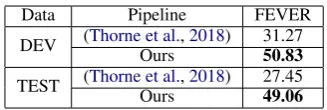
Table4shows the overall FEVER score obtained by our pipeline on the dev and test sets. In the provisional ranking our system ranked 6th.
On closer investigation we find that neither TF-IDF nor sentence embedding based approaches are
Data Pipeline FEVER
DEV (Thorne et al.,2018) 31.27
Ours 50.83
TEST (Thorne et al.,2018) 27.45
[image:4.595.333.497.60.115.2]Ours 49.06
Table 4: FEVER scores on shared task dev and test set
perfect when it comes to sentence selection, al-though TF-IDF works better.
Fox 2000 Pictures released the film
Soul Food 0.29
Soul Food is a 1997 American comedy-drama film produced by Kenneth
”Babyface” Edmonds,Tracey
[image:4.595.313.520.194.270.2]Edmonds and Robert Teitel and released by Fox 2000 Pictures
Table 5: Cosine similarity between claim and support-ing evidence
Table5goes on to prove that we cannot rely on models that entirely depend on semantics. In spite of the two sentences being similar, the cosine sim-ilarity between them is poor mostly because the evidence contains a lot of extra information which might not be relevant to the claim and difficult for the model to understand.
At seventeen or eighteen years of age, he joined Plato’s Academy in Athens and remained there until the age of thirty-seven (c. 347 BC)
Shortly after Plato died , Aristotle left Athens and at the request of Philip II of Macedon ,tutored Alexander the Great beginning in 343 BC
Table 6: The top evidence is selected by Annotators and the bottom evidence by our pipeline
We also found instances where the predicted ev-idence is correct but it does not match the gold evidence. For the claim “Aristotle spent time in Athens”, both evidences given in Table6support it, but still our system gets penalized on not being able to match the gold evidence.
We found quite a few annotations to be incor-rect and hence the FEVER scores are lower than expected. Table 7 show two instances where the gold labels for the claims wasNOT ENOUGH INFO, while in fact they should have beenSUPPORTSand REFUTES, respectively.
Table8reflects the fact thatNOT ENOUGH INFO is often hard to predict and that is where our model needs to improve more.
Claim: Natural Born Killers was directed by Oliver Stone
Evidence: Natural Born Killers is a 1994 American satirical crime film directed by Oliver Stone and starring Woody Harrelson , Juliette Lewis , Robert Downey Jr. , Tom Sizemore , and Tommy Lee Jones .
Claim:Anne Rice was born in New Jersey
[image:5.595.124.233.197.241.2]Evidence: Born in New Orleans, Rice spent much of her early life there before moving to Texas, and later to San Francisco
Table 7: Wrong gold label (NOT ENOUGH INFO)
S N R
S 4635 1345 686 N 2211 3269 1186 R 1348 1470 3848
Table 8: Confusion matrix of entailment predictions on shared task dev set
Table 8. Our models need better understanding of semantics to be able to identify these. Table
9 shows one such example where the gospel
keyword becomes the discriminative factor.
Claim: Happiness in Slavery is a gospel song by Nine Inch Nails
Evidence: Happiness in Slavery,is a song by American industrial rock band Nine Inch Nails from their debut extended play (EP), Broken(1992)
Table 9: Example where our model predictsSUPPORTS
for a claim labeled asNOT ENOUGH INFO
4 Conclusion
The FEVER shared task is challenging primarily because the annotation requires substantial man-ual effort. We presented an end-to-end pipeline to automate the human effort and showed empirically that our model outperforms the baseline by a large margin. We also provided a thorough error analy-sis which highlights some of the shortcomings of our models and potentially of the gold annotations.
References
Piotr Bojanowski, Edouard Grave, Armand Joulin, and Tomas Mikolov. 2017. Enriching word vectors with subword information. Transactions of the Associa-tion for ComputaAssocia-tional Linguistics, 5:135–146.
Danqi Chen, Adam Fisch, Jason Weston, and Antoine Bordes. 2017. Reading wikipedia to answer open-domain questions. pages 1870–1879. In Proceed-ings of the 55th Annual Meeting of the Association for Computational Linguistics (Volume 1: Long Pa-pers).
Alexis Conneau, Douwe Kiela, Holger Schwenk, Lo¨ıc Barrault, and Antoine Bordes. 2017. Supervised
learning of universal sentence representations from natural language inference data. InProceedings of the 2017 Conference on Empirical Methods in Nat-ural Language Processing, pages 670–680, Copen-hagen, Denmark. Association for Computational Linguistics.
Matt Gardner, Joel Grus, Oyvind Tafjord Mark Neu-mann, Pradeep Dasigi, Nelson Liu, Matthew Peters, Michael Schmitz, and Luke Zettlemoyer. 2017. Al-lennlp: A deep semantic natural language process-ing platform.
Sepp Hochreiter and Jurgen Schmidhuber. 1997. Long short-term memory. In Neural computation, 791, pages 1735–1780.
Ankur Parikh, Dipanjan Das Oscar Tackstr om, and Jakob Uszkoreit. 2016. A decomposable attention model for natural language inference. pages 2249– 2255. In Proceedings of the 2016 Conference on Empirical Methods in Natural Language Processing. Association for Computational Linguistics, Austin, Texas.
Matthew E. Peters, Waleed Ammar, Chandra Bhaga-vatula, and Russell Power. 2017. Semi-supervised sequence tagging with bidirectional language mod-els. InACL.
Matthew E. Peters, Mark Neumann, Mohit Iyyer, Matt Gardner, Christopher Clark, Kenton Lee, and Luke Zettlemoyer. 2018. Deep contextualized word rep-resentations. InProc. of NAACL.
James Thorne, Andreas Vlachos, Christos Christodoulopoulos, and Arpit Mittal. 2018. Fever: a large-scale dataset for fact extraction and verification. pages 809–819. Proceedings of NAACL-HLT 2018.