Pyramidal Recurrent Unit for Language Modeling
Sachin Mehta1, Rik Koncel-Kedziorski1, Mohammad Rastegari2, and Hannaneh Hajishirzi1
1University of Washington, Seattle, WA, USA
{sacmehta, kedzior, hannaneh}@uw.edu
2Allen Institute for AI and XNOR.AI, Seattle, WA, USA
Abstract
LSTMs are powerful tools for modeling con-textual information, as evidenced by their suc-cess at the task of language modeling. How-ever, modeling contexts in very high dimen-sional space can lead to poor generalizability. We introduce the Pyramidal Recurrent Unit (PRU), which enables learning representations in high dimensional space with more gener-alization power and fewer parameters. PRUs replace the linear transformation in LSTMs with more sophisticated interactions including pyramidal and grouped linear transformations. This architecture gives strong results on word-level language modeling while reducing the number of parameters significantly. In partic-ular, PRU improves the perplexity of a recent state-of-the-art language model Merity et al.
(2018) by up to 1.3 points while learning 15-20% fewer parameters. For similar number of model parameters, PRU outperforms all previ-ous RNN models that exploit different gating mechanisms and transformations. We provide a detailed examination of the PRU and its be-havior on the language modeling tasks. Our code is open-source and available athttps: //sacmehta.github.io/PRU/.
1 Introduction
[image:1.595.305.520.220.390.2]Long short term memory (LSTM) units ( Hochre-iter and Schmidhuber,1997) are popular for many sequence modeling tasks and are used extensively in language modeling. A key to their success is their articulated gating structure, which al-lows for more control over the information passed along the recurrence. However, despite the so-phistication of the gating mechanisms employed in LSTMs and similar recurrent units, the input and context vectors are treated with simple linear transformations prior to gating. Non-linear trans-formations such as convolutions (Kim et al.,2016) have been used, but these have not achieved the
Figure 1: Comparison of training (solid lines) and validation (dashed lines) perplexities on the Penn Treebank with standard dropout for pyramidal re-current units (PRU) and LSTM. PRUs learn latent representations in very high-dimensional space with good generalizability and fewer parameters. See Section3for more details about PRUs. Best viewed in color.
performance of well regularized LSTMs for lan-guage modeling (Melis et al.,2018).
A natural way to improve the expressiveness of linear transformations is to increase the num-ber of dimensions of the input and context vec-tors, but this comes with a significant increase in the number of parameters which may limit gen-eralizability. An example is shown in Figure 1, where LSTMs performance decreases with the in-crease in dimensions of the input and context vec-tors. Moreover, the semantics of the input and con-text vectors are different, suggesting that each may benefit from specialized treatment.
Figure 2: Block diagram visualizing the transformations in pyramidal recurrent unit (left) and the LSTM (bottom right) along with the LSTM gating architecture (top right). Blue,red,green(ororange), and purple signify the current input xt, output of the previous cell ht−1, the output of transformations, and the fused output, respectively. The color intensity is used to represent sub-sampling and grouping operations.
the heart of the PRU is thepyramidal transforma-tion(PT), which uses subsampling to effect multi-ple views of the input vector. The subsammulti-pled rep-resentations are combined in a pyramidal fusion structure, resulting in richer interactions between the individual dimensions of the input vector than is possible with a linear transformation. Context vectors, which have already undergone this trans-formation in the previous cell, are modified with agrouped linear transformation (GLT) which al-lows the network to learn latent representations in high dimensional space with fewer parameters and better generalizability (see Figure1).
We show that PRUs can better model contextual information and demonstrate performance gains on the task of language modeling. The PRU im-proves the perplexity of the current state-of-the-art language model (Merity et al.,2018) by up to 1.3 points, reaching perplexities of 56.56 and 64.53 on the Penn Treebank and WikiText2 datasets while learning 15-20% fewer parameters. Replacing an LSTM with a PRU results in improvements in per-plexity across a variety of experimental settings. We provide detailed ablations which motivate the design of the PRU architecture, as well as detailed analysis of the effect of the PRU on other compo-nents of the language model.
2 Related work
Multiple methods, including a variety of gating structures and transformations, have been
pro-posed to improve the performance of recurrent neural networks (RNNs). We first describe these approaches and then provide an overview of recent work in language modeling.
Gating-based mechanisms: The performance of RNNs have been greatly improved by gat-ing mechanisms such as LSTMs (Hochreiter and Schmidhuber,1997), GRUs (Chung et al.,2014), peep-hole connections (Gers and Schmidhuber,
2000), SRUs (Lei et al., 2018), and RANs (Lee et al., 2017). In this paper, we extend the gating architecture of LSTMs (Hochreiter and Schmid-huber,1997), a widely used recurrent unit across different domains.
Transformations: Apart from the widely used linear transformation for modeling the tempo-ral data, another transformation that has gained popularity is convolution (LeCun et al., 1995). Convolution-based methods have gained attention in computer vision tasks (Krizhevsky et al.,2012) as well as some of the natural language process-ing tasks includprocess-ing machine translation (Gehring et al.,2017). Convolution-based methods for lan-guage modeling, such as CharCNN (Kim et al.,
Regularization: Methods such as dropout ( Sri-vastava et al.,2014), variational dropout (Kingma et al., 2015), and weight dropout (Merity et al.,
2018) have been proposed to regularize RNNs. These methods can be easily applied to PRUs.
Other efficient RNN networks: Recently, there has been an effort to improve the efficiency of RNNs. These approaches include quantization (Xu et al., 2018), skimming (Seo et al., 2018;
Yu et al., 2017), skipping (Campos et al., 2018), and query reduction (Seo et al., 2017). These approaches extend standard RNNs and therefore, these approaches are complementary to our work.
Language modeling: Language modeling is a fundamental task for NLP and has garnered sig-nificant attention in recent years (see Table 1for comparison with state-of-the-art methods).Merity et al. (2018) introduce regularization techniques such as weight dropping which, coupled with a non-monotonically triggered ASGD optimization, achieves strong performance improvements.Yang et al.(2018) extendMerity et al.(2018) with the mixture of softmaxes (MoS) technique, which in-creases the rank of the matrix used to compute next-token probabilities. Further, Merity et al.
(2017) andKrause et al.(2018) propose methods to improve inference by adapting models to recent sequence history. Our work is complementary to these recent softmax layer and inference proce-dure improvements.
We extend state-of-the-art language model in
Merity et al.(2018) by replacing the LSTM with
the PRU. We show by experiments that the PRU improves the performance ofMerity et al.(2018) while learning fewer parameters.
3 Pyramidal Recurrent Units
We introduce Pyramidal Recurrent Units (PRUs), a new RNN architecture which improves modeling of context by allowing for higher dimensional vec-tor representations while learning fewer parame-ters. Figure 2provides an overview of PRU. We first elaborate on the details of the pyramidal trans-formation and the grouped linear transtrans-formation. We then describe our recurrent unit, PRU.
3.1 Pyramidal transformation for input
The basic transformation in many recurrent units is a linear transformationFLdefined as:
y=FL(x) =W·x, (1)
whereW ∈ RN×M are learned weights that
lin-early mapx∈RN toy∈RM. To simplify nota-tion, we omit the biases.
Motivated by successful applications of sub-sampling in computer vision (e.g., (Burt and Adel-son, 1987; Lowe, 1999; Krizhevsky et al., 2012;
Mehta et al., 2018)), we subsample input
vec-tor x into K pyramidal levels to achieve repre-sentation of the input vector at multiple scales. This sub-sampling operation producesKvectors, represented as xk ∈ R2kN−1, where 2k−1 is the sampling rate and k = {1,· · ·, K}. We learn
scale-specific transformations Wk ∈ R
N 2k−1×
M K
for each k = {1,· · ·K}. The transformed sub-samples are concatenated to produce the pyrami-dal analog toy, here denoted as¯y∈RM:
¯
y=FP(x) =
W1·x1,· · · ,WK·xK
, (2)
where[·,·]indicates concatenation. We note that pyramidal transformation withK = 1is the same as the linear transformation.
To improve gradient flow inside the recurrent unit, we combine the input and output using an element-wise sum (when dimension matches) to produce residual analog of pyramidal transforma-tion, as shown in Figure2(He et al.,2016).
Sub-sampling: We sub-sample the input vector xintoK pyramidal levels using the kernel-based approach (LeCun et al., 1995; Krizhevsky et al.,
2012). Let us assume that we have a kernelκwith
2e+ 1elements. Then, the input vectorxcan be sub-sampled as:
xk= N/s X
i=1 e X
j=−e
xk−1[si]κ[j], (3)
wheresrepresents the stride andk={2,· · · , K}.
Reduction in parameters: The number of pa-rameters learned by the linear transformation and the pyramidal transformation with K pyramidal levels to map x ∈ RN to ¯y ∈
RM are N M
and N MK
K P
k=1
2(1−k) respectively. Thus, pyramidal
transformation reduces the parameters of a linear transformation by a factor ofK(PK
k=12(1−k))−1. For example, the pyramidal transformation (with
3.2 Grouped linear transformation for context
Many RNN architectures apply linear transforma-tions to both the input and context vector. How-ever, this may not be ideal due to the differing se-mantics of each vector. In many NLP applications including language modeling, the input vector is a dense word embedding which is shared across all contexts for a given word in a dataset. In con-trast, the context vector is highly contextualized by the current sequence. The differences between the input and context vector motivate their sepa-rate treatment in the PRU architecture.
The weights learned using the linear transfor-mation (Eq.1) are reused over multiple time steps, which makes them prone to over-fitting (Gal and
Ghahramani, 2016). To combat over-fitting,
var-ious methods, such as variational dropout (Gal
and Ghahramani,2016) and weight dropout (
Mer-ity et al.,2018), have been proposed to regularize these recurrent connections. To further improve generalization abilities while simultaneously en-abling the recurrent unit to learn representations at very high dimensional space, we propose to use grouped linear transformation (GLT) instead of standard linear transformation for recurrent con-nections (Kuchaiev and Ginsburg, 2017). While pyramidal and linear transformations can be ap-plied to transform context vectors, our experimen-tal results in Section 4.4 suggests that GLTs are more effective.
The linear transformation FL : RN → RM maps h ∈ RN linearly to z ∈
RM. Grouped linear transformations break the linear interac-tions by factoring the linear transformation into two steps. First, a GLT splits the input vector h ∈ RN into g smaller groups such that h = {h1,· · · ,hg},∀hi ∈
R N
g. Second, a linear
trans-formationFL : R N
g →
R M
g is applied to maphi
linearly to zi ∈ RMg , for each i = {1,· · ·, g}.
Thegresultant output vectorszi are concatenated to produce the final output vector¯z∈RM.
¯z=FG(h) =
W1·h1,· · ·,Wg·hg (4)
GLTs learn representations at low dimensional-ity. Therefore, a GLT requires g fewer parame-ters than the linear transformation. We note that GLTs are subset of linear transformations. In a lin-ear transformation, each neuron receives an input from each element in the input vector while in a
GLT, each neuron receives an input from a subset of the input vector. Therefore, GLT is the same as a linear transformation wheng= 1.
3.3 Pyramidal Recurrent Unit
We extend the basic gating architecture of LSTM with the pyramidal and grouped linear transfor-mations outlined above to produce the Pyramidal Recurrent Unit (PRU), whose improved sequence modeling capacity is evidenced in Section4.
At timet, the PRU combines the input vectorxt
and the previous context vector (or previous hid-den state vector) ht−1 using the following trans-formation function as:
ˆ
Gv(xt,ht−1) = ˆFP(xt) +FG(ht−1), (5)
wherev ∈ {f, i, c, o}indexes the various gates in the LSTM model, andFˆP(·)andFG(·)represents the pyramidal and grouped linear transformations defined in Eqns.2and4, respectively.
We will now incorporate Gˆv(·,·) into LSTM gating architecture to produce PRU. At time t, a PRU cell takes xt ∈ RN, ht−1 ∈ RM, and ct−1∈RM as inputs to produce forgetft, inputit,
outputot, and contentˆctgate signals. The inputs
are combined with these gate signals to produce context vectorht ∈ RM and cell statect ∈ RM. Mathematically, the PRU with the LSTM gating architecture can be defined as:
ft=σ
ˆ
Gf(xt,ht−1)
it=σ
ˆ
Gi(xt,ht−1)
ˆ
ct=tanh
ˆ
Gc(xt,ht−1)
ot=σ
ˆ
Go(xt,ht−1)
ct=ft⊗ct−1+it⊗ˆct
ht=ot⊗tanh(ct)
(6)
where ⊗represents the element-wise multiplica-tion operamultiplica-tion, andσandtanhare the sigmoid and hyperbolic tangent activation functions. We note that LSTM is a special case of PRU wheng=K=1.
4 Experiments
4.1 Set-up
Dataset: Following recent works, we compare on two widely used datasets, the Penn Tree-bank (PTB) (Marcus et al., 1993) as prepared
by Mikolov et al. (2010) and WikiText2 (WT-2)
(Merity et al.,2017). For both datasets, we follow the same training, validation, and test splits as in
Merity et al.(2018).
Language Model: We extend the language model, AWD-LSTM (Merity et al.,2018), by re-placing LSTM layers with PRU. Our model uses 3-layers of PRU with an embedding size of 400. The number of parameters learned by state-of-the-art methods vary from 18M to 66M with major-ity of the methods learning about 22M to 24M parameters on the PTB dataset. For a fair com-parison with state-of-the-art methods, we fix the model size to 19M and vary the value of g and hidden layer sizes so that total number of learned parameters is similar across different configura-tions. We use 1000, 1200, and 1400 as hidden layer sizes for values ofg=1,2, and 4, respectively. We use the same settings for the WT-2 dataset. We set the number of pyramidal levels K to two in our experiments and use average pooling for sub-sampling. These values are selected based on our ablation experiments on the validation set (Section
4.4). We measure the performance of our models in terms of word-level perplexity. We follow the same training strategy as inMerity et al.(2018).
To understand the effect of regularization meth-ods on the performance of PRUs, we perform ex-periments under two different settings: (1) Stan-dard dropout: We use a standard dropout ( Srivas-tava et al.,2014) with probability of 0.5 after em-bedding layer, the output between LSTM layers, and the output of final LSTM layer. (2)Advanced dropout:We use the same dropout techniques with the same dropout values as inMerity et al.(2018). We call this model as AWD-PRU.
4.2 Results
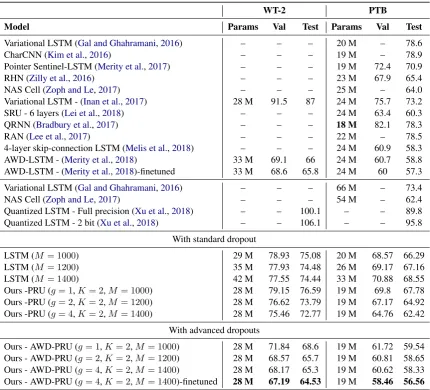
Table 1 compares the performance of the PRU with state-of-the-art methods. We can see that the PRU achieves the best performance with fewer pa-rameters.
Standard dropout: PRUs achieve either the same or better performance than LSTMs. In par-ticular, the performance of PRUs improves with the increasing value of g. At g = 4, PRUs
out-perform LSTMs by about 4 points on the PTB dataset and by about 3 points on the WT-2 dataset. This is explained in part by the regularization ef-fect of the grouped linear transformation (Figure
1). With grouped linear and pyramidal transfor-mations, PRUs learn rich representations at very high dimensional space while learning fewer pa-rameters. On the other hand, LSTMs overfit to the training data at such high dimensions and learn
1.4×to1.8×more parameters than PRUs.
Advanced dropouts: With the advanced dropouts, the performance of PRUs improves by about 4 points on the PTB dataset and 7 points on the WT-2 dataset. This further improves with finetuning on the PTB (about 2 points) and WT-2 (about 1 point) datasets.
Comparison with state-of-the-art: For similar number of parameters, the PRU with standard dropout outperforms most of the state-of-the-art methods by large margin on the PTB dataset (e.g. RAN (Lee et al.,2017) by 16 points with 4M less parameters, QRNN (Bradbury et al.,2017) by 16 points with 1M more parameters, and NAS (Zoph and Le,2017) by 1.58 points with 6M less param-eters). With advanced dropouts, the PRU delivers the best performance. On both datasets, the PRU improves the perplexity by about 1 point while learning 15-20% fewer parameters.
Inference: PRU is a drop-in replacement for LSTM, therefore, it can improve language mod-els with modern inference techniques such as dy-namic evaluation (Krause et al.,2018). When we evaluate PRU-based language models (only with standard dropout) with dynamic evaluation on the PTB test set, the perplexity of PRU (g = 4, k = 2, M = 1400) improves from 62.42 to 55.23 while the perplexity of an LSTM (M = 1000) with simi-lar settings improves from 66.29 to 58.79; suggest-ing that modern inference techniques are equally applicable to PRU-based language models.
4.3 Analysis
WT-2 PTB
Model Params Val Test Params Val Test
Variational LSTM (Gal and Ghahramani,2016) – – – 20 M – 78.6
CharCNN (Kim et al.,2016) – – – 19 M – 78.9
Pointer Sentinel-LSTM (Merity et al.,2017) – – – 19 M 72.4 70.9
RHN (Zilly et al.,2016) – – – 23 M 67.9 65.4
NAS Cell (Zoph and Le,2017) – – – 25 M – 64.0
Variational LSTM - (Inan et al.,2017) 28 M 91.5 87 24 M 75.7 73.2
SRU - 6 layers (Lei et al.,2018) – – – 24 M 63.4 60.3
QRNN (Bradbury et al.,2017) – – – 18 M 82.1 78.3
RAN (Lee et al.,2017) – – – 22 M – 78.5
4-layer skip-connection LSTM (Melis et al.,2018) – – – 24 M 60.9 58.3
AWD-LSTM - (Merity et al.,2018) 33 M 69.1 66 24 M 60.7 58.8
AWD-LSTM - (Merity et al.,2018)-finetuned 33 M 68.6 65.8 24 M 60 57.3
Variational LSTM (Gal and Ghahramani,2016) – – – 66 M – 73.4
NAS Cell (Zoph and Le,2017) – – – 54 M – 62.4
Quantized LSTM - Full precision (Xu et al.,2018) – – 100.1 – – 89.8
Quantized LSTM - 2 bit (Xu et al.,2018) – – 106.1 – – 95.8
With standard dropout
LSTM (M= 1000) 29 M 78.93 75.08 20 M 68.57 66.29
LSTM (M= 1200) 35 M 77.93 74.48 26 M 69.17 67.16
LSTM (M= 1400) 42 M 77.55 74.44 33 M 70.88 68.55
Ours -PRU (g= 1,K= 2,M= 1000) 28 M 79.15 76.59 19 M 69.8 67.78
Ours -PRU (g= 2,K= 2,M= 1200) 28 M 76.62 73.79 19 M 67.17 64.92
Ours -PRU (g= 4,K= 2,M= 1400) 28 M 75.46 72.77 19 M 64.76 62.42
With advanced dropouts
Ours - AWD-PRU (g= 1,K= 2,M= 1000) 28 M 71.84 68.6 19 M 61.72 59.54
Ours - AWD-PRU (g= 2,K= 2,M= 1200) 28 M 68.57 65.7 19 M 60.81 58.65
Ours - AWD-PRU (g= 4,K= 2,M= 1400) 28 M 68.17 65.3 19 M 60.62 58.33
[image:6.595.84.515.61.451.2]Ours - AWD-PRU (g= 4,K= 2,M= 1400)-finetuned 28 M 67.19 64.53 19 M 58.46 56.56
Table 1: Comparison of single model word-level perplexity of our model with state-of-the-art on vali-dation and test sets of Penn Treebank and Wikitext-2 dataset. For evaluation, we select the model with minimum validation loss. Lower perplexity value represents better performance.
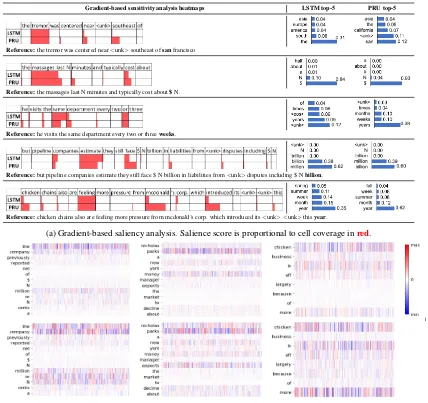
Confidence: As exemplified in Table 2a, the PRU tends toward more confident decisions, plac-ing more of the probability mass on the top next-word prediction than the LSTM. To quantify this effect, we calculate the entropy of the next-token distribution for both the PRU and the LSTM using 3687 contexts from the PTB validation set. Fig-ure3shows a histogram of the entropies of the dis-tribution, where bins of size 0.23 are used to effect categories. We see that the PRU more often pro-duces lower entropy distributions corresponding to higher confidences for next-token choices. This is evidenced by the mass of the red PRU curve lying in the lower entropy ranges compared to the blue LSTM’s curve. The PRU can produce confident decisions in part because more information is en-coded in the higher dimensional context vectors.
Variance in word embeddings: The PRU has the ability to model individual words at differ-ent resolutions through the pyramidal transform; which provides multiple paths for the gradient to the embedding layer (similar to multi-task learn-ing) and improves the flow of information. When considering the embeddings by part of speech, we find that the pyramid level 1 embeddings exhibit higher variance than the LSTM across all POS cat-egories (Figure 4), and that pyramid level 2 em-beddings show extremely low variance1. We hy-pothesize that the LSTM must encode both coarse group similarities and individual word differences into the same vector space, reducing the space be-tween individual words of the same category. The PRU can rely on the subsampled embeddings to
Figure 3: Histogram of the entropies of next-token distributions predicted by the PRU (mean 3.80) and the LSTM (mean 3.93) on the PTB validation set. Lower entropy values indicate higher confi-dence decisions, which is desirable if decisions are often correct.
Figure 4: Variance of learned word embeddings for different categories of words on the PTB valida-tion set. We compute the variance of a group of embeddings as the average squared euclidean dis-tance to their mean. Higher variance may allow for better intra-category distinctions. The PRU with pyramid levels 1 and 2 is shown.
account for coarse-grained group similarities, al-lowing for finer individual word distinctions in the embedding layer. This hypothesis is strengthened by the entropy results described above: a model which can make finer distinctions between indi-vidual words can more confidently assign proba-bility mass. A model that cannot make these dis-tinctions, such as the LSTM, must spread its prob-ability mass across a larger class of similar words.
Gradient-based analysis: Saliency analysis us-ing gradients help identify relevant words in a test sequence that contribute to the prediction (Gevrey et al., 2003;Li et al., 2016;Arras et al.,
2017). These approaches compute the relevance as the squared norm of the gradients obtained through back-propagation. Table2avisualizes the heatmaps for different sequences. PRUs, in gen-eral, give more relevance to contextual words than
LSTMs, such as southeast (sample 1), cost (sam-ple 2), face (sam(sam-ple 4), and introduced (sam(sam-ple 5), which help in making more confident deci-sions. Furthermore, when gradients during back-propagation are visualized (Selvaraju et al.,2017) (Table2b), we find that PRUs have better gradient coverage than LSTMs, suggesting PRUs use more features than LSTMs that contributes to the deci-sion. This also suggests that PRUs update more parameters at each iteration which results in faster training. Language model in (Merity et al.,2018) takes 500 and 750 epochs to converge with PRU and LSTM as a recurrent unit, respectively.
4.4 Ablation studies
In this section, we provide a systematic analysis of our design choices. Our training methodology is the same as described in Section 4.1 with the standard dropouts. For a thorough understanding of our design choices, we use a language model with a single layer of PRU and fix the size of em-bedding and hidden layers to 600. The word-level perplexities are reported on the validation sets of the PTB and the WT-2 datasets.
Pyramidal levels K and groups g: The two hyper-parameters that control the trade-off be-tween performance and number of parameters in PRUs are the number of pyramidal levelsK and groupsg. Figure5 provides a trade-off between perplexity and recurrent unit (RU) parameters2.
Variable Kand fixed g: When we increase the number of pyramidal levelsK at a fixed value of
g, the performance of the PRU drops by about 1 to 4 points while reducing the total number of recur-rent unit parameters by up to 15%. We note that the PRU withK = 4atg= 1delivers similar per-formance as the LSTM while learning about 15% fewer recurrent unit parameters.
Fixed K and variable g: When we vary the value ofgat fixed number of pyramidal levelsK, the total number of recurrent unit parameters de-creases significantly with a minimal impact on the perplexity. For example, PRUs withK = 2 and
g= 4learns 77% fewer recurrent unit parameters while its perplexity (lower is better) increases by about 12% in comparison to LSTMs. Moreover, the decrease in number of parameters at higher value of g enables PRUs to learn the representa-tions in high dimensional space with better gener-alizability (Table1).
[image:7.595.72.289.286.371.2]Gradient-based sensitivity analysis heatmaps LSTM top-5 PRU top-5
Reference:the tremor was centered near<unk>southeast ofsanfrancisco
Reference:the massages last N minutes and typically cost about$N.
Reference:he visits the same department every two or threeweeks.
Reference:but pipeline companies estimate they still face $ N billion in liabilities from<unk>disputes including $ Nbillion.
Reference:chicken chains also are feeling more pressure from mcdonald’s corp. which introduced its<unk> <unk>thisyear.
(a) Gradient-based saliency analysis. Salience score is proportional to cell coverage inred.
LSTM
PR
U
l
[image:8.595.90.518.60.463.2](b) Gradients during back-propagation for a test sequence (x-axis: dimensions of word vector, y-axis: test sequence)
Table 2: Qualitative comparison between the LSTM and the PRU: (a) Gradient-based saliency analysis along with top-5 predicted words. (b) Gradients during back-propagation. For computing the gradients for a given test sequence, the top-1 predicted word was used as thetruepredicted word. Best viewed in color.
(a) PTB (b) WT-2
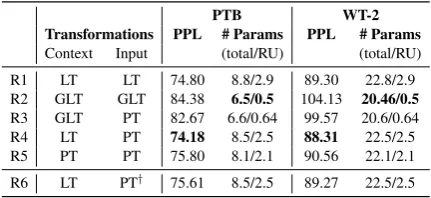
[image:8.595.85.527.550.691.2]Transformations: Table 3shows the impact of different transformations of the input vectorxtand
the context vector ht−1. We make following ob-servations: (1) Using the pyramidal transforma-tion for the input vectors improves the perplex-ity by about 1 point on both the PTB and WT-2 datasets while reducing the number of recur-rent unit parameters by about 14% (see R1 and R4). We note that the performance of the PRU drops by up to 1 point when residual connections are not used (R4 and R6). (2) Using the grouped linear transformation for context vectors reduces the total number of recurrent unit parameters by about 75% while the performance drops by about 11% (see R3 and R4). When we use the pyrami-dal transformation instead of the linear transfor-mation, the performance drops by up to 2% while there is no significant drop in the number of pa-rameters (R4 and R5).
Subsampling: We set sub-sampling kernel κ
(Eq. 3) with stride s = 2 and size of 3 (e = 1) in four different ways: (1) Skip: We skip every other element in the input vector. (2)Convolution:
We initialize the elements ofκrandomly from nor-mal distribution and learn them during training the model. We limit the output values between -1 and 1 usingtanhactivation function to make training stable. (3)Avg. pool: We initialize the elements ofκto 13. (4)Max pool: We select the maximum value in the kernel windowκ.
Table 4compares the performance of the PRU with different sampling methods. Average pooling performs the best while skipping give comparable
PTB WT-2
Transformations PPL # Params PPL # Params
Context Input (total/RU) (total/RU)
R1 LT LT 74.80 8.8/2.9 89.30 22.8/2.9 R2 GLT GLT 84.38 6.5/0.5 104.13 20.46/0.5
R3 GLT PT 82.67 6.6/0.64 99.57 20.6/0.64
R4 LT PT 74.18 8.5/2.5 88.31 22.5/2.5
R5 PT PT 75.80 8.1/2.1 90.56 22.1/2.1
R6 LT PT† 75.61 8.5/2.5 89.27 22.5/2.5
Table 3: Impact of different transformations used for processing input and context vectors (LT - lin-ear transformation, PT - pyramidal transformation, and GLT - grouped linear transformation). Here,
† represents that PT was used without residual
connection, PPL represents word-level perplexity (lower is better), and the number of parameters are in million. We usedK=g=4in our experiments.
Dataset Skip Max pool Avg. Pool Convolution
PTB 75.12 87.6 73.86 81.56
[image:9.595.73.289.546.645.2]WT-2 89.24 107.63 88.88 93.16
Table 4: Impact of different sub-sampling methods on the word-level perplexity (lower is better). We usedg=1andK=4in our experiments.
performance. Both of these methods enable the network to learn richer word representations while representing the input vector in different forms, thus delivering higher performance. Surprisingly, a convolution-based sub-sampling method does not perform as well as the averaging method. The
tanh function used after convolution limits the range of output values which are further limited by the LSTM gating structure, thereby impeding in the flow of information inside the cell. Max pooling forces the network to learn representations from high magnitude elements, thus distinguish-ing features between elements vanishes, resultdistinguish-ing in poor performance.
5 Conclusion
We introduce the Pyramidal Recurrent Unit, which better model contextual information by admitting higher dimensional representations with good gen-eralizability. When applied to the task of language modeling, PRUs improve perplexity across several settings, including recent state-of-the-art systems. Our analysis shows that the PRU improves the flow of gradient and expand the word embedding subspace, resulting in more confident decisions. Here we have shown improvements for language modeling. In future, we plan to study the perfor-mance of PRUs on different tasks, including ma-chine translation and question answering. In ad-dition, we will study the performance of the PRU on language modeling with more recent inference techniques, such as dynamic evaluation and mix-ture of softmax.
Acknowledgments
References
Leila Arras, Gr´egoire Montavon, Klaus-Robert M¨uller, and Wojciech Samek. 2017. Explaining recurrent neural network predictions in sentiment analysis. In 8th Workshop on Computational Approaches to Sub-jectivity, Sentiment and Social Media Analysis,.
James Bradbury, Stephen Merity, Caiming Xiong, and Richard Socher. 2017. Quasi-recurrent neural net-works. In International Conference for Learning Representations (ICLR).
Peter J Burt and Edward H Adelson. 1987. The lapla-cian pyramid as a compact image code. InReadings in Computer Vision. Elsevier.
V´ıctor Campos, Brendan Jou, Xavier Gir´o-i Nieto, Jordi Torres, and Shih-Fu Chang. 2018. Skip rnn: Learning to skip state updates in recurrent neural networks. InInternational Conference for Learning Representations (ICLR).
Junyoung Chung, Caglar Gulcehre, KyungHyun Cho, and Yoshua Bengio. 2014. Empirical evaluation of gated recurrent neural networks on sequence model-ing. arXiv preprint arXiv:1412.3555.
Yarin Gal and Zoubin Ghahramani. 2016. A theoret-ically grounded application of dropout in recurrent neural networks. InAdvances in neural information processing systems (NIPS).
Jonas Gehring, Michael Auli, David Grangier, Denis Yarats, and Yann N Dauphin. 2017. Convolutional sequence to sequence learning. In International Conference on Machine Learning (ICML).
Felix A Gers and J¨urgen Schmidhuber. 2000. Recur-rent nets that time and count. InIEEE-INNS-ENNS International Joint Conference on Neural Networks (IJCNN).
Muriel Gevrey, Ioannis Dimopoulos, and Sovan Lek. 2003. Review and comparison of methods to study the contribution of variables in artificial neural net-work models. Ecological modelling.
Dongyoon Han, Jiwhan Kim, and Junmo Kim. 2017. Deep pyramidal residual networks. InIEEE Confer-ence on Computer Vision and Pattern Recognition (CVPR).
Kaiming He, Xiangyu Zhang, Shaoqing Ren, and Jian Sun. 2016. Deep residual learning for image recog-nition. InIEEE conference on computer vision and pattern recognition (CVPR).
Sepp Hochreiter and Jrgen Schmidhuber. 1997. Long short-term memory.Neural computation.
Hakan Inan, Khashayar Khosravi, and Richard Socher. 2017. Tying word vectors and word classifiers: A loss framework for language modeling. In Inter-national Conference for Learning Representations (ICLR).
Yoon Kim, Yacine Jernite, David Sontag, and Alexan-der M Rush. 2016. Character-aware neural language models. InAssociation for the Advancement of Ar-tificial Intelligence (AAAI).
Diederik P Kingma, Tim Salimans, and Max Welling. 2015. Variational dropout and the local reparame-terization trick. InAdvances in Neural Information Processing Systems (NIPS).
Ben Krause, Emmanuel Kahembwe, Iain Murray, and Steve Renals. 2018. Dynamic evaluation of neural sequence models. In International Conference on Machine Learning (ICML).
Alex Krizhevsky, Ilya Sutskever, and Geoffrey E Hin-ton. 2012. Imagenet classification with deep con-volutional neural networks. In Advances in neural information processing systems (NIPS).
Oleksii Kuchaiev and Boris Ginsburg. 2017. Factoriza-tion tricks for lstm networks. InInternational Con-ference for Learning Representations (ICLR) Work-shop.
Yann LeCun, Yoshua Bengio, et al. 1995. Convolu-tional networks for images, speech, and time series. The handbook of brain theory and neural networks.
Kenton Lee, Omer Levy, and Luke Zettlemoyer. 2017. Recurrent additive networks. arXiv preprint arXiv:1705.07393.
Tao Lei, Yu Zhang, and Yoav Artzi. 2018. Training rnns as fast as cnns. InEmpirical Methods in Natu-ral Language Processing (EMNLP).
Jiwei Li, Xinlei Chen, Eduard Hovy, and Dan Jurafsky. 2016. Visualizing and understanding neural models in nlp. InNorth American Chapter of the Associa-tion for ComputaAssocia-tional Linguistics (NAACL).
David G Lowe. 1999. Object recognition from local scale-invariant features. InIEEE international con-ference on Computer vision (ICCV).
Mitchell P Marcus, Mary Ann Marcinkiewicz, and Beatrice Santorini. 1993. Building a large annotated corpus of english: The penn treebank. Computa-tional linguistics.
Sachin Mehta, Mohammad Rastegari, Anat Caspi, Linda Shapiro, and Hannaneh Hajishirzi. 2018. Esp-net: Efficient spatial pyramid of dilated convolutions for semantic segmentation. InEuropean Conference in Computer Vision (ECCV).
G´abor Melis, Chris Dyer, and Phil Blunsom. 2018. On the state of the art of evaluation in neural language models. In International Conference for Learning Representations (ICLR).
Stephen Merity, Caiming Xiong, James Bradbury, and Richard Socher. 2017. Pointer sentinel mixture models. In International Conference for Learning Representations (ICLR).
Tom´aˇs Mikolov, Martin Karafi´at, Luk´aˇs Burget, Jan ˇ
Cernock`y, and Sanjeev Khudanpur. 2010. Recur-rent neural network based language model. In Eleventh Annual Conference of the International Speech Communication Association.
Ramprasaath R Selvaraju, Michael Cogswell, Ab-hishek Das, Ramakrishna Vedantam, Devi Parikh, and Dhruv Batra. 2017. Grad-cam: Visual explana-tions from deep networks via gradient-based local-ization. InIEEE International Conference on Com-puter Vision (ICCV).
Minjoon Seo, Sewon Min, Ali Farhadi, and Hannaneh Hajishirzi. 2017. Query-reduction networks for question answering. InInternational Conference on Learning Representations (ICLR).
Minjoon Seo, Sewon Min, Ali Farhadi, and Hannaneh Hajishirzi. 2018. Neural speed reading via skim-rnn. InInternational Conference on Learning Rep-resentations (ICLR).
Nitish Srivastava, Geoffrey Hinton, Alex Krizhevsky, Ilya Sutskever, and Ruslan Salakhutdinov. 2014. Dropout: A simple way to prevent neural networks from overfitting. The Journal of Machine Learning Research (JMLR).
Chen Xu, Jianqiang Yao, Zhouchen Lin, Wenwu Ou, Yuanbin Cao, Zhirong Wang, and Hongbin Zha. 2018. Alternating multi-bit quantization for recur-rent neural networks. In International Conference for Learning Representations (ICLR).
Zhilin Yang, Zihang Dai, Ruslan Salakhutdinov, and William W Cohen. 2018. Breaking the softmax bot-tleneck: a high-rank rnn language model. In Inter-national Conference for Learning Representations (ICLR).
Adams Wei Yu, Hongrae Lee, and Quoc Le. 2017. Learning to skim text. InAssociation for Compu-tational Linguistics (ACL).
Julian Georg Zilly, Rupesh Kumar Srivastava, Jan Koutn´ık, and J¨urgen Schmidhuber. 2016. Recurrent highway networks. arXiv preprint arXiv:1607.03474.