Proceedings of the 9th International Workshop on Health Text Mining and Information Analysis (LOUHI 2018), pages 193–203 193
Evaluation of a Sequence Tagging Tool for Biomedical Texts
Julien Tourille1,6, Matthieu Doutreligne1,2, Olivier Ferret3,
Nicolas Paris1,2,4, Aur´elie N´ev´eol1, Xavier Tannier4,5
1LIMSI, CNRS, Universit´e Paris-Saclay,2WIND-DSI, AP-HP,3CEA, LIST,
4Sorbonne Universit´e,5Inserm, LIMICS,6Univ. Paris-Sud
{julien.tourille,matthieu.doutreligne,aurelie.neveol}@limsi.fr, [email protected], [email protected],
Abstract
Many applications in biomedical natural lan-guage processing rely on sequence tagging as an initial step to perform more complex analy-sis. To support text analysis in the biomedical domain, we introduce Yet Another SEquence Tagger (YASET), an open-source multi pur-pose sequence tagger that implements state-of-the-art deep learning algorithms for sequence tagging. Herein, we evaluate YASET on part-of-speech tagging and named entity recogni-tion in a variety of text genres including ar-ticles from the biomedical literature in En-glish and clinical narratives in French. To further characterize performance, we report distributions over 30 runs and different sizes of training datasets. YASET provides state-of-the-art performance on the CoNLL 2003 NER dataset (F1=0.87), MEDPOST corpus (F1=0.97), MERLoT corpus (F1=0.99) and NCBI disease corpus (F1=0.81). We believe that YASET is a versatile and efficient tool that can be used for sequence tagging in biomedi-cal and clinibiomedi-cal texts.
1 Introduction
Many applications in biomedical Natural Lan-guage Processing (NLP), including relation ex-traction or text classification, rely on sequence tag-ging as an initial step to perform more complex analysis. To support text analysis in the biomed-ical domain, we present Yet Another SEquence Tagger (YASET), an open-source multi-purpose sequence tagger written in Python. YASET aims at providing NLP researchers with fast and accurate implementations of cutting-edge deep learning se-quence tagging models. YASET is built using Ten-sorFlow (Abadi et al.,2015), an open source soft-ware library for numerical computation. The code is licensed under the version 3 of the GNU
Gen-eral Public License1 and is freely available on-line2. The main contributions of this work are:
• a fast and accurate implementation of a state-of-the-art sequence tagging model based on Long Short-Term Memory Net-works (LSTMs) (Hochreiter and Schmidhu-ber,1997). The architecture is similar to the one described inLample et al.(2016) and is able to process mini-batches for faster train-ing. Furthermore, YASET supports the use of handcrafted features in combination with word and character embeddings;
• an easy-to-use interface based on a central configuration file that is used to setup exper-iments, with default parameters that are suit-able for most sequence tagging tasks;
• an evaluation on various biomedical corpora and on the CoNLL 2003 corpus, studying the stability of our model and the effect of train-ing data size. We compare YASET perfor-mance with state-of-the-art results published in the literature.
2 Related Work
Several open-source implementations for se-quence tagging based on neural network architec-tures have become available over the last years. Lample et al.(2016) provide a Python implemen-tation3 for the two models presented in their pa-per. They are implemented with Theano (Al-Rfou et al.,2016), a Python library for deep learning.
1https://www.gnu.org/licenses/gpl-3.0.
en.html
2https://github.com/jtourille/yaset 3
NeuroNER4 (Dernoncourt et al., 2017) targets non-expert users and is based on Lample’s Bi-LSTM model. The authors intended to make the tool easy to use by providing automatic format conversion from the brat format (Stenetorp et al., 2012) to the input format and from the output for-mat to the brat forfor-mat. The tool produces sev-eral plots during training for performance analy-sis. It is implemented in Python and makes use of the TensorFlow library. Both implementations of the Bi-LSTM model suffer from a very long training time which makes them cumbersome to use. YASET offers a faster implementation of the model by allowing mini-batch training and by us-ing the pipeline API of TensorFlow.
Rei and Yannakoudakis (2016) released a Python implementation5 of different models pre-sented in their works (Rei and Yannakoudakis, 2016;Rei et al.,2016;Rei,2017). One major dif-ference with YASET resides in the possibility to use a language modeling objective during training. Recently, Yang and Zhang (2018) introduced NCRF++6, a tool presented as the neural ver-sion of CRF++7 and implemented with Py-Torch (Paszke et al.,2017). The tool is very close to YASET, with the possibility to define hand-crafted word features and to performnbest decod-ing.
Another type of neural network model, based on Convolutional Neural Networks (CNNs) for character level representation, is presented in Ma and Hovy (2016). The authors implemented the architecture with PyTorch. The code is freely available online8. The same type of architecture is implemented in the tool released by Reimers and Gurevych (2017). It is implemented with Keras (Chollet et al.,2015) and is freely available online9.
Outside the peer-reviewed scientific environ-ment, many other implementations are freely available online. However, we will not review them in this paper.
4https://github.com/
Franck-Dernoncourt/NeuroNER
5
https://github.com/marekrei/ sequence-labeler
6
https://github.com/jiesutd/NCRFpp
7https://taku910.github.io/crfpp 8https://github.com/XuezheMax/
NeuroNLP2
9
https://github.com/UKPLab/ emnlp2017-bilstm-cnn-crf
3 Neural Network Model
There is currently one neural network model im-plemented in YASET. This model is mostly based on Lample et al. (2016). However, similar ar-chitectures are presented in other work (Collobert et al., 2011; Ma and Hovy, 2016; Rei and Yan-nakoudakis,2016;Rei et al.,2016). Other network architectures will be implemented in the future.
3.1 Main Component
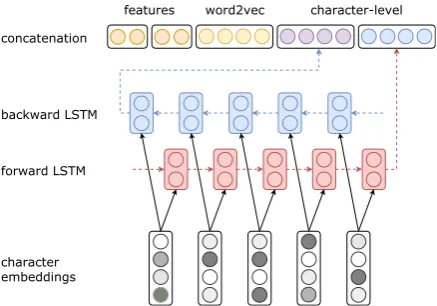
Our approach relies on LSTMs. The architecture of our model is presented in Figure1. For a given sequence of tokens, represented as vectors, we compute representations of left and right contexts of the sequence at every token. These represen-tations are computed using two LSTMs (forward and backward LSTM in Figure1).
Figure 1: YASET neural network architecture overview. The example is extracted from the THYME corpus (Styler IV et al.,2014) used during the shared tasks Clinical TempEval (Bethard et al.,2015, 2016,
2017). One of the objectives was to extract medical events. In the example, the eventSurgeryis marked as a medical event with the typeN/A.
These representations are concatenated and passed through atanhactivation layer whose size is equal to the size of the concatenated vector.
3.2 Input Embeddings
Vectors representing tokens are built by concate-nating a character-based embedding, a word em-bedding and one emem-bedding per feature.
[image:3.595.72.291.321.474.2]An overview of the embedding computation is presented in Figure 2. Following Lample et al. (2016), the character-based representation is com-puted with a Bi-LSTM whose parameters are de-fined by users. First, a random embedding is generated for every character in the training cor-pus. Token characters are then processed with a forward and backward LSTM architecture. The final character-based representation results from the concatenation of the forward and backward representations. The character-based representa-tion is then concatenated to a pre-trained word-embedding and one word-embedding per feature. We apply dropout on the final input embedding.
Figure 2: YASET input embedding computation overview. Embeddings result from the concatenation of a pre-trained word embedding, a character-level rep-resentation of the token and one embedding per cate-gorical feature.
4 Tool Overview
In this section, we present a general overview of YASET. First we describe input data formats (se-quences and pre-trained word embeddings). Then we present the input pipeline, the network training phase, the implemented evaluation metrics and the management of its parameters.
4.1 Input and Output Data
YASET takes CoNLL-like10formatted files as in-put. Sequences are separated by empty lines and there must be one token per line. For each token,
10http://universaldependencies.org/
docs/format.html
the first and last columns are reserved namely for the token itself and the token label. Each token must have a label.
Users can add several categorical features. Fea-ture columns must be specified in the configura-tion file by providing their indexes. Besides the first and last columns, and the feature columns, users can add other columns. They will be ignored by the system.
YASET can take training and development files as input but can also create development instances if there is no development file provided by users. In this case, users can specify the train/dev split ra-tio and may specify a random seed for experiment reproducibility.
Train and development instances consistency is checked upon startup. Each label and feature val-ues from the development instances must appear in the train instances. An example of YASET in-put file format is presented in Figure3.
In prediction mode, test data is supplied in the same format, without the token label column, which will be added with the predicted labels.
...
Lien NNP I-NP I-PER . . O O
China NNP I-NP I-LOC says VBZ I-VP O time NN I-NP O right RB I-ADVP O for IN I-PP O
Taiwan NNP I-NP I-LOC talks NNS I-NP O . . O O
BEIJING VBG I-VP I-LOC 1996-08-22 CD I-NP O ...
Figure 3: Example extracted from the CoNLL 2003 shared task corpus (Sang and Meulder,2003). For each token (col. #1), there is a label (col. #4, IOB format) and two categorical features (cols. #2 and #3), the part-of-speech tagand achunk label(IOB format).
4.2 Word Embeddings
Out Of Vocabulary (OOV) tokens can be ad-dressed by two strategies. In the first one, users provide a vector for OOV tokens. In this case, the vector is expected to be part of the provided word embedding matrix and users must specify the vector ID. In the second strategy, we follow the methodology described in Lample et al. (2016). We insert a randomly initialized vector in the em-bedding matrix that will be used for OOV tokens. Then we replace singletons in the training corpus by the OOV token with a probability ofp, which is defined by users. Word embeddings can be fine-tuned during training in both cases by setting the appropriate flag totruein the configuration file.
4.3 Input Pipeline
Minimizing the memory footprint was one of the core objectives during the development of the tool. YASET leverages the pipeline API of TensorFlow to build a lightweight and fast input pipeline. In-put instances are stored in the binary TensorFlow format. This avoids the need to store the whole dataset in memory. Mini-batches are extracted randomly and fed to the network.
Training instances can be bucketized according to their lengths. This possibility can speedup train-ing with large corpora. Buckets boundaries are automatically computed. To assert effective ran-domization during training, buckets will contain enough instances for several mini-batches.
4.4 Neural Network Training
YASET alternates between two phases during training. In theiteration phase, mini-batches are extracted from the input pipeline and fed to the neural network model. Optimization is performed according to the parameters set by users in the con-figuration file.
At the end of each iteration, YASET enters the
evaluation phasewhere the current model state is used to make predictions on the development in-stances. The performance score is logged for fur-ther analysis and a snapshot of the model is kept if the performance score is the best obtained so far on the development instances. Since model snap-shots can take a lot of memory, we only keep the best one, i.e. the one that performs best on the de-velopment instances.
Network training is performed via back-propagation. Users can select the neural network model architecture (only one available for now),
the maximum number of iterationsnand the pa-tience criterion p. Training will stop if the max-imum numbern is reached or if there are p iter-ations without performance improvement on the development instances.
Users can also set several parameters related to the learning algorithm such as the initial learning rate, and gradient clipping and exponential decay factors. Finally, users can select the mini-batch size, the number of CPU cores to use and the eval-uation metric.
Another set of parameters are related to the neu-ral network model. These parameters allow to se-lect the dropout rate and the different hidden layer and embedding sizes.
4.5 Metrics
Model performance is measured on the develop-ment instances at the end of each iteration. Two metrics are currently implemented in YASET: ac-curacyandCoNLL. The former measures the frac-tion of correctly predicted labels among all the predicted labels. The latter is an entity-based met-ric which outputs precision, recall and F1-measure scores. Precision measures the fraction of cor-rectly predicted entities among all predicted enti-ties. Recall assesses the fraction of correctly pre-dicted entities among all the entities that should have been detected. F1-measure is the harmonic mean of precision and recall. The implementa-tion of the CoNLL metric is inspired by the of-ficial evaluation script used during the CoNLL-2003 shared task (Sang and Meulder, 2003) and by the Python portage of the script by Sampo Pyysalo11. In the case of performance evaluation with the CoNLL metric, token labels must follow either the IOB, IOBE or IOBES tagging scheme12.
4.6 Parameters
YASET parameters are fully customizable and centralized in one configuration file which is used to setup experiments. YASET also targets end-users from a broader community by providing hy-perparameter value suggestions and insights on how to choose them for various sequence-tagging situations.
11https://github.com/spyysalo/
conlleval.py
5 Experiments
We demonstrate the performance of YASET by applying the model to four different corpora se-lected to cover a variety of languages, text gen-res, sequence types and annotation densities. We focus our effort on biomedical texts, using Med-Post (Smith et al., 2004), a corpus of biomedi-cal abstracts annotated with Part-of-Speech (PoS) tags, the NCBI Disease corpus (Islamaj Do-gan and Lu, 2012), a dataset of biomedical ab-stracts annotated with disease related entities and MERLoT (Campillos et al., 2018), a corpus of clinical documents written in French which were annotated with two different Named Entity Recog-nition (NER) tag sets (Protected Health Informa-tion (PHI) and biomedical entities).
We also apply YASET on the CoNLL 2003 En-glish NER corpus (Sang and Meulder, 2003), a classic benchmark corpus for NER in the general domain.
5.1 Presentation of the Corpora
We use the corpus partition provided with the dataset distributions when available. For NCBI and CoNLL 2003, models are trained on the train sets and evaluated on the test sets while the devel-opment sets are used to determine early stopping. For MERLoT and MedPost, partition details are outlined below. The code used to preprocess and analyze the corpora is available online13.
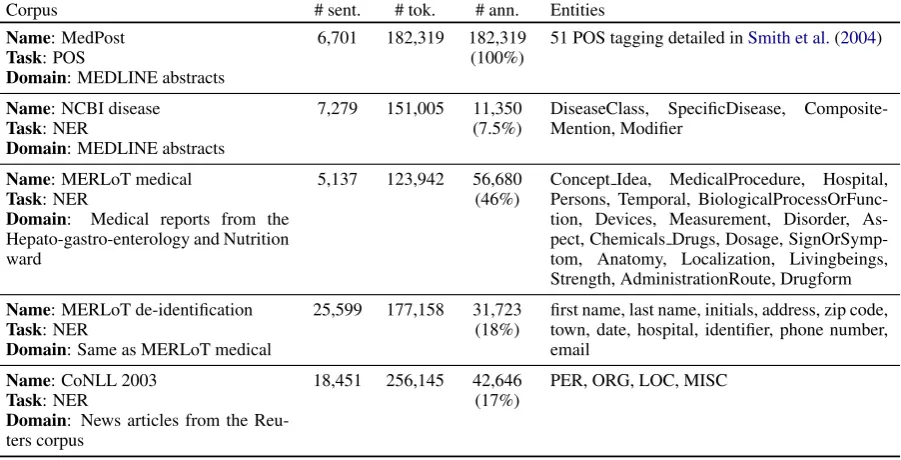
The MedPost corpus is a collection of tok-enized MEDLINE abstracts annotated with PoS tags. It contains 6,701 sentences (≈182,000 to-kens). The corpus is divided in 13 files of differ-ent sizes, from which we extracted one file to serve as development set (tag mb.ioc). The tag set con-tains originally 63 unique entities that we grouped in a coarser set of 51 entities. Grouping affected punctuation signs, which were assigned a unique PUNCT tag.
The NCBI corpuscontains 793 MEDLINE ab-stracts with 11,350 annotations of diseases and disease modifiers. There are 4 different entities. Train and development sets contain 6,594 sen-tences (≈151,000 tokens).
MERLoTis a French clinical corpus with sev-eral levels of annotations. It contains 500 med-ical reports with a total of 25,087 sentences (≈177,000 tokens). We used it for two tasks. The
13
https://github.com/strayMat/ bio-medical_ner
first one is de-identification with a tag set com-prising 11 types of PHI (e.g.names, dates). The second one is medical NER with 19 entity classes (e.g.anatomy,disorder).
The medical entity annotations include nested entities. Because this study aims to experiment on a variety of datasets using the same model, we did not attempt to extract several levels of nested entities. When nested entities occur, our experi-ments only addressed the outer layer correspond-ing to the largest entity. For example, the mention “cancer du sein” (breast cancer) was originally annotated with one DISORDER entity (cancer du sein, breast cancer) and one ANATOMY entity (sein,breast). Nested entity removal reduced the annotations to only one tag per token and in this case, the DISORDER annotation was kept while the ANATOMY annotation was removed. In to-tal, 5,218 entities (8.4% of the complete set) were pruned. For our experiments, we also removed the headers and footers of the documents, which were not available to annotators working towards the gold standard and could cause ambiguities with some entity classes (e.g. person or hospi-tal). This results in a smaller corpus, compared to the corpus used for de-identification experiments (≈123,000 tokens).
The CoNLL 2003 corpusis a common dataset for evaluating NER algorithms. It is based on the Reuters corpus (Lewis et al.,2004) and is the only dataset outside the biomedical domain used in our experiments. The training and development set together contain 18,451 sentences (≈256,000 to-kens) annotated with 4 unique entities.
A detailed overview of the corpus characteris-tics is available in Table1.
5.2 Experimental Setup
In this section, we present the experimental setup used for our experiments. First, we describe how we selected the hyper-parameters. Then, we detail the pre-trained word embeddings that were used in this work. Finally, we present the neural network training parameters.
5.2.1 Hyper-parameter Selection
We used Hyperopt14(Bergstra et al.,2011,2013) to select a set of hyper-parameters that performed well on the MERLoT de-identification dataset. Due to heavy computation times, we re-used this
Corpus # sent. # tok. # ann. Entities
Name: MedPost
Task: POS
Domain: MEDLINE abstracts
6,701 182,319 182,319 (100%)
51 POS tagging detailed inSmith et al.(2004)
Name: NCBI disease
Task: NER
Domain: MEDLINE abstracts
7,279 151,005 11,350 (7.5%)
DiseaseClass, SpecificDisease, Composite-Mention, Modifier
Name: MERLoT medical
Task: NER
Domain: Medical reports from the Hepato-gastro-enterology and Nutrition ward
5,137 123,942 56,680 (46%)
Concept Idea, MedicalProcedure, Hospital, Persons, Temporal, BiologicalProcessOrFunc-tion, Devices, Measurement, Disorder, As-pect, Chemicals Drugs, Dosage, SignOrSymp-tom, Anatomy, Localization, Livingbeings, Strength, AdministrationRoute, Drugform
Name: MERLoT de-identification
Task: NER
Domain: Same as MERLoT medical
25,599 177,158 31,723 (18%)
first name, last name, initials, address, zip code, town, date, hospital, identifier, phone number, email
Name: CoNLL 2003
Task: NER
Domain: News articles from the Reu-ters corpus
18,451 256,145 42,646 (17%)
[image:6.595.75.526.62.292.2]PER, ORG, LOC, MISC
Table 1: Overview of the corpora. The number of annotations corresponds to the number of annotated tokens to be comparable to the size of the corpus measured in number of tokens
set of hyper-parameters on the other datasets. Pa-rameter search space includes the number of units of the character Bi-LSTM, the number of units of the main Bi-LSTM, the dimension of the char-acter embeddings and the dropout rate. The re-tained setup uses character embeddings of size 24, 32 units for the character-level Bi-LSTM, 64 units for the main Bi-LSTM and a dropout rate of 0.5.
5.2.2 Embeddings
Pre-trained word embeddings were shown to boost the performance in various NLP tasks (Collobert et al.,2011;Mikolov et al.,2013a) and specifically in NER (Lample et al., 2016;Dernoncourt et al., 2017).
For each corpus, we used pre-trained word em-beddings created with datasets that were consis-tent in genre and domain with the corpora used in this work. All word embedding models were computed using word2vec. For CoNLL 2003, we trained a model on Google News. For NCBI dis-ease and MedPost, which both comprise abstracts from biomedical articles, we trained a model on the PubMed corpus. For MERLoT, we trained a model on the corpus from which MERLoT is ex-tracted. It contains about 138,000 clinical notes written in French (Campillos et al.,2018).
For each of these word vector models, we com-puted low-dimensional representations by apply-ing Principal Component Analysis (PCA) on the original high-dimensional word vectors (300
di-mensions). During hyper-parameter search, we varied the dimension of the word embeddings and observed important impacts on the performance (up to 2.5 points of F1). We finally picked word vectors of dimension 25 (reduced by PCA), which showed to be the most efficient. This choice im-proved the scores as well as diminished drastically the computation times.
We also ran a few experiments using Fast-Text (Bojanowski et al., 2017) embeddings trained on Wikipedia. Preliminary results on CoNLL 2003 show a major performance improve-ment. An analysis of the impact of the word em-bedding model on performance will be conducted in following work.
5.2.3 Training
In all our experiments, the network was trained us-ing the Adam optimizer (Kus-ingma and Ba, 2015) with an initial learning rate of 0.001. Early-stopping was set to 10 epochs.
6 Results
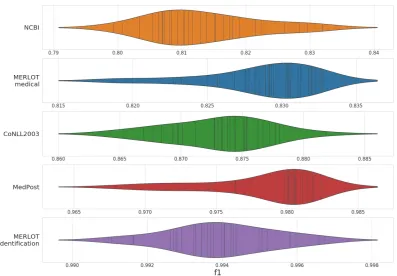
Figure 4: Distributions of F1 scores for the four corpora over 30 trainings for each corpus. Vertical lines refer to each sample. The scales are specific to each dataset for a proper visualization of each distribution.
6.1 Corpus Specific Results
Reimers and Gurevych (2017) report that neu-ral network model training is highly non-deterministic and is subject to the random seed choice. Because of this variability during the train-ing phase, it is crucial to report results on numer-ous trainings. Therefore we ran 30 experiments for each task presented in this work. We report F1-score statistics in Table2. We also plot F1-score distributions for each task in Figure4.
Our experiments show that performance varies across datasets, reflecting the heterogeneous diffi-culties of the tasks, inherent to the nature of the labels and the quality of the annotations. We no-tice that the standard deviations are similar for all NER tasks. It suggests that the variability of the score is independent from the task and mainly due to the model architecture. Previous work perfor-mances are reported in Table3for every dataset.
[image:7.595.86.484.67.343.2]Task Dataset Mean F1 σ Max. Diff. NER NCBI disease 81.33 0.83 3.27 (4.1%) NER MERLoT medical 82.87 0.36 1.40 (1.7%) NER CoNLL 2003 87.31 0.41 1.76 (2.0%) POS MedPost 97.83 0.39 1.44 (1.5%) NER MERLoT de-identification 99.40 0.14 0.568 (0.57%)
Table 2: Performance (%) of YASET on the 4 datasets.
Although our model does not show state-of-the-art performances for all of them, it obtains competi-tive results, demonstrating the generalization abil-ity of the selected shared set of hyper-parameters and embeddings.
Dataset Model F1
NCBI
Dang et al.(2018) 84.41
Islamaj Dogan and Lu(2012) 81.80
This paper 81.33
MERLoT med.a Campillos et al.(2018) 81.40
This paper 82.87
CoNLL 2003
Lample et al.(2016) 90.94
Ma and Hovy(2016) 91.21
Yang and Zhang(2018) 91.35
Peters et al.(2018) 92.22
This paper 87.31
MedPosta Smith et al.(2004) 97.43
This paper 97.83
MERLoT PHI Grouin and N´ev´eol(2014) 94.00
This paper 99.40
aCorpora where the experimental set-up differed between
[image:7.595.306.526.478.657.2]our experiments and that of prior work. For MEDPOST, we used 51 categories instead of 63; for MERLoT med. we removed nested entities.
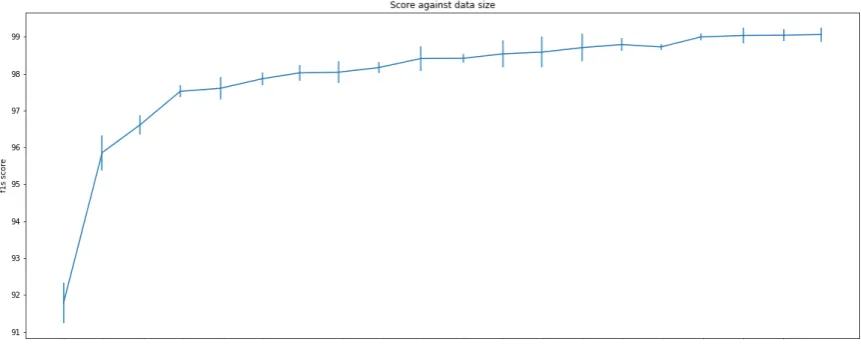
Figure 5: Effect of the training set size on the F1 score for the MERLoT dataset with de-identification annotations. These scores are computed over 6 training iterations per chunk. Vertical bars show the standard deviationσ.
6.2 Performance According to Training Data Size
The development of a labeled dataset for training annotation models is often a heavy investment in time and resources. Having some insight on the performance of the model for different training data sizes is crucial. Thus, we investigate the im-pact of this parameter on model performance. Fo-cusing on the de-identification task of MERLoT, we split the training set into 20 subsets of equal sizes. Then, we built sub-training sets of grow-ing size, that we refer aschunks. This resulted in 20 chunks where small chunks are subsets of the bigger one. Finally, we train YASET 6 times on each chunk, measuring how the performance im-proves with the size of the chunks. Figure5shows the progression of the F1-score according to the number of tokens. Table4presents the model per-formance according to the dataset size.
Dataset 5% 10% 25% 50% 100%
MERLoT PHI 91.79 (0.55)
95.86 (0.47)
97.60 (0.30)
98.41 (0.33)
99.06 (0.19)
Table 4: Performance (F1) against train set size (as per-centage of the total training set indicated on the first row). Standard errors appear between parentheses.
We observe that the performance improves log-arithmically with every chunk added in the train-ing data as shown in Table4. This finding is sim-ilar to the observation ofSun et al.(2017) for vi-sion tasks. Further addition of data will slightly improve the performance as the maximum perfor-mance plateau is almost reached.
7 Conclusion and Future work
We propose an easy-to-use annotation tool im-plementing a state-of-the-art Bi-LSTM-CRF neu-ral architecture. We apply the tool to PoS tag-ging and NER on clinical, biomedical and gen-eral domain texts. By running multiple experi-ment for each dataset, we confirm previous obser-vations that neural network training is highly non-deterministic and dependent on the random seed choice.
Although we did not search for optimal hyper-parameters for each task, we obtain high perfor-mance in all our experiments, suggesting that tai-loring hyper-parameters for a specific task im-proves only lightly the performance of the model and the neural network architecture implemented in YASET is robust with regards to the perfor-mance obtained.
Concerning the impact of the training dataset size on model performance, we confirm the intu-ition that adding more data allows to improve the performance of neural network models. However, result analysis suggests that the growth is logarith-mic with the training data size.
non-overlapping clinical entities at each layer.Ju et al. (2018) present a dynamic end-to-end neural net-work model capable of handling an undetermined number of nesting levels. Katiyar and Cardie (2018) model the task as an hypergraph whose structure is learned with an LSTM network.
Future research will focus on the influence of word embedding models which were shown to sig-nificantly impact on performance. Specifically, models taking into account sub-token informa-tion (Bojanowski et al.,2017) or emphasizing con-text (Peters et al., 2018) should be further ex-plored. Moreover, other neural network models for NER such as the ones proposed by Rei et al. (2016) and Ma and Hovy(2016) will be investi-gated and implemented in YASET. Having a cen-tralized implementation of different NER models will allow us to compare their performances on various corpora.
Acknowledgements
The authors thank the Biomedical Informatics De-partment at the Rouen University Hospital for providing access to the LERUDI corpus for this work. This work was supported in part by the French National Agency for Research under grant CABeRneT ANR-13-JS02-0009-01 and by Labex Digicosme, operated by the Foundation for Scien-tific Cooperation (FSC) Paris-Saclay, under grant C ˆOT.
References
Mart´ın Abadi, Ashish Agarwal, Paul Barham, et al. 2015. TensorFlow: Large-Scale Machine Learning on Heterogeneous Systems.
Rami Al-Rfou, Guillaume Alain, Amjad Almahairi, et al. 2016. Theano: A Python framework for fast computation of mathematical expressions. CoRR.
James Bergstra, Daniel Yamins, and David Cox. 2013. Making a Science of Model Search: Hyperparame-ter Optimization in Hundreds of Dimensions for Vi-sion Architectures. In Proceedings of the 30th In-ternational Conference on Machine Learning, pages 115–123.
James S. Bergstra, R´emi Bardenet, Yoshua Bengio, and Bal´azs K´egl. 2011. Algorithms for Hyper-Parameter Optimization. In Advances in Neural Information Processing Systems 24, pages 2546–2554.
Steven Bethard, Leon Derczynski, Guergana Savova, James Pustejovsky, and Marc Verhagen. 2015.
SemEval-2015 Task 6: Clinical TempEval. In Pro-ceedings of the 9th International Workshop on Se-mantic Evaluation, pages 806–814. Association for Computational Linguistics.
Steven Bethard, Guergana Savova, Wei-Te Chen, et al. 2016. SemEval-2016 Task 12: Clinical TempEval. In Proceedings of the 10th International Workshop on Semantic Evaluation, pages 1052–1062. Associ-ation for ComputAssoci-ational Linguistics.
Steven Bethard, Guergana Savova, Martha Palmer, and James Pustejovsky. 2017. SemEval-2017 Task 12: Clinical TempEval. In Proceedings of the 11th International Workshop on Semantic Evalua-tion, pages 565–572. Association for Computational Linguistics.
Piotr Bojanowski, Edouard Grave, Armand Joulin, and Tomas Mikolov. 2017. Enriching Word Vectors with Subword Information. Transactions of the Associa-tion of ComputaAssocia-tional Linguistics, 5:135–146.
Leonardo Campillos, Louise Del´eger, Cyril Grouin, et al. 2018. A French Clinical Corpus with Com-prehensive Semantic Annotations: Development of the Medical Entity and Relation LIMSI annOtated Text corpus (MERLOT). Language Resources and Evaluation, 52(2):571–601.
Franc¸ois Chollet et al. 2015. Keras. https:// github.com/fchollet/keras.
Ronan Collobert, Jason Weston, L´eon Bottou, et al. 2011. Natural Language Processing (Almost) from Scratch. Journal of Machine Learning Research, 12:2493–2537.
Thanh Hai Dang, Hoang-Quynh Le, Trang M Nguyen, and Sinh T Vu. 2018. D3NER: biomedical named entity recognition using CRF-biLSTM improved with fine-tuned embeddings of various linguistic in-formation.Bioinformatics.
Franck Dernoncourt, Ji Young Lee, ¨Ozlem Uzuner, and Peter Szolovits. 2017. De-identification of Patient Notes with Recurrent Neural Networks. Journal of the American Medical Informatics Association, 24(3):596–606.
Cyril Grouin and Aur´elie N´ev´eol. 2014. De-identification of clinical notes in French: towards a protocol for reference corpus development. Journal of Biomedical Informatics, 50:151–161.
Sepp Hochreiter and J¨urgen Schmidhuber. 1997. Long Short-Term Memory. Neural Computation, 9(8):1735–1780.
Meizhi Ju, Makoto Miwa, and Sophia Ananiadou. 2018. A Neural Layered Model for Nested Named Entity Recognition. In Proceedings of the 2018 Conference of the North American Chapter of the Association for Computational Linguistics: Human Language Technologies, pages 1446–1459. Associ-ation for ComputAssoci-ational Linguistics.
Arzoo Katiyar and Claire Cardie. 2018. Nested Named Entity Recognition Revisited. InProceedings of the 2018 Conference of the North American Chapter of the Association for Computational Linguistics: Hu-man Language Technologies, pages 861–871. Asso-ciation for Computational Linguistics.
Diederik P. Kingma and Jimmy Ba. 2015. Adam: A Method for Stochastic Optimization. In Proceed-ings of the 3rd International Conference on Learn-ing Representations.
Guillaume Lample, Miguel Ballesteros, Sandeep Sub-ramanian, Kazuya Kawakami, and Chris Dyer. 2016. Neural Architectures for Named Entity Recognition. InProceedings of the 2016 Conference of the North American Chapter of the Association for Computa-tional Linguistics: Human Language Technologies, pages 260–270. Association for Computational Lin-guistics.
David D. Lewis, Yiming Yang, Tony G. Rose, and Fan Li. 2004. RCV1: A New Benchmark Collection for Text Categorization Research. Journal of Machine Learning Research, 5:361–397.
Xuezhe Ma and Eduard Hovy. 2016. End-to-end Se-quence Labeling via Bi-directional LSTM-CNNs-CRF. In Proceedings of the 54th Annual Meet-ing of the Association for Computational LMeet-inguis- Linguis-tics, pages 1064–1074. Association for Computa-tional Linguistics.
Tomas Mikolov, Kai Chen, Greg Corrado, and Jeffrey Dean. 2013a. Efficient Estimation of Word Repre-sentations in Vector Space. CoRR, abs/1301.3781.
Tomas Mikolov, Ilya Sutskever, Kai Chen, Greg S. Cor-rado, and Jeff Dean. 2013b. Distributed Representa-tions of Words and Phrases and their Composition-ality. InAdvances in Neural Information Processing Systems 26, pages 3111–3119.
Adam Paszke, Sam Gross, Soumith Chintala, et al. 2017. Automatic differentiation in PyTorch. In NIPS-W.
Jeffrey Pennington, Richard Socher, and Christo-pher D. Manning. 2014. GloVe: Global Vectors for Word Representation. In Proceedings of the 14th Conference of the European Chapter of the Asso-ciation for Computational Linguistics, pages 1532– 1543. Association for Computational Linguistics.
Matthew Peters, Mark Neumann, Mohit Iyyer, et al. 2018. Deep Contextualized Word Representations. InProceedings of the 2018 Conference of the North
American Chapter of the Association for Compu-tational Linguistics: Human Language Technolo-gies, pages 2227–2237. Association for Computa-tional Linguistics.
Radim ˇReh˚uˇrek and Petr Sojka. 2010. Software Frame-work for Topic Modelling with Large Corpora. In Proceedings of the LREC 2010 Workshop on New Challenges for NLP Frameworks, pages 45–50. Eu-ropean Language Resources Association.
Marek Rei. 2017. Semi-supervised Multitask Learning for Sequence Labeling. InProceedings of the 55th Conference of the Association for Computational Linguistics, pages 2121–2130. Association for Com-putational Linguistics.
Marek Rei, Gamal Crichton, and Sampo Pyysalo. 2016. Attending to Characters in Neural Sequence La-beling Models. In Proceedings of the 26th Inter-national Conference on Computational Linguistics, pages 309–318.
Marek Rei and Helen Yannakoudakis. 2016. Com-positional Sequence Labeling Models for Error De-tection in Learner Writing. In Proceedings of the 54th Annual Meeting of the Association for Compu-tational Linguistics, pages 1181–1191. Association for Computational Linguistics.
Nils Reimers and Iryna Gurevych. 2017. Reporting Score Distributions Makes a Difference: Perfor-mance Study of LSTM-networks for Sequence Tag-ging. In Proceedings of the 2017 Conference on Empirical Methods in Natural Language Process-ing, pages 338–348.
Erik F. Tjong Kim Sang and Fien De Meulder. 2003. Introduction to the CoNLL-2003 Shared Task: Language-Independent Named Entity Recog-nition. InProceedings of the 7th Conference on Nat-ural Language Learning. Association for Computa-tional Linguistics.
Laurence H. Smith, Thomas C. Rindflesch, and W. John Wilbur. 2004. MedPost: a Part-of-speech Tagger for BioMedical Text. Bioinformatics, 20(14):2320–2321.
Pontus Stenetorp, Sampo Pyysalo, Goran Topi´c, et al. 2012. brat: a Web-based Tool for NLP-Assisted Text Annotation. InProceedings of the 13th Con-ference of the European Chapter of the Association for Computational Linguistics, volume Demonstra-tion Papers, pages 102–107. AssociaDemonstra-tion for Com-putational Linguistics.
William F. Styler IV, Steven Bethard, Sean Finan, et al. 2014. Temporal Annotation in the Clinical Domain. Transactions of the Association for Computational Linguistics, 2:143–154.