users supported by the system. Hence, for optimum multiuser detection, the entire input bit sequence influencing the current bit decisions must be considered, which results in a high de-tection delay as well as a high receiver complexity. Suboptimal multiuser-detection methods have been proposed based on a truncated observation window, in which the so-called “edge” bits are tentatively estimated by some other means. Using a similar approach, a multiuser detector is developed in this contribution that invokes genetic algorithms (GAs) in order to estimate both the desired bits as well as the edge bits within the truncated observation window. Using computer simulations, we showed that by employing GAs for improving the estimation reliability of the edge bits, our proposed multiuser detector is capable of achieving a near-optimum bit-error-rate performance, while imposing a lower complexity than the optimum multiuser detector.
Index Terms—Code-division multiple access (CDMA), genetic algorithms (GAs), multiuser detection.
I. INTRODUCTION
T
HE optimum multiuser detector for code-division mul-tiple-access (CDMA) systems [1], which is based on the maximum-likelihood sequence-estimation (MLSE) rule, searches exhaustively for the specific combination of the users’ entire transmitted bit sequence that maximizes the so-called log-likelihood function (LLF) [1]. Suppose that the system supports number of active users and that each user transmits an -bit sequence. Then, there will be possible bit com-binations that the optimum multiuser detector must consider by evaluating the LLF. Hence, such an optimum system is clearly impractical to implement due to the typically high values of , resulting in an excessive complexity and a long detection delay. However, the exponentially proportional dependence of the complexity on the length of the bit sequence can be mitigated by exploiting the Viterbi algorithm, as suggested by Verdu [1]. In this case, the computational complexity of the optimum multiuser detector is still exponentially increasing with the number of users, but not as a function of . Since a CDMA system could potentially have a large number of users, this solution is still impractical to implement. This limitation led to numerous so-called suboptimal multiuser detection pro-posals, highlighted by the work of Verdu [2] and the referencesManuscript received May 16, 2003; revised November 18, 2003 and May 11, 2004.
The authors are with the Department of Electronics and Computer Science, University of Southampton, Southampton Hants SO17 1BJ, U.K. (e-mail: [email protected]; http://www-mobile.ecs.soton.ac.uk).
Digital Object Identifier 10.1109/TVT.2004.832412
In an asynchronous direct-sequence CDMA (DS-CDMA) system, every bit of each user is interfered by two bits of every other user in the system, which are overlapping with the bit of interest, assuming an identical channel bit rate for all the users. Hence, the multiuser detector must have knowledge of these two overlapping bits in order to efficiently detect the desired bit. Conventional multiuser detectors, such as the decorrelator [3], operate on the entire length of the users’ bit sequence at once. This results in a long detection delay as well as in a significant receiver complexity, when is high. Several methods [4]–[7] have been proposed in order to reduce the detection delay and the receiver complexity in asynchronous DS-CDMA systems. The simplest way is to cease transmission periodically over a fixed interval for all users [4], [8]. This will effectively break the continuous transmission into frames and, hence, reduce the complexity of the multiuser detector. How-ever, this method requires synchronization among the users. In the proposal by Xieet al.[5], the detection observation window is truncated such that only a portion of the bit sequence length is considered at any one time. The bits that coincide with the window’s edge, referred to as theedge bits, are tentatively estimated employing the conventional single-user correlator. The desired bits within the observation window are then de-tected using conventional multiuser detection techniques. The overall performance of this technique is largely dependent on the estimation reliability of the edge bits by the single-user correlator, which degrades as increases, unless there is sufficient overlapping between adjacent subsequences, in order to reduce the effects of the edge bits. Wijayasuriya et al.[6] proposed a technique, where the edge bits are predicted using previously detected bits with the aid of convolutional decoding, although other channel codecs can also be used. In Shen et al.[7], the edge bits are estimated using a so-called modified one-shot decorrelator. These proposals [5]–[7] demonstrated that a low-edge bit-error probability is essential in order to attain a low overall bit-error-rate (BER) performance.
Genetic algorithms (GAs) [9]–[11] have been employed for solving many complex optimization problems in numerous fields. In a synchronous CDMA system, initial solutions of the problem concerned are first encoded into a population of -bit individuals, constituted by all possible bit combinations of the users. These -bit individuals are then subjected to genetic operations such as selection, crossover, and mutation in order to generate better solutions. While GAs are not perfect, i.e., they do not always find the optimal -element vector in the -sized optimization space, they are efficient in attaining near-optimal solutions significantly faster than conventional
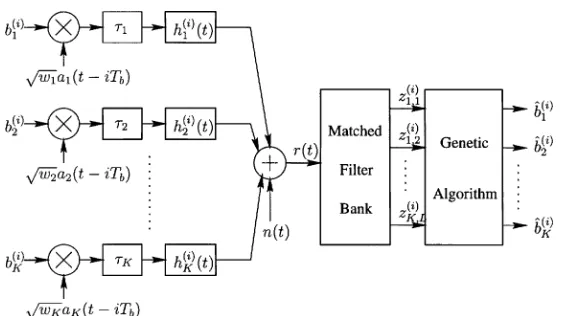
Fig. 1. System model for asynchronous GA-assisted multiuser DS-CDMA.
point-by-point exhaustive search techniques, especially in the large solution spaces associated with supporting many users. A GA-based multiuser detector was first proposed by Junttiet al. [12], where the analysis was based on a synchronous CDMA system communicating over an additive white Gaussian noise (AWGN) channel. It was found that good initial guesses of the possible solutions are needed for the GA in order to obtain a high performance. However, by incorporating an element of local search prior to the GA, Yen et al. [13] showed that the performance of the GA-based multiuser detector approaches the single-user performance bound at a significantly lower computational complexity than that of the optimum multiuser detector. Instead of providing good initial guesses for the GA, the proposal by Ergünet al. [14] used a multistage multiuser detector as part of the GA procedure in order to improve the convergence rate of the GA. Although the results in [14] suggested that the employment of a pure GA-based multiuser detector was unattractive due to its slow convergence rate, in [15] we have demonstrated that slow convergence is not an inherent feature of the GAs. More explicitly, the type of genetic operations used and the associated system parameters have a substantial affect on the convergence rate [15]. Based on the results obtained in [15], an attractive GA configuration that offered an attractive tradeoff between convergence speed and complexity was adopted for our proposed detector. This GA configuration will be highlighted in Section III. The per-formance of a GA-based multiuser detector employed in an asynchronous CDMA system in conjunction with a modified Viterbi algorithm was studied by Wang et al. [16]. It was shown that the GA-based detector achieves almost the same performance as that of the minimum mean-square error (mmse) multiuser detectors at a lower computational complexity.
A GA-assisted multiuser detector designed for a synchronous DS-CDMA system communicating over a flat fading channel with the aid of joint channel estimation, as well as in conjunc-tion with antenna diversity, has been investigated by the authors in [17] and [18], respectively. In this contribution, we extend our proposal to an asynchronous DS-CDMA system transmit-ting over -path Rayleigh-fading channels. In order to reduce the complexity of the detector and to concommittantly decrease the detection time, the observed window is truncated such that it encompasses at most one complete symbol interval of all users in any detection window. Let us assume that we are interested
in detecting the th bit of all users. Then, the edge bits will be the th bits and the th bits of all interfering users, referred to in this contribution as the start edge bits (SEBs) and the end edge bits (EEBs), respectively. The SEBs have been de-tected in the previous observed window and, hence, are known to the receiver. GAs are then developed in order to estimate the desired th bits as well as the th EEBs. In contrast to the previously proposed techniques [6], [7], the EEBs and de-sired bits in our proposal are estimated simultaneously using the same process. This results in minimal detection delay and no ad-ditional hardware is required for predicting the EEBs.
The performance of the proposed multiuser detector is exam-ined by computer simulations, whereby the measure of interest is the desired bit-error probability (DBEP). We will investigate the effects of the ambiguity of the edge bits on the DBEP by comparing the GA-assisted multiuser detector with EEBs esti-mation against that without the GA-assisted EEBs estiesti-mation. In the latter case, the EEBs are estimated based on the hard de-cisions obtained from the users’ correlator output, which is a technique similar to that proposed in [5]. Furthermore, we will evaluate the effects of varying the GA parameters on the DBEP performance in order to strike a balance between detection com-plexity and performance. Our simulation results showed that, upon using GAs to improve the accuracy of the edge bits, our proposed multiuser detector can achieve a near-optimum DBEP performance, while imposing a lower complexity, as compared to that of the optimum multiuser detector [1].
The remainder of this paper is organized as follows. Sec-tion II describes our asynchronous CDMA system communi-cating over multipath Rayleigh-fading channels.1The LLF re-quired for the optimization process is also developed. Section III describes the GAs used to implement our proposed detector. Our simulation results are presented in Section IV, while Section V concludes this paper.
II. SYSTEMDESCRIPTION
We consider binary phase-shift keying (BPSK) transmissions over multipath Rayleigh-fading channels shared by asyn-chronous users employing DS-CDMA, as illustrated in Fig. 1.
1In this paper, vectors and matrices are represented in boldface, while(1)
where , , and are the th path gain, propagation delay and phase, respectively. When communicating over Rayleigh-fading channels, the channel gain is a zero-mean complex Gaussian random variable, where the amplitude is Rayleigh distributed and the phase is uniformly dis-tributed between .
Assuming ideal low-pass filtering for removing the high-fre-quency noise components, the baseband received signal expressed in vectorial notation can be written as
(2)
where
is the users’ signature sequence vector and is the random delay2 corresponding to user ,
is a diagonal matrix containing the power of the users and is an identity
matrix, is the
diagonal CIR matrix,
is the data vector, and is the th user bit vector. For simplicity and without loss of generality, we assumed an ordering of the random delays such that . We also assumed that the powers, channel gains, and random delays of all users are known to the receiver and that the channel gain is normalized so that the average signal-power levels at the output and input of the channel are the same.3
for (3)
The channel noise is modeled by a zero-mean complex white Gaussian process with independent real and imaginary components, each having a double-sided power spectral density
of .
2The random delay takes into account the asynchronous nature of the
transmission, as well as the propagation delay given in (1).
3The effects of imperfect channel estimation as well as a joint GA-assisted
channel estimator and multiuser detector were studied in the context of a syn-chronous CDMA system in [17].
a bank of filters, matched to the signature sequences of the users. Assuming perfect synchronization, the output of the th users matched filter corresponding to the th path sampled at the end of the th symbol interval is given as [19]
(5)
Using vector notation, the output of the matched filter bank at the th symbol interval can be written as
(6)
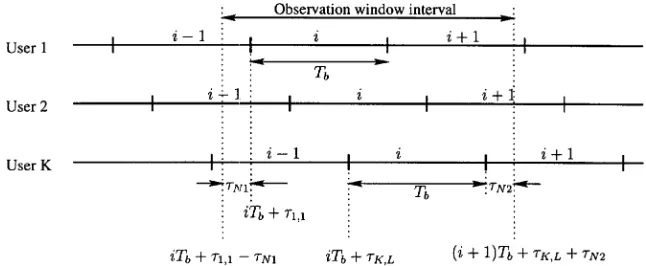
From (6), we can see the presence of the interference contributed by the edge bits. Hence, any joint decision made on the th bits of the users has to take into account the decisions on either the th bit or the th bit of each user, as shown in Fig. 2.
Let us first assume that the receiver has explicit knowledge of the SEB and EEB of all the users. Let us also introduce
..
. ... ...
..
. ... ...
(7)
Fig. 2. Received-sequences model of an asynchronous DS-CDMA system.
which will be used at a later stage in (9) and (10). The trun-cated observation window duration is governed by and ,
where , . As illustrated
by Fig. 2, the truncated observation window interval can span from the most recently received th bit of the th user to the end of the first received th bit of the first user, i.e., . In this way, the decisions made on the desired th bits of the users will only depend on either the th or th bits of all users.
Based on the observation vector given in (6), it can be shown that the LLF required for detecting the th bit of all users within the truncated observation window, given that and
are known to the receiver, can be written as
(8)
where ,
, , and
The vectors and represent the partial matched
filter correlations between and
, respectively, for , which are given as
(9)
(10)
The optimum decision concerning , provided that and are known to the receiver, is formulated as
, which maximizes the LLF given in (8).
However, in practice the receiver is oblivious of the EEBs during the detection of , unless they are pilot bits. On the other hand, the SEBs can be derived from the previous detection process and if the DBEP of the receiver is sufficiently low, it can be assumed that the SEBs are perfectly known. Hence, in order to optimize the decision concerning , it is
imperative that the EEBs are estimated as reliably as possible. In order to lower the EEB error probability (EBEP), we invoke the proposed GA for improving the tentative decision accuracy of the EEBs and, at the same time, we optimize the LLF in order to detect . Hence, the estimated transmitted bit vector of the users can be found by optimizing (8) with respect to the desired bits and the EEBs , yielding
(11)
where denotes the tentative decisons concerning the EEBs based on GA-assisted optimization. In Section III, we will highlight the philosophy of our GA-assisted multiuser detector in order to simultaneously estimate the desired users’ bits and the EEBs. Note that the LLF of (8) assumed perfect knowledge of the channel parameters, such as the users’ CIR and propagation delays. The LLF can, however, be readily mod-ified to take into consideration the imperfect estimation of these parameters, as shown in [20]. In this case, our GA-assisted optimization approach would be based on a modified LLF. However, since the performance of the optimization process itself is not affected by these parameter imperfections, here we assume perfect knowledge of these channel parameters.
III. GA-BASEDMULTIUSERDETECTION
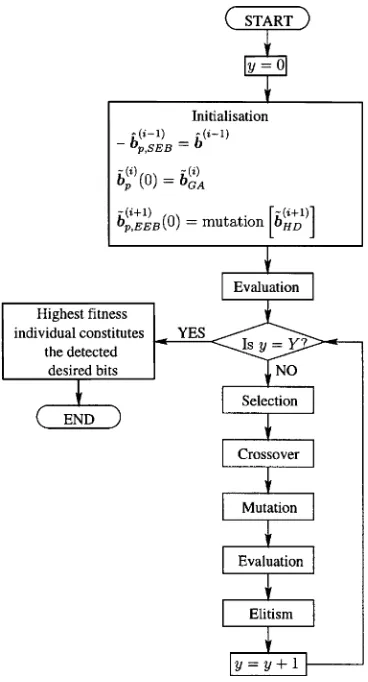
GAs [9]–[11] can be invoked in robust global search and opti-mization procedures that are well suited for solving complex op-timization problems. In this paper, we employed GAs in order to detect the transmitted users’ bit vector , where the so-called objective function is defined by the LLF of (8). The structure of the proposed GA-based multiuser detector can be best under-stood with the aid of the flowchart shown in Fig. 3, which will be often referred to during our further discourse.
GAs commence their search for the optimum solution at the so-called th generation with an initial population of so-calledindividuals, each consisting of antipodal bits. The number of individuals in the population is given by thepopulation size , which is fixed throughout the entire GA iteration process. We will express the th individual here as
, where , ,
Fig. 3. Flowchart depicting the structure of the proposed genetic algorithm used to detect the transmitted users’ bitbbb as well as providing the tentative solutions ofbbb at theith observation window.
Associated with each individual is a figure of merit, more commonly known in GAs as the fitness value, which has to be evaluated. The fitness value, denoted as for
, is computed by substituting the corresponding
ele-ments , and into the LLF of (8). Based
on the evaluated fitness, a new population of individuals is created for the th generation through a series of processes, which are referred to in GA parlance asselection,crossover, mutation, andelitism[11]. These processes are designed to im-prove the average, and possibly the maximum fitness, of the new population as compared to the old population. At the th gener-ation, the desired bits of the individual corresponding to the highest fitness value in the population constitute the detected users’ th bit associated with the observation window interval considered, i.e., with of the th individual ,
where .
As seen in Fig. 3, the GA must be initialized before com-mencing the optimization process for every new observation window. Typically, initialization involves assigning a legitimate random solution to each individual. However, in this case, we can make use of the information already available at the begin-ning of each detection in order to aid and to accelerate the opti-mization. Let us assume that the current bit of interest is the th bit of all users. Hence, the SEB vector will be constituted by the
since these SEBs have been detected previously and any mod-ification of the SEBs will not affect the performance of the de-tector significantly. Thus, the generation index is omitted for the SEB.
It is now clear that the unknown variables involved in the optimization process consist of the current desired bits as well as the EEBs. At the 0th generation, the unknown EEB
for can be initially estimated based on the hard decisions of the correlator outputs of Fig. 1. Hence
mutation for
(12)
where .
Notice that the EEBs of each individual in (12) aremutated versions of the correlator hard decisions. This means that we will change the state of each bit of with a probability . The mutation process [11] of (12) is used to ensure that the GA has a highly diversified search range at the begin-ning. Without this mutation process, all the individuals at the initialization stage would be identical.
Let us now assume that, upon termination of the GA at the end of every observation window, the error probability of the EEBs will be sufficiently low and, hence, these bits can be consid-ered as the tentative solutions for the GA during initialization, when these EEBs become the desired bits in the next observa-tion window. Hence, according to (11)
(13)
After initialization, the GAs are then invoked in order to search for the desired bit string as well as for the EEB string that opti-mizes the LLF according to (11). Let us now highlight the pro-cesses that are involved in the GA [11].
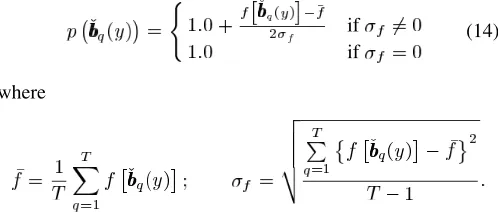
Selection. As suggested by the terminology, the selection process [11] selects two so-calledparentsfrom amating pool consisting of individuals, where , in order to pro-duce two so-calledoffspringfor the next generation population. Individuals having the highest fitness values in the population are placed in the mating pool. We will denote the individuals in
the mating pool as for .
Fig. 4. Example of uniform crossover between two parent bits strings.
of the mating pool’s mean fitness and its associated standard deviation , as formulated as [11]
if if
(14)
where
Crossover. The antipodal bits corresponding to the desired bits as well as the EEBs of the parent vectors are then exchanged using the so-calleduniform crossover[21] process in order to produce two offspring. The process of uniform crossover in-vokes a so-called crossover mask, which is a sequence con-sisting of randomly generated 1s and 0s. Antipodal bits corresponding to the desired bits and the EEBs are exchanged between the pair of parents at bit locations corresponding to 1 in the crossover mask. An illustration of the uniform crossover process is shown in Fig. 4. The selection of parents from the mating pool and the crossover process is repeated until a new population of offspring is produced.
Mutation. Themutationprocess [11] refers to the alteration of the value of an antipodal bit corresponding to the desired bits and the EEBs in the offspring from 1 to orvice versa, with a probability . Here, we will set , such that on average only one bit in each individual is mutated.
Elitism. Finally, due to the process of elitism [11], we identify the lowest merit offspring in the population and replace it with the highest merit individual from the mating pool. This will en-sure that the highest merit individual is propagated throughout the evolution process.
A. Complexity Issues
Since our proposed GA-based multiuser detector optimizes the LLF of (8), we will only consider its complexity in terms of the number of LLF computations required for the optimiza-tion. The optimum multiuser detector using exhaustive search requires evaluations of the LLF. By contrast, our proposed detector requires a maximum of LLF evaluations. In fact, the number of such LLF evaluations can be reduced by avoiding repeated evaluations of identical individuals, either within the same generation or across the entire iteration process, if the re-ceiver has the necessary memory.
For comparison’s sake, consider the complexity of the linear decorrelator [3], which is on the order of due to the associ-ated matrix inversion. This complexity becomes excessive when the number of users supported is high. By contrast, successive
interference cancellation (SIC) [22] is a well-established low-complexity suboptimum multiuser-detection technique. How-ever, the processing delay involved in detecting all the users’ bits can be quite significant, an inherent property that cannot be readily mitigated by parallel processing. On a similar note, other search methods, such as the semi-definite relaxation technique of [23], has a complexity on the order of , which also is quite high. By contrast, the GA-based multiuser detector is ca-pable of offering a flexible tradeoff between the achievable BER performance and the complexity imposed, as well as the pro-cessing delay encountered by varying the population size and the termination criteria to suit the system’s specifications. Nat-urally, one could use a whole host of attractive benchmarker multiuser detectors (MUDs), striking a good balance between complexity and performance, but the most natural choice is the single-user detector.
Before we present our simulation results, we should note here that the employment of our proposed GA-based multiuser de-tector is not restricted to joint bit-by-bit detection. The truncated observation window can actually span over several users’ bits. In such cases, the individuals of the GA must contain these bits. However, since there are more unknown bits to be detected, a higher value and more generations are expected to be invoked.
IV. SIMULATIONRESULTS
In this section, our computer simulation results are presented in order to characterize the DBEP performance of the GA-based multiuser detector highlighted in Section III. For the sake of comparison, we have also included the BER results of the classic SIC [22] and the decorrelator [7], both of which are also oper-ated on a window-by-window basis, similar to the GA-based detectors. For the two-stage SIC, the EEBs are detected after the desired bits have been detected and cancelled from the ceived signal. These EEBs are in turn cancelled from the re-ceived signal before the desired bits are again detected in the second stage. As for the decorrelator, the decorrelating matrix also takes into account the EEBs and the SEBs, hence resulting in a -dimensional matrix. For the sake of further bench-marking, we also simulated a scheme, where the EEBs were es-timated by taking a hard decision based on their maximum ratio combined correlator outputs [5]. In this case, only the desired bits are involved in the GA optimization process, in which the desired bits are initialized based on the mutated version of the correlator’s hard decisions, as given by
mutation for (15)
Fig. 5. Desired bits’ error probability for the GA-based multiuser detector employing the EEB S1 and S2 detection strategies with a population size of
P = 30using random signature sequences of length 31 and supportingK = 10 users. The GA parameters used are the probability of mutation specified by
p = 0:1,p = 0:1for S1, andp = 0:05for S2. The iteration was terminated afterY = 9generations.
Note, however, that our further benchmarking studies, not in-cluded here, indicate that the performance benefits of GAs de-pend on their affordable complexity. Numerous suboptimum benchmarkers have been proposed in the literature [2], [15]; hence, it is unfeasible to compare the proposed GA’s perfor-mance to that of all possible suboptimum MUDs found in the related literature. Therefore, we have opted for using the single-user bound as our ultimate benchmarker. Additionally, we con-ducted further investigations using the classic -algorithm as a well-understood benchmarker, which are not included here for space economy. The conclusion of these studies was that unless the GA’s population size was extremely restricted by the afford-able search complexity, the GA-aided MUD outperformed the -algorithm. The study of other high-powered benchmarkers, such as the semi-definite relaxation techniques of [23], are set aside for future study.
All the results in this section were based on evaluating the DBEP performance of a chip-asynchronous ten-user CDMA system over single-path and two-path Rayleigh-fading channels. For ease of simulation, the relative delays between the different received signals for the single-path scenario were arranged such
that . For the two-path scenario,
the relative delays were arranged according to
and . This arrangement
was made in order to have a well-defined window for our simu-lation purposes. In practice, the delay will be arbitrarily varied so that the window must also be varied accordingly in order to encompass the desired bits. The two paths were assumed to have
equal average received energy, i.e., .
[image:7.594.40.550.66.264.2]The processing gain was and the signature sequences were randomly generated. Perfect power control and CIR esti-mation was assumed for all the simulations. We also assumed that the first bit of all the users was known to the receiver.
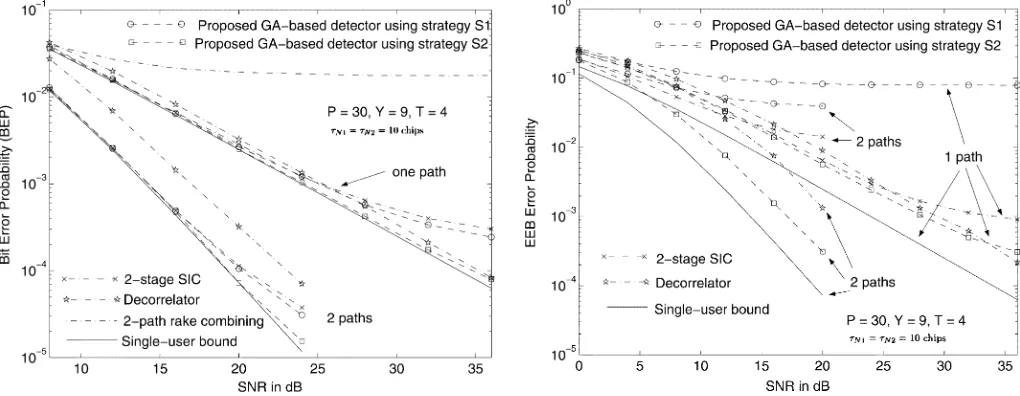
Fig. 6. EEBs’ error probability performance for the GA-based multiuser detector employing the EEB S1 and S2 detection strategies with a population size ofP = 30using random signature sequences of length 31 and supporting
K = 10users. The GA parameters used are the probability of mutation specified byp = 0:1,p = 0:1for S1, andp = 0:05for S2. The iteration was terminated afterY = 9generations.
Figs. 5 and 6 show the DBEP and EBEP performances, re-spectively, against for the GA-based -user de-tector employing the two EEB estimation strategies, respec-tively. The single-user bound was computed using the following equation [24]4:
(16)
where . The GA parameters used in
this case were , , , and
. As Fig. 5 shows, the DBEP of the GA-based mul-tiuser detector employing S1 was inferior compared to that of S2. The error floor observed for S1 in the single-path scenario was caused by the high EBEP, as seen in Fig. 6. In this case, the GA-based multiuser detector was termed as EEB interfer-ence limited. The same can be said for the two-path scenario, albeit only a small degradation was observed with respect to the single-user bound. Despite the fact that the EEBs in the SIC have a lower BER due to the cancellation and detection in the presence of less interference, the SIC still has a performance similar to the S1-aided GA-based detector. As for the decor-relator, the BER increases when the number of interferers in-creases, as can be seen in conjunction with two paths. On the other hand, we can see from Fig. 6 that the EBEP upon em-ploying S2 is fairly low. As a result, the performance of the GA-based multiuser detector utilizing this strategy was not lim-ited by the EEB errors and, hence, was capable of achieving
4The single-user bound constitutes the ultimate performance limit, assisting
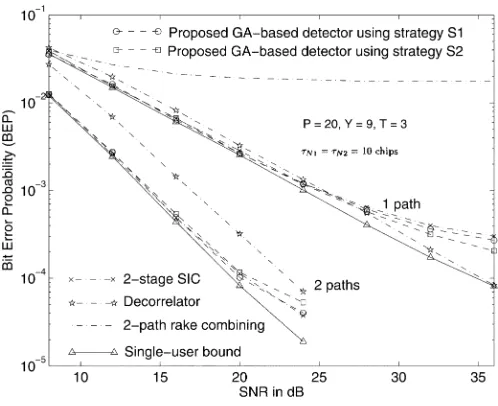
Fig. 7. Desired bits’ error-probability performance for the GA-based multiuser detector employing the EEB S1 and S2 detection strategies with a population size ofP = 20using random signature sequences of length 31 and supportingK = 10users. The GA parameters used are the probability of mutation specified byp = 0:1,p = 0:1for S1, andp = 0:05for S2. The iteration was terminated afterY = 9generations.
a near-optimum single-user-like DBEP performance. Further-more, in comparison to the “brute-force” optimum ML detector requiring LLF evaluations, our proposed multiuser detector is substantially less complex, requiring only a max-imum of 10 LLF evaluations, yet performing close to the optimum performance.
The notion of an EEB interference-limited DBEP perfor-mance employing strategy S1 is further substantiated in Fig. 7, which characterizes the DBEP performance of the proposed detector for a population size of . Naturally, we would expect the performance to degrade as compared to Fig. 5, when the population size decreases. As seen in the figure for both the one- and two-path scenarios, the DBEP performance of the proposed detector employing strategy S1 did not show significant degradation in comparison to that associated with , as illustrated in Fig. 5. This is due to the fact that the EBEP is the same for both and and, hence, the corresponding DBEP performances are limited by the poor reliability of the EEBs. This becomes explicit by comparison to the curve characterizing the scenario using perfect knowledge of the SEBs and EEBs, which exhibited a near-single-user DBEP performance even for . On the other hand, for detectors employing an S2 strategy, a degradation can be seen for compared to that for , as shown in Fig. 5. This is because, in this case, there are variables to be optimized and, therefore, a high population size is required in order to achieve optimum performance. Hence, when , the performance of the detector is degraded. In this case, we referred to the DBEP performance as “GA-limited.”
Fig. 8 shows the effect of the different genetic operations employed on the convergence rate. The results were based on the assumption of perfect knowledge of the EEBs and SEBs at a signal-to-noise ratio (SNR) of 36 dB, when encountering a single path. We can see that by using a selection method based
Fig. 8. Desired bits’ error-probability performance with respect to the number of generations of the GA-based multiuser detector using a combination of different genetic operations at an SNR of 36 dB with one path. The population size isP = 20using random signature sequences of length 31 and supporting
[image:8.594.301.553.67.230.2]K = 10users. The probability of mutation wasp = 0:1.
Fig. 9. EEBs’ error probability performance for the GA-based multiuser detector employing the EEB S1 and S2 detection strategies in a near–far scenario withK = 10, where the power ratio is defined as the power of the desired users(k = 1; . . . ; 5) over the power of the interfering users
(k = 6; . . . ; 10). The population size is 30 and the spreading factor is 31. The GA parameters used are the probability of mutation specified byp = 0:1,
p = 0:1for S1, andp = 0:05for S2. The iteration was terminated after
Y = 9generations.
on sigma scaling in conjunction with a uniform crossover oper-ation, a faster convergence rate was attained than for the single-point crossover [11]. On the other hand, a combination of the proportionate-type selection and one-point crossover, as used in [14], yields the slowest convergence. Hence, the type of genetic operations used can have a significant impact on both the per-formance and on the computational complexity. A faster conver-gence rate implies a reduction in the complexity. A more indepth investigation of the behavior of the various types of genetic op-erations can be found in [15].
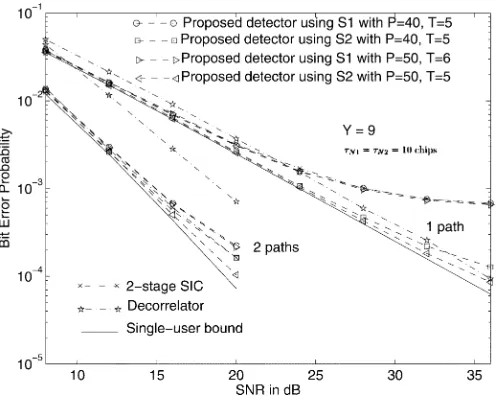
[image:8.594.303.553.300.496.2]Fig. 10. Desired bits’ error-probability performance for the GA-based multiuser detector employing the EEB S1 and S2 detection strategies with population sizes ofP = 40andP = 50using random signature sequences of length 31 and supportingK = 15users. The GA parameters used are the probability of mutation specified byp = 0:1,p = 0:07for S1, and
p = 0:03for S2. The iteration was terminated afterY = 9generations.
the GA employing strategy S1 now exhibits a more significant degradation in terms of DBEP performance with respect to the single-user bound than those employing strategy S2. This is due to the fact that as the number of users increases, the EBEP be-comes higher. Increasing the population size to 50 does not show any significant improvement using the same strategy, since the performance is limited by the EEB interference. We also note that for the DBEP performance of GAs employing strategy S2 did not match the single-user bound, even though it outperformed strategy S1. This is due to the limited popula-tion size, which was too small for optimizing 2 15 variables. However, by increasing to 50, the DBEP performance be-comes near-optimum. Hence, while achieving a superior per-formance, the associated additional computational complexity has to be tolerated. An important observation is that when is increased from 10 to 15 users, a near-optimum DBEP per-formance can be maintained by increasing the population size from 30 to 50, while keeping by employing strategy S2. This constitutes a factor of 5/3 increase in the number of LLF computations. On the other hand, the computational com-plexity of the conventional optimum detector using brute-force optimization is increased by a factor of .
[image:9.594.304.548.64.259.2]Fig. 9 shows the DBEP performance for in a severe near–far scenario. The power ratio scaled on the -axis is the ratio of the desired users’ power to the power of the interfering users . Hence, the DBEP is shown for a range commencing from dB, where the power of the interfering users is ten times higher than the desired users. The upper end of the range is 10 dB, where the power of the interfering users is 10 dB lower than that of the desired users. As expected, the SIC using no power ranking is most affected by the near–far effect. The GA-based detector using S1 is only slighted affected, since the EEBs are based on the conventional matched filter, which is not near–far resistant.
Fig. 11. Desired bits’ error-probability performance for the GA-based multiuser detector employing the EEB S1 and S2 detection strategies with a population size ofP = 30using random signature sequences of length 31 and supportingK = 10users with various truncated window sizes. The GA parameters used are the probability of mutation specified byp = 0:1,
p = 0:1for S1, andp = 0:05for S2. The iteration was terminated after
Y = 9generations.
Both the GA-based detector using S2 and the decorrelator are near–far resistant.
All the simulation results we have seen so far are based on a truncated window size of chips.5This corre-sponds to a minimum processing gain of 10 for both the SEBs and EEBs. The effects of the window size on the SEB error prob-ability can be ignored, since these bits have been detected pre-viously. On the other hand, the EEBs have to be tentatively de-tected based on only the reduced processing gain. In practice, it is not always possible to set chips. The worst case would be chips, while the ideal
case would be chips. We
sim-ulated the effects of varying the window size on the DBEP per-formance based on these two settings ; the associated results are shown in Fig. 11. We can see that for a narrow window width of chips,6the performance of the detectors em-ploying strategy S1 deteriorates more significantly compared to
a wider window size of chips, when
em-ploying strategy S2. This is a consequence of the low detection reliability of the EEBs based on the correlator outputs due to the associated narrower correlation window. As a result, the DBEP performance of detectors employing the approach S1 in con-junction with the EEBs based on the hard decisions of the cor-relator outputs in Fig. 1 becomes more sensitive to the varying window size. On the other hand, the GA-assisted detector em-ploying the approach S2 is capable of improving the error prob-ability of the EEBs. Consequently, the difference in the DBEP performance between a wide window size of (
chips) and a small window size of ( chips) using the strategy S2 is minimal.
5We have set = in order to arrive at a symmetric truncated window
for ease of simulation.
V. CONCLUSION
In conclusion, we formulated the LLF of an asynchronous CDMA system in a multipath channel based on a truncated window size. GAs were then used in order to search for the par-ticular bit sequence that optimizes the LLF. In our approach, GAs were invoked in order to improve the achievable EBEP and at the same time to detect the desired bits within the window. Our simulation results showed that the DBEP performance of the proposed detectors approaches the optimal DBEP perfor-mance, while requiring a substantially lower number of LLF evaluations as compared to the optimum multiuser detector. Fur-thermore, both the EEBs and desired bits are detected by the same GAs, resulting in potential complexity savings. In closing, we note that the set of GA parameters employed is by no means optimal and that our further research will concentrate on con-triving learning algorithms that are capable of adjusting these parameters for satisfying a sufficiently high correct decision probability based on the LLF.
REFERENCES
[1] S. Verdú, “Minimum probability of error for asynchronous Gaussian multiple access channels,”IEEE Trans. Inform. Theory, vol. 32, pp. 85–96, Jan. 1986.
[2] ,Multiuser Detection. Cambridge, U.K.: Cambridge Univ. Press, 1998.
[3] R. Lupas and S. Verdú, “Near–far resistence of multiuser detectors in asynchronous channels,”IEEE Trans. Commun., vol. 38, pp. 496–508, Apr. 1990.
[4] F.-C. Zheng and S. K. Barton, “Near–far resistent detection of CDMA signals via isolation bit insertion,”IEEE Trans. Commun., vol. 43, pp. 1313–1317, Feb./Mar./Apr. 1995.
[5] Z. Xie, R. T. Short, and C. K. Rushforth, “A family of suboptimum de-tectors for coherent multiuser communications,”IEEE J. Select. Areas Commun., vol. 8, pp. 683–690, May 1990.
[6] S. S. H. Wijayasuriya, G. H. Norton, and J. P. McGeehan, “A sliding window decorrelating receiver for multiuser DS-CDMA mobile radio networks,”IEEE Trans. Veh. Technol., vol. 45, pp. 503–521, Aug. 1996. [7] J. Shen and Z. Ding, “Edge decision assisted decorrelators for asyn-chronous CDMA channels,” IEEE Trans. Commun., vol. 47, pp. 438–445, Mar. 1999.
[8] L. Wei, L. K. Rasmussen, and R. Wyrwas, “Near optimum tree-search detection schemes for bit-synchronous multiuser CDMA systems over Gaussian and two-path Rayleigh-fading channels,”IEEE Trans. Commun., vol. 45, pp. 691–700, June 1997.
[9] J. H. Holland, Adaptation in Natural and Artificial Systems. Ann Arbor: Univ. Michigan Press, 1975.
[10] D. E. Goldberg,Genetic Algorithms in Search, Optimization and Ma-chine Learning. Reading, MA: Addison-Wesley, 1989.
[11] M. Mitchell,An Introduction to Genetic Algorithms. Cambridge, MA: MIT Press, 1996.
[12] M. J. Juntti, “Genetic algorithms for multiuser detection in synchronous CDMA,” inProc. IEEE Int. Symp. Inform. Theory, 1997, pp. 492–492. [13] K. Yen and L. Hanzo, “Hybrid genetic algorithm based multiuser de-tection schemes for synchronous CDMA systems,” inProc. 51st IEEE Vehicular Technology Conf., Tokyo, Japan, May 2000, pp. 1400–1404. [14] C. Ergün and K. Hacioglu, “Multiuser detection using a genetic
algo-rithm in CDMA communications systems,”IEEE Trans. Commun., vol. 48, pp. 1374–1383, Aug. 2000.
[15] L. Hanzo, L.-L. Yang, E.-L. Kuan, and K. Yen,Single- and Multi-Car-rier CDMA: Multi-User Detection, Space-Time Spreading, Synchroniza-tion, Standards and Networking. Piscataway, NJ: IEEE Press/Wiley, 2003.
[16] X. F. Wang, W. S. Lu, and J. O. Lilleberg, “A genetic algorithm-based multiuser detector for multiple access communications,” inProc. IEEE Int. Symp. Circuits and Systems (ISCAS’98), vol. 4, 1998, pp. 534–537.
[17] K. Yen and L. Hanzo, “Genetic algorithm assisted joint multiuser symbol detection and fading channel estimation for synchronous CDMA sys-tems,”IEEE J. Select. Areas Commun., vol. 19, pp. 985–998, June 2001. [18] , “Genetic algorithm based antenna diversity assisted multiuser de-tection for synchronous CDMA systems,” presented at the 53rd IEEE Vehicular Technology Conf., Rhodes, Greece, May 2001.
[19] M. K. Varanasi and B. Aazhang, “Multistage detection in asynchronous code division multiple access communications,”IEEE Trans. Commun., vol. 38, pp. 509–519, Apr. 1990.
[20] S. D. Gray, M. Kocic, and D. Brady, “Multiuser detection in mis-matched multiple-access channels,”IEEE Trans. Commun., vol. 43, pp. 3080–3089, Dec. 1995.
[21] G. Syswerda, “Uniform crossover in genetic algorithms,” inProc. 3rd Int. Conf. Genetic Algorithms, J. D. Schaffer, Ed., San Mateo, CA, 1989, pp. 2–9.
[22] P. Patel and J. Holtzman, “Analysis of a simple successive interference cancellation scheme in a DS/CDMA system,”IEEE J. Select. Areas Commun., vol. 12, pp. 796–807, June 1994.
[23] W.-K. Ma, T. N. Davidson, K. M. Wong, Z.-Q. Luo, and P.-C. Ching, “Quasimaximum-likelihood multiuser detection using semi-definite re-laxation with application to synchronous CDMA,”IEEE Trans. Signal Processing, vol. 50, pp. 912–922, Apr. 2002.
[24] J. G. Proakis,Digital Communications, 3rd ed, Singapore: McGraw-Hill, 1995.
[25] L. Wei, “Performance bounds for optimum multiuser DS-CDMA sys-tems,”IEEE Trans. Commun., vol. 47, pp. 185–190, Feb. 1999.
Kai Yenreceived the B.S. degree in electronics en-gineering with (first-class Hons.) from the Nanyang Technological University, Singapore, in 1996 and the Ph.D. degree in mobile communications from the University of Southampton, Southampton, U.K., in 2001.
He was a Research Scientist with the Institute for Infocomm Research (I2R), which is primarily funded by the Agency of Science, Technology and Research (A*STAR), Singapore. He currently is a Visiting Re-searcher with the Centre for Wireless Communica-tions, Oulu, Finland. His research interests include multiuser detection, adaptive rate transmission, and turbo equalization schemes.
Lajos Hanzo (M’91–SM’92–F’04) received the M.S. and Ph.D. degrees in electronics from the Technical University of Budapest, Budapest, Hun-gary, in 1976 and 1983, respectively, and the doctor of sciences (D.Sc.) degree from the University of Southampton, Southampton, U.K., in 2004.
During his career in telecommunications, he has held various research and academic posts in Hungary, Germany, and the United Kingdom. Since 1986, he has been with the Department of Electronics and Computer Science, University of Southampton, Southampton, U.K., where he holds the chair in telecommunications. He coauthored ten books on mobile radio communications, published about 500 research papers, organized and chaired conference sessions, presented overview lectures, and has been awarded a number of distinctions. Currently, he heads an academic research team, working on a range of research projects in the field of wireless multimedia communications sponsored by industry, the Engineering and Physical Sciences Research Council (EPSRC) U.K., the European community, and the Mobile Virtual Centre of Excellence (VCE), U.K. He is an enthusiastic supporter of industrial and academic liaison and offers a range of industrial courses.