Supported by the Ministry of Agriculture of the Czech Republic (Project No. QJ1210109) and by the Ministry of Education, Youth and Sports of the Czech Republic (“S” grant).
Effect of Thawing Method on Bull Sperm Survival
in Ejaculates Frozen in 4 ml and 8 ml Volumes
Zuzana Biniová
1,2*, Luděk Stádník
1,
Martina Doležalová
1, Jaromír Ducháček
11Department of Animal Husbandry, Faculty of Agrobiology, Food and Natural Resources, Czech University of Life Sciences Prague, Prague, Czech Republic
2NATURAL spol. s r.o., Hradištko pod Medníkem, Czech Republic
*Corresponding author: [email protected]
ABSTRACT
Biniová Z., Stádník L., Doležalová M., Ducháček J. (2018): Effect of thawing method on bull sperm survival in ejaculates frozen in 4 ml and 8 ml volumes. Czech J. Anim. Sci., 63, 399–407.
The aim of this study was to evaluate the effect of different thawing protocols (slow (P1), medium (P2), and fast (P3)) on percentage of motile sperm (MOT) and percentage of sperm cells with intact membranes (INT) in Holstein (4 bulls; 72 samples) and Czech Fleckvieh (4 bulls; 72 samples) semen frozen-thawed in 4 ml and 8 ml volumes. MOT was analysed in fresh semen, as well as immediately after thawing (T0) and 30 min after thawing (T30). INT was analysed using hypoosmotic swelling test (HOS test) in fresh ejaculate (FE), after dilut-ing (DE), and at T0. The differences between FE parameters and frozen-thawed ejaculate parameters, express-ing changes that occur durexpress-ing cryopreservation, were calculated. Apart from the effect of thawexpress-ing protocol, the effect of breed and the effect of quality of FE expressed by MOT immediately after collecting were evaluated, too. Unlike thawing of semen cryopreserved in straws (0.25 and 0.5 ml), thawing using the slow protocol (P1) was the most appropriate (P< 0.05) for both observed volumes. There were found significantly higher MOT in the volume of 8 ml in both T0 and T30 and in the volume of 4 ml in T30 in samples thawed using P1 and P2. MOT in T0 was significantly affected by breed in samples frozen in 8 ml and in T30 in samples frozen in 4 and 8 ml. There were found no significant differences in INT in all reported volumes, however decrease of INT during cryopreservation was affected by breed.
Keywords:bovine semen;large volumes; semen processing, sperm quality parameters
Introduction of Double Freezing (DF) method to the commercially used techniques of cryopreserva-tion would have negligibly impact the economy of commercial artificial insemination (AI) centres. The test period of bulls in dairy system takes four years and results of their progeny testing are not known earlier. Thus, AI centres usually produce reserves up to 50 000 straws per bull (Saragusty
et al. 2009), which represents high costs in the case of negative progeny test results.
the DF (Underwood et al. 2009). Apart from the commercial sphere, the use of the DF would be a contribution to the gene reserves utilization or to
in-vitro fertilization(IVF), where only negligible parts of AI straws are being used (Saragusty et al. 2009).
Semen of various domestic animals has been successfully frozen in large volumes in past years. Motility of sperm frozen in large volumes was retained in mammals, namely in stallions (Sara-gusty et al. 2007), bucks (Gacitua and Arav 2005), rabbits (Si et al. 2006), and bulls (Arav et al. 2002; Saragusty et al. 2009) as well as in fish, e.g. com-mon carp (Horvath et al. 2007). Most of the works confirm worse freezability of semen frozen in larger volumes.
Success of semen cryopreservation depends on maintenance of fertilization ability that is deter-mined by preservation of sperm motility includ-ing kinetic parameters of sperm cells (Mortimer 2000), integrity and functions of sperm membranes (James et al. 1999). Sperm motility belongs to the most important factors as it gives information about the sperm energy sources (Verstegen et al. 2002). Its correlations with breed and/or bull fertility were reported in many studies (Beran et al. 2012; Gloria et al. 2013; Simonik et al. 2015; Li et al. 2017).
There were revealed many factors affecting the fertilization ability of frozen-thawed semen. The semen extender composition affects sperm motil-ity (Stadnik et al. 2015; Sichtar et al. 2017; Slanina et al. 2018; Tvrda et al. 2018), plasma membrane integrity (Holt et al. 2015), DNA integrity, and antioxidant activity (Tasdemir et al. 2013). Se-men cooling rate induces irreversible changes in membrane composition and functionality (Watson 2000). Other factors affecting the sperm motility and sperm membrane integrity are time of equi-libration, freezing rate, and interactions between equilibration time and freezing rate (Dolezalova et al. 2016). Cryopreservation process also affects acrosomal integrity and capacitation (Pons-Rejraji et al. 2009). Cryobiology literature states that freezability of bovine semen is determined by some internal factors such as purpose of breeding (Holt et al. 2015) and breed (Beran et al. 2011).
Even though, many negative changes occur in spermatozoa during cryopreservation, there are studies reporting about sperm cells that were able to maintain their functions (Maxwell et al. 2007;
Saragusty et al. 2009) and to fertilise oocytes after several freezing/thawing cycles under both in vitro
(Underwood et al. 2009) and in vivo conditions (Saragusty et al. 2009; Underwood et al. 2010).
Research on thawing protocols shows that thaw-ing rate significantly affects motility and functional traits of sperm frozen-thawed in conventional insemination doses (Barth et al. 1988; Rastegar-nia et al. 2013). However, according to our best knowledge, no research paper concerning thaw-ing of semen frozen in large volumes has been published yet.
Therefore, the objective of this study was to compare the defined thawing protocols in re-lation to sperm motility and integrity of sperm membranes in bovine ejaculates frozen in 4 ml and 8 ml volumes.
MATERIAL AND METHODS
Semen collection. The study was conducted at the A.I. centre of NATURAL spol. s r.o., Hradištko pod Medníkem, Czech Republic. Total number of 144 semen samples from 8 bulls (4 Holstein, 4 Czech Fleckvieh) were analysed. The donor bulls were kept under identical and optimal conditions of feeding, watering, and management during the entire period. The bulls were of similar age (4–5 years), free from any diseases, sexually mature, with good libido, and clinically healthy. The frequency of semen collec-tion was also the same in all bulls in the trial, bulls were collected once per month.
Bulls were collected by the same AI technician using sterilised bovine artificial vagina pre-warmed to 38°C. Each bull was collected two times on the day of collection. The same artificial vagina was used in both two collections. Bag with ejaculates was transported to the laboratory (room tempera-ture) immediately after the semen collection. The semen quality analysis started up to 3 min after the collection. All measurements were performed by one skillful laboratory technician in accordance with the Semen analysis protocol of the NATURAL spol. s r.o. A.I. centre.
To analyse sperm motility (MOT), a small drop of fresh semen was diluted in 0.5 ml of saline (0.9% NaCl solution) and incubated at the temperature of 39°C for 3 min. Thereafter, a small droplet was placed on clean, pre-warmed slide and covered with a pre-warmed cover slip and examined at ×100 magnification under a light microscope (Me-opta 206517; Me(Me-opta, Czech Republic). The MOT evaluation took into consideration only sperm with normal progressive movement. Sperm cells showing circular or oscillating movement were considered as immotile.
Hypoosmotic swelling test (HOS test), developed by Jeyendran et al. (1984), detects the sperm cells with functioning membranes that are able to main-tain equilibrium between the sperm cell and its environment. The fertilization ability is in positive correlation with the percentage of reacted sperm cells. Influx of the fluid due to hypo-osmotic stress causes the sperm tail to coil or swell (Padrik et al. 2012). Aliquots of 0.1 ml of fresh semen were mixed with 1.0 ml of Sörensen’s buffer (prepared by mixing 2.1492 g Na2HPO4 + 12 H2O in 90 ml of distilled water with 0.273 g KH2PO4 in 30 ml distilled water; pre-warmed to 38°C). The mixture was incubated at 37°C for 30 min. Then 0.2 ml of the semen-buffer mixture was dissolved in pre-warmed eosin and after 30 s in pre-warmed nigrosin. A drop of this mixture was placed on a clean pre-warmed microscope slide, spread with another microscope slide and, allowed to air dry. The slide was then examined under a phase microscope at ×100 magnification. In each sample, 200 sperm cells were classified as either reacted (sperm cells with intact membranes (INT)) and non-reacted. The HOS test was repeated after dilution of fresh ejaculate (FE) and its mixing during incubation at room temperature for 10 min with the aim to detect the effect of dilution.
Motility analyses as well as the HOS test slide examinations were provided by the same person.
Samples processing. Only ejaculates (n = 48) with minimum concentration 0.5 × 10⁹ sperm per
mm3 and minimum progressive motility 70% were
processed. These ejaculates were diluted with Andromed (Minitübe, Germany) pre-warmed to 38°C in water bath at the ratio of 1 : 3 (semen : extender). Extended semen was filled into plastic bags (3.5 × 11 cm), placed on perforated paper pad on racks, cooled, and equilibrated at 5°C for 2 h and then frozen in a DigitCool freezer (IMV,
France). Bags were frozen using a three-phase freezing curve (loading temperature in the comb: 4°C, 1st phase: 4 to –10°C in rate 5°C/min, 2nd phase
–10 to –100°C in rate 35°C/min, and 3rd phase
–100 to –140°C in rate 20°C/min). Frozen bags were stored in a liquid nitrogen (–196°C).
Each ejaculate was processed as one set of three samples of either 4 ml or 8 ml, because the volume of extended semen was usually insufficient to cover two different sets of samples. Three sets of 4 ml samples and three sets of 8 ml samples from each donor were produced. Total number of produced samples was 72 of 4 ml and 72 of 8 ml.
Thawing protocols. After removal from liquid nitrogen, each sample of large-volume (4 ml and 8 ml) frozen semen was moved into a new, unfro-zen plastic bag for thawing. The volume of water in thawing bath was sufficient (5 l) in order not to be cooled by the frozen semen. In each set of samples three thawing protocols were applied
Protocol 1 (P1, slow). Sample was placed in the room temperature for 90 s, then pooled into a water bath for 60 s at the temperature of 37°C (Saragusty et al. 2009).
Protocol 2 (P2, medium). Sample was placed in the room temperature for 45 s, than pooled into a water bath for 60 s at the temperature of 40°C. This is a modified method of Horvath et al. (2007) due to the need of semen movement into a new plastic bag and higher volume of thawed samples.
Protocol 3 (P3, fast).Sample was placed in the room temperature for 15 s, than pooled in a water bath for 90 s at the temperature of 40°C. This is a slightly modified method commonly used in the A.I. centre of NATURAL spol. s r.o. for 0.25 ml straw thawing.
Analyses of MOT and INT by methods described above were done immediately after thawing (T0) and 30 min after incubation (T30) in a water bath (38°C). We can consider this time to be theoreti-cally sufficient for evaluation of thawed semen, second dilution to the final sperm concentration, filling of diluted semen in straws, and start of the second freezing that would be used in DF.
Differences between characteristics of FE and frozen-thawed semen were counted to describe changes occurring during the cryopreservation process.
process were counted to exclude the effect of the semen dilution.
Statistical analyses. The recorded data were subjected to statistical analyses using SAS 9.3 soft-ware (SAS/STAT 9.3, 2011). Procedures MEANS and UNIVARIATE were used to calculate the basic characteristics. The REG procedure and the STEP-WISE method were used to select an appropriate model of indices evaluation. The differences be-tween animals and groups were evaluated by the GLM procedure, followed by a detailed evaluation using the Tukey-Kramer test. Following parameters of ejaculates frozen in 4 ml and 8 ml were calculated.
Model equation. The following model equation was used:
yijkl = μ + ai+ bj+ ck+ b*(BULL) + eijkl
where:
yijkl = dependent variable (percentage of sperm with forward motility (MOT) immediately after thaw-ing (T0) and 30 min after thawthaw-ing (T30), per-centage of sperm with intact membranes (INT) after freezing-thawing cycle and their differences compared to fresh ejaculates (FE))
μ = mean value of dependent variable
ai = fixed effect of breed (for 4 ml volume: i = Czech Fleckvieh, n = 36; i = Holstein, n = 36; for 8 ml volume: i = Czech Fleckvieh, n = 36; i = Holstein,
n = 36)
bj = fixed effect of proportion of sperm with intact membranes in FE(for 4 ml volume: j = 70–79%,
n= 39; j = 80–90%, n = 33; for 8 ml volume: j = 70–79%, n = 48; j = 80–90%, n = 24)
ck = fixed effect of thawing protocol (for 4 ml volume:
k = 1 (1st protocol), n = 24; k = 2 (2nd protocol), n = 24; k = 3 (3rd protocol), n = 24; for 8 ml volume: k = 1 (1st protocol), n = 24; k = 2 (2nd protocol), n = 24; k = 3 (3rd protocol), n = 24)
b*(BULL) = regression on bulls (total n = 8 bulls) eijkl = random error
Significance levels P < 0.05 and P < 0.01 were used to evaluate differences between groups.
RESULTS
Results of semen cryopreservation in 4 ml.
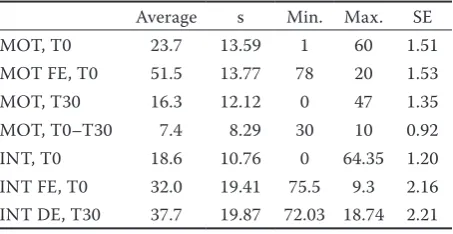
Totally 72 samples were analysed in this part of our work. Average characteristics of semen cryo-preserved in 4 ml are described in Table 1. Average
MOT in T0 was 23.7%, followed by 16.3% in T30. MOT decreased by about 51.5% in frozen-thawed semen in T0 compared to FE. An average decrease of MOT between T0 and T30 was 7.4%. An aver-age INT after thawing was 18.6%.
Table 2 documents the parameters of MOT in T0 and T30 and their decreases between observed times according to the evaluated effects. The high-est MOT was found immediately after thawing, in T0. However, the differences were insignificant in all evaluated groups. The highest MOT in T0 was recorded in Holstein group (26.7%). The ef-fect of breed on bovine semen freezability was confirmed on MOT in T30 with statistical signifi-cance P < 0.05. These results indicate that semen of Holstein bulls is more resistant to the negative effects of cryopreservation in 4 ml volume.
Even though there was no significant effect of MOT in FE on MOT in T0 and T30, the negative impact of cryopreservation was significant (P < 0.05) in ejaculates with higher MOT in FE (80–90%), where higher decrease (54.7%) in this parameter was found.
The effect of thawing protocol, as a factor sig-nificantly (P < 0.05) affecting MOT, was confirmed in MOT in T30, where thawing using Protocol 1 provided better results (19.16%) in comparison to Protocol 2 (11.5%).
[image:4.595.305.532.586.703.2]The change of motility between T0 and T30 can be considered an important indicator of the quality of insemination doses, because motil-ity of most vaginal sperm is diminished within about 30 min after insemination (Brannigan and Lipshultz 2008). The decrease of sperm motility during the thermodynamic test was reported by
Table 1. Average characteristics of semen cryopreserved in 4 ml (n = 72)
Average s Min. Max. SE
MOT, T0 23.7 13.59 1 60 1.51
MOT FE, T0 51.5 13.77 78 20 1.53
MOT, T30 16.3 12.12 0 47 1.35
MOT, T0–T30 7.4 8.29 30 10 0.92
INT, T0 18.6 10.76 0 64.35 1.20
INT FE, T0 32.0 19.41 75.5 9.3 2.16
INT DE, T30 37.7 19.87 72.03 18.74 2.21
Dolezalova et al. (2016). This trait was in our experiment also significantly affected by thawing protocol. Here, the highest decrease was found in Protocol 2 (11.3%), that was significantly higher in comparison to both, Protocol 1 (4.9%; P < 0.01) and Protocol 3 (6.1%; P < 0.05).
Table 3 presents percentage of sperm with intact membranes (INT) in T0 and its changes compared to INT in fresh ejaculate (FE) and INT in diluted semen (DE). Even though there were also found no significant effects of observed groups on INT in T0, we have found significant effects of breed on decrease in INT between T0 and FE (P < 0.05) and between T0 and diluted ejaculate (P < 0.01).
There was no significant effect of MOT in the fresh semen and thawing protocol on INT in all analysed parameters.
Results of semen cryopreservation in 8 ml.
Average characteristics of semen cryopreserved in 8 ml are described in Table 4. Characteristics
[image:5.595.64.533.126.241.2]of the evaluated data set show that average MOT in T0 was 25.1%, followed by 17.9% in T30. MOT decreased by about 49.3% compared to FE and
Table 2. Percentage of motile sperms (MOT) in samples (n = 72) cryopreserved in 4 ml according to the breed, MOT in fresh ejaculate, and thawing protocols. Values are LSM ± SE
Effect Group n MOT, T0 MOT FE, T0 MOT, T30 MOT, T0–T30
Breed Czech FleckviehHolstein 3636 20.7 ± 2.2026.7 ± 2.13 −54.7 ± 2.17−48.7 ± 2.10 13.5 ± 1.86*19.0 ± 1.80* −7.2 ± 1.27−7.7 ± 1.23
MOT, FE higher (80–90%)lower (70–79%) 3933 22.1 ± 2.1125.3 ± 2.18 −48.7 ± 2.09*−54.7 ± 2.16* 15.2 ± 1.7817.3 ± 1.84 −6.9 ± 1.22−8.0 ± 1.26
Thawing protocol
P1 24 24.0 ± 2.26 −51.3 ± 2.59 19.2 ± 2.21* −4.9 ± 1.51**
P2 24 22.8 ± 2.62 −52.6 ± 2.59 11.5 ± 2.21* −11.3 ± 1.51**,*
P3 24 24.2 ± 2.62 −51.2 ± 2.59 18.1 ± 2.21 −6.1 ± 1.51*
MOT = percentage of motile sperms, T0 = immediately after thawing, T30 = 30 min after thawing, FE = fresh ejaculate; P1, P2, P3 = thawing protocol 1, 2, 3
[image:5.595.64.533.324.442.2]statistically significant differences *(P < 0.05), **(P < 0.01)
Table 3. Percentage of sperms with intact membranes (INT) in samples (n = 72) cryopreserved in 4 ml according to the breed, motility in fresh ejaculate, and thawing protocols. Values are LSM ± SE
Effect Group n INT, T0 INT FE, T0 INT DE, T0
Breed Czech FleckviehHolstein 3636 17.6 ± 1.7719.6 ± 1.71 −37.8 ± 3.05*−26.9 ± 2.95* −44.4 ± 2.98**−31.4 ± 2.88**
MOT, FE higher (80–90%)lower (70–79%) 3933 17.5 ± 1.7019.7 ± 1.75 −29.8 ± 2.93−34.9 ± 3.03 −39.7 ± 2.85−36.1 ± 2.95
Thawing protocol
P1 24 17.5 ± 2.10 −33.5 ± 3.63 −39.0 ± 3.54
P2 24 18.1 ± 2.10 −32.8 ± 3.63 −38.4 ± 3.54
P3 24 20.2 ± 2.10 −30.7 ± 3.63 −36.3 ± 3.54
MOT = percentage of motile sperms, INT = percentage of sperms with intact membranes, T0 = immediately after thawing, T30 = 30 min after thawing, FE = fresh ejaculate, DE = diluted ejaculate; P1, P2, P3 = thawing protocol 1, 2, 3
statistically significant differences *(P < 0.05), **(P < 0.01)
Table 4. Average characteristics of semen cryopreserved in 8 ml (n = 72)
Average s Min. Max. SE
MOT, T0 25.1 12.58 2 65 1.40
MOT FE, T0 49.3 12.14 70 5 1.35
MOT, T30 17.9 11.54 0 45 1.28
MOT, T0–T30 7.3 6.34 30 0 0.70
INT, T0 20.9 11.20 5 49.5 1.24
INT FE, T0 32.9 16.65 73.63 5 1.85
INT DE, T30 32.9 24.47 75.9 35 2.72
[image:5.595.305.533.584.701.2]T0. Decrease in MOT in T30 compared to T0 was 7.3%. An average value for INT after thawing was 20.9%, and the decrease of INT between FE and T0 was 32.9%.
Table 5 documents the parameters of MOT in T0 and T30 and their decreases between observed times according to the evaluated effects in semen frozen in 8 ml volume.
Significant effect of breed was confirmed by three parameters, MOT in T0, MOT in T30, and the de-crease of MOT during the cryopreservation process at significance level P < 0.05. The Holstein semen showed better results compared to Czech Fleckvieh semen. The higher MOT in both T0 (29.0 vs 23.5%) and T30 (22.1 vs 15.9%) and the lower difference in MOT between FE and T0 (46.3 vs 52.4%) also manifest better freezability of Holstein semen.
There was found also a significant effect of MOT in FE. Group with higher MOT (80–90%) reached
significantly (P < 0.01) higher MOT in T0 com-pared to the group of lower motility (70–79%), particularly 30.1% vs 22.3%, as well as in T30 (22.9% vs 15.1%).
Regarding the effect of thawing, there were also differences at the significance level P < 0.05 between P1 and P2 thawing protocols in MOT in T0, MOT in T30, and the decrease of MOT during the cryopreservation process. Unlike re-sults of cryopreservation in 4 ml, there was found higher MOT in T0 (31.1%) in P1 group compared to P2 group (22.4%). However, similar results as in 4 ml volume were obtained in T30 (P1 – 23.3% vs P2 – 15.6%). Also difference in MOT in FE and T0 between these two groups was lower in P1 (44.4%) if compared to P2 (53.2%).
[image:6.595.65.533.126.241.2]Table 6 illustrates percentage of sperm cells with intact membranes in sperm frozen-thawed in 8 ml. There was found only one significant
Table 5. Percentage of motile sperms (MOT) in samples (n = 72) cryopreserved in 8 ml according to the breed, MOT in fresh ejaculate, and thawing protocols. Values are LSM ± SE
Effect Group n MOT, T0 MOT FE, T0 MOT, T30 MOT, T0–T30
Breed Czech FleckviehHolstein 3636 23.5 ± 1.76*29.0 ± 1.88* −52.4 ± 1.79*−46.3 ± 1.91* 15.9 ± 1.57*22.1 ± 1.67* −7.6 ± 1.02−6.9 ± 1.09
MOT, FE higher (80–90%)lower (70–79%) 4824 22.3 ± 1.58**30.1 ± 2.07** −48.9 ± 1.60−49.7 ± 2.10 15.1 ± 1.41**22.9 ± 1.85** −7.3 ± 0.92−7.2 ± 1.20
Thawing protocol
P1 24 31.1 ± 2.19* −44.4 ± 2.22* 23.3 ± 1.951* −7.8 ± 1.27
P2 24 22.4 ± 2.19* −53.2 ± 2.22* 15.6 ± 1.95* −6.8 ± 1.27
P3 24 25.2 ± 2.19 −50.4 ± 2.223 18.1 ± 1.95 −7.2 ± 1.27
MOT = percentage of motile sperms, T0 = immediately after thawing, T30 = 30 min after thawing, FE = fresh ejaculate, P1, P2, P3 = thawing protocol 1, 2, 3
statistically significant differences *(P < 0.05), **(P < 0.01)
Table 6. Percentage of sperms with intact membranes (INT) in samples (n = 72) cryopreserved in 8 ml according to the breed, MOT in fresh ejaculate, and thawing protocols. Values are LSM ± SE
Effect Group n INT, T0 INT FE, T0 INT DE, T0
Breed Czech FleckviehHolstein 3636 22.1 ± 1.6720.8 ± 1.81 −37.1 ± 2.48*−28.5 ± 2.65* −34.4 ± 3.86−32.4 ± 4.12
MOT, FE higher (80–90%)lower (70–79%) 4824 19.2 ± 1.5223.7 ± 2.00 −32.6 ± 2.23−32.9 ± 2.93 −31.0 ± 3.46−35.9 ± 4.54
Thawing protocol
P1 24 22.3 ± 2.12 −32.0 ± 3.09 −32.7 ± 4.80
P2 24 17.6 ± 2.12 −36.6 ± 3.09 −37.3 ± 4.80
P3 24 24.5 ± 2.12 −29.7 ± 3.09 −30.4 ± 4.80
MOT = percentage of motile sperms, INT = percentage of sperms with intact membranes, T0 = immediately after thawing, T30 = 30 min after thawing, FE = fresh ejaculate, DE = diluted ejaculate; P1, P2, P3 = thawing protocol 1, 2, 3
[image:6.595.65.532.600.714.2](P < 0.05) effect of breed on the decrease of INT during the cryopreservation process. Semen of Holstein breed showed lesser damage of sperm membranes (difference 28.5%) compared to Czech Fleckvieh (37.1%).
The motility of sperm in FE had no statistically significant effect on any parameters of INT and also the thawing protocol did not affect INT and their changes during the cryopreservation process.
DISCUSSION
The present study shows significant effects of breed, progressive sperm motility (MOT) of fresh semen, and thawing protocol on MOT and integrity of sperm membranes (INT) of semen frozen-thawed in different large volumes (4 ml and 8 ml) and their changes occurring during the cryopreservation process.
Sperm quality is influenced by many internal factors like breed, variation between individuals, and age of sire. Known is also the effect of cattle breed on sperm survival in semen frozen in French 0.25 ml ministraws (Beran et al. 2011). Different demands on semen processing of donors of different breeds have also been described (Holt et al. 2015). However, according to our knowledge, the effect of breed on semen freezability in large volumes has not been described yet. In our study, we have found significant effects (P < 0.05; P < 0.01) of breed on several indicators of freezability of bull semen frozen in both volumes.
According to the parameters of motility and sperm membrane integrity, the Holstein semen seems to be more suitable for freezing in large volumes, where it is more able to maintain MOT in time and in comparison to FE parameters. Beran et al. (2011) reported better survival of sperm during the cryopreservation process in Czech Fleckvieh breed compared to Holstein breeds. However, this was also affected by the age of donor bulls, where young Holstein bulls showed better parameters of motility compared to old bulls. There was found an opposite effect of age in Czech Fleckvieh in their study. In our study young bulls of both breeds were used, therefore the effect of breed found might be in relation to the age of bulls. Beran et al. (2011) suppose that the difference in semen freezability may be determined by different levels of metabolism. Thurston et al. (2002) also suggest
that the sensitivity of sperm to cryopreservation might be partly related to genetic factors, which could explain variations among species, breeds, and individuals.
Padrik et al. (2012) reported high correlation between HOS test and sperm motility, and non-return rates, which was confirmed by Ramu and Jeyendran (2013). Nevertheless, there was found no effect of MOT in FE on INT after thawing, measured by HOS test, and on dynamics of their changes at both observed volumes.
Indeed, MOT in FE had no significant effect on MOT in samples frozen-thawed in 4 ml, al-though it significantly (P < 0.05) affected decrease of MOT during the cryopreservation. However, insignificantly higher MOT in both T0 and T30 was found in samples coming from ejaculates with higher MOT in fresh semen. Although Brinsko et al. (2000) reported correlations between MOT in fresh samples and sperm motility in frozen samples, this part of our study did not confirm their findings.
On the other hand, there was found a significant effect of MOT in FE on MOT of semen frozen-thawed in 8 ml. The effect of volume on sperm survivability was described by Horvath et al. (2007). Thawing protocol significantly (P < 0.05) affected parameters of MOT, where MOT in T30 obtained using P1 protocol was superior compared to P2 pro-tocol in 4 ml volumes. Also the decrease of MOT between fresh semen and frozen-thawed semen was significantly affected by the thawing protocol, where we have found the best results using P1.
cellular organelles and components, including mammalian semen, and are probably linked to the bioenergetic system of the cell (Kohsaka et al. 1992). Exposure of thawed sperm during the time of semen thawing to the temperature 40°C may cause damage of these systems.
Even though the average MOT and INT were low in comparison to standards commonly used by AI centres in commercial AI straws produc-tion, we can confirm survival of bull sperm cells expressed by their motility and sperm membrane functions maintenance during cryopreservation in large volumes that have been previously reported by Arav (2002) and Saragusty (2009).
Based on our findings, Holstein semen seems to be more suitable for freezing in large volumes than the Czech Fleckvieh one, however it might have also been caused by age of the bulls. Therefore subsequent study would be appropriate. Semen with higher fertility shall be given preferences to this type of cryopreservation. According to our results, we can recommend using P1 thawing pro-tocol to thaw bull semen frozen in large volumes.
CONCLUSION
We confirmed the influence of thawing method on motility in semen frozen in large volumes. The effect of breed on MOT and INT in samples fro-zen in large volumes was found. It is known that success of semen cryopreservation is determined by many factors, such as composition of semen extender, cooling, equilibration, and freezing rate. The decrease of MOT and INT in semen frozen-thawed in large volumes may be reduced by using “more friendly” techniques of semen processing. Once these techniques are known, the thawing protocols shall be revised repeatedly.
REFERENCES
Arav A., Yavin S., Zeron Y., Natan D., Dekel I., Gacitua H. (2002): New trends in gamete’s cryopreservation. Mo-lecular and Cellular Endocrinology, 187, 77–81. Barth A.D., Bowman B., Bowman P.A. (1988):
Determina-tion of the best practical method of thawing bovine se-men. Canadian Veterinary Journal, 29, 366–369. Beran J., Stadnik L., Duchacek J., Tousova R., Louda F.,
Stolc L. (2011): Effect of bulls’ breed, age and body
condi-tion score on quantitative and qualitative traits of their semen. Acta Universitatis Agriculturae et Silviculturae Mendelianae Brunensis, 59, 37–44.
Beran J., Stadnik L., Bezdicek J., Louda F., Citek J., Ducha-cek J. (2012): Effect of sire and extender on sperm motility and share of live or dead sperm in bulls’ fresh ejaculate and in AI doses after thawing. Archiv für Tierzucht, 55, 207–218.
Brannigan R., Lipshultz L. (2008): Sperm transport and capacitation. The Global Library of Women’s Medicine. Available at http://editorial.glowm.com/?p=glowm.cml/ section_view&articleid=315 (accessed May 13, 2017). Brinsko S.P., Van Wagner G.S., Graham J.K., Squires E.L.
(2000): Motility, morphology and triple stain analysis of fresh, cooled and frozen-thawed stallion spermatozoa. Journal of Reproduction and Fertility, 56, 111–120. Dolezalova M., Stadnik L., Biniova Z., Duchacek J., Stupka R.
(2016): Equilibration and freezing interactions affecting bull sperm characteristics after thawing. Czech Journal of Animal Science, 61, 515–525.
Gaciuta H., Arav A. (2005): Successful pregnancies with directional freezing of large volume buck semen. The-riogenology, 63, 931–938.
Gloria A., Carluccio A., Contri A., Wegher L., Valorz C., Robbe D. (2013): The effect of chamber on kinetic results in cryopreserved bull spermatozoa. Andrology, 1, 879–885. Holt W.V., Del Valle I., Fazeli A. (2015): Heat shock protein A8 stabilizes the bull sperm plasma membrane during cryopreservation: Effects of breed, protein concentration, and mode of use. Theriogenology, 84, 693–701. Horvath A., Miskolczi E., Mihalffy S., Osz K., Szabo K.,
Urbanyi B. (2007): Cryopreservation of common carp (Cyprinus carpio) sperm in 1.2 and 5 ml straws and oc-currence of haploids among larvae produced with cryo-preserved sperm. Cryobiology, 54, 251–257.
James P.S., Wolfe C.A., Mackie A., Ladha S., Prentice A., Jones R. (1999): Lipid dynamics in the plasma membrane of fresh and cryopreserved human spermatozoa. Human Reproduction, 14, 1827–1832.
Jeyendran R.S., Van der Ven H.H., Perez-Pelaez M., Crabo B.G., Zaneveld L.J.D. (1984): Development of an assay to assess the functional integrity of the human sperm mem-brane and its relationship to other semen characteristics. Journal of Reproduction and Fertility, 70, 219‒225. Kohsaka T., Takahara H., Tagami S., Sasada H., Masaki J.
(1992): A new technique for the precise location of lac-tate and malate dehydrogenases in goat, boar and water buffalo spermatozoa using gel incubation film. Journal of Reproduction and Fertility, 95, 201–209.
organelles during heat shock. Journal of Cell Biology, 122, 1267–1276.
Li Y., Sun M., Zhu J., Jiao G., Lin J., Dong H., Tan J., Zhou J. (2017): Species difference in the expression of Fas and Fas ligand in mature mammalian spermatozoa. Czech Journal of Animal Science, 62, 519–526.
Maxwell W.M.C., Parrilla I., Caballero I., Garcia E., Roca J., Martinez E.A., Vazquez J.M., Rath D. (2007): Retained functional integrity of bull spermatozoa after double
freezing and thawing using PureSperm® density
gradi-ent cgradi-entrifugation. Reproduction in Domestic Animals, 42, 489–494.
Mortimer S.T. (2000): CASA – practical aspects. Journal of Andrology, 21, 515–524.
Padrik P., Hallap T., Kaart T., Bulitko T., Jaakma U. (2012): Relationships between the results of hypo-osmotic swell-ing tests, sperm motility, and fertility in Estonian Hol-stein dairy bulls. Czech Journal of Animal Science, 57, 490–497.
Pons-Rejraji H., Bailey J.L., Leclerc P. (2009): Cryopreser-vation affects bovine sperm intracellular parameters associated with capacitation and acrosome exocytosis. Reproduction, Fertility and Development, 21, 525−537. Ramu S., Jeyendran R.S. (2013): Thy hypo-osmotic swelling
test for evaluation of sperm membrane integrity. Methods of Molecular Biology, 927, 21–25.
Rastegarnia A., Shahverdi A., Rezaei T.T., Ebrahimi B., Shafipour V. (2013): Effect of different thawing rates on post-thaw viability, kinematic parameters and chromatin structure of buffalo (Bubalus bubalis) spermatozoa. Cell Journal, 14, 306–313.
Saragusty J., Gaciuta H., Pettit M.T. (2007): Directional freezing of equine semen in large volumes. Reproduction in Domestic Animals, 42, 610–615.
Saragusty J., Gacitua H., Zeron Y., Rozenboim I., Arav A. (2009): Double freezing of bovine semen. Animal Repro-duction Science, 115, 10–17.
Si W., Hildebrandt T.B., Reid C., Krieg R., Ji W., Fassben-der M., Hermes R. (2006): The successful double cryo-preservation of rabbit (Oryctolagus cuniculus) semen in large volume using the directional freezing technique with reduced concentration of cryoprotectant. Therio-genology, 65, 788–798.
Sichtar J., Nehasilova A., Simonik O., Bubenickova F. (2017): Effect of two freezing extenders on characteristic of fresh
and frozen-thawed semen in endangered Old Kladruber stallions – a pilot study. Czech Journal of Animal Science, 62, 227−233.
Simonik O., Sichtar J., Krejcarkova A., Rajmon R., Stad-nik L., Beran J., Dolezalova M., Biniova Z. (2015): Com-puter Assisted Sperm Analysis – the relationship to bull field fertility, possible errors and their impact on outputs: A review. Indian Journal of Animal Sciences, 85, 3–11. Slanina T., Miskeje M., Tirpak F., Blaszczyk M. (2018): Effect
of taurine on turkey (Meleagris gallopavo) spermatozoa viability and motility. Czech Journal of Animal Science, 63, 127–135.
Stadnik L., Rajmon R., Beran J., Simonik O., Dolezalova M., Sichtar J., Stupka R., Folkova P. (2015): Influence of selected factors on bovine spermatozoa cold shock resistance. Acta Veterinaria Brno, 84, 125–131.
Tasdemir U., Buyukleblebici S., Tuncer P.B., Coskun E., Ozgurtas T., Aydin A.N., Buyukleblebici O., Gurcan I.S. (2013): Effects of various cryoprotectants on bull sperm quality, DNA integrity and oxidative stress parameters. Cryobiology, 66, 38–42.
Thurston L.M., Watson P.F., Holt W.V. (2002): Semen cryo-preservation: A genetic explanation for species and indi-vidual variation? Cryo Letters, 23, 255–262.
Tvrda E., Greifova H., Mackovich A., Hashim F., Lukac N. (2018): Curcumin offers antioxidant protection to cryo-preserved bovine semen. Czech Journal of Animal Sci-ence, 63, 247–255.
Underwood S.L., Bathgate R., Maxwell W.M.C., Evans G. (2009): In vitro characteristics of frozen-thawed, sex sorted bull sperm after refreezing or incubation at 15 or 37°C. Theriogenology, 72, 1001–1008.
Underwood S.L., Bathgate R., Maxwell W.M.C., Evans G. (2010): Birth of offspring after artificial insemination of heifers with frozen-thawed, sex-sorted, re-frozen-thawed bull sperm. Animal Reproduction Science, 118, 171–175. Verstegen J., Iguer-Ouada M., Onclin K. (2002): Computer assisted semen analyzers in andrology research and vet-erinary practice. Theriogenology, 57, 149–179.
Watson P.F. (2000): The causes of reduced fertility with cryopreserved semen. Animal Reproduction Science, 60, 481–492.