Empirical Bayes Prediction for Variables Process
Mean in Sequential Sampling Plan
Khanittha Tinochai,Saowanit Sukparungsee,Katechan Jampachaisri,and Yupaporn Areepong
Abstract—The objective of this study is to utilize the Empirical
Bayes in sequential sampling plan and compare to the traditional approaches, single sampling plan and sequential sampling plan by variables when data are normally distributed under unknown mean but known variance. The probability of acceptance for the lot (Pa) and the average number of sample
size (ASN) are considered as criteria of comparison. It is shown that the proposed plan yielded the average number of sample size smaller than single sampling plan and sequential sampling plan by variables and provided the probability of acceptance the lot higher than the traditional approach. Moreover, the Empirical Bayes in sequential sampling plan is given the approximation of the Pa and ASN more precise than the single
sampling plan and sequential sampling plan by variables.
Index Terms—Empirical Bayes, Single Sampling Plan, Sequential Sampling Plan, Variables Process Mean
I. INTRODUCTION
The statistical analysis was applied in the acceptance sampling plan for inspecting large amounts and it was often impossible to inspect all the products in the batch which can be reduced the producer’s risk and consumer’s risk. The acceptance sampling plan was developed by Dodge and Romig in 1920. It can be classified by three main points as follows. Firstly, there is non-inspection. Next, 100% inspection and thirdly, random inspection, or sampling plan, meaning samples are taken randomly for possible defects of products and are then subject to acceptance or rejection. Advantages for acceptance sampling plan, the majority of the inspectors apply theacceptance sampling plan for testing for destruction, auditing in case of large lots or using suppliers with a good quality history because this method might reduce the damage by less handling of the products, reduced errors, and saves costs and time in the manufacturing process. The acceptance sampling plan by variables is the quantitative data which can be measured by a continuous scale and assumed to be a normal distribution. [1] The advantages are the variables sampling plan, which the production in the lots provide more information than the
Khanittha Tinochaiis with the Department of Applied Statistics, Faculty of Applied Science, King Mongkut’s University of Technology North Bangkok,Bangkok 10800, Thailand (e-mail: [email protected])
Saowanit Sukparungsee is with the Department of Applied Statistics, Faculty of Applied Science, King Mongkut’s University of Technology North Bangkok,Bangkok 10800, Thailand
(e-mail:[email protected])
Katechan Jampachaisri is with the 2Department of Mathematics, Faculty of Science, Naresuan University, Phitsanulok 65000, Thailand (e-mail:
Yupaporn Areepong is with the Department of Applied Statistics, Faculty of Applied Science, King Mongkut’s University of Technology North Bangkok,Bangkok 10800, Thailand
(e-mail: [email protected])
attributes, with the small sample size and high level of acceptable quality levels (AQL). The types of variable sampling plans can be classified by variables sampling for the process parameters and estimation proportion nonconforming in the lot. Then, the part for process parameters analysis is often assessed by process mean which the average is utilized for comparison in acceptance sampling plan. Balamurali et al. [2]considered the repetitive group in the variables sampling plan and assumed normal and lognormal distributions with known and unknown variances. The proposed plan was compared with the single sampling plan, double sampling plan and sequential sampling plan to minimize the average sample number (ASN) at acceptable quality levels (AQL) and at limiting the quality levels (RQL). Sankle and Singh [3] studied the variable single sampling plan when the data were correlated with a known variance. Thus, the sequential sampling plan often provides a small sample size, which is benefit for cost saving. [2] In addition, the sequential sampling plan in variables can be performed either one-tailed or two tailed testing by indicating specification limits for upper testing, lower testing and double testing, respectively. Lam et al. [4] studied Bayesian approach in sequential sampling plan by variables assuming normally distributed data with unknown mean but known variance.
The purpose in this study is testing upper specification limit (USL) of the process mean using the acceptance sampling plan and compared with the single sampling plan, the sequential sampling plan by variables and Empirical Bayes in sequential sampling plan. In section 2, the variables process mean and steps for simulation are expressed. Next section 3 and section 4, the traditional plans, the single sampling plan and the sequential sampling plan by variables are illustrated respectively. The Empirical Bayes in sequential sampling plan is interpreted in section 5. The final part is the simulation data and conclusion.
II. VARIABLE PROCESS MEAN
The testing upper specification limit (USL) for variables process mean is specified by the acceptance control chart which is considered under six-sigma quality level. Also, it has 3.4 defectives per million opportunities
( )
p
then the process mean assume shift to ±1.5𝜎. The data are assumed normal distribution:X
N
(
,
2)
,
the process mean has parameters as follows:
1 is acceptable process level (APL) and
2 is rejectable process level (RPL). Thus, it can be estimated as follows.1 2
( )
1.5
(
)
xAPL
x
RPL
ACL Z
(1) Where ACL is acceptance control limits, it is defined by1
( )
xACL
APL
Z
whenZ
N
(0,1)
. The producer’s risk( )
is the probability of rejection at the APL and the consumer’s risk( )
is the probability of acceptance at the RPL. [11]III. SINGLE SAMPLING PLAN
The single sampling plan by variables in process mean is the classical method in the acceptance sampling plan. This plan can be calculated the sample size
n
and the acceptance limit
X
a as follows.
2
2 1
2 1
a
n
Z
Z
X
Z
Z
Z
Z
(2)The criterion for comparison the results are as follows. 1. Probability of acceptance (Pa) is the probability of
acceptance of the process when the quality level is defined. The graphs of probability of acceptance against the process mean are called the operating characteristic (OC) curve. 2. Average sample number (ASN) is the average sample size is inspected per lot. The graphs of the average sample number are against the process mean it is called the ASN curve. The making decision for single sampling plan is accept the lot if
a
x
X
or to reject the lot ifx
X
a,
the probability ofacceptance the lot is defined by
P z
( )
where
a
xz
x
X
andASN
n
.
[12]IV. SEQUENTIAL SAMPLING PLAN BY VARIABLES The sequential sampling plan by variables can be tested by the specification limits for upper, lower and double respectively. The samples of this method are taken sequentially from the lot. The samples are taken one sample then called and then item-by-item sequential sampling and more than one sample is taken and then called group sequential sampling. The sequential sampling for the item-by-item plan was developed from the sequential probability ratio test: SPRT) by Wald in 1947. [1] The criteria for inspection of the samples are considered by acceptance limit line (Y1) and rejection limit line (Y2) which are shown as
follows.
1 1
2 2
Y
h
s n
Y
h
s n
(3) Specification h1 is the intercept of acceptance line, h2 isthe intercept of rejection line, s is the slope of the lines and n
is the sample sizes. Thus, the making decision is accept the lot if 1
1
,
n i i
x
Y
to reject the batch if 21
n i i
x
Y
and continue sampling unit if 1 2
1
<
n i i
Y
x
Y
. The evaluation the results are the operating characteristic (OC) curve and the average sample number (ASN). The Probability of acceptance (Pa) and the average samplenumber (ASN) are calculated as follows. [13]
1 1
1 1
w
a w w
P
(4)
2 2
2
2 1 2 1
2 1
log 1
2 2
a
L L a
La P
ASN
(5)
where
h
1
Lb
2
2
1
,
22 2 1
,
h
La
2 1
2,
s
a
log 1
,
log 1
,
b
w
2
12
2
1
and
L
2.3026.
V. EMPIRICAL BAYES PREDICTION IN SEQUENTIAL SAMPLING PLAN
The Bayesian approach is the one of methods for estimating parameters when assuming unknown parameters
parameters, called prior distribution function:
|
and are supposed known hyper-parameters
.
Also, the Bayes’ theorem can be given by likelihood function:L
multiple with the prior distribution function called the posterior distribution function:
h
|
x
as follows.
|
|
|
L
h
x
L
M x
On the other hand, when the unknown hyper-parameters are estimated from the observed data it is called Empirical Bayes (EB) approach. In addition, the hyper-parameters can be obtained from the marginal distribution function with using the maximum likelihood (ML) method as follows.
|
|
|
M x
f x
d
Assuming the data are continuously characteristics. [5] However, the Empirical Bayes method is developed for the estimating new observed data or prediction a future observation
(
x
n1)
when based on full dataset1 2 3
(
x x x
,
,
, ...,
x
n orx
),
called the Empirical Bayes prediction approach. Therefore, the prediction a future observation can obtained from posterior predictive distribution function is provided by
1 1
(
n| )
n
|
|
.
h x
x
f x
h
x d
Assuming the samples data
( )
x
are continuous characteristics and independently andf x
n1|
is the function of the future observation. [14]In this study, we consider
X
N
( ,
02),
unknown mean
but known variance(
02)
and assume informative prior on
:
N
( ,
2)
when
is parameter,
and
2are hyper-parameters. The steps for finding the hyper-parameter estimators can be accorded as follows: firstly, specification the marginal likelihood distribution function is provided by2
( | ,
)
( | )
( )
M x
f x
d
2 2 0 1 2 2 2 1 2 22 2 2
2 2 2 2 2
0 1 0 0 1
1 2 1 ( ) 2 2 2 0 1 ( ) 2 2 1
2( ) 2 ( )
2 2 0
1
( | ,
) =
2
1
2
(
)
n i i n n n i i i i x nx x nx
n n
M x
e
e
d
e
n
(6) Next, this is not a closed form then can be determined by ML method and then the likelihood function ofx
given
and
2 is given by2 2
( | , )
( | , )
L x
M x
.Then, the hyper-parameters estimators of the
and
2 with ML method are
ˆ
x
and
ˆ
2
02n
respectively. Thus, the both
ˆ
and
ˆ
2are replaced in the posterior distribution function. For the stage of the estimation parameter, it can be obtained by the posterior distribution function as follow.
2 2 2 2 0 1 1 2 2 2 2 2 2 0 1 22 2 2 2
0 0
2 2 2 2
0 0
1 1
( ) ( ˆ)
2 2
2 2
1 1 ˆ
( ) ( ) ˆ 2 2 ˆ ˆ ˆ ˆ 2 ˆ
( | )
( )
( )
1
1
ˆ
2
2
n i n n i x x n nx n
h
x
L
e
e
e
e
(7) Thus, the posterior distribution function of
|
x
is normal distribution as follows
|
x
N M H
,
where
M
ˆ
02
nx
ˆ
2
n
ˆ
2
02
and
2 2 2 2
0
ˆ
ˆ
0.
H
n
1 2 2
1 2 0
1 1
2 2
2
2 2 2 2
0 0
2 2 2 2
0 0
1 1
1 2 2
( )
0 2
2 2 2
0
ˆ
ˆ ˆ
ˆ
2 ˆ
2 0
(
| )
|
|
ˆ
1
ˆ
2
2
1
2 (
)
n
n n
x
n nx
n
h x
x
f x
h
x d
n
e
e
d
H
2 1 2 0 12
1
2(H ) xn M
e
(8) Also, the posterior predictive distribution function is normal distribution as follows
2
1
|
(
,
0)
n
x
x
N M H
.where the mean of posterior predictive distribution function
1
(
n| )
,
E x
x
M
the same as the mean of posteriordistribution function and the variation of posterior predictive distribution function is
V x
(
n1| )
x
H
02.
Moreover, the Empirical Bayes prediction can apply in the acceptance sampling plan which is utilized in the part of the sequential sampling plan. Then, the mean of posterior distribution function of this method is estimated sequentially and is compared with the acceptance line and the rejection line. The criteria for the making decision is accept the lot if1 1
(
n| )
E x
x
Y
, to reject the lot ifE x
(
n1| )
x
Y
2 andcontinue sampling unit when
Y
1
E x
(
n1| ) <
x
Y
2. [15] VI. NUMERICAL COMPARISONS OF PERFORMANCE The data are simulated under normal distribution:0 1
X
N
( , )
with unknown mean( )
but known variance (
02=1), assuming informative priors2
( ,
)
N
which the hyper-parameters
and
2are estimated by ML method are given by
ˆ
= 1.5027 and2
ˆ
= 0.02. The lot size isN
= 1,000, the sample size isn
= 50 and the number of iteration ist
= 1,000. The [image:4.595.49.293.49.225.2]proportion of defective at APL is
p
= 0.00034 under six-sigma process,
= 0.05 and
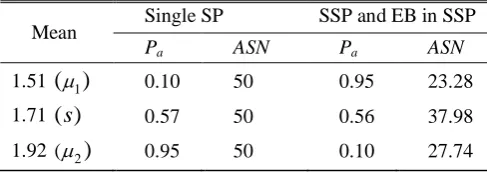
= 0.10. In addition, [image:4.595.305.549.105.191.2]TABLE I show the average
x
and the mean of posterior predictive distribution
E x
(
n1| )
x
are specified by the single sampling plan (Single SP), sequential sampling plan by variables (SSP) and EB in sequential sampling plan (EB in SSP) and are classified by the probability of acceptance (Pa) and the average sample number (ASN) as follows.TABLE I
THE PA AND ASN AT1
,
SAND 2FOR SINGLE SP, SSPAND EB IN SSP
Mean Single SP SSP and EB in SSP
Pa ASN Pa ASN
1.51
( )
1 0.10 50 0.95 23.28 1.71( )
s
0.57 50 0.56 37.98 1.92 (2)
0.95 50 0.10 27.74 For the testing single sampling plan, the acceptance limit isX
a= 1.6857 refer to (2). Thus, the decision is to accept the lot ifx
X
a or to reject the lot ifx
X
a.
The comparison between mean
x
andX
a= 1.6857 found that are to reject the lot for all of the means. The ASN for this plan is 50 for all of the means.The hypothesis testing USL for the process mean with the sequential sampling plan is given by
H
0:
1 vs.1 2
,
H
:
2
1
.
The estimation
1(APL),
2 (RPL) and the slope S are approximated refer to (1) which are
1= 1.51 and
2= 1.92 in TABLE I. Also, the Pa forsingle SP, SSP and EB in SSP are classified by mean at
APL, slope S and RPL. The Pa for single sampling plan
depended on mean. In contrast, the SSP and EB in SSP provided the Pa at the
1 equal to 0.95 and at the
2 equalto 0.10. The ASN of the single sampling plan is 50 per lot for all of averages when ASN of the SSP and EB in SSP are a smaller than single sampling plan and the both are equality and peak at the slope S.
Fig. 1. Comparison of the Cumulative of Mean of SSP with
1
,
Fig. 2. Comparison of the Cumulative of
E x
(
n1| )
x
with1
,
[image:5.595.47.269.325.525.2]Y
Y
2and classification by the Sample Size
n
Fig. 3. Comparison Pa of Single SP, SSP and EB in SSP
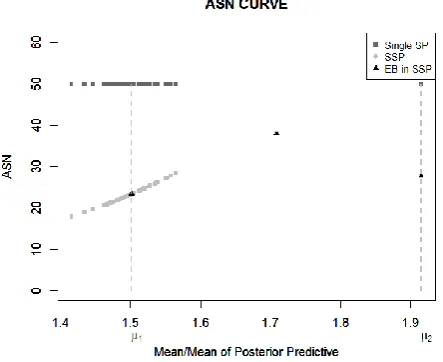
Fig. 4. Comparison ASNof Single SP, SSP and EB in SSP
We consider Fig. 1. under
H
0:
1 this method is compared with the cumulative of mean( )
x
,
Y
1 andY
2which are classified by sample size
n
.
WhenY
1 andY
2can determine from refer to (3) where
h
1= 5.4387,2
h
= 6.9826 and S = 1.7114. Therefore, when the sample size isn
= 28 found that the cumulative of mean is less than1
Y
and then to acceptH
0 or to accept the lot.We consider Fig. 2. under
H
0:
1 the cumulative of1
(
n| )
E x
x
compare with theY
1 andY
2 when following by sample size
n
. At the sample size isn
= 27, the1
(
n| )
E x
x
is less than Y1 and then to acceptH
0or toaccept the lot.
From Fig. 3. the Pa is compared with the single SP, SSP
and EB in SSP found that the single SP provides the smallest Pa and trend to increase when large the average.
However, the Pa of the SSP and EB in SSP trended to
decrease when the mean are reduced. The Pa of the SSP is
given the high and has a wider range than EB in SSP. The Pa
for EB in SSP have nearly 0.95 and are given the narrow range that means the product’s risk a smaller than SSP.
We consider Fig. 4. the ASN are compared by the three methods with mean/ mean of posterior predictive distribution. The single SP provides the highest ASN which is 50 per lot and the ASN of SSP has between 20 and 28 per lot. In contrast, the EB in SSP are given the ASN around 23 per lot. It can see that the propose plan provides the least
ASN.
VII. CONCLUSION
This paper reviewed the testing USL for process mean of the single SP, the SSP and propose plan. The criteria of comparison are the Pa and ASN. The majority result of the
propose plan are provided the high Pa, small the ASN and
more precise than the traditional approach. It is clear that the EB in SSP reduce the product’s risk and safe cost for inspection products in the lot.
REFERENCES
[1] D.C. Montgomery, Statistical Quality Control: A Modern Introduction. (6th ed). New York: Jonh Wiley & Sons. 2009. [2] S. Balamurali, H. Park, C.-H. Jun, K.-J. Kim and J. Lee, “Designing
of Variables Repetitive Group Sampling Plan Involving Minimum Average Sample Number,” Communications in Statistics Simulation and Computation, vol. 34, pp. 799-809, 2005.
[3] R. Sankle and J.R. Singh, “Single Sampling Plans for Variables Indexed by AQL and AOQL with Measurement Error,” Journal of Modern Applied Statistical Methods, vol. 11, no. 2, pp. 396-406, 2012.
[4] Y. Lam, K.-H. Li, W.-C. lp and H. Wong, “Sequential variable sampling plan for normal distribution,” European Journal of Operational Research, vol. 172, no. 1, pp. 127–145, 2006.
[5] B.P. Carlin, and T.A. Louis, Bayesian Methods for Data Analysis. (3rd ed). United States of America: Chapman & Hall/CRC, 2009. [6] R.G. Krutchkoff, “Empirical Bayes Estimation.” American Statistical
Association, vol. 26, no. 5, pp. 14-16, 1972.
[7] G. Casella, “An Introduction to Empirical Bayes Data Analysis.”
American Statistical Association, vol. 39, no. 2, pp. 83-87, 1985. [8] S.S. Gupta and T. Liang, “On Empirical Bayes selection rules for
[image:5.595.48.270.567.748.2][9] M.J. Khaledi and F. Rivaz, Empirical Bayes spatial prediction using a Monte Carlo EM algorithm,” Statistical Methods and Applications, vol. 18, no. 1, pp. 35-47, 2009.
[10] Y. Xu, J. Choi and S. Dass, “Sequential Bayesian Prediction and Adaptive Sampling Algorithms for Mobile Sensor Networks,” IEEE Transactions on Automatic Control, vol. 57, no. 8, pp. 2078-2084, 2012.
[11] T. Taherian and M. B. Asl, “Capability Analysis and use of Acceptance and Control Charts in the 6-Sigma in Pharmaceutical Industries Case Study: Behestan Tolid
Pharmaceutical Co,” International Journal of Applied Information Systems (IJAIS), vol. 11 no. 5, pp. 2249-0868, 2016.
[12] G.S. Narayanan and V. Rajarathinam, “A Procedure for the Selection of Single Sampling Plans by Variables Based on Pareto Distribution,” Journal of Quality and Reliability Engineering, Vol. 2013,2013, Article ID 808741,5 pages. http://dx.doi.org/10.1155/2013/808741 [13] E.G. Schilling and D.V. Neubauer, Acceptance Sampling in Quality
Control. (2nd ed) United States of America: Chapman & Hall/CRC. 2009.
[14] B. Pradhan and D. Kundu, “Bayes estimation and prediction of the two-parameter gamma distribution,” Journal of Statistical Computation and Simulation. vol. 81, no. 9, pp. 1187-1198, 2011. [15] B.P. Carlin, J.B. Kadane, and A.E. Gelfand, Approaches for optimal