A bespoke mobile application for the
longitudinal assessment of depression
and mood during pregnancy: protocol of
a feasibility study
Jose Salvador Marcano Belisario,1 Kevin Doherty,2 John O'Donoghue,1
Paul Ramchandani,3 Azeem Majeed,4 Gavin Doherty,2 Cecily Morrison,1 Josip Car1
To cite: Marcano Belisario JS, Doherty K, O'Donoghue J, et al. A bespoke mobile application for the longitudinal assessment of depression and mood during pregnancy: protocol of a feasibility study. BMJ Open 2017;7:e014469. doi:10.1136/ bmjopen-2016-014469
►Prepublication history and additional material are available. To view these files please visit the journal online (http:// dx. doi. org/ 10. 1136/ 10. 1136/ bmjopen- 2016- 014469).
Received 26 September 2016 Revised 21 December 2016 Accepted 15 March 2017
1Global eHealth Unit, Department
of Primary Care and Public Health, Imperial College London, London, UK
2School of Computer Science
and Statistics, University of Dublin Trinity College, Dublin, Ireland
3The Centre for Mental Health,
Department of Medicine, Imperial College London, London, UK
4Department of Primary Care,
Imperial College London, London, UK
Correspondence to
Dr Jose Salvador Marcano Belisario;
jose. marcano- belisario10@ imperial. ac. uk
AbstrAct
Introduction Depression is a common mental health disorder during pregnancy, with important consequences for mothers and their children. Despite this, it goes undiagnosed and untreated in many women attending antenatal care. Smartphones could help support the prompt identification of antenatal depression in this setting. In addition, these devices enable the implementation of ecological momentary assessment techniques, which could be used to assess how mood is experienced during pregnancy. With this study, we will assess the feasibility of using a bespoke mobile application (app) running on participants’ own handsets for the longitudinal (6 months) monitoring of antenatal mood and screening of depression.
Methods and analysis We will use a randomised controlled study design to compare two types of assessment strategies: retrospective + momentary (consisting of the Edinburgh Postnatal Depression Scale plus five momentary and two contextual questions), and retrospective (consisting of the Edinburgh Postnatal Depression Scale only). We will assess the impact that these strategies have on participant adherence to a prespecified sampling protocol, dropout rates and timeliness of data completion. We will evaluate differences in acceptance of the technology through a short quantitative survey and open-ended questions. We will also assess the potential effect that momentary assessments could have on retrospective data. We will attempt to identify any patterns in app usage through the analysis of log data.
Ethics and dissemination This study has been reviewed and approved by the National Research Ethics Service Committee South East Coast—Surrey on 15 April 2016 as a notice of substantial amendment to the original submission (9 July 2015) under the Research Ethics Committee (REC) reference 15/LO/0977. This study is being sponsored by Imperial College London under the reference number 15IC2687 and has been included in the UK Clinical Research Network Study Portfolio under the Central Portfolio Management System number 19280. The findings of this study will be disseminated through academic peer-reviewed publications, poster presentations and abstracts at academic and professional conferences, discussion with peers, and social media. The findings of this study will also inform the PhD theses of JSMB and KD.
InTroducTIon
Antenatal depression is one of the most common mental health disorders during pregnancy.1–4 Point prevalence estimates vary
between 7% and 12% (depending on the trimester), and period prevalence estimates suggest that as many as 12.7% of pregnant women could experience an episode of major depression.3 5 Moreover, antenatal
depres-sion is associated with long-term adverse health outcomes in both mothers and their offspring. Pregnant women suffering from
Strengths and limitations of this study
► This study will explore (1) the role of mobile technology as a medium to address some of the practical barriers preventing depression screening in antenatal settings; (2) how mood and depression are experienced throughout pregnancy (using momentary, experiential and ecological data) and (3) two critical success factors for the successful deployment of mobile technology in pregnancy: user engagement and adherence to a proposed sampling protocol.
► This study will provide baseline information regarding the appropriateness of a sampling protocol (in terms of its duration, intensity and frequency) for the monitoring of mood and screening of depression during the antenatal period.
► The technology used in this study has been specifically designed and developed to fit within the clinical context and the local care pathways in which it will be deployed.
► This study focuses on mood and antenatal depression. It does not consider other common mental health disorders that occur during pregnancy, or the presence of potential triggers or risk factors (eg, domestic violence).
depression are more likely to engage in unhealthy prac-tices (including poor diet, substance abuse and failure to enrol in prenatal care), and are at increased risk of self-harm (or suicide) and postpartum depression.1 6
Antenatal depression can also affect fetal development, and has been identified as an independent risk factor for a child’s behavioural, cognitive and emotional develop-ment (including through adolescence).1 7–9
Research indicates that there is no difference in the prevalence or incidence of depression between preg-nant and non-pregpreg-nant women.10 However, the rate of
diagnosis and treatment might be lower in pregnant women.10 Approximately three-quarters of pregnant
women meeting the diagnostic criteria for depression (and anxiety) are not identified, and only 1 in 10 of those who require further treatment is able to access it.11 Some
of the barriers to the prompt diagnosis of this disorder include difficulties in differentiating depressive symp-toms from the expected mood and somatic changes of pregnancy, stigma, lack of reassurance that mental health-care is a normal part of antenatal health-care, characteristics of healthcare providers, configuration of health services, insufficient consultation time and the cost-effectiveness of screening practices.10–12
As with other mental health conditions,13–16
smart-phones could help address some of the practical barriers and facilitate the screening and monitoring of depression throughout the antenatal period. The computational capabilities of these devices allow them to implement vali-dated screening scales (usually retrospective self-reports) at any frequency and for any duration. Smartphones are also able to support the implementation of techniques for the collection of momentary, experiential and ecolog-ically valid data. Being collected in real time, momentary data are less susceptible to many of the biases common to retrospective scales (eg, recall bias) and are more sensitive to fluctuations over time.17–19 The networking
capabilities and wide availability (approximately 71% of UK adults)20 21 of smartphones, and the software
develop-ment and distribution framework of mobile applications (apps), could help practitioners to circumvent some of the practical challenges associated with screening and clinical monitoring, and reduce the costs associated with data handling and management.
Altogether, these characteristics could contribute to making the screening and monitoring of antenatal depres-sion more cost-effective: an initial resource-intensive app development phase would be followed by a relatively low-cost, large-scale distribution of the app onto patients who own smartphones. Thereafter, regular depression assessments could take place remotely, at anytime and anywhere (further comprehensive clinical assessments and the provision of treatment being dependent on local referral and care pathways). Nonetheless, the feasibility of using smartphones for this purpose needs to be explored.
In this area of research, a key factor is the patient’s will-ingness to run screening or clinical monitoring apps on their personal handsets.16 This could influence patient
compliance with clinician-led data gathering (sampling) protocols, and thus affect data completeness. The latter refers to the minimum amount of information required by clinicians to inform their decisions, and is an important data quality dimension in healthcare.21 Data
complete-ness is also susceptible to the burden that the intensity of sampling protocols (both in terms of frequency and dura-tion) can place on patients, as well as on the value that patients might derive from the data collected. Moreover, the impact that adding momentary assessments can have on retrospective data also needs to be explored, as this could lead to more efficient diagnostic and therapeutic decisions.
This study is part of a project aimed at understanding the role of mobile technology for the screening and assessment of antenatal depression and psychological well-being in the context of antenatal care pathways in the National Health Service (NHS) in the UK. A previous feasibility study assessed the feasibility of using iPads in the waiting area of antenatal clinics for implementing the National Institute for Health and Care Excellence (NICE) recommendations for the recognition of depres-sion.22 The present study will explore the feasibility of
using a bespoke app to support the longitudinal and remote assessment of mood and depression screening throughout the antenatal period. We will evaluate issues of patient acceptance (namely, adherence to sampling protocols and dropout rates) by comparing two 6-month sampling protocols requiring either (1) monthly retro-spective and momentary assessments or (2) monthly retrospective assessments.
MeThods and analysIs study design
We will assess the feasibility of using a bespoke mobile application, called BrightSelf, running on participants’ own smartphones to assess and monitor depression and mood during the antenatal period through a combination of retrospective assessments and ecological momentary assessments (EMA).
We will use a parallel, randomised controlled study design to assign our participants to one of two types of assessment strategies:
1. Retrospective plus momentary assessment: requiring the completion of (1) the Edinburgh Postnatal Depression Scale (EPDS), (2) five momentary questions (assessing a participant’s mood, sleep, worry, enjoyment and energy levels), and (3) two contextual questions once a month for 6 months 2. Retrospective assessment: requiring the completion
of the EPDS once a month for 6 months.
sample selection and recruitment
this limit to ensure that most assessments will occur during pregnancy.
On the day of their antenatal appointment, each poten-tial participant will be approached by a clinical studies officer (CSO) or a research midwife with appropriate good clinical practice training, and will be provided with a participant information sheet. Potential participants expressing their interest in taking part in this study will be assessed against our inclusion and exclusion criteria (table 1).
Potential participants meeting our inclusion criteria will have all the study details explained to them, and will be given the opportunity to ask as many questions about the study as they need. Potential participants will have a minimum of 24 hours to decide on participation; refusal to take part in this study will not have an impact on their legal rights, medical care or their relationship with care providers.
We will obtain written informed consent from those potential participants who, after receiving all the relevant study information and having all their questions answered to their satisfaction, still wish to take part in this study.
After obtaining consent, participants will be asked to self-complete a baseline assessment using a tablet computer. This assessment will consist of a (1) sociode-mographic survey, (2) the Whooley questions and (3) the EPDS (see online supplementary appendix 1). The last two instruments are recommended by the NICE to screen for depression during pregnancy.23 Subsequently, the
CSO or research midwife will guide participants through the process of downloading (from either the Apple AppStore or Google Play Store) and installing BrightSelf onto their own handsets. To this end, they will be able to use a recruiter booklet provided by the central research team (see online supplementary appendix 2). In order to activate the app, participants will need to enter a nine-digit activation code, which will also be provided by the central research team.
Interventions to be measured
Surveys
Non-validated, sociodemographic survey
We will administer an 11-question survey to collect infor-mation about participants’ age group, ethnic background, marital status, employment status, level of education, smartphone and tablet computer ownership, obstetric history, and personal history of depression.
Whooley questions
The Whooley questions were developed as a case-finding instrument for depression in primary care.24 This two-question instrument assesses depressed mood and anhedonia that have been present during the past month. Respondents are required to answer Yes or No to each question.
Edinburgh Postnatal Depression Scale
The EPDS is a 10-item self-administered survey that was originally developed to screen for postpartum depres-sion.25 Since then it has been validated for use in the
perinatal period and for use in community and clinical settings. This instrument assesses feelings of guilt, sleep disturbance, anhedonia and suicidal ideation that have been present during the past 7 days. Each question is scored on a 4-point scale ranging from 0 to 3 points. An overall score is generated from the sum of these responses.
Although there is variability in the diagnostic accuracy of different EPDS scores, the following thresholds are commonly used: 10 points for possible depression, 13 for probable depression and 15 for antenatal depression.26 In addition, special attention should be paid to item 10, as it deals with suicidal thoughts. Based on these scores, a clinician would be prompted to refer a woman to a mental health professional.
The EPDS is a valid and reliable tool for identifying women who are at risk of depression, both during preg-nancy and postpartum. This instrument is also sensitive to changes in the severity of depression over time.25 The
[image:3.595.56.546.65.221.2]EPDS can be reproduced without further permission provided that the original source of the scale is cited in each reproduced copy.
Table 1 Participant inclusion and exclusion criteria
Inclusion criteria Exclusion criteria
Women who are 18 years old or older Current diagnosis of depression or other mood disorder made by a health professional
Up to 14 weeks pregnant (assessed through a dating ultrasound
scan) Currently receiving treatment for depression or other mood disorder (whether it is talking therapies or pharmacological treatment)
Any parity Recent personal history of depression or other mood disorder
in the past 12 months Attending antenatal clinics in participating National Health
Service sites Not comfortable reading and writing in English
Own smartphone (either an iPhone or any type of Android
Non-validated, momentary mood questions
We will administer five momentary questions to assess participants’ mood, sleep, worry, enjoyment and energy (see online supplementary appendix 3). These questions are based on the work of a research fellow at the Collab-oration for Leadership and Applied Health Research and Care for the East of England.27 Each question will
be mapped onto 5-point pictorial scales, ranging from 1 (low) to 5 points (high). For the purpose of this feasibility study, we will not perform any overall score calculation or attempt any validation of these questions.
Non-validated, contextual questions
Two contextual questions will complement the momen-tary mood questions (see online supplemenmomen-tary appendix 3). They will assess (1) participants’ location and (2) the activity in which they were engaged at the time they were required to complete the five momentary mood ques-tions.
Non-validated, poststudy acceptance survey
We will administer 13 questions (to participants completing retrospective assessments) or 14 questions (to participants completing retrospective plus momen-tary assessments) at the end of the 6-month participation period (see online supplementary appendix 4). The purpose of these questions is to assess the acceptability to participants of BrightSelf in the context of their antenatal care, and to gather information about their experience of using it. These questions were derived from the Useful-ness, Satisfaction and Ease of Use (USE) questionnaire28
(which focuses on usability) and also include a question concerning the desire to continue use (as used to assess engagement29), as well as questions regarding the
expe-rience of use and self-report. We will administer them as a web survey through Snap survey software30 by sending
participants a link via e-mail or short messaging service (SMS).
Mobile system
BrightSelf is a mobile system for the collection of self-reports, both retrospective and momentary, during pregnancy. This system is not a diagnostic tool and is not intended to replace the role of clinicians within antenatal or mental healthcare pathways.
This system elicits retrospective reports through the EPDS, and momentary reports according to the five constructs of mood, sleep, worry, enjoyment and energy. In addition, the system can suggest brief activities that users can perform to lift their mood, additional informa-tion about the system and the feasibility study, addiinforma-tional resources should they need immediate help, and a visualisation of past self-reports. We will emphasise to the participants that BrightSelf is not a clinical tool, and that if they feel they need immediate help at any point during the study they should contact their general prac-titioners.
BrightSelf consists of mobile applications for Android and iOS operating systems, a backend for the storage and management of data, and a website that supports the monitoring of data.
A complete description of BrightSelf is the aim of another publication. Here we describe the two features that are most relevant to this feasibility study, namely the collection of retrospective and momentary self-reports.
Check Back
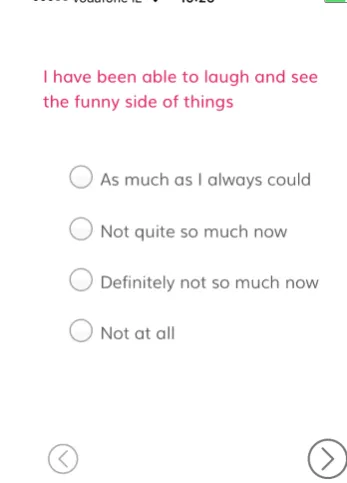
This feature will enable the administration of the EPDS. It consists of two introductory screens informing partic-ipants of the retrospective nature of this scale and its intended applications. These screens will be followed by the 10 EPDS questions, presented one question per screen, using radio buttons to capture participants’ responses (figure 1).
Check In
This feature will enable the administration of the five momentary questions and the two contextual questions. The first five questions will be presented using a 5-point pictorial scale with temporary supporting text (see
figure 2 for an example). The last two questions will use radio buttons to capture participants’ responses.
Retrospective versus momentary assessments
[image:4.595.333.507.55.297.2]Participants will be asked to complete monthly assessments at irregular intervals for 6 months. Whenever an assessment is due (as per the sampling protocol), a notification will be displayed on a participant’s handset. There will be two types of notifications: one for the Check Back feature and one for the Check In feature of BrightSelf. The visual appearance of the notifications will depend on the operating system and on the model of the participant’s handset. The text of the
notifications, however, will remain constant across partici-pants for each type of notification.
Participants will be able to respond (and thus complete the corresponding assessments) or to dismiss the noti-fications. In addition, participants will be able to leave notifications unanswered. If participants do not complete an assessment in response to a notification, they will not receive reminders or follow-up notifications. In these instances, the non-response will be recorded in our data-base and will be coded as such for the purposes of our data analysis.
Outside assessment periods, participants will be able to use BrightSelf in any way they find convenient and there will be no restrictions on the number of assessments they can complete on a single day. However, we will be able to distinguish between assessments completed in response to a notification and those completed spontaneously. At baseline, participants will be randomly allocated to one of two types of assessment strategies:
Retrospective plus momentary assessments
In this experimental manipulation, participants will be asked to complete a combination of retrospective assess-ments and momentary assessassess-ments. A retrospective assessment will be defined as a single administration of the EPDS. A momentary assessment will be defined as the five momentary questions plus the two contextual questions.
Participants will be required to complete assessments for a total of 6 months, and each assessment period will consist of six consecutive days. The 6-month participa-tion period will be calculated from the day on which the app is activated (ie, when participants enter their activation code and activate their account), and it will be divided into six intervals. All participants will receive
the first notification 2 days after activating BrightSelf (ie, first assessment), while the use of the app is fresh within their minds and to give an idea of what to expect during the study. Subsequent assessment periods will be a random selection of six consecutive days within the 21–35 days following the end of the previous assessment period (in order to avoid 12 days of continuous assess-ments).
The assessment period will be structured as follows:
► Day 1: one retrospective assessment at any random time between 17:00 and 21:00
► Days 2–5: three momentary assessments per day, displayed at random times within each of the following intervals: 09:00–12:00, 13:00–16:00 and 17:00–20:00
► Day 6: one retrospective assessment at any random time between 17:00 and 21:00.
At the end of the 6-month period, participants will be sent a link via SMS or by e-mail to complete the non-vali-dated, poststudy acceptance survey.
Retrospective assessments
In this experimental manipulation, participants will be asked to complete retrospective assessments only. A retrospective assessment will be defined as a single admin-istration of the EPDS.
Participants will be required to complete assessments for a total of 6 months, and each assessment period will consist of 1 day. The 6-month participation period will be calculated from the day on which the app is activated (ie, when participants enter their activation code and activate their account), and it will be divided into six intervals. Again, all participants will receive the first notification 2 days after activating BrightSelf (ie, first assessment). Subsequent assessments will take place on a random day within the 21–35 days following the end of the previous assessment period (in order to avoid two consecutive EPDS assessments).
On each assessment day, participants will receive a noti-fication to complete the EPDS at a random time between 17:00 and 21:00.
At the end of the 6-month period, participants will be sent a link via SMS or by e-mail to complete the non-val-idated, poststudy acceptance survey (see figure 3 for an illustration of both sampling protocols).
Duty of care
[image:5.595.83.244.61.300.2]Regardless of participants’ allocation, the central research team will be alerted if any of a series of prespecified conditions are met (table 2). These alerts will be colour-coded according to their severity level. In order to determine the severity level, we have chosen commonly used EPDS scoring thresholds (ie, 10–12 points for possible depression, and 13 points or more for probable depression). We acknowledge the limita-tions of this approach as the diagnostic accuracy of the EPDS can vary depending on the setting and the popu-lation in which it is administered.
Before starting the study, the central research team will agree on a list of designated contacts with the rele-vant clinical care teams. These contacts will include clinicians who are available during normal working hours, as well as those on duty outside working hours (including weekends and bank holidays). If a red or orange alert is generated, the study coordinator will contact the designated member of the clinical care team by phone and e-mail within 24 hours of receiving the alert. The clinical care team will then follow up these alerts directly with the participants.
randomisation
We will use block randomisation procedures (with blocks of four) to allocate participants to one of the two exper-imental arms. Random numbers will be generated using Stata V.14.31 Each consecutive number will be embedded within the nine-digit activation codes that will be distrib-uted to each participating NHS site. The full activation codes will be generated in the same order in which the random numbers were generated. Each NHS site will receive a list of activation codes on a first-come-first-served basis. Members of the local research teams will
not be informed of the random sequence generation and will not be able to identify which number deter-mines participant allocation. They will be required to use activation codes sequentially, as participants are recruited. Activation codes referring to the retrospective plus momentary assessment condition will activate a version of BrightSelf in which both the Check Back and the Check In features are active. Activation codes referring to the
retrospective assessment condition will activate a version of BrightSelf in which only the Check Back feature is active.
outcomes
Adherence to sampling protocols
[image:6.595.109.483.65.261.2]We will calculate the number of participants who complete 100% of the expected assessments (as per the study protocol) as a proportion of the total number of partici-pants who were randomised into the study. We will subdivide this outcome by using the total number of participants who complete the 6-month participation period as the denom-inator.
Figure 3 Sampling protocols for the retrospective plus momentary assessments and for the retrospective assessments. EPDS, Edinburgh Postnatal Depression Scale.
Table 2 Criteria for an alert to be sent to the research team
Type of alert Criteria
Yellow (Mild) Completing more than one EPDS assessment on the same day,
with an overall EPDS score of 9 points or less and a score of 0 on question 10 of the EPDS
Orange (Moderate) Overall EPDS score between 10 and 12 points, with a score of 0 on question 10 of the EPDS
Red (Severe) Overall EPDS score of 13 points or more, and
1 or more points on question 10 of the EPDS, regardless of the overall EPDS score
[image:6.595.38.557.615.728.2]Dropout rates
We will calculate the number of participants who complete the 6-month participation period as a proportion of the total number of participants who were randomised into the study.
Usage patterns
We will assess participants’ usage pattern of BrightSelf by analysing log data (additional variables capturing app usage). These will include the number of additional volun-tary self-reports, time spent using the app, number of interactions with other sections of the app, time taken to complete the self-assessments and other ancillary usage data.
Acceptance
We will calculate participants’ ratings and responses to the poststudy acceptance survey. In addition, we will conduct thematic analysis of participants’ answers to the open-ended questions of this survey using Atlas. ti 8.32
Timeliness of data completion
We will calculate the number of assessments that were completed in response to a notification as a proportion of the total number of expected assessments. We will subdi-vide this outcome by using the total number of completed assessments as the denominator. We will consider that an assessment has been completed in response to a notifica-tion if it takes place within the interval corresponding to that notification (ie, before the next notification is deliv-ered). This broad interval may raise concerns regarding the ecological validity of the report, which we will explore in our statistical analysis.
sample size calculations
We have chosen to relate the proposed sample size to the 95% CI for the adherence rate, as recommended by the Research Design Service in London. Therefore, we would need 96 participants in each arm with a 95% confidence level and a CI of 10. This translates into a total sample of 192 (ie, 96 participants in each experimental group). For this reason, we will aim to recruit at least 250 participants to account for dropouts and potential miscarriages.
data analysis plan
Descriptive statistics
We will report the number of potential participants who were eligible and refused to take part in the study. Where possible, we will report the reasons for refusing to partici-pate.
For each experimental group, we will report the following information:
► Demographic characteristics (as captured by the non-validated, sociodemographic survey)
► Proportion of participants answering Yes to any of the Whooley questions during the baseline assessment
► Proportion of participants scoring at each interval of the EPDS: between 0 and 9 points, between 10 and 12 points, and 13 points or above during the baseline assessment
► Proportion of participants scoring 1 or more points on question 10 of the EPDS during the baseline assessment.
Inferential statistics
We will compare the retrospective and momentary assessment
and the retrospective assessment experimental groups for differences in adherence rates, dropout rates and timeli-ness of data completion. For this we will use a t-test or the non-parametric equivalent.
We will compare acceptance between the two exper-imental manipulations by assessing differences in participants’ rankings to those questions on a 7-point Likert scale of the poststudy acceptance survey. We will also conduct a thematic analysis of the open-ended ques-tions of this survey.
In relation to the momentary assessments, we will examine the distribution of delays between the time of notification and time of report in order to assess the effect of this delay on the ecological validity of reports.
We will analyse usage patterns through regression modelling of log data. We will analyse participants’ momentary and retrospective assessments through time-based analyses or multilevel modelling.33 34 We will attempt
to compare if the momentary assessments had any effect on the retrospective assessments by comparing the EPDS responses given on day 1 to those given on day 6.
Timeline
We expect participant recruitment to start in January 2017, and the last follow-up to take place in August/ September 2017 (assuming a recruitment period of 2 months and a half).
conclusIon
This study addresses an important area of unmet clinical need, with direct and indirect consequences for mothers, children, their families, health systems and society. This study will contribute to the growing body of evidence concerning the role of mobile technologies for the support of mental health. Similarly, it will generate base-line information concerning the acceptability of an EMA sampling protocol (in term of its duration, frequency and intensity) to women attending antenatal care. This study will also evaluate participant engagement with the tech-nology and their adherence to a prespecified sampling protocol, both of which influence the completeness of the data needed by clinicians to inform their decisions. In addition, this study will identify some of the implemen-tation issues that might arise when we attempt to deploy mobile technologies in clinical settings, which could affect their successful adoption.
domestic violence, social isolation, minority groups and low income) are at increased risk of suffering from any of these mental health problems. Although we have not been able to focus on all these issues, we believe that the findings from this feasibility study will produce important lessons that could enable us to design and develop similar technologies and appropriate strategies. We aim to recruit participants from diverse backgrounds, and across multiple settings and geographical areas within England, and to focus on how such technologies can be embedded within existing antenatal care pathways, in order to support the existing patient–midwife relationship.
The findings from this and from a previous feasibility study21 will inform a larger trial evaluating the integration
of mobile technologies into routine antenatal pathways, and their potential impact on clinical outcomes.
Acknowledgements We would like to thank Professors Susan Ayers and Alexandra Thornton of City University London, Joanna Girling and Marie O’Connell of West Middlesex Hospital, Tara Pauley and Charlotte Clayton of Hinchingbrooke Hospital, Antoinette McNulty and Gemma Loebenberg of the Northwest London CRN, and Dr Fiona Blake for their feedback on early versions of BrightSelf and the study protocol, and for their help with our patient and public involvement initiatives. We would also like to thank Marguerite Barry of Trinity College Dublin for running some of the patient and public involvement sessions with us.
Contributors JSMB developed the study protocol in collaboration with KD. JSMB was in charge of obtaining ethics and governance approvals and has been approaching potential participant recruitment centres. KD was in charge of software development. JSMB drafted this manuscript. CM, GD, PR, JOD, AM and JC guided the development of the study protocol. CM, JOD and JC have supervised JSMB's work. GD has supervised KD's work. All the authors reviewed and approved this manuscript.
Funding This work is being supported by a National Institute for Health Research (NIHR) Imperial Biomedical Research Centre (BRC) award through the Population Health Theme, and by the ADAPT Centre through Trinity College Dublin.
Competing interests None declared.
Ethics approval Research Ethics Committee South East Coast – Surrey.
Provenance and peer review Not commissioned; externally peer reviewed.
Open Access This is an Open Access article distributed in accordance with the terms of the Creative Commons Attribution (CC BY 4.0) license, which permits others to distribute, remix, adapt and build upon this work, for commercial use, provided the original work is properly cited. See: http:// creativecommons. org/ licenses/ by/ 4.0/
© Article author(s) (or their employer(s) unless otherwise stated in the text of the article) 2017. All rights reserved. No commercial use is permitted unless otherwise expressly granted.
references
1. Stewart DE. Depression during pregnancy. N Engl J Med Overseas Ed 2011;365:1605–11.
2. Mental Health Foundation. Fundamental facts about mental health 2015. London: Mental Health Foundation, 2015.
3. Gavin NI, Gaynes BN, Lohr KN, et al. Perinatal depression: a systematic review of prevalence and incidence. Obstet Gynecol
2005;106(5 Pt 1):1071–83.
4. Lee AM, Lam SK, Sze Mun Lau SM, et al. Prevalence, course, and risk factors for antenatal anxiety and depression. Obstet Gynecol
2007;110:1102–12.
5. Bennett HA, Einarson A, Taddio A, et al. Prevalence of
depression during pregnancy: systematic review. Obstet Gynecol
2004;103:698–709.
6. Heron J, O'Connor TG, Evans J, et al; ALSPAC Study Team. The course of anxiety and depression through pregnancy and the postpartum in a community sample. J Affect Disord 2004;80:65–73.
7. Kinsella MT, Monk C. Impact of maternal stress, depression and anxiety on fetal neurobehavioral development. Clin Obstet Gynecol
2009;52:425–40.
8. Pearson RM, Evans J, Kounali D, et al. Maternal depression during pregnancy and the postnatal period: risks and possible mechanisms for offspring depression at age 18 years. JAMA Psychiatry
2013;70:1312–9.
9. Braithwaite EC, Murphy SE, Ramchandani PG. Effects of prenatal depressive symptoms on maternal and infant cortisol reactivity. Arch Womens Ment Health 2016;19:581–90.
10. Howard LM, Molyneaux E, Dennis CL, et al. Non-psychotic mental disorders in the perinatal period. Lancet 2014;384:1775–88. 11. Kingston D, Austin MP, Heaman M, et al. Barriers and facilitators
of mental health screening in pregnancy. J Affect Disord
2015;186:350–7.
12. Goodman JH. Women's attitudes, preferences, and perceived barriers to treatment for perinatal depression. Birth 2009;36:60–9. 13. BinDhim NF, Alanazi EM, Aljadhey H, et al. Does a mobile phone
Depression-Screening app motivate mobile phone users with high depressive symptoms to seek a health care professional's Help? J Med Internet Res 2016;18:e156.
14. BinDhim NF, Shaman AM, Trevena L, et al. Depression screening via a smartphone app: cross-country user characteristics and feasibility.
J Am Med Inform Assoc 2015;22:29–34.
15. Woo YS, Bahk WM, Hong J, et al. Use of a smartphone application to screen for bipolar spectrum disorder in a community sample.
Health Informatics J 2016;22:779–88.
16. Torous J, Chan SR, Yee-Marie Tan S, et al. Patient smartphone ownership and interest in mobile apps to monitor symptoms of mental health conditions: a survey in four geographically distinct psychiatric clinics. JMIR Ment Health 2014;1:e5.
17. Moskowitz DS, Young SN. Ecological momentary assessment: what it is and why it is a method of the future in clinical psychopharmacology. J Psychiatry Neurosci 2006;31:13–20. 18. Asselbergs J, Ruwaard J, Ejdys M, et al. Mobile Phone-Based
unobtrusive ecological momentary assessment of Day-to-Day mood: an explorative study. J Med Internet Res 2016;18:e72.
19. Shiffman S, Stone AA, Hufford MR. Ecological momentary assessment. Annu Rev Clin Psychol 2008;4:1–32.
20. Marcano Belisario JS, Jamsek J, Huckvale K, et al. Comparison of self-administered survey questionnaire responses collected using mobile apps versus other methods. Cochrane Database Syst Rev
2015;27:MR000042.
21. Ofcom. Facts & figures. http:// media. ofcom. org. uk/ facts/ [date accessed: 30 August 2016].
22. Marcano-Belisario JS, Gupta AK, O'Donoghue J, et al. Tablet computers for implementing NICE antenatal mental health guidelines: protocol of a feasibility study. BMJ Open 2016;6:e009930.
23. National Collaborating Centre for Mental Health. Antenatal and postnatal mental health: clinical management and service guidance— updated edition. Leicester and London: The British Psychological Society and The Royal College of Psychiatrists, 2014.
24. Whooley MA, Avins AL, Miranda J, et al. Case-finding instruments for depression. two questions are as good as many. J Gen Intern Med
1997;12:439–45.
25. Cox JL, Holden JM, Sagovsky R. Detection of postnatal depression. development of the 10-item edinburgh postnatal depression scale.
Br J Psychiatry 1987;150:782–6.
26. Gibson J, McKenzie-McHarg K, Shakespeare J, et al. A systematic review of studies validating the Edinburgh postnatal depression scale in antepartum and postpartum women. Acta Psychiatr Scand
2009;119:350–64.
27. Blake F. Mumshine – The App: The design of a micro on-line intervention for postnatal women to improve mood and well-being using an app for the smart phone. Presented at: Clahrc East Of England Fellows Showcase Event 2014.
28. Lund AM. Measuring usability with the USE questionnaire. Usability Interface 2001;8:3–6.
29. Schoenau-Fog H. storytelling I, Hooked!–evaluating engagement as continuation desire in interactive narratives. Berlin, Heidelberg: Springer, 2011:219–30. pp.
30. Snap® Surveys Limited. Powerful and flexible software. http://www. snapsurveys. com/ survey- software (accessed 14 December 2016). 31. Stata. Stata statistical software [Program]. 2015. Version 14. 32. Atlas. ti . Atlas. ti qualitative data analysis [Program]. Version 8 . 2016. 33. Schwartz JE, Stone AA. Strategies for analyzing ecological
momentary assessment data. Health Psychol 1998;17:6–16. 34. Shiffman S. Conceptualizing analyses of ecological momentary
feasibility study
mood during pregnancy: protocol of a
longitudinal assessment of depression and
A bespoke mobile application for the
Car
Ramchandani, Azeem Majeed, Gavin Doherty, Cecily Morrison and Josip Jose Salvador Marcano Belisario, Kevin Doherty, John O'Donoghue, Paul
doi: 10.1136/bmjopen-2016-014469
2017 7:BMJ Open
http://bmjopen.bmj.com/content/7/5/e014469
Updated information and services can be found at:
These include:
References
http://bmjopen.bmj.com/content/7/5/e014469#ref-list-1
This article cites 26 articles, 2 of which you can access for free at:
Open Access
http://creativecommons.org/licenses/by/4.0/
use, provided the original work is properly cited. See:
others to distribute, remix, adapt and build upon this work, for commercial the Creative Commons Attribution (CC BY 4.0) license, which permits This is an Open Access article distributed in accordance with the terms of
service
Email alerting
box at the top right corner of the online article.
Receive free email alerts when new articles cite this article. Sign up in the
Collections
Topic
Articles on similar topics can be found in the following collections(221)
Health informatics
Notes
http://group.bmj.com/group/rights-licensing/permissions
To request permissions go to:
http://journals.bmj.com/cgi/reprintform
To order reprints go to:
http://group.bmj.com/subscribe/