Bias-dependent oscillatory electron transport of monatomic sulfur chains
Jing-Xin Yu, Yan Cheng, Stefano Sanvito, and Xiang-Rong Chen
Citation: Appl. Phys. Lett. 100, 103110 (2012); doi: 10.1063/1.3693380
View online: http://dx.doi.org/10.1063/1.3693380
View Table of Contents: http://apl.aip.org/resource/1/APPLAB/v100/i10
Published by the AIP Publishing LLC.
Additional information on Appl. Phys. Lett.
Journal Homepage: http://apl.aip.org/
Journal Information: http://apl.aip.org/about/about_the_journal
Top downloads: http://apl.aip.org/features/most_downloaded
Bias-dependent oscillatory electron transport of monatomic sulfur chains
Jing-Xin Yu,1Yan Cheng,1,a)Stefano Sanvito,2,a)and Xiang-Rong Chen1,3,a)
1
College of Physical Science and Technology, Sichuan University, Chengdu 610064, China
2
School of Physics and CRANN, Trinity College, Dublin 2, Ireland
3
International Centre for Materials Physics, Chinese Academy of Sciences, Shenyang 110016, China (Received 18 December 2011; accepted 18 February 2012; published online 9 March 2012)
The bias-dependent oscillatory electron transport of monatomic sulfur chains sandwiched between gold electrodes is investigated with density functional theory and non-equilibrium Green’s function method. At zero bias, in contrast to the typical odd-even oscillations observed in most metallic chains, we find that the conductance oscillates with a period of four atoms. However, as the bias voltage is increased the current displays a two-atom periodicity. This emerges gradually, first for the longer chains and then, at voltages larger than 0.7 V, for lengths. The oscillatory behaviors are analyzed by the density of states and the energy-dependent and bias-dependent transmission coefficients.VC 2012 American Institute of Physics. [http://dx.doi.org/10.1063/1.3693380]
In recent years, Au, Cu, and other metallic nanowires and nanotubes suspended in two thimble tips in ultra-high vacuum have been the prepared and characterized experi-mentally, with typical wire diameters smaller than 1 nm and lengths larger than 6 nm.1,2 A single-atom chain is formed when the size of an ultra-fine nanowire further reduces. These one-dimensional objects represent a peculiar morphol-ogy, which shares with clusters the atomic scale dimensions. Ohnishi et al.3early in 1998 were able to make suspended Au monatomic chains by scanning tunneling microscopy (STM) experiments and measured their conductance to be
G0¼2e 2
/h(G0 is the quantum conductance,e the electron
charge, andhthe Planck constant). Similarly, Yansonet al.
produced Au monatomic chains by mechanically controlled break junctions (MCBJ) (Ref. 4) and obtained similar con-ductance values. A major breakthrough occurred in 2008 when the structural information about the electrodes and the crystalline orientation of the nanowires were measured with atomic precision by STM.5The study of the various proper-ties of monatomic chains such as the anomalous dependence of the resistance on the chain length,6the presence even-odd conductance oscillations7and of possible negative differen-tial conductances8 is particularly useful in order to under-stand the metallic state of nanoscale objects.
These early experiments inspired a surge of theoretical calculations. In particular, the conductances of Al,9,10Nb,10 Pt,11Pd,11Na,12Ni,13Cu,14Au,15–17Xe,18Si,19and C (Ref.
20) monatomic chains have all been computed by using tight-binding approaches,10,13 the recursive transfer-matrix (RTM) scheme12,14,15 and density-functional theory com-bined with the non-equilibrium Green-function method (DFTþNEGF).16–20Many of these works revealed an inter-esting oscillatory behavior of the zero-bias conductance as the chain length is increased. Smitet al.21found that the con-ductance of monovalent Au, Pt, and Ir atom chains oscillate
metals (AM) and noble-metals (NM) and found that the con-ductance of the NM chains oscillates as a function of the chain length so that its maxima (minima) occurs at an even (odd) number of atoms in the chain. This contrasts to what happens for AM-based monatomic wires, where the oscilla-tions have the opposite phase. Lang and Avouris20 showed that the conductance of odd-numbered carbon-atom chains is higher than that of even-numbered chains and that a stronger electronic coupling between the chains and the electrodes does not necessarily implying a higher conductance. Finally, Thygesen and Jacobsen23 found that the conductance of Al wires has an oscillatory character with a period of four atoms, thus disproving the general conclusion of Smitet al.
about the two-atom period of oscillations.21
Recently, we have investigated the transport properties of S9sulfur clusters, which show strong bonding to Au and
still good conduction,24and explored four different Au(100)-S2-Au(100) nanoscale junctions, which show that the
junc-tion connected to pyramical-shaped Au electrodes at the top site has good conduction.25 In this letter, we focus on Sn
monatomic chains connected to pyramical-shaped Au elec-trodes at the top site, and investigate the electron transport as a function of size (n). In particular, we study both the zero-bias conductance and the finite-zero-bias current for chains com-prising between 1 and 12 sulphur atoms. Our calculations showed that the zero-bias conductance varies in an oscilla-tory manner with the number of atoms in the chain. How-ever, the period of the oscillation is four-atom long similar to that of Al wires.23 Intriguingly, the oscillation period changes as the bias is increased and already at relatively moderate voltages odd-even oscillations are recovered.
The transport properties are calculated with ab initio
cal-scattering potential at finite bias. Our calculations use the Perdew-Zunger form31 of the local density approximation (LDA) to the exchange-correlation functional. Scalar-relativistic Troullier-Martins pseudopotentials32 generated from 5d106s1for gold and 3s23p4for sulfur are employed. To make the calculations more tractable and reduce the computa-tional overheads, a singlenis used as the basis set for Au, and a doublenbasis is adopted for the orbitals of the S atoms. The charge densities and the DFT potential are computed on a real-space grid with cut-off energy of 200 Ry, which is also used in the self-consistent transport calculations. An electrical temperature of 300 K is used throughout the calculation and periodic boundary conditions are applied in the basal plane (orthogonal to the transport direction) with four irreduciblek -points in the two-dimensional Brillouin zone. Ak-grid sam-pling of 22100 for Au electrodes is employed. Finally, we consider 128 real and 50 complex energy points when inte-grating the Green function.
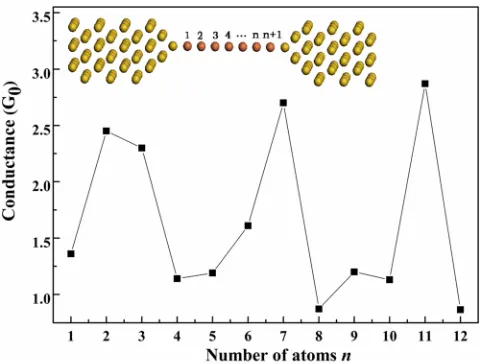
A snapshot of our point contact geometry is presented in Fig.1where ann-site-long chain is sandwiched between two Au electrodes oriented along the (100) direction and termi-nated with a pyramidal apex. Atomic relaxation is performed first by conjugated gradient, where we also relax the five Au atoms binding the Snchain to the current/voltage leads (the
pyramid atoms). A locally stable configuration is found by changing the distance between the end atoms of the chain and the apexes of the point contact. Our results showed that in all the stable structures the chains remain linear and sym-metric about its center. The Au-S bond length agrees well with the experimental value (2.32.4 A˚ ).33The average S-S distance d is 2.20 A˚ , which is much larger than the inter-atomic spacing in bulk S, 1.889 A˚ . Such an extended bond length for monatomic chains with respect to bulk is the result of the different coordination and it has been already observed for other metals like Au.3If we examine the S-S bond distri-bution, we observe that this depends on the parity of the chain. Odd chains present a uniform bond length of 2.2060.03 A˚ , however, even chains are characterized by bond length alternation, with short and long bonds of 2.1460.02 A˚ and 2.2660.03 A˚ , respectively. This means that Peierls distortion34 is strongly active only in even chains.
Fig. 1 also shows the zero-bias conductance, G, as a function of the number of sulfur atomsnin the atomic chain (i.e., of the chain length). We observe that the conductance does not decrease with increasing chain length nor it does ex-hibit the even-odd oscillations. In contrast, it presents an os-cillatory behaviour with a period of four S atoms. Well pronounced maxima appear at n¼3þ4mwhile the minima are at n¼4m, where mis an integer. This oscillatory con-ductance can be rationalized by the resonant transport model proposed first by Thygesen and Jacobsen.23The main idea is that the electron transport occurs via resonances at the Sn
atomic chain energy levels. In general, by assuming that the coupling between the Snchains and the electrodes is energy FIG. 1. (Color online) Calculated zero-bias conductance as a function of the
number of sulfur atoms in the Snchain (n¼1 to 12). The inset shows the
ge-ometry of the device investigated.
FIG. 2. (Color online) Transmission coefficient at zero-bias and DOS as a function of energy for various Snchains
(n¼1 to 12) attached to the Au(100) electrodes.
[image:3.612.54.295.53.235.2] [image:3.612.54.417.510.770.2]independent, one expects that the width of the resonances varies as 1/n with the chain length. The transport is then solely determined by the position of such broadened energy levels with respect to the electrode Fermi energyEF.
In Fig.2, we present the density of states (DOS) and the energy-dependent zero-bias transmission coefficient for all chains withn¼1 to 12. In particular, we include the DOS states belonging to the atomic chain and to the two outermost atoms in the Au tips. In general, the DOS presents a number of discrete peaks, corresponding to the various molecular orbitals of the chain. These correlate well with the energy de-pendent transmission function so that a peak in the DOS cor-responds to a peak in the transmission. The zero-bias conductance is then determined by whether Au Fermi level is positioned in a peak or in a valley of the DOS. In the case of a single S atom,EFis positioned in a relatively featureless
region of the DOS and cuts through the tail of a transmission peak. As such the overall zero-bias conductance is rather small. Different is the situation for both S2and S3, for which
the Fermi level is pinned at a peak in the DOS and the trans-mission is large. A further increase of the chain length adds
molecular orbitals and shifts the chain spectrum with respect to Au Fermi level. For both S4and S5the Fermi energy is
now in between two peaks in the DOS and the transmission is again small, while for S6 and S7, a peak pins the Fermi
level and the transmission is again large. This pattern repeats to all the other lengths investigated and the oscillatory behavior of Fig.1is obtained.
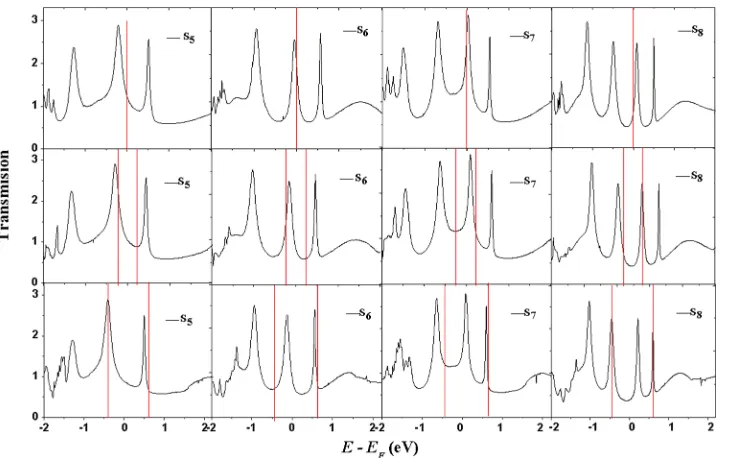
We next investigate how the oscillation pattern changes upon the application of an external bias. This is summarized in Fig.3, where we present the current as a function of chain length for four representative bias voltages, namely 0.22 V, 0.44 V, 0.67 V, and 1.11 V. The most notable feature emerg-ing from the figure is a gradual change of the oscillation pe-riod from two to four atoms as the bias increases. Such a period change starts first for longer chains but then it gradu-ally develops at all lengths. For instance already for a voltage of 0.67 V a period of two is observed for n>3. An insight into such a behavior can be obtained by looking at the trans-mission coefficient as a function of bias presented in Fig. 4
forn¼5-8.
We remind here that the current is just the integral of
T(E;V) over the bias window around the Fermi level (this interval is marked in the figure with vertical lines), so that as the bias is increased a larger portion of the transmission spec-trum determines the transport. From Fig. 4, one can immedi-ately conclude that there is little modification in the transmission function of the various S chains as the bias gets larger, i.e., there are no significant changes in either the posi-tion of the transmission resonances or their broadening. This suggests that the S chains undergo little charge transfer and/or electrical polarization upon bias.35 As such, it is solely the enlargement of the bias window to produce the change in the periodicity. For instance, in the intervaln¼5-8 the two-atom period is obtained because of a significant increase of the cur-rent of the S5chain with respect to those of others Sn(note
that the current gets larger for all chains as the bias is increased). This is simply due to the fact that the dominant transmission peak corresponding to the S5HOMO level
pro-gressively enters the bias window. At 1.11 V the HOMOs of
FIG. 3. (Color online) Current,I,calculated at different bias voltages as a function of the number of sulfur atoms in the Snchains (n¼3 to 12).
[image:4.612.54.294.52.226.2] [image:4.612.53.421.538.767.2]both S5and S6are entirely within the bias window, but that of
S5gives a significantly larger contribution to the current, as
the peak value of the transmission function is larger. Further-more for S5the high-energy boundary of the bias window cuts
right across a second transmission peak (the one correspond-ing to the LUMO), which provides additional contribution to the current. The same does not hold true for S6 where the
same boundary is placed just before the LUMO resonance. In conclusion, we have presented a DFT-NEGF study of the electron transport across sulfur monatomic chains con-nected to Au(100) electrodes. We find that the chains remain straight and symmetric with respect to the electrodes, with a uniform lattice constant in the case of odd-numbered chains and with a significant Peierls distortion for the even-numbered ones. The zero-bias conductance displays an in-triguing four-atom periodicity with the chain length, similar to that previously found for Al monatomic wires, however, the oscillation period reduces to only two atoms as finite bias is applied, with the change developing first for the longest chains and then, at biases in the 1 V range, for all the lengths investigated. The oscillatory behaviors are further analyzed by the device DOS and the energy-dependent and bias-dependent transmission coefficient of S chains containing Au electrodes.
The authors would like to thank the support by the National Natural Science Foundation of China (Grant No. 11174214) and by the SRFDP (Grant No. 20090181110080). The SMEAGOL project (SS) is sponsored by Science Foun-dation of Ireland (Grant No. 07/IN.1/I945), CRANN and KAUST (ACRAB project).
1
Y. Kondo and K. Takayanagi,Science289, 606 (2000). 2
Y. Oshima, A. Onga, and K. Takayanagi, Phys. Rev. Lett.91, 205503 (2003).
3H. Ohnishi, Y. Kondo, and K. Takayanagi, Nature (London)395, 780
(1998). 4
A. I. Yanson, G. Rubio, H. E. van den Brom, N. Agraı¨t, and J. M. van Ruitenbeek,Nature (London)395, 783 (1998).
5J. Kro¨ger, N. Ne´el, and L. Limot,J. Phys.: Condens. Matter20, 223001
(2008). 6
N. D. Lang,Phys. Rev. Lett.79, 1357 (1997).
7H. S. Sim, H. W. Lee, and K. J. Chang, Phys. Rev. Lett.87, 096803 (2001).
8
S. Tsukamoto and K. Hirose,Phys. Rev. B66, 161402 (2002). 9
N. D. Lang,Phys. Rev. B52, 5335 (1995).
10J. C. Cuevas, A. L. Yeyati, and A. Martı´n-Rodero,Phys. Rev. Lett.80,
1066 (1998). 11
V. M. Garcıa-Suarez, A. R. Rocha, S. W. Bailey, C. J. Lambert, S. San-vito, and J. Ferrer,Phys. Rev. Lett.95, 256804 (2005).
12K. Hirose and M. Tsukada,Phys. Rev. B51, 5278 (1995).
13A. M. Bratkovsky, A. P. Sutton, and T. N. Todorov,Phys. Rev. B52, 5036
(1995). 14
H. Mehrez and S. Ciraci,Phys. Rev. B56, 12632 (1997). 15M. Okamoto and K. Takayanagi,Phys. Rev. B60, 7808 (1999).
16C. Zhang, R. N. Barnett, and U. Landman,Phys. Rev. Lett.100, 046801
(2008). 17
M. Zhou, Y. Q. Cai, M. G. Zeng, C. Zhang, and Y. P. Feng,Appl. Phys. Lett.98, 143103 (2011).
18A. Yazdani, D. M. Eigler, and N. D. Lang,Science272, 1921 (1996). 19
J. L. Mozos, C. C. Wan, G. Taraschi, J. Wang, and H. Guo,Phys. Rev. B 56, 4351 (R) (1997).
20N. D. Lang and Ph. Avouris,Phys. Rev. Lett.81, 3515 (1998).
21R. H. M. Smit, C. Untiedt, G. Rubio-Bollinger, R. C. Segers, and J. M. van
Ruitenbeek,Phys. Rev. Lett.91, 076805 (2003). 22
Y. J. Lee, M. Brandbyge, M. J. Puska, J. Taylor, K. Stokbro, and R. M. Nieminen1,Phys. Rev. B69, 125409 (2004).
23K. S. Thygesen and K. W. Jacobsen,Phys. Rev. Lett.91, 146801 (2003). 24
J. X. Yu, X. R. Chen, and S. Sanvito,Phys. Rev. B82, 085415 (2010). 25
J. X. Yu, X. R. Chen, S. Sanvito, and Y. Cheng,Appl. Phys. Lett.100, 013113 (2012).
26A. R. Rocha, V. M. Garcia-Suarez, S. Bailey, C. Lambert, J. Ferrer, and S.
Sanvito,Nature Mater.4, 335 (2005). 27
I. Rungger and S. Sanvito,Phys. Rev. B78, 035407 (2008).
28S. Datta,Electronic Transport in Mesoscopic System(Cambridge
Univer-sity Press, Cambridge, 1995). 29
W. Kohn and L. Sham,Phys. Rev.140A1133 (1965). 30
J. M. Soler, E. Artacho, J. D. Gale, A. Garcia, J. Junquera, P. Ordejon, and D. Sanchez-Portal,J. Phys.: Condens. Matter14, 2745 (2002).
31J. P. Perdew,Phys. Rev. B33, 8822 (1986). 32
N. Troullier and J. L. Martins,Phys. Rev. B43, 1993 (1991). 33
A. Cossaro, R. Mazzarello, R. Rousseau, L. Casalis, A. Verdini, A. Kohl-meyer, L. Floreano, S. Scandolo, A. Morgante, M. L. Klein, and G. Scoles, Science321, 943 (2008).
34
R. Peierls,Quantum Theory of Solids(Clarendon, Oxford, 1955). 35
C. D. Pemmaraju, I. Rungger, and S. Sanvito,Phys. Rev. B80, 104422 (2009).