-
-
-
-
--
-
-
--
-
- - -
-
-
-
-
-
-
-
-
-
- - - -
-
- -
-
-
--
--
--
--
--
--
--
--
--
--
--
---
--
--
-- --
--
--
--
-
-
-
-
- -
---
---
-
-
-
-
--
--
--
-- -
--
-
-
-
-
-
- -
-- --
-
-
--
--
--
--
--
--
--
--
--
---
--
-
- -
--
-
--
--
-- -- --
-
--
-
-
-- - -
--
--
-
-
-
-
- - -
--
-
-
-- --
--
-
-
-
-
- - - -
=
--
--
--
--
--
-- --
--
--
-- -
-
-
-
- -
-
-
---
-...---
--
--
-
-
- -
--
--
--
--
--
--
--
-- -
-
----
-
---
- -
----
-
---
-
-
--
-
-
--
-
-
- -
- -
-- - -
-- --
--
-
-
=-.-
=-
-==-=
-- --
-
-
- -
---
--
----
-
~=~~=
:r= =
-
-
--
--
-
--
----
-
--
----
-
-
---
--
----
-
- -
--- --
- -
-
- - - -
----
-- --
-
-
-
- -
-
- --
-
--
-- -
---
--
--
-
--
---
-
- - -- --
--
- - --
-
-
-
----
-
~-::...:=--
--
~-
- - - -
- - - -
-
-
--
--
--
--
--
--
--
--
--
--
--
---
--
--
---
- - - -
--
--- ---
----
-
-
--
--
--
- --
-- -
--
-
-
-
-
-
--
-- --
--
---
-
-
-
--
--
-- --
- - --
--
-- --
- -
-
-
-
-
- -
- - - -
-
-
- -- --
-
-- --
---
-
--
--
--
--
--
--
----
-
--
--
--
-- -- -- --
--
--
--
--
-
-
-
--
--
-
--
--
--
--
--
--
-
-
---
-
...
-
-
-
--
-- --
-- -
--
--
-
-
-
-- --
--
- -
--
-- -
-
-
- - - -
- - -- --
--
-- ----
-
-- --
--
--
--
-
---
-- --
-- -- --
-- -- --
-- ----
-
-
-
--
-
-
-
-
-
-
--
- --
- -- --
-
--
--
-
-
-
--
--
--
-
-
-
- -
-
-
--
-- -
--
-
- - - -
-
- - - -
--
--
----
--
----
--
----
-
--
--
-
---
---
----
-
-
-
- -
-
-
--
--
-
=
-
-
- - - -
-
- - - -
-
-- --
--
-- -- -- --
-- --
-- --
--
--
-
-=
--
--
--
--
--
--
-
--
-
--
--
-
--
--
--
-
--
--
-
--
--
-
--
--
--
-
--
--
-=== -==-
-
-
-==-
-=-~= =~~:: -§
§~ §~--
-
--
--
-- -- -- --
- - -
-
-
-
---=
--
---
-
--=
=--= --=
- --
---
- -
--
--
--
---
- -
---
---
---
- - -
--
--
--
---
--
--
--
-
-- ---
- -
---
-: §§
§~-
-
= ::
---
=-=
==
=-~
- - -
§a
§§ :Confl&uratloD GuIde to· TurboDOS
September, 1981
CopyrJpt (d I ' l l by Software 2QOO IDe.
All. rigb'CS resened..
No part at this pubJ.1ca;tian may be reprcduc:ec4- transmittec4
transcribec4
01" translatedinto any language- 01'" computer' languag~ in any form or by any m~ elec.tronic,.
mechanic:a4 magnetic,. optic:a4 c:hemic:a4 manual or otherwise, without the prior writ-ten permissiQrl of Software 2000 Inc:.,.. P.O. Box:
9110',.
Los Alamitos,. Call£0nUa. 90720.Software 2000 Inc:. makes no representations 01" warranties with respect to the-
con-tents. of this publlcation,.. and sped:fically disc:laims any implied warranties of mer-chantability or" fitness for a. partic:uJar purpose.. Software 2000 Inc.. shall under no circumstances be llable- for consequential damages or related expenses,. even if it has been noti:fled of the possibility of such damages.. Software 2000 Inc.. reserves the
right to revise this pllbllcation from time to time without obllgatico to notify any
person of such revision ..
Coafigura'tioll Gllid .. to- TurboDOS
Copyright (C) 1981 by Software 2000 Inc:. Tabla at Contents
TABLe or CONTENTS
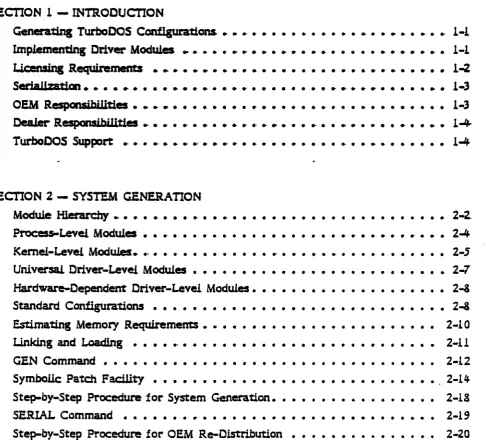
saCTION 1 - INTRODUCTION
Generating TurboDOS Configurations. • • .. • • • • • • • • • • • .. • .. • .. • .. • •
Implementing Driver Modules ... .. • • .. .. • • • .. .. • • .. • • • • • .. • .. • • .. •
• • • • • • • • • • • • • • • • • • • • • • • • • • • • • •
Sena llzaticn. .. • • .. • • • • • • • • • • • ~ • • • • • • • • • e • • • • • • • • • •
Oe:a. ~ R--~i"';I;':-~--~~~ •
...
.
•• • • • • • • • • • • • • • • • • • •
1-1
1-1
1-2
1-3 1-3 .De.aler' ResparISi.bW:ties .. • .. • .. • • • • • .. .. • • • • • • • • .. • • • • • • • • •• 14
TurboDOS Suppcirt .... " . . . l~
SECTION 2 - SYSTEM Ci.ENaRAnON
Module Hi.er2Ir'chy .. • • • .. • • • • • • • • • • • • • • • • • • • • • • • • • • • • e' 2-2..
Process-Level Modules Kernel-Level Modules.
.
.
...
.
• • • • •..
.
• • • • • • • •• • • • • • • • • • • •
..
.
• • • • Universal Driver-Level Modules • • • • • • • • • • • • • •·
.
~.
.
.
.
.
.
. . .
• • • • • • • • • • • •
• • • • • • • •••••
2-4
2-5
2-7
Hardware-Dependent Driver-Level Modules • • • • • • • • • • • • • • • • • • • • 2-&
Standard Configurations • • • • • • • • • • • • • • • • • • • • • • • • • • • • • •
Estimating Memory Requirements • • • • • • • • • • • • • • • • • • • • • • • •
• • • • • • • • • • • • • • • • • • • • • • • • • • • • • • • Gl!N Command • • • • • • • • • • • • • • • • • • • • • • • • • • • • • • • • • •
Symbolic Patch Facility • • • • • • • • • • • • • • • • • • • • • • • • • • • • • Step-by-Step Procedure :fOI" System Generation. • • • • • • • • • • • • • • • •
SERIAL Command
.
.
. . . .
.
~.
.
.
. . .
.
. .
• • • • • • • • • • • • e· • •2-&
2-10
2-11
[image:5.621.86.573.150.596.2]CouIgura'tioll GlIlete t.~ TurDoDOS
Copyright
ec)
1981 by Software 2000 Inc:. Table of ContentsSECTION 3 -SYSTEM IMPLEMENTATION
AsseJn.bler ReqlIiremeJ1tS . . . ... 3-1
Programming Conventions:
Dynamic: Memor:Y Alloc:ation. .. .. • .. .. .. .. • .. .. .. .. • .. .. .. .. .. .. .. .. .. .. .. .... 1-2 Threaded IJ.sts... • .. • • .. • .. • • • • • • • .. • .. • .. .. • • .. • • .. • .. .. • • • .. l~
D.ispa.~ . . . • • • .. •
3-'
Interrupt Service Routines ... 3-1 Poll Routines- ... ..
. .
~.
.
.
~.
.
.
.
...
.
...
.. ..
..
. .
.
Re-Entrancy and Mutual Exclusion ..
.
.
...
.
...
..
.
..
.
...
...
eo . . . Sample-Interrupt-Driven Device Driver .. ... • • • • .. • .. .. .. .. •Sample Polled Device. Driver.. .. .. • • .. .. .. • • .. • .. .. .. • .. .. .. ..
• • • • •
...
Driver Intermce. Spedfic:ations:
• • •
..
.
.
.
..
.
.
.
• • •.
...
...
• •..
.
.
Initialization •• Console Drivers Printer' Drivers
.'
.
.
..
.
..
. . . .
.
.
...
. .
.
.
·
... .
• •
.
.
. .
.
~. . .
.
. . .
.
.
• • • • • • • • •Network Drivers.
..
.
• •.
..
. .
• • • • • • • e· • a- • • .. e' • • •Disk Drivers • • ....
....
.
.
. .
.
..
. . . .
..
.
..
.
.
. .
..
. . .
.
• •
..
..
..
..
·
...
·
...
.~
....
'...
..
.
• •...
ReaL-llJIl8 Clade Driver
Comm Channel Driver
• • • • • • • • • • • • ~ • ~ • • • • e- • • • • • • •
• • • • • • • • • • • • • • • • • • • • • • • • • • • •
800tstrap ROM • • • • • • • • • • • • • • • • • • •
·
...
• • • • • • • • • • • • 3-&3-9 3-1a 3-11
3-12 3-1.3 3-1.3 3-14 3-15 3-17 3-18 3-19
APPENDIX A - Implementation on IMS Equipment • • • • • • • • • • • • • • • • • A-I
APPENDIX 8 - Implementation on TRS-80 Model II. • • • • • • • • • • • • • • • • 8-1
CODfllUr&tlolt Gulde to TurboDOS Copyright (C) 1981 by Software 2000 Inc.
Introduction
INTRQDUCTIQN
This CgnfJantion Guide to IprhgDOS provides. the- information that OEMs, dealers,.
and sophisticated end-usen need to generate various· operating system contlgurations and to implement driver modules for various peripheral. components..
A companion doc:umerrt, entitled UaO Guide to TurboCPS, provides the information that users need to write and run programs under the TurboDOS operating system. It includes an overview at operating system fea~ a discussion of architecture and theory of operation,. a description at each c:a~ ancl a. definition at each user-ca I la bJ.e function.
TurboDOS is a modular operating system consisting of more- than 1100 separate functional modules. These modules are "builcfing b!oc:b" whlc:h can be combined in
various ways to produce a family of compatible operating systems. TurboOOS configurations include Single-task,. spooling, time-sharing and networking, with numerous subtle variations possible in each of these bread categories.
Functional modules of TurboDOS are distributed in re1ocata.ble- farm. Hardware-dependent device drivers are packaged in the same fashion. The GEN command is a specialized linkage editor which may be used to combine the desired combination of modules into an exec:uta.ble version of TurboCOS con:f1gured with the desired set of
functions and device drivers. The G.EN command also includes a symbolic patch faclllty which may be used to aLter a variety of operating system parameters.
Section 2 describes each functional module of TurboCOS in detail, illustrates how these modules can be combined in various configurations, anc:i provides step-by-step system generation procedures..
ImplCIIJCD'tUtol Qriyer Mgdu'a
TurboOOS has been designed to run on any Z80-basec:t micrccomputer with at least '+8K of RAM, a random-access mass storage device, and a fuU-duplex character-oriented console device. The functional modules of TurboOOS are not dependent upon the specific peripheral. devices to be used. Rather, a set of hardware-dependent device driver modules must be included in eacb TurboOOS configuration in order to adapt the operating system to the .speciiic hardware environment.
Configuration Guide t~ TurboDOS Copyright (C) 1981 by Software 2000 Inc:. Introduction
Typic:aJ. hardware-<1ependent device- driver- modules include:
o Console driver
o Printer driver
0- Disk driver
a Network interface
driver-a Real-time' dock driver
a Communications driver
Although Software 2000 Inc:.. can supply TurboDOS pre-configured for certain specifiC hardware configurations,. most OEMs. and. many dealers. and end-users: will want to implement" their own hardware-dependent drivers.. Driver- modules may be readily written by any competan't assembly-language programmer, using a. relocating !XO assembler- such as Digital Research's RMAC, Microsoft's MACRO-SO, or Phoenix Software A.ssoc:iates' P ASM. Section 3 provides detailed instructions to programmers for implementing such driver- moc:fules,. and. the Appendix indudes assembly listings of.
various- sample- drivers.
TurboOOS is a. proprietary software prcxiuc:t of Software 2000 Inc:. TurboDOS may be used only after the user has pald the required license fee, signed a copy of the TurboOOS software license agreement, and returned the signed agreement to So~
2000 Inc.. Then it may ~ used only in strict conformance with the terms of the software license. Each TurboOOS software license agreement must be filled-out and
signed by the end-user (not by an OEM or dealer on his customer's behalI).
Each software license permits the use of TurboOOS only on one specific computer system identified by make, mode! and serial number. A separate license fee must be
pald and a. separate license signed for each computer system on which TurboOOS is used.. Network slave computers which are also capable of stand-alCXle operation under TurboOOS must each be licensed separately, but slave computers which cannot be used stand-alone (e.g., because they. have no mass storage) do not.
·
.' "COllfl&uratioD GuIde to. TurboDOS
Copyright' (C). 19&1 by Software 2000 Inc.
Introduction
Each copy of TurboDOS is magnetlc:aJly ser1allzed with a. unique seria1. number in order to facilitate tracing of unllcensed copies of TurboOO5.
Each relocatable TurboDOS module which is. dlstributed. to a dealer Or" end-user is. magnetic:aUy. seriaJ1zed with a. \A1ique serial number.. The serial number c:ansists of
two components: an origin number (whlch k1entWes the- issuing OEM) and a. unit number (whk:h uniquely icfentWes eacb copy of TurboDOS 1.ssued by that" OEW. The
CEN commanci verWes that all functional modules whid1 make up a TurboDOS configuration are seriaJ.1zed consistent1y, and magnetically serja lizes the resulting
exeartable versiOlt of TurboDOS accard1ngly.
Each relocatable- Turbo DOS module which is. distributed. to an OEM is partially seriallzed with an origin number only.. faa OEM is provided with a. SERIAL command which must be used to add a unique- unit number to the re10catable modules of eaa copy of TurboDOS issuect by that OEM. The GEN command will not accept
partially serialized modules that have not been uniquely seriallzed by the OEM. Conversely, the SERIAL command will not re-seriaJ.lze modules which have already been fully serialized.
Each OEM is provided with a master copy of Turbo DOS re.locatable modules and
command processors- on d1.skette. An OEM is authorized to reproduce and distribute copies of TurboOOS to dealers and end-users for use on specifically authorized hardware confIgurations manufactured 01" dlstributed by the OEM. The OEM is required to seriallze each c:opy of TurboOOS with a unique sequent1aJ. magnetic: serial number, and to register each serial number promptly by returning a registratiat card
to Software 2000 Inc. This registration requirement for OEMs is in addition to
<.ustt
in lieu of) the requirement for licensing of. each end-user ..
Each OEM is provided with a master copy of TurboDOS documentation in both camera-ready form and in ASCII files on diskette. The OEM is responsible for reproducing the documentation and ~oviding it with each copy of TurboDOS issued by
that OEM.
An 0 EM must require a dealer to sign the TurboOOS dealer agreement and return it to Software 2000 Inc. before the OEM may issue copies of TurboOOS to that dealer. An 0 EM must require an end-user to sign the TurboDOS software license and return
it to Software 2000 Inc. before the OEM may issue a copy of TurboDOS directly to
Co·afig.urat'ioa Guide- to T'u.rJJo.DOS
Copyright' (C) 1981 by Software-200(1 Inc:.
Iatroduc:tion
A TurboDOS dealer is permitted to purchase individual. serialized copies at TurboDOS software-anet. documentation from Software 2000 Inc.. or" from an authorized OEM,.. and
to. resell them to end-usen. Dealers. are not: authorized. to make copies at TurboDOS
software. or documentation for any purpose whatever.
A TurboDOS dealer. must' require each end-user-to sign the' TurboDOS' software license
and re'tUm it. to. Software- 2000 Inc:-. before' issuing-a copy of TurboDOS software or documentation to the- enci.-user~
TgrbgDQS SV&UJ9rt
Software 2000 maintains a te!ephone "hot-llneW to provide techn1c:al assistance in the use of TurboDOS to its customers.. OEMs and dealers· should feel free to take advantage ot this service- whenever teclmic:::a! questions arise ccnceming the- use or" conflguration of TurboDOS.
It is the responsibility of each OEM and dealer to provide technlcaJ. support to its end-user customers. Software- 2000 caDDot assist end-users directly. Where
exceptional circumstances seem to require direct contact between Software 200~
Coafl&.ura'tloDl Guide to TurboDOS
Copyright (C) 1981 by Software 2000 Inc:.
. System Generaticn
SYSTIM GENE' AXIQN
TurboOOS is. a modular operating system consisting ot more than f4,O separate functional. mcdu.1es. These modules ant "building blacks" whidt can .be combJnec:L in
various ways to produce a. family ot compatiblet operating systems.. TurboCOS configurations include single-tas~ spooling,. time-sharing and networking, with numerous subtle variations- possible in each of these broact categories.. This. section describes each functional module of TurboDOS in detail,. lllustrates how these modules
can be combined in various. configurations,. and provides. step-by-step system generation procedures.
Functional modules of TurboCOS are dlstributed in re!oc:atah1e: form.
Hardware-dependent device drivers. are pac:Jcaged in the same- :fashion.. The GEN command processor is a. special ized linkage- editor which may be used to bUxl toge1her the desired combination of modules into an executab!e version of TurboCOS c:on:f1gured
with the desired set of functions and device drivers.. GEN also includes a symbolic: patch fadllty which may be-used. to alter a variety 01 operating system parameters.
To simplUy the the system generation process,. the most commonly used combinations of TurboCOS functional modules are pre-packaged into severaL standard configurations. Most requirements for Turbo DOS can be satisfied by linking the appropriate standard package together with the requisite hardware-dependent drivers.
COIl~ilu.ratiolt Guide to- TurboDOS
Copyright
(el
1981 by Software 2000 Inc:..System Generation
The flow diagram on- the facing" page illustrates the functional. inter-rela:tionship ot
TurboOOS modules. M th~ diagram shows,.. the- software elements at TurboOOS can
be viewed as a. three-1eve! hlerarc:hy.
The highest leveL is known- as the "processW leve!. TurboOOS can support many
concurrent processes at this level,. and can share- the- resources of the local computer
among them.. There are active processes. for users who are executing c:ommand.s. and/or transient programs en the local computer. There are also processes for users
who are-- running on remote computers but making network requests at the local
computer .. There ate" processes to support de-spooJIng CI1 each loc:a1. printer. Finally,.
there is & process which periodically causes bufiered disk. records to be- flushed ~
written out) ta dlsk.
The intermediate level is known as the "kerneln leveJ.. The kernel supports the
various, numbered.. TurboOOS functions (man: than 80 of them), and contraJa the
sharing of microcomputer resources such as. processor time, memory, peripheral devices, and disk files. Processes- make requests of the kerne! through a single.
en'trypoint: (OSNTRY) which decodes each function by number and invokes the-appropriate- module in the· kernel..
The lowest level is known as the "drivern level, and contains all of the devi~
dependent' drivers necessary to intenace TurboOOS to a partic:ular configuration of microcomputer hardware. Drivers must be provided for each printer, console, disk controller, and network 1rrter£ace.. A driver is also required for the real-time clock or other periodic interrupt source (used for time-slicing among processes and for timing of delays). TurboOOS operates most ef:ficiently with interrupt-driven, buffered or DMA-type deVices, but can also work satisfactorily with polled ~d
programmed-l/O devices..
The. TurboDOS loader OSLOAO.COM is a special program which contains an abbreviated version of the kernel and drivers. Its purpose is to load the full
operating system into memory at each system start-up.
All TurboOOS process-level and kernel-level modules permit re-entrant executiOn in
Process LeYel.
Dc:Spggi DSPOOL
I
I
I
I
I
I
COll11guratloa Guide to TurboDOS
Copyright (C) 1981 by Software 2000 Inc:.
. System Generation
User's
Transient
Prom
I
LgcaJUJcr
LCLUSR
LCLTBL
CMDINT
AUTLOD SGLUSR AUTLOG
I
Net Syt: B"ffer Flll!,b
NETSVC
SLVTBL MSGf'MT
I
I
I
I
FLUSHR
I
I
I
I
I
I
. . .
~.
. . .
.
. . .
.
.
.
.
.
. . .
.
. .
.
. . .
. .
.
.
.
. .
.
. .
.
.
I
EJmcttgn
Qes;gde-OSNTRY
I
I
I
I
Ngn-FUe fllc. Ncrt Beq
NONFlL FILMGR NETREQ
SGLLOG FILSUP MSGFMT
K~_Levd
I
~LOK NETmLI
FFOMGRI
I
DEVLOKI
I
FASLOD
I
I
I
NORLODI
I
I
I
I
I
I
CloCk
RTCMGR
Loader OSLOAD
I
I
s.lgpga
DSPCHR DSPSGL MEMMGR
COMSUB
Comm. Printer Cgnsgle Rernrd
I
Initfa!jiOChannel LSTMGR CONMGR BUFMGR
I
SYSNlTCOMMGR LST1'BL CONTBL DSKMGR
I
I
I
SPOOLR DOMGR DSKTBLI
I
I
I
INPLNI
I
I
I
I
I
I
I
I
• • • • • • • • • • • • • • • • • • • • • • • • • • • • • • • • • • • • • • • • • • • • • • • •
I
I
I
Comm.
I
I
ChanpOI printer Copsgle tliak. Nonrgrk ClOCk Ipitioa!jie
COMDRV LSTDR@ CONDR@ DSKDR@ NETDR@ RTCDRV HDWNIT
Driver Levd °
or
CONREM
IutPoCQS Module Hierarchy
2-3
or
Conflgura:tloll Glilde to TurboDOS Copyright (C) 1981 by Software 2000 Inc.
System Generation
prq.;"'-yYeJ MqduJa
LCLUSR - Supports a. transient program area. for- a. user at the locaL microcomputer.
In multi-user configurations, there is a separate re-entrant. instance of thtt LCLUSR process for- each locaL user..
nus
module may be omitted from a network master-configuration where only remote ~ slave) users are desired..CIIDINT - Command interpreter- routine- c:allec:1 by LCLUSR to process loc:al.
user-commands and multi-command strings.
AUTLOD - Automatic prolram load routine called by LCLUSR to process
COLDSTRT.AUT and VI ARMSTRT.AUT files if they are present..
SGLUSR - Bufier flushing routine c:aJ.led by LCLUSR to flush and unlink all disk
butfers a't every console input. Included in single-user configurations only.
A UTLOG - Automatic log-on routine- c:aJ.led by LCLUSR to automatically log-on
the-local. user in conflgurations where logon/logofi security is not desired. To activate
this feature, use the- symbolic: patch facility to patch the public symbol AUTUSR to
the desired user number, with the sign-bit set for a privileged log-on (typically
AUruSR
=
80). .NETSVC - Network service process which receives and services netWork requests from slave microcomputers. In network master configurations,. there 1s a separate re-entrant instance of the NETSVC process for each attached slave.
SL V'TBL - Table which controls down-Loading of network slaves.
IISGFIIT - Network message format tables used by NETSVC and NETREQ modules.
DSPOO L -- De-spool process which supports printing of spooled print jobs concurrent with other system activities. In multi-printer configurations, there is a separate re-entrant instance of the DSPOOL process for each printer.
".".'_14= Mmh".
CoaflguratloD Gu.ide to. Tur-boDOS
Copyright (C) ~81 by Softwanr 2000 Inc.
. System Cieneration
OSMTllY - Common kernel entrypoint whic:h deccdes each function by number and
invokes the-appropriate modu.le-lit the kernel.
PILllGa - File manage which prcc:eaes requests involving locaL files.. Not require<t
in sJa.ye configurations which .lade local. dlsk storage..
PII..SUP - FUe support rcutines required by FIUAGR.
PIl.LOK - Mul'tl-user tile iater.loc:k routines called by FILMGR. NO't require<t in
singie-user confIgurations.
PFOIIGJl - f'lPO management rautines c:a.Ued by f'ILLOK. Not required in single-user' configurations.
DEYLOK - Multi-wser-devica interlock routines called by PlLMGR. Not required in
single-user configurations..
P ASLOD - Program load optimizer routine c:alled by FILM GR.
NORLOD - Non-optimized program load routine which may be used instead of
F ASLOD when memory spac:e is at a premium.
BUPMCiR - Sldter manager called by FILM CR. It maintains a poa! of memory-resident record bufiers used for all record-oriented access to locaL disk storage.
DSICMCiR - Oisk manager called by S UFMCR and F ASLOO to perform physic:a1
accesses tc? loc:a.l disk storage.
DSKTBL - Table ot disk driver entrypoints and drive-letter-to-disk-number
equivalences.
CODllgura'tloD Guide to TurboDOS
Copyright (C) 1981 by Software 2000 Inc:.
System: Generation
NO NPIL - Non-file request manager which handles. kernel requests whiclr are not flle.orientecf.
SGLLOG - Optional module which may be 1nc:1ucied in muiti-user configurations to prevent two or- more non-privileged users from logging-«l to the same- user number conc:ummt1y.
CONIlGa - Console manager- whlch handles Jcc:a1 console- input/output.
CONTBL - Table: of cansale driver entrypcinu.
DOIIGR. - DO-file manager wtUdt handles a.c:tiva'tion at Oo-tlles. When a. Oo-flle'
is. ac:'tive~ this module- 1& c;a lIed by CONMGR to satisfy console input requests from the
Do-file..-INPLH - Console input line editor used for bu:f1ered console input (flJl'lction 10), and
required by CMDINT'.
LSTIIGll - llst manager which handles lcc:aJ. (X'irrted output.
LSTTBL- - Table of printer driver-errtrypoints.
SPOO LR - Spooler routine whicb diverts (X'irrt output to spool files when the spoo!e~
is activated.
COYUGa - Comm channel manager which handles the communications channel.
NETR.EQ - Network request manager which passes appropriate kernel requests to the n!!twork to be satisiied by a network master. Required in network slave configurations..
MSGPMT - Network message format tables used by NETSVC and NETREQ modules. Required in both master and slave network configurations.
CODflg.llratlolt Guide 'to TurboDOS
Copyright (C) 1981 by Software 2000 Inc:.
. System Cenerat10n
DSPCHK - Multi-process dispatcher which contrais. the sbadng of local processor time among multiple competing processes-.
DSPSGL - Null. dLspatcber used as. an altemaUve to DSPCHR when cn.ly one prcc:ess.
is required. (e.g~ In OSLOAO.COM and in minimal. single-wser configurations without spoollng).
IIEJlIlCiIt - Memory rranaaer which omtrals the-dynamic allocation and deallocation
of memory segmenu.
COIlStlB - Common subrcutines required in all configurations..
SYSHlT - System iNti' Ijzation routine which is executed at system start-up.
PATCH - OptionaL modlJ1e. ccnsisting of 64-bytes· of zeroes which may be- lnduded to provide space for any required operating system patches.
Qal.,&'
prtvr-Jm:eJ MAdu'a
RTCNUL - Null real-time dock driver for use in CDnfigurations in whlch there is no
perioc11c interrupt source.
CONREII - Remote CDnsaLe driver for netWork master to allow access from slave consoles by means of the MASTER command.
Collfl&"ratioD Guide to Tu.rboDOS
Copyright (C) 1981 by Software 2000 Inc.
System Generation
Driver- modules. ara hardware-dependent'~ and may vary significantly from one
'turbo DOS implementation to another. In general,. the fallowing drivers are' required.
as & minimum:
CONDRY. - Console driver allows: character--by-charac'ter input from a.. conscLe
keyboard and: output to a. console display. TurboDOS S1.lpports. multiple console
I drivers.,
LSTDIilV - Printer- driver allows character--by-character output to a. hardcopy peripheral.. TurboDOS S1.lpports, multiple printer- drivers.
COIIDRV -- Comm .. channel driver allows: charac:ter-by-d1arac:ter input and output:
over one or more- communications channels..
DSICDR. y- - Disk controller driver allows input and cutput of physical-records at a.
rancfam-access mass stQrage device (usually :flexible or- hard disk). TurboDOS supports multiple disk contral.ler· drivers,. each of which may support multiple drives..
NETDRV - Network intertac:e driver allows sending and receiving messages to or from a remote microcomputer. TurboDOS suppor"ts multiple network interiac:e drivers, each of which may communicate with multiple remote computers.
RTCDRV - Real-time clock driver serVices interrupts from a periodic interrupt' source, used for time-slicing, delay measurement, and updating the system date and
time.
HDYNIT - Hardware initialization routine called by SYSNlT. This module usually consists of calls to initia lizaticn entrypoints in other drivers.
Standard CgntJeumtlQDI
Approx.
Mgdllill Sl~=
'lSl
LaUSR
.s
LCLTB!. .0CMDINT
.s
AUn.oD .2 SCiLUSR J.Aun.oG .0
NETSVC 1.1
SLVTBL.
.a
OSPOOL .If.FLUSHR .1
OSLOAO 1.2 OSNTRY .3
FILMGR. 1.2 FlLSUP 2-1 FILLOK .0 FrOMGR .7
DEVLOK .2 FASLOD .3
NORLOD .1
BUf'MGR 1.0 DSKMCiR J
DSKTBL .0
NONf'IL. .2 SCLLaG .1
CONMCiR .1
CONTSL .0 DOMCR oJ
INPLN .1
LSTMCiR J.
LSTTBL .0 SPOOLR oJ
COMMGR .1 NETRJ!Q 1.4
MSGFMT oJ
RTCMCiR .1 RTCNUL .1
DSPCHR .6
DSPSCL .1
MEMMGR ..3 CO MSUS .3 SYSNIT .1
O/S Loader
S"rnI.C! DB
--OSLOAO
FILMGR FlLSUP
-BUFMGR DSKMCiR DSKTBL
CONMCiR CONTSL
RTCNUL
DSPSGL
COMSUS
Comfl&uratloD Guide to! Tu.rboDOS
Copyright (C) 1981 by Software 2000 Inc:. . System Generation
SingJeUser- Network: Network Sing1eUser w/SpooJing Master Slave
~SINcl. STnS:ecCI. smM!SIB STnSl.!~E
LCLUSR LCLUSR LCLUSR LCLUSR LCLTBL LCLTBL LCLTBL LCLTBL CMDINT CMDINT CMDINT CMDINT AUTtOD AUTLOD AUTLOD AUTLOD
SGLUSR SGLUSR AUTLOG AUTLOG
-
-
NETSVC-
SLVTBL--
DSPOOL OSPOOL-
FLUSHROSNTRY OSNTRY OSNTRY OSNTRY
f'ILMGR f'lLMGR FILMGR
-FlLSUP FlLSUP FILSUP mLOK PFOMGR
-
DEVLOKFASLOD f'ASLOD f'ASLOD
BUP'MGR BUPMGR BUPMCiR DSKMCR DSKMCiR DSKMCiR
DSKTBL DSKTBL DSKTBL OSKTBL NONFIL NONFIL NONf'IL NONFIL
CONMGR CONMCiR CCNMCiR CONMCR CONTSL CONTSL CCNTSL CCNTSL
DOMCiR DOMCiR DOMCR DOMCR
INPLN INPLN INPLN INPLN
L.STMCiR L.STMGR L.STMCR L.STMGR LSTTBL LSTl'BL L.STTBL LSTl'BL
SPOOLR SPOOLR COMMGR COMMCR CCMMGR
NETRJ!Q MSGFMT MSCiPMT RTCMCiR RTCMGR RTCMCiR
RTCNUL DSPCHR DSPCHR
DSPSGI. DSPSCL
MEMMCR MEMMCR MEMMGR MEMMCR COMSUB COMSUB CCMSUB CCMSUS
SYSNIT SYSNIT SYSNIT SYSNIT
Con:figllra:tiolt Guide to. TurboDOS
Copyright (e) 1931 by Software 200Q Inc:.. System Generation
To estimate memory requirements for a. partic:ular Turbo DOS conf1gurat1~ it is
necessary to tale- Into account: the combineci size of func:t.ional modules (see- table- CIt previous page), hardware-dependent driver-mod~ disk buffers and ather dynamically
allocated: storage segments..
Hardware-cfependent drivers typically require IK to 3K ot memory, depending on the
complexity of the hardware involved. Disk. buf1er space should be as large- as
possible- for optimum pedo~ especlally in a netWOrk master. About fl.K of disk
bufier- space is ac:c:eptabJ.e for a sing.le-user system, although less can be used in a.
pinch. Other dynamic storage usually doesn't exceed lK.,
The' foUowing table- gives typical memory requirements of standard TurboDOS
configurations:
Single-User' NetWork Network
0/5 Loader Single User w/SpooJ1ng Master
Slave-STPLOADR STPSINGL srpspooL STPMASTR STPSLAYE
Functional Modules 7K 10K 11K 13K 6K
Device Drivers 2K 2K 2K 3K IK
Dlsk BuUer Space If. 1< If. 1< If.K 16K OK
Dynamic Storage :J.K. :JL :J.K. :J.K. ±lK.
Total Memory Req'd 14K 17K 18K 33K 8K
TP A (in 641< system) n/a 1f.7K 1f.6K 31K .56K
YnldDC yd LQAdlDI
COllflgllratlol1 Guide to. TurboDOS
Copyright (C) 1'81 by So:ftware 2000 Inc:. System. Gene. ... t1on
Functional modules of TurboDOS are d1stri.butect In relocata.bJe form. Hardware-dependent de.vice- drivers ant packaged. in the same. fashion. The Gal- command processor is a. specialized Unkage ed1tor which may be used to bind 'together
the-desired combination of modules into an executable verstOft' at TurboDOS con:flgurect
with the desired set at fmc:t1ons and device drivers. CiEN also includes. a symboUc patch fadllty which may be used 'to alter a variety of operating system parameters..
To generate a. TurboDOS system,. the GEN command must be- used to create both an executable loader OSLOAD.COM anet. an executable- muter operating system OSMAST!R.SYS. In networking c:onflgurauonsp the- GEN command must aLso be used
to create- a slave- operating system OSSLA VE'.SYS. The GEN command can also
be-used to generate- the- code for a. start-Ull PROM.
At system start-up,. the start-up PROM loads. the loader program OSLOAD.COM into the TPA of the master computer and executes it. OSLOAD loads the master-operating system OSMASTER.5YS into the- topmast portion of memory. In networking
configura.tions~ the master- operating system down-Loads the slave operating system
OSSLA VE.5YS into the slave computers on the- network.
COllflgurat-loll Guide 't~ ,mrboDOS
Copyrigbt (C) 1981 by Software 2000- Inc.
System Generation
GEN' Cgmmand
The GEN command: is used. for iurboOOS system generation. It.links. a collection at
reloca:tabie-modules together into. at single exec:uta.b1e file. The-command format is:
Gal· fllenamel filenameZ ;options
where llfilenamel- specifies the name of the conf1gura:tion file (type .CEN) &net parameter file (type .PAR) to. be- ~ and "filename2'" sped:fies the name of the
executabLe file- (nonnally type' .COM or- .syS) to be created.. If "fllename2. is. omitted: from the command. llne,. then "flJenamel" Is used for the executable file anet
shou.lct include an explldt f1leo type (.COM or .5YS).
I.f the- configuration flle- (type. .CiaN) is: found, it must' c:ontain the llst' of re.locatable: files- to be linked together. If: the confIguration :file is not: found,.. then the GEN
command operates in an interactive- mod~ reading successive direc:t1ves from the console until ter'minated by a null directive. The format at each directive (or- each
line- ot the configuration file) is:
relfilel, relfi1e2,. ...,. re.lfileN
The GEN command links together all of the specified moduJ.es, a two-pass process
which displays the name of each module as it is encountered. At the end of the second pass, the GEN command looks for a. parameter- file (type .PAR) and processes it (jf found). Finally, the executable :We is written out to dlsk..
Each relocatable TurboOOS module is magnetically serialized with a unique serial number. The serial number consists of two components: an origin number (which identifies the issuing OEM) and a unit number (which uniquely identifies each copy of TurboOOS issued by that OEM). The .GEN command verWes that all modules to be
linked are serialized consistently, and magnetically serializes the resuJ.ting executable
file accordingly.
•
CODflguratloD Gulcle to. TurboDOS·
Copyright (C) 1981 by Software-2000 Inc.
. System Generation
The fallowing. example- uses: the G£N command to Unk the modules llsted in
OSMASTER.CiEN and the pa.tch parameters in OSMASTERI.PAR, creating the
exec:utahle file OSMASTCR.5YS.
oA}~E~ C~M.!s~B~X~ .1 mpJ:F
• STDS1NG~ CON192, LSTCTS,. SP,.42
• SER"80~ BRT4420, RTC442
*
OS1(401, OSKFMTa,. HCWNlTPass I.
LCLUSR LCLTBL CMDINT
OSNTRY f1LMGR FILSUP
OSK1'BL NONf'lL CONMGR
LSTMGR LSTTSL COMMCiR
COMSUB SYSNlT CON192 BRTlfll.2 RTCfH,2 OSK401
Pass 2.
LCLUSR LCLl'BL CMDINT OSNTRY PILMGR PlLSUP
OSKTBL NONPlL CONMGR
LSTMGR LSTTBL COMMGR
COMSUS SYSNIT CON192 BRT442 RTCfH,2 DSK401 Processing parameter file:
AUTLOG
=
80NMBUPS = 8
Writing output file.
OAl
2-13
AUTLOD PASLOD CONTBL RTCMGR
LSTCTS
OSKFMT
AUTLOO PASLOO CONTBL RTCMCiR
LSTCTS
OSKFMT
SGLUSR 5UFMGR DOMCiR OSPSGL SP442
HDWNlT
SGLUSR 5UFMGR OOMGR OSPSGL SPlf.42
HDWNlT
PRVUSR OSKMGR
'INPLN
MEMMGR
S!R430
PRVUSR OSKMGR INPLN MEMMGR
CODflg,lIra'tloD Guide- to TurbcsD'OS Copyright (C) 1981 by Software 2000 Inc:..
System Generation
The G£N command. supports a. sym.bo.Uc:-patch fac:llity which may be used to override various operating system parameters as. well as to efiec:t necessary so1tware corrections.. Symbolic: patches must be stored in a parameter :file (t>'Pe' .P AR), which
may be built using,. any ordinary file- editor.. The format of each .PAR f1Ja entry is:
location • valuel, va1ue2,. ..-po valueN ;comments
where "value!" through "valueN'" are- to be- laadecl into consecutive memory locations
starting with "location ....
The argument "location" may be- a.. public:. symba1. name, a hexadeclma1. number, or an
expression c:omposect 01 names and hexadecimal numbers connected by
"+"
or"_It'.
Hexadecimal. numbers must begin with a. decimal digit (e.g.,. "OFf'Ff1'). The lac:ation expression must be followed by an equal-sign charac:ter.
The arguments "value!. It' through "valueN" may be- expressions. (as defined above) or
quoted ASCII strings,. and must. be' separated by commas. An expression is stored as a Itt-bit word if. its val\le' exceeds V, or if it' is enclosed in parentheses; otherwise, an expressicn is stored as an 8-bit byte. A quoted ASCII string may be enclosed. by
either- quotes or apostrophes, and is stored as a sequence of 8-bit bytes. Within a quoted string, ASCII control characters may be sped:fied by using the circumflex
(e.g., ... X" denotes CTRL-X).
-Example:
CLBLEN
=
90 NMBUP5 = If.BUFSIZ =- 3
CBFCHR
= ....
pCLSCHR
=- "\"
ATNCHR = ~snRESCHR
= ...
Q"ABTCHR = ~C"
TurboOOS Patc:tl Po1Dts
Coaflgu.ratloll Guide to TurboDOS
Copyrigh't (C) 1981 by Software 2000. Inc:.
. System Generation
Parameters in TurboDOS wh1c:h. may be use1ul to patch inc:J.ude the- taUo~ shown
with ttl. standard values:
In ApnOQ Module;
COLDFN := O,"COLDSTRTAUT"
Ca1ci-s'tatt au1:aload file (12 bytes) WARMPN :z O,"VIARMSTRTAtJ"I'
In Alm.oe Module;
AUTUSR :z OFF
In BUfMGR Mgdule;
BUFSlZ
=
3NMBUF5 = fI..
In CMQtNT Module: CLSLEN
=
90 CLSCHR :II " \ "In CC ~Ilnl Mogu!e:
ATNCHR = "'"'5"
ATNBEL
=
"'"'Ci"
R.ESCHR=
.... Q" ABTCHR=
"'"'C" ECOCHR=
"'"'P"
PRTCHR =''''L''
CONAST=
00CONTBL = CONDRA
In PSKTBL Mogule: .
Wann-start autaload file (12 bytes)
Automatic: log-on user number- (sign-bit if privileged)
Default buffer size (O=l2Sp 1=2.56, 2=512,-, 7=16K)
Default number of bufiers
Command line bu£1er length
Command line separator character
Attention c:harac:ter
Attention-rece1ved response
Resume character (attention response) Abort character (attention response)
Echo c:baracter (attention response)
End-print character (attention re~onse) Console assignment table
Console driver ta.bJ.e
DSKAST
=
00,01,02,03,10,11,12,l3,20,21,22,23,30,31,32,33Disk assignment table (16 bytes)
DSKTBL
=
DSKDRA,DSKDRS,DSKDRC,DSKDRD Disk driver table (4 words)In ELUSHR Mogule:
BFLDL Y
=
(012C) Bu:Uer flush delay in ticks (no flush if zero)COllflgll'ra:t1oQ: GuIde- t~ Tu.rboDOS.
Copyright
ec)
1981 by Software 2000 Inc:..System Cenera:tion
In beLIe L MOdule:;
SPLMOD
QUEPTR
SPLDRV
=
1=
1= OFF
In bCLUSR Module;
De:fauJ.t spooL mode
De1aulr spool queue assignment
Default spool drive OO-OP (system drive-If OFF)
MalRES
SOMSC
=-
(0100) Reservect memory between O/S and TPA= "iurboDOS 1.:a, Copyright' (C) 1981~ Software 2000~ Inc. $"
Slgn-on message
"6
bytes, must end with "$")In t.STTBL
Module:-LSTAST
=
00,1 0,20,30LLst assignment table (4-- bytes)
LSTl'BL
=
LSmRA,LSTDRB,lSTDRC,LSTDRDNMSQUE
DSPPAT
NMBPTR
LSTREM
EOPCHR
=- 1
=
1,-,.1..=-
1=- OFr
=-
a
In MEMMCR Module:
MEMaLL = (1103)
In NQNEJL Mgdule:
LOCUSR = IF
In OSLOA 0 Module:
LJst driver table-(4- words)
Number" at de-spooL queues
De-spoal printer- assignment table (16 bytes)
Number at printers
Default print site (O=loca4 OFF=remote)
Encf-o:f-print character (If: nonzero)
Memory base- lower limit (standard assures ~K TP A)
User number for" log-oU (standard is 31)
LOADFN
=
O,nOSMASTERSYS"Default drive and filename for OSLOAD (12 bytes)
MEMTOP
=-
(OFFFF) Top limit of OSLOAD RAM test (don't test if zero)In SLYIB b Module:
NMBSLV
=
2 Number of network slavesConfigura.tion GUide to TurboDOS
Copyright (el 1981 by Software 2000 Inc.
. System Generation
The patch "AUTUSR a 80" should generally be included in single-user configurations
to c:zwse an automatic: privileged log-al to user number zero..
The dlsk assignment table OSKAST can'ta!ns an array of byte entries corresponding to drives A ••• P. The high-order nibble of each entry spec:Wes which dlsk driver Un OSKTBIJ to u~ while the low order nibble is a drive number passed to the selected
driver. In network slaves,. the hlgh-order nibble should be set to U to lndic:ate a.
remote drive..
The list asaignment tab!e LST AST c:antains an array of byte entries corresponding to
priaters A...P. The higIMlrder nibble of each entry specifies whlch printer driver Un LSTTS L) to'~ wblle' the low order nibble Ls a. printer' number passed to the selected
driver in the B-register. The-c:onsole assignment table CONASI' works. the same way.
If EOPCHR is patched to any non-null ASCII c:haracter, then the presence of that c:narac:ter In the print output stream will automatically signal an end-of-print-job condition.
The slave sUlfix table SLVTBL c:cntains an army of byte entries corresponding to slaves A ••• P. Each slave operating system is down-loaded from the file "OSSLAVEx.5YS", where "XU is the proper SLVTBL entry. SLVTBL normally contains
all spaces, so that aU slaves are down-loaded from "OSSLA VE.5YS".
Coaflgur&tlolt Guld .. to. TllrboDOS
Copyright (C) 1981 by Software 2000 Inc.
System- Generation
To generate a. new version. of TurboDOS, the- following steps- may be followed:
1. Bring up a.. single-wier operating system, either CP/M or (preferably) a previous versioft of TurboDOS. It you are- using CP/~ all d1skettes will have. to be in CP/M-compatib1e format (one-sided,. sing1e-density, 128-byte sector size).
2. Make- a working copy at your TurboDOS distribution diskette. Do not use the
original diskette-(in c:ase something goes wrong). Insert 'the- working diskette in a.
convenient c1i.sk drive.
3 .. Using an editor, create or revise 'the file' OSMASTER.GEN containing the names.
of the- relocatable- files to be-l1nked. together.. In most cases, this. will consist of
the-appropriate- STDxxxxx file plus aU required device drivers.
4. Using an editor, create or revise the-file- OSMASTER.PAR containing any required.
patches. This may be omitted if no patches are desired.
5. Using the- command "GEN OSMASTER.5YS", generate an executable system file.
If. the- target machine has les5 than 64K of memory instaLled,. don't forget" to specify a "i
uxxxxn
option at the CiEN command.6. It you need to generate a new O/S loader, create or revise the files
OSLOAD.GEN and OSLOAD.PAR, and use the command liGEN OSLOAD.COM" to generate an executable loader file.
6. I:f you need to generate a new save O/S for a networking cOnfiguration, create or revise the files OSSLA VE.GEN and OSSLA VEeP AR, and use the command "GEN OSSLA VE.Sysn to generate- an executable down-load file.
7. To test the newly generated system, log onto your working diskette, eject all
other diskettes, and enter the command "OSLOAD". If the new system falls to come up or to function properly, you will have to start over at step 1; there is
SERIAL Cgmmend
CODflg.ura'tioD Gulde t~ TlI'rboDOS
Copyright eCl 1981 by Software- 2000 Inc.
. System Generation
Each relocatable TurboDOS module which. is. d1stributect. to an OEM is partially serialized with an origin number- only. Each OEM la. provided with a SERIAL
co m mand processor which must be used. to add a unique unit number- to trut
reJocatable modu1e5 of eadt copy of TurboOOS issued by that OEM.. The format at the SERIAL command is:
SERIAL. src:fUe destflle ;Unnn options
where- "src:1Uelf, "destfile" and "opt1cns1f have exact1y the same meanings as in the COPY command, and "nnnlf is the unit number expressed as a decimal integer. The
Sl!RIAL command. works exactly Wee the COPY command.,. except tbat it has the
additionaL function of magnettc:a11y seriallzing eRa flies.
The CiEN command will not accept partially seriallzed modules. that have not been
uniquely serialized. by the OEM. Conversely, the SERIAL command will not re-seriallze modules which have already been :fully seriaW:ed.
Example:
OA}SgRTAL A; fa; ;I 1639 N
A:ASSlCiN.COM copied to B:ASSICiN.COM •
•
•
A:USER.COM copied to B:USER.COM
OA}
CODtigur&~lolt Guide to TllrboDOS
Copyright (e) 1981 by Software-2000 Inc..
System Generation
To- generate a. seria.11zed: copy of TurboDOS foe' re-<1istribution by an OEM to a. dealer or end-user,. the- following. steps. must be followed:
1.. Assign a tmique sequerrtia1. unit number for this. copy of TurboOO~ and. register it
promptly by fllllng-out a. serial number registration card and. maillng it. to Software 2000 Inc.
2. Initialize a new diskettep. and labe! It with the: TurboDOS version number~ the origin and unit numbers,. and the required notice nCopyright eC) 1981, Software 2000 Inc::.. ....
3.. Using the- SERIAL. command, copy and seria11zer the following files from your OEM redistribution master to: the new diskette:- the appropriate' STDxxxxx illest all necessary driver modules,. and. plus .COM files for AUTOLOAD, BACKUP, BUFFERS, CHANGE, COPY, DATE, DELETE, DIR, 00, DRIVE, DUMP,
ERASaDIR, FIFO,. FIXMAP, PORMAT,. GEN, LABEL,. LOGOFF, LOGON, MASTERir
PRINT, PRINTER, QUEUE, REeElVE~ RENAME, RESET,. SEND, SET, SHOW, TYPE, USER, and VERIFY.. Be certain that the new di.skette dgcs oW contain unseriallzed modules or SERIAL-COM.
If.. Using the new serialized diskette, generate an executable loader and operating system, using the system generation procedure- desc:rihed earlier in this section. .
Guide-.,
~ ,
!
Com:fl&uratloa. Guide to T1IrDoDOS
Copyright eC) 1981 by Software- 2000 Inc:.
System Implementation
SYSTBM IMPLEMKNTATIQN
TurboDOS haa been designed to run CIt any zaO-based micrcc:omputel" with at least If.SIC of RAM,. a. random-access masa storage cleYic:e, and a fuU-duplex character--oriented c:onsa1e device. The process-level and: kernel-level modules at TUrboCOS do nat depend upon the specific pedpheraL devices to be used.. Rather; a set of
hardware-dependeltt device- driver modules must be included in each TurbaCOS con11guration in order to- adapt the operating system to a particuJar hardware environment. Device drivers are typlc:ally required for consoles,. printers, dlsk
controllers,. network lntedacesp real-time clock,. and communications.
Although Software- 2000 Inc:. can. supply TurboCOS pre-con:f1gured for certain spedfic: hardware configurations, most OEMs and many deaJers and end-users will. want to implement 'their own hardware-c1ependen1: drivers.. Driver modules may be readll.y written by any programmer competastt in
zao
assembly-language.nus
section provic:fes detailed instructions to programmers for implementing such driver modules, and the Appendix includes assembly llstings at various sample driven..Ap=mhler Reqp1mIDCPD
Drivers must be written using a
zao
assembler capable of producing relocatable modules with symbolic llnkage- in:formation in the industry-standard Microsoft relocatable m~dule format. Both Microsoft's MACR0-80 and Digital Research's RMAC assemblers have these characteristics, and are well suited for lmplementirig TurboDOS drivers.Phoenix Software Associates' (PSA) assembler (formerly TDL and Xitan) is an excellent reloc:atable
zao
assembler, but it produces object modules in a non-standard format. To. alleviate this problem, a conversion utility (RELCVT.COM) is available from Software 2000 Inc. for converting P5A-format object modules to standardMicrosoft format. The command
RELCVT filename
converts the PSA-format .REL file specified by "filename" into standard Microsoft .REL format. Wherever the characters "." and ''%" appear in names in the PSA-fo.rmat module, they are replaced by the characters "1" and "@" (respectively) in the MIcrosoft-format module.
Co.ltflgura.tloll Guide to< TurboDOS
Copyright (e) 1981 by Software 2000 Inc.
System Implementation
Assembly-Language examples in this section and in the. Appenc:Ux are aU ceded for the PSA assembler .. In the- exampler,. the name suffix
"fJ'"
is. used tQ. denote an extemaL name that is. definect in anothc module.. The label. SUffix"="
.is used to denotlt a.public: name that is available for reference in other- modules.. Some a.uemblen, require- that such names. be dedarect In an EXTERN or PUBLIC statement. Also,. the symbol "."" represents the- current: locaticn cotmter value; some assemblers use "$-or ... instead.
Dynamic lIemory Al1oc:aUaa
The resident port1on
or
TurboOOS resides in tha- topmost portion at system memory .. TurboOOS uses a common memory management module (MEMM GR) to providedynamic allocation and de-aJ.loc:ation of memory space required for- disk adiersp
de-spooL requests,. We interlocks,. DO-fila nesting, etc:. Dynamic memory segments are alloca ted downward from the base at the TurboOOS resident area, thereby recfucing
the- space avalJabJ.e for'" the transien't program area (TP Al. Deallocated segments are
concatenated with any neighbors and threaded an a free llst. A best-fit algorithm is used to reduce- memory fragmentation..
Allocation and de-ailocation of memory segments is acc:omplished in this manner:
LXI
CALL
ORA
JNZ
PUSH
•
• •
POP
CALL
H,36
ALLeCIJ
A
ERROR
H
H
DEALOC,.
;get size of requested segment in HL ;alloc:ate segment
;was segment allocated successfully? iii not, error
;e.lse, segment base address in HL
jget address of memory segment in HL
;de-allocate segment
Confl&uratloll. Guide to TurboDOS
Copyright: (C) 1981 by Software 2000 Inc:..
System Implementation
Sample IDtenupt-OriYell DeYica DriYer
The fallowing is a. simple device driver fol"' an interrupt-driven serial input device-. illustrates. the coding techniques desc:ribeci previously:
MXLOCK:. jmutuaJ.-exdusiolt interlock semaphore-.WORD 1. jsemaphore count (initialized to 11) .WORD • jsemaphore llst head forward pointer • WORO .-2- ;semaphore Jist head backward pointer
•
,
EVENT: ;event semaphore
.WORD
a
;semaphore c:cunt.WORD • ;semaphore list. forward pointer • WORO .-2 jsemaphore llst backward pointer
•
-,
CHRSAV: .BYTE 0 ;input c:haracter save location
;
DRlVER:. LXI H,MXLOCK jget interlock semaphore address
CALL WAlTIJ ;walt 11 driver is already in use
EI ;ensure that interrupts are enabled
LXI H,EVENT jget event semaphore CALL WAlTIJ jwaJ:t for event to occur LOA- CHRSAV jget input: character PUSH PSW jave al stack
LXI H,M:xLOCK jget interlock semaphore address
CALL SICiNAU jsignal driver no longer in use
POP PSW jre'tUm input character-In A-register
RET jdone
;
DEVISR: SSPD INTSPfI lave user's stack pointer
LXI SP,lNTSTKII jset up auxjJljary stack PUSH PSW jsave all registers PUSH
a
PUSH D PUSH H
IN STATUS jget peripheral status
ANI MASK ;is input character available?
JRZ.
..x
;il not, exitIN DATA je1se, get input character STA CHRSAV jsave input character
LXI H,EVENT jget event semaphore address
CALL SIGNALII ;signal that event has occured
.eX: POP H jrestore all registers
POP D
POP B
POP PSW
LSPO INTSPtJ jrestore user's stack pointer
JMP ISRXlTII jexit through dispacher
3-10
Coafl&ura'tioa Guict. 'to Tur-boDOS
Copyright (C). 1981 by Software- 2000 Inc.
SyStem Implementation
All TurboDOS process-leveL and kernel-level modules permit re-entrant execution by multiple processes. However, most driver-level modules are not coded reaentrantly
(since- most peripheraL devices- can cnly do G11~ thing at a. time). Consequently, most
drivers must make use of a mutual-exdusion interlock to prevent re-entrant:
execution.
Using the TurboDOS event semaphore mechanism .. such a. mutual-exc:1usion interlock can be implemented very simply in the fallowing manner:
MXLOCl<:
•
,
.WORD .WORD .WORD
DRIVER: LXI
CALL
•
• •
LXI
CALL
RE.T
1
•
.... 2.
H,MXLOCK
WI.JTIJ
;mutual-exc.1usion interlock semaphore ;semaphore count (init1al1zed to 1I)
;semaphore-list head forward pointer ;semaphore list head backward painter iget interlock semaphore address
iwait if driver is already in use
H,MXLOCK jget interlock semaphore address SIGNALIJ ;signal driver no longer in use
;done
Co ... fl&u.ra~lol1! Guide to TurboDOS
Copyrigtrt (C) 1981 by Software 2000 Inc..
System Implementaticn
Poll RoatiDes
Peripheral. devices which are nat capable-af interrupting the processor-must be-polled.
by the devlct!'" driver"'.. To facllltate thisr the TUrboDOS dispatcher maintains. a.
threaded ll.rt at poll ~ and executes the- routines en. the-list a.t fNery dispatch.
The function of each poJ1. rout1ne' .is to check the status of its peripheral device, and
to signal 'the occurrence ~ an event (e.g.,. c:haracter a.vailabt~ operation c:ompJete) when it ocx:urs., The routine- LNKPOL# can be c:a.lled at any time-to' l1nk a. new pall
r~ cxrto the-polllIste.
The only tricky thing about a. poll rcutine-is. that: it must be- coded in such a. fashion that' it will. not signal the: occurrenCl!' a.. particu!ar event more than once. This can be a.c:compllshed in various wa~ but a. most effldent method. is for"' the poll rcutine. to simply unUtlk itself from the dispatcher's poll llst as soon as it" has signalled the
occurrence
at
an event..nus
can- be-accomplished in 'the following manner:EVENT:
.WORD .WORD .WORD
•
•
•
LXI
CALL
CALL
LXI
CALL
•
•
•
POLNOC: • WORD
.WORD
POLRTN: IN ANI
RZ'
LXI
CALL
LXI
CALL
RET
•
.-2.
D,POLNOC LNKPOLII POLRTN
H,EVENT
WAlTIJ
a
a
STATUS MASK
H,EVENT
SIGNALIJ
H,POLNOD UNLINKII
;ever1't semaphore
isemaphOl'e'
count-;semaphor'e Jist forward painter ;sema.pbote' llst backward pointer
;get poll raJtine node address ;link poll routine onto poll Ust
;pre-test peripheral status (optional) ;get event semaphore address
;wait until event occurs
;poll routine node linkage ;get peripheral status
;is input: c:harac:ter available?
;i:f not, exit
;else, get event semaphore address ;signaJ. that event has occurred iget paU routine node address ;unlink poll routine .from poll list ;done
Coatlgar&tloD Gaide to TarboDOS
Copyright. (C) 1981 by Software 2000 Inc:.
System Implementation
The TurbaDOS dispatching mechanJsm is especially efficient when used with interrupt-driven peripheral devic:er. In mast situations,. the interrupt serviea routine simply
c:alls SIGNAl.#: to 1nd1cate that the event associated. with. the interrupt has accurred. Service routines for jgw-frequency lnterrupts (no more than 100 times per sec:and).
should' exit by means at the standard. interrupt service rcutine exit ISRXlTtt in order to provide frequent time slldng of processes. Service routines. for tugh-frequenc:y interrupts (occurring more than 100 t1mes per seccnd) should simply enable interrupts
and return, in o~ to avoid excessive dispatch overhead.
It" is. gcod programming practic:a for-lntemapt service rcutines. to set up an awriJllary stack,. in order to avoid the possiblllty ot ovedlowing the stack area of a. user's
program. TurboDOS provides a standard interrupt stack area (INTSTKI) anci stade
point« save location (INTSPI) far tlUs purpose. .
A simple interrupt" service rcutJ.ne for a low-frequency interrupt could be coded in
this manner:
DEVlSR: SSPO
LXI
PUSH PUSH PUSH PUSH
IN
LXI
CALl.
POP POP POP POP
LSPO
JMP
INTSPI SP,INTSTKIJ PSW
B
o
H
STATUS
H,.EVENT
SIGNALIJ
H
o
B
PSW
INTSPIJ ISRXlTIJ
jave user's stack pointer ;set up auxjJJiary stade
jave all registers
;teSet the interrupt condition ;ge't event semaphore address
;signal. that event has accured jrestore all registers
jrestore user's stack pointer ;exit through dispacher
Co.aflgllratioD Guide to. ygrboDOS
Copyright. (C) 1981. by So:ftware 200a Inc:. System Implementation
It the occurrence of an event' is. signalled. but no proc:ess is. waiting for it-, then.
SIGNAL,. simply increments the cowrt-word to- a. positive value.. Thus,. a positive count N signifies that there have- been N oc:currences. at the: event for whiclt nO'
process: was waiting. In this· ~ the next N c:alls to VlAirIl CD. that semaphore will ret:um immedlate!y without waiting..
Sometimes it is necessary for a. process to wait' for a specific time- interval (~
head-settle delay, c:arrJage-retum delay) rather' than for the oc:currence of a specific
e.ven't. Th. TurboDOS· dlspatc:her' l%OVides it deJay facility (DEI.A YII) whlc:h permits.
other processes to use the microprocessor while one process. Is waiting for such a.
time interval to: expire. Delay Intervals anr measured in an impJementaticn-<ie11nect unit c:alled. a. "tick."; in most- implementations, tides. occur 'Q or 60 times per second.
Delays; may ~e c:ocfed.1n thtt' following manner:
•
..
LXICALL
•
•
..
H,6
DELAYII
;get number-of tic:ks to delay
;deJay for speci:f1ed Interval
A delay of zero tlc:ks may be specified to =teet a very short delay, or- simply to
relinquish the processor to other proc~ on a ncourtesy" basis..
For- best performance, all driver delays should be- accomplLshed by means of W AITIJ
(walt for an event to be signalled) 01" DELA YII (wait for a given Interval of time to elapse). Drivers mould never be coded to spin in a wait loop.
I
CODflluratlolt Guide to. TllrboDOS.
Copyright (C)1981 by! Saftware 2000
me..
System ImpJementa1icnTurboOOS incorporates an extlemeJ.y efiIdeDt and flexible mec:hanJsm for dispatching the
no
mic:roproc:essor among various competing processes. In writing, device driv~for TurboOOSp the- programmer must take extreme care to use the dispatcher
correc:t1y in order' to attain maximum performance.
Basically, the cf1spatcher enables ate process to wait for some event (e.g., c:haracter available, operation complete) whUe allowing other processes to utilize the microprocessor. Por each such event,. the programmer must define a. tbree-word structure called an nevent. semaphorelf• A semaphore ccnsists of a. count-word followed by a. two-word l1st head. The c:cunt-WOM is used by the dispacher to keep track of the status of the event"~ while the llst head defines a.. threaded l1st at
proc:es-s waiting for the event.
There are two fundamental operations which aUec:t an event semaphore: walting for the event" to occ:ur (W AIrIJ),. and signaWng that the event has oc:c:urrec1 (SIGNAU). These are coded in the following manner;
EVENT:
.WORD .WORD .WORD
• • •
LXI
CALL
•
•
•
LXI
CALl..
a
•
.-2
H,EVENT
WAlTH
H,EVENT
SIGNALII
jevent semaphore ;sem