Citation: Fox, A., & Elliott, N. (2015). Early Warning Scores: A Sign of Deterioration in Patients and Systems. Nursing Management, 22(1), 26-31. doi:
http://dx.doi.org/10.7748/nm.22.1.26.e1337
Title: Early Warning Scores: A Sign of Deterioration in Patients and Systems.
Author details:
Adrian FOX, Clinical Facilitator, St. James Hospital Dublin, ICU St. James street, Dublin 8, IRELAND [email protected]
Naomi ELLIOTT, Associate Professor, Trinity College Dublin, School of Nursing and Midwifery, 24 D’Olier Street, Dublin 2, IRELAND [email protected]
Corresponding Author
Adrian Fox
Acknowledgements
The authors thank all the participants for taking part in the survey, and Green and Allison for their kind permission to adapt their questionnaire for this study.
Conflict of interest None declared.
Abstract:
The early warning score is a decision-making tool that has a simple design, yet its implementation in healthcare organisations is proving complex. This article reports the results of a survey that evaluated the nurses’ experiences of using the NEWS (National Early Warning Score) in an acute hospital in Ireland. Staff reported that the NEWS waseasy to use, did not increase workload and enhanced their ability to identify deteriorating patients. However, they also identified problems related to doctors’ delayed response times, doctors lack of training in the use of the tool, and a failure by doctors to modify parameters for patients with chronic conditions. NEWS enhances nurses’ role in early detection of patient deterioration but delays in response times by doctors,exposes systematic flaws in
healthcare. This suggests that it is not only an indicator of patient deterioration but also of deteriorating healthcare systems.
Keywords:
Introduction
The National Early Warning Score (NEWS) system is used for the adult patient
population in the Republic of Ireland. It was introduced in 2011 in response to a policy
initiative and patient safety programme from the Health Service Executive (HSE) (Health
Service Executive 2011a). Other early warning scores are in place specifically for the
obstetric population. The purpose of early warning score systems is to ensure early
identification and response to the deteriorating patient, and ultimately to improve patient
safety.
Although this new national system has been adopted by health services
internationally, it is important to evaluate it in a hospital context to identify changes that
might be required to optimise performance. The national policy executive in Ireland
recommends audit and evaluation of NEWS to ensure further development and successful
implementation (National Clinical Effectiveness Committee (NCEC) 2013).
This article reports results of an evaluation of the NEWS system from the nurses’
perspectives, focusing on its strengths and limitations in clinical practice, so that problems
and potential solutions can be identified.
Background
The importance of early detection of patient deterioration, and activating a medical
response in acute hospitals, has prompted health services in Canada, Australia and the UK to
implement early warning score systems. Although there are many types of such systems,
they share a common function as a bedside tool to assess basic physiological parameters
and to identify patients ‘at risk’ or critically ill with associated escalation and medical team
Early warning scoring systems are simple in design, yet several studies reveal
problems such as staff failure to recognise deteriorating patients or delayed response to
them, which suggest that implementation of these tools in hospital can highlight
shortcomings in healthcare delivery (Bagshaw et al 2010, Bucknell et al 2013, Donohue and
Endacott 2010, Smith 2012).
Research into the use of early warning score systems has identified a variety of
factors that influence the degree to which they can be implemented successfully (Bucknall
et al 2013, Niegsch et al 2013, Patterson et al 2011). In the UK for example, Patterson et al
(2011) suggest that problems stem from the absence of a standardised national early
warning score system that provides an observation chart, staff training programme and
review mechanism. Other authors suggest that the problems are staff-related, for example
that ward nurses lack confidence in calling for help whenever they think patients are unwell
but cannot provide quantifiable information, and therefore are reluctant to activate medical
teams (Bucknall et al 2013, Jones et al 2006, Niegsch et al 2013).
Despite considerable research into the validity and reliability of the early warning
score, there is a need for more studies that consider issues relating to implementation, or
how to make the NEWS successful in acute hospitals (Kyriacos et al 2011). The introduction
of new systems into healthcare organisations is complex; Etherington (2014) argues that
strategies to improve the implementation of early warning score systems need to take a
‘whole-system’ approach, ensuring that all professional groups take ownership for making
the system work in their hospitals.
Nurses play a central role in implementing an early warning score system and it is
important to capture their ‘voice’ when evaluating the effectiveness of the tool. The
evaluation reported here, which followed implementation of NEWS in Ireland, is timely and
study was to evaluate nurses’ experiences of using NEWS in an acute hospital, and was
aimed at identifying its effects on clinical decision making and highlight any problems with
using the new system in clinical practice.
Survey. Trinity College Dublin and the regional HSE granted ethical approval for the study. Written permission to use Green and Allison’s (2006) questionnaire was obtained. A
regional acute 285-bed hospital which had completed implementation of the NEWS system,
was used as the study site. The national guidelines and framework (HSE, 2011a), the
standard NEWS documentation with a care escalation protocol and the Identify Situation
Background Assessment Recommendation (ISBAR) communication tool had been put in
place throughout all clinical areas. Also, a formal education programme called the
COMPASS© Programme (Health Service Executive 2011b), on how to use the new NEWS
system had been provided.
The COMPASS© Education Programme was modified to suit the Irish healthcare
system and covered key topics including categorisation of patients’ severity of illness, early
detection of patient deterioration, use of ISBAR tool, triggers points that should prompt
early medical review and use of the escalation plan (Health Service Executive 2011b). To
complete the COMPASS© Programme, healthcare professionals were required to work
through the COMPASS© Training Manual and CD independently, complete a multiple choice
question paper and attend a mandatory face-to-face training session with the COMPASS
co-ordinator.
Method. The survey was designed to evaluate the nurses’ experiences of using NEWS with regard to its effect on clinical decision-making and to help identify problems with using the
validated self-report questionnaire and included demographic questions, Likert-scale
questions on participants’ experiences of using NEWS, and open comment sections.
Responses were analysed using the Statistical Package for Social Sciences, which can
perform highly complex manipulation and analysis of data. A content analysis was
conducted on open-ended questions, and key phrases were grouped into topics to provide a
descriptive summary.
Survey sample. All registered staff nurses working in one regional acute hospital who had used the NEWS system at least once (n=140) were invited to participate. Nurses in critical
care areas such as intensive care, high dependency or accident & emergency were excluded
as patients were monitored continuously in these parts of the hospital. Nurses in
out-patient departments were also excluded because out-patients’ vital signs were not routinely
monitored in this area.
Findings.
Seventy-four staff nurses (53% response rate) with experience of using NEWS across
surgical and medical wards responded to the survey, 68% of whom had ten or more years’
experience in nursing, only 4% were newly qualified, with less than one year’s experience. A
training course on how to use NEWS had been provided as part of the implementation
programme and most participants (88%) had completed this.
Effect on clinical decision-making.
When asked about the effect of NEWS on clinical decision-making, most participants
triggers, and 70% agreed that it supported their decisions on whether to call a doctor to
[image:6.595.69.519.154.422.2]review a patient’s condition (Table 1).
Table 1 Nurses’ views on using the NEWS in clinical practice (n= 74)
Strongly agree
Agree Unsure Disagree Strongly disagree
NEWS gives me clear instructions on what to do should a patient trigger.
29% 66% 1% 4% 0%
NEWS helps me make decisions whether or not to call doctor to review patient.
18% 52% 5% 21% 4%
Using the NEWS only makes extra work for me. 4% 13% 15% 55% 13%
NEWS allows me to better prioritise my care. 8% 46% 7% 34% 5%
NEWS takes away my clinical judgment skills 8% 14% 9% 46% 23%
Using the escalation criteria, I get a better response from the doctors
3% 24% 15% 35% 23%
When I inform the doctors using the NEWS, they review the patient within the time frame.
1% 10% 4% 60% 25%
Since introduction of NEWS, the number of times I have to call the doctor has increased.
25% 44% 7% 24% 0%
NEWS supports my gut feeling about an unstable patient 8% 42% 17% 28% 5%
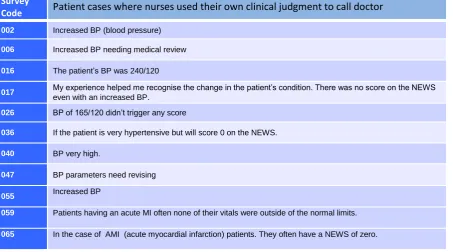
Participants found that NEWS helped them identify patients who needed to be
monitored more closely and they considered that it was a useful decision-making tool for
newly qualified and student nurses. They found the tool helpful but in some cases, for
example in patients with hypertension and acute myocardial infarction, they also used their
Table 2. Patient cases where nurses used their own clinical judgment to call doctor
Survey
Code Patient cases where nurses used their own clinical judgment to call doctor
002 Increased BP (blood pressure)
006 Increased BP needing medical review
016 The patient’s BP was 240/120
017 My experience helped me recognise the change in the patient’s condition. There was no score on the NEWS even with an increased BP.
026 BP of 165/120 didn’t trigger any score
036 If the patient is very hypertensive but will score 0 on the NEWS.
040 BP very high.
047 BP parameters need revising
055 Increased BP
059 Patients having an acute MI often none of their vitals were outside of the normal limits.
065 In the case of AMI (acute myocardial infarction) patients. They often have a NEWS of zero.
Perceived delays in doctors’ response times.
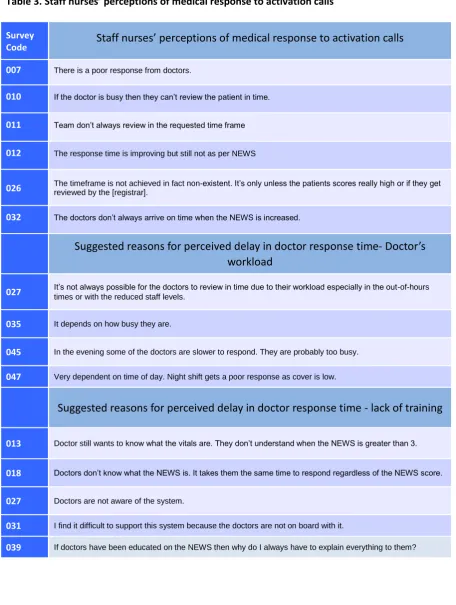
When asked about their experience of response times, 85% of participants
considered that doctors did not review patients within the recommended guidelines. They
perceived the doctor’s workload and lack of awareness of their NEWS role were two
important factors that contributed to the delayed response times (Table 3). Participants
noted that delays in medical team responses occurred when the medical staffing levels were
low, for example out-of-hours, at night and during busy periods.
The second factor that nurses attributed to delayed response times was a lack of
awareness of NEWS among some doctors. It appeared that some doctors were unaware of
the significance of the score’s trigger or the escalation procedure for response times, and
when to contact the registrar and consultant. The participants attributed these problems to
a lack of training, although data on NEWS training of medical staff were not included in this
Table 3. Staff nurses’ perceptions of medical response to activation calls
Survey
Code Staff nurses’ perceptions of medical response to activation calls
007 There is a poor response from doctors.
010 If the doctor is busy then they can’t review the patient in time.
011 Team don’t always review in the requested time frame
012 The response time is improving but still not as per NEWS
026 The timeframe is not achieved in fact non-existent. It’s only unless the patients scores really high or if they get reviewed by the [registrar].
032 The doctors don’t always arrive on time when the NEWS is increased.
Suggested reasons for perceived delay in doctor response time- Doctor’s workload
027 It’s not always possible for the doctors to review in time due to their workload especially in the out-of-hours times or with the reduced staff levels.
035 It depends on how busy they are.
045 In the evening some of the doctors are slower to respond. They are probably too busy.
047 Very dependent on time of day. Night shift gets a poor response as cover is low.
Suggested reasons for perceived delay in doctor response time - lack of training
013 Doctor still wants to know what the vitals are. They don’t understand when the NEWS is greater than 3.
018 Doctors don’t know what the NEWS is. It takes them the same time to respond regardless of the NEWS score.
027 Doctors are not aware of the system.
031 I find it difficult to support this system because the doctors are not on board with it.
039 If doctors have been educated on the NEWS then why do I always have to explain everything to them?
Reluctance to modify parameters for patients with chronic conditions.
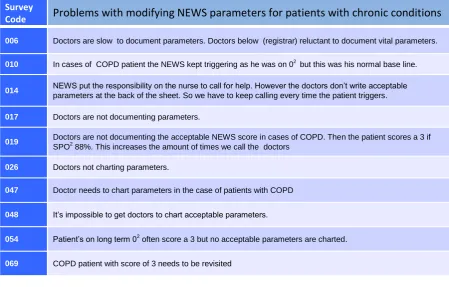
When asked for ‘any other comments’, participants frequently reported that doctors were reluctant
to modify the NEWS parameters for patients with chronic conditions such as chronic obstructive
had a high NEWS despite showing no other signs of clinical deterioration, which led to
[image:9.595.67.517.164.451.2]over-reporting and ‘false’ triggers of the medical team.
Table 4. Problems with modifying NEWS parameters for patients with chronic conditions
Survey
Code Problems with modifying NEWS parameters for patients with chronic conditions
006 Doctors are slow to document parameters. Doctors below (registrar) reluctant to document vital parameters.
010 In cases of COPD patient the NEWS kept triggering as he was on 02 but this was his normal base line.
014 NEWS put the responsibility on the nurse to call for help. However the doctors don’t write acceptable parameters at the back of the sheet. So we have to keep calling every time the patient triggers.
017 Doctors are not documenting parameters.
019 Doctors are not documenting the acceptable NEWS score in cases of COPD. Then the patient scores a 3 if SPO2 88%. This increases the amount of times we call the doctors
026 Doctors not charting parameters.
047 Doctor needs to chart parameters in the case of patients with COPD
048 It’s impossible to get doctors to chart acceptable parameters.
054 Patient’s on long term 02
often score a 3 but no acceptable parameters are charted.
069 COPD patient with score of 3 needs to be revisited
Discussion
This research study has several limitations. Only information from medical-surgical
nurses was collected and other members of the multi-disciplinary team were not included.
The focus was nurses’ experiences of using NEWS and no attempt was made to audit patient
records or measure actual response to patient times. Therefore, the findings must be
interpreted as the participants’ perspectives and it must be acknowledged that other
healthcare team members may have different views.
The findings provide information about the strengths and limitations of NEWS based
on the perspectives of nurses who use it in everyday clinical practice. As a decision-making
decide whether to call a doctor to review a patient’s condition. Cox et al (2006) reported
that nurses’ caring for critically ill patients in general ward settings often lack confidence in
knowing when to call for medical help. Although the nurses in this study were highly
experienced, they valued NEWS as a tool to help them prioritise patient care and
recommended it as a decision-making tool for newly qualified nurses and students.
While NEWS was considered to enhance the nurse’s role in clinical decision-making,
participants used it to supplement rather than replace clinical judgment. As experienced
nurses, they know that NEWS has limitations and that it is unreliable in potentially serious
situations, for example when patients are hypertensive or have an acute myocardial
infarction. Conversely, participants also know that it can trigger ‘false’ positives in patients
with COPD.
The introduction of any new patient safety initiative, including an early warning
score, is supported by clear national policy and guidelines, staff education programmes and
standardised documentation for recording the patient’s vital signs (Patterson et al 2011).
However, successful and full implementation of early warning systems in clinical practice
depends on an appropriate response structure and having medical staff available to respond
to activation calls.
Initiatives such as Hospital-at-Night in the UK, have been piloted to determine if the
provision of out-of-hours medical cover by a centralised multidisciplinary team improves
response times and patient outcomes (Beckett et al 2009). An important feature of the
Hospital-at-Night team is the introduction of medical registrars, senior grade doctors and
independent nurse practitioners instead of relying on junior grade doctors. Initial results
indicate that although the overall time to review is no quicker, there are fewer adverse
patient outcomes, which is attributed to senior clinicians deciding on patient management
Use of communications technology to enhance transfer of patient information
between healthcare professionals and escalation is another way of improving
implementation of early warning score systems (Johnston et al 2014, Georgaka et al 2012).
Initial findings from a study comparing paper-based and electronic-early warning scorecards
(O’Donoghue et al 2011) suggest that e-EWS (electronic early warning scorecard) can greatly
improve data quality.
As these initiatives suggest, successful implementation of NEWS in healthcare
organisations is complex and requires ongoing evaluation and development to resolve
significant problems such as under-resourced response teams and slower paper-based
communication systems.
Conclusion
Evaluations following implementation of early warning score systems are important
to help identify problems and viable ways to address them. Finding solutions within limited
healthcare budgets, for example to resource appropriate medical-nursing response teams
and communication technology is challenging and may require a phased development plan
that is tailored according to the needs of the individual healthcare organisation.
Interdisciplinary education programmes will ensure that nurses and doctors
understand their own and each other’s roles in using NEWS. However, healthcare managers
also need to ensure that training programmes are ongoing so that, as new doctors and
nurses continue to rotate through different healthcare areas, they learn how to use the
References
Bagshaw, S. M., Mondor, E. E., Scouten, C., Montgomery, C., Slater-MacLean, L., Jones, D. A., Bellomo, R., Gibney, R. T. and for the Capital Health Medical Emergency Team Investigators (2010) 'A Survey of Nurses’ Beliefs About the Medical Emergency Team System in a
Canadian Tertiary Hospital', American Journal of Critical Care, 19(1), 74-83.
Beckett, D., Gordon, C., Paterson, R., Chalkley, S., Stewart, C., Jones, M., Young, M. and Bell, D. (2009) 'Improvement in out-of-hours outcomes following implementation of Hospital at Night', QJMed International Journal of Medicine, 102, 539-546.
Bucknall, T. K., Jones, D., Bellomo, R. and Staples, M. (2013) 'Responding to medical
emergencies: System characteristics under examination (RESCUE). A prospective multi-site point prevalence study', Resuscitation, 84(2), 179-183
Cox H., James J. & Hunt J. (2006) The experiences of trained nurses caring for critically ill patients within a general ward setting. Intensive and Critical Care Nursing 22, 283-293.
Donohue, L. A. and Endacott, R. (2010) 'Track, trigger and teamwork: Communication of deterioration in acute medical and surgical wards', Intensive and Critical Care Nursing, 26(1), 10-17.
Etherington, L. (2014) 'Watching closely?', Nursing Management, 21(2), 13.
Georgaka, D., Mparmparousi, M. and Vitos, M. (2012) 'Early Warning Systems', Hospital Chronicles, 2(Supplement 1), 37-43.
Green A. & Allison W. (2006) Staff experiences of an early warning score indicator for unstable patients in Australia. Nursing in Critical Care 11(3), 118-127.
Health Service Executive. (2011a) Guiding Framework and Policy for the National Early Warning Score System to Recognise and Respond to Clinical Deterioration. Health Service Executive. Dublin, Ireland.
http://www.hse.ie/eng/about/Who/clinical/natclinprog/acutemedicineprog/earlywarningsc ore/GuidingFrameworkPolicyNationalEarlyWarningscoresystem.pdf. [accessed 22
November 2011].
Health Service Executive. (2011b) Training Manual for The National Early Warning Score and associated Education Programme. Health Service Executive. Dublin, Ireland.
http://www.hse.ie/eng/about/Who/clinical/natclinprog/acutemedicineprogramme/earlywa rningscore/compass.pdf [accessed 25 February 2015]
Johnston, M. J., King, D., Arora, S., Cooper, K., Panda, N. A., Gosling, R., Singh, K., Sanders, B., Cox, B. and Darzi, A. (2014) 'Requirements of a new communication technology for
Jones, D., Baldwin, I., McIntyre, T., Story, D., Mercer, I., Miglic, A., Goldsmith, D. & Bellomo, R. (2006) Nurses’ attitudes to a medical emergency team service in a teaching hospital.
Quality and Safety in Health Care, 15(6), 427-432.
Kyriacos, U., Jelsma, J. and Jordan, S. (2011) 'Monitoring vital signs using early warning scoring systems: a review of the literature', Journal of Nursing Management, 19(3), 311-330.
National Clinical Effectiveness Committee (NCEC) (2013) National Early Warning Score: National Clinical Guideline No.1, Dublin, Ireland Department of Health.
Niegsch, M., Fabritius, M. and Anhoj, J. (2013) 'Imperfect Implementation of an Early Warning Scoring System in a Danish Teaching Hospital: A Cross-Sectional Study', PLoS ONE e70068, 8(7) doi:10.1371/journal.pone.0070068 e70068 [accessed 08 July 2014].
O'Donoghue, J., O'Kane, T., Gallagher, J., Courtney, G., Aftab, A., Casey, A., Torres, J. and Angove, P. (2011) 'Modified Early Warning Scorecard: The Role of Data/Information Quality within the Decision Making Process', The Electronic Journal Information Systems Evaluation,
13(3), 100-109
Patterson, C., Maclean, F., Bell, C., Mukherjee, E., Bryan, L., Woodcock, T. and Bell, D. (2011) 'Early warning systems in the UK: variation in content and implementation strategy has implications for a NHS early warning system', Clinical Medicine, 11(5), 424-427.
Smith, G. (2012) Time to Intervene? Recognising & responding to deterioration. Simple, yet surprisingly complex. National Confidential Enquiry into Patient Outcome and Death