OBJECT-DATABASE APPROACH FOR A HYPERVIDEO PLATFORM
Qurban A. Memon and Shakeel A. Khoja
Karachi Institute of Information Technology ST-2, Sector-X/VII Gulshan-e-Maymar
Karachi-75340 Pakistan email: [email protected]
ABSTRACT
Web users are seizing on interactive capabilities that software suppliers have developed, and are eagerly awaiting new interactive capabilities now being demonstrated. The capabilities currently being explored include video browsing. This paper focuses on the development of a rich information environment based on a customized platform that enables hyperlinks on objects within a digital video. With the help of such an environment, the user is able to view multiple videos concurrently and browse them spatially and temporally, with the help of an object database. Specifically, the platform is expected to enable users to traverse through that object by linking, and such links have been explored. The links may connect to within a video, or multiple running videos and/or World Wide Web object. The issues such as open hypermedia link base and object database versus multiple videos are also investigated.
Keywords: Hypervideo, Video browser, Object database, Spatial browsing, Temporal browsing
1.0 INTRODUCTION
Traditional relational databases are unable to support video data models using multimedia objects for the following three reasons. First, AV (audio and video) values have a very long duration i.e., of minutes and hours. Secondly, it may not be possible to allow concurrent use of AV objects (as is the case of relational models). Finally, the system resources (buffers, processor cycles, bus bandwidth etc.) can only be allotted in a limited quantity to a process to handle a tuple. A further major problem with conventional databases is the concurrent access to AV data, as it requires explicit scheduling of different processes in the system, by different clients. Since AV sequences are also temporal in nature, the database system should also be responsible for coordinating the presentation of these sources to different clients at different times. Traditional databases usually solve this problem by providing a temporary copy of the particular tuple to each client, and then saving the last modified copy to the master database. As the AV object is of a very large size, the idea of providing individual copy for each client becomes impossible. The above points have convinced researchers of the usefulness of the object oriented data model particularly for videos [6].
In our work, we present an object-based approach – by developing an object database that enables users to navigate spatially as well as temporally. Section 2 presents main issues of hypervideo currently being investigated around the research community. Here we examine the main aims and parameters of current developments in hypervideo. In Section 3, we present object databases and discussion about how such databases will be linked through video. We discuss and analyse the proposed approach with World Wide Web (WWW) model in Section 4. Section 5 presents concluding remarks and future work, followed by references in Section 6.
2.0 CURRENT ISSUES IN HYPERVIDEO ENVIRONMENT
The aim of our current work has been to explore and highlight the multimedia-matching problem areas, which were earlier tried and addressed by the systems mentioned above. The main problem areas include:
(a) Properties: For each media object there are different media properties (image, audio and video) that can be measured in different ways in which two or more objects can be considered similar. For example an image can be matched in terms of color, texture; audio object can be considered in terms of frequency, rhythm, tempo; and video objects can be matched in terms of motion vectors, segment matching etc.
(b) Signatures/Meta data: Each audio visual property of a media can be given different signatures, which are manually edited or auto-generated, and there are different algorithms for calculating and comparing them in different situations.
(c) Similarity: Certain heuristics can be applied to certain perception properties, which are unable to be calculated by machine, should be implemented. Humans usually use world knowledge to recognise certain objects in scenes and sounds that require a level of media understanding, which is not available in computers.
The above-mentioned problems grow tremendously while working on video objects. The first and foremost problem is the different dimensions (spatial and temporal both) of a digital video. Automatic object tracking is another issue, which is highlighted by many researchers [9, 10]. By this we mean that users set anchor position in the start frame and the end frame. The system automatically tracks the objects in the specified segment, by using techniques like pattern matching or normalised correlation. Once the objects are traced, the next issue is to create semantics between them. Kanda and Tanaka in [11] discussed about object tracking in terms of similarity matching and develop certain threshold levels to match a particular link. Lewis and Tansley [12] in their MAVIS2 project came up with certain ideas about developing a layer model to develop a conceptual framework for a particular media object.
The above mentioned projects are still in their infancy stages and no concrete results have been reported, so we term them as attempts to address these issues, however much work in these areas is still needed to overcome them.
3.0 OBJECT-DATABASE DESIGN FOR HYPERVIDEO
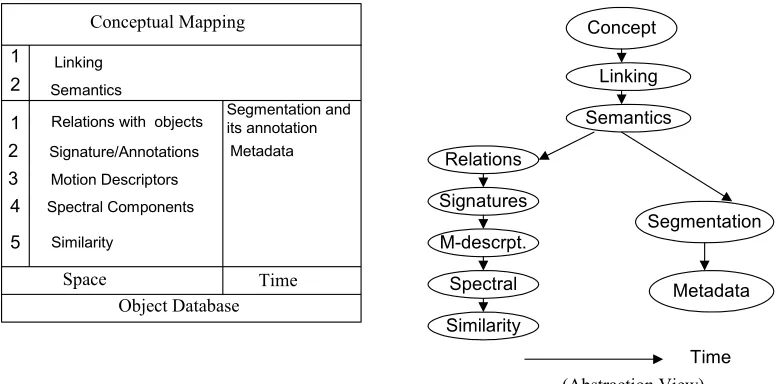
The model shows spatio-temporal representation of object database. The database grows in space and time in respect of various object descriptors for multimedia matching thus enabling tracking of video objects followed by generation of semantics and further linking in space and time. In order to devise a mechanism to support linking, conceptual layer is added at the top to facilitate mapping. In the rest of the section below, we highlight specific methodologies used for each object description/property shown in Fig. 1.
Fig. 1: Development Structure of Object Database
Methodologies:
Physical or conceptual objects in a video can be extracted through temporal or spatial features. These objects can re-occur in multiple frames or segments within a video, or occur only once. The following methodologies are commonly adopted in spatial domain while performing any action on video objects:
a. Similarity Matching: Through content-based retrieval techniques, similarities of objects can be measured. Typical dimensions are shape, color, shade and texture matching.
b. Spectral components: Similarly, spectral components can be measured to compare different objects. They can be gathered by calculating the RGB values of a particular region, encompassing an object.
c. Motion Descriptors: Motion descriptors are tilted up/down, pan left/right, roll, boom up/down, track left/right and dolly forward/backward. Further, object motion is categorised by parametric object motion. d. Signatures/Annotations: Once the above features are extracted, the unique automatic signatures and
annotations are provided to different objects in developing indexes for video objects in databases. These signatures can be generated by concatenating different spectral components. High-level annotations can also be provided by the user at a later stage.
e. Relations: Depending on signatures and annotations, higher-level relations are developed between objects. This can be done by comparing low level annotations developed through spectral components and similarity matching.
Furthermore, physical shape detection can also be categorised into grid layout structure and histogram structure. Further, they are divided by object bounding box properties, region based shape descriptors and contour bases shape descriptors. Color descriptors are models (RGB Scattering, YUH, HSV or HMMD), using dominant color description and histogram. Texture is tagged with luminance edge, histogram description, and/or homogeneous/ heterogeneous textures.
The temporal properties are important from the perspective that a viewer is navigating through a video, and are used in formulating queries that contain object movement constraint among the video frames. Referring to Fig. 1, following temporal properties have been considered for our hypervideo data model:
a. Segmentation: The first step of any video processing system is to segment long chunks of video data into small segments (or streams). These segments, temporal in nature, are usually generated by template matching or histogram matching. Once segments are obtained, they are usually assigned some related information, known as temporal annotations. These annotations can be manually edited or automatically
Object Database
Space Time
1 2
4
5 Similarity
Spectral Components Signature/Annotations
Relations with objects Segmentation andits annotation Metadata Linking
Semantics 1
Conceptual Mapping
2
Motion Descriptors
(Abstraction View) 3
Concept
Linking
Semantics
Relations
Signatures
M-descrpt.
Spectral
Similarity
Segmentation
Metadata
generated. Manual annotations are more specific and depict higher level of intellect, as compared to automatically generated annotations. A segment can also have multiple descriptions, depending upon the semantics used in the segment.
b. Metadata: Metadata for temporal aspect of a video will be stored in order to describe the relationship between objects. This metadata is generated by taking into view the temporal relations of different video objects. For example an object is ‘overlapping’ or is ‘in front of’ or ‘in left direction’ etc. Metadata of different frames and segments will also enable non-linear navigation into a video through hyperlinks.
At a layer above these spatial and temporal descriptions, we develop semantics of the objects to enable linking within/across video(s). Following approaches are proposed at this layer for our model:
a. Semantics: Once the spatial and temporal features of a video are described, semantics are developed at a higher level. These semantics are developed by assessing all of the spatial and temporal properties of a video object. Further, latent semantics define how closely two objects are related to each other [13]. So by using semantics, we develop relations between similar objects.
b. Linking: Hyperlinks allow users to browse the information and access it according to the user’s particular subject of interest. Hyperlink systems as compared to traditional database systems provide an ad-hoc jump or non-linear access to information. For video objects, anchors are placed within the video and the link can traverse within or outside the video document.
As far as complete picture of metadata at different layers is concerned, the following implementation considerations need to be addressed:
• Since video is a continuous media, it should be stored separately and should not be chopped or interlinked with the metadata. i.e., the raw video data should be kept raw and the other metadata or annotations should be stored in a separate database.
• One of the major issues is labeling of segments i.e. what sort of annotation should be provided for the segment or what constitutes a suitable description for a segment. Is free text sufficient or is more structured description necessary? Can keywords provide an adequate description?
• Provision of the semantics to annotations is still one of the problems, because there is no standard available that can define up to what level of hierarchy a user can provide to semantics. And, what sort of relation can a user define between two objects in a video? Similarly, what sort of relation should be incorporated between two segments? etc.
In order to address the corresponding development-related issues, we decided to follow MPEG-7 standard and formulate metadata accordingly. The MPEG-7, also known as “Multimedia Content Description Interface” standard offers comprehensive set of audiovisual tools to create descriptions that will form the basis for applications enabling the needed quality access to content, in order to fully describe the multimedia content, manage it flexibly and globalise data resources. The standard addresses issues of standardisation of a common interface for describing content in multimedia applications [14]. MPEG-7 aims to provide full text descriptions as well as structured fields (database descriptions) to support metadata provided for different audio-video objects. Along with it, a mechanism is also provided, by which different MPEG-7 descriptions will support the ability to interoperate between different content-description semantics. Further a robust linking mechanism that allows referencing audio-visual objects and their instances will be provided [15]. The above mentioned MPEG-7 features complement our approach of object database model (Fig. 1), where the data object follows the hierarchy of conceptual mapping, linking and semantic annotation, and follows the descriptors syntax that is offered by MPEG-7. Such an experimental structure (using Fig. 1) is shown in Fig. 2.
At a higher layer, the concepts are generated by evaluating semantics matching. Concept is an abstract entity corresponding to a real world ‘object’. Each concept is associated with one or more media representations, i.e. multimedia objects that represent the concept. These representations may be a text term or phrase, a portion of an image, a segment of video or any other medium.
Fig. 2: Metadata Structure for Hypervideo
Inter-video links and Open hypermedia linking:
The object database model presented above along with associated methodologies for each of its descriptors at various layers facilitates development of object database for easy access and traversal through hypervideo browser. Furthermore, in order to enable linking of objects across multiple videos, the metadata of a video document can have such information, and can only be placed at a further higher layer in the model as it relates to different videos.
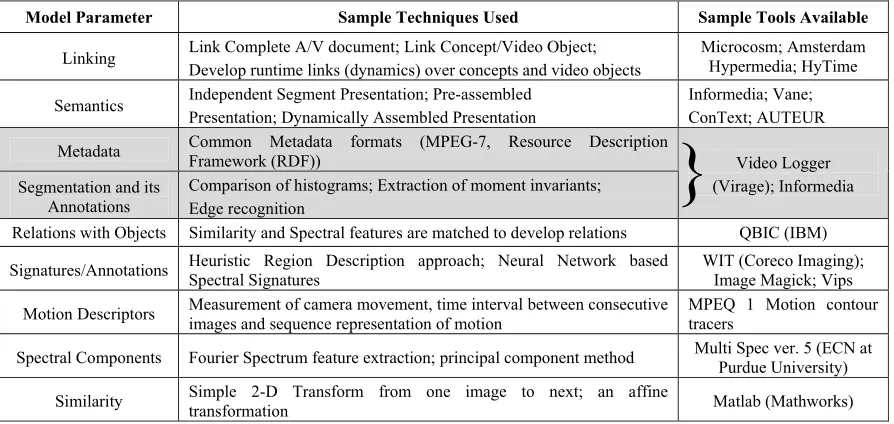
Table 1: Development approach for Object Database versus current common tools available
Model Parameter Sample Techniques Used Sample Tools Available
Linking Link Complete A/V document; Link Concept/Video Object;
Develop runtime links (dynamics) over concepts and video objects
Microcosm; Amsterdam Hypermedia; HyTime
Semantics Independent Segment Presentation; Pre-assembled Presentation; Dynamically Assembled Presentation
Informedia; Vane; ConText; AUTEUR
Metadata Common Metadata formats (MPEG-7, Resource Description Framework (RDF))
Segmentation and its Annotations
Comparison of histograms; Extraction of moment invariants; Edge recognition
Video Logger (Virage); Informedia
Relations with Objects Similarity and Spectral features are matched to develop relations QBIC (IBM)
Signatures/Annotations Heuristic Region Description approach; Neural Network based Spectral Signatures WIT (Coreco Imaging); Image Magick; Vips
Motion Descriptors Measurement of camera movement, time interval between consecutive images and sequence representation of motion MPEQ 1 Motion contour tracers
Spectral Components Fourier Spectrum feature extraction; principal component method Multi Spec ver. 5 (ECN at Purdue University)
Similarity Simple 2-D Transform from one image to next; an affine
transformation Matlab (Mathworks)
An Open Hypermedia System (OHS) is typically a middleware component in the computing environment offering hypermedia functionality to applications orthogonal to their stage and display functionality. An important theme in OHS is the distinction between structure and content i.e. hypermedia links or structural data (metadata in our case) have to be stored outside the document and are not embedded within the original document. This holds true for our model, as the metadata is stored as a wrapper to the document, but not embedded within the video and the actual format of the video is not modified. This feature provides the facility to generate dynamic hyperlinks at the run time. We propose a similar approach as given in [16], as that fits our model objectives. Dynamic links are generated, when a user searches for a particular keyword within a video document, and if any hit is found in metadata, unique URLs are provided to the metadata and the link-base (stored separately) is updated. When a dynamic link is authored, only the content of the source selection is stored in the source anchor. The original location of the source anchor is not retained. At the link (in the following step) only the content (and not the location) of the user selection is matched with the content section of generic link source anchors and the user may
Segment ID Start frame Key Frames
Object
Object ID Object Name Semantic relation
Hyperlink
{
Segment Higher
level
End Frame Frame Histogram Motion descriptor
Signature or Annotation
Relations with Objects
{
Object
Lower level
[image:5.612.88.535.373.585.2]follow links wherever a match is found. This provision is kept in our hypervideo model, so that if the metadata is modified or altered by the user, generic and dynamic links will automatically be updated.
In the next section, we analyse hypervideo model in comparison with WWW model and highlight its critical aspects.
4.0 ANALYSES AND COMPARISON WITH WWW
In this section, we highlight main functional differences between the two media types. Due to its time-based nature, hypervideo model (as proposed) requires different aesthetic and rhetoric consideration than traditional static hypermedia. The main differentiating areas are:
(a) Relationships: Hypermedia applications allow these relationships to be instantiated as links, which connect the various information elements, and are classified as structural links, associative links and referential links. The hypervideo applications, on the other hand as proposed in Section 3, develop such links based on spatio-temporal descriptors and hence are associated at higher level.
(b) Synchronisation: The proposed hypervideo model can find the appropriate video events and coordinate its properties within the routine events. Even a dynamically segmented video can be developed to meet user specific needs. Such flexibility is actually available due to the presence of temporal objects, where as such a complexity is not present within hypermedia.
(c) Authoring: This task in hypervideo is rather tedious than hypermedia, as it requires different rhetoric to accommodate annotations, metadata (provided by users) at different levels (i.e., spatial, temporal and conceptual), and even adding of hotspots links. Although, this part is not directly related to our work, but we address it for the purpose of completeness. For the information of interested readers, it is important to state here that such tools have been developed by various researchers/organisations for authoring a hypervideo [7, 11].
(d) Management and Presentation: This factor becomes more serious when multiple videos are considered such as traversing a link from a source video to a destination video. The concerns such as pause/play versus continue/end in source video, while destination video has been selected, become serious issues if desired to be managed within a hypervideo platform. Such a scenario is completely absent in hypermedia. As stated earlier, like authoring, this part is out of the scope of our current work.
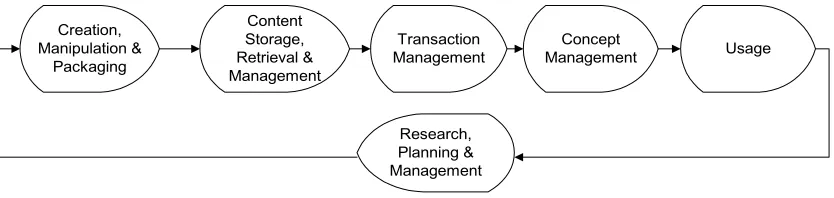
[image:6.612.79.496.552.651.2]Despite much research work carried out, the problem of classifying, storing, and retrieving digital content, regardless of media type, remains a major problem. In fact, it is the context, which gives value to the information. To an uninterested user an archive is not a pool of information but bits and pieces of uncorrelated data where as for a researcher the same may be valuable source of information. Developments like associative stores help but they are slow and require a set of relational links to be specified at the time of storage. The way the brain seems to operate gives hope that ways can be developed, perhaps based on unusual storage techniques, such as holographic stores for quantum computation. This whole discussion suggests that strategy to be adopted for the development of such interactive digital media should address process management of integrated areas in multimedia, and one such strategy is displayed in Fig. 3. This figure shows relevant and peripheral areas surrounding object database, and these are still to be researched further to enable complete management of hypervideo platform.
Fig. 3: Overall integration and process management of interactive digital media Creation,
Manipulation & Packaging
Content Storage, Retrieval & Management
Transaction Management
Concept
Management Usage
5.0 CONCLUDING REMARKS AND FUTURE WORK
We have highlighted the main issues related to the development of a hypervideo currently under investigation by the research community. For the same purpose, we proposed a customised object-database model enabling hyperlinks on objects within a video or across videos. We demonstrated that such an object-based database could develop necessary metadata for traversing through objects by linking. We also discussed the main differentiating factors between such a platform and existing hypermedia. Currently, we are working on management structure of such a platform at different levels, and hence such research will be reported in future.
REFERENCES
[1] D. Liu, C. Lin, and J. Hwang, “Classifying Video Documents by Hierarchical Structure of Video Contents”.
The Computer Journal, Vol. 43, No. 5, 2000, pp. 396-410.
[2] J. Murthy, S. Chen, and S. Chatterjee, “Similarity Measures for Image Databases”, Proceedings of SPIE Conference on Storage and Retrieval for Image and Video Databases III, 1995, pp. 58-65.
[3] N. Ramesh, Sethi, “Feature Identification as an Aid to Content Based Retrieval”, Proceedings of SPIE Conference on Storage and Retrieval for Image and Video Databases III, 1995, pp. 2-11.
[4] S. Smollar, H. Zhang, “Content Based Video Indexing and Retrieval”, IEEE Multimedia Magazine, 1, 2, 1994, pp. 62-72.
[5] W. Ma, Y. Lee, and D. Du, “Video-Based Hypermedia for Education-on-Demand”. IEEE Multimedia Magazine, January-March 1998, pp. 72-83.
[6] M. Dobie, P. Lewis, “Object Tracking in Multimedia Systems”. 4th IEE International Conference on Image
Processing and its Applications”, April 1994, pp. 41-44.
[7] N. Sawhney, D. Balcom and I. Smith, “Authoring and Navigating Video in Space and Time”. IEEE Multimedia Magazine, October-December 1997, pp. 30-39.
[8] A. Salem, J. Potter, “Multimedia Browser”, Proceedings of SPIE Conference on Internet Multimedia Management Systems II, Vol. 4519, July 2001, pp. 203-214.
[9] W. Chen, and S. Chang, “VISMAP: An Interactive Image/Video Retrieval System Using Visualization and Concept Maps”. IEEE International Conference on Image Processing, Greece, Oct. 2001.
[10] E. Oomato, and K. Tanaka, “OVID, Design and Implementation of a Video Object Database System”.
IEEE Transactions on Knowledge and Data Engineering”, Vol. 5, No. 4, August 1993, pp. 629-643.
[11] J. Kanda, K. Wakimoto, H. Abe, S. Tanaka, “Video Hypermedia Authoring using Automatic Object Tracking”, Proceedings of SPIE Conference on Storage and Retrieval for Still Image and Video Database VI, Vol. 3312, January 1998, pp. 108-115.
[12] M. Dobie, R. Tansley, D. Joyce, M. Weal, P. Lewis, W. Hall, “MAVIS 2: A New Approach to Content and Concept Based Navigation”, Proceedings of the IEE Colloquim on Multimedia Databases and MPEG-7, 99(056), 1-1999, pp. 9/1-9/5.
[13] T. Landauer, P. Foltz, and D. Laham, An Introduction to Latent Semantic Analysis, Discourse Processes. University of Colorado, 25:259-284, 1998.
[14] ISO/MPEG N2467, “Description of MPEG-7 Content Set, MPEG Requirements Group”. International Organization for Standardization, Geneva, October 1998.
[16] S. Griffiths, J. Rob, et al., “Media-based Navigation with Generic Links”, 7th ACM Hypertext 96 Conference, Washington DC, March 16-20, 1996.
BIOGRAPHY
Qurban A. Memon received MS and Ph.D. degrees from Florida in 1993 and 1996 respectively. He has served as Assistant Professor at GIK Institute of Engineering Sciences and Technology, and later as Associate Professor at Karachi Institute of Information Technology. He carries an overall professional experience of over ten years. He has thirty-one research publications to his credit in International Journals and Conferences. His research interests include Internet Video, Network Security and Mobile Computing. His biography has been included in millennium edition of Whos’ Who in the World.