?-rE·,7 1:ETHODS OJr' SOLVIWG THE EQUArrIONS :~'OR THE 2"'101/ OF A OOMPRESSIBL:~ FLUID
Thesis 'by
Francis ('Hauser
and
:Milton Clauser
In Partial Fulfillment of the Requirement for the Degree
of
Doctor of Philosophy
California. Institute of Tecl1nology
Pasauena, California
Summary.
e usual equatLn1s fo1· the flo··r of e:. oor:Tprass i·o1e
f'luid are no:n-linear in c11LU'aote1: and difficult t:i Bolve. It haa bee.n f'Jund ·ch:i.t ii tl1e c:n1por.snts of v;:;locity
a1·e
t
ars lin~ar. These equetians are develoned and ne farms
intxoduced
A new function,
r
j s introduced 2.nd 8. method advR needfor
e
ff :::ct in: ~ the transf or~.:i8.t ion fro .. the plane wher:; the 'velocity o onents ;i.re cci1'.fr(}i11a.tes3 t.o tie physicE'.1 pla.ne
ere x and y are coordinates.
A new way of finding plansible solutions to investig2te
1s given <:cn(l tl1e oase of flm1 in E1 curnt:l' is wor1<ed out in detciil, rrl1e :t'low is found to have an ano.nmlous behavior, the reason for which is exnla.ined. This solution is apnli::d
(2)
when ~e Binoeraly thank Doctors Theo6or von Y~xm~n and Haxry 3ate:man :fur layinJ the founJations of the ;:mthors ~
knowledge o:t· com'7Jressi-u1e :flu1d flo-;;1 and for thei1• lcind
and syropathet ic ;uidarice th1·ou,::;i1out the develmrn1ent of th worl< •
.F'u;r•ther, no s;:1<'111 deut of ::;::i:·.st it ude is due to
1iii ss GatLar ir1e llan for har n2rt 10 eparinI; thiei
thesi&.
J~Ci/YV~~ ct~~
XEVl ;,;ETHODS OF SOVll!D THE E~WA l'IONS FOR THE FLO\'! OF A CCWPRESSIBLE FLUID
In the steady flow an inc essible,inviscid.fluid,
if i:rrotationa,1 motio:n is assumed,, the equa.tions of motion
'd t..t..
;;1
·1rreduce to the simple ecue.tion
:
";;(] ~i;(
wl1ere u :i.nd v are the co111ponents of velocity a.lon:S the axes of' x and y. This equation implies the existence of a
velocity
potentia.l
'f
defined by the equations lL-:·-~-fl
J if-:.}.'f.?
'7' h
~1
f. bl f 1 . d - - 'dx
(J .
J' or t e :r ovr O- a compressi e u1,,, tne above rea.sonin; is
st ill vali.d if the :pre ssu.re is a s ir:gl e va.lued function of
the
densityalone.
Fox the oase of inoom:p:reosible flow,the equation of continuity,
~;-
·r-::g
'tr=o,
may be satisfied ·oy
astream
~
g
~~
~w
function
r
de:f'ined bv l.,(. = ~ ~v:- ··-
However,;
.
'()y
;
'2JX'in
the
OB,Seof compressi-ole floif,
iff
is the density, the
equa_tion of continuity is ti'dx
ff
u..)
+
?Jg
(f'
·u-J ::::
o and the streamfunction
isnov1
defi:ieci byf
LA ...=
and
Ci¥!.
(j (/
In
studying compressible
fluids, it isconvenient to
introducethe two components of
momentumJfl-L and f"'r,as new variables. However, in 01·de1·
to gain a
symmetry that will appear later, we shall
define~l... ::; -
J° ·r
,...,..,,
=
J°
t..t... • Introducingthese in
ourequa.t ions we have
o
V- _ ClV-'(;) (/ ? x
and the
e,;
.·;;v,.vz....;I ""J
1 :::
(4)
With the assunpt1.:ms int:roduced aoove J it cen be ~:ohown
ti;at the pressure an0 ctensi.ty caJ1 ea.c~'1 be exnressed ::1.s a
I
~ --:l:fu:wtion of the irelocity..,
ty
c:: .<. .... ~) only. Ti·1ie1 i;rp1iesth2.t () =..
Q.~,,,./'~
is a function of q alone,, (Thesexelatimshiyia bei;;;1een p,
f:;
q and Q a1·a simply va.rioue forus:i.f Be:n~u-ull i 1 :;
lf' Yre use tlns :L's.ct 1~1 ein att t0 find an equat1on
f Jl'
eauatione are non-linear.
~'
...
,, ') )For instance the equa.tion for
f
is -;;ix (f"
~r)
+<$ (
f'
~)
=
owl1e:r·e i~' 1'.'.lust be rer.;2rded ~ a. c;;iven function of
J;.;!+
tr,//. :::::;"J#)·~~(~f).
2
Non-linear equations ere n
1)t(·"'x
"1 .
readily arnena.ble to ancdysis a.nd very li tt1e has been
accomplished ir1 the vmy of direct solutions.
However ,
ithas been
f<:mnd
tha.t ifwe use u
andv as
indepenclent variab1·es ineteacl of ,x and y, thE! result in,; equs.tionei are Jin~&r. In nc1er to de:rive these equations>t're el irfiina.t e cix c:i.r:d dy f'rcH1 the follo"1ing equa.t ions
d
1., 1' ~/ ·11./ _- ..-..-.n... -1x
J. ~l al_)f.t:CJ'
=
(,.<. t?VJC.. -1--zr
·~f j ~ T r,. V'V'. , 7rL'his elimination is effected by solving for dx a,nd dy in the
follo~ins
equations
:;ir,,c_ "'
c)
i:-0k ;.
~
l-'-d "''
~x
r:ig
rl
Ol'
;l·
g
Ll
-
Vl :;:"-
£,{,,,+
d~d "'"-
-
?Jo
/j
-·
L1
-}
=
If
we
e (;I i r c;tr1dfrom
the~)(
the
;:::=
we
obtaintrie
des equations/)\~,{_, + ,..,~
-
"2:,.r'I
~
('.,,,;(,,. -I- .~ti
-
~·P'.t.r + """;,;r;~wj
The fi:rst o:f these equations is :readily obta,ined from the above equa.tions but the second is more difficult.
The
xeverse
if we-I
(
j
(p,
-f-instead of' equations 2.
)<
have
been foundeven
more readily by noting the symmetry of u' v a:ndr
with m, n and-¥J
and intercn19-n~nr1gfirst equation.
them in tl1e
Equations 5 take on a particularly simple form if we use
pol~tr
coordinates
in the hodograph pla.ne J i.e. t•<. : .U,!9-0=
Q
u~..
i1/
The equations now become
*
(
.l
*
During a disouaeion with Dr. H. Bateman, the authors learned that he had obtained the equations in the form givenhere.
However, it is believed that the form givenin equations 5 has not been given before.
{ 6)
These a:re linear eguat ions and .b.enoe a:re :much more readiJ.y trea.ted than the non-linec'.r equations found befol'e. In these equations~ q and Q are the v2.l ues of the vel tloi ty Rnr'l ·tbe
momentum while
fJ
is the e of their cornmon direction. Q 11 be a given function of q alone; in fact in the caser
l
o:;; 1..:01ns'T. <"
of a.d:i.abat ic flov1 vrher e j ··· , we have
() - /;)o
J
LI --
l;J
,if:~/
l-J whereY :
L;;/c:·
,r 1'the l'a.tio of' the specific heats and
/10
and Co axe the densi·ty and velooi ty of sound at a point 'nhereJ'
=
o.Another interesting and extremely useful set of eriua.tions which have been used but little until now are
Ol)tained by introducing the Variables
rx
and /,..-, by means of tbe conta,,~t t:rar1sf oxma.t ionsIf we remember that
~·ti';·
d '/
r~_?P C>~tp)
;;. -1- (..1-"::: t·I --rt.. ::.
-r-
/,...Vt..-·
di
~I /(
9//
'J
x
f
C./
I,
we find the interesting xelations
~_.&
r):
i f
/.. f ':;::. r;;irx
::'..'I
-== d "'X=
(/ 1;)#,•i"L.,.t'?.:.t... ~11r 'j!;),~~
Vthioh lead B.t once to the equations
~( ,.... /_,
rzi;t
,,... ,...-7l
10.
'?.~' ;;:; ~ ~ "''I
j
--
't:l -?v'jl '"" ~·--.... ~·(.. '-;1·1.r
If we again go to polar coordinates in the hodograph plane, tbese become:
Q
-;1/l
'd
/""?;;:
/"a
1
r· ~I I}11.
~;
I
r·
-·,.
ci;['
;/.l ::;•1 I
"1'/e r1ave found simple relations between ~,,. and /',and a.lso
betvreen
;l
a.nd Fu:rthex J there exist relations connectingthese two sets of dependent variables. First there are the
1·el&th1ns given by 001,1biHing equa.tions 8 and 9
,..- 1"
o'
·-;;i .~..,.;.i.,
or in th~ polar ooSrdinates
or
inpolar
coordinates
a~q£
().~>i··-~--
Q
~,=
7
i;)J
r:itfJ
..(.
o2r
Q
'}Cf
c;=
Q ..
-g.
'3ci
,...JlF'd
Q
;;
/ '
,::.---e;J' ,..;i-i.,,
J
l
d;{
'di!J
,...d
I ''Jtl
r
13.
l
f
10-:
~.
( 12.
J
So far, in this analysis, the equations have been presented in sets of two, each set containing at least t11110
{8)
equatior1. can ·ce fo-:J:nd
f'.:treach
:ifthe va:"iables
f ,
?JI
!l;t
and.r '
These independent eque,tions CcUJ be :found whe:rethese V'Jl'ia"oles proves trouolesor:~e ;;: .. nC:. the ,,,:oat useful forms are tLnse e q 1 Q and
iJ
aI·e variables. The desiredIn obtaining solutions
for these equations, it turns out to
ta convenient to use neither
qnor
Qbut to introduce a
dimensionless variable, 'f , defined as '1'-::.. ',;1
J
/c:
wlrni·e
't
and t!.o a:re tLe same as previously defined. It follows 1mr:iedie'"t ely that /Q-:
Clo~
R
'1'(1--
7')
~
J ~
i'-1
It V1ill sh1plify Wc'.tters if we put
-f-1 =-
/8
,
tbenl"1
~
Co(2/'T'
Q::
Co,P"
f.?j57'(1-7'} }
17
Y1e have
The following are expressions for the local velocity of
sound
11 0 11 }jfound in
eler.1entaxyacoustics to be
U ,
and for
d'r
;t ln the previously noted discussion, Dr. Bateman mentioned
the pxassuxe dens 1
ty,
al 1 as fun ct i ans of 1"'It is int to note tbe o:f values of 1' •
:. 0 the CTiti veloc:ity of
sound is
'; c
=f-1-1
the limit velocity corresponding to J =o
is attained ,
•11/ ..
2
:: 1~n c J(,.
= (
tJ -·_;__ a11dr-1
'l;;;/Hence:1
in pr a.ot ice ,,,..
will rangefrom
0 to 1 tbxoughthe point
1 :('
at a of'l-1
IP+1
:;:;: ~ ~for iY::; /.
"
thenormal
valuefor a
diatomic gas such ai:: '""e.ir. In this oa.se / -Inserting
:/fr
:: 0
The first two of these
equations are essentially
t:t1eequations obtained by Tschaplygin.* The
sirrru.ltaneous sets
*
s.
Tsohaplygin - Gas Jets (In Hussiarj Moscow Memoirs 1902
(10)
of equat
&
a.s va.r 11 a.lsovaluable in er work. They are
'<!_f-
~:/
~
tJ
/-
7')
·'f'{ I
-::::
I
Solutions
of
obtstined by
using
ions
19for
-¥1
and
can be r
sions of the form 7l.t;;.
r
Tr,,.1')
"
e
,
and r)
(t9).
The
f ina.1 expressions comeout to
belf
~
'i
F(a,
?·
Ic ·
Jr)
-::.
'T'
F
I i I I " )
(
a.
/ } . . 'l... J~ '1' ) .)ere n may be assigned any value and
6(,,-1-
fr..
= qf
~., ... r.vt: /) ~
,,~·u ,...-,.vt..
J
~
I / +Li
(r
=
II.
/i'::.
Iand
F
a..
Jh-·
J·r)'
is the hypergeometrio functiondefined by the series
F
(a)
Ir.,·
Cf1') -
I +
f' +The reason for the choice of ~ as one of the independent
variaoles becomes apparent upon inspecting the above solutions.
The solutions for
f
and
r
do
::10tturn out so simply but
ifdesired may be obtained without difficulty by using the sin::ultaneous
sets
of equations (20).Howeirer 1 in using these solutions.1 ·t;)1e autlnl's fcmnd
- f ... \.-'
tha.t, in gena:ral, on1y the t'f!7:J functions ~1 a.nd
A .
.arenecessary, the first to determine the streamlines and the
second to effect the tra:nsfo1'mBtio11 :f1·om the hodog:rarJh plane
():f u and v (or 1' and
fJ )
tothe
physical plane o:f x and. y.This latter operation is possible 'because of' the relations
x
=
? ),'
..-~, ..:.t..
(/
~t
::' -J (/' .
-;;i;t;'
ln fact. 1,
t is because ofthe ease and
sinrplicy of this 1·: return t1·a.ns:formation that 'Ghe authors are leadto
believe tnat tt1e :t'unct ion;r
(or r )vrill
:nrove of great value in
future v10rkin
compressiblefluids.
If only
Cf
a:nd/or
jii
are used, as
we.adone
byTschaplygin, the retuxn to the plane of
xand
yis tedious
ancl difficult.
The
value ofJI
is shovm, in thetheory
of gasesJ to be.;2
equal to / -f' ~i:.- where m ie the number of degrees of freedom
of the molecules of the gas.
The solutions given above
reduce to
oases
of theconfluent hypergeornatric
function ifue
a.ssurne the gas to be polyatomic i.e.
.t"VYl "' 00and.
Y=
IThis oo:rres-ponds to an isothermal type of flow.
1~111en/f I oa
r
=;T-1 ___,.,..
and it is ueoessa.:cy todefine a new variable
The final forrrs of
F
:.:
c
-:.,( 12)
/ /
)
. /l ,
t
J <.. J
...
;:.. ' - ( ,£/.f . ..-~
,,
F(a~· .~
t)
=
/ '"">'L
CL ::::.
~
,,
c
':,../-I
s found that no considerable s
ifio ionwas attained by
this specialized ca.se and the more general
solutions (21)
were
used.
As is generally done in solutions of partial
differential equations, general solutions may
be
built up
on the
x-In these expressions, the subscript n denotes that the
corresponding
quantity is a
function
of
n.
Hov1evel', l1e1·e vie a.re confronted ','ii th the pr·oulem common to
all solutions in the hodo5raph plane, namely that
oi'cletermining
solutions (i.e. the constants
A,,,
B.~J vrh ioh vril 1 ha,ve a mec:mir1g ·when t:ra:nsformed tmck intothe physical
·nle.neof
x a.:nd y. l t occuxl'ed ·Go the authors to compare the 11.mi ts
of the
above solutionsas they
approachedthe oase of
inoorrrp:ressible
flow
th the vest quantity of s
ions
alr·eady ob·ta1ned for 1nco1:1pressiole flovro If tlle lim1 tir1g vc..lues we:re :readily comparable with know:c so hit ions, thecomparison :uight give values for
A ....
andB' . ..._
which would result in solutions ths,t might posaibly he,ve a physicalinterpretation. To be sure, thexe is no guarantee that the boundarie.s o:r types of flm7 ·nould correspond, but the met
should indicate likely solutions.
Since the law giving the state of the gas was
assuwed
'
to be
p
=-c
oNS' 7.f" ,
it follov1a that the incompressiblecase ,corresponding to
constant density, is given by'I-,.
c:iciIn this transition, we shall assume ttat both
pa.nd
f
ramain
finite. How C0.<. ;:;;I
f:,1 and if i'Te insert this in our/fl,
'"
:A. /value for 1') we find finite as
d ~
....::if' =
]~
1p°1/'~1-G
which ren:ainsI
Now
p- - -
-~ oI -
J'-1
, and we
a Ir
see that
C
, the coefficient of the second term of the hypergeor.1etric series given in 22, which is equa.1 toap::oroaches 0 as do all the rest of tte terms of' both
hypergeometric series except for the first terms.
Consequentlytlle solutions (24) approach expressions of the form
(14)
/
)
,,.,
,,,-,,.! '-d,
£Tow" normc..lly, solutions for the incompressible case are given in the form
~ . .l 'I
t ·}
tt'
wherE: ~C. ::
x
·1' ".:/-
. { .and ,~ ... = ·-· 'J'". thio.t is J V"li t11011t
";IA )
and }/' is de:f'i:1ed by
tbese components of the
velocity. Howeve:r:, since we shall be comparing incompressible f 1ori soJ.ut ions ''!here jo is a constant, this difference vrill not cause trouble.Differentiating equation 26
shows
ttat.
~U - (
.,r
=
L1 _...,,..-"... --:1--t,
!:Jaw normally this series ca.n be inverted, giving
(In a great many ~oract ical ceses) the series (27) consists of
only one or two terms,in
whichcase,the
inversion issimple.)
Substituting thisin
equation 26gives
.... r'I,..
.£-
r''Vl - ,·t:.r) -=
,..>V
rte
now define the fun ctions
;t'
andr
·oy the re lat ion/:{ ..; / 1n
=
(t( - ,,-·er)
~2·
-f~:-'
y1.. ' ·'P)
which /yields ~>t
::.
?l A ".f
·c,r/1 - '-);:'
/'
)
/ '
This e.grees 1"1i th our previous definitions except for
the now constant quantity ,.:, which vrould be needed as a, factor
i t enuEttion. lf we substit1::.te equatt:mE' 28 29 in 30 we
lr.specticm now Bhi'F7S the close :rese:.i:'bJ ance of equations 29
,
a.nd ~?f?J to thei limiting case of the compressible 1·101n gi11en oy ·::iquations 25. I:u fact; i t is by mec:.ns of this close reserr1bla.nce tha·c tne au·tlwxs :none ths.t likely solutio:ns <)~
·the corr:pressi·cle fluids equations will be o"otair,ed.
method a. litt1e fuTthe1·> let ns consider the case of the unit ci:i.·cula:r cy11nd.e:r.
i~ the case of inoo~pressible fluids is
I I I -
z:<.
from which we find
I
f7=
(u- ( v--)<
ir)
7,·',,,';- . ...!..
r·
4
Simi laxly
.,,. i cf,
-l.
,r __ I .".'. •l....-J
- 2
j / -
z
,,,,?- _ ... -8
(,/'"'
solution
( 16)
the rei:;ul·t might possibly be the flov1 aroun:-1 an obstacle at
:/.
least ''a~uely resembling a sphere. 7 Unfortuna.t ely ll time did
not permit tha auth:irs to inv~stigate this 1rnlut ion fu:rtl"le:r.
lnsteau, ·they have investigz.ted another case 71hicb wi 11 no'v ~e descxi~ed in detail.
f:r.::wt io:ne.l value of n had bee:::i ell.
A
little inveetigatlcn shows that the
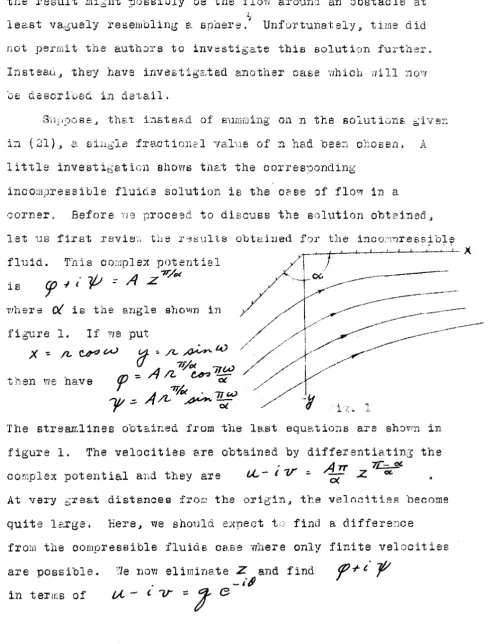
oorres~ondingincom.::iress i ble fluids solution is the oei ae ::if flo1':7 in a
·Jorner. Before n::i proce9d to discuss the snlution obtetnec1,
let iJS fix st r·evie.r., t1.te i·,:isul ts obtained for the inco,··mress~b"J-9
fluid.
Tbis
co~plex potentie.l. 71"/ot
cp~,p:Az is
t
en
we have [image:17.615.70.570.84.729.2]Tl1e strearr:lines o·otained from the last equations a:re sh::rvm in figure 1. 'fhe velocities are
obtained
by differentiating the co:mple.x potential and they are u..,-i
7J"' :.A
TTz
7T~
°'
°'
At very e;xeat distances fror;; the origin, tte velnnitia::i become
quite le,rge.
Here,we
shouldexpect
t:~ finda d
ifferenaefxorn the oompressible fluids case
VThere
only finite velocities
are possible.
in terms of
~,1e now eliminate Z and find
.
_,·1
/
-»-, 77"-i:;;.;·
- A
J
.~
whence
P1otted hi th£ },odJLl'c.ph
shown in 2,. lt should xemei:iOered that the di1·ection of flow is not given by the slope of the st:rearnlines in the
where
I
'lF
/ /
/
4';,
l -~, .-,
/' ,.;;) . .c:.
(
I
hodogrs.ph plane but by the
\,
\,,,
~
'----lL..---~----.:::::::::::::::==:=::=_~~~~
direction of a line through the origin. Finally, we find that
} 33.
;("'A.ff
....
~--!
r
= -
A., ...
~-
ti
whence
where
""l
'=- ~ , the same as in equc:.t ions 32.Now we turn to the solution fox the oon~press ible fluids case. \7e have
Br~
F(a.1~.cir) ~
/.HtJ
8
''1'
"'YaF
(a;
1-,.'
c_,.f)
~
h t~
(18)
22, we :t:
that
/
+
=
the
of the corner.
These are shown
infigure 3.
If either of the first two parameters of the
hyper-function a,re
noinfinite, but becomes a polynomial.
Now figure 3
that both a and a• pass through negative integral
values and
hence by ohosing suitable values of , eitheror could be made to be a finite polynomial in
r .
Such a choice would
ion
not give
that of
more
eatly s
ify oalculation,but therises as to whether these special values
s of flow differing a great deal
case. The Emthors chose a soecial value of ol to perform the
nreliminary
in11estigation a,nd then4
i
l
i
2
t t
-. 3
I
I
c -C.
~--(20)
value of
at..decided upon was
whioh gives
-
3/.e
Ji-::
.,3.8 ;
These values lead
series
r / ..
Ia
Cr·( ; .I
the
our
T')
=
-=
I
/
a.n infinite
es for
is a.
/ 4-
f:
3~jl}'. ~)
1'
+
8
I -l
(-_ / - /, 6
this
h
we shall discuss
f irat
souss
funct
as
to the physical plane, using the
function
to effect this
transformation ..
The stream function can be written in the form
where
r)
to
P
\:i.nd va:rytrig1'
andtP
accordto equations
37.In
practice, the
wa.ythis wa.s done was to plot
T,(T) ,
as
a_function of 'l' (shown in figu:re 4) .. then choose a. range of' s of 1' , find the
valt:.es of
[/'1')
fromf i~ure 4
and solve for the
COI'l' f.Erpond:l.ng va.l ue s of
~
by means of equations 37
written in the form
~
/;."' =
¥/-r;('l'}
'fhis proness ce.n be I'epea:ted tei find differe1~t stra":rnJj:nes
corresponding to different values of
JLl .
The result
in figure 5. Oor:ipru' ir:.g f iguxe1 5I
vritlJ
figure .8, we see ths.t neax the
originsthe
stre8r!:1iner:,are similar as we should expect si:r:oe the effects of
compressibil ty a.re small for sm?ll velaoi ties. Hov1eve1'; f ib'i.l:re 5 shows tha.t the velooi ties no longer become very la:rge but a:re lii'ti ted ·oy the value
cori·esponding to 1'
=
I Fu.Tthexmore 6 the streamJinesa:re closed curves passing smoothly through the critical
velocity of sound.
\'le
shall now oonside1· -briefly what
11ouldhave happened
to this picture in the hodograph plane if a special value had
not been chosen fo1· a• • Refer1'ing to figu:re 4, \Ve see that
T,f
'7') -.:::
o
f"r "/':::.IInvestigation showed that
this was not generally true. For values of
~between O and
ZZ)
1
S...\
I
e,I c
(2) 6
-r;lr=1)
can be Of
F(;;;;t.; · / =
and
is 7.
These different shapes
f o:r
T;
Type (l) o:f figure 6 to a streamline
corresponds to that in
f 9. In both cases, we some streaml which are no longer closed but end
7~
tf-
,-,_,,_,,~ oo:rrespondat to
-"f'::;. I
For
these streamlinesthe :flow star
Off
Vii tb zerodensity.
shall return to a
discussion of these ca.see later, but now we turn OU!' attention to
CA if(/)
v-Ci\$€
(24)
ical
of x
y ioned,,tr an v1111 be effected by mea.ns of the relations which in terms o!
'T
andare
X=
I
As
cons
ions»a:r·e no V/6
F
F
If we insert
nu.~ericalof our case of
theseexpressions
where I
,r:-
-Ti:1e fur:.ot ions 1 1 , , ,, and. /~ 1
i:
axe shown in :fi;;ure 1().position to plot the
I
,...-
=:::Z_
.,_ ...
I
.,c- :::.... ~ .
I
-~ ~rr;
I
"",""
"'·-- l
~
"., F/7'1"j
\''' '
~o
\I
.
I\\ l
·,I
'\
I
\~
'\7e are nov1 i1:i a
sti·eamlines of :figu:re 5 in t11e ple.ne of x and
y .• These a1·e sr.ow11 in f e£i 11 a.nd 12. i1
he :results were moat unexpected and gave the autho:rs no smz~ll amount of
''rorry
at first. The stxeamlines apneared to overlap and to double back on themselves in a mostdisccncE:rting manne1·. Let us trace the course of a. tynical stxeernlina comparing the co:rresponcli:ng: points of figures 5
a:rt e.t -::?oint A in the subsonic region o:f' figui·e 5. In figure 11, t:i1e point A is looeted in the
·t,h.e t:rtr eair.l ine, we pass the point B at 1Nhioh the sonic
velocity is
reached.So far
allis well. However as we
progress a, small finite distance fui'tter we a:rrive at the
point C where the streamline touches the dotted line
(labeled 111 ine of sin,;ulari ties 11) of figure 11. Here tLe
sti'eardine doubles baok on itsel: vrithout a correspondint,£ discontinuity in 1' or
fP ,
indicatinJ that the direction•
of t:ne
stree.rr.line
has not sudder:ly cna.nged by 180 •Tlle strseJnline now goes back th:rou;h tbe :region fro:i1 vrhioh
--
-
-
-/i
I
I
I
I ('
I
I
I
I
f
I
L1NJf~ OF
~INGVJ...ARITliFS
I
I
I I
I
I
I I I
I
( 28)
7ihere it a.~;a.i::1 d ·Mble::i baclc on its elf, Fro~'J here 1 t crnP seis tl:e axj.s of syrnrnetry at E and :reneat s 'the above process
symn.etr ically at the points D' C' and B' • In passing fr0m
D to
J*
i it should be noted that the streatiline crossed the extenai0ns of both walls of tne corner. The datailE thetomfoolery. Investigation showed that the doubling back could he tr~wed to the maxh::ia of the cu:rves of figure 10 and that 11J"here these cusp-like singularities ocrni.1rred, dx and dy
·r1ere both zero. Tb is indicated tha,t there ·;ias a. break-down
of tirn ::nappin:; betwt:~m the hodo'-.:;ra_oli plane and tria :Jhys:Lcal
nlane as exnressed by the condition
"O>~~ ~
;:;::::
o o:r-Y
<i:tZ -;
7
~ ::1v
.zin terms of tlle fa fun ct ion, - _ _
l;:J
,,,c_,, ) ::::o
? u_:L "'&) y:Z. ( ~pV
I:t' the v2,xiables ?' and ~ :=c:re introduced in p1ace of u anr1
v, &,ft er considerable sirnplif ioation and rea:r:re,ngerrient, this condition becomes,
If we use the differential equation for
Z
in the :fo1·mthis equEtion becomes
Inserting the expressions 34 and
r.!I"
using the value C( .~ /,.:::; , this oa.n be put in the form
.. :/::
J
.~
These lines of t.ae si:ngula:r· ies h.:we
en
plotted ~n ~hehe>uoe;rar:ih plane in fit;;u:re 13 and have al1'ea<iy been ioned as the dotted lines in fi5,lres 11 and 12.
To gaiL a clearer insight into WJ:Lat is ·oeb1r:id a.11 of this, let us fir,d the slo1;e of i:;he stxea.mlir,es in the hodo,3:raph plane where they cross these lines of
singula:rities .. (It should be no1:,ed that he1·e,aa p:revjously,
these oonai t L:ms are fix st vrorked out rn~.king no assunmt ions
as to the
for~of
t general function ;( a.nd hence a.rea.pnlicable to all ce8es of irrotfltional inviscid flow.) By cor:lbining equ&.tions 11 and 13 a.nd introduoir:g 1' in place ')f q and
Q
we findj
Dow along a streamline
3
I J,.1Nlf oF
1 S11,1cut..ARt-r1El ,_....
1"('
-I
\i
,Ir;j -;: . .)
~· r
ii/]
.. -~·.,,~-,-· .. _,_
;;y.J
j
4~.
31
.T'Where the streamline crosses a line of
singula:ritieBgtve:n
by equation 43 this ex)reaaion for the slone becomes
/ --· .. v / ·- '/·
/
'---.''·:'.!:iil)f-1
( ..,!. _,.
which is simply the slope of the chara.cte1·isti·".}S of the
differentic-:.1 equations
for the flow of a corrpressiblefluirl.
Thie means that the singularities e,;ce the points at which
the streamlines are tangent to the
characteristics.To
those who i:1.re familiar '!!,fitb the fundawental nature of the che.:ra.cteristics of a. pa1·tial differential equation of the
hy~erbolic tyne, this fact explains to a great degree the
possibility of the existence of a flow patte:rn which is unheard of in the solutions of the normal elli-:::itic type potential flow equation.
To those unfamiliar
with the t:O.eory
ofoha.ractel'istios,, let us say just a word. 'fhe differential equc.t inn for the chai·actexist ios axe tbe same for all 4 of equ&.tions 19 and is essentially equation 47. Integra.ti::m of equation 47 gives epicycloids, port ions of v1hich are shown in f iguxe 13. In the
P1·and
tl-lieyex typeof flovt*
(32)
it vu1s f ou.nd that if a stxea£:1line coincided vri th a
characte1·ist ic, a li::1e in the hJdograph plane mapped into a
001:iplete l'egion in the physical plane. Further .. in the
theory of pa=tisl differential equations, the characteristics constitute an essential tool in tl1e sol11ti1Jn of equations of the hype:r·bolic type sucll as the wave equation. An acooui1t of the rn::i.thema.-:ical tlleol'y is given in Riemann-\7eber.
Dif'f e1•entialgleiohun;ern de:r Physik Bd I, S. 505 Braunaoh'V:'e
~
1925. The application of the metlnd o:f' chc:.racte:ristics to the sol'...ttion of problems in supersonic flow is discussed by
Busemann in Handbuch de:r
Ex:nerimentalphyaik
IV1.
Teil S. 421 Akademische Vexlat!:sgesellschaft J,lBH Leipzig 1931.r;o1'1 is~~ us :reexamine our f'low ;Jattern. ~'ir;p.1re 13 sho~ns
tl-.a.t ·che lines of singule.rities divide t}·1e sect::>x into f:Jul' regions. One of these regions {that which includes the
su·osonio pol'ti:m of the fi.eld) touches both of the re.dial
lines which bound the sector and which correspond t0 the wa,lls
of the corner. Two of the regions touch one of these
boundinJ lines e.:toh, ·while the fourt11 region has no line of contact v1i
tr"
either ·001;:nding line. In t:ne nhysical plane of figure 11, these four regionsmap
into four regi'ms vrhich overlap one another. The first region me,ps into the exneoted flow in c:. corner. The seco11d and third regions oonte.in a flow vhioh heeds the p:resence of one wall but crosses the otherwall,
while the flow in the fourth region crosses ·oath walls.fl ter~s,
every one of
is ssible in its f 1 cuta hodogxaph pH tterne uni i:;e to f :)rm a continuous pc;.tte1·n. The question Etl'ises, now that we have four 11pieces11 of floVT
patt exns with sT.reardines ending Etp-oarently in space, can
t:1ese solutions be extended s~ as to give physically conceivable
ty ·,es of fLn-rl' The I1:a:the~1ic:1tical theJl'Y of che.racte1·istics
ans~ere yesj it is quite possible to add 0n ta any one of
these solutions; all that is necessary is to the shBne
of \.me b;)undin,s wall for any
IVe now return to the pro bl am of the 1 imi te,t ions added by the select i·)n of a special value of Cl • :t'irst, cm.1•
selectLm gave
/l
as a finite polyno:'.:lial in'71 •
It is easy·t,) veri:f'y tiiat if'
,,2',,
had n~1t been e_ finite polynornii:~l, ·the "resultinJ
hypergeometrio
series would havebean
divergent at Since all of the derivatives ofX
;'!ould ll::>ve'/ =-I •
this impl1' e"' tl'iat ..,, "'Tidbeen likewise divergent at • .u ~ A ~
y wc;uld becor:'l8 infinite for "!" : I This means the.t the solution would ha.ve extended to 1nf1nity instead of being confined to the finite pa1·t of the physical plane e.s it did in the case illustrated. F1.u~t:1ermo:re, in connection 'iii th
fie;,"Ures 8 and 9 the streamlines th<;:.t start wi.th maximum
velocity and
zero density VJould come in frorn infinity. Thelines of singularities for these tino
figures 14 and 15. In
figure
14,the sector is
s t i l l divided into four
regions. However in figure 15, the sector is
(34)
divided into seven regions.
Unfortunately, time did not V
permit
anextensive
investigation into the
H:xnever it was found that
in all cas~s the mappin; of tbs first regi0n1 which incl~des
case illustrated.
The solution whio1:1 has -been p:rese.nted l1exe lends itself to an in-terest ing a;pplicati )n. In fact .1 this applicatLm
was the ori,~inc.l pro'ole:._ 1rrhici'1 the auth:;:t•s set out to solve. Meye:r*, irj t1'eat inu; the case of an oblique shook wave,
found that, with a given
an~le of flow after t~e
shook. there was a
limiting: supersonic
velocity, belovr which,
his solution was no longer
ap~olioe.ble. An examination
of photographs of projectiles
in fli~bt showed that for high vel~oities an oblique shook came off directly fxorn the noint of the nrojectile, while for
velocities only slightly
~re er than that of
sound, the sh•)Ck wave stood
out in front of the
:projectile and VTa.s cu1·vad
as
in
e
17.It i e; known tha. t f ,)l' a,
normal shock such as
exists ~ixeotly in front of the projectile, the
,x
velocity bahirid the shock is subsonic :1 in fact the p1'oduct
of the
velooit~infront and
behindare
equal tQ the aquare of· tlle velooi ty of s·nmd. Herice, since tile veloci t.:1 i:nfrunt in er than the sunic velocity, the velocity
behind is subsonic. This sug,;ests the.t we a.::-;ply our solution for the flow in a corner to the region behind the shook
wave. The difficulty is t11at the fluid, when it passes
throu5h the curved shock front gains a rotati:::m or vorticity
~hich is not a property of the flow whic~ was previously
i llust:rated. At first it rre.s thought that the rotation 11·1ould be sma.11 and could be neglected. HoVJevex, subsequent
investigation showed that this is not the case. The next step v1as to try a flow in front of the shock wave whiob had
a. distribution of vorticity such tria.t after the fluid has
(36)
The authors ha.ve not been able co.mpletel:;l to oa:'ry out the proc•sss of fitting a shook 7fave to their solution# but will outline the elements in the meth~d of such a solution.
ln tl1e first place. vie shall he.ve to consider six
v2.riables al on.; the anock, namely x, y ·'
ti (
ti1e veloo i t,y in11
vary
1due t:, the e:ssurnedvo:etici ty) (characteristic of the after the
c·
snook) and GLJ1 the an5le of inclinE1tion of tJ1e shook. Ou:r
equa.tions 39 furnish us :{ and y as functions of 'r and
19
wh icl1 we sl:ic.11 V7r 1 t e)(-;;
/'t~IJ)
y ::
J
(~'(;)
In B1.1sen:ann' a a;;t io1 e (see _ra>5e 32) on page 436 is found the
l'elation >V ~ :.<.
1.~L
·-..2.'
~ ~
-
l
/+I , .
v1nexe u and v are tbe components of velocity behind the
shock and v'i"lf- is the critical velocity of sound. In our
notation, this becomes
.
.,"<
/~(!,{)/.}
IJ)
(t1 Th. {
---_-;:y, ;-,_
I
.;;J' / . t.. 1' CQ:;i) )
~-
·~·""',.-where /
we
/
these five
lwe should be able
one
of
the s
as x as a
:funotiunof
yof the
wavelfo'\vever ,the sis is quite
en
ce.rx 1ed ou't" ·but it is easy
an
e~preaeion tor the :radius of cn.1rvsi.tu:re of the shock dir.eotly
in front of the projectile.
ession is
)(
0
·7
rI -.I _
lj / /
-·~vl+I To L
L VJ~
R
E
is the radius of
x ..the int of the
T
projectile to the shock
and 'f'o is tbe value of "f'
just behind the center
ofthe
shook. As
mentioned above, we
tbe relation
;:0 ::
l
In
(
)
,.<·
- I I
I
has been plotted ae a
en found a.e
ions