f!~
~ROt1r®
C:What's.New™
TRISOFT 1825 E. 38'/2 ST. AUSTIN, TEXAS 78722
(Si2) 472-0144
paT CP/M@ 2.2m IS HERE
This edition of C:What's.New is dedicated to Pickles &: Trout's new CP/M 2.2m (and 2.2mH for the Radio Shack Hard Disk). We don't wish to sound too much like proud parents. But we do feel a good deal 'of pride: our "baby" is now 3 1/2 years of age, she is being used. by several thousand satisfied customers, and she has' gained the reputation of being one of the finest CP/M operating systems on the market today. P&:T CP/M 2.2m is even better.
How is finest to be defined? No doubt, everyone of you has his o~ her own definition - because each of you has somewhat different needs. . We know this very. well, because we have been listening to your suggestions for over three years. And, because we read the same magazines that you do, we also know that you have growing expectations of what your op-erating system should do for you.
P&: T CP/M 2.2m is very much. the child of your sug-gestions and expectations. Not only have we tried to satisfy your present needs and desires - with, for in-stance, a very fast copy utility (which copies the system tracks), a full-screen editor, and a brand new manual - but we have also designed the system so that we can respond to your future suggestions quickly and efficiently. Thus, we expect that every-one of you will find at least every-one feature in the fol-lowing description that you have always wanted - a feature that will lead you to exclaim, "Gee, isn't that neat!" or "Well, its about time!"
M STANDS FOR MENU
Pickles &: Trout has striven to make CP/M 2.2m the most user-friendly operating system available. The new MENU program is one of the best examples of this. Simply by typing "MENU", a user may perform most system functions both quickly and easily. All that is required is a two-letter code and answers to a few system questions (like which logical drive to use). You can, for instance, format, test, and create a new system disk with just 12 key strokes (including the <enter)'s).
This is but one example. MENU makes it easy for even the most inexperienced user to perform such tasks as maintaining program diskettes, testing their computer's memory banks, setting up the system's I/O parameters, and setting the system's time and date. Can it be made any easier?
The simple answer is that it can be, because Pickles &: Trout has added a command line mode to 2.2m's utilities that allows you to set up your own "auto-matic" procedures.
M STANDS FOR A NEW MODE
Several changes have been made tlJ the P&:T CP/M 2 utilities. Of these, the most significant enhancement is the addition of a command line mode to many of the P&: T utilities. Not only does this feature allow you to type in often-used commands very rapidly, but it also allows you to execute these utili ties from a command file. This capability was developed specif-ically for use in integrated applications. By using SUBMIT, some sort of menu program, or a chaining facility, a consultant or supervisor can organize a system so that an end-user need not learn the intri-cacies of the operating system.
The command line mode allows you to send the console output from a utili ty program to the console, the printer, and/or an error file. This ability to create error-reporting files can be especially useful. You might, for instance, embed the DISKCHK utility in an integrated system of programs so that heavily-used diskettes would be checked on a regular basis. You can store the results of these checks in a file so that another program can scan it to check for errors. (Examples of how you can set up this and other useful operations are provided in the new manual.)
M STANDS FOR MODULAR
P&: T CP/M 2.2m is a modular system. This sounds nice. But what does it mean? In essence, any CP/M operating system designed for a Radio Shack Model II, 12, or 16 must include a variety of "drivers", to control the floppy (and/or hard disk) drives, screen,
keyboard, communications ports, and so on. like
most other operating systems, P&T CP/M 2.2e includ-ed all of these drivers in one unit. It was difficult to make significant changes in anyone part without also having to alter other parts. By contrast, the new P&: T modular system has been designed so that the different drivers' are in distinct modules. This makes it is much easier for us to add new features (i.e. modules) and for you to tailor the operating system to your exact requirements.
The MODSEL (or module selection) utility makes it easy to select those features you need. Since there may be several modules of anyone type to choose from, all modules of each type, in turn, are displayed on the screen. With just a few key strokes, you can examine a description of each module and choose the one(s) you wish. MODSEL will show you everything you need to know and allow you to select all of the modules that you need or desire. But it won't allow you to make mistakes. It is so easy that even a new computer user will find it a snap to configure just the system that he or she needs.
The benefi ts of this new system can be most cle arl y illustrated by briefly describing some of the excitinq modules that are presently available.
Each of up to 16 keys can be translated to an-other character. As a result, touch-typists can now work up to their full potential and all of us can overcome the keyboard idiosyncracies of our favorite "canned" programs.
2. Users of the Model II, 12, and 16 now can all have five fully programmable keys (ctrl-1 through ctrl-5), if they select the AUTOKEY module. Each of the keys can be programmed to generate a string of up to 79 characters (with a maximum of 128 characters for all 5 keys). These programmed
keys do NOT replace any control keys. ~ of
these keys can be re-programmed at ~time from the keyboard, even during the execution of a pro-gram. If you wish, you can even write small pro-grams to change them "automatically". Conse-quently, commonly used commands, lines of text, mathematical formulae, etc. can all be "typed" by pressing on just two keys. Once you start using AUTOKEY you will be hooked!
3. If you select the SCRNDUMP module, you can print out the contents of a screen with a single keystroke. Hard copies of short memos or letters, of data, of error messages, of menus, and so on are available instantly. If you are within a gram, you won't even have to interrupt the pro-gram's execution to get printed copies of those screens that you need.
4. The ADM3A module allows the screen driver to emulate the popular ADM 3A terminal, which is found on the installation menu of most programs on the market today. It may be used in those si tuations when the standard P& T screen driver is not on the installation 'menu and you can't seem to custom install it successfully.
5. Users of the Radio Shack hard disk version of P&T CP/M 2.2m will have several preconfigured disk parameter modules to choose from (for both the 8.7 and 12 Mbyte disks). Our experience sug-gests that one of these modules will satisfy the requirements of most users. One key stroke is all that is needed to select the module of your choice. Of course, if one of them does not fit your needs perfectly - because, for instance, you wish to 'chain' 2-4 hard disks together - there is also a utility called HDCONFIG that gives you complete control over the hard disk configuration. Can anyone need more ease and flexibility?
NEW SYSTEM UTILITIES
P&T CP/M 2.2m comes with several new utilities that help you get the most out of your microcompu-ter. They are described below in alphabetical order.
ASSIGN This utility allows you to change your 1/0
device assignment easily and quickly. This ability is still part of the SETUP utility; however, ASSIGN is more convenient to use.
CLEAN This is a special utility designed to work with head-cleaning diskettes. With it, you can clean a read/write head in a matter of seconds.
CLONE One of the more exci ting of the new util-ities, CLONE allows you to make a verified image copy of a diskette. It gives you the option of copying just the system tracks, just the data tracks, all of the tracks, or all of the tracks up to the first empty track. An
added benefit is CLONE's speed: you can
copy a full single-sided, double-density disk-ette in just under a minute (i.e., bdisk-etter than
4 times faster than F ASTCOPY), and verify the copy In less than 30 seconds more.
Finally, unlike other CP/M copy utilities, CLONE allows you to copy Random Access files.
DATIME This utility sends the current system time and date to the console, a printer, and/or a file. Dating reports .and backups is now a snap.
ERROR This utili ty explains the error messages that are generated by the P&T CP/M 2 operating system. Not only do these messages tell you what happened, but they try, when feasible, to suggest why it happened and what re-medial action you might take. And they do this in relatively jargon-free English.
KXEDIT When you are using the KEYXLA TE module, this utility allows you to interactively define or re-define the characters assigned to keys.
PA TCH This utility was designed so that we can cor-rect or enhance P& T utili ties by sending you easy-to-copy character strings (rather than
difficult-to-understand assembly language
patches).
VERIFY This utility allows you to verify that any P&T supplied utility is a perfect copy of the program you originally received.
Several P&T utilities have also been enhanced in very significant ways:
The check, test, and format utilities (DISKCHK, DISKTEST, and FORMAT) now work with either
single- or double-sided and either single- or
double-densi ty diskettes.
CLONE, DISKCHK, DISKTEST,
r
ASTCOPY, andFORMAT now allow you to repeat an operation with a simple "R" command, making them ex-tremely easy to use in production situations. DISKTEST also has both a long and a short test.
FORMAT, F ASTCOPY, and CLONE now option-ally verify the accuracy of their operations.
TRS2CPM will now copy text files generated by RSCOBOL.
FULL SCREEN EDITOR
VEDIT is widely regarded as one of the finest full-screen editors on the market today (see the review in INFOWORLD, May 16, 1983). We are therefore espe-cially pleased that we have been able to add a special (somewhat scaled-down) version of this pro-gram to P&T CP/M 2.2m without increasing the cost of the operating system. We know that you will be
pleased too when you begin to use VEDIT. Among
its very useful features are:
A screen-oriented mode of operation that is so simple even a novice computer user can start using it productively almost immediately.
A fully configurable keyboard layout that you can easily adjust to your needs.
Line and column number displays, automatic in-denting, adjustable tab positions, and text move and copy commands.
Po ... :rful command macros that allow you to per-form many difficult editing tasks quickly and easily.
Special features for use when editing programs in PASCAL, PL/t, COBOL, C, assembly languages, and others.
A scratchpad buffer for cut-and-paste operations.
Although the P&T ver!>ion of VEDlT does not have the word-processing capabilities and some of the more powerful macros that are available on the full version of the editor, it is still a very powerful pro-gram. One that amateur and professional alike will use - and value.
VEDIT comes fully configured and ready to use with CP/M 2.2m. It also comes with a well written and comprehensi ve manual.
M STANDS FOR A NEW MANUAL
P&T CP/M 2.2m also comes with a Pickles & Trout User's Manual that has been entirely reorganized and rewritten. Two goals were uppermost in our minds
when writing this manual: we wanted it to be
friendly enough that our new users could easily learn what they had to know to run the system and com-prehensive enough to satisfy our more experienced users' desire for (often quite technical) details.
We have done three things to try to make the manual easy to read and understand. First, the chap-ters and sections are organized so that the infor-mation that everyone needs to know comes first. Second, we have taken pains to make these sections as non-technical and jargon-free as possible. And, third, we have tried wherever possible to provide screen images that go along with the text. Thus, the user is both shown and told what to do.
The sections that describe the P& T CP/M utilities use this screen image technique extensively. In most instances, literally every line on the example screens is explained and, where appropriate, the possible al-ternatives are discussed in some detail and illustrated (with further screen images) in most cases. In addi-tion, the command line options are discussed and several examples are given.
Other sections of the manual are equally comprehen-si ve. Every part of the operating system is carefully explained and, where appropriate, BASIC, PASCAL, and/or assembly language routines are provided to show you exactly how their features are best utilized. We have tried to answer all of the questions you have been asking our technical support staff for the last 3 1/2 years. The result: even the most exper-ienced of users is going to learn something new from this manual.
Pickles & Trout Is " reglst~red trddemark of Pickles & Trout C;what1s.New Is a trddemark ot Pickles & Trout
CP/M Is a registered trademark ot Dlg!tal Rese4rch, Inc. MP/M Is " trad~mark of Digital Reasearch, Inc.
LYNe Is a trademark of Norton-Ldmbert Corp. Mrmt)ST Is a tradalMrk <>t TeleVldeo Systems, 'Inc.
,:005 I .. a tr"dtll1l4rk <)f (;rnmot1lCo, Inc.
rur boUl)S Is d tr""tJtJm.lrk ut ~<>ttw,j(a 2000 IK~lJuS I'> a tr,IJ.,I1I.Jrk vt r .3ody ''':urp.
RAMO
Model 16 Ram Disk Utility
The execution speed of a program is usually closely related to how often it accesses a disk. RAMO can dramatically improve the performance of programs that perform a lot of reading or writing because it uses the 68000 memory found on Mod 16s (or upgraded Mod 1I/12s) as the equivalent of a disk drive. "Disk" read/write operations can thus occur in the blink of an eye (rather than in the groan of an overworked disk).
How much time can RAMO save you? There is no precise answer since it depends on the nature of your programs, the size of your files, and the size of your
68000 memory. To give you an idea of RAMO's
potential benefits, we used a standard Mod 16 (with 256 Kbytes of 68000 memory, thin-line drives, and a Tandy hard disk) to perform the following operations:
1.
2.
Index a 2300 record, 490 Kbyte dBASE II file (on a 20-character field):
Data and index files on
floppy drive: 1 hr, 8 mins, 21 secs
Data and index files on
hard disk: 24 mins, 46 secs
Data file on floppy and index file on
RAM drive: 6 mins, 32 secs
Move from the top to the bottom of an 84 Kbyte WordStar file (using Ctrl-QC):
Program and data files on floppy:
Program and data files on RAM drive:
36.38 secs
10.22 secs
In some circumstances, you can save literally hours of processing time per week.
The RAMO package includes a diskette and full documentation. Price:
1/'15.
TRISOFT
TriSofl
PASCAL/MT+
The P!'lsca l/MT+ language is tl superset)! the
ISO st!'lnd!'lrd Pasc!'ll, .:tnd provides many addi tiona 1 fa ci l i ties ·for deve loping extensive applic<1 tions and system level programs. The
system includes !'l native code compiler,
linker. and !'l wide range '1f run-time routines, and the compiler generates reloc!'ltable object
~Jde for use with its linker. The ~sc~l/MT+
run-time library supports transcendental )perations, data transfer, input/output, string manipulation, and includes !'l host of other useful procedures and functions.
Pascal/MT+ supports extended features such as modular compilation, variable length strings, linkage to assembly language, and random
access file I/O. Pascal/MT+ also provides
advanced debugging capa bi lities designed to aid the development of complex programs. Since Pasca l/MT+ is !'lv.:ti !able under CP/M-68K, CP/M-86, and CP/M-BO, program portability !'l cross !'l wide b;:t se of ha rd wa re environment is
ensured.
CBASIC (CP-68K)
CBASIC-68K is !'l commercial dialect of the popular BASIC langUAge implemented as !'l Mtive code compiler. Among its many features are:
o Expanded file pr~cessing
o Extended precision decimal arithmetic o Comprehensive string processing o Efficient use of memory
o Reduced software development time o Compatibility with CP/M-86 and CP/M-80 o Assembly code interface
Due to its .efficient use of RAM and
compatibility with a wide variety of hardware and software, more software packages have been written in CBASIC for commercial business applications than in any other microcomputer
language.
FORTUK-77
FORTRAN-77 rema ins the mOs t widely !'l ccepted language for scientific and engineering
applications. SVS FORTRAN-77 now provides to
the microcomputer user the same C8pRbi lities and power once found only on mainframes Iilnd the larger minis. The SVS FORTRAN-77 system provides a language compiler. code generator. and module linker to produce extremely fast and efficient 68000 code.
\
~
The SVS FORTRAN-77 language provides a f.;t se and powerful mechanism for the development of
!'lpplication software. Supported dAta types
include LOGICAL, INTEGER, REAL, DOUBLE
PRECISION, COMPLEX, and CHARACTER. The use of
IF-THEN-ELSE blocks permit the development of
'structured' programs. A full run-time
libr!'lry provides trAnscendent!'ll, logical, and character manipulation fun c t i::)O s • Programs written in SVS FORTRAN-77, SVS PASCAL, and 68000 assembly langUi'lge lIlAy be combined for an optimum progra mming environment.
BASIC-68K
The BASIC-68K language is idea 1 for the programmer who needs a quick and powerful
~i!'llect of the popul!'lr BASIC langU.:ige
lmplemented as a compiler/interpreter. The source code fi le, crea ted by a text edi tor)r word processor, is compiled by BASIC-68K into a n i n ter media te pseudo-c ode (P-code) file
which takes very little disk space. During
program execution the run-time interprets ~ch
P-code: directive and performs the oper!'ltion.
BASIC-68K provides many enhancements to the
standard BASIC langu!'lge. Powerful file
handling capabi lities include sequentia 1, random and ISAM (indexed sequentia 1) support.
An XCALL st!'l tement a llows the use '1f
sub r 0 uti n e s w r i t t e n i n t h e C 1 a n g U!'l g e (compatible with the C compiler provided with every CP / M-68K s Y!i te m). Scr een ha nd 1 i.ng functions are provided for most hardw!'lre systems. And BASIC-68K wi 11 run '1n .:t mini 1M 1 128 kbyte system!
PASCAL-68K
PASCAL-68K is an enhanced version of the
popu la r USCD PASCAL la ngua ge. The PASCAL
language provides an exce llent mea ns for the software developer to generate structured, efficient. and easily maintainable procedures and programs.
The SVS PASCAL-68K system includes a progra m
compiler, 68000 code generator, module linker,
and full run-time library. Detai led
compile-time and run-compile-time error message aid the user
in rapid debug and development. Procedures
written in SVS PASCAL-68K may be combined with SVS FORTRAN-77 routines for a truly flexible
progra mming envir~nment.
·TRISOFT
1825 E. 38 '/2 ST. AUSTIN, TEXAS 78722
Introducing ...
TriSoft introduces the CP/M-6SK operating system for the Radio Shack Model-16 and Model-II
Enhanced computers. This addition to the CP/M family adds the speed and power of the 16/32-bit
MC6S000 under CP/M-68K while maintaining compatibility with the vast library of CP/M 2.2 software.
The Tri-Soft CP/M-6SK operating system runs in conjunction with CP/M 2.2. Easy context switching
allows the user to quickly go from CP/M-6SK to CP/M 2.2 and vice versa. While under CP/M·6SK, the
Z80 processor acts as an I/O slave freeing the 68000 from mundane tasks.
Support utility programs and a 68000 assembler are provided with the CP/M·68K operating system.
An industry standard C compiler is also available under CP/M-6SK.
TRS-80
PASCAL
Model-16
CBASIC
C
FORTRAN-77
CP/M-68K
68000 Assembly
Pick
your
language.
Let
1i1Soft
sho\N
you
how
CP/M-68K
and any
of these
com-pilers can tum }QJr
Radio
Shack ModeI-16 Into the powerful workhorse you
bought It to
be.
TriSoft
1825 E. 38
1/2St.
Austin, Texas 78722
v'S.
S.1.'5'.
s:J..!Js.
S/'5.
~,,. , CPrM-68K. CIVUIC traMmark of Digttal R~~arch. CBASlC. PASCAL. FORTRAN-77 reqUlrt" 256 kbytes. CPlM-bBK requires CPrM·2.2
1-800-531-5170
~
CP/M-68K Commands (Continued) CP/M-68K BOOS Functions
Syntax and Definitions
copies, combines, and F_ Result F_ Result ufn unambiguous file name PIP (afn=afn) transfers specified files
•
System Reset 22 Make File.fn ambiguous file n.me between peripheral 1 Console Input 23 Rename File
( J
optional command field devices 2 Console Output 24 Return login Vector( ) denotes single fil, or valu' ( -B(address») invokes the Relocate 3 Auxiliary Input 25 Return Current Disk RELOC
(relocatable ufn) Utility that relocates a 4 Auxiliary Output 26 Set DMA Address
Multiple Command Format (absolute ufn) command file contain- 5 list Output 28 Write Protect Disk
Multiple commands may be entered on the same command ing relocation informa- 6 Direct Console 110 29 Get Reed-Only Vector line up toa limit of 128 characters. Commands are separated tion to an absolute 7 Get 1/0 Bvte 30 Set File Attributes
by the backslash character I I \ " . address 8 Set I/O Byte 31
Get Disk Parameters
Exemple: dir\dirs\type ufn\user 12\dir REN (ufneufnl renames an existing file to the new name 9 Print String 32 Set/Get User Code
"
Read Console Buffer 33 Read Randomspecified in the 11 Get Console Status 34 Write Random
CP/M-68K Commands command line 12 Return Version Number 35 Compute File Size
AR68 ufn invokes the Archive SENDC68 ufn invokes the SENDC68 13 Reset Disk System 36 Set Random Record Utility that stores object Utility that converts a 14 Select Disk 37 Reset Drive
files in the C run-time command file to the 15 Open File 40 Write Random Zero Fill
library Motorola S-record 16 Close File 46 Get Disk Free Space
AS68 (-F d:1 (-PI (-S d:1 invokes the Assembler format 17 Search for First 47 Chain to Program (-U) (-LI (-N) SIZE68 ufn invokes the SIZE68 18 Search for Next 48 Flush Buffers
(-a(object ufn») Utility that prints the 19 Delete File 59 Program Load
(source ufn) ()( listing size of a command file 20 Read Sequential 61 Set Exception Vector ufn)1 STAT (afnl provides general stat is- 21 Write Sequential 62 Set Supervisor State C ufn invokes the C language tical information about
compiler file storage and device
CP68 (-I d:) ufn.C ufn.l invokes the C language assignment CP/M-68K BIOS Functions
preprocessor for SUBMIT ufn executes a file of CPIM
F. Function Name Description
processing macros commands
0 Init can for cold boot DIR (afn) displays the directory TYPE ufn displays the contents of
Warm Boot call for warm boot of files from a specified an ASCII file on the 1
check for console character ready
disk default output device, a 2 Const
DIRS (afn) displays the directory 3 Conin read console character in
console. write console character out
of system files displays and changes 4 Conout
DDT (ufn) invokes DDT, the CP/M- USER (n) 5 List write listing character out
the current user
68K debugger number; n ranges from 6 Auxiliary Output write character to auxiliary
DUMP ufn invokes the Dump
o
to 15 output deviceUtility that prints the Z80 TriSoft Model-16 7 Auxiliary Input read character from auxiliary
contents of a file in command to transfer input device
hexadecimal or ASCII control to CP/M 2.2 8 Home move to track ••
notation 9 Seldsk select disk drive
ED ufn invokes the CP/M-68K
"
Settrk set track numbertext editor CP/M-68K Line Editing and Output Control 11 Setsec let sector number
ERA (afn) erases one or more 12 Setdma set DMA offset address
specified files ctl-C CP/M system reboot when typed at the start of 13 Read read selected sector l068 (-Fd:J (-RJ (-Sd:J invokes the Unker command line 14 Write write selected sector
(-SI (-I) (-0 (ufn») ctl-E physical end of line: carriage is returned, but line 15 listlt return list status (-XI (-Z (address») is not sent until carriage return key is depressed 16 Sectran sector translate
(-0 (address») ctl-H backspace one character position 18 Get Memory Region address of memory region table I -B (address») ctl-J terminate current input (line feed) Table Addr
(object ufn) ... ctl-M terminate current input (carriage return) 19 Get 1/0 Byte get 1/0 mapping byte (object ufn) ctl-Q restart console 1/0 after ctl-S halts it 21 Set 1/0 Bvte set I/O mapping byte [)message ufn) ctl-P starts and stops output to the currently assigned 21 Flush Buffers writes modified buffers M68 TriSoft Model-16 list device 22 Set Exception Vector sets exception vector
command to transfer ctl-R retype current command line: types a "clean control to CP/M-68K:' line" following character deletion with rubouts n: changes to disk drive ctl-S stop the console output and wait for ctl-Q to
un"; n ranges from "A" restart it
to "P" ctl-U delete the current tine CP/M·68K, CP/M 2.2 are trademarks of Digital Rese.rch. NM68 ufn invokes the N M68 ctl-X backspace to beginning of current line Model·16, Mode'·11 Enhenced .r. tr.demerks of RedloShac:kl
Utility that prints the ctl-Z end input from the c:onsole (used in PIP and ED) Tendy.
[image:6.797.526.767.24.537.2]68K-BASIC
That's RIGHT!
At last TriSoft is able to announce the availability of
68K-BASIC for immediate shipment. This, the first of the long awaited
BASIC languages, is finally ready for all users of CP/M-68K.
68K-BASIC is a P-Code type compiler and run-time library with many
______ .1: __ , & _ _ ... _ _ _ _ _ ...J _ ... _ ... ~ __ .... A ... ,.. ." .. ~ ... e ... ,.,. ~.o.~ ... .eo ~"'.o..~ wc:~ J. U.. J.C:G ~u~c:~ Gu.u. c:A.~c:u.O .. u££~. nIIIUU,/5""O - _ .... J .... _ ... ~ ...
o Access to the full 68000 memory.
No more program size problems.
o Screen support adaptable to all
CP/M-68K systems for
maximum
transportability.
o Ability to call routines written
in Assembly and
'c'
languages.
o Compatible with
ALPHA - MICRO_
BASIC.
o Eleven
digit
floating point
accuracy.
o Screen support for P&T, ATON,
and Lifeboat CP/M-2.
o Powerful file access features
including Indexed Sequential
Access Method (ISAM).
o Compact '.RUN' compiled files
save precious disk space.
o Approximately
50%
to 100%
faster than TRSDOS BASIC
o DEBUG
and TRACE capability.
For users interested in MC68000 program development in BASIC the
68K-BASIC is a very powerful tool. Its large memory capacity (up to 1 Megabyte
on a Model-16B) and enhanced floating point accuracy allow for advanced
business and scientific applications.
And the ISAM file capability gives
micro users file and record handling features usually found only on
mainframes.
68K-BASIC is available from TriSoft for
$
99., including 68K-BASIC
manual, installation document, and shipping (UPS ground).
Users interested
in conversion of existing TRSDOS or MicroSoft BASIC programs may wish to
first purchase the 68K-BASIC manual for only $25., refundable with later
purchase of 68K-BASIC.
To order. or for additional information, please contact TriSoft at
1-800-531-5170
TRISOFT
1825 E. 38'/2 ST. AUSTIN, TEXAS 78722
(512)
472-0744
REFORMA TTER®
is a diskette utility program which gives the TRSDOS user complete access to CP/M formatted diskettes. With REFORMATIER, you noW have the ability to transfer files back and forth between TRS-80 Model 11/16 microcomputers and CP/M based computers which have 8" flo~py disks.REFORMATTER
sets up a chain of events permitting new applications for microcomputers.REMOTE DATA ENTRY (KEYDISKl
lOW·COST SOFTWARE LARGE VOLUME OF PROGRAMS IN BASIC WORD·PROCESSORS INTERPRETERS COMPILERS
REFORMArrER
REFORMATTER
applications extend beyond file transfer to a series of conversions going from diskettes through magnetic tape to most other mini or mainframe systems.REFORMATTER
enables you to:• Access CP/M program source files written in BASIC, COBOL FORTRAN or assembly language.
• Move data files from application programs between TRSDOS and CP/M operating systems.
• Exchange source programs and data with other microcomputers using the standard CP/M diskette format.
This gives you access to a much larger base of developed software and the ability to use the best operating system for your application, while still maintaining integrated operation.
REFORMATTER
has the following features:• Transfers files bidirectionally between TRSDOS and CP/M • Operates under TRSDOS (CP/M operating system is not
required)
• Gives complete file statistics for CP/M directory listings • Provides TRSDOS directory listing
• Deletes or renames CP/M files • Changes user number on CP/M files
• Supports all TRSDOS file types (variable or fixed) • Operates on a single drive system. Allows multiple files
to be transferred with wildcards. • Displays CP/M diskette usage
• Dumps (hexadecimal display) or displays (ASCII display) CP/M files
CP/M
DISKETIE
PROCESS MONITOR AND CONTROL
REMOTE DATA ENTRY (KEY-DISK]
LOW-COST HARDWARE MODEMS
8080/Z80 PlOmRS
MICCRQCP/M oBAMSpEuDTERt---
~Z~~RAMMERS
GRAPHIC TERMINALS PARALLEL I/O SERIAL 1/0LOW-COST SOFTWARE LARGE VOLUME OF PROGRAMS IN BASIC WORD-PROCESSORS INTERPRETERS COMPILERS
• Converts TRSDOS diskettes to single density CP/M format • Completely menu driven, and virtually "crash-proof"
REFORMATTER
supports CP/M single density format (128 bytes per sector), 8" single-sided diskettes. Single density diskettes written under MP/M, CP/M86 or CP/M lookalikes such as Turbodos or SDOS are also acceptable.REFORMATTER
will run on a single drive system, although multiple drives are recommended.. REFORMATTER
runs on the Model 16 in Model II mode. 64K memory required.REFORMATTER
is supplied on a TRSDOS diskette. Also supplied is a comprehensive User's Manual which contains operating and installation instructions, a section on the theory of operation and appendices withnumerous examples.
TRISOFT 1825 E. 381/2 ST.
AUSTIN, TEXAS 78722
. [Q]
DIGITAL
RESEARCH~
.
Product Brief
CP/M·68KTM
CP/M-68KT" OVERVIEW
CP / M-68K extends the popular CP / M® operating sys-tem to the Motorola MC68000™ family of microproces-sors. It is a high performance single-user, single-tasking operating system. CP / M-68K is ideal for the business user - it is easy to learn and use. CP / M-68K also , features a flexible application program interface and powerful system utilities combined with a C compiler to provide a complete software development environment. CP
I
M-68K includes a fast, reliable file system. It has a time tested, modular design which allows it to be easily customized to run in a particular hardware environment. System dependent input/ output device handlers are located in a module called the Basic Input/Output Sys-tem (BIOS). The BIOS interfaces to the logical, hard-ware independent portion of the operating system, and is the only module which differs from machine to machine.The RAM resident portion of CP
I
M-68K is small, requir-ing about 24K bytes of memory. Its size is dependent on the size of the BIOS. The actual size of the customized BIOS is dependent on the number of peripheral devices in the system. Although it is compact, CPI
M-68K can manage up to 16 Mb of RAM, and up to 16 disk drives, making it a good match for today's MC68000-based microcomputer systems.TriSoft
1825 E.
38~
St., Suite
202
Austin, Texas 78722
(512) 472 .. 0744
CP/M-6SK FEATURES
• CP/M and CP/M-86 Compatible
• Supports from 64 Kilobytes to 16 Megabytes of RAM • Support for 1 to 16 Disk Drives of up to 512
Mega-bytes each • C Language
• Sophisticated Software Development Tools • Standard CP
I
M Utilities• Multiple Programs can Coexist in RAM _ n __
:...J _ _ .&. C"~ ._"' _ _ r ... ,.a. ___ : __ _
- nt;;~lut::11l OY;:)lt::111 C.II.lt::II;:)IVII;:)
• Allows Full Access to MC68000 Hardware Features • Cross Development Tools
CP/M AND CP/M-S8'" COMPATIBILITY
CP / M-68K supports an enhanced version of the file system used by CP 1M Version 2 and CP IM-86™ Ver-sion 1. The CP IM-68K file system is compatible with all other CP / M and MP /MTM file systems. This simplifies conversions of CP 1M and CP IM-86 software to run on CP /M-68K.
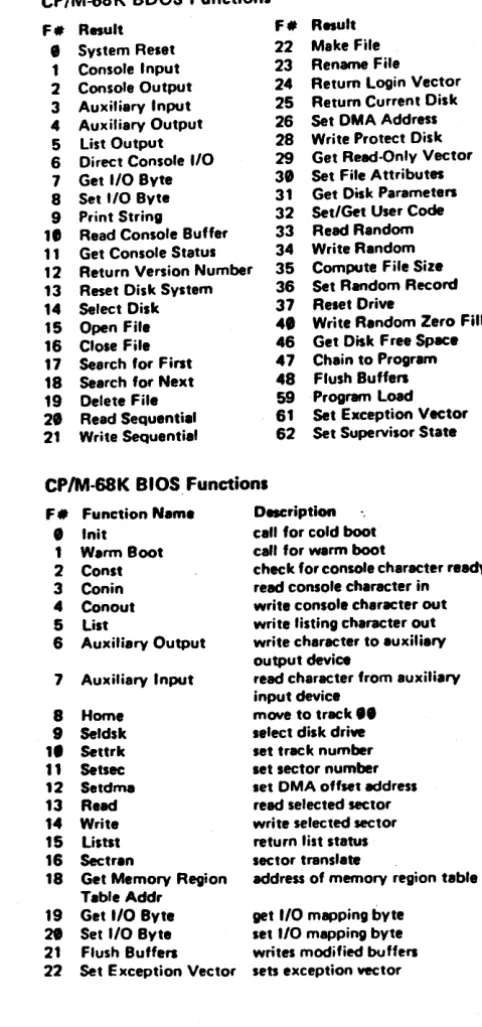
The end-user will notice no significant difference be-tween CP I M-68K and previous versions of CP 1M. Commands such as DIR, TYPE, PIP, STAT, and ED respond the same way in both systems. The program interface is also unchanged - CP / M-68K calls for system services have the same function numbers as CP 1M and CP IM-86. Upgrading existing CP 1M and CP IM-86 application software to run under CP / M-68K is straightforward, because CP IM-68K is so similar to its predecessors. Although assembly language grams will require recoding, high-level language pro-grams will recompile with little or no modification.
MEMORY SUPPORT
CP IM-68K is capable of using as little as 64K or as much as 16 Mb of RAM. The memory used by CP
I
M-68K can reside anywhere within the address space of the machine. However, user program memory must be contiguous.DISK DRIVE SUPPORT
CP / M-68K can support up to 16 logical drives, each containing up to 512 Megabytes, for a maximum of 8 Gigabytes of on-line storage. A file can be up to 32 Megabytes long, with space dynamically allocated and released. Each disk has a directory which maps each file's physical locations on the disk. Disk definition tables in the BIOS translate this logical information to the physical characteristics of the disk.
C LANGUAGE
The CP IM-68K package includes a C compiler and run-time library which are subset compatible with UNIX® Version 7. This provides a bridge from UNIX to CP IM-68K - C programs developed under the UNIX operating system can easily be transported to run under CP IM-68K.
SOPHISTICATED SOFTWARE DEVELOPMENT TOOLS
The CP IM-68K package includes the following set of software development tools:
• A C compiler and C run-time library compatible with UNIX software.
• An assembler which supports standard Motorola MC68000 assembly language.
• A linker which produces both relocatable and abso-lute load modules.
• An object module librarian.
• A utility to convert CP
I
M-68K load modules to Motorola S-Record form.• A relocation utility to convert relocatable load modules to absolute form.
• A utility to list the symbol table contained in a load module file.
• A utility which prints the memory size required by the load module.
These tools can run on any CP
I
M-68K system with at least 128K of memory.STANDARD CP/M UTILITIES
PIP
The Peripheral Interchange Program provides file trans-fer between devices and disk files. Various reformatting and concatenation operations may also be performed with PIP. These include: parity bit removal, case con-version, subfile extraction, tab expansion, line number generation, and pagination.
ED
The CP
I
M-68K text editor allows creation and modifica-tion of ASCII files using extensive commands: string substitution, string search, insert, delete and block move. ED allows text to be located by context, line number, or relative position. A macro command allows making repetitive text changes with a single command line.DDT
The CP
I
M-68K Dynamic Debugging Tool allows the user to test and debug programs interactively in a CPI
M-68K environment. The command set allows users to trace program execution with a full register and status display.STAT
The STAT utility alters and displays I
10
device and file status including free space computations, status of online disks and physical-to-Iogical device assignment.SUBMIT
The SUBMIT command lets the user execute a com-mand sequence stored in a disk file.
DUMP
The DUMP utility displays any file with. side-by-side hexadecimal and ASCII representations. Output may be redirected to a file or the listing device if desired.
MULTIPLE PROGRAMS CAN COEXIST IN RAM
The CP
I
M-68K program load function allows an appli-cation program to load other programs into memory. The number of programs which can be loaded is limited only by memory space on the machine. This feature can be used to implement program overlays. Overlays canb~ called 'using the standard CP
I
M-68K loading se-quence. Relocatable overlays can be loaded anywhere in user program memory, eliminating the need to relink all overlay segments with every program change.RESIDENT SYSTEM EXTENSIONS
The CP
I
M-68K RSX facility allows customization of the operating system on a selective basis. RSX modules are attached to the base of the operating system where they intercept operating system functions and either perform the function or forward the function to the operating system. RSX modules can remain permanently in memory or be removed when a user program terminates.FULL ACCESS TO MC8aOOO HARDW ARE
CP / M-68K gives the applications program complete access to the advanced features of the MC68000 microprocessor. Support is provided for intercepting 68000 exceptions, using the CPU supervisor state, and accessing I/O devices within the user program. CP /M-68K places no restrictions on the use of copro-cessor chips by the application program. All support for such devices must be supplied by the application, however.
TriSoft
1825 E.
38~
St., Suite 202