concentration, however, may be achieved at reason-able cost by electrodialysis.
Electrodialysis in the Food and Chemical Industry
Several applications of electrodialysis in the food in-dustries, such as the demineralization of cheese whey, have considerable economic signiRcance and are well established today. Other applications, such as the deashing of molasses or de-acidiRcation of fruit juices, are still in an experimental stage. In the chem-ical industry electrodialysis is used for the desalina-tion of protein, dextran or sugar soludesalina-tions. Here, electrodialysis is often in competition with other sep-aration procedures such as dialysis and solvent extraction. The separation of organic acids is an ap-plication of electrodialysis that is of interest to the pharmaceutical industry.
Production of Ultra Pure Water
Electrodialysis is now being used for the production of ultra pure water for the semiconductor industry. By combining electrodialysis with mixed-bed ion ex-change resins, deionized water is obtained without a chemical regeneration of the ion exchange resin. The process has been commercialized recently.
Conclusions
Electrodialysis has a long and proven history in the desalination of brackish waters. However, new applications in waste water treatment as well as in the
food and the chemical industry are becoming more and more important. There are still a multitude of problems to be solved. Some are related to the proper-ties of the membranes and the process design, while others are caused by the lack of application know-how and practical experience.
Further Reading
Bergsma F and Kruissink ChA (1961) Ion-exchange mem-branes.Fortschrifte in der Hochpolymer-Forschung21: 307}362.
Helfferich F (1962) Ion-Exchange. London: McGraw-Hill.
Katz WE (1979) The electrodialysis reversal (EDR) process. Desalination28: 31}40.
Lacey RE (1972) Basis of electromembrane processes. In: Lacey RE and Loeb S (eds)Industrial Processing with Membranes. New York: John Wiley.
Nishiwaki T (1972) Concentration of electrolytes prior to evaporation with an electromembrane process. In: Lacey RE and Loeb S (eds)Industrial Processing with Mem-branes. New York: John Wiley.
Schaffer LH and Mintz MS (1966) Electrodialysis. In: Spiegler KS (ed.)Principles of Desalination, pp. 3}20. New York: Academic Press.
Spiegler KS (1956) Electrochemical operations. In: Nachod FC and Schubert J (eds) Ion Exchange Technology, pp. 118}181. New York: Academic Press.
Strathmann H (1995) Electrodialysis and related processes. In: Nobel RD and Stern SA (eds)Membrane Separation Technology, pp. 213}281. Amsterdam: Elsevier. Wilson JR (1960) Design and operation of electrodialysis
plants. In: Wilson JR (ed.) Demineralization by Elec-trodialysis. London: Butterworth.
Filtration
R. Sahai, EuTech Scientific Services, Morganville, NJ, USA
Copyright^ 2000 Academic Press
Introduction
Filtration is a key processing operation in the pharma-ceutical, chemical and cosmetic industries. For example, Rltration may be necessary to clear process solutions before analysis or as process step in manufac-turing or in the sterilization of process solutions. Ana-lytical testing requires only laboratory-scale Rltration and is usually performed by a variety of membrane types depending upon the application. Filtration in manufacturing requires large-scale Rltering in engin-eered devices called membrane modules or cartridges.
Filtration Mechanism
Filtration is a mechanical phenomenon, which is sometimes aided by chemical manipulations of the
Rltration medium to make it more efRcient. In any case, a driving force across the Rlter media is required. The following methods can be used to gen-erate this driving force:
E Vacuum
E Pressure difference E Centrifugal force E Gravity pull
E Concentration difference E Electrical potential difference E Temperature difference
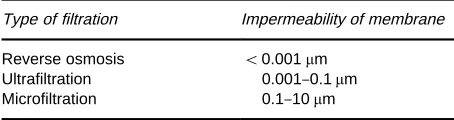
Table 1 Filtration threshold of common membrane-filtration processes
Type of filtration Impermeability of membrane
Reverse osmosis (0.001m Ultrafiltration 0.001}0.1m Microfiltration 0.1}10m Filtration is either through a membrane or bed of
Rlter media. The chemical composition of the Rlter media and physical conditions to perform theR ltra-tion constitute a large number of Rltration choices available today.
Membrane Filtration
Membrane Rltration through a very thin Rlter medium is also known as ‘surface Rltration’. The solid particles to be separated are usually large compared to the pore size characteristic of the membrane. The pores on the surface are of irregular shapes. The rejection of particles is dependent on several factors affecting the trans-port through these pores into the tortuous channels. The separation is based on exclusion discrimination by physical size, charge or afRnity or a combina-tion of these properties. Large particles are rejected on the surface and do not accumulate on the surface and do not get a chance to enter into the interior of theRlter.
Other types of membrane Rlters are screen Rlters and here the pores do not lead into tortuous capillary paths. The pore size is uniform but the distribution of the pores is random on theRlter surface. TheRlter is made by bombarding a thin polycarbonateRlm with neutrons in a reactor. TheRlm is then placed in a bath of etching solution which preferentially attacks the polymer along the track of the neutrons. The pore size is regulated by selecting the appropriate reagent, ex-posure time and temperature.
MembraneRltration can be dead end or cross-Sow. In dead-end Rltration all the solution is forced through the membrane. Retained particles collect on the membrane surface and in theRlter greatly reduc-ingSow. A current application of dead-endRltration is in bacterial testing where the liquid to be tested is passed through theRlter retaining all bacteria on the surface. Most chromatographic Rltration applica-tions are of this type. In cross-Sow membraneR ltra-tion, the feed liquid Sows tangentially to the mem-brane surface, which prevents the build up of cake on the membrane. Both types of Rltration use similar membranes.
By convention, membraneRltration or microR ltra-tion is limited to membranes used to remove particles larger than 0.1m in diameter. Membranes able to remove smaller particles are called ‘ultraRltration membranes’ and microsolutes can be removed by reverse osmosis. UltraRltration and reverse osmosis are discussed elsewhere. This article is limited to the process of microRltration.
The Rltration thresholds of common
membrane-Rltration processes are shown in Table 1.
Micro\ltration
MicroRltration is used to separate suspended solids or colloidal particles between 0.1 and 10m in diameter from solution. Most of the chromatography applica-tions are microRltration based. The same type of membrane with different pore size is used for these applications. The membrane acts like a physical sieve. The Suid passes through tortuous channels while the particles are rejected on the surface of the
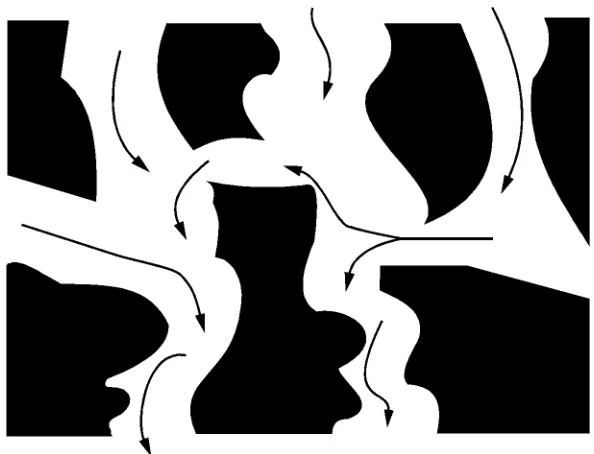
Rlter. It can be easily understood as a mechanical sieve with pores leading into a capillary forming a tortuous path; within this tortuous path, there could be mechanical entrapment and adsorption (Figure 1). MicroRltration membranes can be subjected to har-sher conditions compared to ultraRltration mem-branes. Membranes of different polymers in varying pore sizes are available. Even nominally the same pore-size membranes of a polymer may dif-fer from each other in Rltration characteristics because they may have different pore-size distri-butions, i.e. varying pore size all across the mem-brane. To aid in wetting, many membranes have some surfactant pretreatment and their effective pore size may be different from the real pore size. Often a membrane Rlter becomes more efRcient as small particles are entrapped within the pores. The large particles captured on theRlter can also alter the effective particle-size rejection in subsequent R l-tration. Filter capacity may vary depending on the solute particle-size variation in the feed. Uniform size particles result in faster clogging ofRlters.
Depth Filter
Figure 1 Tortuous path of micro- and ultrafiltration.
eventually a cake is formed over the medium stopping theSow through theRltration device. When theRlter bed is full of solids and the pressure drop is very high, the entrapped solids can be back-washed. Usually less than 0.1% solids concentration is Rltered through this type ofRlter to avoid pressure build up. There is always some liquid left behind in depth Rlters and some solid material still makes it through the Rlter medium depending upon the efRciency of the system. To use the system effectively, variations of this procedure using moving-bedRlters, radialSow
Rlters, or travelling back-wash Rlters can be em-ployed. The commercial products available for this kind ofRltration are application speciRc.
Filtration Matrices
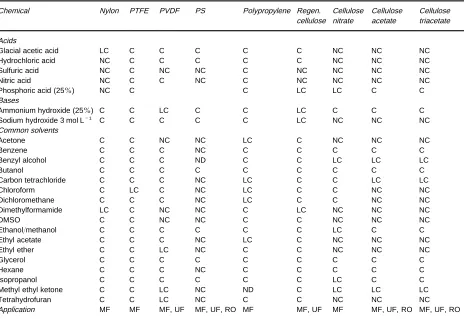
A variety of polymers are used to manufactureRlter media. Each type has speciRc attributes and could be best for certain applications but could be a complete failure for other applications. The sameRlter material from different manufacturers can differ in physical properties and in Rltration characteristics. However, the chemical compatibility of the material is almost the same irrespective of the manufacturer (Table 2).
Incompatible chemicals can cause shedding, af-fecting pore size, as well as adding extractables. Hy-drophobic membranes have to be wet before starting theRltration. In some cases, it is desirable to convert the hydrophobic membranes into hydrophilic mem-branes by modifying the surface. Surface reactions can also be used for changing the surface charge. The
polyvinylidene Suoride (PVDF) membranes can be treated to render them hydrophilic and can be reacted to modify the surface charge. The use of aggressive solvents should be avoided with theseRlters to min-imize deterioration of the surface. Membranes used in
Rltration usually have surface-active agents incorpor-ated in them to make the pre-wetting easier.
Filtration Devices
TheRltration application dictates the type of device to be used. Industrial applications demand a high surface area, ease of cleaning and low clogging. For enhanced yield and capacity, open-channel tangentialSow sys-tems, which require two pumps for recirculation and permeation, are available from several manufacturers. Different designs are used to overcome gel forma-tion and to continuously sweep away the contamina-tion in theRltration process. The details of these sys-tems are beyond the scope of this article.
Table 2 Chemical compatibility of common filter membranes with widely used solventsa
Chemical Nylon PTFE PVDF PS Polypropylene Regen. cellulose
Cellulose nitrate
Cellulose acetate
Cellulose triacetate
Acids
Glacial acetic acid LC C C C C C NC NC NC
Hydrochloric acid NC C C C C C NC NC NC
Sulfuric acid NC C NC NC C NC NC NC NC
Nitric acid NC C C NC C NC NC NC NC
Phosphoric acid (25%) NC C C LC LC C C
Bases
Ammonium hydroxide (25%) C C LC C C LC C C C
Sodium hydroxide 3 mol L\1
C C C C C LC NC NC NC
Common solvents
Acetone C C NC NC LC C NC NC NC
Benzene C C C NC C C C C C
Benzyl alcohol C C C ND C C LC LC LC
Butanol C C C C C C C C C
Carbon tetrachloride C C C NC LC C C LC LC
Chloroform C LC C NC LC C C NC NC
Dichloromethane C C C NC LC C C NC NC
Dimethylformamide LC C NC NC C LC NC NC NC
DMSO C C NC NC C C NC NC NC
Ethanol/methanol C C C C C C LC C C
Ethyl acetate C C C NC LC C NC NC NC
Ethyl ether C C LC NC C C NC NC NC
Glycerol C C C C C C C C C
Hexane C C C NC C C C C C
Isopropanol C C C C C C LC C C
Methyl ethyl ketone C C LC NC ND C LC LC LC
Tetrahydrofuran C C LC NC C C NC NC NC
Application MF MF MF, UF MF, UF, RO MF MF, UF MF MF, UF, RO MF, UF, RO
aPTFE, polytetrafluoroethylene; PVDF, polyvinylidene fluoride; PS, polysulfone. C, compatible; LC, limited compatibility; NC, non-compatible;
ND, not done; MF, microfiltration; UF, ultrafiltration; RO, reversed osmosis.
can be tiring, a mechanical device is now available which is helpful when repeated Rltration is required.
Another common type of laboratory Rltration is with centrifugeRlters. These devices are the method of choice for molecular weight cut-off Rltration and for theRltration of viscous materials. The driving force here is centrifugal force. TheRlter is manufac-tured toRt in the rotors of laboratory centrifuges. In these rotors, several Rltrations can be carried out simultaneously.
Filtration Applications
In every type ofRltration process, the result is always a retentate (restricted to pass through theRlter media) and permeate (down stream collection). Retentate or permeate can be the desired product of the process. Selective Filtration
SelectiveRltration is used to retain only a particular type of solute. Usually in these cases membranes are
modiRed for the desired afRnity. There are several applications and products available based on ionic attraction.
Purifying Water
The constantly increasing demand for drinking water requires the sea or other sources to be converted into potable water. Most of the potable water plants use reverse-osmosis treatment. Water used in injectables, buffers and chromatography generally has very deRned speciRcations. For most laboratory applica-tions, water with an electrical resistance of not less than 18 Mis required to be pyrogen- and bacteria-free. The water used in chromatography should be free of UV/vis-absorbing and ionic impurities. Chromatographic Applications
for processing samples and solvent is an essential part of instrument preventive maintenance programmes. The Rltration of the mobile phase also results in degassing, which is essential for long pump life in high pressure liquid chromatography. The most com-mon devices used for sample preparations are syringe
Rlters.
Biological Applications
The use of Rltration as a sterilizing technique is be-coming increasingly popular. Other sterilization tech-niques such as autoclaving, radioactive exposure or ethylene oxide treatment can be detrimental for the product. A dead-end Rltration using 0.22m pore-sized membrane is considered good for sterilizing by
Rltration. Viruses can permeate through the mem-brane of 0.22m Rlter. A 0.1m pore-size Rlter is used to prepare a virus-free solution.
Filtration is also used for desalting or buffer exchange of proteins and nucleic acids, deproteiniz-ing samples, screendeproteiniz-ing natural products and combina-torial products, and separation of oligonucleotide primers from nucleic acid preparations.
Selecting the Right Filtration System
Each application requires a speciRcRltration charac-teristic. Choosing the rightRltration device and media are necessary when selecting the correct Rltration system. The following considerations help when de-ciding whichRlter device is to be used:
E Objective ofRltration. E Sample size.
E Filter parameters required: permeability, capacity andSow rate.
E Physical conditions to which the Rltration is re-quired to be subjected.
E TangentialSowRlter or dead-endRlter.
The choice ofRlter material, pore size and physical conditions depends on the following factors:
E The chemical and physical condition of the feed. E Size and shape of molecules.
E Zeta potential and isoelectric point. Filtration car-ried out at a pH close to the isoelectric point results in reduced electrostatic interactions.
E Hydrophobicity or hydrophillicity. E Solvent in which solute is dissolved.
E Properties of theRlter feed, pH, viscosity, surface tension, ionic strength, osmolarity and chemical functionality.
E Intended use afterRltration of the sample
Choice is always application speciRc. For example, in the bacterial examination of water, the purpose is to retain all the particles on theRlter surface. A dead-endRltration is used on a 0.2mRlter. The cross-Sow
Rlter is useful for concentrating particles with the removal of solvent. In selecting theRltration system, it is necessary to always consider yield, simplicity, technical reasons and cost.
In some applications, using a combination of dif-ferent Rltration techniques in a certain order is the most efRcient method. Sometimes it helps to pre-treat the solution to be Rltered. The pretreatment could include coagulation andSocculation, magnetic treatment, pH adjustments, and an electric Reld. A proper washing procedure is usually employed to have the most efRcientRltration.
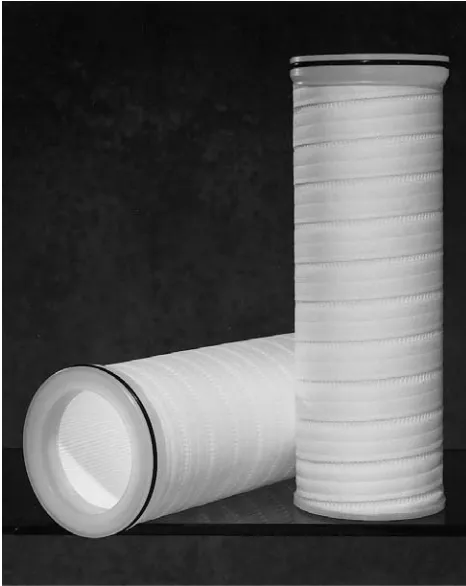
TwoRlters supplied by Pall Corporation are shown inFigures 2and3.
Filtration Validation
The validation of Rltration processes includes all the equipment, physical conditions and material re-quirements of the process. Usually theRlter manufac-turer performs the basic testing to ensure the type, pore size and integrity of theRlter. TheRlter material characteristics are covered in this article. Some of the most common tests used for this purpose are shown below.
Bubble Point
Bubble point is a function of pore size,Rlter medium wettability, surface tension and angle of contact. The
Rlter membrane is wetted and a gradual increasing gas pressure is applied. The bubble starts forming from the largest pore Rrst. The gas pressure at this time is the bubble point for the membrane. This is an indirect measurement of the size of the largest pore on theRlter. It does not indicate the variability of pore sizes or irregularity of the membrane.
Water Breakthrough
The water-breakthrough test is used for hydrophobic membranes. It is similar to bubble point as this test also give information about the largest pore of the
Rlter membrane. In this test, the minimum pressure required to permeate water from aRlter membrane is measured. The water-breakthrough number is depen-dent on pre-wetting, temperature and pore size of the
Figure 2 (See Colour Plate 49). Pall Ultipor威VF2+Grade DV50 virus filters for high protein-transmissive virus filtration. (Photo courtesy of Pall Corporation, East Hills, NY.)
Extractables
The Rlter devices and materials can be a source of contamination in theRltration process. The source of impurities could be additives, stabilizers, surface modiRers, detergents and monomers in theRlter ma-terial. Some contaminants occur in small quantities but some detergents can make up as much as 2}3% of the dry weight of the Rlter. This large amount of detergent helps in efRcient Rltration, lower pres-sure requirements and permits autoclaving for steril-ization. The additives and monomers can be entrapped within the body of theRlter. Sometimes the source of impurities is not from theRltering material but from the housing or support of the Rlter. This housing material is usually plastic, and the manufac-turer tests that the plastic used in containing theRlter material is not going to leach out impurities under
experimental conditions. Although aggressive sol-vents or physical conditions may be very compatible with the Rlter membrane, they may affect the
Rlter-containment system.
In some analyses, even a small amount of con-taminant is enough to cause problems. Commercial
Rlter manufacturers now certify for speciRc applica-tions. For many biological applications, the manufac-turer certiRes theRltration material to be pyrogen-free. For chromatographic applications theRlter material is certiRed not to add impurities to the process. The safest way to useRlters for chromatography is to wash them with the same solvent used during Rltration and to discard an initial volume of theRltrate. TheRlters used in ion analysis should be completely free of any ionic impurities. The standard operating procedure of the
Figure 3 (See Colour Plate 50). Pall Ultipleat威high flow filters, providing efficient and economical high-flow filtration with reduced waste disposal costs. (Photo courtesy of Pall Corporation, East Hills, NY.)
Table 3 Microfiltration rating by test organisms
Microfiltration rating Test organism
1m Candida albicans
0.8m Lactobacillus
0.45m Serratia marcescens
0.2m Pseudomonas diminuta
0.1m Acholeplasma laidlawii Flow Rate
TheSow rate is determined by using water or alcohol to determine the permeability to Sow before any extra pressure drop produced by theRlter cake. Flow rate is dependent on the hydrophobicity of theRlter material, temperature of the procedure, physical thickness and pore-size distribution of the Rlter ma-terial. It is expressed as millilitres per minute per square centimeter. An optimum Sow rate is needed for the expected life of aRlter.
Capacity
Capacity of Rltration is the ability to maintain an acceptable permeability. The capacity of a Rlter is measured until an increase of about three times in differential pressure or &60% decrease of in-itialSow. It is expressed as time, volume of liquid, or by quantity of retained particles.
Pore Size
Pore size is probably the most misunderstood prop-erty of theRlter membrane. The estimation of pore size depends upon the method employed to determine the porosity. The usual methods are all indirect. For
a nominal rating, a range of neutral polymers of different sizes is challenged individually on the membrane and the percentage of a particular size retained on the surface rates it for that size. It could be anywhere from 60 to 98% for a given size rating by the manufacturer. The variability of pore sizes is also polymer dependent. The pore sizes are irregular in membranes manufactured by solvent casting. The pore size is averaged to give a mean pore size assuming all pores are circular. The importance of this point is that the efRciency of the Rlter should be measured above this point. In actual practice, pore size is used only as a guide; retained particle size data are closer to reality in the Rltration process. MostRlter manufacturers give particle size retained data traceable to standards from the National Insti-tute of Standards and Testing. In membranes manu-factured by neutron bombardment, the pores are cir-cular and same-size pores are randomly distributed along the surface of the membrane. The pore size given is the actual pore size of the membrane. In manyRlter membranes, detergents are used for en-hancing Rlter characteristics; the effective pore size in these membranes is usually larger than the actual pore size.
Microbial Challenge Test
The absolute rating of a membrane is determined by challenging with test organisms (Table 3). The vol-ume of the feed is such that it averages out to one organism per pore on the membrane surface. The absolute rated membrane is accepted if no more than one organism is present in the permeate.
A membrane with a pre-rating of 0.22m is ac-ceptable for liquidRltration sterilization. The ability of a membrane to remove bacteria is dependent on the size of the pores and the thickness of the mem-brane. There is a Rnite number of speciRc bacteria, which can be retained by the membrane before it becomes effectively clogged.
Filtration Challenges
[image:7.568.290.516.631.710.2]there are still some areas where any advancement will makeRltration a friendlier process.
Scaling Up for Manufacturing
The Rltration process development remains a chal-lenge because the efRcient separation at small volume level is not always transferable to pilot or production scale with the same efRciency and chemistry. Several manufacturers claim new scalable technologies providing similar results in large scale as applications using tangentialSow with the sameRbre material used throughout the development of theR l-tration process. SpecialRltration scale-up software is available commercially.
Membrane Fouling, Gel and Cake Formation
The Rltration membranes may start fouling during use. This means that particles start attaching on the surface and in the internal porous structure of the membrane. Large suspended or colloidal particles usually are the cause of fouling. Fouling is a result of van der Waals forces, electrostatic attraction, or hy-drogen bonding. The fouling ofRlter media results in a reduction in membrane permeability and uncontrol-led solute removal efRciency. The pretreatment of the feed can be helpful in delaying or completely avoiding fouling. Gel formation and cake formation on the surface can be reversible andRlter media can be reused. Macromolecules and some interacting small organic molecules can result in gel formation on theRltration surface.
Cleaning the Filter Media
It is not cost effective to clean the Rlter in labor-atory-scale Rltration. For large-scale Rltration, usu-ally cleaning and validation protocols are used. The cleaning process could involve cleaning with deter-gents or other strong chemicals. It could also involve treating with proteolytic enzymes to break down pro-tein impurities trapped in the Rlter medium and EDTA to arrest activity of bacterial enzymes. Devel-opment of cleaning procedures and validation ofRlter media is very application speciRc and requires experi-enced people to design and implement.
Extractables
The extractables in the Rlter medium can create a problem in the subsequent use of the permeate. This remains a problem in someRlter media where addi-tives are used for improved performance. The origin of extractables is either in the processing or the hous-ing device of the Rlter. Various kinds of extract-ables are found, including metals, oligomers, loose polymers, plasticizers, wetting agents, antioxidants,
resins,Rllers and mould-release chemicals. The usual practice is to wash off the Rlter material immedi-ately before use. The type and amount of impurity in
Rlter media is not consistent. Each type of impurity has its own rate of extraction from the medium. Hence there is no universalRlter-treatment procedure which can ensure a contamination-free permeate. The washing procedure could be under- or overdone in certain applications. The challenge exists to manufac-ture consistent contamination-freeRlter media.
Conclusion
Tremendous developments have taken place in both laboratory and large scale Rltration techniques in recent years. Various new types of matrices have been exploited forRltration applications. The heavy use of
Rltration in industry has clearly identiRed the chal-lenges that remain to be solved. Research continues on selective Rltration as a cost-effective way of separation for various applications. In the next few years, we will witness improvement in both the chem-ical and mechanchem-ical properties of Rltration equip-ment.
See Colour Plates 49, 50.
See also: II/Membrane Separations: Microfiltration; Ultrafiltration.
Further Reading
Chenoweth MB (ed.) (1986)Synthetic Membranes. New York: Harwood.
Cheryan M (1986) UltraTltration Handbook. Lancaster: Technomic.
Cooper AR (ed.) (1980) UltraTltration Membranes and Applications. New York: Plenum Press.
Crespo JG and Boddekar KW (ed.) (1994)Membrane Pro-cess in Separation and PuriTcation. Dordrecht: Kluwer. Gutman RG (1987)Membrane Filtration. Bristol: IOP
Pub-lishing.
Levy RV and Leahy TJ (1991)Disinfection, Sterilization and Preservation. Philadelphia: Lea and Febiger. Lombardi R (1998)Membrane Filtration in
Chromatogra-phy}A Trivial Pursuit.LC}GC supplement, S47. Matteson MJ and Orr C (ed.) (1987)Filtration:Principles
and Practices. New York: Marcel Dekker.
Murkes J and Carlsson CG (1988)Cross Filtration. New York: John Wiley.
Nachinkin OI (1991)Polymeric MicroTlters. New York: Harwood.
Osada Y and Nakagawa T (ed.) (1992)Membrane Science and Technology. New York: Marcel Dekker.