PASCAL USERS GROUP
NUMBER
20)\
(.)
·--
0
n.
POLICY: PASCAL NEWS (15-Sep-80)
*Pascal News is the official but informal publication of the User's Group. * Pascal News contains all we (the editors) know about Pascal; we use it as
·the vehicle to answer all inquiries because our physical energy and resources for answering individual requests are finite. As PUG grows, we unfortunately succumb to the reality of:
l. Having to insist that people who need to know "about Pascal" join PUG and read Pascal News - that is why we spend time to produce it!
2. Refusing to return phone calls or answer letters full of questions - we will pass the questions on to the readership of Pascal News. Please understand what the collective effect of individual inquirieshas at the "concentrators" (our phones and mailboxes). We are trying honestly to say: "We cannot promise more that we can do."
* Pascal News is produced 3 or 4 times during a year; usually in March, June, September;-and December.
* ALL THE NEWS THAT'S FIT, WE PRINT. Please send material (brevity is a virtue) for Pascal News single-spaced and camera-ready (use dark ribbon and 18 .5 cm lines!)
-* Remember: ALL LETTERS TO US WILL BE PRINTED UNLESS THEY CONTAIN A REQUEST TO THE CONTRARY.
* Pascal News is divided into flexible sections:
POLICY - explains the way we do things (ALL-PURPOSE COUPON, etc.)
EDITOR'S CONTRIBUTION - passes along the opinion and point of view of the editor together with changes in the mechanics of PUG operation, etc. HERE AND THERE WITH PASCAL - presents news from people, conference announcements arid reports, new books and articles (including reviews), notices of Pascal in the news, history, membership rosters, etc.
APPLICATIONS - presents and documents source programs written in Pascal for various algorithms, and software tools for a Pascal environment; news of significant applications programs. Also critiques regarding program/ algorithm certification, performance, standards conformance, style, output convenience, and general design.
ARTICLES - contains formal, submitted contributions (such as Pascal philosophy, use of Pascal as a teaching tool, use of Pascal at different computer installations, how to promote Pascal, etc.).
OPEN FORUM FOR MEMBERS - contains short, informal correspondence among members which is of interest
to
the readership of Pascal News.[ J
[ J
ALL PURFUSE COUPON
-Pascal User's Group, c/o Rick Shaw P.O. Box 888524
Atlanta, Georgia 30338 USA
**NoTE**
(15-Sep-80)
Membership fee and All Purpose Coupon is sent to your Regional Representative.
SEE THE POLICY SECTION ON TH~ REVERSE SIDE FOk PRICES AND
ALTERNATE ADDRESS if you are located in the European or
Australasian Regions.
Membership and Renewal are the same price.
Note the discounts below, for multi-year subscription and renewal. The U. S. Postal Service does not forward Pascal News.
-
-
- --
- - - ~ - --
-- -
- - - -- - -
--USA Eurof2e Aust.
[ ] l year $10. £6. A$ 8. Enter nie as a new member for:
[ ] 2 years $18. £10. A$ 15. Renew my subscription for:
[ ] 3 years $25. £14. A$ 20.
Send Back Issue(s)
[ ] My new address/phone is listed below
[ ] Enclosed please find a contribution, idea, article or opinion which is submitted for publication in the Pascal News.
NAME .
PHONE
$
ENCLOSED PLEASE FIND: A$
£
! CHECK no.
JOINING PASCAL USER'S GROUP?
Membership is open to anyone: Particularly the Pascal user, teacher, maintainer, implementor, distributor, or just plain fan.
- Please enclose the proper prepayment (check payable to "Pascal User's Group"); we will not bill you.
- Please do not send us purchase orders; we cannot endure the paper work!
- When you join PUG any time within a year: January 1 to December 31, you will receive all issues of Pascal News for that year.
- We produce Pascal News as a means toward the end of promoting Pascal and communicating news Of events surrounding Pascal to persons interested in Pascal. We are simply interested in the news ourselves and prefer to share it through Pascal News. We desire .to minimize paperwork, because we have other work to do. ~~
- American Region (North and South America): Send $10.00. per year to the address on the reverse side. International telephone: 1-404-252-2600.
- European Re1ion (Europe, North Africa, Western and Central Asia): Join through PUGUK). Send £5.00 per year to: Pascal Users Group, c/o Computer Studies Group, Mathematics Department, The University, Southampton S09 5NH, United Kingdom; or· pay by direct transfer into our Post Giro account
(28 513 4000); . International telephone: 44-703-559122 x700.
- Australasian Region (Australia, East Asia - incl. Japan): PUG (AUS). Send $Al0. DO per year to: Pascal Users Group, c/o Arthur Sale, Department of Iriformation Science, University of Tasmania, Box 252C GPO, Hobart, Tasmania 7001, Australia. International telephone: 61-02~23 0561 x435
PUG(USA) produces Pascal News and keeps all mailing addresses on a common list. Regional representatives collect memberships from their regions as a service, and they reprint and distribute Pascal News using a proof copy and mailing labels sent from PUG(USA). Persons in the Australasian and Eurppean Regions must join through their regional representatives. People in other places can join through PUG(USA).
RENEWING?
- Please renew early (before November and please write us a line or two to tell us what you are doing with Pascal, and tell us what you think of PUG and Pascal News. Renewing for more than one year saves us time.
ORDERING BACK ISSUES OR EXTRA ISSUES?
- Our unusual policy of automatically sending all issues of Pascal News to anyone who joins within a year means· that- we eliminate many requests for backissues ahead of time, and we. don't have ta· reprint important information in every issue--especially about Pascal implementations!
- Issues 1 .. 8 (January, 1974 - May 1977) are out of print.·
(A few copies of issue 8 remain at PUG(UK) available for £2 each.)
- Issues 9 .. 12 (September, 1977 - June, 1978) are availab1e from PUG(USA) all for $15. 00 and fr.om PUG (AUS) all for $Al5. DO
- Issues 13 • . 16 are av ail able from PUG (UK) all for £10;. from PUG (AUS) all for $Al5.00; and from PUG(USA) all for $15.00.
- Extra single copies of new issues (current academic year) are: $5.00 each - PUG(USA); . £3 each - PUG(UK); and $A5.00 each - PUG(AUS).
SENDING MATERIAL FOR PUBLICATION?
PASCAL NEWS #20
DEC8'1BER,
1980Editor's Contribution
RENEWING
This is the last issue of the year. (Bet you thought it would never get here!!) So if you have not ·renewed yet, RENEW NOW ! ! ! It is easy to tell if you need to renew, because all you have to do is look at your mailing label. (Except in the Australasian Region.) If the number in square brackets says 80 (i e. 11 [80] 11 ) then
this is your last issue. This number is the year your subscription expires.
THIS ISSUE
This issue contains the full text of the "Second Draft" of the proposed ISO Pascal Standard. I hope it is the last one we publish; because it is the last one! Andy Mickel ( remember Andy?! ) was present at the X3J 9 meeting in Huntsville, and has also been doing plenty of long distance politicing for this standard. He asked if he could write a guest editorial and the text follows.
l5i1
UNIVERSITY OF MINNESOTATWIN CITIES
University Computer Center
227 Experimental Engineering Building 208 Union Street S.E.
Minneapolis, Minnesota 55455
1981-01-08 '
This special issue of Pascal News presents the second draft proposal of the ISO Pascal Standard now out for public comment and voting by the appropriate national bodies. More formally this document is known as (revised) DP7185.1.
[Alice Droogan, ISO TC97/SC5 Secretariat said to send all comment to:
PASCAL NEWS #20 DEC8'iBERJ 1980
As was reported by Jim Miner on page 74 of Pascal News #19, the first draft received 11 yes and 4 no votes. Most of the people I know associated with ISO Pascal Standards activities (including myself) expect unanimous approval on this draft. There are several things I can say about this:
1. The ISO Pascal standard is badly needed now and is overdue, but it will have set speed records in approval.
2. Even though the draft standard is imperfect (and always will be) the realization among those experts from the ISO Working Group is that extra time spent on_the draft in an effort to perfect it has reached the point of diminishing returns.
3. This draft can be expected to be very close to the final standard. 4. Pascal users will at last benefit from a single standard when it
will be adopted by the national standards groups in ISO member
countries (such as in the USA by ANSI/IEEE/NBS and the Federal Govt.). What I wrote two years ago in an editorial in Pascal News #14 which introduced the third BSI working draft of a Pascal Standard still applies:
Pascal Standards should be given special consideration (in other words, there are not necessarily applicable precedents found in the standards processes of other languages). The Pascal Standards process has been a model phenomenon in Computer Science history.
First and foremost Pascal was designed by a single person (Niklaus Wirth) and is not a committee-designed language. Pascal Standards Committees have so far rightly refrained from adding committee-designed features. Secondly, Pascal is the first major programming language standardized outside the United States. As I1ve said before, it has European origins
but to be more accurate, Pascal is truly international. I think that1s
wonderful and neat!
Pascal is in very wide use (even though there are dozens of programmers ignorant of its impact and uses). Its design goals mentioned in my Pascal News #14
editorial have been mef'and exceeded (even though there are plenty of computing people who deny this).
Finally, let me reiterate the implications of an imperfect Pascal standard. In the time given, with the people involved, and with the resources we1ve had,
it1s a remarkable achievement. (Thank you, Tony Addyman!) And it is still
imperfect. But now the existence of a finished standard is more important thatn spending any more time.
In spite of the attitude of many of us technical people, you can't always
fix certain things--technical problems don't always have clean solutions. It's not clear in some cases that solutions can be attained. In other words, if you put enough constraints on a problem-:-lt could be the case that the set of
solutions is empty.
PASCAL
NEWS
#20 DECEMBERJ 1980american national standards institute, inc· 1430 broadway, new york, n.y. 10018 · (212) 354-3300
Cable: Standards, New York International Telex: 42 42 96 ANS I U I
January 21, 1981
Dear Mr. Shaw:
Enclosed please find second draft proposal ISO/DP 7185 - Specification for the Computer Programming Language - Pascal. This document is being circulated to 97/5 committee members for voting on by March 31, 1981.
Comments on the document are welcome and will be considered but must be in written form and must be received by March 31, 1981. Please address all comments to ANSI's X3J9 Chairman:
Dr. Carol Sledge On-Line Systems, Inc.
115 Evergreen Heights Drive
Pit~sburgh, PA 15229
Comments should be clearly marked with the name, address and telephone numbe_r of the comm.en tor, the section and subsection to which the
comment applies, and a rationale or explanation for any proposed text changes. Spe~ific proposed text changes are the most desirable form for comments, but general changes or criticisms, or questions, are also welcome.
AD/MAC
Encl.
Sincerely,
Q1
~
'
fl
..
~IJ~
Alice Droogan
PASCAL NEWS #20 DECEMBtRJ 198U
ISO/TC 97/SC 5 N
59
5
January 1981 .
DP7185
SPECIFICATION FOR THE COMPUTER PROGRAMMING LANGUAGE Pascal
CONTENTS
Pa9eForeword 1
o.
1. 2. 3. 4. 5. 5. 1 5.2 6. 6 .1 6.2 6.3 h.4 6.5 6.6 6.7 6.8 6.9 6.10 6 .11 Introd1JctionScoPe of this standard References
Definitions
Definitional Conventions ComPliance
Processors Pros rams Requirements Lexical Tokens
Blocks• scope, activations Cansta~t-definitions
TYPe-def initions
Declarations and denotations of variables Procedure and function declarations
Expressions Statements
InPut and output _ Programs
Hardware representation
APPENDICES
A.
B.
c.
Collected sYntax Index
Required Identifiers
TABLES
1 •z.
3. 4. 5. 6.M~talan9Uase symbols
DYadic arithmetic operations Monadic arithmetic operations Set ot=ierations
Rel~tional operations
Alternative sYmbols Foreword 2 2 -=·
·-·
... .;:, 4 4 5 6 6q ..
11 12 24 28 45 51 55"1 65 67 69 77 8:3 47 47 4E: 49 68
The l~nsua9e Pascal was desi9ned bY Professor Niklaus Wirth to satisfy
two Principal aims:
(a) to make available a lan9Ua9e suitable for teaching Pro9rammin9 as a systematic disciPline bas~d on certain fundamental concepts
clearly and naturally reflected bY the language.
PASCAL NEWS·#20
DECEMBER, 1980
Seco~d Draft Proposal
Howev~rt it has become aPParent that Pascal has attributes which so far beyond these orisinal soals. It is now beins increasinslY used commerciall~ in the writing of both system and aPPlication software. This standard is Primarily a consequence of the srowins commercial interest in Pascal and the need to Promote the Portability of Pascal prosrams between data Processins SYstems.
In draftins this standard the continu~d stability of Pascal has been a Prime obJective. However, aPart · from changes to clarify the
sPecification1 two maJor chanses have been introduced:
<a>
the sYntax used to specify Proc~du~al and functional has been ch an 9 e d to re q u i re the use o f a. Pro c e d 1,w eheading, as aPFroPriate <see 6.6.3.1). This change was to overcome a lan9Ua9e insecurity;
Par-ameters or function introduced
<b>
afifth
kind of Farametert the conformant array Parametert has been introduced· (see 6:6.3.7). With this kind of Parameter• ther~quired bounds of the index-type of an actual Parameter are not
fixed• but a~~ restricted to a specified ranse of values.
O. INTRODUCTION
The appendices are included for the tonvenience of th~ reader
6f
this standard, They do not form a Part of the requirements of this 1tandal"'d.1. SCOPE OF THIS STANDARD
1.1 T~is standard specifies the semantics and SYntax of the comPutel"' Pro9ramrnins langua9e Pascal bY SPecifYin9 requirements far a Processor and for a conforming Prosram. Two levels of compliance are defined for both Processors and Programs.
1.2 This standard does not sPecifY
Cal
the size or comPlexitY of a Program and itsdata
that will exceed the capacity of anY specific data Processing system or the caPacitY of a Particular processor;(b) the minimal requirements of a d~ta processing sYstem that is caPable of sUPPortins an imPlernentation of a Processor for Pascall
Cc> the method of activating the Profram-block or the set of commands used to control
the
environment fn which a Pascal Pro9ram is transformed and executed; ,(d) the mechanism by which Programs writte~ in Pascal are transformed
for usJ bY ~ data Processing system;
<e> the method for reporting errors or warnings;
(f) the tYP09raPhical representation of a Prosram published for human
reading.
2. REFERENCES
Second Draft ProFosal
3. DEFINITIONS
3. 1
3 .-.
.
..:;,3.4
error. A violation by a Prosram of the requirements of this standard whose detection by a Processor is optional.
implementation-defined. Possibly differing between rrocessorst but defined for anY Particular Processor.
imPlementation-deFendent. Possibly differins between Processors and not necessarily defined for any Particular Processor.
Processor. A compiler' interPretert or other mechanism which accepts the Program as input and either executes it, Prepares it
for execution, or both.
4. DEFINITIONAL CONVENTIONS
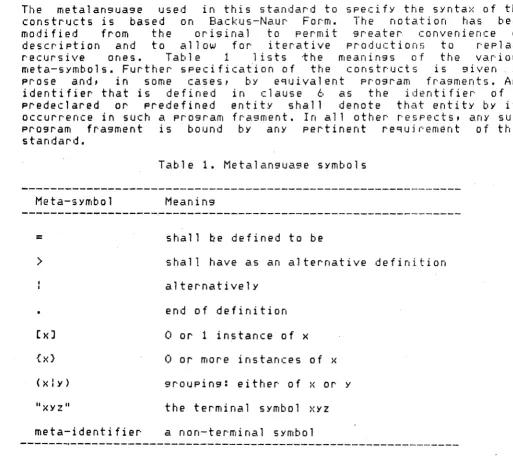
The metalansuase used in this standard to specify the sYntax of the constructs is based on Backus-Naur Form. The notation has been modified from the orisinal to Permit sreater convenience of descriPtion and to allow for iterative Productions to rePlace recursive ones. Table 1 lists the meaninss of the various meta-symbols. Further sFecificafion of the constructs is siven by Prose andt in some casest by equivalent Prosram frasments. AnY identifier that is defined in clause 6 as the id@ntifier of a Predeclared or Predefined entity shall denote that entity bY its occurrence in such a Program fragment. In all other respects, any such Program frasment is bound by anY Pertinent re9uirement of this standard.
Table 1. Metalansuage symbols
Meta-sYmbol Meaning
---~---=
shall be defined to be>
shall have as an alternative definition alternativelyend of definition [xJ 0 or 1 instance of x
{x} 0 or more instances of x
<xlY) grouping: either of x or y
II XYZ II the terminal sYmbol xyz
meta-identifier a non-terminal symbol
[image:10.613.49.562.262.726.2]---~---PASCAL NEWS #20
DECEMBERJ 1980
Second Draft ProPosal
A meta.-identi fier shal 1 be a seq1.Jence' of 1 etter-s and hYrhens beginning with a letter.
A sequence of ter-minal and non-ter-minal sYmbols in a
imPlies the concatenation of the te:<t that theY 1.Jltimai·e:·1y Within 6.1 this concatenation is direct; no characters may
In all other Parts of this standard the concatenation is in with the rules set out in 6.1.
Production rePr-esent.
intervene. accor·dance
The characters required to form Pascal Programs are those imPlicitlY required to form the tokens and separators defined in 6.1.
Use of the words oft int containing and closest-containing when expressin9 a relationship between terminal or non-terminal sYmbols shall have the following meanings.
the x of a y: refers to the x occ1.Jrrin9 directly in a Production defining y.
the x in a y: is sYnonymo1.Js with "the x of a Y11 •
a Y containing an x: refers to anY x directly or indirectly
derived from y.
the ~ closest-containins an x: that Y which contains an x but does
not contain another Y containins that x.
These ~Yntactic conventions are used in clause 6 to specify certain sYntactic requirements and also the contexts within which certain semantic specifications aPPlY.
5. COMPLIANCE
NOTE.
There are two levels of tomPliance - level0
and level1.
Level 0 does not include conformant array parameters. Level 1 doe5include conformant array Parameters. 5.1 Proces$Ol"'s
A Processor ~omPlYins with the requirements of this standard shall: (a)
if
it complies at level Ot accePt all the features of the lan9ua9especified in clause 6t except for- 6.6.3.6Ce>• 6.6.3.7 and 6.6.3.8,
with
the meaninss defined in clause 6;<b>
if it complies at level lt accePt all. the featur·es of the language~Pe~ified in clause 6 with the meanings defined in clause 6;
Cc) not require the inclusion of substitute or additional language elements in a Prosram in order to accomPlish a feature of
the
lansuage that is specified in clause 6;(d) be accompanied bY a document that Provides a definition of all implementation-defined features;
(e) detect any violation bY a Pr-09ram of the re~uirements of this standard that is not designafed an error;
PASCAL NEWS #2U
Second Draft Proposal
1) there shall be a statement in an accomPanYin9 document that the error is not reported;
2) the Processor shall have reported a Prior warning that ~n
occurrence of that error was Possible;
3) the Processor shall report the error durins Preparation of the Program for execution;
4) the Processor shall report the error during execution of the Prosram1 and terminate exectition of the Program.
(9) be accompanied by a document that seParatelY describes any
features accepted bY the Processor that are not specified in
claus~ 6. Such extensions shall be described as be1n9 'extensions
to Pascal specified by 1807185: 198-'.
Ch> be able to Process in a manner similar to that specified for errors anY use of any such extension;
Ci) be able to process in a manner similar to that SPecified for errors any use of an imP1ementation-dependent feature.
5.2 Progr-ams
A Pf"'09ram comPlYin9 with the r-e~uirements of this standard shall:
(a) if it complies at level 01 use onlY those features of the lan9uase specified in clause 61 excePt for 6.6.3.6(e), 6.6.3.7 and 6.6.3.8; (b) if it comPlies at level 11 use onlY those features of the languase
specified in clause 6;
(c) not r-elY on any Particular interpretation of imPlementation-dePendent features.
NOTE. The results Produced by the Processin9 of a comP1Yin9 Program by different comPlYins Processors ~re not re9uired to be
PASCAL NEWS #20
DEC8'1BERJ 1980
.:.. RCQLJIREMENTS
6.1 Lexical tokens
NOTE. The syntax siven in this sub-clause (6.1) describes the formation of lexical tokens from characters and the seParation of these tokenst and therefore doe& not adhere to the same rules as
the sYntax in the ~est of this standard.·
6.1.1 General •. · The lexical tokens used to construct Pascal programs
shall be classified into special-sYmbolst identifiers, directivest unsisned-numberst labels and character-strings. The representation of any letter (upper-case or lower-caset differences of fontt etc) occurring anywhere outside of a character-strins <see 6.1.7) shall be insisnificant in that occurrence to the meaning of the Prosram.
1 e t t e r
=
11 a 11 : u b ,. : 11 c 11 : 11 d 11 1 11 e H : 11 f 11 : 11 9 ,. : 11 h 11 : 11 i ,, l 11 .j 11 : " k 11 1 11 1 " : 11 m 11 :11 n11 : 110 11 l"P": 11q11 I11r 11 I11s 11 l11t 11 : 11u11 : "v11 I11w11 I11~·:11 l 11)'11 l 11z11 •
disit = 11011:11111111211111311111411111511111t.ul"7":"8"l"911 •
6.1.2 SPecial-sYmbols. The special-sYmbols are tokens havins special meanings and shall be used to delimit the sYntactic units of the
lansuage.
sPecical-sYmbol
=
11+11 I"-"I 11*
11 I11 / 11 : 11=":
"<
11 : 0 ) 11 : " [ " : "J11 :word-sYmbol =
II. II: II
t":
II:It:
II; II: llAll: " (II I II) II:"< >"
l 11<= 11 I">=
11 I":·=" l 11 •• " I word-sYmbo 111and11 I'1arr·ay11 I11be9in" I 11case 11 : 11 const 11 l 11div 11 I
11do11 : 11 down ta" I 11 el s e 11 l 11 end" l 11 f i l e" : 11 for~· : 11 function 11 : "a o to" : "if 11 l "in 11 I 11 label " : 11 mod" I 11ni 111 : ''not" I "of" I "or": "pack:ed11 l11pr-ocedur·e11 I
"pr-osr·am" I "recor·d" I 11rePeat11 I "set11 : 11 then11 :
"to11 I "type": "unti 1" I "var" l "whi 1e"I11wi th" •
6.1.3 Identifiers. Identifiers may be of anY length. All characters af an identifier· shall be sisnificant. No identifier shall have the
same sPellins as any word-symbol.
identifier ~ letter {letter : di9it} • ExamPles:
X time readinteser WG4
lnquireWorkstationTransformation lnquireWorkstationldentification
AlterHeatSettin9
6.1.4 Directives. A directive shall occur only in a Procedure-declaration or function-declaration. The directive forward shall be the onlY required directive (see 6.6.1 and 6.6.2). Other
imPleme"tation-dePendent directives may be Provided. No directive shall h~ve the same sPellins as anY word-symbol.
directive
=
letter {letter I disit} •PASCAL NEWS #20 DECEMBERJ 1980
SJcond Draft Proposal
to, or that has
been Produced bY1the
Proc~ssor.6.1.5 Numbers. An unsi9ned-inte9er shall denot~ in.decimal notation a value of inteser-tYPe (see b.4.2.2). An unsisned-real shall denote in decimal nota.tior1 a val1Je of real-tYPe <see 6.4.2.2). Tlie letter 11e11
Preceding a scale factor shall mean 'times ten to the Power of'. The value denoted by an unsisned-inteser shall be in the closed interval 0 to maxint (see 6.4.2.2 and 6.7.2.2).
disit-se9uence
=
di9it {digit} • unsisned-inte9er = di9it-se9uence • unsisned-real=
unsi9ried-inteser 11 • 11 di9it-secwence [11e11 scale-factor·]
unsigned-integer 11e11 scale-factor •
unsisned-number
=
unsisned-inteser : unsigned-real • scale-factor =signed-integer •sign
=
n+u : 11 - 11 •signed-inteser
=
CsignJ unsi9ned-inteser • signed-real = CsisnJ unsisned-real •sisned-number = signed-integer l sisned-real • ExamPles:
1e10 l +100 -0.1 5e-3 87.35E+8
6.1.6 Labels. Labels shall be disit-sequences and shall be
distinguished by their apparent int~sral values, that shall be in the closed interval 0 to 9999.
label
=
disit-se9uence •6.1.7 Character-strings. A character-strins containins a sinsle string-element shall denote a value of char-type (see 6.4.2.2>. A charact~r-strin9 containin9 more than one ~trins-element shall denote a value of a strins-tYPe <see 6.4.3.2) with the same number of components as the character-string contains st~ins-elements. If the
strin9 of characters is to contain an aPostroPhet this aPostroPhe shall be denoted by an apostroPhe-imase. Each strins-character shall
denote an imPlementation-defined value of char-type.
character-string = 11111 strins-element
{stl"'ing-element} 11111 •
strins-element
=
apostroPhe-imase I strins-character •apostrophe-image = 111111 •
string-charactel"' =
one-of-a-set-of-imPlementation-defined-characters • Examples:
I A,
'Pascal'
./ • I
,
I I I ./PASCAL NEWS #20
DECEMBER.. 1980
Second Draft Proposal
6.1.8 Token separators. The construct
11 { " anY-s e9 u ence-o f-cha.rac te r s-and-s e Parat ion s-o f-1 inc~ s-no
t-con ta in i ns-r i sht-brace 11 } 11
sha.11 be a comment if the 11 { 11 does not occur within a char·acter·-strins or within a comment. The sub~titution of a space for· c:.~ .comment shall not alter the meanins of a Prosram.
Comments• spaces <except ih character-strinss), and the separation of consecutive lines shall be considered to be token separators. Zero or more token separ·ators maY occ1Jr be.tween anY two 1:onsecutive tokens• or before the first token of a Prosram text. There shall be at least one separator between anY Pair of consecutive tokens made UP of
identifiers, word-sYmbolst labels or unsisned-numbers. No separators
PASCAL NEWS #20 DECH1BER., 1980
6.2 Blocks, scope and activations
6.2~1 Blotk.
A
block closest-containin9 a label-declaration-Part in ~hich a label occurs shall closest-contain exactly one statement in which that label occurs. The occurr·ence of a label in the label-declaration-Part of a block shall be its definins-point as a label for the re9ion which is the block.block
=
label-declaration-Partconstant-definition-pa~t type-definition-Part
variable-declaration-Part
procedure-and-function-declaration-part statement-Part •
label-declaration-Part= ("label" label {11 t 11 label} 11 ; " ] _.
constant-definition-Part= [ 11const11 ·constant-definition 11 ; 11
{constant-definition ";"}J •
type-definition-part = C"tYPe" type-definition ";" {type-definition ";"}] •
var·iable-declaration-Par·t = ["var" variable-declar·ation ";" {var·iable-declaration 11 ; 11 } ] .
Procedure-and-function-declaration-part =
.{(Procedure-declaration : function-declar·ation) ";"} •
The statement-Part shall specify the algorithmic actions to be executed upon an activation of the block.
statement-part
=
compound-statement •All ·variables contained by an activationt except for those listed as program-Parameters, shall be totally-undefined at the commencement of
th~t activation.
6.2.2 Scope
6.2.2.1 Each identifier or label contained by the Prosram-block shall have a defining-point.
6.2.2.2 Each defining-point shall have a region that is a Fart of the Program text, and a scoPe that is a Part or all of that
res ion.
6.2.2.3 The region of each defining-point is defined elsewhere (see 6.2.1, 6.2.2.10, 6.31 6.4.1t 6.4.2.31 6.4.3.31 6.5.1t
6.5.3.31 6.6.lt 6.6.21 6.6.3.lt 6.8.3.10).
6.2.2.4 The scope of each defining-point shall be its region <including all regions enclosed by that resicn> subJect to 6.2.2.5 and 6.2.2.6.
6.2~2.5 When an identifier or label that has a defining-point for
region A has a further defining-point for some region B enclosed bY At then region Band all re9ions enclosed by B sh a 1 1 be ex c 1 u de d from the s co Pe o f ., the de f i n i n 9-p o i n t for
region A.
6_2.2.6 The field-identifier of the field-specifier of a field-designator {see 6.5.3.3) shall be one of the field-identifiers associated with a component of the
r~cord-tYPe Possessed by the record-variable of the
PASCAL NEWS #20
DECEMBER., 1980Second Draft P(oposal
6.2.2.7 The scope of a defining-point of an identifier 0r label shall
include no other defining-point of the same identifier or
1abe1 •
6.2.2.8 Within the scope of a defining-point of a~ identifier or label1 all occurrences of that identifier or label shall be desisnated aPPlied occurrences1 except for an occurrence that constituted the defining-point of that identifier or label; such an occurrence shall be designated a defining occurrence. No occurrence outside that scope shall be an aPPlied occur-rence.
6.2.2.9 The definins-point of an identifier or label shall Precede all aPPlied occurrences of· that identifier or label contained bY the Pro9ram-block with one excePtion1 namely that a type-identifier may have an aPPlied occurf'ence in the domain-type of anY new~Pointer-tYPes contajned bY the type-definition-Part that contains the defining-point of the
type-identifi•r. ·
6.2.2.10 Identifiers that denote required constants, tYPes1 Procedures and functions shall be used as if their definins-points have a region enclosins the prosram.
6.2.2.11 Whatever an identifier or label denotes at its definin9-point shall be de'noted at all aPPlied occur-r·e11.:es of that identifier or Jabel.
6.2.3 Activations
6.2.3.1. A Procedure-identifie~ ot defining-point for a re9ion which procedure-and-function-declaration-Part desisnated local to that block.
function-identifier having a is a blockt within the of that block shall be
6.2.3.2. The activation of a block shall contain
(a) for the statement-part of the block1 an a19orithmt the comPletion of which shall terminate the activation <see also 6.8.2.4);
(b) for each label in a statement, having a defining-point in the
label-declaration-part of the blockt a program-Point in the alsorithm of the activation of that statement;
(c) for each variable-identifier havina a defining-point for the
resion which is the blockt a variable Possessins the tYPe associated with the variable-identifier;
(d) for each Procedure-identifier local to the blockt a Procedure with
the formal parameters associated witht and the procedure-block corresPondins tot the Procedure-identifier; and
Ce> for each function-identifier local to the block1 a function with the formal Parameters associated with1 the function-block correspond ins to1 and the tYPe Possessed bY1 the
function-identifier.
6.2.3.3. The activation ~f a ·Procedure or function shall be the activation of the block of its Procedure-block or function-block,
respectively, and shall be designated within:
PASCAL NEWS #20
DECEMBERJ 1980
Second Draft Proposal
NOTE. An activation of a block B can onlY be within activations of blocks containin9 B. Thus an activation is not within another activation of the same block.
Within an activationt an applied occurrence of a label or variable-identifiert or of a Procedure-irlentifier or function-identifier· local to the block of the activaticir1t shall denote the correspondin9 Pro9ram-Point1 variable• Procedure• or function•
~esPectivelYt of that activation.
6.2.3.4. A procedure-statement or function-desi9nator contained in the alsorithm of an activation and that specifies the 3Ctivation of a block shall be designated the activation-Point of that activation of the block.
6.2.3.5. The
functions• if activation.
al9orithm1 Program-pointst anYt shall exist until
variablest Procedures and the termination of the
6.3 Constant-definitions. A cunstant-definition shall introduce an identifier to denote a value.
constant-definition= ident·ifier 11=11
constant = [sign] (unsisned-nurnber character-string • constant-identifier
=
identifier •constant •
constant-identifier)
PASCAL NEWS #20 DECH1BER., 1980
6.4 TYPe-definitions
6.4.1 General. A type-definition shall introduce an identifier to
~enote a tYPe. TYPe shall be an attribute that is PossEsied bY every
value and every variable. Each occurrence of a new-type shall denote a tYPe that is distinct from any other new-tYPe.
type-definition= identifier· 11=11 type-denoter •
type-denoter
=
type-identifier : new-tYPe •new-tYFe
=
ne~-ordinal-tYPe new-structured-tYPe neW~Pointer-tYPe •The occurrence of an identifier in a type-definition of a type-definition-Part of a block shall constitute ·its definins-point fo.r the resion that is the block. Each aPPlied occ11r·rence of that identifier shall be a type-identifier and shall denote the same tYPe
as that which is denoted bY its type-denoter. Exc~Pt for aPPlied
occurrences as the damain-tYPe of a new-Pointer-tYPet the type-denoter
shall not contain an aPPlied occurrence of the identifier in the
type-definition.·
TYPes shall be classifi~d as simPlet structured or Pointer types. The .-.ectuired tvpes. shal 1 be denoted by- predefined type-identifiers <see 6.4.2.2 and 6.4~3.5>.
simPle-tYPe-identifier = type-identifier •
structured-type-identifie~
=
type-identifier •pointer-tYPe-identifier = type-identifier • tvpe-identifier
=
identifier ,A type-identifier shall be considered as a simPle-tYPe-identifier1 a structured-tvPe-identifie.-.t or a Pointer-tYPe-identifiert accordin9 to the tYPe that it denotes.
b.4.2 SimPle-tvPes
6.4.2.1 Gene.-.al. A simPle-tYPe shall determine an ordered set of
values. The values of ~ach ordinal-tYPe shall have integer ordinal numbers, An ordinal-tYPe-identifier shall denote an ordinal-type.
simP)e-tYPe
=
ordinal-type l real-tYPe • ordinal-tYPe=
new-ordinal-tYPe linte9er-tYPe l Boolean-type l char-tYPe brdinal-tYPe-identifier •
new-ordinal-tYPe
=
enumerated-tYPe l subrange-tYPe • ordinal-type-identifier=
identifier •6.4.2.2 Required simPle-tYPes. The following tYPes shall exist:
real-type
The required inteser-tvpe-identifier integer shall denote the integer-type. The values shall be a subset of the whole numbers• denbted as specified in 6.1.5 bY the si9ned-inteser values (see also 6.7.2.2>. The ordinal number of a value of inte9er-tYPe shall bathe
value itself.
The required real-type-identifier real-type. The values
imPlementati~n-defined subset of
denoted as specifi~d in 6.1.5 values.
real shall denote the
shall be an
PASCAL NEWS #20
Boolean-tYPe
chal"-tYPe
Second Draft Proposal
The re9uired Boolean-type-identifier Boolean shall denote the Boolean-type. The values shall be the enumer·ation of tr1.Jth values denoted bY the r·e9uir·ed constant-identifiers false and truet such that false is the predecessor of true. The ordinal numbers of the truth values denoted bY false and. true shall be the
integer values 0 and 1 resPectivelY.
The required char-type-identifier char shall denote the char-type. The values shall be the enumeration of a set of imPlementation-defined characterst some Possibly without sraPhic representations. The ordinal numbers of the character values shall be values 01 inteser-tYPet
that are imPlementation-definedt and that are determined by maPPins the character values on to consecutive non-n~sative inteser val·ues starting at zero. The maPPin9 shall be order Preserving. The followins relations shall hold:
(a) The subset of disits 0 to 9 conti9UOUS.
character shall be
values rePresentin9 numerically ordered
the and
Cb) The subset of character values representing the lJPPer·-case letters A to Zt if avai1ablet shall be alphabetically ordered but not necessarily contisuous.
<c> The subset of character values representing the lower-case letters a to Zt if availablet shall be alPhabeticallY ordered but not necessarily contiguous.
(d) The ordering relatianshiP between anY two character values shall be the same as between their ordina~ number·s.
NOTE. Operators aPPlicab~e to the requir~d simPle-tYPes are spe,ified in 6.7.2.
6.4.2.3 Enumerated-types. An enumerated-type shall determine an ordered set of values by enumerati~n of the identifiers that denote those values. The orderins of these values shall be determined by
the sequence in which their identifiers are enumerated1 i.e. if x Precedes Y th~n x is less than Y. The ordinal number nf a value that
is of an enume~ated-tYPe shall be determined by maPPin9 all the values of the tYPe as their identifiers occur in the identifier-list of the enumerated-type on to consecutive non-negative values of inte9er-tYPe
starting from zero.
enumerated-tYPe = 11 ( 11 identifier-list 11 ) 11 •
identifier-1ist =identifier { 11 , 11 identifier
..
J •PASCAL NEWS #20 DECEMBERJ 1980
Second Draft P~oPosal
enumerated-tYPe shall constitute its defining-point as a constant-identifier for the region which is the block close-st-containing the enumerated-tYPe.
Examic>les:
CredtYellowtsreentblue1tartan> CclubtdiamondthearttsPade)
(marriedtdivorcedtwidowedtsingle> Cscannins1foundtnotPresent>
CBusYtlnterruPtEnabletParitYErrortOutOfPaPer1LineBreak>
6.4.2.4 Subrange-types. The defiriition of a tYPe as a subranse of an ordinal-tYPe shall include identification of the smallest and the largest value in the subrange. The first constant of a subrange-type shall specify the smallest value1 and this shall be less than or equal to the largest value which shall be specified bY the other constant of the subrange-tYPe. Both constahts shall be of the same ordinal-type, and that ordinal-type shall be designated the host tYPe of the subrange-tYPe.
subrange-tYPe
=
constant 0 11 constant •ExamPles:
1. .100
-10 •• +10
red •• 9reen '0' •• '9'
6.4.3 Structured-tYPes
6.4.3.1 General. A new-structured-type shall be classified as an arraY-tYPet record-tYPet set-tYPe or file-tYPe accordins to the unPacked-structured-tYPe closest-contained by the new-structured-tYPe. A component of a value of a structured-tYPe shall be a value.
structured-tYPe
=
new-structured-type Istructured-tYPe-identifier •
UnPacked-structured-tYPe
=
arraY-tYPe I record-type I set-tYPe·l file-tYPe •new-structured-type
= [
11packed11J unPacked-str1Jctul"'ed-tYPe •The occurrence of the token Packed in a rrew-structured-tYPe shall
designat~ the type denoted thereby as Packed. The d~sianation of a
structul"'ed-tYPe as Packed shall indicate to the Processor that data-storage of values 5hould be economisedt even if this
tauses
oPer.ations on1 or accesses to components oft variables Possessinsthe
tYPe to be l°ess efficient ~n terms of 'space of' time.PASCAL NEWS #20
DECH1BER) 1980Second Draft Proposal
NOTE. The waYs. in which the treatment of entities of a type is affected bY whether or not the tYPe is desisnated Packed are sP~cified in 6.4.3.21 6.4.51 6.6.3.31 6.6.3.8t 6.6.5.4 and 6.7.1.
6.4.3.2 Array-types. An arraY-tYPe shall be structured as a maPPin9
from each value specified by its index-tYPe onto a distinct component. Each component shall have the type denoted by the type-denoter of the
comPonent-tYPe of the array-tYPe.
_a r r a Y - t y Pe
=
"a r ray 11 11 [ 11 i n de :<- t Y Pe { 11 , 11 i n d e }(-t y Pe } 11 J 11 11 o f 11cornPonent-tYPe • index-tYPe = ordinal-type • component-type
=
type-denoter • ExamP 1 e·s:array [1,.100] of real array [Boolean] of colour
An arraY-tYPe that sPecifies a sequence of two or more index-tYPes shall be an abbreviated notation for an array-type specified to have as its index-tYPe the first index-tYPe in the se9uence1 and to have a component-type that is an arraY-tYPe specifYin9 the se9uence of index-types without the first and sPecifYin9 the same component-type as the original specification. The comPonent-tYPe thus constructed shall be desi9nated packed if and onlY if the ori9inal array-type is desi9nated Packed. The abbreviated form and the full farm shall be equivalent.
NOTE.
Each of the following two examples thus contains different waYs of expressing its arraY-tYPe.Example 1.
arraYCBooleanJ of arraY[l •• lOJ of arraY[sizeJ of real arraY[BooleanJ of arraY[1 •• 101sizeJ of real
arraY[Boolean11 •• 10tsizeJ of real
arraY~Booleant1 •• 10J of arraY[sizeJ of real
Example 2.
Packed arraY[1 •• 101l •• 8J of Boolean
packed arraY[1 •• 10J of Packed arraY[1 •• 8J of Boolean
Let
i denotea
value of the index-tYPe; let v(iJdenote a
value of that component Qf the arraY-tYPe that corresponds to th~ value i by the structure of the arr~y-type; let the smallest ~nd largest values specified by the index-type be denoted by m and n; and let k =<ordCn)-ordCml+l) denote the number of values specified by the
index-type. Then the values of the arraY-tYPe shall be the distinct k-tuPles of the form: ·
(v[mJ, ••• tV[nJ)
PASCAL NEWS #20
DECH1BER) 1980Second Draft ProPC$al
of the ar-r·ay-typ:ie is c ra.is&d to t·he Flower k.
AnY tYP~ desisnated Packed and denoted by an arraY-tYPe having as its
index-type a denotation of a subrange-type specifying a smallest value of lt and having as its comPonent-tYPe a denotation of the char-tYPe• shall be desi9nated a strins-tYPe.
The correspondence of character~strin9s to values of string-types is obtained by relatins the individual characters of the character-string, taken in left to risht order, to th8 ~omPonents of the values of the strins-tYPe in order of increasins index.
NOTE. The values of a strins-type Possess additional Properties whicht allow writing them to textfiles (see 6.9.4.7> and define their use with relational-operators (see 6.7.2.5).
6.4.3.3 Record-tYPes. The structure and values of a record-type shall
be the structure and values of the field-list of the necord-type. record.-tYPe ·= 11record11 fiel d-1 ist 11end11 •
field-list= .
[ (fixed-Pal"t [ 11 ; 11 variant-Part J I variant-Part) [11 ; 11J] •
fixed-Part.= record-section { 11 ; 11 record-section} •
record-section= identifier-list 11 : 11 type-denoter •
var·iant-part.
=
11case11 variant-selector 11of11·var-iant { u;u var·iant }·.
variant-selector = [tag-field 11 : " ] tag-type •
tag-field = identifier •
variant = case-constant--1 ist 11 : 11 11 ( 11 · f iel d-1 ist 11 ) 11 •
tas-tYPe
=
or-dinal-tYPe-identifier •case-constant-list= case-constant { 11 t 11 case-constant } •
case-constant
=
constant •A field-list which contains neither a fixed-Part nor a variant-part shall have no comPonentst shall define a sinsle null valtJe1 and shall
be d~sisnated emPtY.
The occurrence of an identifier in the identifier-list of a
record-section of a fixed-Part of a field-list shall constitute its defining-point as a field-identifier for the resion which is the record-type closest-containing the field-listt and shall associate the field-identifier with a distinct comPonentt which shall be desisnated
a fieldt of the record-tYPe and of the field-list. That component shall have the tYPe denoted bY ~he type-denoter of the record-section. The field-list closest-containins a variant-Part shall have a distinct component which shall have the values and structure defined bY the variant-Part.
Let Vi denote the value of the i-th field-list havins rn comPonents; then the shall b~ distinct m-tuples of the form
component
values of of the
lJL\..Ll"lDLl\J .L:::JOU
Second Draft Proposal
( V 1 , V2, ••• 1 Vm > •.
NOTE. If the tYPe of the i-th 1:omPonent has F.i val11es1 then the cardinality of the set of values of the field-list shall be
(Fl* F2
* ...
*Fm>.
A tag-type shall denote the type denoted bY the ordinal-type-identifier of the ta9-type. A case-constant shall denote the value denoted bY the constant of the case-constant.
The tYPe of each case-constant in the case-constant-list of a variant of a variant-Part shall be compatible with the tas-tYPe of the variant-selector of the variant-part. The values denoted bY all case-constants of a tYPe that is re~uired to be compatible with a given tag-type shall be distinct and the set thereof shall be e~ual to the set of values specified bY the ta9-type. The values denoted bY the case-constants of the case-constant-list of a variant shall be desisnated as correspondins to the variant.
With each variant-Part shall be associated a type designated the selector-type Possessed bY the variant-part. If the variant-selector of the variant-Part contains a ta9-field1 or if the case-constant-list of each variant of the variant-Part contains onlY one case-constantt then the selector-type shall be denoted by the tas-tYPe1 and each variant of the variant-Fart shall be associated with those values specified bY the selecto~-tYPe d~noted bY the case-constants of the case-constant-list of ·the variant. Otherwise1 the selector-type Possessed bY the variant-part shall be a new ordinal-tYPe constructed such that there is exactly one value of the tYPe for each variant of the variant-Part, and no others1 and each variant shall be associated with a distinct value of that tYPe.
Each variant-Part shall have a component which shall be desisnat~d the selector oi the variant-Part, and which shall Possess the selector-type of the variant-Part. If the variant-selector of the variant-Part contains a ta9-fiefd1 then the occurrence of an identifier in the tag-field shall constitute the definins-point of the identifier as a field-identifier for the region which is the record-type closest-containins the variant-partt and shall associate the field-identifier with the selector of the variant-Part. The selector shall be desisnated a field of the record-type if and onlY if it is associated with a field-identifier.
Each variant of a variaot-Part shall denote a distinct component of the variant-Part; the component shall have the values and structure of the field-list of the variant, and shall be associated with those values specified bY the selecto~-tYPe possessed by the variant-Part which are associated with the variant. The value of the selector of the variant-Part shall cause the associated variant and component of the variant-Part to be in a state that shall be designated active. The values of a variant-Part shall be the distinct Pairs
PASCAL NEWS #20
DECEMBERJ 1980
Second Draft Propos•l
where k represents a value of the selector of the varl~nt-Partt and Xk is a 1value of the field-list of the active variant of the
var·iant-Part.
NOTES
1. If there are n values specified by the selector-tYPet and if the field-list of the variant associated with the i-th value has Ti values• then the cardinalitY of the set of values of the variant-Part is <T1 + T2 + ••• + Tn>. There is no component of a
value of a variant-part correspondins to any non-active variant of the variant-Part.
2. Restrictions Placed on the use of fields of a record-variable Pertainins to variant-Parts are specified in 6.5.3.3t 6.6.3.3 and
6.(: .• 5.3.
E>:amples: record
Year : 0 .• 2000;
month : 1 •• 12;
da.Y : 1. .31
end
record
name• firstname : string; age : 0 •• 99;
case married : Boolean of
true : CSPousesname : strins>; false: ()
end recor-d
Xt>' : r·eal;
ar-·ea : r·ea 1 ;
case shaPe of tr-ian~le :
<side : real;
inclinationt an9le1t angle2 rectar19l e
(sidelt side2 real; skew r angle);
circle :
(diameter- : r-eal);
end
6.4.3.4 Set-tYPes.
is structured as the set-tYPe shall be
base-type.
A
set-type shall determine the set of values that Powerset of its base-tvPe. Thus each value of aa set whos~ members shall be uni9ue values of the
PASCA1- NtWS #ZD .. lJtLtr'l~tK., .l~W
Second Draft Proposal base-tYPe = ordinal-type
NOT£. 0Pera to,-.s app 1 icab le to values .of set-types are specified in
6.7.2.4 •. Examples:
set of
char-set of <club1 diamondt hearb spade)
NOTE. If the base-tYPe of a set-type has b values then the cardinality of the set of values is 2 raised to the Power- b.
For every ~rdinal-tYPe
s,
there exists an unpacked set designated the unpacked canonical set-of-T tYPe and there exists a Packed set type desisnated the packed canonical set-of-T tYPe. If S is a subr-anse-tYPe then T is the host tYPe of S; otherwise T is S. Each value of the type set of S i s also a value of the unpacked canonical set-of-T tYPe1 and each value of the tYPe Packed set of S i s also a value of the packed~anonical set-of-T tYPe.
6.4.3.5 File-tYPes.
NOTE.
A
file-tYPe describes sequences of values of the specified comPonent-tYPe1 together with a cur-rent position in each sequence and a mode which indicates whether- the seq~ence is beins inspected or generated.file-tYPe
=
11file 11 11of" component-type.A type-denoter shall not be Permissible as the component-type of a file-tYPe if it denotes either a file-tYPe or a structured-type having any component whose type-denoter is not Permissible as the comPonent-tYPe of a file-tYPe.
E><amPles:
file of real file of vector
A file-tYPe shall define imPlicitlY a type designated a sequence-type havin9 exactly those valuest which shall be desisnated sequencest defined bY the following five rules.
NOTE. The notation x-y represents the conc~tenation of sequences x and Y. The explicit ~ePresentation of sequences (e.s. S(c))t of concatenation of se9uences1 of the first, last and rest selectorst and of sequence equality is not Part of the Pascal language. The~e notations are used to define file values, belowt and the re~~ired file operations in 6.6.5.2 and 6.6.6.5.
(a) SC> shall be a value of the sequence-type designated the empty sequence. The emPtY sequence components.
PASCAL NEWS #20
DECH1BER, 1980
Second Draft Proposa1
Cb) Let .c be ti value of the specified comPonent-tYP·et and let x be a
value of the sequence-type S. Then S(c) shall be a se~uence of
tYPe 81 consisting of the sin9le comP1onent val:U1e er and :S;(c)""x
shall also be a sequencet distinct from S(), of tYPe S.
(c) Let Ct St and x be as in {b); let Y denote the ss~uence S<c>-x~
and let z denote the sequence x-S(c); then the notation Y.first shall denote c (i.e.1 ·the first component value of Y)t Y.rest
shall denote x (i.e.t the se~uence obtained from Y by deletins the
first c:JmPonent>' and z. last shan denob~ c {i.e.,, the last comPonent value of z).
· Cd) Let ~ and Y each be a non-empty sequenc~ of tYPe S; then x
=
Yshall be true if and onlY if both <x.first
=
Y.first> and ex.rest=
Y~rest) are true. If x is the emPtY sequencet then x = Y shallbe true if and only if Y is also the empty se9uence.
Ce) Let Xt Yt and z be se9uences of type S; then x~{y-z)
=
(x-y)-z,S<>-x
=
Xt andx-sc>
=
x shaJl be true.A file-tYPe also shall define imPlicitlY a tYPe desi9nated a mode-tYPe having exactly two values which are designated Inspection and Generation.
NOTE. The exPlicit den~tation of these values is not Part of the Pascal 1 an91Ja9e.
A file-tYPe shall be structured as three components. Two of these comPonents1 designated f.L and f.Rt shall be of th~ imPlicit se9uence-tYPe. The third comPonent1 designated f.Mt shall b~ of the implicit mode-tYPe.
Let f.L and f.R each be a sin91e value of the sequence-type; let f.M be a sin9le value of the mode-type; then each value of the file-tYP~
shall be a distinct triPle of the form Cf.Lt f.Rt f .M>
where f.R shall be the ~mPtY se9uence if f.M is the value Generation. The valuet ft of the file-tYPe shall be designated emPtY if and onlY if f.L-f.R is the empty sequence.
NOTE. The two comPonentst f.L and f.Rt of a value of the file-tYPe maY be considered to represent the single se9uence f~LNf.R
together with a current Position in that sequence. Jf f.R is non-empty, then f.R.first may be considered the current component as determined by the ~ur~ent Position; othe~wiser the current Position is designated the end-of-file Position.
PASCAL NEWS #20
DECEMBER~1980
Second Draft Proposal
£equence of components havins the char-type, and e represents a special component value, which shall be desiBnated an end-of-linet and which shall be indistinguishable from the char value space excePt bY the required function eoln (6.6.6.5) and by the re9uired Procedures reset (6.6.5.2), writeln (6.9.5), and Pa9e <6.9.6). If x is a line then no component of x other than x.last shall be an end-of-line. This definition shall not be construed to determine the under1Yin9 representation, if anYt of an end-of-line component used by a Processor.
A line-sequence,
z,
shall be either the empty sequence or the sequencexNY where xis a line and Y is a line-sequence.
EverY value t of the tYPe denoted by text shall satisfy one of the
fallowing two rules.
(a) If
t.M
=
InsPectiont then t.L-t.R shall be a line-se9uence.Cb> If t.M ~Generation, then t.L-t.R shall be x-y where x is a line-sequence and y is a sequence of components havin~ the
char-tYPe.
NOTE. In rule (b)t Y may be consideredt especially if it is non-emPtYt to be a. Partial line which is beins senerated. Such a partial line cannot occur durins inspection of a file. Also• Y does not correspond to t.R since t.R is the emPtY se9uence if t.M
=
Gener-ation.A variable that Possesses the type denoted bY the required structured-type-identifier text shall be desisn•ted a textfile.
NOTE. All required Procedures and functions aPPlicable to a
var i ab 1 e o f t Y Pe f i 1 e o f ch a r are a P Fl. 1 i ca. b 1 e to text f i 1 e s •
Additional required Procedures and functionst applicable on1¥ to textfilest are defined in 6.6.6.5 and 6.9.
6.4.4 Pointer-tYPes. The values of a Pointer-tYPe shall consist of a sinsle nil-value, and a set of identifYins-values each identifYins a distinct variable possessing the domain-tYPe of the pointer-tYFe. The set of identifying-values shall be dYnamict in that the variables and
the
values identifYins themt may be created and destroYed durins the execution of the Prosram. IdentifYins-values and the variables identified by them shall be created onlY bY the re9uired procedure new(see 6.6.5.3).
NOTE. Since the nil-value is not an identifYins-value it does not identify a variable.
The token nil shall denote the nil-value in all Pointer-tYPes. Pointer-tYPe = new-Pointer-type : Painter-tYPe-identifier • new-Pointer- .... tYPe
=
11 " 11 domain-type •PASCAL NEWS #20
DECEMBERJ 1980
Second Draft Proposal
NOTE.
The
token nildoes
nothave a
sin9le tYPet but •ssumesa
suitable pointer-tYPe to satisfy the assisnment-comPatibilitY rules1 qr the comPatibilitY rules for operators1 if Possible.6.4.5 Compatible types. TYPes Tl and T2 shall be desisnated comPatible if anY of the four statements that follow is true.
(a) Tl and T2 are the same tYPe.
Cb) Tl is a subranse of T21 or T2 is a subranse of Tl1 or both Tl ~nd
T2 are subranses. of the same host tYPe.
(c) Tl and T2 are set-tYPes of compatible base-tYPest and either both Tl .and T2 are desisnated Packed or neither Tl nor T2 is desisnated Packed.
Cd) Tl and T2 are string-types with the same number of com~onents.
6.4.6 Assi9nment-comPatibilitY. A value of tYPe T2 shall be desisnated assi9nment-comPatible with a type Tl if anY of the five statements that follow is true.
(a) Tl and T2 are the same tYPe which is neither a file-tYPe nor a structured-type with a file component <this rule is ta be interpreted recursively),
(b) T1 is the real-type and T2 is the inteser-tYPe.
(c) Tl and T2 are compatible ordinal-tYPes and the value of tYPe T2 is in the closed interval specified bY the tYPe Tl.
(d) Tl and T2 are compatible set-types and all the members of the
value of tYPe T2 al"e in the closed interval' specified by the base-type of T1.
Ce> Tl and T2 are compatible string-types.
At any Place where the rule of assi9nment-comPatibilitY is used:
(a) It shall be an error if Tl and T2 are compatible ordinal-tYPes and the value of type T~ is not in the closed interval specified bY the tYPe Tl.
(b) It shall be an error if Tl and T2 are compatible set-tYPes and anY member of the value of type T2 is not in the closed interval specified bY the base-tYPe of the tYPe Tl.
6.4.7 Example of a type-definition-part tYPe
natural =
o ..
maxint; count = integer; ranse=
integer;colour= (red1 ~ellowt 9reent blue);
s e x = C ma 1 e t f e ma 1 e > ;
Year= 1900 •• 1999;
shaP~ = <trian9let rectan9l~1 circle);
Punchedcard = arraY(1 •• 80J of char; charsequence = file of char;
Polar
=
recol"dPASCAL NEWS #20 __ _
DECtMBtK~ 1~8UindextYPe
=
1 •• limit;vector~ arraY tindextYPeJ of real;
Person= Ape~sondetails; Persondetails
=
record
namet firstname : charse9uence; age : inteser;
married : Boolean;
father, childt sibling : Person; .case s : sex of
end;
male :
Cenlistedtbearded : Boolean); female :
(mother1Prosrammer : Boolean> File0flnte9er
=
file of inte9er~NOTES
PASCAL NEWS #20
DECEMBER, 1980
6.S Declarations and denotations of variables
6.5.1 Variable-declarations. A variable is an entity to which a <current) value maY be attributed (see 6.8.2.2). Each identifier in
the idintifier-list of a v~ri~Lle-declaration shall denote a distinct variable POl~esiins the type denoted bY the type-denoter of the vari~ble-d1claration.
variable-de1:laration =identifier-list 11 : 11 type-denoter.
The occurrence of an identifier in the identifier-list of a variable-declaration of the variable-declaration-Part of a block shall constitute its definins-Point a~ a variable-identifier for the region that is the block. The structure of a variable possessing a structured-type shall be the structure of the structured-type. A use of a variable-access shall be an access' at the time of the use1 to the variable thereby denoted. A variable-access• accordin9 to whether it is an entire-variable• a comPonent-variablet an identified-variablet or a buffer-variable, shall denote either a declared variable, or a component of a variablet a variable which is identifjed by a pointer value (see 6.4.4)t or a buffer-variable, resPecti.vel'I.
variable-access ~ entire-variable I component-variable : identified-variable : buffer-variable •
An assisnin9-reference to a variable shall occur if any of the six statements that follow is true.
(a) The variable is de~oted bY the variable-access of an assignment-statement.
Cb) The variable is denoted by an actual variable Parameter in a function-designator or Procedure~statement.
<c> The variable is denoted by an actual Parameter in a
Procedure-statement that specifies the activation of the required Procedure read or the re~uired Procedure readln.
(d) The variable occurs as the control-variable of a for-~tatement.
(e) A Procedure-statement or a function-desi9nator contains a Procedure-identifier associated with a Procedure-black containin9 an assi9nin9-reference to the variable.
(f) A procedure-statement or a functian-d~si9nator contains a function-identifier· associated with a function-block containing an assisnins-Feference ta the variable.
Example of a variable-declaration-part var
x , y ' z t max : r ea 1 ;
itj: intesier;
k:
o ..
9;p,q,r; Boolean;
operator: (plust minust times); a: arraY[O •• 63J of real;
c: colour;
f: file of char;
hue1thue2: set of colour; P1tP2: Person;
m1m1tm2: arraY[1 •• 10t1 •• 10J of real; coord : Polar;
PASCAL NEWS #20
DECEMBER) 1980
Second DrAf t Pr0Po1al
date I r-1c:ord
month 1 1 •• 12;
Year : inteser end;
NOTE. Variables occurring in examples in the remainder of this standard should be assumed to have been declared as specified in 6.5.1.
6.5.2 Entire-variables.
entire-variable =variable-identifier • variable-identifier = identifier •
6.5.3 Component-variables
6.5.3.1 General. A comPonent of a variable shall be a variable. A component-variable shall denote a component of a variable.
A
referencet assignins-reference or access to a component of a variable shall constitute a referencet assisnins-reference or accesst resPectivelYt to the variable. The valuet if anYt of the component of a variable shall be the same component of the valuet if ~nYt of the variable.component-variable
=
indexed-variable l field-designator •6.5.3.2 Indexed-variables.
A component of a
variable Possessin~ anarraY-tY~e shall be denoted by an indexed-variable.
indexed-variable =
arraY-variable 11 ( 11 index-expression { 11111 index-expression} "J".
arraY-variable = variable-access • index-expression = expression •
An
array-variable ~shall be a variable-access that denotes a variable Possessing an arraY~tYPe. For an indexed-variable closest-containing a $insle index-expressiont the value of the index-exPr~ssion shall be assignment-compatible with the index-tYPe of the array-type. The component denoted by the indexed-variable shall be the component that corresponds to the v~lue of the index-expression bY the maPPing of the type possessed by the array-variable <see 6.4.3.2).Examples: at12J a(i+jJ
mCkJ
If the array-variable is itself an indexed-variable an abbreviation ~aY be used. In the abbreviated formt a single comma shall replace the seciuence 11] 11 11 ( 11 that oc•:urs in the ful 1 form. The .abbrevia