
Palatability of different concentrations of a liquid
nutritional supplement in healthy cats and dogs
of different ages and breeds
A. Verbrugghe, G.P.J. Janssens, M. Hesta
Faculty of Veterinary Medicine, Ghent University, Merelbeke, Belgium
ABSTRACT: Hypo- and anorexia are the most commonly presented complaints for many diseases in veterinary medicine, leading to malnutrition, immunosuppression, compromised wound healing and altered drug metabolism. Stimulating appetite and palatability are therefore important factors in managing anorectic pets. The palatability of a liquid nutritional supplement for cats (LNScat) and dogs (LNSdog), which can be added to the diet as appetite stimulant, was evaluated in healthy pets. In total, 60 cats and 60 dogs of different ages and breeds were included in the study. Acceptance tests were performed using LNS with a concentration of 100% (LNS100) and preferences of water and three different concentrations of LNS (LNS50, LNS70, LNS100) were tested using a traditional two-pan preference test. Acceptance tests with LNS100 showed that cats and dogs generally accepted LNS very well. In dogs, a weak positive correlation existed between acceptance and age, whereas in cats no correlation with age was observed. Furthermore, preference tests showed a clear preference for LNS, regardless of dilution (LNS50, LNS70 and LNS100), when compared to water. In cats, LNS100 was generally better accepted than LNS50 and LNS70. Dogs preferred LNS70 and LNS100 to LNS50. The present study demonstrated that LNS is highly palat-able for healthy dogs and cats. If future research confirms that LNS is also highly palatpalat-able for ill and hospitalised patients and stimulates appetite in a hospital setting, a practical tool to improve moisture and nutrient intake in patients with hypo- or anorexia will become available.
Keywords: acceptance test; cat; dog; liquid supplement; traditional two-pan preference test
Anorexia, defined as a total loss of appetite for food, and hyporexia, defined as a reduction in appe-tite, are the most commonly presented complaints for many disease processes with widely varying eti-ologies and pathogenesis in veterinary medicine (Delaney 2006; Chan 2009). However, not only in-tensive care patients or sick cats and dogs may have hypo- or anorexia. A reduced appetite may also be the result of olfactory impairment which may occur in geriatric pets (Doty et al. 1984; Wysocki and Gilbert 1989; Steinbach et al. 2008) or may be due to poor general and dental health, marginal nutritional status and use of medication (Griep et al. 1995; Griep et al. 1997). Furthermore, pets may need a special diet for medical reasons but may refuse it because they are not accustomed to eating commercial food, as the owners rely on
un-conventional diets such as table scraps, home-pre-pared, vegetarian or raw food diets (Michel 2006; Remillard 2008). Consequently, dogs and cats may suffer from hypo- or anorexia at different stages during their life. As prolonged poor food intake can cause malnutrition (Delaney 2006), leading to impaired metabolic function, immunosuppres-sion, decreased tissue synthesis and repair, altered drug metabolism, increased complication rates, in-creased hospital stays and costs as well as overall increased morbidity and mortality (Remillard 2002; Chan and Freeman 2006; Chan 2009), stimulating palatability and appetite are important factors in managing anorectic pets.
dogs. However, this effect as well as the palatability of these supplements in healthy pets and diseased pets was never investigated under controlled con-ditions. Therefore, the present trial was aimed at evaluating the palatability of this supplement in healthy cats and dogs with a variety of age and breeds through the use of acceptance and prefer-ence tests.
MATERIAL AND METHODS
Animals and feeding
60 healthy domestic shorthair cats, 31 intact females and 29 neutered males, between 1.9 and 16.9 years of age, with a mean body weight of 4.1 kg (range 2.5–8.0 kg) and 60 healthy dogs, 21 intact females, two spayed females and 37 intact males, between 1.8 and 16.2 years of age, with a mean body weight of 15.4 kg (range 5.8–30.1 kg) entered the study. For this study, a variety of dog breeds was used: 31 mongrels, seven Beagles, five Fox Terriers, five Cocker Spaniels, two Border Collies, one Pommerian, one Cavalier King Charles Terrier, one Cairn Terrier, one Jack Russell Terrier, one Springer Spaniel, one Welsh Corgi, one Boxer, one Labrador Retriever, one Golden Retriever and one Greyhound.
Cats and dogs were housed in their usual group housing and were allowed to go outside during the day. However, during the acceptance and prefer-ence tests, cats and dogs were housed individually. During the study the animals were fed a standard commercial dry cat/dog food (cats: Science Plan Feline Adult, Hill’s, Topeka, Kansas, USA; dogs: Mini Adult 27, Medium Adult 25 or Maxi adult 26, Royal Canin, Aimargues, France) once daily accord-ing to the animal’s maintenance energy require-ment (cats: 418.4 kJ/kg0.67; dogs: 585.8 kJ/kg0.75) (NRC 2006a) which was adjusted in order to main-tain stable body weight. The evening before the acceptance and preference tests all food was re-moved. Water was available ad libitum for all cats and dogs.
Two liquid nutritional supplements (LNS) were tested, one for cats (LNScat, Viyo® Veterinary
Cat, Viyo International N.V., Antwerp, Belgium) and one for dogs (LNSdog, Viyo® Veterinary Dog,
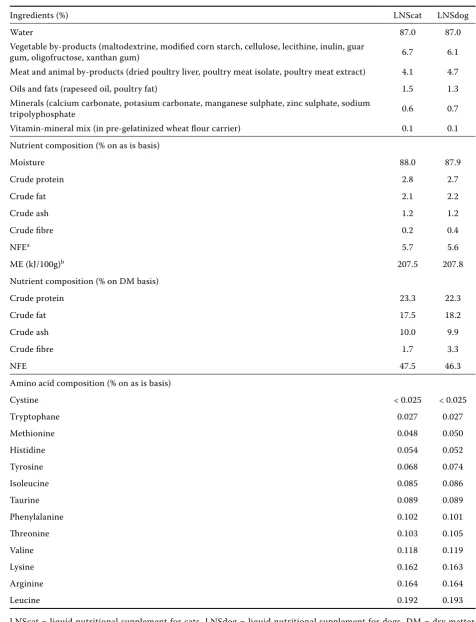
Viyo International N.V., Antwerp, Belgium). The ingredient list, proximate analyses and amino acid analyses can be found in Table 1.
Experimental design
Acceptance test. Each morning before the meal, for four consecutive days, cats and dogs were of-fered 30 ml of LNS, with a concentration of 100% (LNS100). Next, the liquid intake was recorded every 15 s for 150 s in cats and every 10 s for 100 s in dogs.
Preference tests. The preferences of water (W) and three concentrations of LNS, namely LNS100 (100% LNS), LNS70 (70% LNS + 30% water), and LNS50 (50% LNS + 50% water), were tested, using a traditional two-pan preference test (Sunday et al. 1983; Griffin et al. 1984; Rashotte et al. 1984; Verbrugghe et al. 2007). At 3.00 pm for four con-secutive days, cats and dogs were offered 30 ml of two different liquids in two separate bowls si-multaneously. On a daily basis, the position of the food bowls was changed randomly. Five different preference tests were performed; W was compared with LNS50, LNS70 and LNS100; LNS100 was also compared to LNS50 and LNS70. During all prefer-ence tests, the liquid intake was recorded from the first day, every 15 s in cats and every 10 s in dogs. Both liquids were available to cats for a maximum of 150 s, to dogs for a maximum of 100 s. At that time or if one bowl was empty before that time, both bowls were removed and leftovers were re-corded.
The experimental design was in accordance with institutional and national guidelines for the care and use of animals.
Measurements and calculations
Liquid intake was recorded using an intake score of 0 to 5, namely 0 = not touched, 1 = just touched, 2 = 25% intake, 3 = 50% intake, 4 = 75% intake, 5 = 100% intake.
For the acceptance tests, the percentage of cats and dogs was calculated for each intake score at three different time points (cats: 15, 75 and 150 s; dogs: 10, 50 and 100 s), based on the average in-take scores of four days. The acceptance index was calculated as the weighted arithmetic mean of the intake scores over 150 s in each cat and over 100 s in each dog, using the time as weighing factor, as an average of four days.
Table 1. Nutrient and amino acid composition of both tested liquid nutrition supplements (LNScat and LNSdog)
Ingredients (%) LNScat LNSdog
Water 87.0 87.0
Vegetable by-products (maltodextrine, modified corn starch, cellulose, lecithine, inulin, guar
gum, oligofructose, xanthan gum) 6.7 6.1
Meat and animal by-products (dried poultry liver, poultry meat isolate, poultry meat extract) 4.1 4.7 Oils and fats (rapeseed oil, poultry fat) 1.5 1.3 Minerals (calcium carbonate, potasium carbonate, manganese sulphate, zinc sulphate, sodium
tripolyphosphate 0.6 0.7
Vitamin-mineral mix (in pre-gelatinized wheat flour carrier) 0.1 0.1 Nutrient composition (% on as is basis)
Moisture 88.0 87.9
Crude protein 2.8 2.7
Crude fat 2.1 2.2
Crude ash 1.2 1.2
Crude fibre 0.2 0.4
NFEa 5.7 5.6
ME (kJ/100g)b 207.5 207.8
Nutrient composition (% on DM basis)
Crude protein 23.3 22.3
Crude fat 17.5 18.2
Crude ash 10.0 9.9
Crude fibre 1.7 3.3
NFE 47.5 46.3
Amino acid composition (% on as is basis)
Cystine < 0.025 < 0.025
Tryptophane 0.027 0.027
Methionine 0.048 0.050
Histidine 0.054 0.052
Tyrosine 0.068 0.074
Isoleucine 0.085 0.086
Taurine 0.089 0.089
Phenylalanine 0.102 0.101
Threonine 0.103 0.105
Valine 0.118 0.119
Lysine 0.162 0.163
Arginine 0.164 0.164
Leucine 0.192 0.193
LNScat = liquid nutritional supplement for cats, LNSdog = liquid nutritional supplement for dogs, DM = dry matter. NFE = nitrogen free extract, ME = metabolisable energy, NM = not measured
100 s, based on the average intake scores of four days with ‘A’ the intake score for liquid A and ‘B’ the intake score for liquid B. A ratio from 0.49 to 0.51 demonstrated no differences in preference between both liquids. Values > 0.51 expressed a preference for liquid A, while values < 0.49 expressed a prefer-ence for liquid B. Based on the intake ratio at three different time points, the percentages of cats and dogs preferring liquid A, preferring liquid B or hav-ing no preference, were calculated. The preference ratio (A/T) was also calculated at three different time points (cats: 15, 75 and 150 s; dogs: 10, 50 and 100 s), based on the average intake scores of four days with ‘A’ the intake score for liquid A and ‘T’ the total amount of liquid offered (liquid A + liquid B).
Statistical analyses
Statistical analyses were performed using SPSS version 16 (SPSS Inc., Chicago, IL, USA). Acceptance indices were statistically analysed using regression analysis, investigating correlations between accept-ance and age and between acceptaccept-ance and body weight. Preference ratios were statistically analysed using general linear model univariate analyses with liquid A (W, LNS50, LNS70, LNS100) and liquid B (W, LNS50, LNS70, LNS100) as a fixed factor. A Tukey test was performed as a posthoc test, in which both liquid A and B were tested. Data are expressed as mean ± SD.
RESULTS
Acceptance test
Cats.68% of cats already reached LNS100 after 15 s (score: A ≥ 1). Within 150 s, 52% of cats ate 75 to 100% (score 4 ≤ A ≤ 5) of LNS100; of these, 52% ingested all LNS100. Only seven out of 60 cats (12%) did not touch LNS100 after 150 s (score 0 ≤ A < 1). No significant correlations were found be-tween acceptance of LNS 100 and age and bebe-tween acceptance and body weight (data not shown).
Dogs.88% of dogs touched LNS100 already after 10 s (score: A ≥ 1). Within 100 s 73% of dogs ate 75 to 100% (score 4 ≤ A ≤ 5) of the offered LNS100, of these, 91% ate all the LNS100. Only six of 60 dogs (10%) did not touch LNS100 within 100 s (score 0 ≤ A < 1). A very weak linear correlation (P = 0.006; R2 = 0.121) was observed between acceptance of
LNS100 and age, expressing a higher acceptance with increasing age. Furthermore, no relation was found between acceptance of LNS100 and body weight (data not shown).
Preference tests
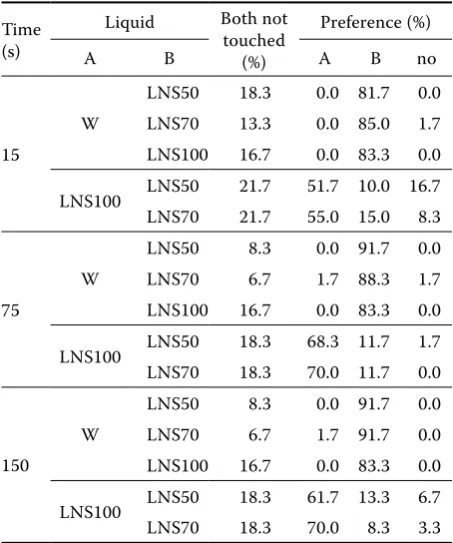
Cats.As shown in Table 2, nearly all cats preferred LNS depending on the time point and dilution, when LNS50, LNS70 and LNS100 where offered simul-taneously with W. Only one cat preferred W. The concentration of LNS had only a minor influence on the preference when compared to W.
[image:4.595.304.531.153.425.2]The average preference ratios of each liquid after 15, 75 and 150 s are shown in Table 3. At each time point, a significant effect of liquid A (P < 0.001) and liquid B (P < 0.001) existed, interactions between liquid A and B were not noted. Posthoc analyses of liquid A, after 15, 75 and 150 s, demonstrated the lowest preference ratio with W, when compared to LNS100, LNS70 and LNS50. The highest preference ratio was found for LNS100 when compared to W, LNS50 and LNS70. LNS50 and LNS70 did not differ
Table 2. Percentage of cats that preferred liquid A or B or had no preference after 15, 75, 150 s, following different preference tests with water (W) and different concen-trations of a liquid nutritional supplement (LNScat), in 60 cats, based on the calculation of the intake ratio
Time (s)
Liquid Both not touched
(%)
Preference (%)
A B A B no
15
W
LNS50 18.3 0.0 81.7 0.0 LNS70 13.3 0.0 85.0 1.7 LNS100 16.7 0.0 83.3 0.0
LNS100 LNS50 21.7 51.7 10.0 16.7 LNS70 21.7 55.0 15.0 8.3
75
W
LNS50 8.3 0.0 91.7 0.0 LNS70 6.7 1.7 88.3 1.7 LNS100 16.7 0.0 83.3 0.0
LNS100 LNS50 18.3 68.3 11.7 1.7 LNS70 18.3 70.0 11.7 0.0
150
W
LNS50 8.3 0.0 91.7 0.0 LNS70 6.7 1.7 91.7 0.0 LNS100 16.7 0.0 83.3 0.0
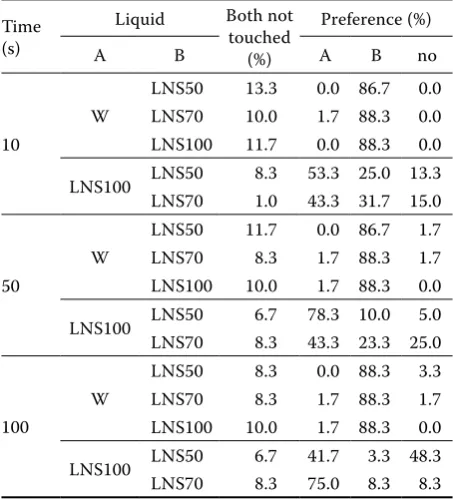
at the three time points. Posthoc analyses of liq-uid B, after 15, 75 and 150 s, showed the opposite. Dogs. As shown in Table 4, nearly all dogs fa-voured LNS, depending on time point and dilution, when LNS50, LNS70 and LNS100 were offered si-multaneously with W. Only one dog preferred W. The concentration of LNS had only a minor influ-ence on the preferinflu-ence when compared to W.
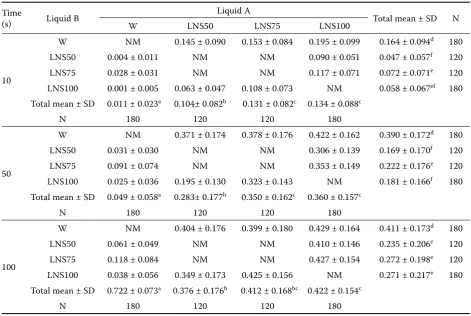
[image:5.595.64.531.112.404.2]The average preference ratios of each liquid after 10, 50 and 100 s are shown in Table 5. At each time point, a significant effect of liquid A (P < 0.001) and liquid B (P < 0.001) existed and interactions between liquid A and B were observed (10 s: P = 0.008, 50 s: P = 0.005, 100 s: P = 0.055). Posthoc analyses of liquid A, after 10, 50 and 100 s, demonstrated the lowest preference ratio with W, when compared to LNS100, LNS70 and LNS50. The highest preference ratio was found for LNS100 when compared to W and LNS50, as well as LNS70 when compared to W and LNS50, but for LNS50 this was only the case after 10 s and 50 s. LNS100 and LNS70 did not differ at the three time points. Posthoc analyses of liquid B, after 10, 50 and 100 s, showed the opposite.
Table 3. Mean preference ratios of each liquid after 15, 75 and 150 s, following different preference tests with water (W) and different concentrations of a liquid nutritional supplement (LNScat) in 60 cats
Time
(s) Liquid B
Liquid A
Total mean ± SD N
W LNS50 LNS75 LNS100
15
W NM 0.094 ± 0.072 0.106 ± 0.063 0.128 ± 0.075 0.109 ± 0.071d 180
LNS50 0.004 ± 0.009 NM NM 0.082 ± 0.065 0.043 ± 0.060e 120
LNS75 0.006 ± 0.013 NM NM 0.086 ± 0.068 0.046 ± 0.063e 120
LNS100 0.002 ± 0.007 0.038 ± 0.040 0.036 ± 0.045 NM 0.026 ± 0.039f 180
Total mean ± SD 0.004 ± 0.010a 0.066 ± 0.064b 0.071 ± 0.065b 0.099 ± 0.072c
N 180 120 120 180
75
W NM 0.251 ± 0.169 0.255 ± 0.155 0.301 ± 0.182 0.269 ± 0.170d 180
LNS50 0.007 ± 0.015 NM NM 0.220 ± 0.167 0.114 ± 0.159e 120
LNS75 0.014 ± 0.021 NM NM 0.223 ± 0.160 0.118 ± 0.155e 120
LNS100 0.006 ± 0.020 0.102 ± 0.104 0.103 ± 0.112 NM 0.070 ± 0.039f 180
Total mean ± SD 0.009 ± 0.019a 0.176 ± 0.159b 0.179 ± 0.155b 0.248 ± 0.173c
N 180 120 120 180
150
W NM 0.277 ± 0.182 0.310 ± 0.176 0.323 ± 0.191 0.303 ± 0.183d 180
LNS50 0.012 ± 0.040 NM NM 0.264 ± 0.196 0.138 ± 0.189e 120
LNS75 0.020 ± 0.030 NM NM 0.260 ± 0.190 0.140 ± 0.181e 120
LNS100 0.010 ± 0.040 0.175 ± 0.165 0.135 ± 0.141 NM 0.107 ± 0.145e 180
Total mean ± SD 0.014 ± 0.037a 0.226 ± 0.180b 0.223 ± 0.181b 0.282 ± 0.193c
N 180 120 120 180
N = number of preference tests, NM = not measured
a, b, csignificant differences within one row d, e, fsignificant differences within one column
Table 4. Percentage of dogs that preferred liquid A or B or had no preference after 10, 50, 100 s, following differ-ent preference tests with water (W) and differdiffer-ent con-centrations of a liquid nutritional supplement (LNSdog), in 60 dogs, based on the calculation of the intake ratio
Time (s)
Liquid Both not touched
(%)
Preference (%)
A B A B no
10
W
LNS50 13.3 0.0 86.7 0.0 LNS70 10.0 1.7 88.3 0.0 LNS100 11.7 0.0 88.3 0.0
LNS100 LNS50 8.3 53.3 25.0 13.3 LNS70 1.0 43.3 31.7 15.0
50
W
LNS50 11.7 0.0 86.7 1.7 LNS70 8.3 1.7 88.3 1.7 LNS100 10.0 1.7 88.3 0.0
LNS100 LNS50 6.7 78.3 10.0 5.0 LNS70 8.3 43.3 23.3 25.0
100
W
LNS50 8.3 0.0 88.3 3.3 LNS70 8.3 1.7 88.3 1.7 LNS100 10.0 1.7 88.3 0.0
[image:5.595.304.531.506.756.2]DISCUSSION
The acceptance tests in the present study showed that healthy cats and dogs generally ac-cept pure LNScat and LNSdog (LNS100) very well. Furthermore, preference tests showed a clear pref-erence for LNScat and LNSdog, regardless of the dilution (LNS50, LNS70, LNS100), when compared to water. In cats, LNS100 was generally better ac-cepted than LNS50 and LNS70. In contrast, dogs preferred both LNS100 and LNS70 above LNS50.
Nevertheless, any method used to assess preference in cats and dogs should be addressed critically. The traditional two-pan preference test, as performed in the present study, is the most common method for as-sessing palatability in dogs (Griffin et al. 1984; Araujo et al. 2004; Verbrugghe et al. 2007). This approach allows palatability to be determined rapidly, but does not control for satiety effects or food interactions. The two-pan test may not be useful for long-term palatability trials because the nutritional or caloric
characteristics of the foods may interfere with the results. Furthermore, cats have different feeding behaviour compared to dogs. As cats have an ad libitum meal-pattern, taking multiple small meals spread throughout the 24 hours of the day (Bradshaw 2006), offering the food once daily to assess pal-atability deviates from the cat’s natural behaviour. A novel cognitive palatability assessment protocol (CPAP) for dogs has been determined, based on a discrimination-learning procedure. This approach provides an objective measure of food preference using a limited number of animals, while controlling for other factors influencing feeding, such as sati-ety (Araujo and Milgram 2004; Araujo et al. 2004). However, in the present study the novel CPAP was not used because of the intensive and time-consuming training and learning protocol (Araujo et al. 2004).
[image:6.595.62.534.113.429.2]Nonetheless, the results from the present study show that healthy cats and dogs generally accept pure LNS very well and prefer LNS above water. Therefore, these liquid supplements are accepted
Table 5. Mean preference ratios of each liquid after 10, 50 and 100 s, following different preference tests with water (W) and different concentrations of a liquid nutritional supplement (LNSdog) in 60 dogs
Time
(s) Liquid B
Liquid A
Total mean ± SD N
W LNS50 LNS75 LNS100
10
W NM 0.145 ± 0.090 0.153 ± 0.084 0.195 ± 0.099 0.164 ± 0.094d 180
LNS50 0.004 ± 0.011 NM NM 0.090 ± 0.051 0.047 ± 0.057f 120
LNS75 0.028 ± 0.031 NM NM 0.117 ± 0.071 0.072 ± 0.071e 120
LNS100 0.001 ± 0.005 0.063 ± 0.047 0.108 ± 0.073 NM 0.058 ± 0.067ef 180
Total mean ± SD 0.011 ± 0.023a 0.104± 0.082b 0.131 ± 0.082c 0.134 ± 0.088c
N 180 120 120 180
50
W NM 0.371 ± 0.174 0.378 ± 0.176 0.422 ± 0.162 0.390 ± 0.172d 180
LNS50 0.031 ± 0.030 NM NM 0.306 ± 0.139 0.169 ± 0.170f 120
LNS75 0.091 ± 0.074 NM NM 0.353 ± 0.149 0.222 ± 0.176e 120
LNS100 0.025 ± 0.036 0.195 ± 0.130 0.323 ± 0.143 NM 0.181 ± 0.166f 180
Total mean ± SD 0.049 ± 0.058a 0.283± 0.177b 0.350 ± 0.162c 0.360 ± 0.157c
N 180 120 120 180
100
W NM 0.404 ± 0.176 0.399 ± 0.180 0.429 ± 0.164 0.411 ± 0.173d 180
LNS50 0.061 ± 0.049 NM NM 0.410 ± 0.146 0.235 ± 0.206e 120
LNS75 0.118 ± 0.084 NM NM 0.427 ± 0.154 0.272 ± 0.198e 120
LNS100 0.038 ± 0.056 0.349 ± 0.173 0.425 ± 0.156 NM 0.271 ± 0.217e 180
Total mean ± SD 0.722 ± 0.073a 0.376 ± 0.176b 0.412 ± 0.168bc 0.422 ± 0.154c
N 180 120 120 180
N = number of preference tests, NM = not measured
to be very palatable and may be a worthwile tool for increasing the palatability of the pet’s diet and stimulating appetite. Still, it is important to under-score that healthy cats and dogs were used in the present study and that therefore no data are avail-able to support the acceptance and preference of LNS in sick or hospitalized animals nor to support its effect on the diet’s palatability and appetite.
In cats, LNS100 was preferred above LNS70 com-pared to dogs in which no differences were noted between preference of LNS100 and LNS70. This observation shows that in cats a higher concentra-tion of LNS is required, which can be explained by species differences in flavour preference. The palatability of food is a composite function of a va-riety of factors including aroma, taste, texture and consistency. In dogs, increasing dietary moisture, fat and protein content, adding sugars or salt and warming food to body temperature can increase the palatability of the food (Delaney 2006). The same factors can be used in cats. Yet, adding sugar does not increase palatability, as cats are unable to taste sweet stimuli, due to the lack of a functional Tas1r2 gene and the inability to form a functional sweet-taste receptor (Li et al. 2005, 2006). Still, both tested liquid supplements contained high lev-els of nitrogen-free extract (NFE) (LNScat: 47.5% DM; LNSdog: 46.3% DM) as vegetable by-products (LNScat: 6.7%, LNSdog: 6.1%) were in second place on the ingredient list. Especially in cats, acceptance and preference may have been higher if the sup-plement contained higher levels of protein and fat and lower amounts of carbohydrates.
It should be highlighted that LNScat and LNSdog can only be used as a supplement as it is not a complete and balanced liquid food for dogs and cats. The recommended dose (30 ml) only provides about 60 kJ, which doesn’t cover the pet’s energy re-quirements [LNSdog: 2.0% of maintenance energy requirement, 3.5% of resting energy requirement, based on a 10 kg dog, LNScat: 5.7% of mainte-nance energy enquirement, 7.2% of resting energy requirement, based on a 4 kg cat, calculated accord-ing to the NRC (2006a)]. Also, these supplements do not meet protein requirements; as compared to the recommended allowances according to the NRC (2006a), the recommended dose provides only 4.5% of the protein requirement for maintenance in dogs and only 6.1% of the protein requirement for maintance in cats, keeping in mind that pro-tein requirements may be much higher in diseased and injured patients. If owners use LNS as a single
food for their pet, deficiencies and malnutrition may occur.
As cats and dogs of different ages and breeds generally accepted and preferred LNS, regardless of the dilution, above water, LNS can be considered as very palatable and may be useful as a palatability enhancer and appetite stimulant. If future research confirms that LNS is also highly palatable for ill and hospitalised patients and stimulates appetite in a hospital setting, a practical tool to improve mois-ture and nutrient intake in patients with hypo- or anorexia, will become available.
Acknowledgements
The expenses of this study were covered by Viyo International N.V. (Antwerp, Belgium), who also provided the liquid nutritional supplements for cats (cat vets) and dogs (dog vets). The authors grate-fully acknowledge De Morgenstond (Dussen, The Netherlands) for animal care and technical assistance.
REFERENCES
Araujo JA, Milgram NW (2004): A novel cognitive pal-atability assessment protocol for dogs. Journal of Animal Science 82, 2200–2206.
Araujo JA, Studzinski CM, Larson BT, Milgram NW (2004): Comparison of the cognitive palatability assess-ment protocol and the two-pan test for use in assessing palatability of two similar foods in dogs. American Journal of Veterinary Research 65, 1490–1496. Bradshaw JWS (2006): The evolutionary basis for the
feed-ing behaviour of domestic dogs (Canis familiaris) and cats (Felis catus). Journal of Nutrition 136, 1927S– 1931S.
Chan D (2009): The inappetent hospitalised cat. Clincal approach to maximising nutritional support. Journal of Feline Medicine and Surgery 11, 925–933.
Chan DL, Freeman LM (2006): Nutrition in critical ill-ness. Veterinary Clinics of North America – Small Animal Practice 36, 1225–1241.
Delaney SJ (2006): Management of anorexia in dogs and cats. Veterinary Clinics of North America – Small Animal Practice 36, 1243–1249.
Doty RL, Shaman P, Applebaum SL, Giberson R, Siksor-ski L, Rosenberg L (1984): Smell identification ability: changes with age. Science 226, 1441–1443.
relation to age, nutritional, and health-status. Journals of Gerontology Series A – Biological Science 50, B407–B414.
Griep MI, Mets TF, Collys K, Vogelaere P, Laska M, Mas-sart DL (1997a): Odour perception in relation to age, general health, anthropometry and dental state. Ar-chives of Gerontology and Geriatrics 25, 263–275. Griffin RW, Scott GC, Cante CJ (1984): Food preferences
of dogs housed in testing-kennels and in consumers’ homes: some comparisons. Neuroscience and Biobe-havioral Reviews 8, 253–259.
Li X, Li W, Wang H, Cao J, Maehashi K, Huang L, Bach-manov AA, Reeds DR, Legrand-Defretin V, Beau-champ GK, Brand JG (2005): Pseudogenization of a sweet-receptor gene accounts for cats’ indifference toward sugar. PloS Genetics 1, 27–35.
Li X, Li W, Wang H, Bayley DL, Cao J, Reeds DR, Bach-manov AA, Huang L, Legrand-Defretin V, Beauchamp GK, Brand JG (2006): Cats lack sweet taste receptor. Journal of Nutrition 136, 1932S–1934S.
Michel KE (2006): Unconventional diets for dogs and cats. Veterinary Clinics of North America – Small Animal Practice 36, 1269–1281.
National Research Council (NRC) (2006a): Chapter 15, Nutrient requirements and dietary nutrient recom-mendations. In: Nutrient requirements of dogs and cats. The National Academies Press, Washington, DC. 354–370.
National Research Council (NRC) (2006b): Chapter 3, Energy. In: Nutrient requirements of dogs and cats.
The National Academies Press, Washington, DC. 28–48.
Rashotte ME, Foster DF, Austin T (1984): Two-pan and operant lever-press tests of dogs’ preference for vari-ous foods. Neuroscience and Biobehavioral Reviews 8, 231–237.
Remillard RL (2002): Nutritional support in critical care patients. Veterinary Clinics of North America – Small Animal Practice 32, 1145–1164.
Remillard RL (2008): Homemade diets: Attributes, pit-falls and a call for action. Topics in Companion Animal Medicine 23, 137–142.
Steinbach S, Staudenmaier R, Hummel T, Arnold W (2008): Loss of olfaction with aging: a frequent disor-der receiving little attention (in German). Zeitschrift für Gerontologie und Geriatrie 41, 394–402.
Sunday SR, Sanders SA, Collier G (1983): Palatability and meal patterns. Physiology and Behavior 30, 915–918.
Verbrugghe A, Hesta M, Gulbrandson KE, Janssens GPJ (2007): The effect of salmon oil freshness on the palat-ability of dog foods. Vlaams Diergeneeskundig Tijd-schrift 76, 201–207.
Wysocki CJ, Gilbert AN (1989): National geographic smell survey – Effects of age are heterogenous. Annals of the New York Academy of Science 561, 12–28.
Received: 2012–05–03 Accepted after corrections: 2012–07–05
Corresponding Author:
Myriam Hesta, Ghent University, Faculty of Veterinary Medicine, Laboratory of Animal Nutrition, Salisburylaan 133, 9820 Merelbeke, Belgium
![[N957.Ebook] PDF Download Dr Beckers Real Food For Healthy Dogs And Cats By Beth Taylor And Karen Shaw Becker Dvm.pdf](data:image/gif;base64,R0lGODlhAQABAIAAAP///wAAACH5BAEAAAAALAAAAAABAAEAAAICRAEAOw==)