An evaluation of the introduction
of blended learning to Continuing
Professional Development (CPD)
Pat Young, Margaret Glogowska, Lesley Lockyer,
and Pam Moule
Commissioned by NHS South West
An evaluation of the introduction of blended learning to Continuing
Professional Development (CPD)
Acknowledgements
The research team are indebted to NHS South West for making this
evaluation possible. We are also grateful to all the staff and students who
worked on the CPD modules and who helped in the evaluation. We would like
to thank especially the Project Leads, the Steering Group members, module
leaders and the students who participated in our Advisory Group. Special
thanks to Charlotte Prowle for administrative support and excellent
minute-taking.
Pat Young
Margaret Glogowska
Lesley Lockyer
Pam Moule
Centre for Learning and Workforce Research
Faculty of Health and Life Sciences
University of the West of England, Bristol
Glenside Campus
Blackberry Hill
Stapleton
Contents
Summary
4
Introduction
9
The curriculum development project
The national context
Definition of e-learning terms
Aims and objectives of the evaluation
11
Research approach and methods
12
Findings: analysis of applications and completions
data
14
Findings: the staff interviews
16
Findings: the student questionnaire
26
Findings: the student interviews
34
Conclusions
44
Recommendations
50
Bibliography
53
Appendices
1 Topic guide for staff interviews
2 Student questionnaire
3 Student interview guide
54
List of Tables
Table 1
Pre-FACE level 3 Practice Modules
14
Table 2
FACE modules
14
Table 3
Previous e-learning experience
26
Table 4
Access to computers with internet
26
Table 5
Use of computers
27
Table 6
Rating the on-line materials
27
Summary
Introduction
• The curriculum development project to develop a blended learning model for
continuing professional development (CPD) began in 2006. The evaluation explored staff and student experiences, seeking to illuminate good practice and make recommendations for future developments. The evaluation was funded by NHS South West.
The curriculum development project
• Previous to this development, CPD was provided through a series of modules
delivered through traditional teaching formats and attendance patterns. The introduction of a blended learning approach was driven by service stakeholders at senior management level seeking a more flexible form of delivery.
• The blended learning model for CPD consists of core modules and a series of
further specialist learning options. There are currently two key pathways: Managing Long Term Conditions; and Foundations of Acute Critical and Emergency Care (FACE).
• The modules previously ran a day a week for eight weeks. In moving to
blended learning, most module teams opted for an approximately 50/50 split of face-to-face and on-line learning.
• The blended learning model aimed to make full creative use of the interactive
potential of on-line media and maximise learning opportunities.
• The model for the project management established a team approach with: a
steering group; a project leader for each of the pathways; project teams, administrative support; and involvement of The Learning Technology Development Unit (LTDU).
• The students studying the blended learning modules were mainly nurses, but
included some allied health professionals. They were mainly employed within the National Health Service but some students worked within voluntary organisations or within the military.
The national context
• National government policies have urged those delivering education to health
and social care professions to explore the potential of e-learning (Dearing, 1997; Department for Education and Employment (DfEE), 1998; DfEE, 2003).
• There are a number of reported benefits of e-learning delivery, particularly for
adult learners trying to balance learning alongside employment and home demands.
• There are some concerns that the employment of e-learning might be
ability to meet learner need. A percentage of learners remain reluctant to engage with new modes of learning, preferring the ‘traditional’ face-to-face delivery (Kamin et al, 2001).
Research approach and methods
• The evaluation has been planned collaboratively with staff and students,
through meetings, email correspondence and the establishment of an advisory group.
• The data collection methods included:
Analysis of Applications and Completions data
A questionnaire sent to all students enrolled on the new modules: 40 questionnaires returned
Follow up telephone interviews with students: 17 interviews completed Interviews with key staff: 20 interviews completed
Findings: Applications and Completions
• More students were enrolled in the blended learning modules analysed than
in the related pre-blended learning modules.
• A larger number of students from the new modules did not submit for
assessment. The overall pass rate was lower reflecting the larger number of non-active students and the mean overall mark dropped from 53.8% to 48%. The difference in the results may be for a number of reasons. It may be that students chose to enrol on the module to access some of the learning but did not seek to be assessed. Students may not be used to the blended approach which requires a strong self directed learning approach.
Findings: The Staff Experience
• Staff interviewed believed the main driver to come from service stakeholders
at senior management level. Other factors mentioned included the need to widen the appeal of the CPD provision, and to provide more flexible and interactive learning.
• The creation of a project infrastructure with funding and leadership was seen
as critical to the success of this kind of development.
• There was widespread agreement that the enthusiasm and energy of the
Pathway Leaders was crucial to the development.
• The steering group provided a forum for support, particularly for the Pathway
Leaders, but some communication difficulties were reported by module staff.
• Overall, staff views of blended learning at the beginning were more negative
• The development was experienced as a learning curve, with associated high levels of anxiety, especially for lecturers without previous experience of developing on-line learning.
• Interviewees spoke of difficulties in understanding the roles of technical and
academic staff in terms of initiating processes and divisions of labour.
• Although there was finance available to support the development, it was
sometimes difficult to make use of the resource. Resources were more successfully used for external funding of development work.
• Delays and frustrations arose in checking copyright issues. This issue was
resolved when some of the work was contracted out.
Findings: The Student Questionnaire and Interviews
• All respondents had some previous experience of on-line or blended learning.
• Just over half the respondents agreed that they felt confident about on-line
learning at the beginning of the course; this increased to 75% of respondents by the end of the course.
• Most students accessed materials from home and work, with home access
the most popular.
• Students felt protected time was needed for on-line study, but found it easier
to secure for classroom work. Most worked in half-day or day study blocks and felt they used more time than was allocated by employers.
• Although most did have computers at home, some felt these were not able to
cope with the demands of the modules.
• There was praise for the work and academic support of the module leaders
and tutors. Most students found technical help available when needed.
• Feedback on the on-line materials was generally good. The majority of
respondents gave positive ratings on the quality and relevance of the material, ease of navigation and interactivity.
• Resources which were seen as most useful were: links to web materials;
multiple choice quizzes, course information; the introductory exercise; Pdfs; Powerpoints; ‘drag and drop’ self tests; image labelling exercises; images; ‘fill the gap’ exercises; case-studies; and self test questions with example answers.
• Factors that created difficulties for more than 50% of respondents were:
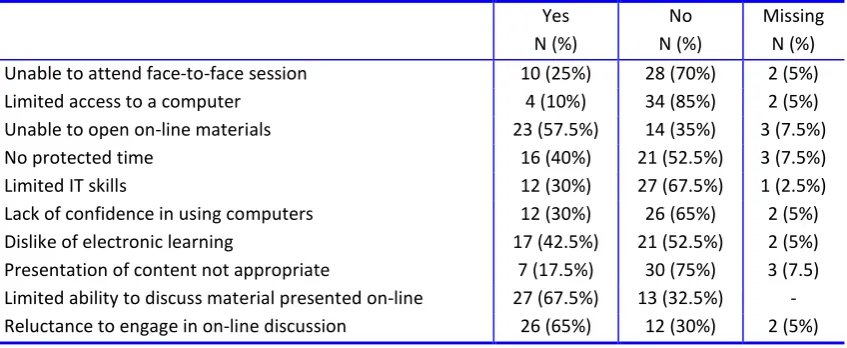
limited ability to discuss on-line materials; reluctance to engage in on-line discussions; and inability to open on-line materials.
• There was general agreement that the on-line discussion board did not
• About a third stated there was excessive volume of material. They would have welcomed more help in deciding what was relevant.
• A small majority found the material provided on-line too complex, with a
bigger percentage feeling there were insufficient opportunities to discuss the on-line material.
• Face-to-face sessions were viewed positively in terms of the expertise of
outside speakers and lecturers and the opportunity to learn from fellow students.
• The majority of respondents agreed that studying on-line provided useful
skills for continuing learning and was more convenient for part-time study.
Conclusions
• The curriculum development project has been effective in achieving its aim to
develop a blended learning model for CPD delivery.
• The development project has successfully created quality on-line materials,
with high degrees of interactivity and variety, and changed face-to-face delivery away from traditional lectures to the establishment of master classes and greater emphasis on practical and other groupwork.
• The process of the curriculum development project has demonstrated much
good practice to inspire future developments in the Faculty and across the University, as well as some lessons which can be learned to improve future curriculum development.
• The starting point for many of the staff was one of scepticism regarding the
value of blended learning. Most were however pleased with the end result and some of the anxieties regarding students’ ability to manage blended learning proved unfounded.
• The students’ accounts did not fit a simple ‘love it or loathe it’ view of blended
learning. Views were mixed and qualified and most students pragmatically accepted the need to adapt to blended learning as a significant part of their futures.
Recommendations
• Future developments in blended learning should employ the project model
and infrastructure used here, to provide effective leadership and funding to support staff in making successful curriculum change.
• Communication between groups, for example steering groups and project
groups needs to move in both directions, with discussions and decisions of steering groups made transparent and accessible to all.
• Models of project management need to be consistent with the culture and
• There is a need for staff training on pedagogical aspects of e-learning and on project management.
• Change management should be explicit in helping staff understand that
change is stressful and that radical curriculum development is likely to involve loss, anxiety, and take time.
• There is a need for a database of learning and teaching expertise within the
Faculty, the University and also in the wider HE networks to enable people to benefit from the experience and knowledge of others.
• There is a need to think through assessment issues of blended learning and
provide guidelines for module leaders.
• Copyright issues need to be understood from the beginning and ways of
dealing with copyright factored into the development of on-line or blended learning.
• Frontline staff should be brought into any future development as soon as
possible, to enable all to understand what is being done and why, and to input into early plans.
• The energy, enthusiasm, leadership and funding for the initial stages of
development needs to be maintained to enable the on-line materials to be updated and revised and to support new module teams coming in later.
• Employers need to provide protected time for on-line study, as well as for
attending face-to-face sessions.
• Mentor support in practice would be valuable in helping students make
decisions for prioritising learning and relating learning to practice.
• Student input is important in deciding what material should go on-line and
what should be taught in face-to-face contexts.
• Materials on-line should be integrated into classroom sessions with
opportunities to discuss work done on-line.
• There is a need for careful editing on on-line materials to ensure students are
not overwhelmed by too much material. Students need a clear message that they are not expected to cover all the material and guidance on selection.
• Students’ expectations regarding immediate and ‘anytime’ access to support
need to be managed.
• Consideration should be given to experimenting with alternatives to
Introduction
The curriculum development project to develop a blended learning model for continuing professional development (CPD) began in 2006. The aim was to create provision which would be flexible in meeting the individual needs of the students, using a blended learning approach which combines on-line learning and face-to-face learning. The evaluation focused on student experiences of blended learning, staff experiences of developing blended learning, and the process of project management by which this development has been achieved. The evaluation seeks to illuminate good practice and to make recommendations for future developments. The evaluation is funded by NHS South West. The evaluation was granted ethical approval by the Faculty of Health and Life Sciences Research Ethics Committee.
This report explains the context to the development in institutional and national policy, describes the aims and findings of the evaluation, offers conclusions and makes recommendations for further developments of this kind. The statements in the report represent findings at a particular moment in time. As such they are a snapshot of a situation which in reality was constantly changing. Ongoing evaluation has led to changes in the delivery of the modules and there have been a number of staff changes since the commencement of the evaluation.
The curriculum development project
Development of the blended learning model began in 2006. Previous to this development, CPD was provided through a series of modules delivered through traditional teaching formats with students attending one day a week for eight weeks. Although on-line materials were included to some extent, this was most commonly Pdf files which students could download, rather than the creation of any form of interactive learning. The introduction of a blended learning approach was driven by service stakeholders at senior management level seeking a more flexible form of delivery. The model was developed through a consultation process involving Faculty staff and management and external stake-holders in health and social care.
The blended learning model for CPD (previously described as a Hub and Spoke model) includes a core module and a series of further specialist learning options. The provision is flexible to meet the individual needs of the students. The core module is not compulsory and some students complete only one of the specialist modules as a short course, providing evidence of learning rather than contributing to an award. The blended learning approach combines on-line learning and face-to-face learning. The face-to-face learning includes Masterclasses which are attended by students taking modules, but also by people signing up to these classes on a stand-alone basis.
There are two key pathways:
1. Managing Long Term Conditions (core), commenced Jan 24th 2008, with specialist modules:
• Neuro-science, commenced March 2008
• Pain management, commenced November 2008
• Posture for Function, commenced November 2008
• Orthopaedic, commenced April 2009
• Diabetes, to be developed
• Renal, commenced October 2008
2. Foundations of acute critical and emergency care (FACE) (core), commenced Jan 08 with spokes:
• Principles of Emergency care, commenced January 2008
• Principles of Critical care, commenced January 2008
• Principles of Cardiac care, commenced April 2008
The on-line modules are housed outside of the VLE Blackboard to enable access for those outside the university and not enrolled on a UWE module. The sites include a discussion forum to support social dialogue and networking. The blended learning model aimed to make full use of the interactive potential of the media and to creatively use the full functionality in maximising learning opportunities.
The model for the project management established a team approach with a steering group; two project leaders; and project teams. It was intended that the infrastructure and the resources provided would enable staff to be supported to provide highly effective learning experiences for students.
The national context
Policy drivers
The provision of health and social care education is complex, facilitated through a range of providers and drawing on the Higher Education (HE) sector as one key stakeholder. National government policies have urged those delivering education to health and social care professions to explore the potential of e-learning (Dearing, 1997; Department for Education and Employment (DfEE), 1998; DfEE, 2003). E-learning is viewed as a means of contributing to a digital and knowledge based economy (Department for Education and Skills (DfES), 2003). The flexibility and accessibility of such modes of delivery are seen as offering opportunities to meet lifelong learning agendas and support widening participation (Scottish Executive, 1999; Department of Health (DH),1998, 2000, 2001, 2002; DfEE, 2003, Social Care Institute for Excellence (SCIE) 2007). E-learning has been seen as crucial to the support of learners; with the Department for Education and Skills (2003) predicting that by 2013 effective learning would be impossible without access to e-learning.
Potential benefits of use of e-learning delivery
There are a number of reported benefits of e-learning delivery. Bates (2001) commented on the benefits of using e-learning for those who have full time jobs and hectic social and personal lives. Many health and social care professionals fit into this category and will be looking to technology to provide access to necessary education, training materials and opportunities. The flexibility of ‘any-time, any-where’ delivery is often seen as helpful to learners trying to balance learning alongside employment and home demands.
Potential issues of e-learning use
levelled at technologies such as widely employed virtual and managed learning environments (VLEs and MLEs), that are said to favour content creation rather than supporting learner diversity and pedagogic creation (Britain and Liber, 2004). The VLE provides a toolkit that often constrains the educationalists’ ability to develop and implement teaching and learning strategies and equally limits the learner. Educators can fail to employ all of the pedagogic options available for e-learners. For example, it is suggested that despite an increasing emphasis on active learning, e-learning systems are predominately used to provide digital information access and dissemination (Crook and Barrowcliff, 2001), including the provision of lecture notes, reading lists, journal articles and images (Levy, 2005).
Whilst educators may fail to fully use e-learning tools it should also be acknowledged that a percentage of learners remain reluctant to engage with new modes of learning, preferring the ‘traditional’ face-to-face delivery (Kamin et al, 2001). Indeed, the cultural and wider changes required in adopting new learning approaches should not be under-estimated and many issues still remain for its adoption within health and social care education.
Definition of e-learning terms
A number of organisations and individuals offer different definitions of e-learning. The Social Care Institute for Excellence (SCIE) defined e-learning as, ‘the use of information and communication technologies (ICT) to provide, support or enhance learning.’ (SCIE, 2007, p1). This is a broad definition that includes any learning facilitated through electronic media. In this study we use the term on-line learning to refer to the use of a computer linked to the Internet via a telephone line connection. The internet enables one to one communication (for example between a student and
a lecturer) or one to many (for example the use of group discussion). Blended
Aims and objective of the evaluation
The aims were:
• To explore the effectiveness of the project management approach,
infrastructure and process
• To explore the effectiveness of the blended learning model in supporting the
CPD curriculum.
The objectives were:
• To explore the role of the steering group and the relationships between the
steering group and the project teams
• To understand the experiences of the project leaders in leading, managing
and implementing the blended learning model
• To measure the effectiveness of the blended learning model in attracting
students to the faculty
• To understand the students’ experiences of the blended learning model
• To explore the effectiveness of the blended learning model in developing
student learning for practice
• To ascertain the student’s perception of the impact of blended learning on
their use of IT in professional practice
• To review teaching staff perceptions of the purpose of the CPD model
• To ascertain whether the model meets the aims of the original Health and
Social Care CPD review (October 2006)
• To understand the experiences of academic staff in developing and
Research approach and methods
Pawson and Tilley (1997) see the purpose of evaluation research as being to inform development of policy and practice. They suggest that the question asked in realistic evaluation is not ‘What works?’ or ‘Did this program work?’ but ‘What works for whom in what circumstances?’ and suggest evaluators begin by expecting measures to vary in impact depending on circumstances. The key problem for evaluation is then how, and under what circumstances, a given measure will produce impacts. Realistic evaluation aims to recognize complexity, reframe questions, and support development.
The realistic evaluation approach suggests that outcomes follow from mechanisms acting in contexts. The mechanisms here are the project management process and blended learning, about which a realistic evaluation would ask ‘what is it about this measure that may lead it to have a particular outcome pattern in a given context?’ Operations are however always contingent on context, since subjects only act upon resources and choices offered by a program if they are in conducive settings. Context refers to spatial and institutional locations of social situations together crucially with the norms, values and interrelationships found in them – here the CPD curriculum within the school and in the wider employment context. The question asked about the context is: ‘what conditions are needed for a measure to trigger mechanisms to produce particular outcome patterns?’ The outcomes here are the student and staff experiences, achievement and impact on practice.
The approach allows for a range of data collection that acknowledges the complexity of introducing the blended learning CPD curriculum, and the number of variables likely to play a part in its introduction, development and use. Realistic evaluation tries to identify the people and situations for whom the initiative will be beneficial by drawing on success and failure rates of different subgroups within and between interventions. The aim is to understand context-mechanism-outcome pattern configurations, creating propositions stating what it is about a program that works for whom in what circumstances.
All stages of the evaluation have been discussed by stakeholders. Meetings were held with key staff before beginning the evaluation. An advisory group which included student and staff representatives met three times to discuss the project and monitor progress.
Research Methods
The data collection methods were:
1. Analysis of Applications and Completions data 2. Interviews with key staff
3. A questionnaire sent to all students enrolled on the new modules 4. Follow up telephone interviews with students
Analysis of Applications and Completions data
Staff Interviews
The key staff involved in the development and the delivery of the blended learning CPD framework were contacted by email and invited to take part in individual interviews guided by open questions (see appendices for topic list). The interviews were audio-recorded, transcribed and thematically analysed.
Student Questionnaire
Questionnaires were posted to the home addresses of all students who enrolled on modules in the 2007-8 year. Students were offered a £10 token from Marks and Spencer as a token of appreciation for their time in participating in the research. This was sent to an address provided by the student on completion of the questionnaire (regardless of whether or not they are willing to be interviewed by telephone). The responses from the questionnaire were recorded in SPSS and analysed to identify attitude measures to certain statements and to provide descriptive statistics. Open-ended questions would be reviewed for key issues and themes.
Student interviews
Findings: Analysis of Applications and Completions data
Blended learning modules were compared to pre-blended learning modules using the Foundations of Acute, Critical and Emergency Care (FACE) Module as a case study. The comparison was of the FACE Module in the first year of its delivery with the final year of delivery of the four Pre-FACE practice modules.
The Pre-FACE Level 3 practice modules were:
• Critical care practice (Applied Coronary Care)
• Critical care practice (Applied Intensive Care)
• Critical care practice (Management of the Acutely Ill Ward Patient)
• Emergency Care
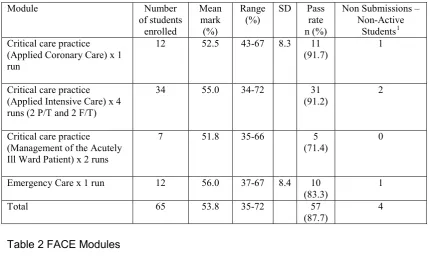
The results for the pre-FACE modules are shown in Table 1 and the FACE Modules in Table 2.
Table 1 Pre-FACE level 3 Practice Modules
Module Number of students enrolled Mean mark (%) Range
(%) SD Pass rate n (%)
Non Submissions – Non-Active
Students1
Critical care practice (Applied Coronary Care) x 1 run
12 52.5 43-67 8.3 11
(91.7) 1
Critical care practice (Applied Intensive Care) x 4 runs (2 P/T and 2 F/T)
34 55.0 34-72 31
(91.2) 2
Critical care practice (Management of the Acutely Ill Ward Patient) x 2 runs
7 51.8 35-66 5
(71.4) 0
Emergency Care x 1 run 12 56.0 37-67 8.4 10
(83.3) 1 Total 65 53.8 35-72 57
[image:16.595.83.514.309.569.2](87.7) 4
Table 2 FACE Modules
Module Number of students
enrolled
Mean
mark (%) Range (%) SD Pass rate n (%) Non Submissions – Non-Active Students
FACE x 2
runs 101 48.0 0-70 66 (65.3) 17
More students were enrolled in the FACE modules (101 versus 65) than in the pre-FACE modules; however a larger number of students did not submit from the pre-FACE modules, the overall pass rate was lower(65.3% versus 87.7%) reflecting the larger
1 The means range, and SD do not include the zeros awarded for non-active students’ non-submission,
number of non-active students and the mean overall mark dropped from 53.8% to 48%.
Findings: The Staff Interviews
We invited all staff involved in the development of the new CPD programme to be interviewed. This included the two pathway leaders, all module leaders, the LTDU team, support staff, and members of the steering group. Twenty interviews were
completed.
The interviews were arranged through an administrator and took place at the University campus. The interviews were digitally recorded and independently transcribed.
Ethical issues and insider research
We are grateful for the honesty with which the participants shared their experiences with us and feel the interviews provide a rich source of data which tells an important story of a process of educational development. We are conscious however of the sensitive nature of this material and difficulty in protecting identities in a small sample. These difficulties are exacerbated by the fact that, although there are some themes which are common across all the interviews, there are also very differing perspectives. It is important that we represent the range of views, without compromising confidentiality. To directly attribute views to particular staff roles would risk breaking confidentiality and exposing people in ways we would not consider acceptable. Given these issues, we have decided to attempt to write up the interviews in a broad and generalised way which does not attribute views to particular roles and makes only limited use of direct quotations. All the points we make are however based firmly in the data. To reduce individual subjectivity in interpretation we have each studied the transcripts separately before discussing our interpretations and agreeing our findings.
There were negative experiences in the process we are describing and we have heard, in quite strong language, of pain and suffering experienced by staff. However, the emphasis of the majority of the interviews was on creating something positive in terms of learning and improvement. Participants were keen that the learning from the experience should be maximised and taken forward to improve processes in any subsequent development. We share that commitment and the emphasis in this report of our findings is on learning and improvement.
Previous provision and drivers for change
As was noted earlier in this report, CPD was previously provided through modules delivered through traditional teaching formats and student attendance. On-line materials were typically limited to Pdf files for students to download. The introduction of a blended learning approach was driven by service stakeholders at senior management level, seeking a more flexible form of delivery.
Another factor mentioned by interviewees, although less frequently, was the need to widen the appeal of the CPD provision from predominantly nursing staff from statutory services to include staff from Allied Health Professions and from non-statutory sectors. This was enthusiastically advocated by one respondent who
believed strongly that ‘we teach subject not profession’ and the knowledge base
needed to be shared across a range of hospital and community based professions.
For some of the respondents the development provided a welcome challenge to be more creative in providing learning in more interactive forms than standard lectures. A new, more student-centred approach to learning, which no longer would start from a notion of hours of attendance, could be explored through the flexibility of various media included within a blended learning approach. Learning formats would include sessions which students would be expected to attend but these too could be re-designed using Masterclasses and workshops, and avoiding traditional lecture formats. One respondent reported that in the previous all face-to-face version, participants were not able to attend all classes and:
‘were losing out and missing out on crucial elements of the course’. ‘The blended learning approach has reduced required attendance’ and means ‘we’ve avoided all school holidays, public holidays and all that, so of course there’s a lot more freedom and flexibility’.
Drivers in terms of educational benefits were mentioned less frequently than the push from the Trusts, and perhaps were more thoroughly understood by staff leading the development and less generally recognised by module leaders at the frontline of the development process. It was hoped by the leader of the development that the structure of the CPD programme could become more flexible in allowing students to access units smaller than modules, perhaps only attending one Masterclass or workshop, and to allow students to study without following credit bearing courses. This was seen to be consistent with more national moves towards flexible learning packages.
Some staff expressed a recognition of the need to keep up with developments in
e-learning, with statements like ‘we live in a digital age’, and referred to UWE agendas
to move to increase blended learning provision to free up staff for other work by ‘having a slightly smarter way of working’. One member of staff referred to the
advantages of a ‘greener’ form of provision, reducing the need for students to drive to
the campus.
The old modules: ‘It ain’t broke’
Everyone interviewed felt that the existing modules were successful and popular, as evidenced by positive evaluations. Students were often attending on the basis of positive feedback and recommendations from their colleagues. So there was a
predominant feeling that the modules to be changed ‘ain’t broke’. Some expressed a
sense of loss over previous arrangements.
As we explore in more detail later, the perceptions of the external impetus for change impacted on the process of the development. Although explaining that she did not intend this as a complaint, one of the participants stated:
‘I very much felt that we were told ‘this is what we are doing. Deliver it’.
‘thrust upon us … we could have intervened more, and actually offered more to make sure it worked better’.
This perception of a ‘top down approach’ was also acknowledged by interviewees
from the steering group.
It was not felt by anyone interviewed that the impetus for change to a blended learning approach came from students. Indeed staff believed that the students would be likely to regret the reduced opportunities to have time away from the stressful environments in which they work, and the more limited opportunities to network with colleagues from other settings. It was also felt that the majority of students would not be confident about using information technology, and were likely to feel anxious and somewhat threatened by the new development. Interviewees did however acknowledge that the students’ experience was less problematic than expected and positive feedback was received.
In one case, a module leader opted to take the module into the blended learning format as, although the module was popular with those taking it, numbers were dropping as people in the particular field found it harder to attend. The module was also in a clinical environment in which most learning was thought to be moving to e-learning.
Curriculum development – the ‘hub and spoke’ model – the pathways
Although this report focuses on the blended learning aspect of the development, it is important to note that this was in fact a multi-faceted change. Some of the people we spoke to felt it would have been easier to only focus on the blended learning aspect. The changes in modules meant that everything had to be processed through UWE’s modular procedures, taking time and creating delays. We have heard how admissions staff had to deal with students’ queries when there was no concrete information on the modules and nothing for students to enrol on. The wider changes also provoked issues of identity for staff with strong senses of ownership of material.
It had been decided that the development would be supported by a project infrastructure with a steering group, adequate funding for the work to be done, and administrative support. The first stage of the project was built around two areas of learning: emergency and critical care and managing long term conditions. A member of the academic staff from each of these areas was identified as a Pathway Leader to lead staff through the development. The Learning Technology Development Unit (LTDU) was brought in to provide support for developing on-line learning.
Everyone interviewed agreed that the idea of a project with funding and leadership is critical to the success of this kind of development.
The modules were traditionally run a day a week for eight weeks. In moving to blended learning, most module teams opted for an approximately 50/50 split of face-to-face and on-line learning.
The Pathway Leaders’ role
A Pathway Leader was identified for each of the two areas: Emergency and Critical care, and Long Term Conditions. There was widespread agreement that the enthusiasm and energy of the Pathway Leaders was crucial to the development. The role of the pathway leaders was to take the project forward, to look at areas that could be involved, establish and support small groups of staff working on new materials, and to report back to the Steering Group.
‘The two pathway leaders were really instrumental in driving (the pathways) … they worked really hard to get the modules up and running but it was a hard job for them’.
The Pathway Leaders had the contact with the module team staff and were expected to advise, guide, bolster up, and generally move people along.
‘the project lead was extremely helpful, we rang her or emailed her with any problems, and she was very quick to get back, so I don’t think we felt isolated’.
This was a very difficult and challenging role, partly because of the difficulties of managing staff who are peers and indeed often friends. Pathway Leaders found themselves in the middle: managing and mediating the expectations of the steering group, and being in the firing line for the frustrations and difficulties of the staff.
The Steering Group
The steering group was set up to bring together people from various parts of the Faculty management and services to ensure key people had an opportunity to input into discussions, and to monitor any potential impact of the development on other areas such as the library. The monthly meetings of the steering group provided a forum for support, particularly for the Pathway Leaders who found themselves in an otherwise lonely and sometimes disheartening role. Some members of module teams reported using members of the Steering Group for individual contact and support.
The purpose of the Steering Group was not to directly support staff at the module leader level, but the existence of the Group created a sense of resentment amongst
module staff. Communication was perceived as ‘a one-way street’: staff reported in
the interviews that they did not receive minutes and did not feel confident that their views were represented there or that responses to issues were communicated back down.
‘you need to appreciate that people’s views have to be heard and there has to be good communication both up the system and down the system … we didn’t have minutes from the meetings … you need to know that your thoughts and your views have been taken up and come back down again … it might have been better to have a bigger meeting with everybody and then the steering group break off, so at least you felt like your voice was heard’
who were unsure when the responsibility would revert back to them. It was also said
that the Steering Group was ‘used as a whip sometimes’.
Part of this problem at least may result from a lack of understanding amongst ground level staff of the processes of curriculum development work at a strategic level. One of the steering group members, aware of the resentment felt by others, spoke of her greater understanding based on previous experiences of curriculum development. She says:
‘I could see the steering group being there as a kind of more strategy kind of group identifying what needs to be done, how it was going to pan out across the programme … I think though the people on the subgroups, the other module leaders and the module team members found it very difficult to see what the relationship was between them and the steering group.’
She adds:
‘I think some kind of clarity about the steering group and the purpose and the remit would have been helpful’.
A number of respondents from the Steering Group referred to a very helpful de-briefing session in which participants analysed what had worked and not worked and
the meeting served to ‘de-personalise everything’. It might have been useful to
extend this opportunity to other staff and allow them also to reflect in a more constructive way on what was, for some at least, a painful journey.
Project management issues
A project manager with experience of project management in business contexts was employed on the project for a period of time but did not stay to the end. Some of the interviewees referred to this member of the team, mostly in terms of an over-enthusiasm for GANTT charts and a lack of understanding of the way academics work.
Some of the interviewees referred to a lack of project management experience amongst staff. A number of interviewees referred to a conflict between the attempt to project manage this work and the lack of direct management usually experienced at
UWE. People who were ‘used to managing our own time as academics’ suddenly
found themselves being asked to say exactly what would they produce, and when. There were variations in levels of confidence: a member of the Steering Group states:
‘we were confident it would be done… but the team couldn’t always stick to the dates … so that caused a bit of tension and a bit of friction’.
Staff views on Blended Learning
It is probably true to say that the overall views of blended learning at the beginning were more negative than positive. Some staff were keener than others, seeing scope for creativity and a more interactive form of learning. We were told how those less supportive of the idea tended to discuss endlessly, seeking answers that were not available. In some cases it was thought to be better to drop those people who were
advantages of blended learning, these were often expressed in terms of a better alternative to on-line learning, as blended learning does at least allow for issues to be resolved in face-to-face teaching environments. In terms of on-line teaching materials, quizzes and crosswords were spoken of mostly favourably; discussion boards least favourably.
Concerns were expressed by some interviewees about ownership of work placed on-line and accessible by all, although this was resolved in time with authorship
acknowledged for work. Staff referred to the need for ‘updating of material on-line
even whilst the material was being prepared’ and the need for ‘continuing updating’.
Some staff suggested the on-line media enable lecturers to ‘get carried away and
upload too much material’, presenting problems for students who ‘think they have to do it all’. There was a strong message of lecturers’ sense of loss in not getting to know their students:
‘I miss the face-to-face contact and don’t feel I got to know the students as well’.
The issue most commonly complained of was the time-consuming nature of on-line learning from the staff point of view. This was contrasted to the ideal of academics being freed by on-line learning and was not only the issue of the time taken in preparing new on-line materials.
‘Once it’s up and running, you think your workload will be less, because it is less actual contact time, but actually there’s more because you are having to monitor, is anybody putting anything on the discussion boards … and modifying the content to reflect that you know its got to be a very up to date site … and keep it relevant to all those content areas’.
Some interviewees were very honest in expressing a change to their early scepticism as they saw the quality of the final product on-line. A lecturer told how, as someone
who trained in the early 90s and likes to teach, she had ‘huge reservations’ and did
not enjoy the early stages of the development, but told how:
‘having seen the work transformed into an interactive document which is now marketable has changed my opinion’.
She now feels that there is always a place for face-to-face learning but also for on-line learning.
A learning curve
It was a learning curve for everyone. There were very high levels of anxiety. It was
described in terms of ‘learning as you went along’ and ‘making up processes’.
Sometimes people were wanting answers that could not be provided. There were varying degrees of recognition that anxiety is probably an inevitable part of change. Talking of students’ anxiety on realising the module they were signed up for involved e-learning one of the interviewees said:
‘I think they were more anxious about it, but then that’s fine, that’s part of the processes in changing something’.
by staff as an inevitable part of process of developing something new and complex, but ultimately worthwhile. One of the steering group suggested:
‘Sometimes things do have to be painful to come out the other end, as long as it’s not so painful that people are ill because of it’.
Some interviewees did however give the impression that this line was crossed and
we were told of ‘animosity, aggression and bullying’. There were occasions reported
to us of people reduced to tears.
Things were easier where lecturers had previous experience of developing on-line learning. One member of staff with previous experience comments:
‘it was fine for me because I’d had previous experience … it wasn’t daunting or frightening for me at all’,
but adds that the work still takes much longer than preparing a lecture. This suggests that as more staff gain familiarity with this kind of development, it may become increasingly easier.
Challenges for staff developing on-line learning materials
Where to start?
For staff with no experience of this work, there were difficulties in knowing, what was possible, how to start and even how to ask for help:
‘we didn’t even know what help we wanted because we had no idea what we were supposed to do … that’s probably why it took three months to get ourselves to know what we were doing really’.
Academic staff did not understand what was being offered or what was possible.
Interviewees spoke of difficulties in terms of who initiates process and who does what. Some of the staff interviewed felt they wanted help in form of being able to say ‘this is what I want to teach, how can I teach it?’ whereas the support staff wanted the academics to come with material and then they would offer suggestions for additional aspects or changes. The academic staff were looking for more proactive help than was, at least initially, being offered. Staff who were most happy with the support available were those with existing experience. An interviewee who had previous experience and didn’t find the process particularly challenging (and had missed the beginning so maybe was better by the time she got there) said:
‘Yeah it was fine, yeah that wasn’t too bad you know they were friendly around there and they were really helpful and they’d you know took it on, they very rarely said no, so they generally you know say oh well you can do it this way and they would get on and do it for you, so I mean they are really an excellent team round there.’
‘I’ve learned how to develop wizzy things, that I could have drag and drop exercises and do all that, but I’m still not sure I’ve learned what makes students learn on-line’.
The tensions resulting from differing expectations tended to ease as the development progressed and people gained a better understanding of each others’ ways of working. There was much praise from academic staff for the support offered once the LTDU support workers were allocated to module teams and confidence grew as the development began to move faster and more smoothly.
Although there was finance available to support the development, and people were aware of this, it was sometimes difficult to make use of the resource as academics did not want to give up their teaching or marking. Resources were more successfully used to fund others to contribute to the development work
Re-inventing the wheel
People seemed to be inventing their own wheel:
‘We felt we were very much developing it from scratch without really having any real knowledge and floundering our way through when half of that should have been avoidable.’
There is expertise in the Faculty which was not used. One participant told how, a little too late, she showed others materials already on-line which demonstrated the scope and potential of e-learning. She reflected:
‘perhaps I should have gone in there earlier and flagged it up, you don’t like to do that, you don’t like to hold yourself in this establishment and say, hey I have got some expertise in there, … we come in here and go into our little burrows and get on with the job and hope it’s going to work for our students.’
A particular example of this was a form of software for developing educational materials called ‘Hot Potatoes’, which a number of staff found useful, but wished they had known of earlier in the development process.
Time and timing
The issue mentioned most frequently was the amount of time needed for this work and the difficulty of accurately assessing the time needed. A module leader explained how she underestimated the time and the work that was involved for the module team to create on-line learning from previous teaching, and many other interviewees commented that everything took longer than expected with resulting frustrations and a sense of getting nowhere. The best use of on-line media includes forms such as animation and video which are very time-consuming to develop.
materials in place early would allow time to deal with glitches. This conflict of working patterns led to tensions, particularly in the early months of the project.
Copyright
Delays and frustrations arose as a result of the need for care to avoid infringing copyright regulations. This issue was eventually resolved when some of the work was contracted to the illustrations department at University Hospitals Bristol NHS Foundation Trust, and a contract set up to provide videos and graphics.
New forms of assessment
Some of the module teams deliberately avoided on-line assessment, fearing this would risk more students failing assignments. Those who did experiment with on-line assessment encountered some unforeseen problems. In one case students were asked to complete an assessment in an IT suite at the university. Two students arrived not knowing their username and password (which caused the lecturer to wonder how often they logged on). A decision had to be made to ask all the students all wait whilst the two left to get the necessary details. Luckily it did not result in much of a delay, but still was thought to be stressful for the others to wait. Another student managed to turn her programme off and lost her work. Again staff had to decide on the spot what to do and decided to let her start again. There was speculation as to whether on-line assessment enabled students to cheat and search the internet, but it was thought that there probably was not enough time for this. The issues were raised at the Learning, Teaching and Assessment Committee, as no guidelines existed for this kind of assessment.
Communication
There were a number of issues identified which can be seen as aspects of communication. Although there was mention of people feeling there was too much talking over the same ground, a stronger point of view seemed to be that not enough time was spent at the beginning talking over issues and anticipating problems. As has been suggested there were problems between people in different roles in the
university not ‘talking each other’s language’. These problems decreased as time
went on and people began to understand each other better and increase trust that different forms of working could still produce the desired outcomes.
It seems that meetings were less effective forms of communication and problems arose where staff in part time employment at the university did not attend meetings. More effective communication was more flexible to individual needs with emails and phone calls dealing with issues as they arose and providing individual support.
Staff perceptions of students’ experiences
The difficulties of judging a new development on the basis of the first year of student feedback were pointed out and this is a point to bear in mind. There is a tendency for people to respond negatively to change.
not have reported poorly on the module to their colleagues. Feedback from the majority of students was positive: most had enjoyed the modules and would be prepared to join another course which involved blended learning. Students tend to like the more interactive parts of the on-line materials. Problems referred to were more often pedagogic rather than particularly on-line issues, for example too much material and students’ difficulty in discriminating and prioritising. The modules were designed for diverse groups and materials included to be relevant to all, so it was not intended that every student would study all the materials.
Staff felt that for some students the flexibility offered by the on-line learning in terms of attendance was valued. Although it was felt that difficulties of access from the NHS
meant it could not be thought of as study ‘anywhere, anytime’. Students were thought
to like the idea that they could work on the modules at home. However they were given study days by the Trust and tended therefore to be geared into working whole days and expected to complete the tasks in one day. This was not how staff wanted the work, but this was acknowledged to be:
‘a cultural thing that will change over time as students get more used to using blended learning’.
It was thought that students worried at the beginning about not having enough contact with staff: even though staff gave all contact details:
‘there was always this worry of where will you be if I need you’.
Previously students could expect to ask a question the following weeks, but the new timetable meant they might not see the lecturer for three or four weeks.
Some interviewees suggested that students felt it was a ‘lazy way of delivering the
course for us as a university’: this particularly rankled with staff who felt they had worked harder to develop the on-line teaching than if they taught in the classrooms.
Findings: The Student Questionnaire
Demographic background
Forty students responded 37 (92.5%) women and three (7.5%) men. Two (5%) were aged between 18-25 years, 19 (47.5%) between 26-35 years, 11 (27.5%) between 36-45 years and eight (20%) between 46-55 years. Thirty-nine (97.5%) were nurses and one (2.5%) was an occupational therapist. Twenty-seven (67.5%) were employed at Band 5, 11 (27.5%) at Band 6 and two (5%) at Band 7. Eight (20%) worked part time and 32 (80%) full time. The minimum time in practice was two years and the maximum 32 years with a mean of 10.8 years.
Previous experience
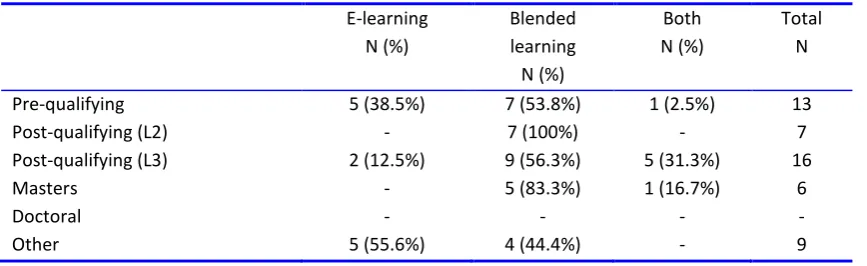
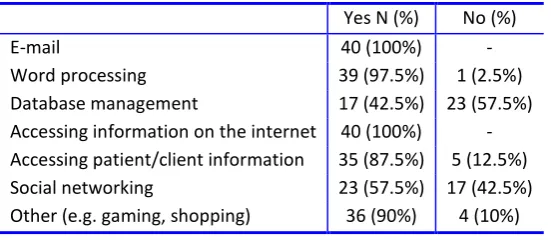
[image:28.595.84.518.358.491.2]All the respondents had some previous experience of on-line or blended learning (Table 3). Almost all had the use of a computer with internet access at home and at work (Table 4). All were already using computers for email and accessing information on the internet and the majority used computers for other additional purposes (Table 5).
Table 3 Previous e-learning experience
E-learning N (%)
Blended learning
N (%)
Both N (%)
Total N
Pre-qualifying 5 (38.5%) 7 (53.8%) 1 (2.5%) 13
Post-qualifying (L2) - 7 (100%) - 7
Post-qualifying (L3) 2 (12.5%) 9 (56.3%) 5 (31.3%) 16
Masters - 5 (83.3%) 1 (16.7%) 6
Doctoral - - - -
Other 5 (55.6%) 4 (44.4%) - 9
Table 4 Access to computers with internet
Table 5 Use of Computers
Yes N (%) No (%)
E-mail 40 (100%) -
Word processing 39 (97.5%) 1 (2.5%) Database management 17 (42.5%) 23 (57.5%) Accessing information on the internet 40 (100%) - Accessing patient/client information 35 (87.5%) 5 (12.5%) Social networking 23 (57.5%) 17 (42.5%) Other (e.g. gaming, shopping) 36 (90%) 4 (10%)
On-line materials
All the students stated they had accessed the on-line materials for the course they had studied at UWE during the 2007 to 2008 academic year. Thirty-nine (97.5%) had accessed these materials from home, 26 (65%) had accessed them from work, 17 (42.5%) had accessed them from the university, 11(27.5%) had accessed them from a library. One student had stated they had accessed the materials from another (unknown) on-line source.
[image:29.595.96.404.476.579.2]Students were asked to rate the on-line materials (Table 6). Only 10% did not find the quality and relevance of the material satisfactory. Eighty per cent found the ease of navigation and the interactivity of the learning materials to be satisfactory. The volume of on-line material available was rated as the least satisfactory with some respondents feeling there was too much material. However most (65%) of the respondents were satisfied with the amount of material available to them.
Table 6 Rating the on-line materials
Satisfactory N (%)
Unsatisfactory N (%)
Missing N (%) Ease of navigation around site 32 (80%) 8 (20%) - Interactivity of learning materials 32 (80%) 8 (20%) - Volume of material 26 (65%) 14 (35%) - Relevance of material 35 (87.5%) 4 (10%) 1 (2.5%) Quality of material 36 (90%) 4 (10%) -
Table 7 Factors that created difficulties that affected learning
Yes N (%)
No N (%)
Missing N (%) Unable to attend face-to-face session 10 (25%) 28 (70%) 2 (5%) Limited access to a computer 4 (10%) 34 (85%) 2 (5%) Unable to open on-line materials 23 (57.5%) 14 (35%) 3 (7.5%) No protected time 16 (40%) 21 (52.5%) 3 (7.5%) Limited IT skills 12 (30%) 27 (67.5%) 1 (2.5%) Lack of confidence in using computers 12 (30%) 26 (65%) 2 (5%) Dislike of electronic learning 17 (42.5%) 21 (52.5%) 2 (5%) Presentation of content not appropriate 7 (17.5%) 30 (75%) 3 (7.5) Limited ability to discuss material presented on-line 27 (67.5%) 13 (32.5%) - Reluctance to engage in on-line discussion 26 (65%) 12 (30%) 2 (5%)
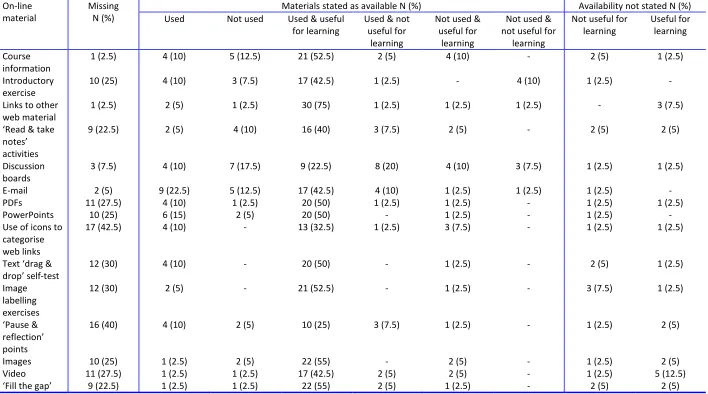
Respondents were provided with a list of possible resources and asked to indicate if they had used these or not and whether or not they were useful (Table 8). This was an ambitious and perhaps overly complex request, attempting to allow for various circumstances on different modules. It is likely that some of the students did not tick boxes in the way hoped for. The most popular resource was links to other web material. This was followed by multiple choice quizzes. Other resources seen as useful by 50% or more respondents were: course information; introductory exercise; Pdfs; Powerpoints; ‘drag and drop’ self tests; image labelling exercises; images; ‘fill the gap’ exercises; case-studies; self test questions with example answers. Six items scored below 50% but in some cases, the students may not have understood the reference. The lowest scoring item was discussion boards. Others with less than 50% were navigation; ‘pause and reflect’ points; ‘read and take notes’ activities, use of icons to categorise icons and email.
Face-to-face learning
Table 8 Availability of on-line materials and their usefulness
On-line material
Missing N (%)
Materials stated as available N (%) Availability not stated N (%) Used Not used Used & useful
for learning
Used & not useful for
learning
Not used & useful for
learning
Not used & not useful for
learning
Not useful for learning
Useful for learning
Course information
1 (2.5) 4 (10) 5 (12.5) 21 (52.5) 2 (5) 4 (10) - 2 (5) 1 (2.5)
Introductory exercise
10 (25) 4 (10) 3 (7.5) 17 (42.5) 1 (2.5) - 4 (10) 1 (2.5) -
Links to other web material
1 (2.5) 2 (5) 1 (2.5) 30 (75) 1 (2.5) 1 (2.5) 1 (2.5) - 3 (7.5)
‘Read & take notes’ activities
9 (22.5) 2 (5) 4 (10) 16 (40) 3 (7.5) 2 (5) - 2 (5) 2 (5)
Discussion boards
3 (7.5) 4 (10) 7 (17.5) 9 (22.5) 8 (20) 4 (10) 3 (7.5) 1 (2.5) 1 (2.5)
E-mail 2 (5) 9 (22.5) 5 (12.5) 17 (42.5) 4 (10) 1 (2.5) 1 (2.5) 1 (2.5) - PDFs 11 (27.5) 4 (10) 1 (2.5) 20 (50) 1 (2.5) 1 (2.5) - 1 (2.5) 1 (2.5)
PowerPoints 10 (25) 6 (15) 2 (5) 20 (50) - 1 (2.5) - 1 (2.5) -
Use of icons to categorise web links
17 (42.5) 4 (10) - 13 (32.5) 1 (2.5) 3 (7.5) - 1 (2.5) 1 (2.5)
Text ‘drag & drop’ self-test
12 (30) 4 (10) - 20 (50) - 1 (2.5) - 2 (5) 1 (2.5)
Image labelling exercises
12 (30) 2 (5) - 21 (52.5) - 1 (2.5) - 3 (7.5) 1 (2.5)
‘Pause & reflection’ points
16 (40) 4 (10) 2 (5) 10 (25) 3 (7.5) 1 (2.5) - 1 (2.5) 2 (5)
Images 10 (25) 1 (2.5) 2 (5) 22 (55) - 2 (5) - 1 (2.5) 2 (5)
On-line material
Missing N (%)
Materials stated as available N (%) Availability not stated N (%) Used Not used Used & useful
for learning
Used & not useful for
learning
Not used & useful for
learning
Not used & not useful for
learning
Not useful for learning
Useful for learning
exercises
Navigation 21 (52.5) 2 (5) 1 (2.5) 9 (22.5) 1 (2.5) 2 (5) 1 (2.5) 1 (2.5) 2 (5) Case studies 10 (25) 1 (2.5) 2 (5) 21 (52.5) 1 (2.5) 1 (2.5) - 1 (2.5) 3 (7.5) Multiple
choice quizzes
4 (10) - 4 (10) 25 (62.5) 1 (2.5) 1 (2.5) - 1 (2.5) 4 (10)
Self-test questions with example answers
Table 9 Available resources and their usefulness
On-line material
Missing N (%)
Resources stated as available N (%) Availability not stated N (%) Used Not used Used & useful
for learning
Used & not useful for
learning
Not used & useful for
learning
Not used & not useful for
learning
Not useful for learning
Useful for learning
Master classes 14 (35%) 1 (2.5) 1 (2.5) 20 (50) - 1 (2.5) - - 3 (7.5) Seminars 13 (32.5) 3 (7.5) 3 (7.5) 19 (47.5) 1 (2.5) 1 (2.5) - - - Networking 20 (50) 3 (7.5) 4 (10) 11 (27.5) - - 1 (2.5) 1 (2.5) - Clinical skills
networking
25 (62.5) 2 (5) 2 (5) 9 (22.5) 1 (2.5) - 1 (2.5) - -
Essays 9 (22.5) 3 (7.5) 1 (2.5) 22 (55) 2 (5) - - 1 (2.5) 2 (5)
Support
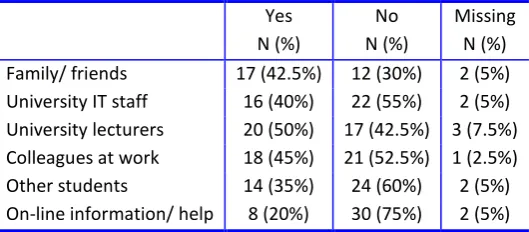
[image:34.595.87.352.191.307.2]Respondents stated help was received in accessing on-line materials from a range of individuals including families, friends, colleagues and academic staff. Least used was on-line help and information (Table 10):
Table 10 Help received in accessing on-line materials
Yes N (%)
No N (%)
Missing N (%) Family/ friends 17 (42.5%) 12 (30%) 2 (5%) University IT staff 16 (40%) 22 (55%) 2 (5%) University lecturers 20 (50%) 17 (42.5%) 3 (7.5%) Colleagues at work 18 (45%) 21 (52.5%) 1 (2.5%) Other students 14 (35%) 24 (60%) 2 (5%) On-line information/ help 8 (20%) 30 (75%) 2 (5%)
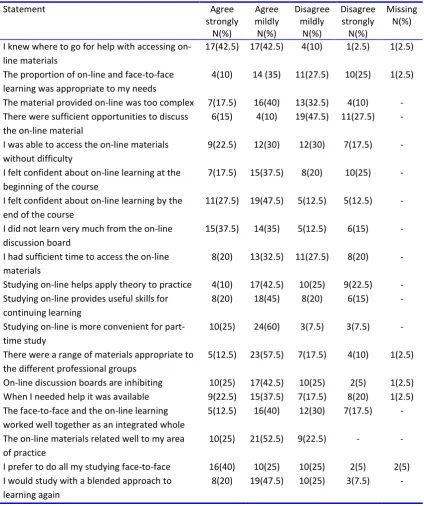
Respondents were asked whether they agreed or disagreed with a series of statements (Table 11). Fifty-five percent of respondents agreed that they felt confident about on-line learning at the beginning of the course; this had increased to 75% of respondents by the end of the course. Grouping together those who indicated strong or mild agreement, students were fairly evenly split in their assessment of their ability to access the on-line materials without difficulty; with 85% of the respondents stating they knew where to go for help in accessing on-line materials and 60% agreeing that when they needed help it was available.
Although 65% of the respondents felt they would prefer to do all their studying face-to-face, 67.5% agreed that they would study with a blended approach to learning again. Respondents were fairly evenly split in their assessment of the proportion of face-to-face to on-line learning, and whether there was sufficient time to access the on-line material. Respondents were fairly evenly split over whether or not studying on-line helped apply theory to practice, 65% agreed studying on-line provided useful skills for continuing learning. 85% agreed that studying on-line is more convenient for part-time study.
Table 11 Beliefs and perceptions about on-line learning
Statement Agree
strongly N(%) Agree mildly N(%) Disagree mildly N(%) Disagree strongly N(%) Missing N(%)
I knew where to go for help with accessing on-line materials
17(42.5) 17(42.5) 4(10) 1(2.5) 1(2.5)
The proportion of on-line and face-to-face learning was appropriate to my needs
4(10) 14 (35) 11(27.5) 10(25) 1(2.5)
The material provided on-line was too complex 7(17.5) 16(40) 13(32.5) 4(10) - There were sufficient opportunities to discuss
the on-line material
6(15) 4(10) 19(47.5) 11(27.5) -
I was able to access the on-line materials without difficulty
9(22.5) 12(30) 12(30) 7(17.5) -
I felt confident about on-line learning at the beginning of the course
7(17.5) 15(37.5) 8(20) 10(25) -
I felt confident about on-line learning by the end of the course
11(27.5) 19(47.5) 5(12.5) 5(12.5) -
I did not learn very much from the on-line discussion board
15(37.5) 14(35) 5(12.5) 6(15) -
I had sufficient time to access the on-line materials
8(20) 13(32.5) 11(27.5) 8(20) -
Studying on-line helps apply theory to practice 4(10) 17(42.5) 10(25) 9(22.5) - Studying on-line provides useful skills for
continuing learning
8(20) 18(45) 8(20) 6(15) -
Studying on-line is more convenient for part-time study
10(25) 24(60) 3(7.5) 3(7.5) -
There were a range of materials appropriate to the different professional groups
5(12.5) 23(57.5) 7(17.5) 4(10) 1(2.5)
On-line discussion boards are inhibiting 10(25) 17(42.5) 10(25) 2(5) 1(2.5) When I needed help it was available 9(22.5) 15(37.5) 7(17.5) 8(20) 1(2.5) The face-to-face and the on-line learning
worked well together as an integrated whole
5(12.5) 16(40) 12(30) 7(17.5) -
The on-line materials related well to my area of practice
10(25) 21(52.5) 9(22.5) - -
I prefer to do all my studying face-to-face 16(40) 10(25) 10(25) 2(5) 2(5) I would study with a blended approach to
learning again
Findings: The Student Interviews
Students who returned their questionnaires were asked to indicate whether or not they were willing to be interviewed by telephone. Of the 168 questionnaires sent out, 40 were returned. Of those, 25 students indicated that they were happy to be contacted by telephone for this purpose. Attempts were made to contact everyone who had given preliminary consent to take part but not all were available or contactable during the time period for the interviews. Seventeen students were interviewed during March-April 2009.
In the telephone interviews, the focus was not on ‘checking’ the information given by the respondents in the questionnaire, but on encouraging them to describe and explain their perceptions and experiences in more depth, and to give concrete examples wherever possible e.g. things that had acted as barriers to their learning, their likes and dislikes with regard to the on-line materials etc. An interview plan was used, which followed on from responses in the questionnaire and probed these responses. It also set out more generally the topics to be covered in the interviews so that similar information could be sought from all the respondents, thereby to ensure parity across the interviews.
The interviews were audio-taped and transcribed. A set of codes was drawn up and the transcribed interviews were coded using computer software for qualitiative analysis (NVivo 8). A set of descriptive accounts of the codes mapping the nature and range of the experiences reported was prepared. This was felt to be necessary so that all opinions could be noted and acknowledged. These accounts form the framework for this section of the report.
Characteristics of the respondents
The 17 respondents were all women. All but one of them were nurses. In terms of age group, one respondent was in the 18-25 range; five were 26-35; five were 36-45 and six were 46-55.
In information provided on the questionnaire, of the 17 respondents, four told us they had no previous experience of e- or blended learning; 11 described themselves as having limited experience and a further two described themselves as having extensive experience. On the questionnaire they were also asked to indicate how confident they were about blended learning at the beginning of the module. Of the 17, 11 felt confident and six did not feel confident.
Modules attended
The respondents had attended a wide range of the CPD blended learning modules available at UWE. These included:
• Foundations of Acute, Critical and Emergency Care (10 of the 17 respondents
had attended this module)
• Managing Long-Term conditions (four respondents)
• Principles of Critical Care (four respondents)
• Principles of Cardiac Care (three respondents)
• Principles of Emergency Care (three respondents)
• Principles of Neurosciences for Health (one respondent)
Nine out of the 17 respondents had enrol