4-Chloro-
N
-(2-chlorophenyl)benzamide
Aamer Saeed,a* Rasheed Ahmad Khera,aKazuma Gotohb and Hiroyuki Ishidab
a
Department of Chemistry, Quaid-I-Azam University, Islamabad 45320, Pakistan, andbDepartment of Chemistry, Faculty of Science, Okayama University, Okayama 700-8530, Japan
Correspondence e-mail: [email protected]
Received 19 August 2008; accepted 9 September 2008
Key indicators: single-crystal X-ray study;T= 223 K; mean(C–C) = 0.003 A˚; Rfactor = 0.052;wRfactor = 0.155; data-to-parameter ratio = 22.3.
In the molecular structure of the title compound, C13H9Cl2NO,
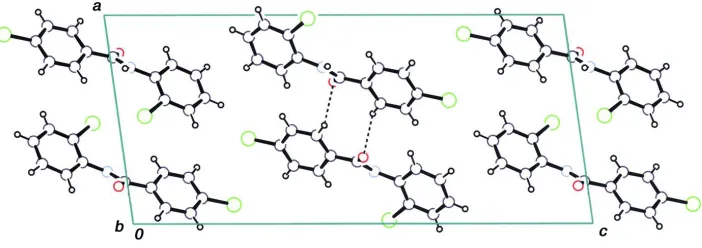
the amide N—C O plane makes dihedral angles of 31.53 (8) and 36.23 (8), respectively, with the 4-chloro- and 2-chloro-phenyl rings. The dihedral angle between the two benzene rings is 6.25 (8). The molecules are stacked in columns along thebaxis through intermolecular N—H O hydrogen bonds. The columns are further connected by weak C—H O hydrogen bonds. The compound is not isomorphous with the fluoro analogue.
Related literature
For general background, see: Capdevilleet al.(2002); Chopra & Row (2005); Hoet al.(2002); Igawaet al.(1999); Jacksonet al. (1994); Makino et al. (2003); Zhichkin et al. (2007). For related structures, see: Chopra & Row (2005).
Experimental
Crystal data
C13H9Cl2NO Mr= 266.13
Monoclinic,P21=n a= 10.7913 (14) A˚
b= 4.8078 (6) A˚ c= 23.570 (3) A˚
= 97.718 (3)
V= 1211.8 (3) A˚3 Z= 4
Mo-Kradiation
= 0.52 mm1 T= 223 (1) K 0.350.310.05 mm
Data collection
Rigaku R-AXIS RAPID II diffractometer
Absorption correction: multi-scan (ABSCOR; Higashi, 1995) Tmin= 0.884,Tmax= 0.975
14924 measured reflections 3527 independent reflections 1847 reflections withI> 2(I) Rint= 0.042
Refinement
R[F2> 2(F2)] = 0.051 wR(F2) = 0.154 S= 1.00 3527 reflections 158 parameters
H atoms treated by a mixture of independent and constrained refinement
max= 0.23 e A˚
3 min=0.39 e A˚
3
Table 1
Hydrogen-bond geometry (A˚ ,).
D—H A D—H H A D A D—H A
N1—H1 O1i 0.85 (2) 2.12 (2) 2.901 (2) 154 (2) C2—H2 O1ii
0.94 2.59 3.456 (3) 153
Symmetry codes: (i)x;y1;z; (ii)xþ1;yþ2;zþ1.
Data collection: PROCESS-AUTO (Rigaku/MSC, 2004); cell refinement: PROCESS-AUTO; data reduction: CrystalStructure
(Rigaku/MSC, 2004); program(s) used to solve structure:SHELXS97
(Sheldrick, 2008); program(s) used to refine structure:SHELXL97
(Sheldrick, 2008); molecular graphics: ORTEP-3 (Farrugia, 1997); software used to prepare material for publication:CrystalStructure
andPLATON(Spek, 2003).
AS gratefully acknowledges a research grant from Quaid-I-Azam University, Islamabad.
Supplementary data and figures for this paper are available from the IUCr electronic archives (Reference: BH2189).
References
Capdeville, R., Buchdunger, E., Zimmermann, J. & Matter, A. (2002).Nat. Rev. Drug Discov.1, 493–502.
Chopra, D. & Row, T. N. G. (2005).Cryst. Growth Des.5, 1679–1681. Farrugia, L. J. (1997).J. Appl. Cryst.30, 565.
Higashi, T. (1995).ABSCOR. Rigaku Corporation, Tokyo, Japan.
Ho, T.-I., Chen, W.-S., Hsu, C.-W., Tsai, Y.-M. & Fang, J.-M. (2002). Heterocycles,57, 1501–1506.
Igawa, H., Nishimura, M., Okada, K. & Nakamura, T. (1999). Jpn Patent Kokai Tokkyo Koho. JP 11 171 848.
Jackson, S., DeGrado, W., Dwivedi, A., Parthasarathy, A., Higley, A., Krywko, J., Rockwell, A., Markwalder, J., Wells, G., Wexler, R., Mousa, S. & Harlow, R. (1994).J. Am. Chem. Soc.116, 3220–3230.
Makino, S., Nakanishi, E. & Tsuji, T. (2003).Bull. Korean Chem. Soc.24, 389– 392.
Rigaku/MSC (2004).CrystalStructureandPROCESS-AUTO. Rigaku/MSC, The Woodlands, Texas, USA.
Sheldrick, G. M. (2008).Acta Cryst.A64, 112–122. Spek, A. L. (2003).J. Appl. Cryst.36, 7–13.
Zhichkin, P., Kesicki, E., Treiberg, J., Bourdon, L., Ronsheim, M., Ooi, H. C., White, S., Judkins, A. & Fairfax, D. (2007).Org. Lett.9, 1415–1418. Acta Crystallographica Section E
Structure Reports
Online
supporting information
Acta Cryst. (2008). E64, o1934 [doi:10.1107/S1600536808028882]
4-Chloro-
N
-(2-chlorophenyl)benzamide
Aamer Saeed, Rasheed Ahmad Khera, Kazuma Gotoh and Hiroyuki Ishida
S1. Comment
The benzanilide core is present in compounds with a wide range of biological activities, and for this reason it has been
called a privileged structure. Benzanilides serve as intermediates towards benzothiadiazin-4-ones (Makino et al., 2003),
benzodiazepine-2,5-diones (Ho et al., 2002), and 2,3-disubstituted 3H-quinazoline-4-ones (Zhichkin et al., 2007).
Benzanilides have established their efficacy as centroid elements of ligands that bind to a wide variety of receptor types.
Thus, benzanilides containing aminoalkyl groups originally designed as peptidomimetic compounds, have been
incorporated in an Arg-Gly-Asp cyclic peptide, yielding a high affinity GPIIb/IIIa ligand (Jackson et al., 1994). Imatinib
is an ATP-site binding kinase inhibitor and platelet-derived growth factor receptor kinase (Capdeville et al., 2002).
Benzamides have activities as acetyl-CoA carboxylase and farnesyl transferase inhibitors (Igawa et al., 1999).
In the crystal structure of the title compound (Fig. 1), the molecules are stacked in columns along the b cell-axis through
intermolecular N—H···O hydrogen bonds (Table 1). The columns are also connected by weak C—H···O hydrogen bonds
(Fig. 2). No significant π–π interactions are observed in the columns. The title compound is not isomorphous with the F
analogue compound, 4-fluoro-N-(2-fluorophenyl)-benzamide, which exhibits a dimorphic behaviour, with
non-centrosymmetric space groups P21 and Pca21 (Chopra & Row, 2005). The different crystal structures of the F analogue
are probably originated from the intermolecular C—H···F interactions.
S2. Experimental
4-Chorobenzoyl chloride (5.4 mmol) in CHCl3 was treated with 2-chloroaniline (21.6 mmol) under a nitrogen atmosphere
at reflux for 4 h. Upon cooling, the reaction mixture was diluted with CHCl3 and washed consecutively with aq. 1 M HCl
and saturated aq. NaHCO3. The organic layer was dried over anhydrous sodium sulfate and concentrated under reduced
pressure. Crystallization of the residue in CHCl3 afforded the title compound (84%). Anal. calcd. for C13H9Cl2NO: C
58.67, H 3.41, N 5.26%; found: C 58.23, H 3.46, N 5.08%.
S3. Refinement
The N-bound H atom was located in a difference map and refined freely. Other H atoms were positioned geometrically (C
Figure 1
The molecular structure of the title compound. The displacement ellipsoids are drawn at the 40% probability level.
Figure 2
Crystal packing, viewed along the b axis. Intermolecular C—H···O hydrogen bonds are shown as dashed lines.
4-Chloro-N-(2-chlorophenyl)benzamide
Crystal data
C13H9Cl2NO
Mr = 266.13 Monoclinic, P21/n
Hall symbol: -P 2yn
a = 10.7913 (14) Å
b = 4.8078 (6) Å
c = 23.570 (3) Å
β = 97.718 (3)°
V = 1211.8 (3) Å3
Z = 4
F(000) = 544.00
Dx = 1.459 Mg m−3
Mo Kα radiation, λ = 0.71075 Å Cell parameters from 8924 reflections
θ = 3.0–30.0°
µ = 0.52 mm−1
T = 223 K Plate, colourless 0.35 × 0.31 × 0.05 mm
Data collection
Rigaku R-AXIS RAPID II diffractometer
Detector resolution: 10.00 pixels mm-1
ω scans
Absorption correction: multi-scan
(ABSCOR; Higashi, 1995)
Tmin = 0.884, Tmax = 0.975
14924 measured reflections 3527 independent reflections 1847 reflections with I > 2σ(I)
Rint = 0.042
[image:3.610.131.482.289.413.2]h = −15→15
k = −6→6
l = −31→33
Refinement
Refinement on F2
Least-squares matrix: full
R[F2 > 2σ(F2)] = 0.051
wR(F2) = 0.154
S = 1.00 3527 reflections 158 parameters 0 restraints
0 constraints
H atoms treated by a mixture of independent and constrained refinement
w = 1/[σ2(F
o2) + (0.079P)2]
where P = (Fo2 + 2Fc2)/3
(Δ/σ)max < 0.001
Δρmax = 0.23 e Å−3
Δρmin = −0.39 e Å−3
Fractional atomic coordinates and isotropic or equivalent isotropic displacement parameters (Å2)
x y z Uiso*/Ueq
Cl1 0.01681 (5) 0.18996 (11) 0.55784 (3) 0.0701 (2)
Cl2 0.40856 (8) 0.29994 (18) 0.27592 (3) 0.1044 (3)
O1 0.31900 (14) 0.9176 (3) 0.52035 (6) 0.0704 (4)
N1 0.24949 (15) 0.4883 (3) 0.54060 (7) 0.0533 (4)
H1 0.246 (2) 0.321 (5) 0.5293 (10) 0.074 (7)*
C1 0.32607 (17) 0.5666 (4) 0.45021 (8) 0.0523 (4)
C2 0.4236 (2) 0.6900 (4) 0.42566 (10) 0.0650 (6)
H2 0.4721 0.8303 0.4456 0.078*
C3 0.4487 (2) 0.6070 (5) 0.37257 (11) 0.0725 (6)
H3 0.5152 0.6882 0.3565 0.087*
C4 0.3765 (2) 0.4053 (5) 0.34303 (10) 0.0695 (6)
C5 0.2787 (2) 0.2815 (5) 0.36606 (10) 0.0680 (6)
H5 0.2295 0.1444 0.3454 0.082*
C6 0.25440 (19) 0.3623 (4) 0.41982 (9) 0.0599 (5)
H6 0.1887 0.2780 0.4359 0.072*
C7 0.29897 (17) 0.6734 (3) 0.50645 (9) 0.0528 (5)
C8 0.20311 (18) 0.5546 (4) 0.59237 (8) 0.0531 (4)
C9 0.09424 (19) 0.4263 (4) 0.60525 (8) 0.0554 (5)
C10 0.0457 (2) 0.4875 (5) 0.65537 (9) 0.0727 (6)
H10 −0.0267 0.3965 0.6639 0.087*
C11 0.1041 (3) 0.6823 (6) 0.69252 (11) 0.0870 (8)
H11 0.0701 0.7295 0.7259 0.104*
C12 0.2115 (3) 0.8069 (5) 0.68088 (11) 0.0833 (8)
H12 0.2517 0.9368 0.7069 0.100*
C13 0.2623 (2) 0.7451 (4) 0.63118 (10) 0.0694 (6)
H13 0.3366 0.8322 0.6239 0.083*
Atomic displacement parameters (Å2)
U11 U22 U33 U12 U13 U23
C1 0.0492 (11) 0.0427 (9) 0.0664 (12) 0.0048 (8) 0.0125 (9) 0.0010 (8) C2 0.0556 (12) 0.0544 (11) 0.0883 (16) −0.0030 (9) 0.0215 (11) −0.0019 (10) C3 0.0654 (14) 0.0695 (13) 0.0890 (16) 0.0007 (11) 0.0333 (12) 0.0051 (12) C4 0.0710 (14) 0.0737 (14) 0.0667 (13) 0.0155 (11) 0.0193 (11) 0.0037 (11) C5 0.0673 (14) 0.0718 (13) 0.0649 (14) −0.0011 (11) 0.0085 (10) −0.0083 (10) C6 0.0560 (12) 0.0605 (11) 0.0647 (12) −0.0051 (9) 0.0137 (9) −0.0010 (9) C7 0.0468 (10) 0.0411 (9) 0.0714 (12) 0.0028 (7) 0.0114 (9) −0.0016 (8) C8 0.0581 (11) 0.0459 (9) 0.0546 (11) 0.0081 (8) 0.0050 (8) −0.0026 (8) C9 0.0584 (12) 0.0542 (10) 0.0536 (10) 0.0086 (9) 0.0078 (9) 0.0019 (9) C10 0.0785 (15) 0.0826 (14) 0.0596 (12) 0.0170 (12) 0.0185 (11) 0.0073 (12) C11 0.111 (2) 0.0959 (19) 0.0554 (14) 0.0370 (17) 0.0142 (14) −0.0010 (13) C12 0.105 (2) 0.0804 (16) 0.0593 (14) 0.0151 (15) −0.0073 (13) −0.0202 (11) C13 0.0756 (15) 0.0632 (12) 0.0665 (14) 0.0028 (11) −0.0010 (11) −0.0106 (10)
Geometric parameters (Å, º)
Cl1—C9 1.729 (2) C5—C6 1.384 (3)
Cl2—C4 1.739 (2) C5—H5 0.9400
O1—C7 1.230 (2) C6—H6 0.9400
N1—C7 1.357 (2) C8—C13 1.388 (3)
N1—C8 1.416 (2) C8—C9 1.396 (3)
N1—H1 0.84 (2) C9—C10 1.387 (3)
C1—C6 1.388 (3) C10—C11 1.376 (4)
C1—C2 1.399 (3) C10—H10 0.9400
C1—C7 1.487 (3) C11—C12 1.364 (4)
C2—C3 1.375 (3) C11—H11 0.9400
C2—H2 0.9400 C12—C13 1.391 (3)
C3—C4 1.373 (3) C12—H12 0.9400
C3—H3 0.9400 C13—H13 0.9400
C4—C5 1.384 (3)
C7—N1—C8 125.20 (16) O1—C7—N1 122.49 (18)
C7—N1—H1 116.3 (16) O1—C7—C1 121.24 (16)
C8—N1—H1 118.4 (16) N1—C7—C1 116.26 (16)
C6—C1—C2 118.98 (18) C13—C8—C9 118.34 (19)
C6—C1—C7 122.80 (16) C13—C8—N1 122.11 (19)
C2—C1—C7 118.10 (18) C9—C8—N1 119.55 (17)
C3—C2—C1 120.3 (2) C10—C9—C8 121.1 (2)
C3—C2—H2 119.8 C10—C9—Cl1 119.00 (17)
C1—C2—H2 119.8 C8—C9—Cl1 119.86 (15)
C4—C3—C2 119.9 (2) C11—C10—C9 119.5 (2)
C4—C3—H3 120.0 C11—C10—H10 120.2
C2—C3—H3 120.0 C9—C10—H10 120.2
C3—C4—C5 121.0 (2) C12—C11—C10 120.0 (2)
C3—C4—Cl2 119.89 (18) C12—C11—H11 120.0
C5—C4—Cl2 119.1 (2) C10—C11—H11 120.0
C6—C5—C4 119.1 (2) C11—C12—C13 121.2 (2)
C4—C5—H5 120.4 C13—C12—H12 119.4
C5—C6—C1 120.66 (19) C8—C13—C12 119.8 (2)
C5—C6—H6 119.7 C8—C13—H13 120.1
C1—C6—H6 119.7 C12—C13—H13 120.1
C6—C1—C2—C3 −0.8 (3) C2—C1—C7—N1 −151.15 (18)
C7—C1—C2—C3 −177.11 (19) C7—N1—C8—C13 −39.9 (3)
C1—C2—C3—C4 1.1 (3) C7—N1—C8—C9 140.0 (2)
C2—C3—C4—C5 −0.5 (3) C13—C8—C9—C10 0.3 (3)
C2—C3—C4—Cl2 −179.88 (18) N1—C8—C9—C10 −179.58 (17)
C3—C4—C5—C6 −0.4 (3) C13—C8—C9—Cl1 179.47 (15)
Cl2—C4—C5—C6 179.04 (17) N1—C8—C9—Cl1 −0.4 (2)
C4—C5—C6—C1 0.6 (3) C8—C9—C10—C11 1.4 (3)
C2—C1—C6—C5 0.0 (3) Cl1—C9—C10—C11 −177.82 (17)
C7—C1—C6—C5 176.07 (19) C9—C10—C11—C12 −2.2 (4)
C8—N1—C7—O1 7.0 (3) C10—C11—C12—C13 1.4 (4)
C8—N1—C7—C1 −171.95 (16) C9—C8—C13—C12 −1.1 (3)
C6—C1—C7—O1 −146.2 (2) N1—C8—C13—C12 178.72 (19)
C2—C1—C7—O1 29.9 (3) C11—C12—C13—C8 0.3 (4)
C6—C1—C7—N1 32.7 (3)
Hydrogen-bond geometry (Å, º)
D—H···A D—H H···A D···A D—H···A
N1—H1···O1i 0.85 (2) 2.12 (2) 2.901 (2) 154 (2)
C2—H2···O1ii 0.94 2.59 3.456 (3) 153
C13—H13···O1 0.94 2.46 2.884 (3) 108