Diagnosing Student Errors in e-Assessment
Questions
Philip Walker†
, D. Rhys Gwynllyw
‡ and Karen L. Henderson∗‡
†School of Mathematics, University of Leeds, Leeds, LS2 9JT, United Kingdom ‡Department of Engineering Design and Mathematics, University of the West of England,
Bristol, BS16 1QY, United Kingdom
∗Email: [email protected]
We demonstrate how the re-marker and reporter facility of the DEWIS e-Assessment system facilitates the capture, analysis and reporting of student errors using two case studies: logarithms and indices for first-year computing students at the Uni-versity of the West of England, and Sturm-Liouville problems for second-year math-ematics students at Leeds University. The differences in approach needed for error capture for commonly-used numerical or algebraic answer inputs are discussed and are shown to facilitate efficient capture and reporting of student errors. Not only does such information provide a way to tailor question feedback to address these errors for use by future students, but can be made available to current students by re-marking their answers using the newly-identified errors and hence making the improved feedback available to them too.
1
Introduction
Using e-Assessment for formative and summative means has become standard practice in many University mathematics departments (Sangwin, 2013). This is due in part to academics having access to open-source algorithmic e-Assessment systems, such as STACK (Sangwin, 2004), Num-bas (Foster, Perfect and Youd, 2012), DEWIS (Gwynllyw and Henderson, 2009) and Math e.g. (Greenhow and Kamavi, 2012) and also due to the many advantages that e-Assessment affords, such as providing students with instant feedback in a time-efficient manner. A fuller review of the benefits of e-Assessment can be found in Bull and McKenna (2003) and Robinson, Hernandez-Martinez and Broughton (2012).
The e-Assessment systems listed above have the capacity to give a fully worked through solution to the question asked. Greenhow and Gill (2008) found that students learn from e-Assessment feedback, using it to perfect their technical knowledge and there is evidence that students find the availability of practice tests to be one of the most useful study resources which supports their learning (McCabe, 2009). However, one of the potential barriers to the uptake of such systems by lecturers is the perceived lack of individualised feedback (Broughton, Robinson and Hernandez-Martinez, 2013).
A mal-rule is an understandable but incorrect implementation of a process resulting from a student’s misconception (Rees and Barr, 1984). For example a student answering a2+b2 when
and classifyingstudent errorswas time-consuming and concluded that the frequency of mal-rules is extremely skewed. Gill and Greenhow (2007) examined several years’ worth of paper-based exam scripts in order to discover mal-rules used on mechanics questions and attempted to characterise them with metadata. They subsequently created multiple-choice e-Assessment questions (MCQs) covering this material. For these questions the mal-rules found previously were used to create distractors and tailored feedback was provided if a particular distractor is chosen by the student. Jordan (2007) analysed student answers to interactive online assessment questions taken by science students in order to gain insight on their mathematical misconceptions. This information was used to improve the questions for subsequent years giving targeted feedback in response to commonly incorrect responses.
A key advantage to capturing and reporting mal-rules within an e-Assessment is that the e-Assessment is able to simulate the human marker. However by providing full and excellent feedback, e-Assessment outstrips the efficacy of a human by providing instant feedback that is precisely tailored and can have links to other backup material too. Also by examining which particular mal-rules have been triggered by a cohort of students, in an easy to read format, the academic is in a position to tailor future classes to address any misconceptions that have arisen. For e-Assessment systems which have the capacity to store all data from students’ assessment attempts, there is a wealth of post-assessment information available which may be analysed. The focus of this paper is to illustrate how the re-marker and reporter facility of the DEWIS e-Assessment system facilitates the diagnosing of student errors. In particular we focus on two e-Assessments run at different institutions involving numeric and algebraic inputs. These are two common type of inputs used for mathematical e-Assessment questions, and the difference in approaches needed for analysing mal-rules in each type of input is described. An advantage of working with questions that require a free-form student answer, as opposed to using MCQs, is that it doesn’t presuppose all the mistakes that students may make.
2
Methodology
The e-Assessments were run using DEWIS, a fully algorithmic open-source e-Assessment system, which was designed and developed at UWE. It was primarily designed for numerate e-assessments and is currently used in the fields of Business, Computer Science, Nursing, Engineering and Math-ematics (Gwynllyw and Henderson, 2009; Gwynllyw and Henderson, 2012). The DEWIS system is data-lossless, that is, all data relating to every assessment attempt is recorded on the server. The DEWIS system, via its reporter feature, facilitates a detailed analysis of every e-Assessment run. The analysis of an e-Assessment is much more than the simplistic approach of analysing student’s marks. For example, the analysis includes the use of performance indicators (PIs) to identify the triggering of mal-rules. The analysis also includes a search mechanism to identify pre-viously unanticipated student errors. Such ‘new’ mal-rules can be fed back into the e-Assessment’s marking and feedback schemes for detection and reporting. Not only will future students benefit from this updated feedback but it will also benefit current students; using the data-lossless feature, the updated feedback can easily be applied retrospectively to past assessments.
examine wrong answers submitted by a student and where possible to determine the mal-rule that may have been used to achieve this wrong answer. By coding this candidatestudent errorinto the question and retrospectively re-marking all the submissions it is possible to see how many students triggered the same mistake. Having identified a new mal-rule, the feedback to the question was amended to provide detailed, tailored feedback in this situation. This process may be repeated until all the incorrect responses are exhausted.
The educational benefits to being able to efficiently capture and reportspecific errors to stu-dents and staff are threefold
• this information may be used to improve the questions by providing enhanced, tailored feedback which will benefit future students taking the e-Assessment;
• through the use of the rmarking facility current students, who have already tried the e-Assessment, may access this new improved feedback by viewing details of their previous attempts;
• by looking at the results for a particular cohort, the academic is able to see which areas of the syllabus need more emphasis in lectures.
3
Case Study 1
In this section we shall illustrate how DEWIS facilitates the diagnosing of student errorsfor an e-Assessment given to a cohort of first year computing students at UWE. The e-e-Assessment content was on the general topic of indices and logarithms. The material covered in this e-Assessment was not formally taught in the award but was part of a directed reading assignment. For a period of two weeks the students were given access to the e-Assessment in formative mode as part of the learning process. After this period, students were allowed two attempts in summative mode. Full feedback was provided at the end of each e-Assessment attempt for both delivery modes.
The e-Assessment contained eight questions and we will concentrate on the analysis of data for just the last question asked in this assessment. In formative mode, students were allowed up to a maximum of five attempts. In all, there were 329 submissions from 110 distinct students and 81 responses for this question were incorrect. In the following discussion, we shall include snap-shots of displays provided by the reporter facility on DEWIS. Note that the student identities in these displays have been anonymised.
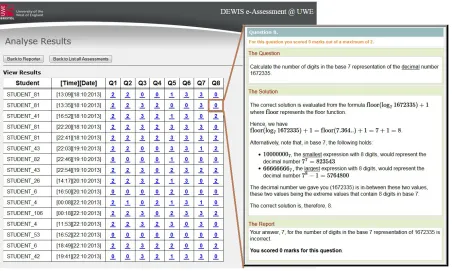
Figure 1 shows the Reporter output regarding the marks awarded per question for the e-Assessment. Each one of the marks is also a hyperlink. On clicking the link the academic can view the actual instance of the question that was asked, together with the result of the marking and feedback process for that particular question.
Students may view all their previous assessment attempts, with the resulting view being similar to that shown in the pop-up box in Figure 1. One significant disadvantage of displaying the results in the form shown in Figure 1 is that it is not possible for the academic, without clicking on each question link, to view why a student, or a student cohort, has scored specific marks. For example by viewing all the data corresponding to Figure 1, we would only see that a significant proportion of students obtained zero marks for Question 8. However, from this we cannot see whether the students obtained zero by not answering the question or by answering the question incorrectly. This further analysis could be performed by clicking on each ‘zero’ link but this would be cumbersome.
Figure 1: Data from the first sixteen e-Assessment submissions, showing the marks awarded per question. Each mark is a hyperlink to the actual instance of the question asked together with the marking and feedback information, as displayed on the right for Question 8.
standard PI contains, at least, a simple indication of whether the student’s answer was correct, incorrect or not answered. Additional PIs can easily be created by the question author to supply more information about the performance of the student’s answer. For example additional PIs can be used to indicate whether particular mal-rules were triggered in the marking process.
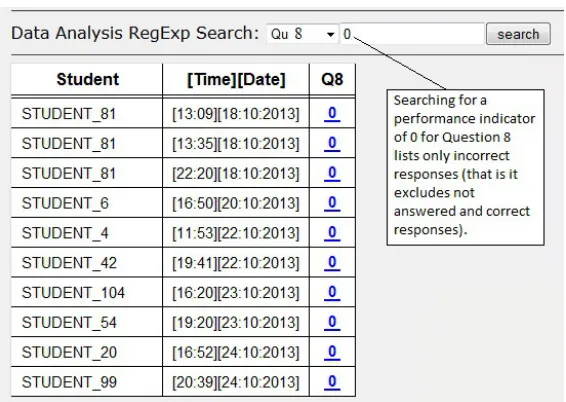
For the specific question being analysed here, which requires an integer answer, the standard PI takes one of the following values: 1 (correct), 0 (incorrect), -1 (not answered). The DEWIS reporter supports a regular expression search mechanism which allows the academic to display student attempts that satisfy a particular PI criteria. Figure 2 illustrates the resulting screen output for the PIs where we have included the search criteria of only including the assessments for which the performance flag for Question 8 has a value of zero. This corresponds to listing only the assessments for which an incorrect answer was supplied for Question 8, thus ignoring the correct and not-answered responses. The displaying of PIs together with the search/filter facility facilitates the process of analysing why a student has answered a question incorrectly.
Figure 2: Display of the performance indicator data for Question 8, filtered to show incorrect responses only (not all data shown).
For the 2013/14 academic year, Question 8 was presented to the student without any mal-rule detection. From the Questionpart of Figure 1, we can see that the question asks the student for thenumber of digitsin the base brepresentation of a decimal numbern. In this instance the base is seven, the decimal number is 1672335 and the correct answer is 8. The value of n is chosen randomly to be a number containing between four and ten decimal digits. The value of base bis chosen to be between 3 and 9 but excluding 8 (the octal base). One intention of this question was for students to be able to evaluate the answer efficiently; a valid exercise for computing students. Even in the case of b = 3, the answer to the question is not a big integer. However, it was initially surprising to note that some students were entering answers which were significantly larger than the correct answer, and thus misunderstanding what the question was asking for. This led us to suspect that the students were not reading and/or understanding the question correctly and that they may instead be entering the basebrepresentation ofn. It would have been inefficient for us to manually trawl through all the incorrect answers checking for this proposed mal-rule. One powerful feature of DEWIS is that we can alter the question code and mark retrospectively. In order to detect whether any students performed this incorrect base conversion, an additional PI was programmed into Question 8 which took the values shown in Table 1.
1 The student entered the base b representation ofn. 0 Else.
Table 1: Values and explanations of the second performance indicator for Question 8.
3.1 Outcomes from the analysis
of Figure 3. It is interesting to note that the same student made this mistake on three occasions and it is hoped that this would not occur in future years due to students having access to the enhanced feedback immediately after submission.
Figure 3: Display of the performance indicator data for question 8, filtered to show the second PI taking a value of 1. The right-hand side shows the proposed enhanced feedback supplied in this case, note that the worked solution has been omitted for brevity.
Further investigation revealed that two students had evaluated the base 10 representation of
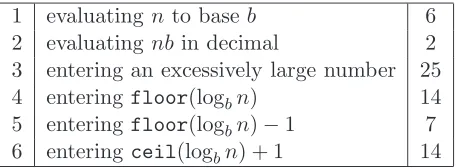
nb. For the remaining 25 attempts that entered an excessive number of digits, it was not possible to determine exactly what mistake the student had made. Some may have attempted to evaluate the decimalnto basebbut simply failed in their attempt. A complete list of the mal-rules detected for this question is illustrated in Table 2. It was not possible to explain the mistake in 13 of the 81 incorrect attempts.
Including mal-rule detection has very little additional computational overhead, hence, for future uses of this question, we will search for the mal-rules listed in Table 2 with any specific error detection being reflected in enhanced feedback provided to the student.
1 evaluating nto base b 6 2 evaluating nbin decimal 2 3 entering an excessively large number 25 4 enteringfloor(logbn) 14 5 enteringfloor(logbn)−1 7 6 enteringceil(logbn) + 1 14
Table 2: Mal-rule analysis for Question 8: performance indicator flags, descriptions and counts.
4
Case Study 2
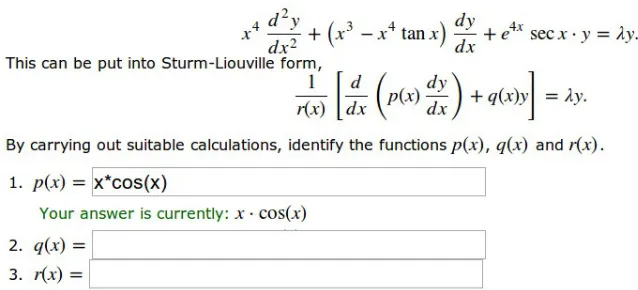
[image:6.612.75.305.511.595.2]Figure 4: A realisation of the Sturm-Liouville question asked, with the answer for p(x) filled in by the user, for illustration purposes.
p, q and r, and using the functions so generated to construct a differential equation of the form
a(x)ddx2y2 +b(x) dy
dx+c(x)y=λy. A realisation of the question is shown in Figure 4.
The question was run as a live assessment during the module, and then re-opened as an opportunity for practice during the revision period. In the 2013/14 academic year, there were 563 student attempts, of which 197 attempts had input which was marked as algebraically valid: that is, the expression entered was a well-formed function but incorrect.
Algebraic student function input is one of the more complicated forms of input an e-assessment system is required to handle, and provides some of the greatest scope for student errors to arise. It is therefore beneficial to provide students with feedback that relates directly to the answers they have given and identifies potential sources of error. The DEWIS e-assessment system is able to mark a student inputted algebraic entry explicitly against a test function in order to determine whether the two match. The most obvious use of this facility is to mark the student answer against the correct answer; however, it can also be used to mark against potential mal-rules.
For the case of a question requiring one algebraic input, the marking algorithm that incorporates mal-rule detection will consist of three inputs: the student’s answer, the correct answer and a lookup-table containing a list of mal-rules. Both the correct answer and the lookup-table are dependent on the question parameters which construct the question. Without mal-rule detection there is only one performance indicator (PI) associated with the marking process, in which case the student input is simply compared to the correct answer. In this case the PI can take any one of four integer values as shown in Table 3.
1 when the two functions match
0 when the two functions do not match -1 when the question is not answered
-2 when the student answer is not a well-formed function
Table 3: Standard PI values for algebraic inputs
lookup-table, resulting in a string of PIs which can be easily viewed in the DEWIS Reporter. In the question being analysed here, there are three inputs, and an error could potentially affect anywhere between one and all three inputs. As a consequence, the data structures used in the actual marking and mal-rule detection code were more complicated than described above. In particular, the lookup table containing mal-rule answers contained a key and an array with its effect on each of the three inputs in turn.
Prior to running the algorithm on the data, four potential student errors were identified by thinking about the structure of the question, and another four were identified by inspecting a few student attempts. Not all student attempts could be explained, as some of them were validchatter (such as “0,0,0” or “x,x,x”) supplied, presumably, in order to receive feedback which took the form of a fully worked solution to the question.
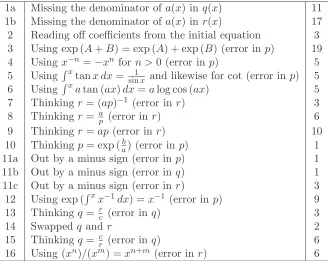
[image:8.612.79.407.316.577.2]After running the algorithm, some of the remaining unexplained answers were inspected in order to glean new mal-rules; these mal-rules were then coded into the system and the algorithm re-run. This process continued for some 16 iterations. By this point, after amalgamating equivalent errors, the lookup table contained 19 separate potential sources of error divided into 16 categories. Table 4 gives the mal-rules flags used, together with a description of each and a count of the number of occurrences.
1a Missing the denominator ofa(x) in q(x) 11 1b Missing the denominator ofa(x) in r(x) 17 2 Reading off coefficients from the initial equation 3 3 Using exp (A+B) = exp (A) + exp (B) (error in p) 19 4 Usingx−n=
−xn forn >0 (error inp) 5
5 UsingRxtanx dx= sin1x and likewise for cot (error in p) 5 6 UsingRxatan (ax)dx=alog cos (ax) 5 7 Thinkingr= (ap)−1 (error inr) 3
8 Thinkingr= a
p (error in r) 6
9 Thinkingr=ap(error in r) 10 10 Thinkingp= exp (b
a) (error in p) 1
11a Out by a minus sign (error inp) 1 11b Out by a minus sign (error inq) 1 11c Out by a minus sign (error inr) 3 12 Using exp (Rxx−1dx) =x−1 (error in p) 9 13 Thinkingq= rc (error inq) 3
14 Swappedq and r 2
15 Thinkingq= rc (error inq) 6 16 Using (xn)/(xm) =xn+m (error inr) 6
Table 4: Mal-rule analysis for the Sturm-Liouville question: performance indicator flags, descriptions and counts. Data drawn from 87 student attempts.
also simplifies greatly the algorithm for mal-rule detection since it separates identification of errors from propagation of errors.
The conclusion of the iterations detailed above was that of 197 incorrect attempts, 87 were explained by the various rules identified above, and a further 42 had some other, unidentified error which continued through the student answer.
The feedback to the student, which initially consisted of a worked solution, has been improved by the addition of a section which appears if the student’s answers trigger one of the flags. For example, flag 13 raises the prompt, “You might have thought that q(x) = rc((xx)). In fact, q(x) =
c(x)r(x).” The feedback was constructed with a separate lookup table containing prompts that relate to each mal-rule discovered, allowing relevant feedback to be displayed to the student. Follow-on performance indicator flags can be used similarly.
4.1 Outcomes from the analysis
A proportion of students’ attempts included more than one error or potential error: at least 24 student attempts raised more than one flag, although this is undoubtedly an underestimate of the number of combined errors since the algorithm can detect at most one error per input. This is an area which requires mathematical study as well as technical development, since a calculation contains several steps, and interchanging steps or introducing errors at different stages in different orders could easily result in different final answers.
One of the key features to arise from the analysis of the student data was the occurrence of errors due to relatively basic mathematical mistakes, also reported by Jordan (2007). Errors in integration and common identities involving exponential indices were not infrequent: for example, the mal-rule exp (A+B) = exp (A) + exp (B) was identified in at least 19 student attempts, and at least 10 student attempts included some kind of failure to integrate tan (ax). The errors associated with flags 3–6 and 16 were all errors of basic mathematics: 39 attempts triggered at least one of these flags.
With the exception of flags 11a–c, the remainder of the mal-rules correspond to errors in the formal syllabus material, although in some cases (e.g. flag 2) one could not tell whether a student misunderstood the material or simply copied the question’s functions as a form of ‘advanced chatter’. There were 52 attempts which raised at least one of these flags. Five attempts raised both a ‘basic mathematics’ and a ‘syllabus material’ flag.
Some of the mal-rules, though logically independent, were conceptually very strongly linked. An example of such an error is in the calculation of the functionsq andr, having foundp (flags 8 and 15). The correct formulae to use are a= pr and c = qr; any student thinking one of p= a
r or
q = cr invariably thought the other as well. These errors were not logically equivalent, but could have a common cause in a confusion between the differential equation and its Sturm-Liouville form.
5
Conclusions and Discussion
We have shown a process of analysis of post-submission e-Assessment question and answer data that allows for the detection of previously unsuspected student errors. The process takes advantage of the fact that the e-Assessment system used is fully algorithmic and has lossless-data collection which allows for retrospective marking. The process is time efficient and allows for an evaluation of the e-Assessment resulting in improved feedback and thus improves the student experience of e-Assessment.
by monitoring the use of the e-Assessment tests over the coming years. This finding ties in with the work of Payne and Squibb (1990) who found that most mal-rules occur very infrequently.
For future years, the DEWIS analysis tools will be used to help academics develop their lectures and/or learning materials. For example, by viewing the mal-rule capture results for a particular cohort of students, an academic will be able to identify which areas of the syllabus students need more help with and will be in a position to to address any misconceptions that have arisen.
The instances of mal-rules being triggered in this paper may, in some cases, be due to slips by the student as opposed to the student lacking understanding of the process. However the ability to capture these instances is still valuable to the student through the enhanced feedback that they receive. An interesting future investigation would be to examine the likelihood and prevalence of specific student errors under summative conditions (more stress) as against formative assessments. The focus of this article was on the process of detecting and reportingspecific errors, as opposed to providing a comprehensive study of mal-rules themselves. However, identifying and classifying mal-rules is an area which has received sporadic attention and more information can always be used. Building on existing taxonomies of errors (Haynes and Herman, 2014) would further facilitate this process. Considering mal-rule combinations is a rich area for future work, as it raises interesting mathematical questions, as well as being a clear technical challenge.
Philip Walker is currently a Teaching Fellow in the School of Mathematics, Leeds University, Leeds, United Kingdom.
Rhys Gwynllyw is currently a Senior Lecturer in the Department of Engineering Design and
Mathematics at the University of the West of England, Bristol, United Kingdom.
Karen Henderson is currently a Senior Lecturer in the Department of Engineering Design and
Mathematics at the University of the West of England, Bristol, United Kingdom.
References
Broughton, S. J., Robinson, C. L. and Hernandez-Martinez, P. (2013). Lecturers perspectives on the use of a mathematics-based computer-aided assessment system, Teaching Mathematics and its Applications 32(2): 88–94.
Bull, J. and McKenna, C. (2003). Blueprint for Computer-Assisted Assessment, Routledge, Lon-don.
Foster, B., Perfect, C. and Youd, A. (2012). A completely client-side approach to e-assessment and e-learning of mathematics and statistics, International Journal of e-Assessment 2(2).
Gill, M. and Greenhow, M. (2007). Computer-aided assessment in mechanics: question design and test evaluation, Teaching Mathematics and its Applications26(3): 124–133.
Greenhow, M. and Gill, M. (2008). How effective is feedback in computer-aided assessments?, Learning, Media and Technology33(3): 207–220.
Greenhow, M. and Kamavi, K. (2012). Maths e.g. - a web assessment application for STEM and beyond,Proceedings of the HEA STEM Learning and Teaching Conference.
Gwynllyw, R. and Henderson, K. (2009). DEWIS: a computer aided assessment system for math-ematics and statistics, CETL-MSOR 2008 Conference Proceedings, pp. 38–44.
Haynes, L. and Herman, D. (2014). An investigation into common student errors in first year calculus and algebra. In preparation.
Jordan, S. (2007). The mathematical mis-conceptions of adult distance-learning science students, CETL-MSOR 2006 Conference Proceedings, pp. 87–92.
McCabe, M. (2009). The exponential growth of mathematics and technology at the University of Portsmouth, Teaching Mathematics and its Applications28(4): 222–227.
Payne, S. J. and Squibb, H. R. (1990). Algebra mal-rules and cognitive accounts of error,Cognitive Science14: 445–481.
Rees, R. and Barr, G. (1984). Diagnosis and prescription in the classroom : some common maths problems, Harper and Row.
Robinson, C., Hernandez-Martinez, P. and Broughton, S. (2012). Mathematics lecturers’ practice and perception of computer-aided assessment,in P. Iannone and A. Simpson (eds),Mapping University Mathematics Assessment Practices, University of East Anglia, pp. 105–117.
Sangwin, C. (2004). Assessing mathematics automatically using computer algebra and the internet, Teaching Mathematics and its Applications23(1): 1–14.
Sangwin, C. (2013). Computer Aided Assessment of Mathematics, Oxford University Press.