Name ________________________ Period _________
Chapter 11: How Genes Are Controlled
Guided Reading Activities
Big idea: Control of gene expressionAnswer the following questions as you read modules 11.1–11.11:
1. True or false: The expression of genes can be turned on or off. If false, make it a correct statement.
2. Match the following terms to their description: operator, operon, promoter, repressor, and activator.
A protein that binds to DNA and stimulates transcription: ____________
Genes that serve a related function and the sequences that control them: ____________ Place where RNA polymerase begins transcription: ____________
Protein that blocks the RNA polymerase from binding the DNA: ____________
DNA sequence that determines whether RNA polymerase binds the promoter: ____________
3. A mutation in the bacterial gene that codes for the lac repressor creates a repressor that binds irreversibly to the lac operator. Briefly explain what effect, if any, this would have on the bac-terium’s metabolism of lactose.
4. The process by which a cell becomes specialized in structure and function is called ____________.
6. A geneticist working for the National Institutes of Health (NIH) discovers a rare mutation of a human gene that leads to a high degree of methylation on the male Y chromosome. Briefly explain what effect this might have on gene expression on the Y chromosome.
7. Which of the following is a sequence of DNA that resides far away from the gene it helps to control?
a. Enhancer b. Barr body
c. Transcription factor d. Promoter
8. A biologist is working to identify a single-celled organism that was discovered in a pond. After a series of experiments, she determines that every gene she has observed has its own promoter. What type of cell is this? Conversely, what type of cell is it not? Briefly explain your answer either way.
9. The default state of most eukaryotic genes is ____________.
10. Which of the following does not occur in the nucleus of a eukaryotic cell? a. Methylation
b. Alternative RNA splicing c. Regulation of transcription d. RNA interference
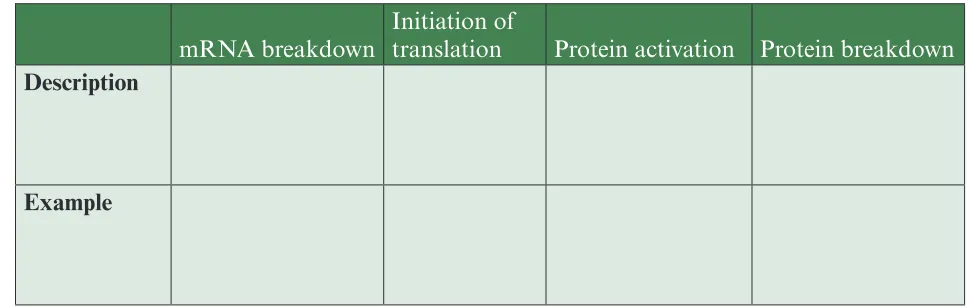
12. Complete the following table, which compares late-stage gene regulation mechanisms.
mRNA breakdown Initiation of translation Protein activation Protein breakdown
Description
Example
13. Briefly explain why control valves on a water pipe are a good analogy for control of gene expression in eukaryotes.
14. ____________ determines which end of the fruit fly becomes the head.
15. True or false: A mutation in a homeotic gene does not affect which end of the fly becomes the head. If false, make it a correct statement.
16. An oncologist wants to study how gene expression changes in pancreatic cancer cells. What technique might the oncologist use? Briefly explain how that would be of benefit to the oncologist.
17. cDNA is made from ____________ using reverse transcriptase. a. mRNA
b. DNA c. cDNA d. miRNA
19. List the key events of a signal transduction pathway.
20. A cell has a mutation that causes a shape change in a cell-surface receptor protein that binds a signaling molecule. What effect is this likely to have on that particular signal transduction pathway?
21. What does the fact that many organisms on earth share similar mechanisms of signal trans-duction mean with respect to evolution?
Big idea: Cloning of plants and animals
Answer the following questions as you read modules 11.12–11.14:
1. True or false: Genes that are unexpressed retain the ability to be expressed. If false, make it a correct statement.
2. An organism produced from a single parent is referred to as a(n) ____________.
3. Briefly explain the genetic relationship between the two carrot plants in Figure 11.12 on page 221 in your textbook.
4. List the steps of nuclear transplantation.
5. A scientist trying to clone a Bengal tiger via nuclear transplantation obtains the donor nucleus from a gametic cell rather than a somatic cell. Briefly explain why this is not going to work.
6. Which of the following results in stem cells that can be used in treating medical ailments? a. Reproductive cloning
b. Regeneration
7. Complete the following table, which compares embryonic stem cells to adult stem cells.
Embryonic stem cells Adult stem cells
Description
8. Ideally, a person would get ES cells made from one of his or her own donated somatic cells. Briefly explain why this is so advantageous.
Big idea: The genetic basis of cancer
Answer the following questions as you read modules 11.15–11.18:
1. A gene that causes cancer is known as a(n) ____________.
2. Proto-oncogenes and oncogenes are often misunderstood. Briefly describe the relationship between the two. Provide an example to help explain your answer.
3. A tumor-suppressor gene is mutated such that its expression is increased. Would this increase or decrease your chance of cancer? Briefly explain your answer.
4. True or false: Cancer usually develops as fast as a typical cold. If false, make it a correct statement.
6. Complete the Venn diagram that compares stimulatory with inhibitory signal transduction pathways.
7. Any substance that mutates DNA, which leads to cancer, is known as a(n) ____________.
8. True or false: Only women get breast cancer. If false, make it a correct statement.
CoNNECTiNG THE BiG iDEAs
Use your knowledge of the information contained within this chapter’s “Big Ideas” to answer this question.
Identical twins have been studied extensively to help us understand the inheritance of traits in humans. We have long believed that the sequence of nucleotides in our genes was the ultimate determinant of protein function. If that is true, what could explain the observations that one identi-cal twin can have asthma but not the other? What about when one identiidenti-cal twin has severe depres-sion and not the other?
Inhibitory signal transduction pathway Stimulatory signal