Shulyak Oleksandr V., Flyunt Igor-Severyn S., Flyunt Victor R., Fil’ Vitaliǐ M., Hrinchenko Borys V., Snihur Oleh V., Zukow Walery, Yanchiy Oksana R., Popovych Igor L. Influence balneotherapy on spa Truskavets’ with taking Canephron® N on urina lithogenicity and its metabolic and neuroendocrine-immune accompaniments in patients with chronic pyelonephrite and cholecystite. Journal of Education, Health and Sport. 2015;5(11):453-465. ISSN 2391-8306. DOI http://dx.doi.org/10.5281/zenodo.34351
http://ojs.ukw.edu.pl/index.php/johs/article/view/2015%3B5%2811%29%3A453-465 https://pbn.nauka.gov.pl/works/673673
Formerly Journal of Health Sciences. ISSN 1429-9623 / 2300-665X. Archives 2011–2014 http://journal.rsw.edu.pl/index.php/JHS/issue/archive
Deklaracja.
Specyfika i zawartość merytoryczna czasopisma nie ulega zmianie.
Zgodnie z informacją MNiSW z dnia 2 czerwca 2014 r., że w roku 2014 nie będzie przeprowadzana ocena czasopism naukowych; czasopismo o zmienionym tytule otrzymuje tyle samo punktów co na wykazie czasopism naukowych z dnia 31 grudnia 2014 r.
The journal has had 5 points in Ministry of Science and Higher Education of Poland parametric evaluation. Part B item 1089. (31.12.2014). © The Author (s) 2015;
This article is published with open access at Licensee Open Journal Systems of Kazimierz Wielki University in Bydgoszcz, Poland and Radom University in Radom, Poland
Open Access. This article is distributed under the terms of the Creative Commons Attribution Noncommercial License which permits any noncommercial use, distribution, and reproduction in any medium, provided the original author(s) and source are credited. This is an open access article licensed under the terms of the Creative Commons Attribution Non Commercial License (http://creativecommons.org/licenses/by-nc/3.0/) which permits unrestricted, non commercial use, distribution and reproduction in any medium, provided the work is properly cited. This is an open access article licensed under the terms of the Creative Commons Attribution Non Commercial License (http://creativecommons.org/licenses/by-nc/3.0/) which permits unrestricted, non commercial
use, distribution and reproduction in any medium, provided the work is properly cited. The authors declare that there is no conflict of interests regarding the publication of this paper.
Received: 25.09.2015. Revised 25.10.2015. Accepted: 24.11.2015.
INFLUENCE BALNEOTHERAPY ON SPA TRUSKAVETS’ WITH
TAK
ING
CANEPHRON® N ON URINA LITHOGENICITY AND ITS METABOLIC AND
NEUROENDOCRINE-IMMUNE ACCOMPANIMENTS IN PATIENTS WITH
CHRONIC PYELONEPHRITE AND CHOLECYSTITE
Oleksandr V. Shulyak
1, Igor-Severyn S. Flyunt
2, Victor R. Flyunt
3,6, Vitaliǐ M. Fil’
2,
Borys V. Hrinchenko
3, Oleh V. Snihur
3, Walery Zukow
4, Oksana R. Yanchiy
5, Igor L. Popovych
61Scientic Reseach Institute of Urology, Kyiv, Ukraine [email protected]
2Faculties of Biology and Physical Education, Ivan Franko Pedagogical University, Drohobych, Ukraine
[email protected] [email protected]
3JSC “Dnipro-Beskyd”, Truskavets’, Ukraine [email protected]
4Faculty of Physical Education, Health and Tourism, Kazimierz Wielki University, Bydgoszcz, Poland
5
Departament of Biology, OO Bohomolets’ National Medical University, Kyiv, Ukraine
6Laboratory of Balneology, OO Bohomolets’ Institute of Physiology NAS, Truskavets’-Kyiv, Ukraine
SUMMARY
Theophilinesensitive T-Lymphocytes, Monocytes and serum IgM also decreasing CD4
+T-Lymphocytes
and Neutrophiles Phagocytose Count vs Staphylococcus aureus.
In addition
, Canephron® N potentiates
increasing Parathyrine Activity, serum level IgG and Bactericidic Capacity of Neutrophiles vs
Staphylococcus aureus also decreasing Urea and Creatinine plasma level, Sodium urina concentration and
Neutrophiles Phagocytose Count vs Escherichia coli.
Conclusion.
Introduce Canephron® N into standard
balneotherapeutic complex spa Truskavets’ contribute to decrease urina Lithogenicity accompanied by
decreasing of HRV and EEG markers of chronic Stress and favorable modulation parameters of Immunity
in patients with chronic pyelonephrite and cholecystite.
Keywords:
lithogenicity of urina, EEG, HRV, immunity, spa Truskavets’, Canephron® N.
INTRODUCTION
We have previously analyzed the links urina Lithogenicity in patients with chronic pyelonephrite and
cholecystite with a concentration in urine and plasma electrolytes and nitrogenous metabolites and the
parameters Gall-bladder Motility, HRV, EEG and Immunity. Revealed significantly correlation
urina
Lithogenicity with Uric acid Plasma level and Gall-bladder postprandial Volume, Baevskiy’s Stress Index,
Sympatho-Vagal Balance Index HRV, δ-rhythm amplitude, α-rhythm frequency and θ-rhythm asymmetry
index EEG, blood levels of CD19
+B-Lymphocytes and CD16
+NK-Lymphocytes. Canonical correlation
between urina Lithogenicity and Neuro-Humoral-Immune factors is veri strong: R=0,97 [12].
It has long
been known that balneotherapy on spa Truskavets' did not significantly affect the
Ca/Mg ratio of urina
(before 1,9±0,2, after 1,8±0,2) [30]
.
Uric acid/Creatinine ratio of urina
different groups of patients respond
to balneotherapy ambiguous (0,61
±0,09 and 0,43±0,11 in 6; 0,65±0,06 and 0,42±0,03 in 36; 0,65±0,13
and 0,23±0,03 in 15; 0,36±0,11 and 0,63±0,05 in 5 before and after
balneotherapy respectively while the
normal average is
0,22±0,02
) [14].
This is due, perhaps, ambiguous influence balneotherapy on the
parameters of neuroendocrine-immune complex and metabolism
[2,5-7,13,14,16,17,24].
We found that
the Ca/Mg ratio of urina increased
in 29,3% patients of spa Truskavets’ with chronic pyelonephrite, some
more in 63,2% persons it is on the upper limit of normal or somewhat exceeds it [10]
.
Thus, the search for
means reduction urina Lithogenicity remains relevant. We opted for herbal remedies
Canephron® N.
He
has combined neuroprotective, anti-inflammatory, diuretic, antispasmodic, vasodilatory and anti-bacterial
action in children with renal tubulointerstitial lesions
[15]
.
T
he inclusion of the drug in the treatment of
chronic calculous pyelonephritis is effective in elimination of infectious inflammatory process in the
kidneys, preventing recurrence of pyelonephritis and re-stone formation
[29]
. Amid drug use observed
most expressive and positive dynamics bladder syndrome (decrease leukocyturia tripled bacteriuria – 2,7
times), peripheral blood parameters (normalization of leukocyte count, erythrocyte sedimentation rate,
reducing C-reactive protein - in 1,3 times)
[9
].
Canephron® N
is appropriate and safe drug recommended
to restore immune and antioxidant status after antibiotic therapy in active stage pyelonephrite and
antirelapse event in remission in all patients with pyelonephrite [19
].
MATERIALS AND METHODS
The object of observation were 24 men aged 24-70 (mean 50±2) years, who were treated at the spa
Truskavets’ from chronic pyelonephritis, combined with cholecystitis in remission. In the morning on an
empty stomach electrocardiogram recorded in II lead to assess the parameters of HRV [1] (software and
hardware complex "KardioLab+HRV" production "KhAI-MEDICA" Kharkiv) and background
electroencephalogram in 16 monopolar leads (software and hardware complex "NeuroCom" the same
production). Details are given in our previous articles
[26,27].
On the tone and motility of gall-bladder, that subordinates neuro-humoral influences, judged by its
volume on an empty stomach in the morning and after 5, 15 and 30 min after ingestion cholekinetic (50 ml
of 40% solution of xylitol). The method echoscopy (echocamera
“Radmir”) applicated [21].
count) and completeness (percentage of dead microbes - Killing index) phagocytosis museum cultures
Staphylococcus aureus (ATCC N 25423 F49) and Escherichia coli (O55 K59) from laboratory
Truskavetsian hydrogeological regime-operational station
[8,16].
Immune status evaluated on a set of I and II levels recommended by the WHO. For phenotyping
subpopulations of lymphocytes used the methods of rosette formation and indirect immunofluorescent
binding reaction monoclonal antibodies [22] from company "Sorbent" (RF) with visualization under
fluorescent microscope. T-cellular immunity assessed by the following parameters: blood levels of a
subpopulation of “active”, theophiline resistance and sensitive T-lymphocytes and T-lymphocytes
phenotype of CD3
+CD4
+(helpers/inductors). State of killer link of immunity estimated by the content of
CD3
+CD8
+-lymphocytes (T-killers) and CD16
+-lymphocytes (natural killers). The state of humoral
immunity judged by the content of EAC and CD19
+B-lymphocytes and concentration in serum of
immunoglobulins classes G, A, M (radial immunodiffusion method) and circulating immune complexes
(with polyethylene glycol precipitation method), using standardized methods described in manual [18].
In the urine collected during the day, determined oxalate content and nitrogen metabolites: creatinine,
urea and uric acid, electrolytes: phosphates, chloride, calcium, magnesium, potassium and sodium.
Nitrogenous metabolites in plasma of venous blood were determined also. Used unified methods [11].
In addition, registered the delay in breath (Stange’s Test) as a marker of resistance to hypoxia [16].
Testing was performed twice - at admission and after 10-12 days standard balneotherapy (drinking
bioactive water Naftussya 3 ml/kg three times a day; application of ozokerite on the lumbar region, t 45
oC,
lasting 20-30 minutes, every other day; baths mineral, concentration
Cl
-SO
4
2-
Na
+Mg
2+salt 20-30 g/l, t
o36-37
oC, duration 8-10 minutes every other day) [16,23,25] or with the additional taking Canephron® N
according to the instruction.
Results processed by methods of correlation, canonical and discriminant analyses, using the software
package "Statistica 5.5".
RESULTS AND DISCUSSION
Lithogenicity Index (Lith) urine was calculated using the formula HS Tiselius [31] with our
modification [12]:
Lith=(Oxalates•Uric acid•Calcium/Magnesium•Creatinin)
0,2.
0,6 0,7 0,8 0,9 1 1,1 1,2 1,3
0,6 0,7 0,8 0,9 1 1,1 1,2 1,3
Initial Lithogenicity, units
F
inal Lit
h
o
g
enicity
, un
it
s
[image:4.612.98.457.71.327.2]Control Experiment
Fig. 1. Personal initial and final indexes of Lithogenicity in patients of Control and
Experimental groups
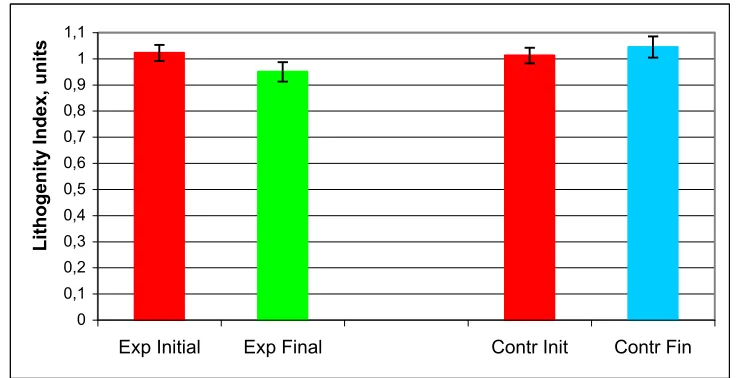
The visual impression is confirmed by calculating Means of initial and final indexes (Fig. 2).
0 0,1 0,2 0,3 0,4 0,5 0,6 0,7 0,8 0,9 1 1,1
Exp Initial Exp Final Contr Init Contr Fin
L
it
h
o
g
enit
y Ind
ex, un
it
s
Fig. 2. Means of initial and final indexes of Lithogenicity in patients of Experimental and
Control groups
[image:4.612.91.461.401.590.2]Table 1.
Changes in urine concentration lipolytic and lithogenic substances in patients in the
Control and Experimental groups
Groups n
Lithoge-nicity Creatinine, mM/l Magnesium, mM/l Oxalates, mM/l Uric acid, mM/l Calcium, mM/l Before therapy (Basal level)
23 M m 1,015 0,024 3,02 0,15 2,39 0,11 1,10 0,13 2,00 0,12 2,69 0,29 After standard therapy (Control)
12 M m Δ mΔ 1,045 0,041 +0,033 0,029 2,80 0,22 -0,21 0,23 2,16 0,18 -0,24 0,21 0,61 0,14 -0,49 0,22* 2,14 0,14 +0,14 0,15 2,81 0,31 +0,13 0,18 After combined therapy (Experiment)
12 M m Δ mΔ 0,950 0,042 -0,073 0,031*# 3,18 0,54 +0,17 0,20 1,99 0,18 -0,40 0,22 0,61 0,09 -0,47 0,18* 1,69 0,16 -0,31 0,05*# 2,42 0,28 -0,28 0,18
Notices
: M – Mean; m- its Standard Error;
Δ- Change in Mean; mΔ -
its Standard Error.
Significant
differences between the values Before and After balneotherapy* and between the Control and
Experimental groups
#Accompanied changes metabolic parameters of urine and blood, as well as EEG, HRV and Immunity
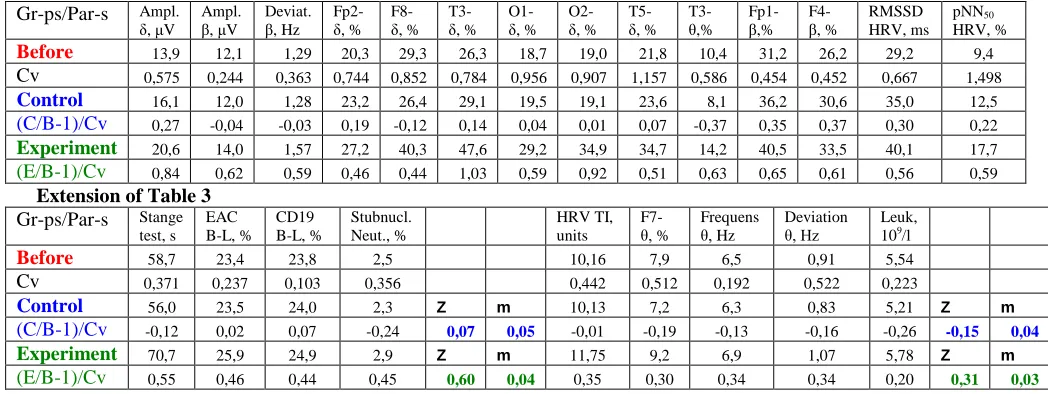
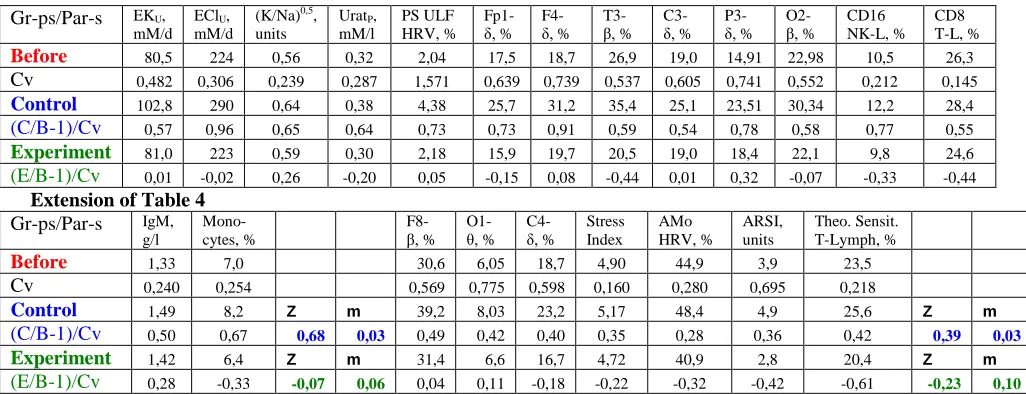
were grouped into a number of patterns (Tables 2-7)
.
The changes expressed in Z-scores, that take into
account the variability (Cv) of parameters before treatment. Significant believed Z-scores over 0,5 σ.
Table 2.
Parameters independent of action standard balneotherapy, but falling under the
influence
Canephron® N
Gr-ps/Par-s CClU, mM/l
CKU, mM/l
ARSI (orth.)
Active T-L,%
EEG rhythms asymmetry, % Normalized PSD of α-rhythm (%) in locus
δ θ α T6 O2 Fp2 F8
Before 103 37,7 4,7 28,6 41,5 30,3 17,4 37,7 52,0 37,6 30,1
Cv 0,263 0,479 0,699 0,169 0,518 0,607 0,695 0,520 0,372 0,352 0,593
Control 109 38,4 5,4 27,9 40,3 31,2 23,7 31,2 45,4 32,5 27,1 Z m
(C/B-1)/Cv 0,24 0,04 0,23 -0,14 -0,05 0,05 0,52 -0,33 -0,34 -0,38 -0,17 -0,03 0,09
Experiment 81 29,7 3,2 25,2 27,6 18,0 10,0 24,3 38,3 24,0 19,0 Z m
(E/B-1)/Cv -0,82 -0,44 -0,46 -0,71 -0,65 -0,67 -0,61 -0,68 -0,71 -1,02 -0,62 -0,67 0,05
Table 3.
Parameters independent of action standard balneotherapy, but rising under the
influence
Canephron® N
Gr-ps/Par-s Ampl.
δ, μV Ampl. β, μV Deviat. β, Hz Fp2-δ, % F8- δ, % T3- δ, % δ, % O1- O2- δ, % T5- δ, % T3- θ,% Fp1- β,% F4- β, % RMSSD HRV, ms pNN50 HRV, %
Before 13,9 12,1 1,29 20,3 29,3 26,3 18,7 19,0 21,8 10,4 31,2 26,2 29,2 9,4
Cv 0,575 0,244 0,363 0,744 0,852 0,784 0,956 0,907 1,157 0,586 0,454 0,452 0,667 1,498
Control 16,1 12,0 1,28 23,2 26,4 29,1 19,5 19,1 23,6 8,1 36,2 30,6 35,0 12,5
(C/B-1)/Cv 0,27 -0,04 -0,03 0,19 -0,12 0,14 0,04 0,01 0,07 -0,37 0,35 0,37 0,30 0,22
Experiment 20,6 14,0 1,57 27,2 40,3 47,6 29,2 34,9 34,7 14,2 40,5 33,5 40,1 17,7
(E/B-1)/Cv 0,84 0,62 0,59 0,46 0,44 1,03 0,59 0,92 0,51 0,63 0,65 0,61 0,56 0,59
Extension of Table 3 Gr-ps/Par-s Stange
test, s EAC B-L, % CD19 B-L, % Stubnucl. Neut., % HRV TI, units F7- θ, % Frequens θ, Hz Deviation θ, Hz Leuk, 109/l
Before 58,7 23,4 23,8 2,5 10,16 7,9 6,5 0,91 5,54
Cv 0,371 0,237 0,103 0,356 0,442 0,512 0,192 0,522 0,223
Control 56,0 23,5 24,0 2,3 Z m 10,13 7,2 6,3 0,83 5,21 Z m
(C/B-1)/Cv -0,12 0,02 0,07 -0,24 0,07 0,05 -0,01 -0,19 -0,13 -0,16 -0,26 -0,15 0,04
Experiment 70,7 25,9 24,9 2,9 Z m 11,75 9,2 6,9 1,07 5,78 Z m
[image:5.612.72.584.96.239.2] [image:5.612.74.598.524.721.2]The first pattern (Table 2) shows that
reducing urina Lithogenicity accompanied by a decrease urina
concentration Chloride and Potassium, as well as Baevskiy’s Activity Regulatory Systems Index,
Asymmetry δ-, θ- and α-rhythms of background EEG and α-rhythm normalized Power Spectrum Density
(PSD) in right loci Fp2, F8, T6 and O2, while (Table 3) HRV markers of vagal tone (Triangulary Index –
TI, RMSSD, pNN50) also Frequency Deviation θ- and β-rhythms, Amplitude
β- and δ-rhythms, δ-rhythm
PSD in loci Fp2, F8, T3, T5, O1, O2, β-rhythm
PSD in loci Fp1, F4 as well as θ-rhythm
PSD in loci T3
and F7 rising
.
However
,
Canephron® N prevents or reverses increasing Uric acid plasma level, urina
K/Na ratio as marker of Mineralocorticoide Activity, Sympathetic tone, Baevskiy’s Stress Index and PSD
ULF HRV as well as decreasing PSD VLF HRV
(Table 4)
.
Thus, reducing
Lithogenicity
associated with vagotonic shift of sympatho-vagal balance
associated in
turn with modulation parameters EEG [26,27].
This is consistent with the provisions of the role of Stress
in urina
Lithogenicity [3,4] as well as stresslimiting properties of Phytopreparations [7,16,23].
Concerning
parameters of Immunity Canephron® N decreases blood level “active” T-Lymphocytes
but increases level B-Lymphocytes, Stubnucleary Neutrophiles and total Leukocytes (Table 3) as well as
prevents or reverses increasing CD16
+NK-Lymphocytes, CD8
+and Theophilinesensitive T-Lymphocytes,
Monocytes and serum IgM (Table 4) also decreasing CD4
+T-Lymphocytes and Neutrophiles Phagocytose
Count vs Staphylococcus aureus (Table 5).
Apparently discovered immunomodulation caused by
neurogenic [17,23,28].
Table 4.
Options boost which influenced the standard balneotherapy
Canephron® N preventes
or reverses
Gr-ps/Par-s EKU, mM/d
EClU, mM/d
(K/Na)0,5, units
UratP, mM/l
PS ULF HRV, %
Fp1-
δ, % F4- δ, % T3- β, % C3- δ, % P3- δ, % O2- β, % CD16 NK-L, % CD8 T-L, %
Before 80,5 224 0,56 0,32 2,04 17,5 18,7 26,9 19,0 14,91 22,98 10,5 26,3
Cv 0,482 0,306 0,239 0,287 1,571 0,639 0,739 0,537 0,605 0,741 0,552 0,212 0,145
Control 102,8 290 0,64 0,38 4,38 25,7 31,2 35,4 25,1 23,51 30,34 12,2 28,4
(C/B-1)/Cv 0,57 0,96 0,65 0,64 0,73 0,73 0,91 0,59 0,54 0,78 0,58 0,77 0,55
Experiment 81,0 223 0,59 0,30 2,18 15,9 19,7 20,5 19,0 18,4 22,1 9,8 24,6
(E/B-1)/Cv 0,01 -0,02 0,26 -0,20 0,05 -0,15 0,08 -0,44 0,01 0,32 -0,07 -0,33 -0,44
Extension of Table 4 Gr-ps/Par-s IgM,
g/l
Mono-cytes, %
F8-
β, % O1- θ, % C4- δ, % Stress Index AMo HRV, %
ARSI, units
Theo. Sensit. T-Lymph, %
Before 1,33 7,0 30,6 6,05 18,7 4,90 44,9 3,9 23,5
Cv 0,240 0,254 0,569 0,775 0,598 0,160 0,280 0,695 0,218
Control 1,49 8,2 Z m 39,2 8,03 23,2 5,17 48,4 4,9 25,6 Z m
(C/B-1)/Cv 0,50 0,67 0,68 0,03 0,49 0,42 0,40 0,35 0,28 0,36 0,42 0,39 0,03
Experiment 1,42 6,4 Z m 31,4 6,6 16,7 4,72 40,9 2,8 20,4 Z m
(E/B-1)/Cv 0,28 -0,33 -0,07 0,06 0,04 0,11 -0,18 -0,22 -0,32 -0,42 -0,61 -0,23 0,10
Table 5.
Options reduction which influenced the standard balneotherapy
Canephron® N
prevents
Gr-ps/Par-s PS VLF HRV, %
α-rhythm Index, %
F4-
α, % C3- α,% P3- α,% T6- θ, % 0-Lympho-cytes, %
Microb. Count vs Staph. aur.
Before 41,16 62,5 43,1 45,3 52,69 8,4 38,3 64,0
Cv 0,468 0,427 0,420 0,409 0,359 0,549 0,150 0,135
Control 31,44 44,6 29,1 35,6 42,63 4,8 35,3 59,2 Z m
(C/B-1)/Cv -0,50 -0,67 -0,77 -0,53 -0,53 -0,79 -0,52 -0,56 -0,61 0,04
Experiment 42,08 63,3 34,4 42,9 52,3 7,9 40,5 61,4 Z m
[image:6.612.77.590.357.554.2]Extension of Table 5 Gr-ps/Par-s C4-
α, % F8- θ, % T3- α, % T4- θ, % θ, % P4- F4- θ, % Fp2- θ,% F3- α, % CD4 T-L, %
Before 44,1 10,0 36,5 10,9 8,81 12,0 10,0 41,4 24,9
Cv 0,381 0,596 0,554 0,783 0,688 0,886 1,041 0,511 0,118
Control 36,0 7,3 27,3 7,2 6,77 9,0 6,5 32,1 24,1 Z m
(C/B-1)/Cv -0,48 -0,45 -0,45 -0,44 -0,34 -0,28 -0,33 -0,44 -0,28 -0,39 0,03
Experiment 41,1 9,3 34,4 9,2 8,8 12,4 8,7 37,2 25,1 Z m
(E/B-1)/Cv -0,18 -0,12 -0,10 -0,20 0,00 0,04 -0,13 -0,20 0,08 -0,09 0,04
In addition
, Canephron® N potentiates increasing urina P/Ca Ratio as marker of Parathyrine Activity,
serum level IgG and Bactericidic Capacity of Neutrophiles vs Staphylococcus aureus as well as
decreasing Urea and Creatinine plasma level, Sodium urina concentration and Neutrophiles Phagocytose
Count vs Escherichia coli (Table 6).
We interpret this immunomodulation as neurogenic endocrine and
metabolic caused and beneficial for prevention of recurrence of inflammation in the kidney and
gall-bladder.
Table 6.
The parameters increase or decrease which influenced the standard balneotherapy
Canephron® N increases
Gr-ps/Par-s F3-
β, % PTA= (P/Ca)0,5 IgG, g/l
BCN vs St. aur., 109/l
UreaP, mM/l
CreatinineP,
μM/l CNamM/l U,
Microb. Count vs E. coli
Before 20,7 2,00 12,6 92,3 7,09 100,7 119,7 64,4
Cv 0,388 0,246 0,282 0,301 0,177 0,127 0,330 0,089
Control 26,9 2,37 14,3 104,3 Z m 6,21 88,73 101,0 60,0 Z m
(C/B-1)/Cv 0,78 0,74 0,49 0,43 0,61 0,09 -0,71 -0,93 -0,47 -0,77 -0,72 0,10
Experiment 31,0 2,56 15,8 115,8 Z m 5,73 85,53 90,0 57,7 Z m
(E/B-1)/Cv 1,30 1,13 0,90 0,84 1,04 0,10 -1,09 -1,18 -0,75 -1,18 -1,05 0,10
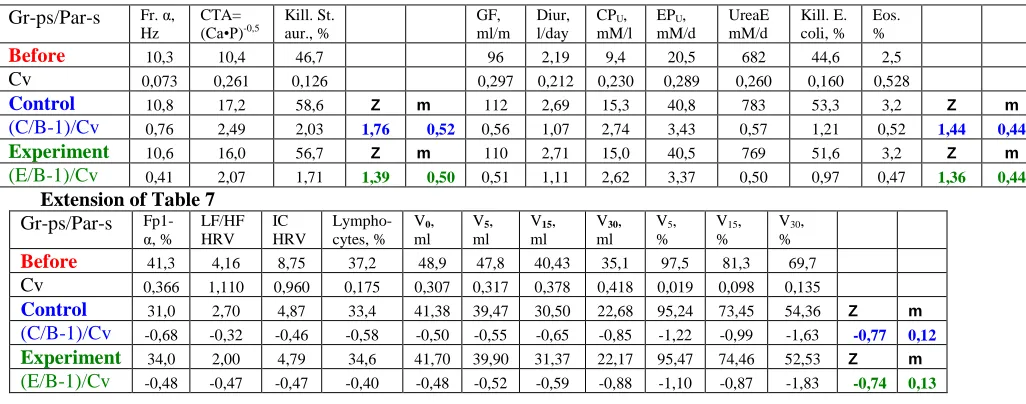
[image:7.612.73.497.75.175.2]Finally, a number of parameters of Urina, Cholekinetics, Immunity, EEG and HRV not subordinated
to the influence of the tested drug (
Table 7).
Table 7.
Options to increase or decrease which influenced standard balneotherapy Canephron®
N has no effect
Gr-ps/Par-s Fr. α, Hz
CTA=
(Ca•P)-0,5 Kill. St. aur., % GF, ml/m Diur, l/day mM/l CPU, EPmM/d U, UreaE mM/d Kill. E. coli, % Eos. %
Before 10,3 10,4 46,7 96 2,19 9,4 20,5 682 44,6 2,5
Cv 0,073 0,261 0,126 0,297 0,212 0,230 0,289 0,260 0,160 0,528
Control 10,8 17,2 58,6 Z m 112 2,69 15,3 40,8 783 53,3 3,2 Z m
(C/B-1)/Cv 0,76 2,49 2,03 1,76 0,52 0,56 1,07 2,74 3,43 0,57 1,21 0,52 1,44 0,44
Experiment 10,6 16,0 56,7 Z m 110 2,71 15,0 40,5 769 51,6 3,2 Z m
(E/B-1)/Cv 0,41 2,07 1,71 1,39 0,50 0,51 1,11 2,62 3,37 0,50 0,97 0,47 1,36 0,44
Extension of Table 7 Gr-ps/Par-s Fp1-
α, % LF/HF HRV IC HRV
Lympho- cytes, %
V0, ml
V5, ml
V15, ml
V30, ml
V5, %
V15, %
V30, %
Before 41,3 4,16 8,75 37,2 48,9 47,8 40,43 35,1 97,5 81,3 69,7
Cv 0,366 1,110 0,960 0,175 0,307 0,317 0,378 0,418 0,019 0,098 0,135
Control 31,0 2,70 4,87 33,4 41,38 39,47 30,50 22,68 95,24 73,45 54,36 Z m
(C/B-1)/Cv -0,68 -0,32 -0,46 -0,58 -0,50 -0,55 -0,65 -0,85 -1,22 -0,99 -1,63 -0,77 0,12
Experiment 34,0 2,00 4,79 34,6 41,70 39,90 31,37 22,17 95,47 74,46 52,53 Z m
(E/B-1)/Cv -0,48 -0,47 -0,47 -0,40 -0,48 -0,52 -0,59 -0,88 -1,10 -0,87 -1,83 -0,74 0,13
[image:7.612.72.585.486.688.2]among themselves.
Identification turned out 23 parameters, including 9
neural
, 6
immune
, 4
urinary
,
2
cholekinetic
and
2
metabolic
(Table 8).
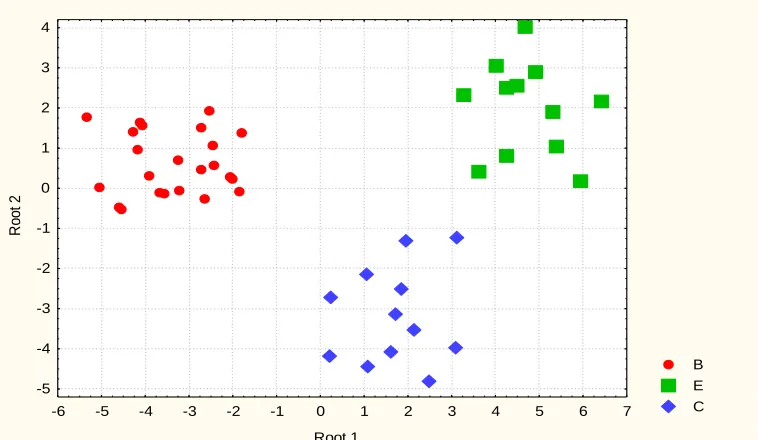
[image:8.612.71.594.188.480.2]Information about these options condensed in two canonical discriminant roots (76% in Root 1 and
24% in Root 2). This reflects the major radical 7 parameters
inverse
way while other 7 variables
directly
.
On the other hand, minor root
inversely
correlated with 7 parameters and
directly
with only two (Table
9).
Table 8. Discriminant Function Analysis Summary.
Wilks' Lambda: 0,014; approx. F(46)=6,98;
p<10
-6Variables currently in model Wilks'Λ Part. Λ F-rem p Toler F ent p Λ F p
Gall-bladder PPV30, % ,023 ,635 6,31 ,0068 ,191 14,2 10
-4
,607 14,2 10-5
Phosphaturia, mM/l ,017 ,858 1,82 ,1852 ,501 9,12 10-3 ,426 11,4 10-6
Diurese, l/24 h ,032 ,454 13,2 ,0002 ,269 3,68 ,034 ,363 9,24 10-6
Killing Index vs Staph. aureus, % ,021 ,701 4,70 ,0200 ,322 6,73 ,003 ,273 9,36 10-6
Uricemia, mM/l ,017 ,855 1,87 ,1778 ,326 3,31 ,047 ,234 8,52 10-6
Gall-bladder PPV15, ml ,017 ,843 2,05 ,1531 ,211 3,05 ,059 ,203 7,94 10
-6
Frequency θ-Rhythm, Hz ,019 ,774 3,21 ,0599 ,323 2,39 ,105 ,180 7,37 10-6
LF/HF HRV ,022 ,649 5,95 ,0086 ,035 3,04 ,060 ,155 7,14 10-6
Microbial Count vs Staph. aureus ,025 ,590 7,64 ,0030 ,148 3,31 ,048 ,131 7,07 10-6
Chloriduria, mM/l ,030 ,479 12,0 ,0003 ,382 2,85 ,071 ,112 6,95 10-6
Activity Regulatory Systems Index ,023 ,626 6,58 ,0057 ,321 1,77 ,185 ,102 6,60 10-6
TheophilinesensitiveT-Lymph., % ,021 ,705 4,60 ,0214 ,441 1,68 ,202 ,092 6,30 10-6
PS VLF HRV, % ,026 ,562 8,57 ,0018 ,095 2,16 ,131 ,081 6,17 10-6
(VLF+LF)/HF HRV ,020 ,725 4,17 ,0291 ,030 1,98 ,155 ,072 6,03 10-6
PS ULF HRV, % ,031 ,472 12,3 ,0003 ,262 1,90 ,167 ,064 5,91 10-6
Microbial Count vs E. coli ,025 ,585 7,80 ,0028 ,122 2,58 ,093 ,054 5,96 10-6
PSD F8-β, % ,029 ,496 11,2 ,0005 ,125 2,96 ,068 ,045 6,13 10-6
PSD F3-β, % ,025 ,574 8,17 ,0022 ,105 5,31 ,011 ,032 6,86 10-6
PSD C4-δ, % ,021 ,681 5,15 ,0146 ,278 4,16 ,027 ,024 7,39 10-6
Glomerular Filtration, ml/min ,017 ,835 2,18 ,1370 ,264 2,25 ,126 ,021 7,45 10-6
Bacterocidity vs Staph. aur., 109/l ,016 ,883 1,46 ,2548 ,304 1,72 ,201 ,018 7,36 10-6
Serum IgG, g/l ,017 ,860 1,79 ,1906 ,407 1,48 ,249 ,016 7,22 10-6
Creatininemia, μM/l ,016 ,907 1,13 ,3404 ,418 1,13 ,340 ,015 6,98 10-6
Table 9. Factor Structure Matrix. Correlations Variables-Canonical Roots
(Pooled-within-groups correlations) and Means of Canonical Variables
Variables currently in model Root 1 Root 2 Basal level Control group Experimen-tal group
Gall-bladder PPV30, % -0,22 ,04 69,7 54,4 52,5
Creatininemia, μM/l -0,15 ,02 101 89 85
Microbial Count vs E. coli -0,10 ,00 64,4 60,0 57,7
Gall-bladder PPV15, ml -0,08 ,04 40,4 30,5 31,4
(VLF+LF)/HF HRV -0,07 ,04 8,8 4,9 4,8
LF/HF HRV -0,06 ,01 4,2 2,7 2,0
Microbial Count vs Staph. aureus -0,04 ,05 64,0 59,2 61,4
Diurese, l/24 h 0,19 -,10 2,19 2,69 2,71
Phosphaturia, mM/l 0,17 -,10 9,4 15,3 15,0
Killing Index vs Staph. aureus, % 0,17 -,09 46,7 58,6 56,7
Serum IgG, g/l 0,11 ,02 12,6 14,3 15,8
Bacterocidity vs Staph. aur., 109/l 0,07 ,02 92 104 116
PSD F3-β, % 0,07 -,01 20,7 26,9 31,0
Glomerular Filtration, ml/min 0,05 -,02 96 112 110
[image:8.612.73.540.516.713.2]TheophilinesensitiveT-Lymph., % -,05 -0,17 23,5 25,6 20,4
Chloriduria, mM/l -,06 -0,13 103 109 81
Activity Regulatory Systems Index -,03 -0,12 3,9 4,9 2,8
PS ULF HRV, % ,03 -0,10 2,0 4,4 2,2
PSD C4-δ, % ,00 -0,07 18,7 23,2 16,7
PSD F8-β, % ,02 -0,07 30,6 39,2 31,4
PS VLF HRV, % -,01 0,10 41,2 31,4 42,1
Frequency θ-Rhythm, Hz ,02 0,06 6,5 6,3 6,9
Roots Means of Canonical Variables
1 -3,4 +1,7 +4,7
2 +0,6 -3,2 +2,0
Table 10. Coefficients and Constants for Canonical Variables as well as Squared Mahalanobis
Distances between Groups
Coefficients for Canonical Variables Standardized Raw
Variables currently in model Root 1 Root 2 Root 1 Root 2 Gall-bladder PPV30, % -1,431 -,125 -,207 -,018
Phosphaturia, mM/l ,110 -,583 ,025 -,134
Diurese, l/24 h ,900 -1,264 2,375 -3,334
Killing Index vs Staph. aureus, % ,964 ,294 ,171 ,052
Uricemia, mM/l ,440 -,578 5,830 -7,656
Gall-bladder PPV15, ml ,890 ,111 ,086 ,011
Frequency θ-Rhythm, Hz ,392 ,834 ,376 ,801
LF/HF HRV -3,168 1,015 -,993 ,318
Microbial Count vs Staph. aureus 1,146 1,390 ,151 ,183
Chloriduria, mM/l -,768 -1,011 -,023 -,030
Activity Regulatory Systems Index -,291 -1,165 -,141 -,563 TheophilinesensitiveT-Lymph., % -,553 -,695 -,115 -,144
PS VLF HRV, % -2,232 ,131 -,152 ,009
(VLF+LF)/HF HRV 3,153 -,153 ,535 -,026
PS ULF HRV, % -1,067 -1,094 -,337 -,346
Microbial Count vs E. coli -1,510 -1,274 -,205 -,173
PSD F8-β, % -1,196 -1,839 -,071 -,109
PSD F3-β, % 1,690 1,321 ,144 ,112
PSD C4-δ, % 1,096 -,203 ,087 -,016
Glomerular Filtration, ml/min -,653 ,538 -,026 ,022 Bacterocidity vs Staph. aur., 109/l ,357 -,576 ,013 -,021
Serum IgG, g/l ,509 ,360 ,155 ,110
Creatininemia, μM/l -,427 -,260 -,042 -,026
Squared Mahalanobis Distances B-C: 43 (F=6,8; p<10-4);
B-E: 71 (F=11,4; p<10-6); C-E: 38 (F=4,6; p<10-3)
Constants 5,567 14,47 Eigenvalues 12,73 4,02 Discr. Properties
Canonical R
76 % 0,963
24 % 0,895
B E C
Root 1
R
o
o
t
2
-5 -4 -3 -2 -1 0 1 2 3 4
-6 -5 -4 -3 -2 -1 0 1 2 3 4 5 6 7
Fig. 3. Personal unstandardized canonical scores
before
(B) and after therapy in
control
(C)
and experimental (E) groups
-4 -3 -2 -1 0 1 2
-4 -3 -2 -1 0 1 2 3 4 5 Root 1
Ro
o
t 2
Experimental group after (12) Control group after (12) Experimental group before (12) Control group before (11)
[image:10.612.94.473.71.291.2] [image:10.612.94.565.340.535.2]-6 -5 -4 -3 -2 -1 0 1 2 3 4 5 6 7
B E B C B E B C B E B C B E B C B E B C B E B C B E B C B E B C B E B C B E B C B E B C B E B C
12 21 9 11 1 19 6 2 23 17 15 4 10 18 3 16 22 5 20 8 7 0 14 13
Ro
o
t 1
-6 -5 -4 -3 -2 -1 0 1 2 3 4
B E B C B E B C B E B C B E B C B E B C B E B C B E B C B E B C B E B C B E B C B E B C B E B C
1 21 10 16 9 4 14 17 7 8 23 5 3 19 15 13 20 11 6 18 12 2 22 0
Ro
o
[image:11.612.94.559.108.489.2]t 2
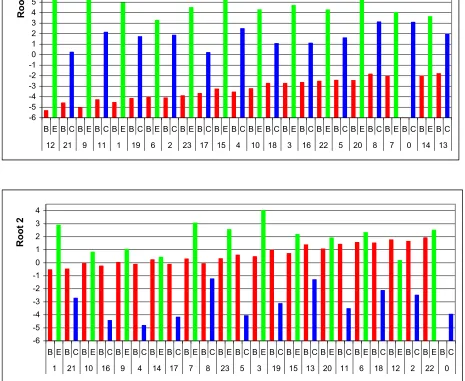
Fig. 5. Personal unstandardized canonical scores for Root 1 and 2
before
(B) and after therapy
in
control
(C) and experimental (E) groups
Delimitiation along the axis of the first root reflect the
decrease
or
increase
the 14 initial parameters
of patients after standard balneotherapy and potentiation of changes additional drug use.
On the other hand, the overlap zones of initial state and after combined treatment along the axis of the
second root displays the prevention or reversing by Canephron® N change the initial settings predefined
standard balneotherapy.
Personal effects standard and combined therapy for neuroendocrine-immune complex and metabolism
visualized in Fig. 5.
References
1. Baevskiy RM, Ivanov GG. Heart Rate Variability: theoretical aspects and possibilities of clinical application [in Russian]. Ultrazvukovaya i funktsionalnaya diagnostika. 2001; 3: 106-127.
Truskavets’. Journal of Education, Health and Sport. 2015; 5(3): 247-258.
3. Brundig P, Berg W, Schneider HJ. Stress und Harnsteinbildungsrisiko. I. Der Einfluss von Stress auf lithogene Harnsubstanzen. Urol. Int. 1981; 36(4): 199-207.
4. Brundig P, Berg W, Schneider HJ. Stress und Harnsteinbildungsrisiko. II. Der Einfluss von Stress auf litholytische Harnsubstanzen. Urol. Int. 1981; 36(4): 265-273.
5. Chebanenko OI, Chebanenko LO, Popovych IL. Multivariate Balneoeffects of Factors of Spa Truskavets’ and Forecasting [in Ukrainian]. Kyiv: UNESCO-SOCIO. 2012. 496 p.
6. Chebanenko OI, Flyunt IS, Popovych IL, Balanovs’kyi VP, Lakhin PV. Water Naftussya and Water-Salt Exchange [in Ukrainian]. Kyiv: Naukova dumka. 1997. 141 p.
7. Chebanenko OI, Popovych IL, Chebanenko LO. Adaptogenic Essence of Balneotherapy [in Ukrainian]. Kyiv: UNESCO-SOCIO. 2013. 380 p.
8. Douglas SD, Quie PG. Investigation of Phagocytes in Disease. Churchil. 1981. 110 p.
9. Dudnyk VM, Zvenyhorods’ka HYu. Experience with Phitopreparation "Canephron N" acute uncomplicated pyelonephritis in children[in Ukrainian]. Contemporary pediatrics. 2012; 4(44): 1-4.
10. Flyunt VR, Flyunt IS, Barylyak LG, Piskov GG, Yanchiy OR. Links of urine Са/Mg coefficient of Lithogenicity of some parameters of electrolyte exchange in patients spa Truskavets’ [in Ukrainian]. Medical Hydrology and Rehabilitation. 2013; 11(3): 43-49.
11. Goryachkovskiy АМ. Clinical Biochemistry [in Russian]. Odesa: Astroprint. 1998. 608 p.
12. Hrinchenko BV, Snihur OV, Flyunt VR, Zukow W. Relationships between urina lithogenicity and neuro-humoral immune factors in patients with chronic pyelonephrite and cholecystite. Journal of Education, Health and Sport. 2015; 5(5): 44-51.
13. Іvassivka SV, Popovych IL, Aksentiychuk BI, Bilas VR. Nature of Balneofactors Water Naftussya and the Essense its therapeutic and preventive Action [in Ukrainian]. Truskavets’: Truskavets’kurort. 1999. 125 p. 14. Іvassivka SV, Popovych IL, Aksentiychuk BI, Flyunt IS. Physiological Activity of Uric Acid and its Role in
the mechanism of action of Water Naftussya [in Ukrainian]. Kyiv: Computerpress. 2004. 163 p.
15. Kaladze NN, Slobodyan YeI. Pathogenetically oriented method for optimizing rehabilitation treatment of children with chronic pyelonephritis [in Russian]. Contemporary pediatrics. 2012; 2(42): 1-6.
16. Kostyuk PG, Popovych IL, Іvassivka SV (editors). Chornobyl’, Adaptive and Defensive Systems, Rehabilitation [in Ukrainian]. Kyiv: Computerpress. 2006. 348 p.
17. Kozyavkina OV, Kozyavkina NV, Gozhenko OA, Gozhenko AI, Barylyak LG, Popovych IL. Bioactive Water Naftussya and Neuroendocrine-Immune Complex [in Ukrainian]. Kyiv: UNESCO-SOCIO. 2015. 349 p. 18. Lapovets’ LYe, Lutsyk BD. Handbook of Laboratory Immunology [in Ukrainian]. L’viv. 2002. 173 p.
19. Lavrenchuk OV, Korol’ LV, Driyans’ka VE., Bagdasarova IV. Phytoprophylaxis recurrence of pyelonephritis in children [in Ukrainian]. Contemporary pediatrics. 2013; 2(50):
20. Lukovych YuS, Popovych АI, Kovbasnyuk MM, Korolyshyn TA, Barylyak LG, Popovych IL. Neuroendocrine-immune accompaniment of diuretic effect of balneotherapy on spa Truskavets’ [in Ukrainian]. Pochki. Nyrky. Kidney. 2015; 2(12): 7-14.
21. Marfiyan OM, Korolyshyn TA, Barylyak LG, Kovbasnyuk MM, Yavors’kyi OV, Zukow W, Popovych IL. Neuroendocrine-immune and metabolic accompaniments of cholecystokinetic effects of balneotherapy on spa Truskavets’. Journal of Education, Health and Sport. 2015; 5(5): 21-30.
22. Pinchuk VG, Gluzman DF. Immunocytochemistry and Monoclonal Antibodies in Oncohematology [in Russian]. Kyiv: Naukova dumka. 1990. 230 p.
23. Popovych IL. Stresslimiting Adaptogene Mechanism of Biological and Curative Activity of Water Naftussya [in Ukrainian]. Kyiv: Computerpress. 2011. 300 p.
24. Popovych IL, Barylyak LG. Influence of course using of bioactive water Naftussya on stress level at women with endocrine and gynecological pathology [in Ukrainian]. Medical Hydrology and Rehabilitation. 2009; 7(3): 100-118.
25. Popovych IL, Flyunt IS, Alyeksyeyev OI, Barylyak LG, Bilas VR. Sanogenetic Principles of Rehabilitation on Spa Truskavets’ Urological Patients Chornobyl’ Cohort [in Ukrainian]. Kyiv: Computerpress. 2003. 192 p. 26. Popovych IL, Kozyavkina OV, Kozyavkina NV, Korolyshyn TA, Lukovych YuS, Barylyak LG. Correlation
between Indices of the Heart Rate Variability and Parameters of Ongoing EEG in Patients Suffering from Chronic Renal Pathology. Neurophysiology. 2014; 46(2): 139-148.
27. Popovych IL, Lukovych YuS, Korolyshyn TA, Barylyak LG, Kovalska LB, Zukow W. Relationship between the parameters heart rate variability and background EEG activity in healthy men. Journal of Health Sciences. 2013; 3(4): 217-240.
Naftussya and their Neuroendocrine-Immune, Metabolic and Hemodynamic Accompaniments [in Ukrainian]. Kyiv: UNESCO-SOCIO. 2014. 163 p.
29. Sarychev LP, Sarychev YaV. The therapeutic potential of modern herbal medicine chronic calculous pyelonephritis in elderly and senile patients under long-term use [in Russian]. Men's Health. 2014; 4(51): 14-17.
30.Stetsenko HI, Beyda PA, Perchenko VP, Loyik IV, Flyunt IS, Yatsyuk VM. Resort Rehabilitation Victims of Chornobylian Accident [in Ukrainian].- Kyiv: Zdorovya. 1999. 45-57.