DO NOW:
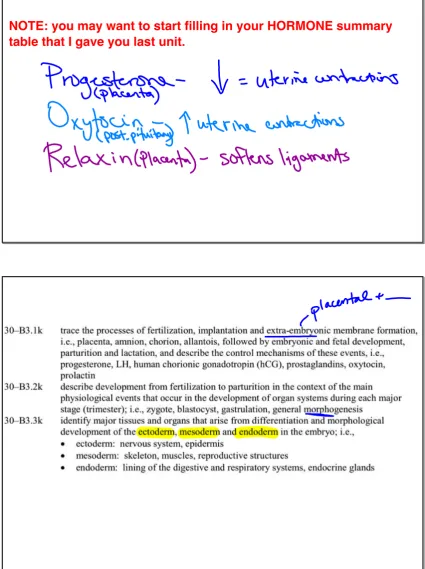
explain to partner what 3 hormones are required for Parturition. Origin, Target, Effect
Fetal Development
A blastocyst
• embeds in the uterine wall
• Consists of cells of the future embryo
• Surrounded by a sphere of cells
-Embryonic membrane (extra-embryonic membrane)
-Support the developing embryo
video: ~28mins left in "Life's greatest..."
Fetal Development cont.
Amnion
• Innermost embryonic membrane
-Next to baby
-Fluid-filled sac that cushions the baby
-"amniotic fluid"
•
Protects embryo from trauma and temp
fluctuations
•
Allows freedom of movement, prevents
limbs from sticking to body
Chorion
• Outermost membrane
-Part of the placenta
-Secretes HCG
Umbilical Cord
• Connection between mother and baby
-Belly-button to placenta
• Carries baby’s blood to and from
placenta
Fetal Development cont.
Placenta
(Allantois)(review)
• A disc-shaped organ
• Size of dinner plate
• Contains maternal & fetal blood vessels
-NO mixing of maternal and fetal blood!!
• Diffusion of gasses, nutrients, & wastes
• Continues production of HCG, estrogen, progesterone
Fetal Development cont.
Embryonic Development
• A blastocyst undergoes gastrulation
-Series of cell movements and shape changes
-Produces an embryo with 3 cellular layers
1.
Ectoderm
• Outer layer of cells
• Will become skin and nervous system
2.
Mesoderm
• Middle layer of cells
• Skeleton, muscles gonads, kidneys, circulatory system
3.
Endoderm
• Inner layer of cells
• Liver, pancreas, lungs, lining of digestive tract
Ectoderm
L –
L
ungs and linings (gut)
M –
M
uscles & heart
HUMAN GESTATION
Divided into 3 trimesters:
•
1
st- weeks 1 to 12
•
2
nd- weeks 13-24
•
3
rd- weeks 25-38
Watch: "National Geographic, In The Womb" in sections
1st Trimester
• From fertilization to end of 3
month (0 – 12
rdweeks)
• Zygote begins cell division as it moves down
oviduct
• Development of body organs (anterior brain, limb buds)
• Heart starts beating by week 4
• Week 7, testosterone begins to be secreted if a Y-chromosome
is present
-This testosterone causes development of testes.
•
Embryo is 7mm (500x larger than egg)
•
Sucking reflex evident
1st Trimester cont.
• By week-8 all major structures of the adult are
present (in basic form)
-Embryo is now called a fetus
• Embryo is most sensitive during first trimester
-Due to rapid development
-Sensitive to radiation and drugs
2nd Trimester
• Fetus grows rapidly
-To about 30 cm
• Quite active
• Hair begins to develop
The Hand Picture:
An Amazing Story
May 2, 2000
USA Today
An Amazing Story - Aug. 19, 1999
·
Samuel Armas' tiny hand grips Dr. Joseph P.
Bruner's finger just as Bruner finishes returning him
to his mother's womb.
·
Bruner, director of fetal diagnosis and treatment
at Vanderbilt University Medical Center (Nashville),
was performing a cutting-edge procedure on the
21-week-old fetus.
·
Bruner and Samuel's parents hope the surgery will
alleviate the effects of spina bifida, a disabling birth
defect in one or two of every 1,000 babies born.
·
Because fetuses undergoing this procedure are so
young -- Samuel could not survive outside his mother's
womb -- this kind of surgery is gaining attention
nationwide from the medical community and the media.
An Amazing Story - Aug. 19, 1999
·
During the procedure, surgeons remove the uterus from
the mother, drain the amniotic fluid, perform surgery on
the tiny fetus, replace everything and put the entire
package back inside the mother.
·
Dr. Bruner said regarding the picture, "The baby did not
reach out," Bruner says. "The baby was anesthetized. The
baby was not aware of what was going on."
·
Bruner says he saw the hand "sort of pop up in the
incision" on the womb, and he "reached over and picked it
up."
·
Samuel, now nearly 5 months old [may 2, 2000], & is
“developing normally and hitting his monthly milestones.
He smiles often and is nearly sitting up on his own.”
·
It will take years to know how much difference the surgery
made, but Alex Armas [father] says he's happy the photo
has been seen by millions.
"Today, Samuel is nearly
four years old and has
not had to endure the
surgeries that are
common for most
children with spina
bifida. He's walking with
leg braces, is cognitively
normal, and loves
3rd Trimester
• Rapid growth of fetus
-To about 53 cm
-3-3.5 kg
• Fetal activity decreases
-Less room to move
• Fully mature
Fertilization & Pregnancy:
Summary
• In humans, fertilization and cleavage takes place in the
Fallopian tubes. Cleavage is the division of cells in which the cell number increases but the embryo stays the same size.
• When the embryo reaches the uterus, it attaches to the
wall of the endometrium
• The implanted embryo secretes hCG, which maintains the
corpus luteum. The corpus luteum secretes progesterone and estrogen to prevent shedding of the endometrium (menstruation).
Fertilization & Pregnancy:
Summary
•
Changes in hormone levels in a pregnant woman's body
trigger the formation of structures that protect and
nurture the developing embryo changes, including the
amniotic cavity, the placenta, and the umbilical cord.
Fertilization & Pregnancy:
Summary
•
Pregnancy is divided into three trimesters. Development of
the embryo takes place in the first trimester.
Development of the fetus takes place over the last two
trimesters.
•
Birth begins with parturition (labour). During labour,
uterine contractions are triggered by the hormone
oxytocin. The hormone relaxin loosens the pelvis and
softens the cervix.
Fertilization & Pregnancy:
Summary
•
Breast development is stimulated by estrogen and
progesterone levels during pregnancy. Milk production is
stimulated by prolactin. After birth, suckling triggers
release of oxytocin, which stimulates release of milk.
•
Reproductive technologies can help people with lower
Birth Control
Teen Pregnancy Rates per 1,000 Canada,
1974-2000
The first condoms in the US were made
from vulcanized rubber in the 1870s. They
were expensive and annoyingly thick and
meant to be reused.
Egyptians inserted stones into their
vagina to prevent pregnancy. (It worked
kind of like the modern IUD by preventing
implantation).
Birth Control: FYI
Sterilization
• Most effective
• In males vas deferens is cut off and sealed
-Only effects sperm content of semen so minimal
side effects
• In females tubal ligation or cutting of the oviducts
Vasectomy
•
Incision through scrotum
•
Cut and tie off
vas deferens
•
Sperm is still produced but can’t get out
Tubal Ligation
• A combination of estrogen and progesterone given
for 21 days of the 28 day cycle
• Effectively shuts down FSH and LH production so
follicles do not develop.
• Many of the early problems have been sorted out but
side effects possible
Barrier Methods:
condoms, IUDs, diaphragms
Condom
Diaphragm
• which fits over the cervix and prevents semen from
entering the uterus
• both of these methods are more reliable when used in
conjunction with a spermacidal foam or jelly
Barrier Methods:
Barrier Methods:
condoms, IUDs, diaphragms
IUD
• Inter-Uterine Device
• placed in the uterus by a physician,
• prevent implantation of the blastocyst in the
endometrium.
Natural Family Planning
• Requires knowledge of the day of ovulation
• If known, can avoid the 4 days either side of ovulation to account
for unusually long -lived sperm or eggs.
• Women need exceptionally regular cycles to be effective
Reproductive Technologies
Amniocentesis
• a long needle is used to remove a sample of amniotic fluid from
the amniotic sac surrounding the fetus
Reproductive Technologies
Amniocentesis
Reproductive Technologies
Reproductive Technologies
Chorionic Villi Sampling (CVS)
• a small sample of tissue is removed from the chorion -the fetal part of the placenta.
• Can be performed earlier in the pregnancy than amniocentesis
• results can be obtained within a few days
• greater risk of spontaneous abortion from CVS than from amniocentesis
• ethical considerations: essentially all detectable fetal disorders remain untreatable in the uterus, and many cannot be corrected even after birth
Chorionic Villi Sampling (CVS)
Reproductive Technologies
In Vitro Fertilization
• ova can be surgically removed from a woman whose oviducts are
blocked
• These are fertilized in a Petri dish in a laboratory
• The resulting embryos can than be inserted into the woman's uterus
(or into a surrogate mother's uterus)
Sexually Transmitted Infections
(STI's)
• were once called venereal diseases • More than 20 STIs identified
• Most of the time, STIs have no symptoms, particularly in women • STIs tend to be more severe and more frequent for women than in men
-Some STIs can spread into the uterus and fallopian tubes to cause
pelvic inflammatory disease (PID), which causes infertility and ectopic (tubal) pregnancy
• STIs in women have been associated with cervical cancer
• STIs can be passed from mother to baby before, during, or immediately
after birth
AIDS/HIV
• AIDS (acquired immunodeficiency syndrome)
• First reported in the United States in 1981.
• It is caused by the human immunodeficiency virus (HIV),
-a virus that destroys the body's ability to fight off infection.
• People who have AIDS are very susceptible to many life-threatening
diseases (called opportunistic infections) and to certain forms of
cancer.
Chlamydia
Chlamydia
• many cases involve no symptoms and therefore infected persons may not seek medical treatment.
• This infection is now the most common of all bacterial STI's, with an estimated 4 to 8 million new cases occurring each year.
• In both men and women • abnormal genital discharge • burning with urination
• In women, untreated chlamydial infection may lead to pelvic inflammatory disease
-one of the most common causes of ectopic pregnancy and infertility in women.
• Many people with chlamydial infection, however, have few or no symptoms of infection.
Chlamydia
Genital Herpes
• Affects an estimated 60 million Americans.• Approximately 500,000 new cases of this incurable viral infection develop annually. • Caused by herpes simplex virus (HSV). • painful blisters or open sores in the genital area.
• These may be preceded by a tingling or burning sensation in the legs, buttocks, or genital region.
Genital Herpes cont.
• Severe or frequently recurrent genital herpes is treated with
one of several antiviral drugs that are available by
prescription.
• These drugs help control the symptoms but do not eliminate
the herpes virus from the body.
• Suppressive antiviral therapy can be used to prevent
occurrences and perhaps transmission.
• Women who acquire genital herpes during pregnancy can
transmit the virus to their babies.
• Untreated HSV infection in newborns can result in mental
retardation and death.
Gonorrhea
• discharge from the vagina or penis-“Ooooze”
• and painful or difficult urination. • The most common and serious complications occur in women and, these complications include PID, ectopic pregnancy, and infertility.
• Historically, penicillin has been used to treat gonorrhea, but in the last decade, four types of antibiotic resistance have
emerged.
• New antibiotics or combinations of drugs must be used to treat these penicillin
Syphilis
• caused by a spirochete bacterium.
• The first symptoms of syphilis may go undetected because they are
very mild and disappear spontaneously.
• The initial symptom is a chancre;
-usually a painless open sore that usually appears on the penis or
around or in the vagina.
-can also occur near the mouth, anus, or on the hands.
Syphilis
• may go on to more advanced stages, including a transient
rash and, eventually, serious involvement of the heart and
central nervous system.
• The full course of the disease can take years.
Genital Warts
• Caused by human papillomavirus,
-a virus related to the virus that causes common skin warts.
• Genital warts usually first appear as small, hard painless bumps in the vaginal area, on the penis, or around the anus.
• If untreated, they may grow and develop a fleshy, cauliflower-like appearance.
• Genital warts infect an estimated 1 million Americans each year.
• In addition to genital warts, certain high-risk types of HPV cause cervical cancer and other genital cancers.
• Genital warts are treated with a topical drug (applied to the skin), by freezing, or if they recur, with injections of a type of interferon.