Chapter
7
Applications of
Definite Integrals
T
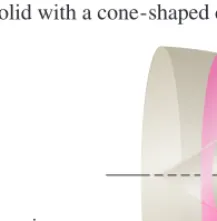
he art of pottery developed independently
in many ancient civilizations and still exists in
modern times. The desired shape of the side
of a pottery vase can be described by:
y
5.0
2 sin (
x
/4) (0
x
8
p
)
where
x
is the height and
y
is the radius at
height
x
(in inches).
A base for the vase is preformed and placed on a
potter’s wheel. How much clay should be added to
the base to form this vase if the inside radius is
al-ways 1 inch less than the outside radius? Section 7.3
contains the needed mathematics.
Chapter 7 Overview
By this point it should be apparent that finding the limits of Riemann sums is not just an
intellectual exercise; it is a natural way to calculate mathematical or physical quantities
that appear to be irregular when viewed as a whole, but which can be fragmented into
reg-ular pieces. We calculate values for the regreg-ular pieces using known formulas, then sum
them to find a value for the irregular whole. This approach to problem solving was around
for thousands of years before calculus came along, but it was tedious work and the more
accurate you wanted to be the more tedious it became.
With calculus it became possible to get
exact
answers for these problems with almost
no effort, because in the limit these sums became definite integrals and definite integrals
could be evaluated with antiderivatives. With calculus, the challenge became one of fitting
an integrable function to the situation at hand (the “modeling” step) and then finding an
antiderivative for it.
Today we can finesse the antidifferentiation step (occasionally an insurmountable
hur-dle for our predecessors) with programs like NINT, but the modeling step is no less
cru-cial. Ironically, it is the modeling step that is thousands of years old. Before either calculus
or technology can be of assistance, we must still break down the irregular whole into
regu-lar parts and set up a function to be integrated. We have already seen how the process
works with area, volume, and average value, for example. Now we will focus more closely
on the underlying modeling step: how to set up the function to be integrated.
Integral As Net Change
Linear Motion Revisited
In many applications, the integral is viewed as net change over time. The classic example
of this kind is distance traveled, a problem we discussed in Chapter 5.
EXAMPLE 1
Interpreting a Velocity Function
Figure 7.1 shows the velocity
d
d
s
t
v
(
t
)
t
2t
8
1
2 scemcof a particle moving along a horizontal
s
-axis for 0
t
5. Describe the motion.
SOLUTION
Solve Graphically
The graph of
v
(Figure 7.1) starts with
v
0
8, which we
in-terpret as saying that the particle has an initial velocity of 8 cm
sec to the left. It slows to a
halt at about
t
1.25 sec, after which it moves to the right
v
0
with increasing speed,
reaching a velocity of
v
5
24.8 cm
sec at the end.
Now try Exercise 1(a).EXAMPLE 2
Finding Position from Displacement
Suppose the initial position of the particle in Example 1 is
s
0
9. What is the
parti-cle’s position at
(a)
t
1 sec?
(b)
t
5 sec?
SOLUTION
Solve Analytically
(a)
The position at
t
1 is the initial position
s
0
plus the displacement (the
amount,
Δ
s
, that the position changed from
t
0 to
t
1). When velocity is
7.1
What you’ll learn about
• Linear Motion Revisited
• General Strategy
• Consumption Over Time
• Net Change from Data
• Work
. . . and why
The integral is a tool that can be
used to calculate net change and
total accumulation.
continued
[0, 5] by [–10, 30]constant during a motion, we can find the displacement (change in position) with the
formula
Displacement
rate of change
time.
But in our case the velocity varies, so we resort instead to partitioning the time interval
0, 1
into subintervals of length
Δ
t
so short that the velocity is effectively constant on
each subinterval. If
t
kis any time in the
k
th subinterval, the particle’s velocity throughout
that interval will be close to
v
t
k. The change in the particle’s position during the brief
time this constant velocity applies is
v
t
kΔ
t.
rate of change timeIf
v
t
kis negative, the displacement is negative and the particle will move left. If
v
t
kis positive, the particle will move right. The sum
v
t
kΔ
t
of all these small position changes approximates the displacement for the time interval
0, 1
.
The sum
v
t
kΔ
t
is a Riemann sum for the continuous function
v
t
over
0, 1
. As
the norms of the partitions go to zero, the approximations improve and the sums
con-verge to the integral of
v
over
0, 1
, giving
Displacement
1
0
v
t
dt
1
0
(
t
2t
8
1
2)
dt
[
t
3
3
t
8
1
]
1
0
1
3
8
2
8
1
3
1
.
During the first second of motion, the particle moves 11
3 cm to the left. It starts at
s
0
9, so its position at
t
1 is
New position
initial position
displacement
9
1
3
1
1
3
6
.
(b)
If we model the displacement from
t
0 to
t
5 in the same way, we arrive at
Displacement
5
0
v
t
dt
[
t
3
3
t
8
1
]
5
0
35.
The motion has the net effect of displacing the particle 35 cm to the right of its starting
point. The particle’s final position is
Final position
initial position
displacement
s
0
35
9
35
44.
Support Graphically
The position of the particle at any time
t
is given by
s
t
t0
[
u
2u
8
1
2]
du
9,
because
s
t
v
t
and
s
0
9. Figure 7.2 shows the graph of
s
t
given by the
parametrization
x
t
NINT
v
u
,
u
, 0,
t
9,
y
t
t
,
0
t
5.
Reminder from Section 3.4
A change in position is a displacement. If s(t) is a body’s position at time t, the displacement over the time interval from tto tΔtiss(tΔt)s(t). The displacement may be positive, negative, or zero, depending on the motion.
(a)
Figure 7.2a supports that the position of the particle at
t
1 is 16
3.
(b)
Figure 7.2b shows the position of the particle is 44 at
t
5. Therefore, the
dis-placement is 44
9
35.
Now try Exercise 1(b).The reason for our method in Example 2 was to illustrate the
modeling step
that will
be used throughout this chapter. We can also solve Example 2 using the techniques of
Chapter 6 as shown in Exploration 1.
Revisiting Example 2
The velocity of a particle moving along a horizontal
s
-axis for 0
t
5 is
d
d
s
t
t
2t
8
1
2.
1.
Use the indefinite integral of
ds
dt
to find the solution of the initial value
problem
d
d
s
t
t
2t
8
1
2,
s
0
9.
2.
Determine the position of the particle at
t
1. Compare your answer with the
answer to Example 2a.
3.
Determine the position of the particle at
t
5. Compare your answer with the
answer to Example 2b.
EXPLORATION 1
We know now that the particle in Example 1 was at
s
0
9 at the beginning of the
motion and at
s
5
44 at the end. But it did not travel from 9 to 44 directly—it began its
trip by moving to the left ( Figure 7.2). How much distance did the particle actually travel?
We find out in Example 3.
EXAMPLE 3
Calculating Total Distance Traveled
Find the
total distance traveled
by the particle in Example 1.
SOLUTION
Solve Analytically
We partition the time interval as in Example 2 but record every
position shift as
positive
by taking absolute values. The Riemann sum approximating
total distance traveled is
v
t
kΔ
t,
and we are led to the integral
Total distance traveled
5
0
v
t
dt
5
0
t
2t
8
1
2dt
.
Evaluate Numerically
We have
NINT
(
t
2t
8
1
2,
t
, 0, 5
)
42.59.
Now try Exercise 1(c). [–10, 50] by [–2, 6]
(a) T = 1
X = 5.3333333 Y = 1
[–10, 50] by [–2, 6]
(b) T = 5
X = 44 Y = 5
Figure 7.2 Using TRACE and the
What we learn from Examples 2 and 3 is this: Integrating velocity gives displacement
(net area between the velocity curve and the time axis). Integrating the
absolute value
of
velocity gives total distance traveled (total area between the velocity curve and the time
axis).
General Strategy
The idea of fragmenting net effects into finite sums of easily estimated small changes is
not new. We used it in Section 5.1 to estimate cardiac output, volume, and air pollution.
What
is
new is that we can now identify many of these sums as Riemann sums and express
their limits as integrals. The advantages of doing so are twofold. First, we can evaluate one
of these integrals to get an accurate result in less time than it takes to crank out even the
crudest estimate from a finite sum. Second, the integral itself becomes a formula that
en-ables us to solve similar problems without having to repeat the modeling step.
The strategy that we began in Section 5.1 and have continued here is the following:
Strategy for Modeling with Integrals
1.
Approximate what you want to find as a Riemann sum
of values of a continuous
function multiplied by interval lengths. If
f
x
is the function and
a
,
b
the
inter-val, and you partition the interval into subintervals of length
Δ
x
, the
approximat-ing sums will have the form
f
c
kΔ
x
with
c
ka point in the
k
th subinterval.
2.
Write a definite integral,
here
abf
x
dx
, to express the limit of these sums as
the norms of the partitions go to zero.
3.
Evaluate the integral
numerically or with an antiderivative.
EXAMPLE 4
Modeling the Effects of Acceleration
A car moving with initial velocity of 5 mph accelerates at the rate of
a
t
2.4
t
mph per second for 8 seconds.
(a)
How fast is the car going when the 8 seconds are up?
(b)
How far did the car travel during those 8 seconds?
SOLUTION
(a)
We first model the effect of the acceleration on the car’s velocity.
Step 1:
Approximate the net change in velocity as a Riemann sum.
When acceleration
is constant,
velocity change
acceleration
time applied.
rate of change timeTo apply this formula, we partition
0, 8
into short subintervals of length
Δ
t.
On
each subinterval the acceleration is nearly constant, so if
t
kis any point in the
k
th
subinterval, the change in velocity imparted by the acceleration in the subinterval is
approximately
a
t
kΔ
t
mph.
m sep c
h sec
The net change in velocity for 0
t
8 is approximately
a
t
kΔ
t
mph.
Step 2:
Write a definite integral.
The limit of these sums as the norms of the partitions
go to zero is
8 0a
t
dt
.
Step 3:
Evaluate the integral.
Using an antiderivative, we have
Net velocity change
8
0
2.4
t dt
1.2
t
2]
80
76.8 mph.
So, how fast is the car going when the 8 seconds are up? Its initial velocity is 5 mph and
the acceleration adds another 76.8 mph for a total of 81.8 mph.
(b)
There is nothing special about the upper limit 8 in the preceding calculation.
Apply-ing the acceleration for any length of time
t
adds
t 02.4
u du
mph
uis just a dummy variable here.(b)
to the car’s velocity, giving
v
t
5
t
0
2.4
u du
5
1.2
t
2mph.
The distance traveled from
t
0 to
t
8 sec is
8 0v
t
dt
8
0
5
1.2
t
2dt
Extension of Example 3[
5
t
0.4
t
3]
80
244.8 mph
seconds.
Miles-per-hour second is not a distance unit that we normally work with! To convert to
miles we multiply by hours
second
1
3600, obtaining
244.8
36
1
00
0.068 mile.
m h i
sec se
h c mi
The car traveled 0.068 mi during the 8 seconds of acceleration.
Now try Exercise 9.Consumption Over Time
The integral is a natural tool to calculate net change and total accumulation of more
quan-tities than just distance and velocity. Integrals can be used to calculate growth, decay, and,
as in the next example, consumption. Whenever you want to find the cumulative effect of a
varying rate of change, integrate it.
EXAMPLE 5
Potato Consumption
From 1970 to 1980, the rate of potato consumption in a particular country was
C
t
2.2
1.1
tmillions of bushels per year, with
t
being years since the beginning of 1970.
How many bushels were consumed from the beginning of 1972 to the end of 1973?
SOLUTION
We seek the cumulative effect of the consumption rate for 2
t
4.
Step 1:
Riemann sum.
We partition
2, 4
into subintervals of length
Δ
t
and let
t
kbe a time
in the
k
th subinterval. The amount consumed during this interval is approximately
C
t
kΔ
t
million bushels.
The consumption for 2
t
4 is approximately
C
t
kΔ
t
million bushels.
Step 2:
Definite integral.
The amount consumed from
t
2 to
t
4 is the limit of
these sums as the norms of the partitions go to zero.
4 2C
t
dt
4
2
2.2
1.1
tdt
million bushels
Step 3:
Evaluate.
Evaluating numerically, we obtain
NINT
2.2
1.1
t,
t
, 2, 4
7.066 million bushels.
Now try Exercise 21.
Net Change from Data
Many real applications begin with data, not a fully modeled function. In the next example,
we are given data on the rate at which a pump operates in consecutive 5-minute intervals
and asked to find the total amount pumped.
EXAMPLE 6
Finding Gallons Pumped from Rate Data
A pump connected to a generator operates at a varying rate, depending on how much
power is being drawn from the generator to operate other machinery. The rate (gallons
per minute) at which the pump operates is recorded at 5-minute intervals for one hour
as shown in Table 7.1. How many gallons were pumped during that hour?
SOLUTION
Let
R
t
, 0
t
60, be the pumping rate as a continuous function of time for the hour.
We can partition the hour into short subintervals of length
Δ
t
on which the rate is nearly
constant and form the sum
R
t
kΔ
t
as an approximation to the amount pumped
dur-ing the hour. This reveals the integral formula for the number of gallons pumped to be
Gallons pumped
60
0
R
t
dt
.
We have no formula for
R
in this instance, but the 13 equally spaced values in Table 7.1
enable us to estimate the integral with the Trapezoidal Rule:
600
R
t
dt
2
6
•
0
12
[
58
2
60
2
65
…
2
63
63
]
3582.5.
The total amount pumped during the hour is about 3580 gal.
Now try Exercise 27.Work
In everyday life,
work
means an activity that requires muscular or mental effort. In science,
the term refers specifically to a force acting on a body and the body’s subsequent
displace-ment. When a body moves a distance
d
along a straight line as a result of the action of a
force of constant magnitude
F
in the direction of motion, the
work
done by the force is
W
Fd.
The equation
W
Fd
is the
constant-force formula
for work.
[image:7.684.36.194.216.425.2]The units of work are force
distance. In the metric system, the unit is the
newton-meter, which, for historical reasons, is called a joule (see margin note). In the U.S.
cus-tomary system, the most common unit of work is the
foot-pound.
Table 7.1 Pumping Rates
Time (min) Rate (gal
min)0 58
5 60
10 65
15 64
20 58
25 57
30 55
35 55
40 59
45 60
50 60
55 63
60 63
Joules
The joule, abbreviated J and pro-nounced “jewel,” is named after the English physicist James Prescott Joule (1818–1889). The defining equation is
1 joule (1 newton)(1 meter).
In symbols, 1 J 1 N • m.
Hooke’s Law
for springs says that the force it takes to stretch or compress a spring
x
units from its natural (unstressed) length is a constant times
x.
In symbols,
F
kx
,
where
k
, measured in force units per unit length, is a characteristic of the spring called the
force constant.
EXAMPLE 7
A Bit of Work
It takes a force of 10 N to stretch a spring 2 m beyond its natural length. How much work
is done in stretching the spring 4 m from its natural length?
SOLUTION
We let
F
x
represent the force in newtons required to stretch the spring
x
meters from
its natural length. By Hooke’s Law,
F
x
kx
for some constant
k.
We are told that
F
2
10
k
•2,
so
k
5 N
m and
F
x
5
x
for this particular spring.
We construct an integral for the work done in applying
F
over the interval from
x
0
to
x
4.
Step 1:
Riemann sum.
We partition the interval into subintervals on each of which
F
is
so nearly constant that we can apply the constant-force formula for work. If
x
kis any point in the
k
th subinterval, the value of
F
throughout the interval is
approximately
F
x
k5
x
k.
The work done by
F
across the interval is
approximately 5
x
kΔ
x
, where
Δ
x
is the length of the interval. The sum
F
x
kΔ
x
5
x
kΔ
x
approximates the work done by
F
from
x
0 to
x
4.
Steps 2 and 3:
Integrate.
The limit of these sums as the norms of the partitions go to
zero is
4 0F
x
dx
4
0
5
x dx
5
x
2
2
]
4
0
40 N
•m.
Now try Exercise 29.
We will revisit work in Section 7.5.
The force required to stretch the spring 2 m is 10 newtons.
Numerically, work is the area under the force graph.
Quick Review 7.1
(For help, go to Section 1.2.)
In Exercises 1–10, find all values of x(if any) at which the function changes sign on the given interval. Sketch a number line graph of the interval, and indicate the sign of the function on each subinterval.
Example: fxx21 on 2, 3
Changes sign at x 1.
1. sin 2x on 3, 2 Changes sign at p 2, 0,
p
2
2. x23x2 on 2, 4 Changes sign at 1, 2 –2 –1
+ – +
1 3
f (x)
x
3. x22x3 on 4, 2 Always positive 4. 2x33x21 on 2, 2 Changes sign at 1
2
5. xcos 2x on 0, 4 Changes sign at p 4,
3 4
p ,5
4
p 6. xex on 0,
∞
Always positive7.
x2
x
1
on 5, 30 Changes sign at 0
8. x
x
2
2
2 4
on 3, 3 Changes sign at 2, 2, 2, 2
9. sec1 1sin2x on
∞
,∞
10. sin1x on 0.1, 0.2 Changes sign at3 1
p,2 1
p
In Exercises 1–8, the function v(t) is the velocity in m
sec of a particle moving along the x-axis. Use analytic methods to do each of the following:(a)Determine when the particle is moving to the right, to the left, and stopped.
(b)Find the particle’s displacement for the given time interval. If
s(0)3, what is the particle’s final position? (c)Find the total distance traveled by the particle.
1. vt5 cost, 0t2p See page 389.
2. vt6 sin 3t, 0tp
2 See page 389.3. vt499.8t, 0t10 See page 389.
4. vt6t218t12, 0t2 See page 389. 5. vt5 sin2tcost, 0t2p See page 389. 6. vt 4t, 0t4 See page 389.
7. vtesintcost, 0t2p See page 389.
8. vt
1
t t2
, 0t3 See page 389.
9. An automobile accelerates from rest at 13 tmph
sec for 9 seconds.(a)What is its velocity after 9 seconds? 63 mph
(b)How far does it travel in those 9 seconds? 344.52 feet
10.A particle travels with velocity
vtt2sint m
sec for 0t4 sec.(a)What is the particle’s displacement? 1.44952 meters
(b)What is the total distance traveled? 1.91411 meters
11.Projectile Recall that the acceleration due to Earth’s gravity is 32 ft
sec2. From ground level, a projectile is fired straight upward with velocity 90 feet per second.(a)What is its velocity after 3 seconds? 6 ft/sec
(b)When does it hit the ground? 5.625 sec
(c)When it hits the ground, what is the net distance it has traveled? 0
(d)When it hits the ground, what is the total distance it has traveled? 253.125 feet
In Exercises 12–16, a particle moves along the x-axis (units in cm). Its initial position at t0 sec is x015. The figure shows the graph of the particle’s velocity vt. The numbers are the areasof the enclosed regions.
4
5
a b c
24
12.What is the particle’s displacement between t 0 and t c? 13.What is the total distance traveled by the particle in the same
time period? 33 cm
14.Give the positions of the particle at times a,b, and c.
15.Approximately where does the particle achieve its greatest positive acceleration on the interval 0,b? ta
16.Approximately where does the particle achieve its greatest positive acceleration on the interval 0,c? t c
In Exercises 17–20, the graph of the velocity of a particle moving on the x-axis is given. The particle starts at x 2 when t 0.
(a)Find where the particle is at the end of the trip.
(b)Find the total distance traveled by the particle.
17.
18.
19.
20.
21. U.S. Oil Consumption The rate of consumption of oil in the United States during the 1980s (in billions of barrels per year) is modeled by the function C 27.08•et25, where tis the number of years after January 1, 1980. Find the total consumption of oil in the United States from January 1, 1980 to January 1, 1990. 332.965 billion barrels
22.Home Electricity Use The rate at which your home consumes electricity is measured in kilowatts. If your home consumes electricity at the rate of 1 kilowatt for 1 hour, you will be charged
t (sec) v(m/sec)
0 1 3
2 3 4 5 6 7
– 3
8 9 10 t (sec) v(m/sec)
0 1 2
2 3 4 5 6 7
– 2 1
0
1 2 3 4
–1 v (m/sec)
t (sec) v (m/sec)
t (sec) 2
1 2 3 4 0
Section 7.1 Exercises
23 cm
a: 11 b: 16 c:8
(a)6 (b)4 meters
(a) 2 (b)4 meters
(a)5 (b)7 meters
for 1 “kilowatt-hour” of electricity. Suppose that the average consumption rate for a certain home is modeled by the function
Ct 3.9 2.4 sinpt
12, where Ct is measured in kilowatts and tis the number of hours past midnight. Find the average daily consumption for this home, measured in kilowatt-hours. 93.6 kilowatt-hours23.Population Density Population density measures the number of people per square mile inhabiting a given living area. Washerton’s population density, which decreases as you move away from the city center, can be approximated by the function 10,0002 r at a distance rmiles from the city center. (a) If the population density approaches zero at the edge of the city, what is the city’s radius? 2 miles
(b)A thin ring around the center of the city has thickness Δrand radius r.If you straighten it out, it suggests a rectangular strip. Approximately what is its area? 2prr
(c) Writing to Learn Explain why the population of the ring in part (b) is approximately
10,0002r2
p
rΔr.(d) Estimate the total population of Washerton by setting up and evaluating a definite integral. 83,776
24.Oil Flow Oil flows through a cylindrical pipe of radius 3 inches, but friction from the pipe slows the flow toward the outer edge. The speed at which the oil flows at a distance r
inches from the center is 810 r2inches per second. (a) In a plane cross section of the pipe, a thin ring with thickness Δrat a distance rinches from the center approximates a rectangular strip when you straighten it out. What is the area of the strip (and hence the approximate area of the ring)?
(b)Explain why we know that oil passes through this ring at approximately 810 r22prΔr cubic inches per second. (c)Set up and evaluate a definite integral that will give the rate (in cubic inches per second) at which oil is flowing through the pipe. 396pin3/sec or 1244.07 in3/sec
25.Group Activity Bagel Sales From 1995 to 2005, the
Konigsberg Bakery noticed a consistent increase in annual sales of its bagels. The annual sales (in thousands of bagels) are shown below.
Sales Year (thousands)
1995 5
1996 8.9
1997 16
1998 26.3
1999 39.8
2000 56.5
2001 76.4
2002 99.5
2003 125.8
2004 155.3
2005 188
(a) What was the total number of bagels sold over the 11-year period? ( This is not a calculus question!) 797.5 thousand
(b) Use quadratic regression to model the annual bagel sales (in thousands) as a function Bx, where xis the number of years after 1995. B(x) 1.6x22.3x5.0
(c) Integrate Bxover the interval 0, 11to find total bagel sales for the 11-year period. 904.02
(d) Explain graphically why the answer in part (a) is smaller than the answer in part (c). See page 389.
26.Group Activity (Continuation of Exercise 25)
(a) Integrate Bxover the interval 0.5, 10.5to find total bagel sales for the 11-year period. 798.97 thousand
(b) Explain graphically why the answer in part (a) is better than the answer in 25(c).
27. Filling Milk Cartons A machine fills milk cartons with milk at an approximately constant rate, but backups along the assem-bly line cause some variation. The rates (in cases per hour) are recorded at hourly intervals during a 10-hour period, from 8:00 A.M. to 6:00 P.M.
Use the Trapezoidal Rule withn10 to determine approx-imately how many cases of milk were filled by the machine over the 10-hour period. 1156.5
28.Writing to Learn As a school project, Anna accompanies her mother on a trip to the grocery store and keeps a log of the car’s speed at 10-second intervals. Explain how she can use the data to estimate the distance from her home to the store. What is the connection between this process and the definite integral?
29.Hooke’s Law A certain spring requires a force of 6 N to stretch it 3 cm beyond its natural length.
(a) What force would be required to stretch the string 9 cm beyond its natural length? 18 N
(b) What would be the work done in stretching the string 9 cm beyond its natural length? 81 N
cm30. Hooke’s Law Hooke’s Law also applies to compressingsprings; that is, it requires a force of kxto compress a spring a distance x
from its natural length. Suppose a 10,000-lb force compressed a spring from its natural length of 12 inches to a length of 11 inches. How much work was done in compressing the spring
(a) the first half-inch? (b) the second half-inch? Rate
Time (cases
h)8 120
9 110
10 115
11 115
12 119
1 120
2 120
3 115
4 112
5 110
6 121
2prr
Population Population density Area
24. (b) 8(10 r2) in/sec
(2pr)rin2flow in in3/secof each rectangle is above the curve and part is below.
See page 389.
Standardized Test Questions
You may use a graphing calculator to solve the following problems.
31. True or False The figure below shows the velocity for a parti-cle moving along the x-axis. The displacement for this particle is negative. Justify your answer. False. The displacement is the
32. True or False If the velocity of a particle moving along the
x-axis is always positive, then the displacement is equal to the total distance traveled. Justify your answer.
33. Multiple Choice The graph below shows the rate at which water is pumped from a storage tank. Approximate the total gallons of water pumped from the tank in 24 hours. C
(A)600 (B)2400 (C)3600 (D)4200 (E)4800
34. Multiple Choice The data for the acceleration a(t) of a car from 0 to 15 seconds are given in the table below. If the velocity at t0 is 5 ft/sec, which of the following gives the approximate velocity at t15 using the Trapezoidal Rule? D
(A)47 ft/sec (B)52 ft/sec (C)120 ft/sec
(D)125 ft/sec (E)141 ft/sec
35. Multiple Choice The rate at which customers arrive at a counter to be served is modeled by the function Fdefined by
F(t)126 cos
pt
for 0t60, where F(t) is measured in customers per minute and tis measured in minutes. To the near-est whole number, how many customers arrive at the counter over the 60-minute period? B(A)720 (B)725 (C)732 (D)744 (E)756 r (gal/hr)
t (hr) 50
100 150 200 250
6
0 12 18 24
t (sec) v(m/sec)
0 1 2
1
2 3 4 5
– 2 – 1
6
36. Multiple Choice Pollution is being removed from a lake at a rate modeled by the function y20e0.5ttons/yr, where tis the
number of years since 1995. Estimate the amount of pollution re-moved from the lake between 1995 and 2005. Round your an-swer to the nearest ton. A
(A)40 (B)47 (C)56 (D)61 (E)71
Extending the Ideas
37.Inflation Although the economy is continuously changing, we analyze it with discrete measurements. The following table records the annual inflation rate as measured each month for 13 consecutive months. Use the Trapezoidal Rule with n12 to find the overall inflation rate for the year. 0.04875
38.Inflation Rate The table below shows the monthlyinflation rate (inthousandths) for energy prices for thirteen consecutive months. Use the Trapezoidal Rule withn 12 to approximate the annualinflation rate for the 12-month period running from the middle of the first month to the middle of the last month. 40 thousandths or 0.040
Monthly Rate Month (in thousandths)
January 3.6
February 4.0
March 3.1
April 2.8
May 2.8
June 3.2
July 3.3
August 3.1
September 3.2
October 3.4
November 3.4
December 3.9
January 4.0
Month Annual Rate
January 0.04
February 0.04
March 0.05
April 0.06
May 0.05
June 0.04
July 0.04
August 0.05
September 0.04
October 0.06
November 0.06
December 0.05
January 0.05
t (sec) 0 3 6 9 12 15
a(t) (ftsec2) 4 8 6 9 10 10
integral of the velocity from t0 to t5 and is positive.
39. Center of Mass Suppose we have a finite collection of masses in the coordinate plane, the mass mklocated at the point xk,yk
as shown in the figure.
Each mass mkhas moment mkykwith respect to thex-axisand moment mkxkabout they-axis.The moments of the
entire system with respect to the two axes are
Moment about x-axis:Mx
mkyk, Moment about y-axis:My mkxk. The center of massis Jx,Jywherex
J MMy and Jy M M
x
.
mkykmk
mkxkmk
x y
O
xk
xk yk
yk mk
(xk, yk)
Suppose we have a thin, flat plate occupying a region in the plane.
(a) Imagine the region cut into thin strips parallel to the
y-axis. Show that
x
J
xddmm,
where dmddA,ddensity (mass per unit area), and
Aarea of the region.
(b) Imagine the region cut into thin strips parallel to the
x-axis. Show that
y
J
yddmm,
where dmddA,ddensity, and Aarea of the region. In Exercises 40 and 41, use Exercise 39 to find the center of mass of the region with given density.
40.the region bounded by the parabola yx2and the line y4 with constant density d x0,y12/5
41.the region bounded by the lines yx,y x,x2 with constant density d x4/3,y0
1. (a) Right: 0 tp/2, 3p/2 t2p
Left:p/2 t3p/2 Stopped:tp/2, 3p/2
(b)0; 3 (c)20
2. (a)Right: 0 tp/3 Left:p/3 tp/2 Stopped:t0,p/3
(b)2; 5 (c)6
3. (a) Right: 0 t5 Left: 5 t10 Stopped:t5
(b)0; 3 (c)245
4. (a) Right: 0 t1 Left: 1 t2 Stopped:t1, 2
(b)4; 7 (c)6
5. (a)Right: 0 tp/2, 3p/2 t2p
Left:p/2 tp,pt3p/2 Stopped:t0,p/2,p, 3p/2, 2p
(b)0 ; 3 (c)20/3
6. (a) Right: 0 t4 Left: never Stopped:t4
(b)16/3; 25/3 (c) 16/3
7. (a)Right: 0 tp/2, 3p/2 t2p
Left:p/2t 3p/2 Stopped:tp/2, 3p/2
(b) 0; 3 (c)2e(2/e) 4.7
8. (a)Right: 0 t3 Left: never Stopped:t0
(b)(ln 10)/2 1.15; 4.15 (c)(ln 10)/2 1.15
25. (d)The answer in (a) corresponds to the area of left hand rectangles. These rectangles lie under the curve B(x). The answer in (c) corre-sponds to the area under the curve. This area is greater than the area of the rectangles.
28.One possible answer:
Plot the speeds vs. time. Connect the points and find the area under the line graph. The definite integral also gives the area under the curve.
Areas in the Plane
Area Between Curves
We know how to find the area of a region between a curve and the
x
-axis but many times
we want to know the area of a region that is bounded above by one curve,
y
f
x
, and
below by another,
y
g
x
( Figure 7.3).
We find the area as an integral by applying the first two steps of the modeling strategy
developed in Section 7.1.
1.
We partition the region into vertical strips of equal width
Δ
x
and approximate each
strip with a rectangle with base parallel to
a, b
( Figure 7.4). Each rectangle has area
f
c
kg
c
kΔ
x
for some
c
kin its respective subinterval ( Figure 7.5). This expression will be
nonnega-tive even if the region lies below the
x
-axis. We approximate the area of the region
with the Riemann sum
f
c
kg
c
kΔ
x
.
7.2
What you’ll learn about
• Area Between Curves
• Area Enclosed by Intersecting
Curves
• Boundaries with Changing
Functions
• Integrating with Respect to
y
• Saving Time with Geometric
For-mulas
. . . and why
The techniques of this section
allow us to compute areas of
complex regions of the plane.
Upper curve
Lower curve x y
y f(x)
a
b
y g(x)
a
x y
y f(x)
b
y g(x)
x y
a
b
(ck, g(ck)) (ck, f(ck))
ck
x
f(ck) g(ck)
Figure 7.3 The region between yf(x) and yg(x) and the lines xaand
xb.
Figure 7.4 We approximate the region with rectangles perpendicular to the x-axis.
Figure 7.5 The area of a typical rectan-gle is f(ck)g(ck)Δx.
2.
The limit of these sums as
Δ
x
→
0 is
b af
x
g
x
dx.
This approach to finding area captures the properties of area, so it can serve as a
definition.
DEFINITION
Area Between Curves
If
f
and
g
are continuous with
f
x
g
x
throughout
a
,
b
, then the
area between
the curves
y
f
(
x
)
and
y
g
(
x
)
from
a
to
b
is the integral of
f
g
from
a
to
b
,
A
b
a
EXAMPLE 1
Applying the Definition
Find the area of the region between
y
sec
2x
and
y
sin
x
from
x
0 to
x
p
4.
SOLUTION
We graph the curves (Figure 7.6) to find their relative positions in the plane, and see that
y
sec
2x
lies
above y
sin
x
on
0,
p
4
. The area is therefore
A
p4
0
sec
2x
sin
x
dx
[
tan
x
cos
x
]
p4
0
2
2
units squared.
Now try Exercise 1. y
x 0
y sin x
– 4 y sec2 x 2
[image:14.684.49.198.299.436.2]1
Figure 7.6 The region in Example 1.
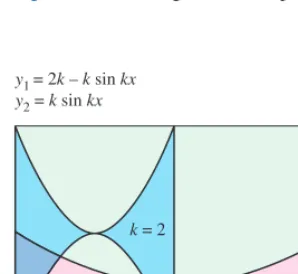
A Family of Butterflies
For each positive integer
k
, let
A
kdenote the area of the butterfly-shaped region
en-closed between the graphs of
y
k
sin
k x
and
y
2
k
k
sin
kx
on the interval
0,
p
k
. The regions for
k
1 and
k
2 are shown in Figure 7.7.
1.
Find the areas of the two regions in Figure 7.7.
2.
Make a conjecture about the areas
A
kfor
k
3.
3.
Set up a definite integral that gives the area
A
k.
Can you make a simple
u
-substitution that will transform this integral into the definite integral that
gives the area
A
1?
4.
What is lim
k→∞A
k?
5.
If
P
kdenotes the perimeter of the
k
th butterfly-shaped region, what is
lim
k→∞P
k? ( You can answer this question without an explicit formula for
P
k.)
EXPLORATION 1
[0, ] by [0, 4] k = 2 y1 = 2k – k sin kx y2 = k sin kx
k = 1
Figure 7.7 Two members of the family
of butterfly-shaped regions described in Exploration 1.
Area Enclosed by Intersecting Curves
When a region is enclosed by intersecting curves, the intersection points give the limits of
integration.
EXAMPLE 2
Area of an Enclosed Region
Find the area of the region enclosed by the parabola
y
2
x
2and the line
y
x.
SOLUTION
We graph the curves to view the region ( Figure 7.8).
The limits of integration are found by solving the equation
2
x
2x
either algebraically or by calculator. The solutions are
x
1 and
x
2.
continued
[–6, 6] by [–4, 4] [image:14.684.48.198.535.673.2]y1 = 2 – x2 y2= – x
Since the parabola lies above the line on
1, 2
, the area integrand is 2
x
2x
.
A
2
1
2
x
2x
dx
[
2
x
x
3
3
x
2
2]
2
1
9
2
units squared
Now try Exercise 5.
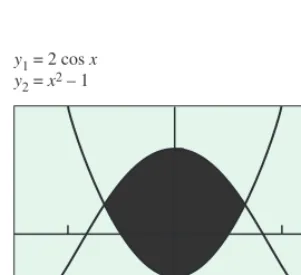
EXAMPLE 3
Using a Calculator
Find the area of the region enclosed by the graphs of
y
2 cos
x
and
y
x
21.
SOLUTION
The region is shown in Figure 7.9.
Using a calculator, we solve the equation
2 cos
x
x
21
to find the
x
-coordinates of the points where the curves intersect. These are the limits of
integration. The solutions are
x
1.265423706. We store the negative value as
A
and
the positive value as
B.
The area is
NINT
2 cos
x
x
21
,
x
,
A
,
B
4.994907788.
This is the final calculation, so we are now free to round. The area is about 4.99.
Now try Exercise 7.
Boundaries with Changing Functions
If a boundary of a region is defined by more than one function, we can partition the region
into subregions that correspond to the function changes and proceed as usual.
EXAMPLE 4
Finding Area Using Subregions
Find the area of the region
R
in the first quadrant that is bounded above by
y
x
and
below by the
x
- axis and the line
y
x
2.
SOLUTION
The region is shown in Figure 7.10.
[–3, 3] by [–2, 3]y1 = 2 cos x y2 = x2 – 1
x y
0 2
2
(4, 2)
y x 2
y 0 4
1
y ⎯√⎯x 2
B
A
Area ⌠⎮ √⎯⎯x x 2 dx
⌡
4 ⎡
⎣ ⎡⎣
Area ⌠⎮ √⎯⎯x dx
⌡
2
0
Figure 7.9 The region in Example 3.
Finding Intersections by Calculator
[image:15.684.36.187.219.356.2]The coordinates of the points of inter-section of two curves are sometimes needed for other calculations. To take advantage of the accuracy provided by calculators, use them to solve for the values and storethe ones you want.
While it appears that no single integral can give the area of
R
(the bottom boundary is
defined by two different curves), we can split the region at
x
2 into two regions
A
and
B.
The area of
R
can be found as the sum of the areas of
A
and
B.
Area of
R
2
0
x
dx
4
2
x
x
2
dx
area of A area of B
2
3
x
32
]
20
[
2
3
x
32
x
2
2
2
x
]
4
2
1
3
0
units squared
Now try Exercise 9.
Integrating with Respect to
y
Sometimes the boundaries of a region are more easily described by functions of
y
than by
functions of
x.
We can use approximating rectangles that are horizontal rather than vertical
and the resulting basic formula has
y
in place of
x.
x
A =
∫
d[f(y) – g(y)]dy.c
y
c
0
For regions like these
use this formula x⫽ f(y) d
x y
c
0 d
x y
c 0 d
x⫽ g(y)
x⫽ f(y)
x⫽ g(y)
x⫽ f(y) x⫽ g(y)
EXAMPLE 5
Integrating with Respect to
y
Find the area of the region in Example 4 by integrating with respect to
y.
SOLUTION
We remarked in solving Example 4 that “it appears that no single integral can give the
area of
R,
” but notice how appearances change when we think of our rectangles being
summed over
y.
The interval of integration is
0, 2
, and the rectangles run between
the same two curves on the entire interval. There is no need to split the region
( Figure 7.11).
We need to solve for
x
in terms of
y
in both equations:
y
x
2
becomes
x
y
2,
y
x
becomes
x
y
2,
y
0.
continued
xy
0 1
2 4
2
y 0
x y 2 x y2 (4, 2)
y (g(y), y)
(f(y), y)
f(y) g(y)
We must still be careful to subtract the lower number from the higher number when
form-ing the integrand. In this case, the higher numbers are the higher
x
-values, which are on
the line
x
y
2 because the line lies to the
right
of the parabola. So,
Area of
R
2
0
y
2
y
2dy
[
y
2
2
2
y
y
3
3
]
2
0
1
3
0
units squared.
Now try Exercise 11.
EXAMPLE 6
Making the Choice
Find the area of the region enclosed by the graphs of
y
x
3and
x
y
22.
SOLUTION
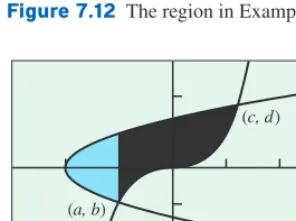
We can produce a graph of the region on a calculator by graphing the three curves
y
x
3,
y
x
2
, and
y
x
2
( Figure 7.12).
This conveniently gives us all of our bounding curves as functions of
x.
If we integrate
in terms of
x
, however, we need to split the region at
x
a
( Figure 7.13).
On the other hand, we can integrate from
y
b
to
y
d
and handle the entire region
at once. We solve the cubic for
x
in terms of
y:
y
x
3becomes
x
y
13.
To find the limits of integration, we solve
y
13y
22. It is easy to see that the
lower limit is
b
1, but a calculator is needed to find that the upper limit
d
1.793003715. We store this value as D.
The cubic lies to the right of the parabola, so
Area
NINT
y
13y
22
,
y
,
1, D
4.214939673.
The area is about 4.21.
Now try Exercise 27.Saving Time with Geometry Formulas
Here is yet another way to handle Example 4.
EXAMPLE 7
Using Geometry
Find the area of the region in Example 4 by subtracting the area of the triangular region
from the area under the square root curve.
SOLUTION
Figure 7.14 illustrates the strategy, which enables us to integrate with respect to
x
with-out splitting the region.
Area
4
0
x
dx
1
2
2
2
2
3
x
32
]
40
2
1
3
0
units squared
Now try Exercise 35.
The moral behind Examples 4, 5, and 7 is that you often have options for finding the
area of a region, some of which may be easier than others. You can integrate with respect to
x
or with respect to
y
, you can partition the region into subregions, and sometimes you can
even use traditional geometry formulas. Sketch the region first and take a moment to
deter-mine the best way to proceed.
[–3, 3] by [–3, 3] y1 = x3, y
2 = √x + 2, y3 = – √x + 2
(a, b)
[image:17.684.37.185.257.367.2](c, d)
Figure 7.12 The region in Example 6.
Figure 7.13 If we integrate with respect to xin Example 6, we must split the region at xa.
[–3, 3] by [–3, 3] (c, d)
(a, b)
x y
0 1
2
2 4 2
y 0
y x 2 2
Area 2 (4, 2)
y √⎯x
Figure 7.14 The area of the blue region is the area under the parabola y x
Quick Review 7.2
(For help, go to Sections 1.2 and 5.1.)
In Exercises 1–5, find the area between the x-axis and the graph of the given function over the given interval.
1. ysin x over 0,p 2
2. ye2x over 0, 1 1
2(e21) 3.195
3. ysec2x over p
4,p4 2 4. y4xx3 over 0, 2 4 5. y 9x2 over 3, 3 9p/2In Exercises 6–10, find the x- and y-coordinates of all points where the graphs of the given functions intersect. If the curves never intersect, write “NI.”
6. yx24x and yx6 (6, 12); (1, 5) 7. yex and yx1 (0, 1)
8. yx2px and ysinx (0, 0); (p, 0) 9. y
x2 2
x
1
and yx3 (1,1); (0, 0); (1, 1) 10. ysinx and yx3
Section 7.2 Exercises
In Exercises 1–6, find the area of the shaded region analytically.
1. p/2
2. 4p/3
3. 1/12
x y
1
0 1
(1, 1) x y3
x y2 t y
– 3 1
– 4 0 2
y sec1– 2 t 2
– 3 –
y 4 sin2 t –
2
x y
y 1
0
y cos2x 1
4. 4/3
5. 128/15
6. y 22/15
x 0
y x2 1
1
– 2 –1
y – 2x4
x y
y 2x2
2 (2, 8) 8
1 – 2
(– 2, 8)
y x4 2x2
–1
NOT TO SCALE
–1
1 x
y
0
1 x 12y2 12y3
x 2y2 2y