PowerPoint Lectures for
Campbell Biology: Concepts & Connections, Seventh Edition
Reece, Taylor, Simon, and Dickey
Chapter 6
Introduction
In eukaryotes, cellular respiration
– harvests energy from food,
– yields large amounts of ATP, and
– Uses ATP to drive cellular work.
A similar process takes place in many prokaryotic organisms.
Figure 6.0_1
Chapter 6: Big Ideas
Cellular Respiration: Aerobic Harvesting
of Energy
CELLULAR RESPIRATION:
AEROBIC HARVESTING
6.1 Photosynthesis and cellular respiration
provide energy for life
Life requires energy.
In almost all ecosystems, energy ultimately comes from the sun.
In photosynthesis,
– some of the energy in sunlight is captured by chloroplasts,
– atoms of carbon dioxide and water are rearranged, and
– glucose and oxygen are produced.
6.1 Photosynthesis and cellular respiration
provide energy for life
In cellular respiration
– glucose is broken down to carbon dioxide and water and
– the cell captures some of the released energy to make ATP.
Figure 6.1
Sunlight energy ECOSYSTEM
Photosynthesis in chloroplasts
Cellular respiration in mitochondria
(for cellular work)
Heat energy
Glucose CO2
H2O O2
Figure 6.1_1
Sunlight energy ECOSYSTEM
Photosynthesis in chloroplasts
Cellular respiration in mitochondria
(for cellular work)
Glucose CO2
H2O O2
6.2 Breathing supplies O
2for use in cellular
respiration and removes CO
2 Respiration, as it relates to breathing, and cellular respiration are not the same.
– Respiration, in the breathing sense, refers to an exchange of gases. Usually an organism brings in
oxygen from the environment and releases waste CO2.
Figure 6.2
Breathing
Lungs
Bloodstream
CO2 O2
O2 CO2
Muscle cells carrying out Cellular Respiration
Figure 6.2_1
Breathing
Lungs
Bloodstream CO2
Muscle cells carrying out Cellular Respiration
CO2 O2
6.3 Cellular respiration banks energy in ATP
molecules
Cellular respiration is an exergonic process that
transfers energy from the bonds in glucose to form ATP.
Cellular respiration
– produces up to 32 ATP molecules from each glucose molecule and
– captures only about 34% of the energy originally stored in glucose.
Figure 6.3
Glucose Oxygen Carbon Water
dioxide
C6H12O6 6 O2 6 6 H2O ATP
6.4 CONNECTION: The human body uses energy
from ATP for all its activities
The average adult human needs about 2,200 kcal of energy per day.
– About 75% of these calories are used to maintain a
healthy body.
6.4 CONNECTION: The human body uses energy
from ATP for all its activities
A kilocalorie (kcal) is
– the quantity of heat required to raise the temperature of 1 kilogram (kg) of water by 1oC,
– the same as a food Calorie, and
– used to measure the nutritional values indicated on food labels.
Figure 6.4
Activity kcal consumed per hour
by a 67.5-kg (150-lb) person* Running (8–9 mph)
Dancing (fast)
Bicycling (10 mph) Swimming (2 mph) Walking (4 mph) Walking (3 mph) Dancing (slow) Driving a car Sitting (writing)
Figure 6.4_1
Activity kcal consumed per hour
by a 67.5-kg (150-lb) person* Running (8–9 mph)
Dancing (fast)
Bicycling (10 mph)
Swimming (2 mph)
Walking (4 mph)
Walking (3 mph)
Dancing (slow)
Driving a car Sitting (writing)
6.5 Cells tap energy from electrons “falling”
from organic fuels to oxygen
The energy necessary for life is contained in the arrangement of electrons in chemical bonds in organic molecules.
An important question is how do cells extract this
energy?
6.5 Cells tap energy from electrons “falling”
from organic fuels to oxygen
When the carbon-hydrogen bonds of glucose are broken, electrons are transferred to oxygen.
– Oxygen has a strong tendency to attract electrons.
6.5 Cells tap energy from electrons “falling”
from organic fuels to oxygen
Energy can be released from glucose by simply burning it.
The energy is dissipated as heat and light and is not available to living organisms.
6.5 Cells tap energy from electrons “falling”
from organic fuels to oxygen
On the other hand, cellular respiration is the controlled breakdown of organic molecules.
Energy is
– gradually released in small amounts,
– captured by a biological system, and
6.5 Cells tap energy from electrons “falling”
from organic fuels to oxygen
The movement of electrons from one molecule to another is an oxidation-reduction reaction, or
redox reaction. In a redox reaction,
– the loss of electrons from one substance is called
oxidation,
– the addition of electrons to another substance is called
reduction,
– a molecule is oxidized when it loses one or more electrons, and
– reduced when it gains one or more electrons.
6.5 Cells tap energy from electrons “falling”
from organic fuels to oxygen
A cellular respiration equation is helpful to show the changes in hydrogen atom distribution.
Glucose
– loses its hydrogen atoms and
– becomes oxidized to CO2.
Oxygen
– gains hydrogen atoms and
Figure 6.5A
Glucose Heat
C6H12O6 6 O2 6 CO2 6 H2O ATP Loss of hydrogen atoms
(becomes oxidized)
6.5 Cells tap energy from electrons “falling”
from organic fuels to oxygen
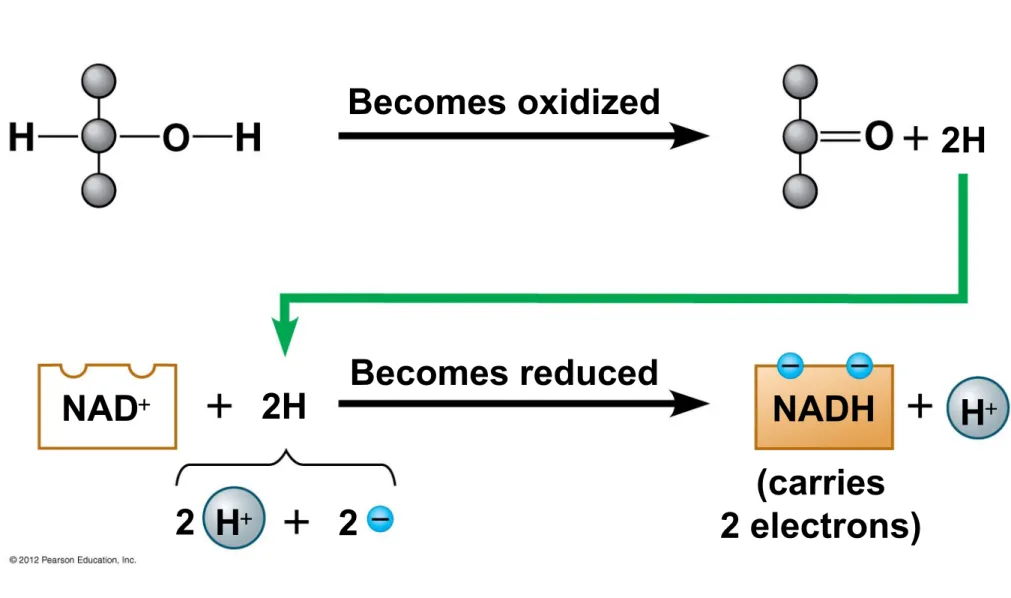
Enzymes are necessary to oxidize glucose and other foods.
NAD+
– is an important enzyme in oxidizing glucose,
– accepts electrons, and
Figure 6.5B
Becomes oxidized
Becomes reduced
2H
2H
NAD NADH
H
H
6.5 Cells tap energy from electrons “falling”
from organic fuels to oxygen
There are other electron “carrier” molecules that function like NAD+.
– They form a staircase where the electrons pass from
one to the next down the staircase.
– These electron carriers collectively are called the
electron transport chain.
Figure 6.5C Controlled release of energy for synthesis of ATP NADH NAD H
H O
2
6.6 Overview: Cellular respiration occurs in
three main stages
Cellular respiration consists of a sequence of steps that can be divided into three stages.
– Stage 1 – Glycolysis
– Stage 2 – Pyruvate oxidation and citric acid cycle
– Stage 3 – Oxidative phosphorylation
6.6 Overview: Cellular respiration occurs in
three main stages
Stage 1: Glycolysis
– occurs in the cytoplasm,
– begins cellular respiration, and
6.6 Overview: Cellular respiration occurs in
three main stages
Stage 2: The citric acid cycle
– takes place in mitochondria,
– oxidizes pyruvate to a two-carbon compound, and
– supplies the third stage with electrons.
6.6 Overview: Cellular respiration occurs in
three main stages
Stage 3: Oxidative phosphorylation
– involves electrons carried by NADH and FADH2,
– shuttles these electrons to the electron transport chain embedded in the inner mitochondrial membrane,
– involves chemiosmosis, and
Figure 6.6
NADH
NADH FADH2
ATP ATP
ATP CYTOPLASM
Glycolysis
Electrons carried by NADH
Glucose Pyruvate Pyruvate
Oxidation Citric AcidCycle
Figure 6.6_1
NADH
NADH FADH2
ATP ATP
ATP CYTOPLASM
Glycolysis
Electrons carried by NADH
Glucose Pyruvate Pyruvate
Oxidation Citric AcidCycle
6.7 Glycolysis harvests chemical energy by
oxidizing glucose to pyruvate
In glycolysis,
– a single molecule of glucose is enzymatically cut in half through a series of steps,
– two molecules of pyruvate are produced,
– two molecules of NAD+ are reduced to two molecules of
NADH, and
– a net of two molecules of ATP is produced.
Figure 6.7A
Glucose
2 ADP
2 P 2 NAD
2 NADH
2 H
6.7 Glycolysis harvests chemical energy by
oxidizing glucose to pyruvate
ATP is formed in glycolysis by substrate-level
phosphorylation during which
– an enzyme transfers a phosphate group from a substrate molecule to ADP and
– ATP is formed.
The compounds that form between the initial
reactant, glucose, and the final product, pyruvate, are called intermediates.
Figure 6.7B
Enzyme Enzyme
P
P
ADP
P
ATP
6.7 Glycolysis harvests chemical energy by
oxidizing glucose to pyruvate
The steps of glycolysis can be grouped into two main phases.
– In steps 1–4, the energy investment phase,
– energy is consumed as two ATP molecules are used to
energize a glucose molecule,
– which is then split into two small sugars that are now primed
to release energy.
– In steps 5–9, the energy payoff,
– two NADH molecules are produced for each initial glucose
molecule and
– ATP molecules are generated.
Figure 6.7Ca_s1 Glucose Glucose 6-phosphate Fructose 6-phosphate Fructose 1,6-bisphosphate ENERGY INVESTMENT PHASE P P P P ADP ADP ATP ATP Step Steps – A fuel
Figure 6.7Ca_s2 Glucose Glucose 6-phosphate Fructose 6-phosphate Fructose 1,6-bisphosphate Glyceraldehyde 3-phosphate (G3P) ENERGY INVESTMENT PHASE P P P P P P ADP ADP ATP ATP Step Steps – A fuel
molecule is energized, using ATP.
Figure 6.7Cb_s1
5 5 5
Step
A redox reaction generates NADH. ENERGY PAYOFF PHASE 1,3-Bisphospho-glycerate NADH NADH NAD NAD
H H
P P
P
P P
P
Figure 6.7Cb_s2
6 6 6
5 5 5
9
9 9
8 8
7 7
Step
A redox reaction generates NADH.
Steps –
ATP and pyruvate are produced. ENERGY PAYOFF PHASE 1,3-Bisphospho-glycerate 3-Phospho-glycerate 2-Phospho-glycerate Phosphoenol-pyruvate (PEP) Pyruvate NADH NADH NAD NAD
H H
ADP ADP
ADP ADP
ATP ATP
ATP ATP
H2O H2O
6.8 Pyruvate is oxidized prior to the citric acid
cycle
The pyruvate formed in glycolysis is transported from the cytoplasm into a mitochondrion where
– the citric acid cycle and
6.8 Pyruvate is oxidized prior to the citric acid
cycle
Two molecules of pyruvate are produced for each molecule of glucose that enters glycolysis.
Pyruvate does not enter the citric acid cycle, but undergoes some chemical grooming in which
– a carboxyl group is removed and given off as CO2,
– the two-carbon compound remaining is oxidized while a molecule of NAD+ is reduced to NADH,
– coenzyme A joins with the two-carbon group to form acetyl coenzyme A, abbreviated as acetyl CoA, and
– acetyl CoA enters the citric acid cycle.
Figure 6.8
Pyruvate
Coenzyme A
Acetyl coenzyme A
NAD NADH H
CoA
CO2 3
2
6.9 The citric acid cycle completes the oxidation of
organic molecules, generating many NADH
and FADH
2molecules
The citric acid cycle
– is also called the Krebs cycle (after the German-British researcher Hans Krebs, who worked out much of this pathway in the 1930s),
– completes the oxidation of organic molecules, and
– generates many NADH and FADH2 molecules.
Figure 6.9A
Acetyl CoA
Citric Acid Cycle
CoA
CoA
CO2 2
3 3
NAD
3 H
NADH
ADP
ATP P FAD
6.9 The citric acid cycle completes the oxidation of
organic molecules, generating many NADH
and FADH
2molecules
During the citric acid cycle
– the two-carbon group of acetyl CoA is added to a four-carbon compound, forming citrate,
– citrate is degraded back to the four-carbon compound,
– two CO2 are released, and
– 1 ATP, 3 NADH, and 1 FADH2 are produced.
6.9 The citric acid cycle completes the oxidation of
organic molecules, generating many NADH
and FADH
2molecules
Remember that the citric acid cycle processes two
molecules of acetyl CoA for each initial glucose.
Thus, after two turns of the citric acid cycle, the overall yield per glucose molecule is
– 2 ATP,
– 6 NADH, and
Figure 6.9B_s1
CoA
CoA
1
Acetyl CoA
Oxaloacetate
Citric Acid Cycle
2 carbons enter cycle
Step
Acetyl CoA stokes the furnace.
Figure 6.9B_s2 NADH NADH NAD NAD H H CO2 CO2 ATP ADP P CoA CoA 3 2 1 3 1 2 Acetyl CoA Oxaloacetate
Citric Acid Cycle
2 carbons enter cycle
Citrate
leaves cycle
Alpha-ketoglutarate
leaves cycle
Figure 6.9B_s3 NADH NADH NAD NAD NAD NADH H H H CO2 CO2 ATP ADP P FAD FADH2 CoA CoA 3 2
1 4 5
3 4 5 1 2 Acetyl CoA Oxaloacetate
Citric Acid Cycle
2 carbons enter cycle
Citrate leaves cycle Alpha-ketoglutarate leaves cycle Succinate Malate Step
Acetyl CoA stokes the furnace.
Steps –
NADH, ATP, and CO2
are generated during redox reactions.
Steps –
6.10 Most ATP production occurs by oxidative
phosphorylation
Oxidative phosphorylation
– involves electron transport and chemiosmosis and
6.10 Most ATP production occurs by oxidative
phosphorylation
Electrons from NADH and FADH2 travel down the electron transport chain to O2.
Oxygen picks up H+ to form water.
Energy released by these redox reactions is used
to pump H+ from the mitochondrial matrix into the
intermembrane space.
In chemiosmosis, the H+ diffuses back across the
inner membrane through ATP synthase
complexes, driving the synthesis of ATP.
Figure 6.10
Oxidative Phosphorylation
Electron Transport Chain Chemiosmosis
Mito-chondrial matrix Inner mito-chondrial membrane Intermem-brane space Electron flow Protein complex of electron carriers Mobile electron
carriers ATPsynthase
NADH NAD 2 H
FADH2 FAD
O2 H2O
ADP P ATP
Figure 6.10_1 H H H H H H H H H H H Oxidative Phosphorylation
Electron Transport Chain Chemiosmosis
I
II
III
IV
NADH NAD 2 H
FADH2 FAD
O2 H2O
ADP P ATP
2 1 Electron flow Protein complex of electron carriers Mobile electron
6.11
CONNECTION: Interrupting cellular respiration can have both harmful and beneficial effects Three categories of cellular poisons obstruct the process of oxidative phosphorylation. These
poisons
1. block the electron transport chain (for example, rotenone, cyanide, and carbon monoxide),
2. inhibit ATP synthase (for example, the antibiotic oligomycin), or
Figure 6.11
ATP
synthase
NAD
NADH
FADH2 FAD
H
H
H
H
H
H H H
2 H
H2O ADP P ATP O2
2 1
Rotenone Cyanide,
carbon monoxide Oligomycin
6.11
CONNECTION: Interrupting cellular respiration can have both harmful and beneficial effects Brown fat is
– a special type of tissue associated with the generation of heat and
6.11
CONNECTION: Interrupting cellular respiration can have both harmful and beneficial effects In brown fat,
– the cells are packed full of mitochondria,
– the inner mitochondrial membrane contains an
uncoupling protein, which allows H+ to flow back down
its concentration gradient without generating ATP, and
– ongoing oxidation of stored fats generates additional heat.
6.12 Review: Each molecule of glucose yields
many molecules of ATP
Recall that the energy payoff of cellular respiration involves
1. glycolysis,
2. alteration of pyruvate,
3. the citric acid cycle, and
6.12 Review: Each molecule of glucose yields
many molecules of ATP
The total yield is about 32 ATP molecules per glucose molecule.
This is about 34% of the potential energy of a glucose molecule.
In addition, water and CO2 are produced.
Figure 6.12
NADH
FADH2
NADH NADH FADH2
or NADH Mitochondrion CYTOPLASM Electron shuttles across membrane Glycolysis
Glucose Pyruvate2
Pyruvate Oxidation 2 Acetyl CoA Citric Acid Cycle Oxidative Phosphorylation (electron transport and chemiosmosis) Maximum per glucose: by substrate-level
phosphorylation by substrate-levelphosphorylation by oxidativephosphorylation 2
2 2 2
6 2
FERMENTATION: ANAEROBIC
HARVESTING OF ENERGY
6.13 Fermentation enables cells to produce ATP
without oxygen
Fermentation is a way of harvesting chemical energy that does not require oxygen. Fermentation
– takes advantage of glycolysis,
– produces two ATP molecules per glucose, and
– reduces NAD+ to NADH.
The trick of fermentation is to provide an anaerobic
6.13 Fermentation enables cells to produce ATP
without oxygen
Your muscle cells and certain bacteria can oxidize NADH through lactic acid fermentation, in which
– NADH is oxidized to NAD+ and
– pyruvate is reduced to lactate.
6.13 Fermentation enables cells to produce ATP
without oxygen
Lactate is carried by the blood to the liver, where it is converted back to pyruvate and oxidized in the mitochondria of liver cells.
The dairy industry uses lactic acid fermentation by bacteria to make cheese and yogurt.
Other types of microbial fermentation turn
– soybeans into soy sauce and
– cabbage into sauerkraut.
Figure 6.13A
2 NAD
2 NADH
2 NAD
2 NADH 2 Pyruvate
Glucose
2 ADP
2 ATP 2 P
G
ly
co
ly
si
6.13 Fermentation enables cells to produce ATP
without oxygen
The baking and winemaking industries have used
alcohol fermentation for thousands of years.
In this process yeasts (single-celled fungi)
– oxidize NADH back to NAD+ and
– convert pyruvate to CO2 and ethanol.
Figure 6.13B
2 NAD
2 NADH
2 NAD
2 NADH 2 Pyruvate
Glucose
2 ADP
2 ATP 2 P
G
ly
co
ly
si
s
6.13 Fermentation enables cells to produce ATP
without oxygen
Obligate anaerobes
– are poisoned by oxygen, requiring anaerobic conditions, and
– live in stagnant ponds and deep soils.
Facultative anaerobes
– include yeasts and many bacteria, and
– can make ATP by fermentation or oxidative phosphorylation.
6.14 EVOLUTION CONNECTION: Glycolysis
evolved early in the history of life on Earth
Glycolysis is the universal energy-harvesting process of life.
The role of glycolysis in fermentation and respiration dates back to
– life long before oxygen was present,
– when only prokaryotes inhabited the Earth,
6.14 EVOLUTION CONNECTION: Glycolysis
evolved early in the history of life on Earth
The ancient history of glycolysis is supported by its
– occurrence in all the domains of life and
– location within the cell, using pathways that do not involve any membrane-bounded organelles.
6.15 Cells use many kinds of organic molecules
as fuel for cellular respiration
Although glucose is considered to be the primary source of sugar for respiration and fermentation, ATP is generated using
– carbohydrates,
– fats, and
– proteins.
6.15 Cells use many kinds of organic molecules
as fuel for cellular respiration
Fats make excellent cellular fuel because they
– contain many hydrogen atoms and thus many energy-rich electrons and
Figure 6.15
Food, such as peanuts
Sugars Glycerol Fatty acids Amino acids
Amino groups
Oxidative Phosphorylation Citric
Acid Cycle
Pyruvate Oxidation Acetyl CoA
ATP Glucose G3P Pyruvate
Glycolysis
Figure 6.15_1
Sugars Glycerol Fatty acids Amino acids
Amino groups
Oxidative Phosphorylation Citric
Acid Cycle
Pyruvate Oxidation Acetyl CoA
Glucose G3P Pyruvate Glycolysis
Carbohydrates
ATP
6.16 Food molecules provide raw materials for
biosynthesis
Cells use intermediates from cellular respiration for the biosynthesis of other organic molecules.
Figure 6.16
Carbohydrates Fats
Proteins
Cells, tissues, organisms
Amino acids Fatty acids Glycerol Sugars
Amino groups Citric Acid Cycle Pyruvate Oxidation Acetyl CoA ATP needed to drive biosynthesis ATP Glucose Synthesis
Figure 6.16_1
Carbohydrates Fats
Proteins
Cells, tissues, organisms
Amino acids Fatty acids Glycerol Sugars Amino groups Citric Acid Cycle Pyruvate Oxidation Acetyl CoA ATP needed to drive biosynthesis ATP Glucose Synthesis
6.16 Food molecules provide raw materials for
biosynthesis
Metabolic pathways are often regulated by
feedback inhibition in which an accumulation of
product suppresses the process that produces the product.
You should now be able to
1. Compare the processes and locations of cellular respiration and photosynthesis.
2. Explain how breathing and cellular respiration are related.
3. Provide the overall chemical equation for cellular respiration.
You should now be able to
5. Explain how the energy in a glucose molecule is released during cellular respiration.
6. Explain how redox reactions are used in cellular respiration.
7. Describe the general roles of dehydrogenase,
NADH, and the electron transport chain in cellular respiration.
8. Compare the reactants, products, and energy yield of the three stages of cellular respiration.
You should now be able to
9. Explain how rotenone, cyanide, carbon
monoxide, oligomycin, and uncouplers interrupt critical events in cellular respiration.
10. Compare the reactants, products, and energy yield of alcohol and lactic acid fermentation.
11. Distinguish between strict anaerobes and facultative anaerobes.
Figure 6.UN01 Substrate-level phosphorylation Substrate-level phosphorylation Oxidative phosphorylation
ATP ATP ATP NADH
NADH FADH2
Mitochondrion Glycolysis Pyruvate Oxidation Citric Acid Cycle Oxidative Phosphorylation (electron transport and chemiosmosis) Electrons carried by NADH
Glucose Pyruvate
Figure 6.UN02 cellular work chemiosmosis glucose and organic fuels Cellular respiration
generates has three stages oxidizes uses produce some produces many to pull electrons down
H diffuse
through ATP synthase
pumps H to create
uses
uses by a process called
Figure 6.UN03
Time Time Time
C o lo r in te n si ty
a. b. c.