CC S.. =
BY NC ND
http://doi.org/10.5114/bta.2019.90237
Optimizing the biosynthesis
of renewable polyhydroxyalkanoate copolymer
containing 3-hydroxyvalerate by
Massilia haematophila
using statistical modeling
JONG T.KIUN1, TAN S.M.AMELIA1, KAI HEE HUONG2, AL-ASHRAF ABDULLAH AMIRUL2,3, KESAVEN BHUBALAN1,3*
1Faculty of Science and Marine Environment, Universiti Malaysia Terengganu, Kuala Nerus, Terengganu, Malaysia
2School of Biological Sciences, Universiti Sains Malaysia, Penang, Malaysia
3Malaysian Institute of Pharmaceuticals and Nutraceuticals (Ipharm), NIBM, Penang, Malaysia
Abstract
Polyhydroxyalkanoate (PHA) is a microbial storage polymer that is naturally produced by certain bacteria. This is the first study on the ability of this particular species Massilia haematophila to synthesize a PHA copolymer containing 3-hydroxyvalerate (3HV) monomer. Using the statistical design on Massilia haematophila UMTKB-2, this study highlights the optimization of poly(3-hydroxybutyrate-co-3-hydroxyvalerate), P(3HB-co-3HV), copolymer production for shaken-flask cultivation. Moreover, the mechanical and thermal features of the polymers were de-termined. The production of P(3HB-co-3HV) by Massilia haematophila UMTKB-2 using optimal conditions pro-vided by response surface methodology (RSM) yielded 5.0 g/l of P(3HB-co-7 mol% 3HV), which was higher than the value obtained from unoptimized conditions such as 4.40 g/l of P(3HB-co-4mol% 3HV). This result showed a 14% increase in copolymer concentration and a two-fold increase in 3HV composition. In this study, the P(3HB-co-3HV) synthesized was determined as a block copolymer and its thermal properties were better than P(3HB). Using RSM, the optimization conditions were successfully obtained for this bacterium, and this result is a starting platform for additional studies of a larger scaled PHA production from Massilia haematophila UMTKB-2 using bioreactors.
Key words: 3-hydroxyvalerate, biorenewable, Massilia haematophila, optimization, polyhydroxyalkanoate, res-ponse surface methodology
Introduction
Nowadays, the increasing demand of petrochemical-based plastic is essentially because of its outstanding chemical and physical features such as resistance to-wards chemical and thermal degradation, which allows it to endure in an exposed environment (Loo and Su-desh, 2007). However, using a petrochemical-based plas-tic is environmentally unfriendly because of its non-bio-degradable properties and requirement of a constant supply of finite resources. The amount of plastic
dis-posed into the marine environment has annually been estimated to reach 12.7 million metric tons from land-based sources (Jambeck et al., 2015).
Environmental awareness has led people to gradually replace petrochemical-based plastic with biodegradable plastic to mitigate environmental issues. There are multiple types of biodegradable polymers such as poly-lactide (PLA), starch-based polymers, and polyhydroxy-alkanoate (PHA). These polymer types are completely degradable in the environment within a short time
riod; thus, they are more environmentally friendly than the petrochemical-based plastic. The PHA polymer is one of the most popular groups of biodegradable poly-mers that has been extensively studied and commercia-lized (Kourmentza et al., 2017). According to a recent study, the global market for PHA increased by US$19.63 million from an estimated US$72.63 million in 2016 to US$92.25 million by 2021 (Kourmentza et al., 2017).
For certain bacterial cytoplasms, PHA is a type of na-tural biodegradable polymer that is synthesized as intra-cellular granules (Sudesh et al., 2011). These granules are energy and carbon reserves in situations with an ex-cessive carbon source and limited nutrients (Lee et al.,
1999). Recently, there have been -150 different PHA
structures in which homopolymers and copolymers have been identified (Kourmentza et al., 2017). Moreover, PHA has been classified into two groups according to the size of monomers: medium-chain-length PHA (MCL PHA) and short-chain-length PHA (SCL PHA). In the monomer units, the MCL PHA comprises six to fourteen carbon atoms, whereas the SCL PHA comprises three to five carbon atoms (Narayanan and Ramana, 2012).
Poly(3-hydroxybutyrate), P(3HB), is the most com-monly produced PHA homopolymer. Nevertheless, its application has been restricted because of its poor me-chanical properties. Many researchers have performed studies to enhance the features of P(3HB), including thermal and mechanical properties, by incorporating co-monomer units such as 3-hydroxyhexanoate (3HHX), 3-hydroxyvalerate (3HV), 3-hydroxyoctanoate (3HO), or 4-hydroxybutyrate (4HB) to form copolymers (Loo and
Sudesh, 2007). P(3HB-co-3HV) is a well-known
copoly-mer that has been extensively studied (Zakaria et al., 2010), which can be obtained by feeding a homopolymer with precursors with odd carbon-numbers, namely, hep-tanoic acid, valeric acid, levulinic acid, propionic acid,
and sodium valerate (Koller et al., 2014). The P(3HB
-co-3HV) copolymer is relatively less crystalline and more ductile than most copolymers. Hence, it is suitable for applications that require similar properties such as shampoo bottles, cosmetic containers, cardboard and film and personal hygiene articles (Shantini et al., 2013). The major challenge in PHA commercialization is its production cost, which is dependent on the fermentation processes. For bacterial fermentation, strain producti-vity is an important factor, which can often be improved by fine-tuning culture parameters using statistical
de-signs. Efforts have been taken to statistically optimize the accumulation of various PHA types by selected production strains (Shantini et al., 2012; Yatim et al., 2017). One-factor-at-a-time, which is executed by experi-mentally observing the effect of one variable at a time, is a traditional technique for improving PHA fermentation. The disadvantages of this approach are that it is labo-rious and tedious and that one cannot study the inter-action of more than two factors (Zafar et al., 2012). Re-cently, this method has been replaced by a statistical optimization method such as a response surface metho-dology (RSM), which is the common statistical and ma-thematical design used for building an experimental de-sign, evaluating the interaction effect between factors, and finding optimum circumstances of variables for sui-table responses in various biochemical processes (Mor-shedi and Akbarian, 2014).
Massilia haematophila (known as Naxibacter haema-tophila) is a non-motile, non-spore-forming, rod-shaped, Gram-negative, fastidious, and slow-growing bacterium that can be safely handled in Biosafety Level 2 laboratory (Kampfer et al., 2008; Kampfer et al., 2011). There have
been reports on identifying other bacteria from the
Mas-silia genus from soil, air, drinking water, terrestrial, and aquatic plants (Bassas-Galia et al., 2012; Cerrone et al.,
2012; Han et al., 2014). The ability of genus Massilia to
produce PHA was earlier reported but limited to only P(3HB), and the conditions for optimising the PHA synthesis and copolymer producibility of this genus have not been studied in detail (Bassas-Galia et al., 2012; Cer-rone et al., 2012; Han et al., 2014).
Previously, researchers have reported that a newly
isolated Massilia haematophila UMTKB-2 from brackish
water was able to incorporate 3HV comonomer (Kiun et al., 2016). In this study, researchers studied in-depth
the P(3HB-co-3HV) copolymer production and
optimiza-tion by M. haematophila UMTKB-2. The production of
P(3HB-co-3HV) copolymer in shaken-flask cultivations
was optimized using alcohol- and acid-based 3HV
precur-sors. Consequently, this is the first study on the Massilia
genus producing the PHA copolymer with a 3-hydroxy-valerate monomer. This study’s results may help in es-tablishing fermentation conditions for a scaled-up
pro-duction of P(3HB-co-3HV) copolymer by this strain and
Materials and methods
Bacterial strain
In this study, M. haematophila UMTKB-2, previously
isolated from brackish water, was investigated (Kiun et al., 2016). This strain was retained on nutrient-rich agar (10 g of a beef extract, 2 g of yeast extract, 10 g of peptone, and 14 g of bacteriological agar powder in 1 l of
distilled water) for 24 h at 30EC and 200 rpm. The beef
extract, yeast extract, peptone, bacteriological agar pow-der, glucose, chloroform, and methanol were purchased from Thermo Fisher Scientific (Massachusetts, USA),
and KH2PO4, Na2HPO4, urea of analytical reagent (AR)
grade, and other chemicals were purchased from Merck (Darmstadt, Germany).
Bacterial growth and the biosynthesis of PHA
The bacteria were first precultured in 50 ml of nu-trient-rich broth in a 250-ml Erlenmeyer flask.
Approxi-mately 2 loopfuls of M. haematophila UMTKB-2 were
in-oculated and the culture was incubated in a Certomat orbi-tal shaker by Sartorius (Goettingen, Germany) for 12 h at
200 rpm at 30EC. Then, 0.1 g/l of pre-cultured cells was
transferred into 50 ml of mineral salt medium (MSM) in a 250-ml Erlenmeyer flask. The MSM comprised 0.03 g/l of MgSO4@7H2O, 2.8 g/l of KH2PO4, 3.32 g/l of Na2HPO4, 0.3 g/l of urea, and 1 ml/l of trace elements solution
(1.98 g MnCl2@4H2O, 0.29 g ZnSO4@7H2O, 2.78 g
FeSO4@7H2O, 1.67 g CaCl2@2H2O, 0.17 g CuCl2@2H2O,
and 2.81 g CoSO4@7H2O per litre of 0.1 M HCl) (Doi,
1995; Amirul et al., 2008). Sterilized glucose, as a carbon source, and precursors were supplied into the MSM me-dium using smooth-walled flasks, and then fermented on
the orbital shaker for 72 h at 30EC and 200 rpm to
pro-mote bacterial growth and PHA production. The cell growth was determined after 72 h, and the culture was pelleted and washed twice with distilled water before measuring the optical density of the culture at 600 nm using the Genesys 10S UV-vis spectrophotometer (Ther-mo Fisher Scientific, Massachusetts, USA). Then, the culture was harvested by pelleting with Sartorius Centri-fugation Sigma 3-18K (Goettingen, Germany).
Experimental design for optimizing copolymer P(3HB-co-3HV)
One-factor-at-a-time method (OFAT)
The OFAT method was performed according to
Aghjeh and Aramvash (2015). All experiments were
car-ried out using the abovementioned MSM. The influence of the carbon to nitrogen (C/N) ratio (10, 20, 30, 40, and 50), 3HV precursors (1-pentanol, valeric acid, sodium propionate, and sodium valerate), and the incubation
time on the production of P(3HB-co-3HV) copolymer
were investigated. All cultures were incubated on the
orbital shaker for 72 h at 30EC and 200 rpm. All the ex-periments were then conducted in triplicates.
Response surface methodology
The central composite design (CCD) was conducted using the Design Expert software(trial version 9.0) by Stat-Ease (Minneapolis, USA) (Shantini et al., 2012). Three variables were investigated, namely, 1-pentanol concentration, agitation and incubation time. A number of 20 experimental designs were constructed by the De-sign Expert software. Two responses, PHA concentration and 3HV monomer composition were tested in CCD.
The statistical analysis of the model was completed using the ANOVA procedure. The ANOVA, which in-cluded Fisher’s F test, a lack of fit test, and the
cor-relation coefficient R2, was used to model the adequacy.
Three-dimensional (3D) surface plots were constructed to graphically envisage the interactions among variables by maintaining one factor at a constant value while
al-tering the other two independent factors. The
experi-mental result was fitted using a second-order polynomial equation (Morshedi and Akbarian, 2014):
Y = α0 + α1χ1 + α2χ2 + α3χ3 + α11χ12 + α22χ22 + α33χ23 +
+ α12χ1χ2 + α13χ1χ3 + α23χ2χ3 (1)
where Y is the predicted response; α0 is the offset item; α1, α2, and α3 are linear coefficients, α11, α22, and α32 are quadratic coefficients; and α12, α13, and α23 are interaction coefficients. The Design Expert software was used to design the second-order polynomial coefficients. To
verify the validity of the optimal condition predicted by
Design Expert software, a biosynthesis was performed using the shaken-flask cultivation approach. The experi-ment was then carried out in triplicates.
Analytical methods of P(3HB-co-3HV)
15 % (v/v) concentrated sulphuric acid. The mixture was
heated for 2 h and 20 min at 100EC. A volume of 1 ml
distilled water was inserted, vortexed and then left over-night for separation. Subsequently, the organic layer was
separated and dried over Na2SO4. A volume of 500 μl
caprylic methyl (CME) solution as an internal standard
and 500 μl of the sample were then transferred into the
vial. The sample was analyzed using 30 m × 0.25 mm ×
0.25 μm film thickness of SPB-1 Fused Silica Capillary
Column (Supelco, Pennsylvania, USA).
Extraction and preparation of P(3HB-co-3HV) polymer film
The polymer was extracted by dissolving 1 g of lyo-philized cells in 200 ml of chloroform, and then it was stirred at room temperature for 48 h (Amirul et al., 2008). Next, the mixture was filtered, after which the filtrate was collected in a round bottom flask. Then, the filtrate was concentrated using a R-200 rotary evaporator (BÜCHI, Flawil, Switzerland) and precipitated in cold methanol. The precipitated polymer was subsequently
filtered by a 0.45 μm PTFE membrane (Sartorius,
Goet-tingen, Germany), and the polymer was placed in a fume hood (Esco, Singapore) at room temperature for drying. Next, a polymer film was developed using a
solvent-casting technique by dissolving -0.5 g/l of polymer in
25 ml of chloroform. Then, the mixture was transferred in a glass Petri dish of having a diameter of 9 cm and dried at room temperature.
Characteristics of P(3HB-co-3HV) Nuclear magnetic resonance analysis
Deuterated chloroform (CDCl3; 1 ml) was used to
dis-solve about 25 mg polymer film at a total concentration of 25 mg/ml. The solution was subjected to 700 MHz NMR analysis (Bruker, Massachusetts, USA).
Con-sequently, Me4Si, which acted as an internal chemical
shift reference, was used (Amirul et al., 2008). Then,
polymer randomness was determined using 13C-NMR
analysis by referring to the carbonyl resonances. The dyad sequence distributions of the 3HV and 3HB units in the copolymers were described by Bernoullian sta-tistics and simplified as shown:
KVV = KV2 (2)
KBV = KBV = KV (1 !KV) (3) KBB = (1 !KV)2 (4)
Parameter D was used to analyze the variation degree
from a random arrangement of monomer units. This parameter was determined based on the dyad fractions defined by Kamiya et al. (Kamiya et al. 1989) using the following equation:
D = FBBFVV/FBVFVB (5)
Mechanical and thermal properties of P(3HB-co-3HV)
A tensile machine Al-3000 with load cell (Gotech Testing Machines, Taichung City, Taiwan) capacity at 100 N was used to determine the mechanical properties. A dumbbell shape of 75 mm length and 4 mm width was cut out of a polymer film using steel punches according to the American Society for Testing and Materials (ASTM) F638-93 standard. The cross-head speed applied was 20 mm/min (Huong et al. 2015).
A differential scanning calorimetry (DSC) machine (Perkin Elmer, Massachusetts, USA) was used to ana-lyze the thermal properties (Huong et al., 2017). An
alu-minium pan was used to enclose -5–8 mg of polymer
film. Then, the sample was heated, quenched, and
re-heated in a temperature range of !50 to 200EC. The
cooling and heating rate were subsequently 20EC/min
and 10EC/min, respectively.
Results and discussion
Variation of C/N ratios on P(3HB) production
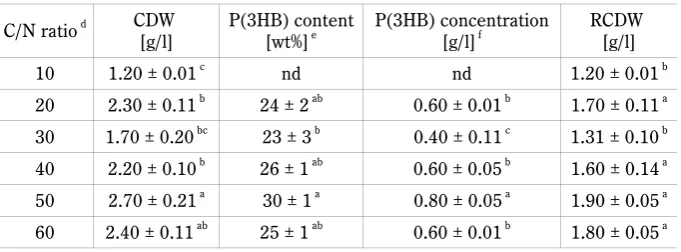
The production of P(3HB) using various C/N ratios, with glucose as a carbon source and urea as a nitrogen source, is shown in Table 1. Cerrone et al. (2012)
re-ported that seven species from the Massilia genus,
in-cluding Massilia albidiflava, Massilia dura, Massilia lutea, Massilia brevitalea, Massilia aurea, and Massilia plicata, could synthesize P(3HB) using starch without fixing the
C/N ratio. Because M. haematophila has never been
screened for the best C/N ratio of P(3HB) production, we tested a well-known range based on previous reports. A C/N ratio of 50 yielded the maximum P(3HB) produc-tion and bacterial growth in this study. The P(3HB) production increased from 0.40 ± 0.11 to 0.80 ± 0.05 g/l when C/N ratio was increased from 30 to 50. However, P(3HB) accumulation decreased to 0.60 ± 0.01 g/l at the
C/N ratio of 60. M. haematophila UMTKB-2 was unable
Table 1. Effect of various C/N ratios on P(3HB) production
C/N ratio d CDW
[g/l] P(3HB) content[wt%]e P(3HB) concentration[g/l]f RCDW [g/l]
10 1.20 ± 0.01c nd nd 1.20 ± 0.01b
20 2.30 ± 0.11b 24 ± 2ab 0.60 ± 0.01b 1.70 ± 0.11a
30 1.70 ± 0.20bc 23 ± 3b 0.40 ± 0.11c 1.31 ± 0.10b
40 2.20 ± 0.10b 26 ± 1ab 0.60 ± 0.05b 1.60 ± 0.14a
50 2.70 ± 0.21a 30 ± 1a 0.80 ± 0.05a 1.90 ± 0.05a
60 2.40 ± 0.11ab 25 ± 1ab 0.60 ± 0.01b 1.80 ± 0.05a
C/N – carbon to nitrogen; CDW – cell dry weight; P(3HB) – Poly(3-hydroxybutyrate); RCDW – residual cell dry weight; nd – not detected. The data are the mean value derived from three independent repeats. a-c within the same column are significantly different at P# 0.05 level
(Tukey test); d the glucose concentrations 0.1 wt%, 0.3 wt%, 0.4 wt%, 0.6 wt%, 0.7 wt% and 0.8 wt%
were applied to C/N ratios 10, 20, 30, 40, 50 and 60 respectively; e P(3HB) content in freeze-dried
cell was analyzed by gas chromatography (GC-FID); f P(3HB) content multiple by CDW
Several studies stated that relatively higher P(3HB) concentrations were accumulated within C/N ratios of 20–50 (Amirul et al., 2008; Wang et al., 2007). The PhaA
(β-ketothiolase enzyme) condenses acetyl-CoA into
acetoacetyl-CoA, followed by reduction by PhaB (aceto-acetyl-CoA reductase enzyme) to (R)-3-hydroxybutyryl-CoA, and polymerization into P(3HB) by PhaC (PHA syn-thase enzyme) (Bhubalan et al., 2011). This biosynthesis pathway can be used to convert glucose into P(3HB). Amirul and co-workers stated that the use of C/N ratio of >50 had a negative effect on the bacterial growth and PHA production. The bacterial growth and PHA yield, which were 8.31 g/l and 5.60 g/l at the C/N ratio of 20 decreased to 5.20 g/l and 3.60 g/l at the C/N ratio of 50 (Amirul et al., 2008). In conclusion, the C/N ratio of 50 was appropriate for the accumulation of P(3HB) by M. haematophila UMTKB-2.
Effect of various 3HV precursors on P(3HB-co-3HV) production
We evaluated the ability of M. haematophila UMTKB-2
to produce P(3HB-co-3HV) copolymer from valeric acid,
sodium propionate, sodium valerate, and 1-pentanol with glucose (Table 2). This strain was tested for producing
other copolymers, such as P(3HB-co-4HB); however, no
bacterial growth was observed when other 4-hydroxy-butyrate (4HB) precursors were added (data not shown).
The use of a common 3HV precursor, valeric acid, contributed to the highest 3HV monomer composition (91 ± 1 mol%) incorporated in the P(3HB) homopolymer compared with other 3HV precursors (Table 2). This
might be influenced by the alternative pathway that con-verted valeric acid to valery-CoA by an enzyme known as acyl-CoA synthase (Huong et al., 2017). Based on similar reports, valeryl-CoA was further converted into the (R)-3-hydroxyvaleryl-CoA and finally converted to the copoly-meric 3HV monomer unit. A similar result was reported by Bhubalan and co-workers (2008), whereby the use of valeric acid as a precursor led to a two-fold increase in the 3HV monomer composition. However, the acid form of this precursor inhibited bacterial growth, which was caused by the toxicity effect towards bacterial cells.
Salt-based precursors, such as sodium valerate and sodium propionate, are less toxic compared to acid-ba-sed precursors such as valeric acid (Bhubalan et al.,
2008). Some bacteria, such as Burkholderia sacchari
IPT101T and Corynebacterium glutamicum, exhibited
a similar increase in cell biomass when sodium propio-nate was supplied to the growth media (Brämer et al., 2002; Matsumoto et al., 2011). Based on the same re-ports, sodium propionate, when supplied to both bacteria B. sacchari and C. glutamicum, was converted into pro-pionyl-CoA and then utilized in the 2-methylcitrate cycle for subsequent use by the tricarboxylic acid cycle and growth. Compared to acid-based precursors, a higher bac-terial growth but a lower 3HV monomer composition was obtained using salt-based precursors.
To date, there has been no report on the capability of the Massilia genus for utilizing either alcohol-based pre-cursors or alcohol-based carbon sources. This is the first
study on the versatility of M. haematophila for
P
H
A
c
ont
ent
[w
t%
]
3H
V mon
o
m
e
r
co
m
pos
iti
o
n [
m
ol
%
]100 90 80 70 60 50 40 30 20 10 0
CD
W
[g
/l]
P
H
A
c
onc
entr
a
tii
on
[g
/l]
RCD
W
[g
/l]
I
II III IV
1
2
3
6
5
4
3
2
1
0 0 12 24 36 48 60 72 84 96 108 120
Time [h] Table 2. Effect of different precursors with glucose on P(3HB!co!3HV) production
Substrate CDW[g/l] P(3HBcontent-co-3HV) [wt%]e
Monomer composition [mol%] P(3HB-co-3HV)
concentration [g/l]f
RCDW [g/l]
3HB 3HV
Valeric acid 0.80 ± 0.14c 4 ± 1b 9 ± 1a 91 ± 1a 0.10 ± 0.01b 0.70 ± 0.10c
1-pentanol 3.00 ± 0.10a 45 ± 2a 93 ± 1d 7 ± 1d 1.30 ± 0.20a 1.70 ± 0.10a
Sodium propionate 1.10 ± 0.10b 2 ± 1b 29 ± 4b 74 ± 4b 0.10 ± 0.01b 1.00 ± 0.01b
Sodium valerate 0.90 ± 0.01b 3 ± 1b 34 ± 3c 66 ± 3c 0.10 ± 0.01b 0.80 ± 0.10bc
CDW – cell dry weight; P(3HB-co-3HV) – poly(3-hydroxybutyrate-co-3-hydroxyvalerate); 3HB – 3-hydroxybutyrate; 3HV – 3-hydroxyvalerate; RCDW – residual cell dry weight. The data are the mean value derived from three independent repeats. Approximately 0.64 wt% of glucose was added for each combination and 3HV precursor concentration was standardized at 0.06 wt%. a–d within the same column are significantly
different at P# 0.05 level (Tukey test); e P(3HB-co-3HV) content in freeze-dried cell was analyzed by gas chromatography (GC-FID); f P(3HB-co-3HV) content multiple by CDW
precursor. This strain, cultivated using 1-pentanol (3HV precursor) and glucose as the carbon sources, had
achie-ved the highest P(3HB-co-3HV) content at 45 ± 2 wt%
with a copolymer concentration of 1.30 ± 0.20 g/l. This is likely caused by the alcohol’s relatively lower toxicity toward bacterial cells compared to other 3HV precursors (Shantini et al., 2013; Huong et al., 2017). For example, the use of 1-pentanol with oleic acid resulted in the pro-duction of up to 4.5 ± 0.3 g/l with 8 mol% of 3HV
mono-mer by Cupriavidus sp. USMAA2-4 (Shantini et al.,
2013). In conclusion, M. haematophila UMTKB-2
sho-wed a good versatility using either salt-based or
alcohol-based precursors for P(3HB-co-3HV) copolymer
accu-mulation.
Stages of P(3HB-co-3HV) copolymer accumulation
The incubation duration for producing P(3HB
-co-3HV) and overall bacterial growth was investigated. The PHA production and cell growth of most bacteria, such as Bacillus aryabhattai and Halomonas campisalis MCM
B-1027, reached the stationary phase at -36 h when
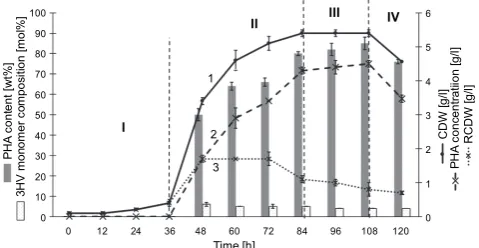
in-cubated using semi-optimized PHA production condi-tions (Kulkarni et al., 2010; Pillai et al., 2017). However, M. haematophila UMTKB-2 showed a long dormant ac-climatization of up to 36 h for growth (below 0.50 g/l) and no copolymer accumulation because of the slow ada-ptation of this strain in the nutrient-limited media
(Fig. 1). Furthermore, a rapid increase in P(3HB
-co-3HV) accumulation and cell growth was observed be-tween 48 and 84 h. The RCDW was maintained at 1.70 ± 0.10 g/l between 48 and 72 h with a slight decline to 1.10 ± 0.10 g/l at 84 h. The accumulation of copolymer began at 48 h (1.70 ± 0.10 g/l), and then drastically in
Fig. 1. Effect of incubation on P(3HB-co-3HV) production by M. haematophila UMTKB-2 using shaken-flask cultivation, glucose as carbon source, 1!pentanol as 3HV precursor, and urea as nitrogen source; the data are the mean value derived from three independent repeats; the cultures were incubated at 200 rpm at 30EC; the cultures were harvested every 12 h; I – lag phase; II – exponential phase; III – stationary phase
and IV – death phase
creased until the final exponential phase at 84 h (4.2
± 0.05 g/l). Based on this result, M. haematophila
UMTKB-2 was determined as a growth-associated PHA-producing bacterium and was categorized within the two major groups of PHA producers (Shabina et al., 2015).
The copolymer accumulation and cell growth reached the stationary phase between 84 and 108 h, whereby the RCDW slightly decreased from 1.10 ± 0.02 to 0.80 ± 0.04 g/l at 84 and 108 h, respectively. The copolymer concentration was relatively consistent (4.30 ± 0.04 g/l
to 4.40 ± 0.03 g/l). M. haematophila UMTKB-2 achieved
the highest copolymer production at the stationary phase, which is similar to the results obtained by Paula
and co-workers (2017) using Pandoraea sp. cultivated in
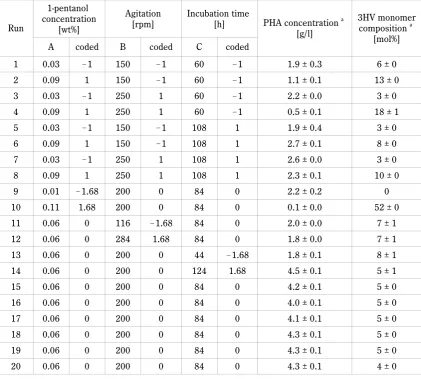
Table 3. Experimental design for the optimization of P(3HB-co-3HV) as suggested by RSM
Run
1-pentanol concentration
[wt%]
Agitation
[rpm] Incubation time [h] PHA concentration a
[g/l]
3HV monomer composition a
[mol%]
A coded B coded C coded
1 0.03 !1 150 !1 60 !1 1.9 ± 0.3 6 ± 0
2 0.09 1 150 !1 60 !1 1.1 ± 0.1 13 ± 0
3 0.03 !1 250 1 60 !1 2.2 ± 0.0 3 ± 0
4 0.09 1 250 1 60 !1 0.5 ± 0.1 18 ± 1
5 0.03 !1 150 !1 108 1 1.9 ± 0.4 3 ± 0
6 0.09 1 150 !1 108 1 2.7 ± 0.1 8 ± 0
7 0.03 !1 250 1 108 1 2.6 ± 0.0 3 ± 0
8 0.09 1 250 1 108 1 2.3 ± 0.1 10 ± 0
9 0.01 !1.68 200 0 84 0 2.2 ± 0.2 0
10 0.11 1.68 200 0 84 0 0.1 ± 0.0 52 ± 0
11 0.06 0 116 !1.68 84 0 2.0 ± 0.0 7 ± 1
12 0.06 0 284 1.68 84 0 1.8 ± 0.0 7 ± 1
13 0.06 0 200 0 44 !1.68 1.8 ± 0.1 8 ± 1
14 0.06 0 200 0 124 1.68 4.5 ± 0.1 5 ± 1
15 0.06 0 200 0 84 0 4.2 ± 0.1 5 ± 0
16 0.06 0 200 0 84 0 4.0 ± 0.1 5 ± 0
17 0.06 0 200 0 84 0 4.1 ± 0.1 5 ± 0
18 0.06 0 200 0 84 0 4.3 ± 0.1 5 ± 0
19 0.06 0 200 0 84 0 4.3 ± 0.1 5 ± 0
20 0.06 0 200 0 84 0 4.3 ± 0.1 4 ± 0
The values given above are the average of three experiments each in triplicate conducted on different occasions. a calculated from GC analysis
(50 wt%) at the stationary phase of growth. The 3HV monomer composition slightly decreased, while the co-polymer production increased during the fermentation period (Fig. 1). Moreover, as shown by Shantini (2015), lesser amounts of 3HB monomer were incorporated into the copolymer chains during the early phase of
fermenta-tion. By increasing the fermentation of M. haematophila
UMTKB-2, more 3HB monomers were synthesized and the PHA concentration in bacterial cells increased. Si-multaneously, the 3HV monomer production decreased too. This result was similar to a recent study where the 3HV monomer composition of the copolymer
synthe-sized by Cupriavidus sp. USMAA2-4 declined from
25 mol% at 24 h to 5 mol% at 72 h (Shantini 2015).
Optimization of P(3HB-co-3HV) production using the statistical design
To maximize the production of P(3HB-co-3HV) by
M. haematophila UMTKB-2, the fermentation parameters, namely, 1-pentanol concentration, agitation and incubation time, were investigated using RSM. Note that RSM had
been carried out on bacterium Cupriavidus sp. USM1020
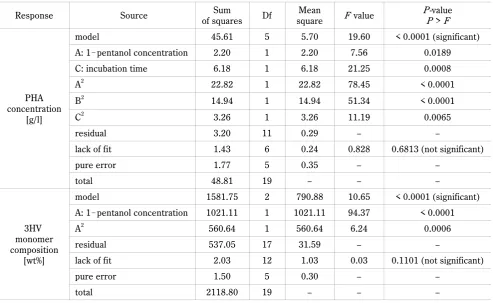
Table 4. Analysis of variance (ANOVA) and regression analysis for PHA concentration and 3HV monomer composition in RSM
Response Source of squaresSum Df squareMean F value PP-value > F
PHA concentration
[g/l]
model 45.61 5 5.70 19.60 < 0.0001 (significant)
A: 1!pentanol concentration 2.20 1 2.20 7.56 0.0189
C: incubation time 6.18 1 6.18 21.25 0.0008
A2 22.82 1 22.82 78.45 < 0.0001
B2 14.94 1 14.94 51.34 < 0.0001
C2 3.26 1 3.26 11.19 0.0065
residual 3.20 11 0.29 – –
lack of fit 1.43 6 0.24 0.828 0.6813 (not significant)
pure error 1.77 5 0.35 – –
total 48.81 19 – – –
3HV monomer composition
[wt%]
model 1581.75 2 790.88 10.65 < 0.0001 (significant)
A: 1!pentanol concentration 1021.11 1 1021.11 94.37 < 0.0001
A2 560.64 1 560.64 6.24 0.0006
residual 537.05 17 31.59 – –
lack of fit 2.03 12 1.03 0.03 0.1101 (not significant)
pure error 1.50 5 0.30 – –
total 2118.80 19 – – –
R2 (RCDW) = 0.9273; R2 (PHA concentration) = 0.9344; R2 (3HV monomer) = 0.9010; Df – degree of freedom; F – variance ratio; P – probability
In Table 3, the results on 20 experiment runs in RSM are presented. To define the significance of the three-response model, ANOVA was performed and the data are shown in Table 4. The model was highly significant as evident from a low probability value (P > F), which is < 0.0001 for both 3HV monomer composition and PHA
concentration. Furthermore, the “Lack-of-fit F value” for
the 3HV monomer composition and PHA concentration were 0.030 and 0.828, respectively, which indicated that all lack-of-fit values were insignificant relative to pure error. The ANOVA clearly indicated that all models had effectively fitted the experimental data. The coefficient
R2 was used to determine the goodness-of-fit of the
mo-del. For all the responses, R2 was more than 90%, which
indicated that this experiment was reliable.
The RSM generated the following regression equa-tions with the responses and tested variables in the co-ded unit irrespective of their significance:
PHA concentration = 4.96 ! 0.40A ! 0.033B + 0.67C !
+ 0.25AB + 0.39AC + 0.073BC !
+ 1.26A2! 1.02B2! 0.48C2 (6)
3HV monomer = 4.67 + 8.65A + 0.29B ! 1.54C + + 1.25AB ! 1.25AC ! 9.465E!16BC +
+ 6.12A2! 0.24B2! 0.42C2 (7)
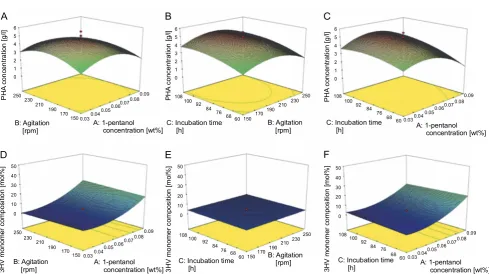
The terms A, B, and C represent the coded factors of 1-pentanol concentration, agitation and incubation time, respectively. Moreover, the 3D response surface is a re-latively visual representation to study the interaction between variables and responses. Figure 2 shows the 3D response surfaces for the PHA concentration and 3HV monomer composition.
agita-A B C
D E F
P H A c onc en tr at io n [g /l] P H A c onc ent ra tion [g/ l] P H A c onc e ntr ati on [g /l] B: Agitation [rpm] A: 1-pentanol concentration [wt%] 6 5 4 3 2 1 0 6 5 4 3 2 1 0 6 5 4 3 2 1 0 B: Agitation [rpm] B: Agitation [rpm] B: Agitation [rpm] A: 1-pentanol concentration [wt%] A: 1-pentanol concentration [wt%] A: 1-pentanol concentration [wt%] C: Incubation time
[h]
C: Incubation time [h]
C: Incubation time [h]
C: Incubation time [h] 3H V m on ome r co mp osi tio n [ m o l% ] 3 H V mo nome r c om pos iti on [ m ol% ] 3 H V mono mer c o mpos ition [mol %] 50 40 30 20 10 0 50 40 30 20 10 0 50 40 30 20 10 0 250 230 210 190 170
150 0.030.04 0.050.06 0.070.08 0.09 108 100 92 84 76
6860 150 170 190 210
230250 108100 92
84 76
68 60 0.030.04
0.050.06 0.070.08 0.09 250 230 210 190 170
150 0.030.04 0.050.06 0.070.08 0.09 108 100 92 84 76 68 60 150170
190210
230250 108100 92
84 76 68
60 0.030.04 0.050.06
0.070.08 0.09
Fig. 2. The 3D surface graphs generated by RSM: response toward PHA concentration (A–C) and 3HV monomer composition (D–F); the interaction effect of: differenced 1!pentanol concentration and agitation at 84 h (A and D), differenced incubation time and agitation at 0.06 wt% 1!pentanol concentration (B and E) and differenced 1!pentanol concentration and incubation
time at 200 rpm (C and F)
tion negatively affected copolymer production. Agitation can be studied as a parameter that influences the amount of dissolved oxygen in shaken-flask cultures, and the aggregation or shearing of bacterial cells (Zhou et al., 2018). According to Baei et al. (2010), high agita-tion rates caused a high shear force that disturbed the formation of PHA granules in the bacterial cells. Further-more, a decreased PHA productivity was reported with agitation rates of > 220 rpm despite the increased bac-terial growth (Alsafadi and Mashaqbeh, 2017; Kynadi and Suchithra, 2017). However, agitation rates below the optimal level caused cell aggregation and a heterogene-ous culture media (Musa et al., 2016). Furthermore, agi-tation was used as an optimisation parameter of PHA production in several studies (Aramvash et al., 2015; Ge-ethu et al., 2019).
Increasing the concentration of 1-pentanol from 0.03 to 0.09 wt% considerably increased the 3HV monomer composition, but the latter was unaffected by agitation or incubation time (Fig. 2D, Fig. 2E and Fig. 2F). The 3HV monomer composition that had been increased by ele-vating the 1-pentanol concentration could be because of
the enzyme expression or pH. One of the enzymes, 3-ketothiolase, led to the formation of 3-ketovaleryl-CoA. A higher expression of 3-ketothiolase could lead to a higher amount of 3HV monomer (Shantini et al.,
2013).Other than the enzyme expression, pH has been
known to affect the monomer composition of the copoly-mer at certain levels (Salim et al., 2011).
ob-Table 5. PHA concentration and 3HV monomer composition before and after optimization of conditions
Variables PHA concentration[g/l] 3HV monomer composition[mol%]
beforec afterd before after before after
predictede actualf predictede actualf
1-pentanol concentration [wt%] 0.06 0.07
4.40 ± 0.03b 4.34 5.00 ± 0.04a 4b 6 7a
Agitation [rpm]
Incubation time [h] 200108 176122
RCDW – residual cell dry weight; 3HV – 3-hyroxyvalerate; a-b within the same column are significantly different at P# 0.05 level (Tukey test); c conditions before optimization; d conditions after optimization; e predicted value generated by software; f actual value; the data shown are
the average of 3 replicates
Table 6. Mechanical and thermal properties of polymers
Polymer
Properties
mechanicalf thermalg
tensile strength
[MPa]
Young’s modulus [MPa]
elongation of break
[%]
melting temperature
[TmEC]
glass transition temperature
[TgEC]
Hm
[J/g] crystallinity h [%]
P(3HB) 17 ± 1b 239 ± 7b 7 ± 1b 172 ± 1a 6.9 ± 0.1a 65.4± 1.0 a 46 ± 1a
P(3HB-co-7 mol% 3HV)i 11 ± 1c 97 ± 6c 13 ± 1a 149 ± 1c 4.4 ± 0.2b 48.7 ± 1.0c 34 ± 1b
P(3HB-co-6 mol% 3HV)j 25 ± 2a 196 ± 12d 8 ± 1b 167b !7c 46b 33b
P(3HB-co-24 mol% 3HV)j 14c 1300a NA 140d !12d NA NA
NA – not available; P(3HB) – poly(3-hydroxybutyrate); P(3HB-co-3HV) – poly(3-hydroxybutyrate-co-3-hydroxyvalerate); a–e within the same
column are significantly different at P# 0.05 level (Tukey test); f mechanical properties were determined by using tensile machine (the data
shown are the average of 10 replicates); g thermal properties were determined by using DSC (the data shown are the average of 3 replicates); h percentage of crystallinity was calculated based on Gumel et al. (2012); i data obtained from the post-optimized copolymer of this study; j data obtained from Shantini et al. (2013)
served; hence, the value gap obtained in this study was considered as normal. Using optimized conditions with the RSM statistical tool, the actual PHA yield produced was higher than the predicted PHA yield.
Furthermore, the result from the optimal conditions was compared to the result from the OFAT method (un-optimized conditions). After optimization using RSM, a 14% increment was observed of PHA concentration from 4.40 ± 0.03 g/l to 5.00 ± 0.04 g/l. Moreover, the 0.01 wt% increase of 1-pentanol supply, as suggested by the software, had accumulated copolymer with approxi-mately twofold increment of 3HV monomer composition from 4 to 7 mol%. However, in this study, the 3HV mono-mer composition obtained achieved a two-fold increase that was higher than the result obtained by Huong and co-workers who observed a decrease in 3HV monomer com-position after RSM optimization (Huong et al., 2017).
Characteristics of the PHA produced by UMTKB-2
The properties of P(3HB-co-7 mol% 3HV) copolymer
produced by Massilia haematophila have been examined
in this study. The polymeric randomness was determi-ned by carbonyl resonance, which split into four peaks according to the dial sequences of B*B, V*V, and B*V + V*B (Kynadi and Suchithra, 2017). The dyad sequence distributions for the FBB,FBV, FVB, and FVV values of the copolymer were 0.8288, 0.0650, 0.0736, and 0.0255,
respectively. As expected, the result showed that P(3HB
-co-7 mol% 3HV) was a block copolymer, which
corres-ponded with two studies whereby, similar block
copoly-mers were synthesized using Paracoccus denitrificans
ATTC 17741 (Chanprateep et al., 2006) and
Cupria-vidus sp. USMAA2-4 (Shantini, 2015). The P(3HB -co-3HV) that has more than 7 mol% of 3HV units was de-termined as a random copolymer, in agreement with
Table 6 shows the mechanical and thermal properties
of the polymers. The Tm of the P(3HB-co-3HV)
copoly-mers of this study fell in a normal range between 150
and 160EC (Allen et al., 2010). According to Table 6,
both Tm and Tg decreased in the following order, which
was inversely correlated with the 3HV monomer
compo-sition: P(3HB-co-24mol% 3HV) < P(3HB-co-7 mol% 3HV)
< P(3HB). The copolymer in this study had a Tm that was
lower than 160EC; hence, it was considered as a stable
polymer with reduced thermal degradation of molecular weight for better processing in industrial applications such as packaging (Bhati and Mallick, 2012). Moreover, the elastomeric properties of the copolymer increased because of the large volume of molecular movement that increased mobility in the amorphous state (Bhati and Mallick, 2012).
By incorporating 7 mol% of 3HV monomers, the co-polymers showed a significant decrease in the per-centage of crystallinity (34 ± 1%) compared to P(3HB) (46 ± 1%). The copolymers with a lower percentage of
crystallinity showed a lower Hm value (Table 6). This is
because of the slower rate of crystal growth and nuclea-tion in copolymers as the ethyl side chains of 3HV mono-mer units acted as an obstruction to the P(3HB) lattice, thus increasing the lattice dimension (Kunioka et al., 1989). In the current study, the percentage of polymer crystallinity was half of the values reported by Silva and co-workers (2005), which was 62–64% for the polymers that contained 0–8 mol% of 3HV monomer, respectively. Furthermore, the crystallization process influenced the
mechanicalproperties of the copolymer (Pena etal., 2014).
The P(3HB-co-3HV) comprising >30 mol% of 3HV
mono-mer showed isomorphism properties (Liu et al., 2014);
hence, no isomorphism occurred in P(3HB-co-7 mol%
3HV). Furthermore, the mechanical properties of the
polymer were affected by Tg. In this study, the polymeric
tensile strength observed decreased by 6 MPa when Tg
decreased by -3EC (Table 6), which indicated that the
co-polymer became softer and more flexible compared to P(3HB). Zakaria and co-workers (2013) stated that a ten-sile strength of 14 MPa, which is close to the tenten-sile
strength (11 MPa) of P(3HB-co-7mol% 3HV), was
obser-ved for P(3HB-co-7mol% 3HV) synthesized in this study.
Conclusions
This is the study to report the PHA-producing ability
of the species and strain, M. haematophila UMTKB-2.
This brackish-water isolate was able to synthesize the
block P(3HB-co-3HV) copolymer with the 3HV
comono-mer using alcohol-based or acid-based 3HV precursors,
as well as glucose as a carbon source. M. haematophila
UMTKB-2 demonstrated good versatility for utilizing an
alcohol-based precursor, 1-pentanol, to produce P(3HB
-co-3HV). The condition optimization of PHA production
through statistical modeling successfully increased the
accumulation of P(3HB-co-3HV) in terms of PHA
concen-tration and 3HV monomer composition. The optimiza-tion almost doubled the 3HV monomer composioptimiza-tion and increased the copolymer production by 14%. The optimal
conditions to produce P(3HB-co-3HV) from this strain
are as follows: 0.07 wt% of 1-pentanol, 176 rpm agitation rate, and 122 h of incubation time. Moreover, this strain and species had been reported to produce P(3HB) in a previous study (Kiun et al., 2016).
Acknowledgments
The present research was supported by the National Institutes of Biotechnology Malaysia, Malaysian Institute of Pharma-ceuticals and NutraPharma-ceuticals [Grant number 02-05-23-SF0023] and K.J.T. is grateful for the MyMaster scholarship awarded by the Ministry of Education, Malaysia.
References
Aghjeh S.D., Aramvash A. (2015) One-factor-at-a-time optimi-zation of polyhydroxybutyrate production and growth of Alcaligenes eutrophus by altering culture parameters and incubation time. J. Sci. Islam. Republ. Iran 26: 303–313. Alsafadi D., Mashaqbeh O. (2017) A one-stage cultivation pro-cess for the production of poly-3-(hydroxybutyrate-co-hy-droxyvalerate) from olive mill wastewater by Haloferax mediterranei. New Biotechnol. 34: 47–53.
Allen A.D., Anderson W.A., Ayorinde F.O., Eribo B.E. (2010) Biosynthesis and characterization of copolymer poly(3HB-co-3HV) from saponified Jatropha curcas oil by Pseudomonas oleovorans. J. Ind. Microbiol. Biotechnol. 37: 849–856. Amirul A.A., Yahya A.R.M., Sudesh K., Azizan M.N.M., Majid
M.I.A. (2008) Biosynthesis of poly(3-hydroxybutyrate-co-4-hydroxybutyrate) copolymer by Cupriavidus sp. USMAA1020 isolated from Lake Kulim, Malaysia. Bio-resour. Technol. 99: 4903–4909.
Aramvash A., Shahabi Z.A., Aghjeh S.D., Ghafari M.D. (2015) Statistical physical and nutrient optimization of bioplastic polyhydroxybutyrate production by Cupriavidus necator. Int. J. Environ. Sci. Technol. 12: 2307–2316.
Bassas-Galia M., Nogales B., Arias S., Rohde M., Timmis K.N., Molinari G. (2012) Plant original Massilia isolates pro-ducing polyhydroxybutyrate, including one exhibiting high yields from glycerol. J. Appl. Microbiol. 112: 443–454. Berezina N. (2012) Enhancing the 3-hydroxyvalerate
compo-nent in bioplastic PHBV production by Cupriavidus neca-tor. Biotechnol. J. 7: 304–309.
Bhati R., Mallick N. (2012) Production and characterization of poly(3-hydroxybutyrate-co-3-hydroxyvalerate) co-polymer by a N2-fixing cyanobacterium, Nostoc muscorum Agardh. J. Chem. Technol. Biotechnol. 87: 505–512.
Bhubalan K., Chee J.Y., Sudesh K. (2011) Prospect and su-stainable production of polyhydroxyalkanoate from palm oil. [in:] Bioprocess sciences and technology. Ed. Liong M.T., USA, Nova Science Publishers: 55–84.
Bhubalan K., Lee W.H., Loo C.Y., Yamamoto T., Tsuge T., Doi Y., Sudesh K. (2008) Controlled biosynthesis and chara-cterization of poly(3-hydroxybutyrate-co-3-hydroxyvalerate-co-3-hydroxyhexanoate) from mixtures of palm kernel oil and 3HV-precursors. Polym. Degrad. Stab. 93: 17–23. Brämer C., Silva L.F., Gomez J.G., Priefert H., Steinbuchel A.
(2002) Identification of the 2-methylcitrate pathway invol-ved in the catabolism of propionate in the polyhydroxy-alkanoate-producing strain. Microbiology 68: 271–279. Braunegg G., Sonnleitner B., Laffer R.M. (1978) A rapid gas
chromatographic method for the determination of Poly-$ -hydroxybutyri acid in microbial biomass. Eur. J. Appl. Microbiol. Biotechnol. 6: 29–37.
Cerrone F., Peinado M.D.M.S., Díaz M.R., López J.G., Pozo C. (2012) PHAs production by strains belonging to Massilia genus from starch. Starch 63: 236–240.
Chanprateep S., Shimizu H., Shioya S. (2006) Characterization and enzymatic degradation of microbial copolyester P(3HB-co-3HV)s produced by metabolic reaction model-based system. Polym. Degrad. Stab. 91: 2941–2950. Doi Y. (1995) Microbial synthesis, physical properties, and
biodegradability of polyhydroxyalkanoates. Macromol. Symp. 98: 585–599.
Geethu M., Vrundha R., Chandrashekar H.R., Divyashree M.S. (2019) Improvement of the production and characterisa-tion of polyhydroxyalkanoate by Bacillus endophyticus using inexpensive carbon feedstock. J. Polym. Environ. https://doi.org/10.1007/s10924-019-01397-z
Han J., Wu L.P., Hou J., Zhao D., Xiang H. (2015) Biosynthesis, characterization, and hemostasis potential of tailor-made poly(3-hydroxybutyrate-co-3-hydroxyvalerate) produced by Haloferax mediterranei. Biomacromolecules 16: 578–588. Han X., Satoh Y., Kuriki Y., Seino T., Fujita S., Suda T. et al.
(2014) Polyhydroxyalkanoate production by a novel bac-terium Massilia sp. UMI-21 isolated from seaweed, and molecular cloning of its polyhydroxyalkanoate synthase gene. J. Biosci. Bioeng. 118: 514–519.
Huong K.H., Shantini K., Lim S.Y.H., Amirul A.A. (2015) Bio-synthetic enhancement of single-stage poly(3-hydroxybuty-rate-co-4-hydroxybutyrate) production by manipulating the substrate mixtures. J. Ind. Microbiol. Biotechnol. 42: 1291–1297.
Huong K.H., Shantini K., Sharmini R., Amirul A.A. (2017) Ex-ploring the potential of 1-pentanol and oleic acid for opti-mizing the production of poly(3-hydroxybutyrate-co-3-hydroxyvalerate) copolymer by Cupriavidus sp. USMAA1020. Arab J. Sci. Eng. 42: 2313–2320.
Jambeck J.R., Geyer R., Wilcox C., Siegler T.R., Peryman M., Andrady A., Narayan R., Law K.L. (2015) Plastic waste inputs from land into the ocean. Science 347: 768–771. Kamiya N., Yamamoto Y., Inoue Y., Chiib R., Doi Y. (1989)
Microstructure of bacterially synthesized poly(3-hydroxy-butyrate-co-3-hydroxyvalerate. Macromolecules 22: 1676–1682.
Kampfer P., Falsen E., Busse H.J. (2008) Naxibacter varians sp. nov. and Naxibacter haematophilus sp. nov., and emen-ded description of the genus Naxibacter. Int. J. Syst. Evol. Microbiol. 58: 1680–1684.
Kampfer P., Lodders N., Martin K., Falsen E. (2011) Revision of the genus Massilia La Scola et al. 2000, with an emen-ded description of the genus and inclusion of all species of the genus Naxibacter as new combinations, and proposal of Massilia consociata sp. nov. Int. J. Syst. Evol. Microbiol. 61: 1528–1533.
Kiun J.T., Bhubalan K., Amirul A.A. (2016) Novel PHA bio-plastic producing bacteria isolated from brackish environ-ment. [in:] The 14th Symposium of Malaysian Society of Applied Biology. Ed. Ibrahim N., Ryadi H., Dyari E., Sairi F., Liew W.Y.P., Ali M.M., Omar R., Malacca: The Malay-sian Society of Applied Biology: 149–155.
Koller M., Salerno A., Strohmeier K., Schober S., Mittelbach M., Illieva V., Chiellini E., Braunegg G. (2014) Novel pre-cursors for production of 3-hydroxyvalerate-containing poly[(R)-hydroxyalkanoate]s. Biocatal. Biotransformation 32: 161–167.
Kourmentza C., Plácido J., Venetsaneas N., Figols A.B., Var-rone C., Gavala H.N., Reis M.A.M. (2017) Recent advances and challenges towards sustainable polyhydroxyalkanoate (PHA) production. Bioengineering 4: 55.
Kulkarni S.O., Kanekar P.P., Nilegaonkar S.S., Sarnaik S.S., Jog J.P. (2010) Production and characterization of a bio-degradable poly (hydroxybutyrate-co-hydroxyvalerate) (PHB-co-PHV) copolymer by moderately haloalkalitolerant Halomonas campisalis MCM B-1027 isolated from Lonar Lake, India. Bioresour. Technol. 101: 9765–9771. Kunioka M., Tamaki A., Doi Y. (1989) Crystalline and thermal
properties of bacterial copolyesters: poly(3-hydroxybuty-rate-co-3-hydroxyvalerate) and poly(3-hydroxybutyrate-co-4 hydroxybutyrate). Macromolecules 22: 694–697. Kynadi A.S., Suchithra T.V. (2017) Formulation and
optimi-zation of a novel media comprising rubber seed oil for PHA production. Ind. Crops Prod. 105: 156–163. Lee S.Y., Choi J.I., Wong H.H. (1999) Recent advances in
polyhydroxyalkanoate production by bacterial fermenta-tion: mini-review. Int. J. Biol. Macromol. 25: 31–36. Liu Q., Zhang H., Deng B., Zhao X. (2014) Poly
Loo C., Sudesh K. (2007) Polyhydroxyalkanoates: bio-based microbial plastics and their properties. MPJ 2: 31–57. Matsumoto K., Kitagawa K., Jo S.J., Song Y., Taguchi S. (2011)
Production of poly(3-hydroxybutyrate-co-3-hydroxyvalerate) in recombinant Corynebacterium glutamicum using propio-nate as a precursor. J. Biotechnol. 152: 144–146.
Morshedi A., Akbarian M. (2014) Application of response sur-face methodology: design of experiments and optimization: a mini review. JLS 4: 2434–2439.
Musa H., Bolanle B.B., Kasim F.H., Arbain D. (2016) Scre-ening and production of polyhydroxybutyrate (PHB) by bacterial strains isolated from rhizosphere soil of ground-nut plants. Sains Malaysiana 45: 1469–1476.
Narayanan A., Ramana K.V. (2012) Polyhydroxybutyrate pro-duction in Bacillus mycoides DFC1 using response surface optimization for physico-chemical process parameters. 3 Biotech 2: 287–296.
Paula F.C.D., Kakazu S., Paula C.B.C.D., Gomez J.G.C., Con-tiero J. (2017) Polyhydroxyalkanoate production from crude glycerol by newly isolated Pandoraea sp. JKSUS 29: 166–173.
Pena C., Castillo T., Garcia A., Millan M., Segura D. (2014) Bio-technological strategies to improve production of microbial poly-(3-hydroxybutyrate): A review of recent research work. Microb. Biotechnol. 7: 278–293.
Pillai A.B., Jaya Kumar A., Thulasi K., Kumarapillai H. (2017) Evaluation of short-chain-length polyhydroxyalkanoate ac-cumulation in Bacillus aryabhattai. Braz. J. Microbiol. 48: 451–460.
Salim Y.S., Abdullah A.A.A., Nasri C.S.S.M., Ibrahim M.N.M. (2011) Biosynthesis of poly(3-hydroxybutyrate-co-3-hy-droxyvalerate) and characterisation of its blend with oil palm empty fruit bunch fibers. Bioresour. Technol. 102: 3626–3628.
Shabina M., Afzal M., Hameed S. (2015) Bacterial
poly-hydroxyalkanoates-eco-friendly next generation plastic: production, biocompatibility, biodegradation, physical pro-perties and applications. Green Chem. Lett. Rev. 8: 56–77. Shantini K. (2015) Optimized production of
Poly(3-hydroxy-butyrate-co-3-hydroxyvalerate) from Cupriavidus sp. USMAA2-4 and its characterization. Ph.D Thesis: Uni-versiti Sains Malaysia.
Shantini K., Bhubalan K., Yahya A.R.M., Amirul A.A. (2013) Productivity increment of biodegradable and biorenewable copolymer containing 3-hydroxyvalerate monomer initiated by alcohols as precursor substrates. J. Chem. Technol. Biotechnol. 88: 1364–1370.
Shantini K., Yahya A.R.M., Amirul A.A. (2012) Empirical mo-deling development for integrated process optimization of poly(3-hydrxybutyrate-co-3-hydroxyvalerate) production. J. Appl. Polym. Sci. 125: 2155–2162.
Silva M.G.D., Vargas H., Poley L.H., Rodriguez R.S., Baptista G.B. (2005) Structural impact of hydroxyvalerate in poly-hydroxyalkanoates (PHA scl) dense film monitored by XPS and photothermal methods. J. Brazil Chem. Soc. 14: 790–795.
Sudesh K., Bhubalan K., Chuah J.A., Kek Y.K., Kamilah H., Sridewi N., Lee Y.F. (2011) Synthesis of polyhydroxy-alkanoate from palm oil and some new applications. Appl. Microbiol. Biotechnol. 89: 1373–1386.
Wang Y.J., Hua F.L., Tsang Y.F., Chan S.Y., Sin S.N., Chua H., Yu P.H.F., Ren N.Q. (2007) Synthesis of PHAs from waster under various C:N ratios. Bioresour. Technol. 98: 1690–1693.
Yatim A.F.M., Syafiq I.M., Huong K.H., Amirul A.A.A., Effendy A.W.M., Bhubalan K. (2017) Bioconversion of novel and renewable agro-industry by-products into a biodegradable poly ( 3-hydroxybutyrate ) by marine Bacillus megaterium UMTKB-1 strain. BioTechnologia 98: 141–151.
Zafar M., Kumar S., Dhiman A.K. (2012) Optimization of poly-hydroxybutyrate (PHB) production by Azohydromonas lata MTCC 2311 by using genetic algorithm based on artificial neural network and response surface methodology. Bio-catal. Agric. Biotechnol. 1: 70–79.
agar F., Kr an A. (2009) Sequence distribution dependence on molar mass in microbial poly(3-hydroxybutyrate-co-3-hydroxyvalerate) copolyesters. Acta Chim. Slov. 52: 386–391.
Zakaria M.R., Ariffin H., Aziz S.A., Hassan M.A., Shirai Y. (2013) Improved properties of poly(3-hydroxybutyrate-co-3-hydroxyvalerate) produced by Comamonas sp. EB172 utilizing volatile fatty acids by regulating the nitrogen source. Biomed. Res. Int. 2013: 1–7.
Zakaria M.R., Ariffin H., Johar N.A.M., Aziz S.A., Nishida H., Shirai Y., Hassan M.A. (2010) Biosynthesis and characteri-zation of poly(3-hydroxybutyrate-co-3-hydroxyvalerate) copolymer from wild-type Comamonas sp. EB172. Polym. Degrad. Stab. 95: 1382–1386.