ISSN : 2394-2231
http://www.ijctjournal.org
Page 151
COMPARATIVE STUDY ON WIRELESS SENSOR NETWORK INTEGRATED
WITH CLOUD COMPUTING USING MIDDLEWARE SERVICES
1Mrs. Elavarasi J,
2Ms. Lavanya S.
1 M.Phil Research Scholar, Department of Computer Science Auxilium College (Autonomous), Vellore, TamilNadu,
India.
2Assisant Professor, HOD Department of Computer Science Auxilium College (Autonomous), Vellore,
TamilNadu, India.
---
************************
---Abstract:
Wireless Sensor Networks (WSN) has been a focal point for research for quite a few years. WSN
enables novel and attractive solutions for information gathering across the spectrum of Endeavour including
transportation, business, health-care, industrial automation, and environmental monitoring. Clouds are
mainly used for storage processing that provides infrastructure, applications and infrastructure. While
combining these two technology helps in easy management of remotely connected sensor nodes and the data
generated by these sensor nodes. In this field WSN integrated with cloud computing that enables several
applications. A sensor network is a group of specialized transducers with a communications infrastructure
intended to monitor and record conditions at diverse locations. Generally observed parameters are
temperature, humidity, pressure, wind direction and speed, illumination intensity, vibration intensity, sound
intensity, power-line voltage, chemical concentrations, pollutant levels and vital body functions. Here this
research mainly focused to observe the techniques which are proposed N care system with using WSN
integrated Cloud in recent years and evaluated with basic outline metrics and compare each system
performance based on the different situation.
Keywords
—Wireless Sensor Networks (WSN), spectrum, monitoring.
---
************************
---I. INTRODUCTION
The wireless sensor network (WSN) is becoming a very popular technology. Wireless which is comprised on a number of numerous sensor and they are interlinked or connected with each other for performing the same function collectively or cooperatively for the sake of checking and balancing the environmental factors. This type of networking is called as wireless sensor networking. A wireless sensor network(WSN) consists of a group of self organizing, lightweight sensor nodes that are used to cooperatively monitor temperature ,sound, humidity, vibration, pressure and motion. Each sensor node in a WSN is equipped with a radio transmitter,
several sensor, a battery unit and a microcontroller. Fig.1.1 Wireless Sensor Network
1.1 Inspiration
Cloud services include online file storage, social networking sites, webmail, and online business applications. The cloud computing model allows access to information and computer resources from anywhere that a network connection is available. Cloud computing provides a shared pool of resources, including data
ISSN : 2394-2231
http://www.ijctjournal.org
Page 152
storage space, networks, computer processing power, and specialized corporate and user applications. Recent electronics and computer technologies have paved the way for the proliferation of wireless sensor networks (WSN).
1.2 Wireless Sensor Network with Cloud Overview
WSN have generated tremendous interest among researchers these years because of their potential usage in a wide variety of applications. Sensor nodes are inexpensive portable devices with limited processing power and energy resources. Sensor node can be used to collect information from the environment, locally process this data and transmit the sensed data back to the user. Sensor nodes consists of five main components
Computing Unit Communication Unit Sensing Unit Memory Unit Power supply Unit
1.3 Applications of WSN
1.3.1 Earth/Environmental monitoring
It has evolved to cover many applications WSN to earth science research. This includes sensing volcanoes, oceans, glaciers, forests etc. some of the major areas are listed below.
Air Quality Monitoring Interior Monitoring Exterior Monitoring Air Pollution Monitoring
Forest Fire Detection
1.3.2 Agriculture
Using wireless sensor networks within the agricultural industry are increasing common using a wireless network frees the farmer from the maintenance of wiring in a difficult environment. Gravity feed water systems can be monitored using pressure transmitters to monitor water tank levels, back to a central control center for billing. Irrigation automation enables more efficient water use and reduces waste.
1.3.3 Area Monitoring
The WSN is developed over a region where some phenomenon is to be monitored. A military example is the use of sensors detects enemy intrusion; a civilian example is the geo-fencing of gas or oil pipelines.
II. LITERATURE REVIEW
2.1. Cyber physical cloud systemThe authors propose a framework to integrate wireless sensor networks with Cloud. The users of the framework are not allowed to see or act on the data if they are not registered through the user identity & Access
Management Unit. Data coming from the WSN is passed through a gateway and sent to the data processing unit which stores it in the Data Repository also it alerts the Pub/Sub Broker that new data was received.
The broker checks the subscriptions with the help of Request Subscriber module and forwards the data to the respective users. Role-based Access Policy (RBAC) is used to authenticate and authorize users in the system. Also, in order to protect the data, the user identity & Access Management Unit implements Diffie-Hellman keys and Kerberos.
Disadvantages
Not more efficient use of resources Modular composition is difficult Rapid development and scalability risk
Smart adaptation to environment at not for every scale
2.2. WSN integrated Cloud Computing for Agricultural
Wen-Yaw Chung et al. present an integrated framework for agriculture monitoring systems composed of a WSN which collects data from temperature, humidity etc. sensors and a Cloud platform which stores and presents the data and useful graphs to the users The proposed Cloud system has 1 master server and 4 slave computers which are doing the work of collecting, sampling and analyzing sensors data. Also the client communicates with the system through a web service. either a data curve or a panorama map. On the panorama map the user can click on the specific sensor to see its information and data that it generated.
The system presents an integrated wireless sensor network (WSN) to monitor the information from agriculture systems namely temperature, humidity, hydro genii (pH) value...etc. The purpose is to provide a faster and more convenient platform for the client to obtain information from an array of sensor nodes that has been set-up in an agricultural system. A WSN will collect the values of various parameters from the front-end sensors at the host end. At the client sides, one can use the internet to request for Web Services that will store this big data into distributed SQL databases which are already in our proposed cloud system.
Disadvantages
Client’s end can’t monitor the environmental condition of the agricultural place at any place without internet connection.
Web Service and user control center not send acknowledgment properly.
Data packets were sent via only USB connection to the host end which transmits the Values of particular environmental parameters coming from the front-end sensors.
ISSN : 2394-2231
http://www.ijctjournal.org
Page 153
2.3 Secure Cloud-based Architecture for e-HealthWSNs
Alam Onik demonstrated the challenges of storing data using cloud computing technology. Accordingly, they were proposed Health Cloud architecture for secured data management of the patients To implement a fine grained privacy and security policy, in this proposed to implement Cipher text-Policy Attribute Based Encryption (CP-ABE algorithm within our proposed Security Manager module in our system.
In this system allows the users to have a fine grained access control using private keys to decrypt the encrypted files. Through performance evaluation we have measured the time needed for key generation, encryption and decryption. We are claiming that if we implement the CP-ABE algorithm in the cloud then there will be less performance overhead for the security and confidentiality of the data. Because it does not need to check whether a user in the cloud is doctor or other medical staff or patient.
Disadvantages
1. Sometimes reports will be change.
2. Data storage from WSN is slow from other function. 3. Well known person only can access this system. 4. Without secret key we can’t able to access patient
details.
III. PROPOSED WORK
3.1 CloudA Cloud system consists of 3 major components such as clients, datacenter, and distributed servers. Each element has a definite purpose and plays a specific role.
Clients
End users interact with the clients to manage information related to the cloud. Clients generally fall into three categories as given in:
Mobile: Windows Mobile Smartphone,
Smartphone, like a Blackberry, or an iPhone.
Thin: They don't do any computation work. They
only display the information. Servers do all the works for them. Thin clients don't have any internal memory.
Thick: These use different browsers like IE or
Mozilla Firefox or Google Chrome to connect to the Internet cloud.
Fig.3.1 Three components make up a cloud computing solution
3.2 Services Provided by Cloud Computing
Service means different types of applications provided by different servers across the cloud. It is generally given as "as a service". Services in a cloud are of 3 types as given in
Software as a Service (SaaS) Platform as a Service (PaaS) Hardware as a Service (HaaS) or Infrastructure as a Service (IaaS)
Software as a Service (SaaS)
In SaaS, the user uses different software applications from different servers through the Internet. The user uses the software as it is without any change and does not need to make lots of changes or doesn’t require integration to other systems. The provider does all the upgrades and patching while keeping the infrastructure running.
Platform as a Service (PaaS)
PaaS provides all the resources that are required for building applications and services completely from the Internet, without downloading or installing software. PaaS services are software design, development, testing, deployment, and hosting. Other services can be team collaboration, database integration, web service integration, data security, storage and versioning etc.
Fig.3.5 Platform as a service (PaaS)
Hardware as a Service (HaaS)
It is also known as Infrastructure as a Service (IaaS). It offers the hardware as a service to a organization so that it can put anything into the hardware according to its will.
3.3 Different Wireless Sensor Network with Cloud Approaches in Different Middleware
Comparative Study on all different Wireless Sensor Network Integrated Cloud Computing in different System levels of Applications. From our literature survey find six types of applications that provide by WSN in cloud network. In this approach can be identified by some important aspect of cloud users and performance of the system based some important metrics.
The main areas in WSN or Smart Grids Cloud Computing used are:
ISSN : 2394-2231
http://www.ijctjournal.org
Page 154
Military
Transportation
Health Care
Smart Cities
3.4 Wireless Sensor-Cloud Database
A sensor network produces huge amount of multidimensional streaming data which are inherently noisy and ephemeral in nature. The data in sensor network have spatio temporal dimension which needs additional processing unlike traditional database system. In sensor networks must have both live data and stored data processing i.e. sensor database must support continuous query processing and one-time query processing techniques.
3.5 Features
N-care System using following features; User Level N-care System on stock application Cloud setup and application deployment
Getting cloud statistics and performance evaluation of each node
Resource Monitoring of cloud nodes
Deploying an application war file on cloud nodes considering their CPU, RAM usage using cloud controller
IV. COMPARISON OF DIFFERENT APPROACHES IN SENSOR-CLOUD INFRASTRUCTURE
4.1 Design Phase Requirements for Network Control System (NCS)
The design phase requirements of Internet-based control systems which include requirement specification, architecture design, control algorithm design, interface design, and security and safety analysis.
These links result in a range of response time, resolution, reliability, and reparability depending upon the level at which the connection is made. For example, if a fast response time is required a link to the control loop level should be made.
If only management information is needed, the Internet should be linked with a higher level in the information architecture such as the management level or the optimization level.
Monitoring the condition of machinery via the Internet
Remotely control machine
Collaborate with skilled operators situated in geographically diverse location
4.1 Typical information architecture 4.2 Challenges in Sensor-Cloud
System architecture design, i.e. how to structure this new type of control system and where to place Internet in the control system
Overcoming Web-related traffic delay, i.e. dealing with Internet latency and data loss
Web-based interface design, i.e. how to provide an operator an efficient operating environment
4.3 Service Life Cycle Model of Sensor-Cloud
Before creating the service instances within Sensor-Cloud infrastructure, preparation phase is needed, and this includes the following.
Preparing the IT resources (processors, storage, disk, memory etc.).
Preparing the physical sensor devices. Preparing the service templates.
The Sensor Cloud service life cycle, the users of the sensors can select the appropriate service template and request the required service instances. These service instances are provided automatically and freely to the users, which can then be deleted quickly when they become useless.
4.4 Comparison of Different Approaches in Sensor-Cloud Infrastructure
First present the advantages and disadvantages of Sensor-Cloud infrastructure in terms of agility, reliability, portability, real-time, and flexibility. Next, we provide a technical comparison of different messaging approaches and algorithms used in several existing research on Sensor-Cloud.
4.4.1 Pros of Sensor-Cloud Infrastructure
(i) Service requesters or end users can control the service instances freely.
ISSN : 2394-2231
http://www.ijctjournal.org
Page 155
(iii)Service requesters can use the virtual sensors without worrying about the implementations detail.
(iv)The client/users need not to worry about the exact locations and detailed description of their sensors.
The service instances are automatically provisioned whenever a request is made.
4.4.2 Sensor-Cloud Infrastructure Drawbacks
The IT resources and physical sensors should be prepared prior to operation of the Sensor-Cloud infrastructure.
(i) The Sensor-Cloud infrastructure will not provide much accurate data as in the case of direct sharing of physical sensors data
(ii) Sensor-Cloud infrastructure is vulnerable and more prone to sophisticated distributed intrusion attacks like DDOS (distribute denial of service) and XSS (cross-site scripting)
(iii)A continuous data connectivity is needed between end users and Sensor-Cloud server
4.5 Honey Bee Foraging Algorithm
This algorithm is derived from the behavior of honey bees for finding and reaping food. There is a class of bees called the forager bees which forage for food sources, upon finding one, they come back to the beehive to advertise this using a dance called waggle dance. The display of this dance, gives the idea of the quality or quantity of food and also its distance from the beehive. Scout bees then follow the foragers to the location of food and then began to reap it. They then return to the beehive and do a waggle dance, which gives an idea of how much food is left and hence results in more exploitation or abandonment of the food source.
4.6 The Standard Honey Bees Algorithm
1 for i=1,…,ns i scout[i]=Initialise_scout()
ii flower_patch[i]=Initialise_flower_patch(scout[i]) 2 do until stopping_condition=TRUE
i Recruitment() ii for i =1,…,nb
1 flower_patch[i]=Local_search(flower_patch[i]) 2
flower_patch[i]=Site_abandonment(flower_patch[i]) 3
flower_patch[i]=Neighbourhood_shrinking(flower_patch[i ])
iii for i = nb,…,ns
1 flower_patch[i]=Global_search(flower_patch[i])}
As mentioned, the Bees Algorithm is an optimization algorithm inspired by the natural foraging behavior of honey bees to find the optimal solution pseudo code for the algorithm in its simplest form. The algorithm requires a number of parameters to be set, namely:
number of scout bees (n), number of sites selected out of n visited sites (m), number of best sites out of m selected sites (e), number of bees recruited for best e sites (nep),
number of bees recruited for the other (m-e) selected sites (nsp), initial size of patches (ngh) which includes site and its
neighborhood and stopping criterion. The algorithm starts with the n scout bees being placed randomly in the search space. The fitnesses of the sites visited by the scout bees are evaluated in step 2.
1. Initialize population with random solutions. 2. Evaluate fitness of the population.
3. While (stopping criterion not met) //Forming new population.
4. Select sites for neighborhood search.
5. Recruit bees for selected sites (more bees for best e sites) and evaluate fitnesses.
6. Select the fittest bee from each patch.
7. Assign remaining bees to search randomly and evaluate their fitnesses.
End While.
V. PERFORMANCE EVALUATIONS AND ANALYSIS 5.1 An Introduction to Cygwin
Cygwin is free software that provides a Unix-like environment and software tool set to users of any modern x86 32-bit and 64-bit versions of MS-Windows (XP with SP3/Server 20xx/Vista/7/8) and (using older versions of Cygwin) some obsolete versions (95/98/ME/NT/2000/XP without SP3) as well. Cygwin consists of a Unix system call emulation library, cygwin1.dll. With Cygwin installed, users have access to many standard UNIX utilities. They can be used from one of the provided shells such as bash or from the Windows Command Prompt.
5.2 Regarding Job Execution and Completion
Whenever a node does or executes a job, it deletes an incoming edge, which indicates reduction in the availability of free resource.
After completion of a job, the node creates an incoming edge, which indicates an increase in the availability of free resource.
ISSN : 2394-2231
http://www.ijctjournal.org
Page 156
Fig.5.1 Biased Random samplingWhen sampling the team must strive to minimize the bias in the sampling procedure. Bias is the difference between the nature of the data in the sample and the true nature of the entire population. Avoid convenience sampling. Don't sample because the item is easy to get to. Difficult customers are hard to capture data from but represent a valuable source of information. Minimize data errors and missing data.
5.2.1 Active Clustering
Active Clustering works on the principle of grouping similar nodes together and working on these groups. The process involved is:
A node initiates the process and selects another node called the matchmaker node from its neighbors satisfying the criteria that it should be of a different type than the former one.
The so called matchmaker node then forms a connection between a neighbor of it which is of the same type as the initial node.
The matchmaker node then detaches the connection between itself and the initial node.
Algorithm 1:
S <- List of Servers
X<- Current Task
Most efficient Server (mes) <- NULL
For All s in S do
If s is avalible to process X then If mes = NULL or s. Eincrment < mes.Eincrement
then
Mes<- s
End if End if End for
If not mes = NULL then
X is allocated to mes End if
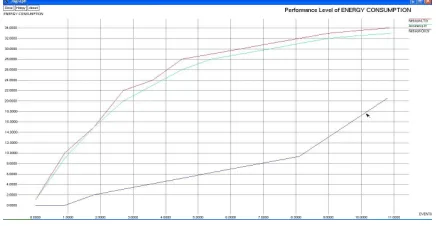
Fig 5.2 Energy Consumption
Measurement/report time versus number of slaves corresponding to master and variable inverse link speed b for single level tree network with master and sequential reporting time Till now we have discussed on basic concepts of Cloud Computing and N- Care System and studied some existing N- Care System algorithms, which can be applied to clouds. In addition to that, the closed-form solutions for minimum measurement and reporting time for single level tree networks with different N- Care System strategies were also studied. The performance of these strategies with respect to the timing and the effect of link and measurement speed were studied. A comparison is also made between different strategies.
ISSN : 2394-2231
http://www.ijctjournal.org
Page 157
Fig.5.3 Packet LossMeasurement/report time versus number of slaves corresponding to master and variable inverse measuring speed a for single level tree network with master and sequential reporting time. the measurement/report time is plotted against the number of slaves corresponding to a master for the simultaneous measurement start simultaneous reporting termination case. The value the inverse link speed b is varied from 0 to 1 at an interval of 0.3 while the inverse measuring speed a is fixed to be 1.5. In this case the minimum finish time decreases as the number of slaves under a master in the network is increased. This assumes that the communication speed is fast enough to distribute the load to all the slaves under a master
.
CONCLUSION:
The N Care System offers many advantages. The use of cloud infrastructure increases the computational power of the system. In such a system, computation is done using the cloud infrastructure rather than by individual sensor nodes. As a result the power requirements and size of each sensor can be reduced. Smaller sensors are easier to sustain in times of an emergency such as a natural calamity and to conceal for detecting crime. Additionally, NCS offers a high degree of scalability. As a result it can handle increase in number of sensor nodes without much performance overheads. Since the system is dynamic, back-up sensors can be enabled, in case the main sensors fail. NCS can be utilized to collect data from different types of heterogeneous sensors and to provide domain specific sensor data to the end users.
FUTURE WORK
Compared to the current state-of-the-art in building applications on Sensor Node, our approach enables an efficient deployment of several types of applications on Sensor Node thus allowing these resource-constrained platforms to achieve better performance with a controlled overhead. Our optimization has focused so far only on the client side and has assumed the server’s resources to be infinite. Describing in detail its working core, that is a Cloud middleware called SensCLEVER. The virtualization techniques implemented in SensCLEVER for integrating sensing infrastructures in a Cloud environment guarantees efficient and secure services at the infrastructure, platform and application layers.
REFERENCES:
1. R. Bloor. What is a cloud database. Technical report.
2. S. Bose and R. Liu. Cloud computing complements wireless sensor networks to connect the physical world. Technical report. 3. Chandrakant N, Bijil A P, Deepa Shenoy P,
Venugopal K R, and L M Patnaik. Middleware service oriented rescue and crime information system (rcis) using heterogeneous fixed nodes in wsns. In ADCONS 2011, December 16-18, 2011, Karnataka, India.
4. Chandrakant N, Bijil A P, Deepa Shenoy P, Venugopal K R, and L M Patnaik. Middleware service oriented rescue and crime information on cloud (rcic) using heterogeneous nodes in wsns. In ADCONS 2011, December 16-18, 2011, Karnataka, India, pages 1–5, 2012.
5. I. Giurgiu, O. Riva, D. Juric, I. Krivulev, and G. Alonso. Calling the cloud: Enabling mobile phones as interfaces to cloud applications. In Proceedings of the 10th International Middleware Conference Middleware’09), November 30 December 4, 2009. 6. D. Huang, X. Zhang, M. Kang, and J. Luo. Mobicloud: Building secure cloud framework for mobile computing and communication. In Service Oriented System Engineering (SOSE), 2010 Fifth IEEE International Symposium, pages 27 – 34, June 2010.
7. Hung-Chin Jang, Yao-Nan Lien, and Tzu-Chieh Tsai. Rescue information system for earthquake disasters based on manet emergency communication platform. In IWCMC09, June 21 24, 2009, Leipzig, Germany.
8. G. Kaefar. Cloud computing architecture.
9. A. Khan and K. Ahirwar. Mobile cloud computing as a future of mobile multimedia database. In International Journal of Computer Science and Communication.
10. D. Kovachev, Y. Cao, and R. Klamma. Mobile cloud computing: A comparison of application models. In Service Oriented System Engineering (SOSE), 2010 Fifth IEEE International Symposium.
11. MadokaYuriyama, Takayuki Kushida, (2010), “Sensor Cloud Infrastructure: Physical Sensor Management with Virtualized Sensors on Cloud Computing” 13th International Conference on Network-Based Information Systems, IEEE, 2010. 12. C.O. Rolim, F.L. Koch, C.B. Westphall, J.Werner, A.
Fracalossi, G.S. Salvador, (2010),” A Cloud Computing Solution for Patient's Data Collection in Health Care Institutions”, 2nd Intl Conference on eHealth, Telelmedicine, and social medicine, 2010, pp. 95-99.
13. Margaret O'Brien, (2008), “Remote Telemonitoring - A Preliminary Review of Current Evidence”, European Center for Connected Health, 30thJune 2008 .
ISSN : 2394-2231
http://www.ijctjournal.org
Page 158
and Li Xiaorong, (2010), “ Processing of wearable sensor data on the cloud – a step towards scaling of continuous monitoring of health and well-being” 32 Annual Intl Conference, IEEE EMBS, pp. 3860-3863, 2010.
15. O. Gnawali, R. Fonseca, K. Jamieson, D. Moss and P. Levis, (2009), “Collection Tree Protocol,” The 7th ACM Conference on Embedded Networked Sensor Systems (SenSys 2009), 2009.
BIOGRAPHIES
Mrs. ELAVARASI J.,
M.Phil ResearchScholar, Department of Computer Science Auxilium College (Autonomous), Vellore, TamilNadu, India.
Ms. LAVANYA S. M.Sc., M.Phil., (Ph.D).,
Asst. Prof HOD I/C Department of