
Journal of Positive Psychology & Wellbeing 2017, 1(1), 10–21; www.journalppw.com
Initial Development and
Validation of the Positive
Teacher Scale
Ali Eryılmaz
Osmangazi University, Turkey
Abstract
In literature, positive features of teachers have been investigated under many dimensions. Positive teacher studies focus more on positive teacher-student relationships. Although there are measurement tools that measure positive student-teacher relationships in the literature, there are no tools of measuring the positive teacher characteristics in a comprehensive way. The aim of this study is to develop a scale that measure positive teacher qualities. Parallel with the aim of the present study, a cross sectional research design was used. In this study, scale development process was followed. Item preparations, item analysis, exploratory and confirmatory factor analysis, reliability and validity analysis have been considered in this study. The data were collected form university students (203 individuals in exploratory analysis group; 209 individuals in confirmatory analysis group). According to factor analysis results, the scale which is consist of six dimensions which are named such as “satisfying students’ need for competence”, “building positive relationships with students”, “concretize the subject which is taught”, “being extravert”, “supporting students’ flow experience” and “supporting students’ class engagement” has 66.01% explained variance. In the future some studies might be carried out via Positive Teacher Scale.
Keywords.
Positive teacher, develop a scale, reliability, validity, positive psychology.
Corresponding author:
Students are not machines. They are social creatures. Thus, education is based on student-teacher interactions in the school and other settings (Connell, 1990; Goodnenow, 1993; Wentzel, 2002). Both students and teachers bring their qualities which might be positive or negative in learning process and classroom (Birch & Ladd, 1997; Eryılmaz, 2014; Eryılmaz & Mammadov, 2016). In literature positive features of teachers have been investigated under many dimensions. To sum up these features, generally positive teacher qualities might be considered in two important domains in the literature. Firstly, positive relationships with students might be an important indicator of positive teachers’ qualities. This feature has been investigated with so many terms such as sense of relatedness, belongingness, and perceived pedagogical caring (Connell, 1990; Goodnenow, 1993; Wentzel, 1998). Positive relationships with students have been yielded positive results. For instance, according to Wentzel (2002), students are predisposed to internalize positive school-related values and goals via positive relationships between students and teachers. Moreover, positive relationships between students and teachers are associated with decreasing in externalizing, internalizing and learning problems; increasing motivation to learn and school adjustment, academic achievement (Baker, 2006; Howes & Hamilton, 1992; Hughes, Cavell, & Jackson, 1999; Pianta & Steinberg, 1992).
The second most important positive teacher qualities are some certain personality traits. According to literature, some kinds of teachers’ qualities such as well-balanced, eager to teach, humble, friendly, fond of their job, polite, serious, warm, creative, flexible, openness and extraversion might be seen as indicator of positive teacher qualities (Beishuizen et al., 2001; Bennett, 1982; Eilam & Vidergor 2011; Goldstein & Benassi, 2006; Larsgaard, Charles, Kelso, Thomas, & Schumacher, 1998; Polk, 2006; Thibodeau & Hillman, 2003). Recent studies indicate that positive teachers’ personality traits have been related with students’ subjective well-being and academic achievement (Eryılmaz, 2014).
positive teacher qualities, few studies are directly related the development of the scales which are positive teacher qualities. For this reason, the scale development study which is directly related with positive teacher qualities might be the most important tool to reach some educational goal and achievements. To sum up, the aim of this study is to develop a scale that measure positive teacher qualities.
Method
Participants
In this study, there were two study groups. The first group was exploratory factor analysis group. The second one was confirmatory factor analysis group. Exploratory factor analysis group: There were 203 university students of whom 63 (31.0%) male and 140 (69.0%) female. They were undergraduate students in mathematics science, counselling, and primary and history teachers’ departments. Their ages ranged from 18 to 31. Mean age was 2.76, and also standard deviation was 1.84. They selected positive teachers who taught 40 different lessons. Their selected positive teachers mean age was 37.80, and also standard deviation was 7.51. They selected 203 positive teachers of whom 79 (38.9%) female and 124 (61.1%) male. Confirmatory factor analysis group: There were 209 university students of whom 71 (34.0%) male and 138 (66.0%) female. They were undergraduate students in biology science, counselling, tourism, agricultural engineer, and also geography and history teachers’ departments. Their ages ranged from 18 to 39. Mean age was 22.69, and also standard deviation was 2.54. They selected positive teachers who taught 51 different lessons. Their selected positive teachers mean age was 37.35, and also standard deviation was 8.54. They selected 209 positive teachers of whom 59 (28.2%) female and 149 (71.3%) male. Measures
Positive-Negative Affect Scale (PANAS). The PANAS was developed by Watson and his colleagues (1998). The scale consists of 10 positive emotions and 10 negative emotions, and also is a five point likert type. Gençöz adapted the scale into Turkish culture. In the adaptation study, the scale reliability values were found .83 for positive affect and .86 for negative affect. According to criterion validity, positive affect was computed with depression and anxiety (-.48 and -.22); and also negative affect was computed with them (.51 and .47). Data Analyses and Procedures
The aim of this study is to develop a scale that measure positive teacher qualities. The data were collected form university students. All ethical considerations were applied. Several steps were followed in this research. First, scale items were created. Secondly, item analysis was carried out. Third, exploratory factor analysis and reliability analysis studies were conducted. A fourth, confirmatory factor analysis study was conducted. Fifth, the validity of the scale was examined.
these positive emotions?” Sentence based content analysis method was used to answer these questions. The results of analysis indicate that six important themes might be considered. These sentences were transformed into scale items. Two specialists who have PhD degree measurement and educational psychology checked these items. As a result, 30 items were utilized in the trial version of the scale.
Then, the study was carried out with this trial form. In this study, positive-negative affect scale PANAS was used for validity of the scale. PANAS was used for two different aims. The first is to determine students’ affection in the positive teachers’ lessons. The second one is to determine teachers’ affection that is experienced in the classroom on the point of observers. The aim of this study is to develop a scale that measure positive teacher qualities. Parallel with the aim of the present study, a cross sectional research design was used. In this study, scale development process was followed. Item preparations, item analysis (27% upper-below group), exploratory and confirmatory factor analysis, reliability and validity analysis have been considered in this study.
Results
Item Analysis
In this study before the factor analysis step, item analysis has been carried out. In ıtem analysis process 27% upper and lower group analysis method was utilized. According to results, all items set apart from upper group to lower group (p < .01; t values ranged from 5.276 to 11.651).
Exploratory Factor Analysis
To analysis of the factor structure of the Positive Teacher Scale principal component analysis method was used. Thus, Kaiser-Meyer-Olkin (KMO) and Barlett`s Test of Sphercity were investigated. Acording to results, KMO value was .848; and also Barlett`s Test of Sphercity test was 235.683 (p<.00). These results indicated that the sample size was sufficient. Subsequently, factor analysis was carried out.
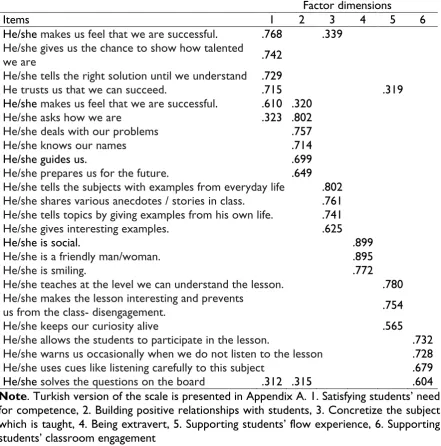
According to factor analysis results, the scale which is consist of six dimensions which are named such as “satisfying students’ need for competence”, “building positive relationships with students”, “concretize the subject which is taught”, “being extravert”, “supporting students’ flow experience” and “supporting students’ class engagement” has 66.01% explained variance. Satisfying students’ need for competence dimension has 13.46% variance and 3.23 eigenvalue; building positive relationships with students dimension has 13.40% variance and 3.22 eigenvalue; concretize the subject which is taught dimension has 11.14% variance and 2.67 eigenvalue; being extravert dimension has 1.49% variance and 2.52 eigenvalue; supporting students’ flow experience dimension has 8.85% variance and 2.12 eigenvalue; and also supporting students’ class engagement dimension has 8.66% variance and 2.08 eigenvalue
The Reliability of the Positive Teacher Scale
The reliability of the positive teacher scale was computed with Cronbach Alpha technique and test-retest method. According to reliability analysis, satisfying students’ need for competence dimension has .86 alpha value; building positive relationships with students’ dimension has .83 alpha value; concretize the subject which is taught dimension has .78 alpha value; being extravert dimension has .87 alpha value; supporting students’ flow experience dimension has .71 alpha value; and also supporting students’ class engagement dimension has .68 alpha value. Additionally, the total point of the scale has .89 alpha values.
coefficient; being extrovert dimension has .62 correlation coefficient; supporting students’ flow experience dimension has .76 correlation coefficient; and also supporting students’ class engagement dimension has .67 correlation coefficient. Additionally, total point of the scale has .80 correlation coefficient value.
Table 1. The results of exploratory factor analysis
Factor dimensions
Items 1 2 3 4 5 6
He/she makes us feel that we are successful. .768 .339 He/she gives us the chance to show how talented
we are .742
He/she tells the right solution until we understand .729
He trusts us that we can succeed. .715 .319
He/she makes us feel that we are successful. .610 .320
He/she asks how we are .323 .802
He/she deals with our problems .757
He/she knows our names .714
He/she guides us. .699
He/she prepares us for the future. .649
He/she tells the subjects with examples from everyday life .802
He/she shares various anecdotes / stories in class. .761
He/she tells topics by giving examples from his own life. .741
He/she gives interesting examples. .625
He/she is social. .899
He/she is a friendly man/woman. .895
He/she is smiling. .772
He/she teaches at the level we can understand the lesson. .780
He/she makes the lesson interesting and prevents
us from the class- disengagement. .754
He/she keeps our curiosity alive .565
He/she allows the students to participate in the lesson. .732
He/she warns us occasionally when we do not listen to the lesson .728
He/she uses cues like listening carefully to this subject .679
He/she solves the questions on the board .312 .315 .604 Note. Turkish version of the scale is presented in Appendix A. 1. Satisfying students’ need for competence, 2. Building positive relationships with students, 3. Concretize the subject which is taught, 4. Being extravert, 5. Supporting students’ flow experience, 6. Supporting students’ classroom engagement
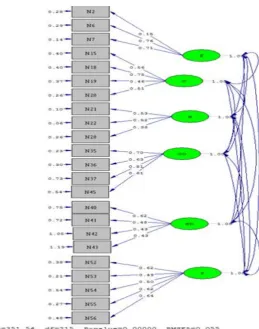
The Results of the Confirmatory Factor Analysis of the Positive Teacher Scale In this study, confirmatory factor analysis also has been carried out. Some fit indexes were found such as NFI = .92; NNFI = .96; CFI = .97; IFI = .97; RFI = .91; GFI = .86 and AGFI = .83. The ratio of chi-square / df was found 1.63.
The Validity of the Positive Teacher Scale
Discussion
In this study, the positive teacher scale was developed. The findings of related studies indicated that positive experiences that produced positive emotions enhanced not only students’ subjective well-being, motivation to learn and academic success but also teachers’ achievement, self-regulation and classroom management (Eryılmaz, 2014, 2015; Meyer & Turner, 2006; Pekrun, 1992; Sutton, Mudrey-Camino & Knight, 2009). In contrast, negative experiences that produced negative emotions decreased not only students’ interest, academic achievement, motivation and engagement but also teachers’ achievement in the learning process (Birch & Ladd, 1997; Eryılmaz, 2014; Pekrun, 1992). Thus, how positive emotions could be activated in school settings for teacher and students is an important subject. The present study is directly related to positive experiences. Therefore, it appears to make an important contribution to the literature.
According to the results of the analysis, items structure and literature, the first dimension of the scale was named as satisfying students’ need for competence in this study. Competence is the most important psychological need that caused optimal development (Deci & Ryan, 1985); and also increased perceived control (Skinner, 1995), intrinsic motivation, social development and well-being (Ryan & Deci, 2000). These gains indicate that need for competence should be satisfied in the classroom settings. Students might satisfy this need themselves. This study shows that teachers also satisfy this need as a mediator. If they satisfy this students’ need, they might be called positive teacher.
According to the results of the analysis, items structure and literature, the second dimension of the scale was named as building positive relationships with students in this study. Human is a social creature. Intimate and positive relationships are essential for healthy development (Prager, 1997). Studies indicate that positive teacher-student relationships diminish students’ aggression (Meehan, Huges & Cavell, 2003), stress (Yoon, 2002), and also increase students’ satisfaction with school (Baker, 1999), subjective well-being and academic achievement (Eryılmaz, 2014). These relationships have been seen as resources for students’ learning and development (Meehan, Huges & Cavell, 2003). Furthermore, according to Wubbels and Brekelmans (2005) the way of creating positive teacher–student relationships has been investigated in the two decades of research. This study indicates that positive teachers might be seen as a positive relationships builder.
Figure 1. Confirmatory factor analysis
Note: Co=Satisfying Students’ Need for Competence; r=Building Positive Relationships with Students; c=Concretize the Subject Which Is Taught; e=Being Extravert; f=Supporting Students’ Flow Experience” And En: Supporting Students’ Class Engagement
According to the results of the analysis, items structure and literature, the fourth dimension of the scale was named as being extrovert in this study. According to literature the most important feature of the happy people is extroversion (Costa & McCrea, 1980; DeNeve & Cooper, 1998; Eryılmaz & Ercan, 2011; Eryılmaz & Öğülmüş, 2010; Myers & Diener, 1995). Furthermore, extrovert individuals are happier than the others (Lyubomirsky, 2001). Eryılmaz (2104) indicate that extrovert teachers’ students have higher academic achievement and subjective well-being. Thus, this study shows that extroversion is the most important positive teachers’ feature.
Declaration of Conflicting Interests
The author(s) declared no conflicts of interest with respect to the research, authorship, and/or publication of this article.
Funding
References
Amon, S., & Reichel, N. (2007). Who is the ideal teacher? Am I? Similarity and difference in perception of students of education regarding the qualities of a good teacher and of their own qualities as teachers. Teachers and Teaching: Theory and Practice, 13(5), 441-464.
Baker, J. A. (1999). Teacher-student interaction in urban at-risk classrooms: Differential behavior, relationship quality, and student satisfaction with school. The Elementary School Journal, 100(1), 57-7.
Baker, J. A. (2006). Contributions of teacher–child relationships to positive school adjustment during elementary school. Journal of School Psychology, 44(3), 211-229. Beishuizen, J. J., Hof, E., Putten, C. M., van Bouwmeester, S., & Asscher, J. J. (2001). Students’
and teachers’ cognitions about good thinking. British Journal of Educational Psychology, 71, 185-201.
Bennett, S. K. (1982). Student perceptions of and expectations for male and female instructors: Evidence relating to the question of gender bias in teaching evaluation. Journal of Educational Psychology, 74, 170–179.
Birch, S. H., & Ladd, G. W. (1998). Children’s interpersonal behaviors and the teacher–child relationship. Developmental Psychology, 35, 61–79.
Basom, M. R., & Frase, L. (2004). Creating optimal work environments: Exploring
teacher flow experiences. Mentoring & Tutoring: Partnership in Learning, 12(2), 241-258.
Chamorro-Premuzic, T., & Furnham, A. (2005). Personality and intellectual competence. Mahwah: Lawrence Erlbaum Associates.
Connell, J. P. (1990). Context, self, and action: A motivational analysis of self-system processes across the lifespan. In D. Cicchetti, & M. Beeghly (Eds.), The self in transition: From infancy to childhood (pp. 61– 97). Chicago7 University of Chicago Press.
Costa, P. T., & McCrae, R. R. (1980). Influence of extraversion and neuroticism on subjective well-being: happy and unhappy people. Journal of Personality and Social Psychology, 38, 668-678.
Çapa, Y., Çakıroğlu, J., & Sarıkaya, H. (2005). Öğretmen özyeterlik ölçeği Türkçe
uyarlamasının geçerlik ve güvenirlik çalışması. Eğitim ve Bilim, 30, 137, 74-81.
Deci, E. L., & Ryan, R. M. (1985). Intrinsic motivation and self-determination in human behavior. New York: Plenum.
DeNeve, K., & Cooper, H. (1998). The happy personality: A meta-analysis of personality traits and subjective well-being. Psychological Bulletin, 124,197-229.
Diener, E., & Seligman, M.E. P. (2002). Very happy people. Psychological Science, 13, 80–83. Eilam, B., & Vidergor, H. E. (2011). Gifted Israeli students’ perceptions of teachers’ desired
characteristics: A case of cultural orientation. Roeper Review, 33, 86–96.
Eryılmaz, A. (2013). Okulda motivasyon ve amotivasyon: Derse katılmada öğretmenden beklentiler ölçeğinin” geliştirilmesi. Mehmet Akif Ersoy Üniversitesi Eğitim Fakültesi Dergisi, 13, 25, 1 – 18.
Eryılmaz, A. (2014). Perceived personality traits and types of teachers and their relationship to the subjective well-being and academic achievements of adolescents. Educational Sciences: Theory and Practice, 14(6), 2049-2062.
Eryilmaz, A. (2015). Positive psychology in the class: the effectiveness of a teaching method based on subjective well-being and engagement ıncreasing activities. International
Eryılmaz, A., & Ercan, L. (2011). Öznel iyi oluşun cinsiyet, yaş grupları ve kişilik
özellikleri açısından incelenmesi. Türk Psikolojik Danışma ve Rehberlik Dergisi,
4(36), 139-149.
Eryılmaz, A., & Mammadov, M. (2016). Developing the scale of factors ıncreasing study motivation. Journal of European Education, 6(2),73-87.
Eryılmaz, A., & Öğülmüş, S. (2010). Ergenlikte öznel iyi oluş ve beş faktörlü kişilik modeli.
Kırşehir Eğitim Fakültesi Dergisi, 11(3), 189-203
Flavell, J. H. (1987). Speculations about the nature and development of metacognition. In F. E. Weinert, & R. H. Kluwe (Eds.), Metacognition, motivation and understanding (pp. 21–29). Hillsdale, NJ: Erlbaum.
Gençöz, T. (2000). Pozitif ve negatif duygu ölçeği: geçerlik ve güvenirlik çalışması. Türk Psikoloji Dergisi, 15(46), 19-26.
Goldstein, G., & Benassi, V. (2006). Students’ and instructor’s beliefs about excellent lecturers and discussion leaders. Research in Higher Education, 47(6), 685-707. Goodenow, C. (1993). The psychological sense of school membership among adolescents:
Scale development and educational correlates. Psychology in the Schools, 30, 79–9. Howes, C., & Hamilton, C. E. (1992). Child relationships with child care teachers: Stability
and concordance with parental attachments. Child Development, 63, 859– 866. Hughes, J. N., Cavell, T. A., & Jackson, T. (1999). Influence of teacher–student relationship
on childhood aggression: A prospective study. Journal of Clinical Child Psychology, 28, 173–184.
Kolb, D. A. (2000). Learning styles inventory. The Power of the 2 2 Matrix, 267.
Larsgaard, J. O., Charles, E., Kelso, J. R., Thomas, W., & Schumacher, M. S. (1998). Personality characteristics of teachers serving in Washington State Correctional Institutions. Journal of Correctional Education, 49(1), 20-38.
Lyubomirsky, S. (2001). Why are some people happier than others? The role of cognitive and motivational processes in well-being. American Psychologist, 56, 239-249.
Meehan, B. T., Hughes, J. N., & Cavell, T. A. (2003). Teacher–student relationships as
compensatory resources for aggressive children. Child development, 74(4),
1145-1157.
Meyer, D. K., & Turner, J. C. (2006). Re-conceptualizing emotion and motivation to learn in classroom contexts. Educational Psychology Review, 18(4), 377-39.
Montalvo, G., Mansfield, E., & Miller, R. (2007). Liking or disliking the teacher: student motivation, engagement and achievement. Evaluation & Research in Education, 20(3), 144-158.
Myers, D. & Deiner, E. (1995). Who is happy. American Psychological Society. 6,1-19. Pekrun, R. (1992). The impact of emotions on learning and achievement: Towards a
theory of cognitive/motivational mediators. Applied Psychology, 41(4), 359-376.
Pianta, R. C. (1999). Enhancing relationships between children and teachers. Washington, D.C.7 American Psychological Association.
Pianta, R. C., & Steinberg, M. S. (1992). Teacher–child relationships and the process of adjusting to school. New Directions for Child Development, 57, 61– 8.
Polk, J. A. (2006). Traits of effective teachers. Arts Education Policy Review, 107(4), 23-29. Prager, K. J. (1997). The psychology of intimacy. Guilford Press.
Reynolds, A. (1992). What is competent beginning teaching? A review of the literature. Review of Educational Research, 62(1), 1-35.
Ryan, R. M., & Deci, E. L. (2000). Self-determination theory and the facilitation of
intrinsic motivation, social development, and well-being. American Psychologist, 55, 68–78.
realize your potential for lasting fulfillment. New York: Free Press. Seligman, M. E. P., & Csikszentmihalyi, M. (2000). Positive psychology. American
Psychologist, 55, 5–14.
Seligman, M. E.,Ernst, R. M., Gillham, J., Reivich, K., &Linkins, M. (2009).
Positive education: Positive psychology and classroom interventions. Oxford Review of Education, 35(3), 293-311.
Shernoff, D. J., Csikszentmihalyi, M., Schneider, B., & Shernoff, E. S. (2003). Student
engagement in high school classrooms from the perspective of flow theory. School Psychology Quarterly, 18(2), 158–176.
Skinner, E. A. (1995). Perceived control, motivation, & coping (Vol. 8). Sage Publications. Standing, L. (1973). Learning 10000 pictures. The Quarterly Journal of Experimental
Psychology, 25(2), 207-222.
Sutton, R. E., Mudrey-Camino, R., & Knight, C. C. (2009). Teachers' emotion
regulation and classroom management. Theory into Practice, 48(2), 130-137. Tandogan, R. O., & Orhan, A. (2007). The effects of problem-based active learning in science
education on students' academic achievement, attitude and concept learning. Online Submission, 3(1), 71-81.
Thibodeau, G. P., & Hillman, S. J. (2003). In retrospect: Teachers who made a difference from the perspective of pre-service and experienced teachers. Education, 124(1), 168-181.
Vermunt, J. D. (1996). Metacognitive, cognitive and affective aspects of learning styles and strategies: A phenomenographic analysis. Higher Education, 31(1), 25-5.
Watson, D., Clark, L. A., & Tellegen, A. (1988). Development and validation of brief measures of positive and negative affect: The PANAS scales. Journal of Psychology, 54(6), 1063-107.
Wentzel, K. R. (2002). Are effective teachers like good parents? Teaching styles and student adjustment in early adolescence. Child Development, 73, 287– 301.
Wentzel, K. (1998). Social relationships and motivation in middle school: The role of parents, teachers, and peers. Journal of Educational Psychology, 90, 202-209.
Wubbels, T., & Brekelmans, M. (2005). Two decades of research on teacher–student relationships in class. International Journal of Educational Research, 43(1), 6-24. Yoon, J. (2002). Teacher characteristics as predictors of teacher-student relationships:
Stress, negative affect, and self-efficacy. Social Behavior and Personality: An
H
iç
Ço
k Az
B
ir
az
Ço
ğ
unl
uk
l
a
Ço
k F
azla
Öğrencinin akış yaşamasına yardımcı olmak Dersi anlayabileceğimiz düzeyde anlatır
Dersi ilginç hale getirerek dersten kopmamızı engeller Derse karşı merakımızı canlı tutar
Öğrencinin yetkinlik ihtiyacını doyurmak Başarılı olduğumuzu hissettirir
Bize ne kadar yetenekli olduğumuzu gösterme şansı verir Doğru çözümü biz anlayıncaya kadar anlatır
Derste, başarılı olabileceğimiz konusunda bize güven verir Dışa dönük olmak
Sosyaldir Cana yakındır Güler yüzlüdür
Konuyu somutlaştırmak
Konuyu günlük hayattan örneklerle anlatır Derste değişik hikâyeleri/anekdotları paylaşır Kendi hayatından örnekler vererek ders anlatır İlginç örnekler verir
Öğrencinin derse katılımını sağlamak Bizi derse kaldırır
Biz dersi dinlemediğimizde arada bir bizi uyarır
Derste burayı can kulağı ile dinleyin gibi cümleler kullanır Soruları tahtada çözer
Öğrenci ile olumlu ilişkiler kurmak Hal hatır sorar
Sorunlarımızla ilgilenir İsimlerimizi bilir
Bize yol gösterir
Gelecekteki yaşamımız için destek olur
![Heterosis and Combining Abilities for Yield and Quality Traits in Forage Sorghum [Sorghum bicolor (L.) Moench]](data:image/gif;base64,R0lGODlhAQABAIAAAP///wAAACH5BAEAAAAALAAAAAABAAEAAAICRAEAOw==)