http://doi.org/10.33851/JMIS.2019.6.4.259
259
I. INTRODUCTION
Mobile phones recently have evolved to become ubiquitous communication and computing platforms, called smartphone, where users can make the usual phone calls, play games, edit documents, listen to music, and access the Internet. These devices are able to perform complex computing tasks and communicate through a variety of different methods (3G, Wi-Fi, Bluetooth, etc.). A smartphone, which is almost the same as a traditional computer, only smaller in size and computing power, has been focused on enabling user experience in pervasive smart game-based learning devices. The implications of delivering game experiences for education and training on mobile devices are enormous. Its accessibility, mobility, convenience, and affordability could meet the educational goals set up for current young generations who are indulged in various types of games every day. Hence, the emergent development of educational functional games are required to ease and complement the offline education activities [5], [6], [7], [8], [9].
It is reported that the Korean spoken population worldwide are growing rapidly and approximated 75 million, ranked as 10th the most used language
internationally. Korean is also adopted as one of the ten official languages by international Patent Cooperation Treaty (PCT). This kind of trend drives the global
propagation of Korean language and the growing necessity of appropriate its teaching methods for foreigners. In this context, it is natural that the educational functional games for teaching Korean language on mobile platform could be considered as one of the smart killer apps.
Learning a foreign language is to be boring process without considering a certain kinds of educational, psychological and engineering paradigms, especially done when by using mobile devices. When education procedure feels dull, students are not being engaged and motivated. Learning doesn’t mean rote memorization, rather it means acquiring the skills and thought processes needed to respond appropriately under pressure, in a variety of situations. Hence more effective, interactive experiences that motivate and actively engage students in the learning process is needed than that in the classroom. This is where game-based learning comes in. As it turns out that games could be effective teaching tools to overcome the psychological shortcomings stemming from traditional classroom-based education paradigms, many related researches have been conducted at universities mainly and commercial sectors as one part of functional games [7].
The main purpose for educational functional game is to ease the learning tension, increasing the communication capability, and developing and refining educational abilities in a situation that is fun [8], [9]. In addition to those merits, the advantages of general e-learning solutions can be bestowed such as the plausibility of giving infinite reviews,
A Functional Game Application for Korean Words Learning
Based on Smartphone Environments
YoungMee Choi
1*Abstract
In this paper, the prototyping process for developing syllable-initial consonant-based game ‘Korean Guards’ is described. Users may effectively learn Korean words using alphabetically sequential approaches, but the easiness of access bestowed on the smart environments and game algorithms could be fully utilized for the functional advantages for educational purposes. This functional game is developed on Android OS and the prototypical outcome is shown.
Key Words: Smartphone application, Functional game, E-learning application, Smart learning application.
Manuscript received November 11, 2019; Revised November 21 2019; Accepted November 25, 2019. (ID No. JMIS-19M-11-031)
Corresponding Author (*): YoungMee Choi, Dept. of Media Software, Sungkyul University, Manan-gu Anyang-si, Rep. of Korea, 031-467-8164, [email protected]
260
constant contents upgrades, proactive, adaptive and creative learning environments [2],[4],[6]. Well-designed game-based learning applications can draw us into virtual environments that look and feel familiar and relevant. Also this is motivational because we can quickly see and understand the connection between the learning experience and our real-life work. Within an effective game-based learning environment, we work toward a goal, choosing actions and experiencing the consequences of those actions along the way. We make mistakes in a risk-free setting, and through experimentation, we actively learn and practice the right way to do things. This keeps us highly engaged in practicing behaviors and thought processes that we can easily transfer from the simulated environment to real life. Research supports the effectiveness of game-based learning in virtual environments—for example, according to a meta-analysis of flight simulator training effectiveness, simulators combined with aircraft training consistently produced training improvements compared to aircraft-only training. In contrast, traditional, passive training approaches drill us on certain narrow procedures, and then evaluate us on our memory of what we were told. Even when we successfully retain the lesson’s facts and procedures, our behavior in true-to-life situations remains untested. In addition, even the most comprehensive training program cannot cover procedures for every complex eventuality that we will encounter—no matter how thick the binder is. In game-based environments, we learn not only the facts, but also the important, underlying how is and why is. This understanding of deeper, more abstract principles prepares us to perform consistently and effectively, even in new and unexpected situations.
This research prototypes a functional game for learning Korean words with focus on native Korean vocabularies by using syllable-initials. This paper consists of as follows. Section II mentions about what game-based learning and the related researches. In Section III, we will give the overall system design and implementation and the gaming situation is described in Section IV. Then the conclusion with a short comment on future work in Section V.
II. RELATED RESEARCHES AND
DESIGN PRINCIPLES
Many smart applications for learning Korean language are currently available on App Store and Android market [9]. These apps can be divided into several types according to interface modalities and content features. Most of them provide the interface with multiple interaction modalities, e.g., text, audio and static images. For example, Gengo Flashcards Korean Lite and others introduce multiple senses into learning process, using photos, vocabulary lists,
and audio to enforce an ability to memorize vocabulary. Gengo Quiz Korean and others ask a series of language questions appropriate to user’s ability. Many of them support interactive features like audio review tracks, vocabulary lists and detailed explanations, whereas none of them features the gaming fun during learning process. Also the target users are not clearly specified. Based on these observations above, some key principles are set up for designing new game-based Korean learning application.
Principle 1: User’s prior knowledge about Korean is
strongly required, but the user’s age is not considered, since many applications are available for beginner level. Learning pure native Korean vocabularies and its correct grammatical usage are main concern here.
Principle 2: User’s gaming motivation determines, directs
and sustains what to learn. This may be the challenging point in this research. Users are expected to be highly motivated by in-game feedback such as interactions with characters, scores and items given after evaluations. In the process without consciously realization, learning process is operating within the game environment, actively thinking, experimenting and involving along the way to accomplish their learning goals
Principle 3: Users must acquire practical knowledge about Korean words and their usage, practice integrating them, and know when to apply what they have learned. Learning is a process that happens in bite-sized chunks, each learner working at a different pace. Thoughtfully and adaptively designed, game-based learning is tailored to each learner. A learner begins with syllabic basic concepts and advances in the game to next step according to learner’s learning pace.
http://doi.org/10.33851/JMIS.2019.6.4.259
261
Principle 5: Learning, even at its start, takes place in a simplified subset of the real domain. That is, the setting for the learning gaming procedure should represent an actual learning process, so that users can easily map their in-game behavior to real conversation with Korean-spoken person or reading comprehension.
Principle 6: The learning environment must encourage active and critical, not passive, learning. This means users do not merely memorize Korean vocabulary. Users play with correct and incorrect examples of Korean words, followed by an adaptive evaluation phase to give more personally customized gaming session. They actually think, act, experience consequences and pursue learning goals in a variable game environment.
Principle 7: Learning is a cycle of doing something; reflecting on this action and, on this basis, forming a hypothesis; re-probing the world to test the hypothesis; and then accepting or rethinking the hypothesis. For example, users play a certain session of game which must present a functional environment in which uses may choose from and evaluate many different actions. The goal is to find the right course of action via experimentation—making choices and experiencing the consequences adaptively.
Principle 8: Learners get lots of practice in a context where the practice is not boring (i.e. in a virtual world that is compelling to learners on their own terms and where the learners experience ongoing success).
III. DEVELOPING PROCESS
“Korean Guards” is developed on Android platform. Android is a software stack for mobile devices that includes an operating system, middleware and key applications. The Android SDK provides the tools and APIs necessary to begin developing applications on the Android platform using the Java programming language. All features on Android are introduced at the official Android website. Figure 1 shows the major components of the Android operating system. By providing an open development platform, Android offers developers the ability to build extremely rich and innovative applications. Developers are free to take advantage of the device hardware, access location information, run background services, set alarms, add notifications to the status bar, and much, much more. Developers have full access to the same framework APIs used by the core applications. The application architecture is designed to simplify the reuse of components; any application can publish its capabilities and any other application may then make use of those capabilities (subject
to security constraints enforced by the framework). This same mechanism allows components to be replaced by the user. Android includes a set of C/C++ libraries used by various components of the Android system. These capabilities are exposed to developers through the Android application framework [10].
Fig. 1. Android architecture in [3].
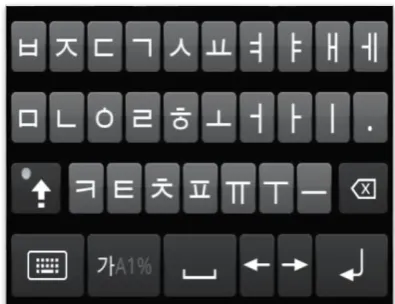
“Korean Guards” uses the QWERTY-type soft keyboard, which has 5 x3 dimension and 14/15 buttons. To keep from the frequent keyboard input errors, 27-button keyboard is rejected (see in Fig. 2) because of the limited size of screen. As the survey shows, the keyboard size of 72cm2 marks the
highest score for usability in games. However, the larger is reported to be the better [4].
Fig. 2. QWERTY-type soft keyboard.
262
Theoretical Background
-structure of Korean language -learning/teaching methodologies -game-based learning paradigm Usability
Analysis -target user and mobile devices -application benchmarking -interfacing paradigm
-gaming structure (level, time, items, hints, etc.)
Development -Android architecture and SDK -graphic and character design -data flow diagram
-database and its managing structure
Evaluation and Feedback
-guidelines
-learning cycle and performance analysis
-feedback
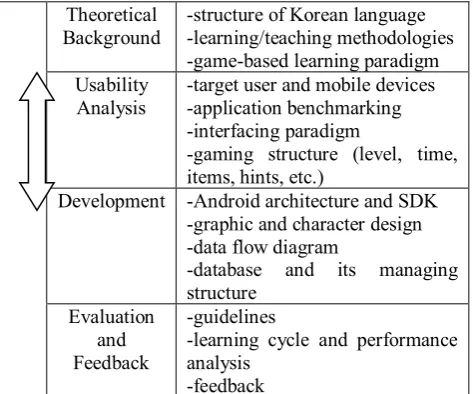
Fig. 3. Summary of the developing process.
IV. GAMING SITUATION
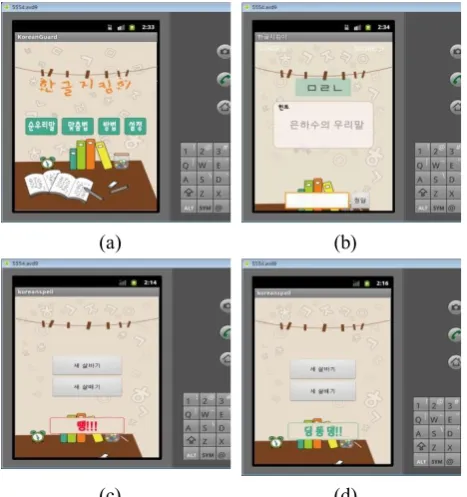
When a new session of game starts, player can choose the one of two themes, composition and correction. In composition game, the random consonant syllable-initials and tips (selective, but by default, hidden mode) are given. The multimedia supports, such as graphics and audio clips, are also available. According to player’s inputs, player’s profile are generated and the next gaming step is set up adaptively. To give fun interactions, simple animations are combined with audio sound to present the correct word made of suggestive initials. To make it possible, the special object-oriented database is constructed to accommodate text, audio, animations clips and control signals like leveling, timing and hinting supports illustrated in Table 1. The overall data flow diagram is shown at Fig. 4. Figure 5 shows the main menu and gaming screen shots.
Fig. 4. Data flow diagram.
V. CONCLUSION AND FUTURE
RESEARCH
This paper has presented prototyping research on game-based Korean learning application. Educational game is to
enhance user’s learning capacity by integrating gaming strategies into learning framework. This system is currently in prototyping phase and has to solve lots of issues involved in teaching strategies performing in game environments. The player’s model should be working properly in real-time, but it addresses a problem of their inability to help players learn, which could be included later. The database model is based on object-oriented paradigms, but it is not fully implemented here. This research will go on to solve the issues and problems addressed during developing period.
Table 1. Database structure for illustration in Korean.
initial wordMeaning
( Korean) audio video Level control related links ㅎㄷ 허당 움푹 패어 빠지기 쉬운 땅
#id_au #id_vi 2 hint#id
Misspelled, Closely-related Partial synonymy ㄱㅅ 길섶 길
가장자리 #id_au #id_vi 2 hint#id
Misspelled, Closely-related Partial synonymy
ㅎㅇ 한울 우주 #id_au #id_vi 2 hint#id
Misspelled, Closely-related Partial synonymy ㄱㄹㅂ 가랑 비 가늘게 내리는 비
#id_au #id_vi 3 hint#id
Misspelled, Closely-related Partial synonymy ㅁㄹㄴ 미리
내 은하수 #id_au #id_vi 3 hint#id
Misspelled, Closely-related Partial synonymy ㅅㄴㅂ ㄹ 시나 브로 모르는 사이에 조금씩, 조금씩
#id_au #id_vi 4 hint#id
Misspelled, Closely-related Partial synonymy ㅅㅅㅎ ㄷ 섬서 하다 사이가 서먹서먹 하다
#id_au #id_vi 4 hint#id
Misspelled, Closely-related Partial synonymy ㅎㄴㅂ ㄹ 하늬
바람 서풍 #id_au #id_vi 4 hint#id
http://doi.org/10.33851/JMIS.2019.6.4.259
263
In Table 1, #id_au is the identification of audio part, #id_vi is the identification of video part, and hint#id denotes the identification of hint track.
(a) (b)
(c) (d)
Fig. 5. (a) Main interface screen, (b) screen for composition game, and (c)-(d): screens for correction game.
REFERENCES
[1] JungHoon Kim, “Google’s Android and Android Market”, Korea Contents Journal, vol. 7, no. 2, 2009. [2] SungAe Kim, “Study on Korean vocabulary using
audio-visual tools and Game”, Sarim Language & Literature Study, vol. 18, no. 1, pp. 181-203, 2008. [3] PyungJong Kim, “Android platform and application
framework technology”, Journal of Korean Information Processing, vol. 17, no. 3, pp. 51-60, 2010.
[4] HanWoong Kim, “Usability evaluation of soft keyboard based on Android smartphone”, presented at Korean Industrial Engineering, Spring, 2010.
[5] SaeKyung Cho, “Foreign language learning using smartphone”, Multimedia-Assisted Language Learning, vol 12, no. 3, pp. 211-228, 2009.
[6] HyunCheol Lee, et al., “Development of Functional Game Contents Using Wireless Acceleration Sensor,”
IJCSNS, voL.10, no. 4, April 2010
[7] Jessica Trybus, “Game-Based Learning: What it is, Why it Works, and Where it's Going,” White Papers, http://www.newmedia.org/game-based-learning. [8]Tania Cowling,” Ideas to Make Functional Learning
Games,” http://www.ehow.com.
[9] Learn Korean in the fastest, easiest and most fun way,
http://www.koreanclass101.com/apps/, Dec. 2019.
[10] Android, http://developer.android.com/index.html, Dec. 2019.
[11] So-hui Son, Im-kyeong Lee, Jun-ho Huh, “A System Algorithm for Recommending User-Customized Games,”
Journal of Multimedia Information System, vol. 4, no. 3, pp. 145-150, 2017.
Author
YoungMee Choi has received her BS and MS degree in the Department of Mathematics from Ewha Womans University, Korea, in 1979 and 1981, respectively. In 1993, she received a PhD degree in the Department of Computer Engineering from Ajou University. In March 1994, she joined the Department of Media Software at Sungkyul University, Korea where she is currently a professor.