© 2013 Jeeva Gladys R. This is an open access article distributed under the terms of the Creative Commons Attribution License -NonCommercial-ShareAlike Unported License (http://creativecommons.org/licenses/by-nc-sa/3.0/).
Journal of Applied Pharmaceutical Science Vol. 3 (07), pp. 176-182, July, 2013 Available online at http://www.japsonline.com
DOI: 10.7324/JAPS.2013.3831 ISSN 2231-3354
Screening of Siddha Medicinal Plants for Anti Cancer Activity - A
review
Jeeva Gladys. R
1*Kalai arasi.R
2Elangovan.S
3Mubarak.H
41,2,3
PG Scholars, Dept. of Kuzhanthai maruthuvam (Paediatrics), GSMC, Palayamkottai.
4
Senior Research Fellow (S), SCRU, Palayamkottai.
ARTICLE INFO ABSTRACT
Article history:
Received on: 23/05/2013 Revised on: 05/06/2013 Accepted on: 17/06/2013 Available online:
India is a peninsula of herbal hub, in which Siddha system of medicine has flourished as an enlightment in the field of Medicine. Currently medicinal plants have become the paramount source of drug discovery in research for treating diverse form of diseases including Cancer. In this review Siddha classical literature and evidence based research data were emphasized to explore the Siddha medicinal plants with potent anticancer activity. This literature analysis based on both Siddha philosophy and modern parameters reveals that each medicinal plant has its own specific effects on specific type of Cancer.
Key words:
Anticancer, Siddha, Medicinal plants.
INTRODUCTION
Medicinal herbs play an important role in primary health care system among rural population since synthetic anti-cancer remedies are beyond the reach of common man because of the cost factor. The herbal medicines have a vital role in the prevention and treatment of cancer which execute their therapeutic effect by inhibiting cancer activating enzymes and hormones, stimulating DNA repair mechanism, promoting production of protective enzymes inducing anti-oxidant action and enhancing immunity (Thakore et al,2001). Siddha system of medicine provides a good base for scientific exploration of potent anti-cancer herbs.
Cancer and Its causes
The term neoplasm denotes a mass of tissue formed as a result of abnormal, excessive, uncoordinated, autonomous and purposeless proliferation of cells. The most common cause of cancer is due to genetic factors where the incidence is higher among patients with positive family history. Next common cause is exposure to radiations in which nearly all tissues are susceptible to tumour induction with variable sensitivity. The principle carcinogenic agent in our environment is inhaled tobacco smoke in which the incidence of lung cancer is tenfold higher in smokers
.
* Corresponding Author Email: [email protected]
than non smokers. Furthermore it can induce cancer in oral cavity, oesophagus, kidney, bladder and pancreas. Unfortunately occupational exposure is a dreadful cause of inducing cancer in working sectors. Although there has been extensive research on viral oncogenesis, there are number of situations in which viruses are linked to the occurrence of specific cancers with high incidence like Hepatitis B infection and are correlated with hepato-cellular carcinoma. The ultimate cause regardless of above discussion is often exposure to carcinogenic chemicals(Harrison,1998).
Aim of Cancer therapy
The primary aim of cancer therapy is to act at cellular level which includes inhibiting cancer cells proliferation, promoting apoptosis of cancer cells, enforcing the necrosis of tumour and blocking its metastasis. The secondary aim is to maintain the haemopoietic functions to remain normal and to promote the reverse transformation from tumour cells to normal cells. Thereby to alleviate the symptoms of anorexia, insomnia, pain and to make the patient feel comfortable(Harrison,1998).
Cancer – Siddha Perspective
the individual are thought to be required to maintain the integrity of a living system. In benign neoplasm one or two of the three bodily systems are out of control and is not too harmful to the body as the body could overcome this condition. Malignant tumours (Vippuruthi, Putru) (Sambasivam pillai,1998) are very harmful because all the three major humours loose mutual coordination and thus cannot prevent tissue proliferation resulting in deadly morbid condition. Here, Siddha literature deals with various types of malignancies, mentioned by Siddhars. Saint Yugi, used the term Vippuruthi and Dhunmangism in his text Yugi
vaidhya chinthamani(Yugi vaithya chinthamani,1998) which can
be correlated with cancer. Some of other interesting texts like
Agathiyar rana vaithyam, Nagamuni nayanavithi, Agathiyar
nayanavithi deals with cancer as Putru (Naaku putru, Sevi putru,
Vaai putru) which are cancer of tongue, ear and mouth
(Utthamarayan, 2005). Several medicinal plants are mentioned in Siddha texts for cancer. The concept of single drug administration has been mentioned in Siddha as Yega mooligai prayogam (Single drug therapy). Siddha literature is based on the three humours of subtle energy such as Vatham (Wind), Pitham(Fire) and
Kapham(Water) which mutually coordinate to perform the normal
functions of the body. Yugi vaidhya chinthamani, a book on Siddha pathology addresses in detail about the Vippurudhi roga
nidhanam (Diagnosis of the disease) according to which seven
types are established on functional disorders and organ involvement. Based on thefunctional disorders, they are classified
as Vadha vippurudhi, Pitha vippurudhi, and Kapha vippurudhi.
Based on the organs involved, they are classified as Kuvalai(lung) vippurudhi, Karpa(uterine) vippurudhi, Sandu (Bone and joints)
vippurudhi, Oodu(metastatic) vippurudhi. The etiological factors
for Vippurudhi are excessive intake of salty and spicy food,
excessive intake of meat, excessive intake of minerals, frequent sexual intercourse and sexual contact with elderly women.
According to another text Anubava vaithya dheva
raghasiyam, there are 10 major areas which are prone to
Vippurudhi. They are Nabi (Umblicus), Vasthi (Bladder),
Kalleeral (Liver), Manneeral (Spleen), Kanaiyam (Pancreas),
Iraipai (Stomach), Abanam (Anorectal), Karuppai (Uterus),
Thodai iduku (Groin), Moothira kiranthi (Prostate gland) (Seetharam Prasath,1997).
Noi Guna Iyal (Pathophysiology)
Pitham which is responsible for digestion and various metabolic functions is present in each and every cell. In cancer, there is a decrease in agni (fire) which is inversely proportional to
Kapham (↓agni = ↑Kapha) resulting in excessive tissue growth.
Vatham can be related to the anabolic growth phase. Kapham can
be related to the catabolic phase of morbidity. In cancer, the metabolic crisis develops with decrease in agni followed by counter increase in Vatham and Kapham forces, both interacting with each other resulting in proliferation. According to Siddha system of medicine, the stages of cancer can be categorized based on the type of humour deranged and the choice of traditional medicinal plants and their preparations based on their taste
potential whereby it compensates the suppressed or vitiated humours. The decrease in Pitham is pacified by Kaippu (bitter),
Inippu (sweet) and Thuvarpu (astringent) tastes. The increase in
Vatham is pacified by Inippu (sweet), Pulipu (sour) and Uppu
(salt) tastes. The increase in Kapham is pacified by Kaippu (bitter),
Karppu (pungent) and Thuvarpu (astringent) tastes(
Shanmugavelu,2006). Many herbs that have been used for cancer in traditional system of medicine constructed on the Siddha philosophy of three humours, have now gained predominant focus in research and paving way for new drug discovery.
Significance of Herbs in Cancer Therapy
Plant derived phytochemicals possessing anticancer activities have received considerable attention in recent years due to the adverse effects produced by chemotherapy and radiation therapy. Phytochemicals derived from traditional medicinal plants have been found to posses anticancer and chemo protective effects. They are safer for long-term use in cancer patients. They provide nutrition and reduce the side effects of conventional cancer therapy due to effective antioxidant activity.
DISCUSSION
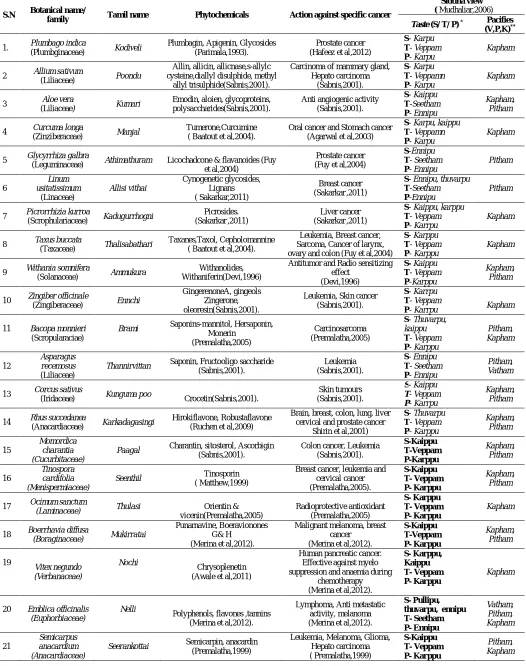
In an attempt of screening the traditional medicinal plants for anticancer activity the present review of literature has identified the presence of several compounds such as flavanoids, polyphenols, saponins, etc with specific anti cancer activity against particular type of cancer (Table 1.1). Further analysing the stage of cancer based on the derangement of three humours and selecting the herbs based on its taste could pacify the deranged humours. Plants with sweet, sour, salty taste pacify the symptoms of deranged Vatham. Plants of bitter, pungent and astringent taste pacify the symptoms of deranged Kabam. Plants of bitter, sweet and astringent taste pacify the symptoms of deranged
Pitham(Table 1.2). Thus they alleviate clinical manifestations of
cancer such as cancer pain, mental depression, insomnia, anxiety, cough, shortness of breath, loss of appetite, diarrhoea, constipation, anorexia and cancer cachexia (Table 2).
CONCLUSION
The literature evidences quoted in various Siddha texts and recent pharmacological studies on medicinal plants, inferred that medicinal plants represent a good source of pharmacologically active agents treating various type of malignancies. Also, since many herbs play chemo protective action, a combination of Siddha medicine and conventional therapy could also be recommended to inhibit the growth of cancer cells and to reduce the side effects of radiation and chemotherapy.
ACKNOWLEDGEMENTS
Plumbago indica Picrorhiza kurroa Crocus sativus
Vitex negundo Allium sativum Taxus buccata
Rhus sucedanea Emblica officinalis Aloe vera
Withania somnifera Momordica charantia Semicarpus anacardium
Curcuma longa Zingiber officinale Tinospora cardifolia
Andrographis paniculata Glycyrrhiza galbra Bacopa monnieri
Ocimum santum Albezia lebbek Linum usitatissimum
Asparagus recemosus Boerrhavia diffusa Vitis vinefera Rubia cordifolia
Table . 1.1: Anti cancerous activity of Siddha medicinal plants.
S.N Botanical name/
family Tamil name Phytochemicals Action against specific cancer
Siddha view ( Mudhaliar,2006)
Taste (S/ T/ P) * Pacifies
(V,P,K)**
1. Plumbago indica
(Plumbginaceae) Kodiveli
Plumbagin, Apigenin, Glycosides (Parimala,1993).
Prostate cancer (Hafeez et al,2012)
S- Karpu T- Veppam P- Karpu
Kapham
2 Allium sativum
(Liliaceae) Poondu
Allin, allicin, allicnase,s-allylc cysteine,diallyl disulphide, methyl
allyl trisulphide(Sabnis,2001).
Carcinoma of mammary gland, Hepato carcinoma (Sabnis,2001). S- Karpu T- Veppamn P- Karpu Kapham
3 Aloe vera
(Liliaceae) Kumari
Emodin, aloien, glycoproteins, polysaccharides(Sabnis,2001).
Anti angiogenic activity (Sabnis,2001). S- Kaippu T-Seetham P- Ennipu Kapham, Pitham
4 Curcuma longa
(Zinziberaceae) Manjal
Tumerone,Curcumine ( Baatout et al,2004).
Oral cancer and Stomach cancer (Agarwal et al,2003)
S- Karpu, kaippu T- Veppamn P- Karpu
Kapham
5 Glycyrrhiza galbra (Leguminaceae) Athimathuram Licochadcone & flavanoides (Fuy
et al,2004)
Prostate cancer (Fuy et al,2004)
S-Ennipu T- Seetham P- Ennipu Pitham 6 Linum usitatissimum (Linaceae) Allisi vithai Cynogenetic glycosides, Lignans ( Sakarkar,2011) Breast cancer (Sakarkar,2011)
S- Ennipu, thuvarpu T-Seetham P-Ennipu
Pitham
7 Picrorrhizia kurroa
(Scrophulariaceae) Kadugurrhogni
Picrosides. (Sakarkar,2011)
Liver cancer (Sakarkar,2011)
S- Kaippu, karppu T- Veppam P- Karrpu
Kapham
8 Taxus buccata
(Taxaceae) Thalisabathari
Taxanes,Taxol, Cepholomannine ( Baatout et al,2004).
Leukemia, Breast cancer, Sarcoma, Cancer of larynx, ovary and colon (Fuy et al,2004)
S- Karppu T- Veppam P- Karppu
Kapham
9 Withania somnifera
(Solanaceae) Ammukura
Withanolides, Withaniferin(Devi,1996)
Antitumor and Radio sensitizing effect (Devi,1996) S- Kaippu T- Veppam P-Karppu Kapham, Pitham
10 Zingiber officinale
(Zingiberaceae) Ennchi
GingerenoneA, gingeols Zingerone, oleoresin(Sabnis,2001).
Leukemia, Skin cancer (Sabnis,2001).
S- Karrpu T- Veppam
P- Karrpu Kapham
11 Bacopa monnieri
(Scropularaciae)
Brami Saponins-mannitol, Hersaponin,
Monerin (Premalatha,2005) Carcinosarcoma (Premalatha,2005) S- Thuvarpu, kaippu T- Veppam P- Karppu Pitham, Kapham 12 Asparagus recemosus (Liliaceae)
Thannirvittan Saponin, Fructooligo saccharide
(Sabnis,2001). Leukemia (Sabnis,2001). S- Ennipu T- Seetham P- Ennipu Pitham, Vatham
13 Corcus sativus (Iridaceae) Kunguma poo Crocetin(Sabnis,2001). (Sabnis,2001).Skin tumours
S- Kaippu T- Veppam P- Karrpu
Kapham, Pitham
14 Rhus succedanea (Anacardiaceae) Karkadagasingi Hirokiflavone, Robustaflavone (Ruchen et al,2009)
Brain, breast, colon, lung, liver cervical and prostate cancer
Shirin et al,2001)
S- Thuvarpu T- Veppam P- Karppu Kapham, Pitham 15 Momordica charantia (Cucurbitaceae)
Paagal Charantin, sitosterol, Ascorbigin
(Sabnis,2001).
Colon cancer, Leukemia (Sabnis,2001). S-Kaippu T-Veppam P-Karppu Kapham, Pitham 16 Tinospora cardifolia (Menispermiaceae)
Seenthil Tinosporin
( Matthew,1999)
Breast cancer, leukemia and cervical cancer (Premalatha,2005). S-Kaippu T- Veppam P- Karppu Kapham, Pitham
17 Ocimum sanctum
(Laminaceae) Thulasi Orientin &
vicenin(Premalatha,2005) Radioprotective antioxidant (Premalatha,2005) S- Karppu T- Veppam P- Karppu Kapham
18 Boerrhavia diffusa
(Boraginaceae) Mukirratai
Punarnavine, Boeravionones G& H
(Merina et al,2012).
Malignant melanoma, breast cancer
(Merina et al,2012).
S-Kaippu T-Veppam P- Karppu Kapham, Pitham 19 Vitex negundo (Verbanaceae) Nochi Chrysoplenetin (Awale et al,2011)
Human pancreatic cancer. Effective against myelo suppression and anaemia during
chemotherapy (Merina et al,2012).
S- Karppu, Kaippu T- Veppam P- Karppu
Kapham
20 Emblica officinalis
(Euphorbiaceae)
Nelli
Polyphenols, flavones ,tannins (Merina et al,2012).
Lymphoma, Anti metastatic activity, melanoma (Merina et al,2012).
S- Pullipu, thuvarpu, ennipu T- Seetham P- Ennipu Vatham, Pitham, Kapham 21 Semicarpus anacardium (Anacardiaceae)
Seerankottai Semicarpin, anacardin
(Premalatha,1999)
REFERENCES
Agarwal BB, Kumar A, Bharti AC. Anticancer potential of curcumin: preclinical and clinical studies. Anticancer Res, 2003; 23:363-98.
Anonymous, Yugi vaithya chinthamani. 1998.Chennai, India; Directorate of Indian Medicine and Homeopathy Publications.
Awale.S et al,Identification of Chrysoplenetin from Vitex negundo as a potential cytotoxic agent PANC – 1 human cancer cells.Phytotherapy research,2011;25(12) : 1770–5.
Baatout S, Derradji H, Jacquet P,et al. Effect of curcuma on radiation-induced apoptosis in human cancer cells. Int J Oncol, 2004; 24: 321–329
Bilal Bin Hafeez, Weixiong zhong et al. Plumbagin inhibits prostate cancer development in TRAMP mice via targeting PKCε, Stat3
and neuroendocrine markers. Oxford journals,Carcinogenesis2012;33(3):644 -651.
Devi PU. Withania somnifera Dunal (Ashwagandha) a potential plant source of a promising drug for cancer chemotherapy and radiosensitisation. Indian J Exp Biol, 1996; 34:927–32.
Fu Y, Hsieh TC et al. Licochalcone -A novel flavanoid isolated from licorice root (Glycyrrhiza glabra) arrests prostate cancer cells. Biochemical and biophysical research communications, 2004; 10:332(1) : 322(1): 263-270.
Harrison T.R.1998,Principles of internal medicine,14th edition, Mc Graw-Hill Book Company.
Jang M et al, Cancer chemopreventive activity of Resveratrol, a natural product derived from Grapes. Science 10, Jan 1997; 275 no. 5297:218–20.
Karnick CR. 1996. Pharmacology of Ayurvedic medicinal plants. Newdelhi, India; Sri Satguru Publications.
Matthew S, Kuttan G.Immunomodulatory and antitumour activities of Tinosporacordifolia. Fitoterapia, 1999;70:35-43.
Mukund sabnis VD 2006. Chemistry and Pharmacology of Ayurvedic medicinal plants.Varanasi,India; Chaukhamba Amarabhati Publications.
Murugesa mudhaliar KS. 2006. Siddha materia medica-medicinal plant division. Chennai, India: Directorate of Indian medicine and Homeopathy Publications.
Narah Merina, Kalita Jogen Chandra et al. Medicinal plants with potent anticancer activity -A review. International research journal of pharmacy, 2012;3(6);26.
Ohnuma T et al. Phase I study of indicine N-oxide in patients with advanced cancer. Cancer Treat Rep,1982;66:1509–15.
Parimala R, Sachdanandam P. Effect of Plumbagin on some glucose metabolising enzymes studied in rats in experimental hepatoma. Mol Cell Biochem, 1993; l: 125:59–63.
Premalatha Balachandran, Rajgopal Govindarajan.Cancer -An Ayurvedic Perspective. Pharmacological research, 2005;51: 19-30.
Premalatha B, Sachdanandam P. Semecarpus anacardium L nut extract administration induces the in vivo antioxidant defense system in aflatoxin B1 mediated hepatocellular carcinoma,J Ethnopharmacol,1999;66:131–9.
Sakarkar DM, Deshmukh VN. Ethnopharmacological review of traditional medicinal plants for anti cancer activity. International journal of Pharm Tech research, Jan – mar 2011;3(1);298-308
Sambasivampillai TV.1998.Dictionary based on Indian medicinal science. Chennai, India; Directorate of Indian Medicine and Homeopathy Publications.
Seetharam Prasath J. 1997.Anuboga vaithya dheva ragasiyam. Chennai, India; Rathna Nayakkar & Sons.
22
Andrographis paniculata
(Acanthaceae)
Nilavembu Andrographiolide,
Andrographiside (Trivedi,2001).
Squamous cell carcinoma of nasopharynx, Lymphatic
leukemia(Trivedi,2001).
S-Kaippu T- Veppam P- Karppu
Pitham, Kapham
23 Albezia lebbek
(Mimosaceae) Vagai Budmunchiamine,
flavanoids(Premalatha,2005).
Sarcoma, Human epidermal carcinoma of nasopharynx(Premalatha,2005).
S- Karrpu, Kaippu T- Veppam P- Karrpu
Kapham
24 Vitis vinefera
(Vitaceae) Thiratchai Resveratrol (Jang et al,1997).
Breast cancer, Prostate cancer, Non –hodgkins lymphoma(Sakarkar,2011).
S- Thuvarpu T- Seetham P- Karppu
Pittham, Kapham
25 Rubia cordifolia
(Rubiaceae) Manjitti Rubiadin (Karnick,1996).
Melanoma, Sarcoma, Lung carcinoma, Lymphatic leukemia.
(Sabnis,2001).
S- Karrpu, kaippu T- Veppam P- Karrpu
Kapham
* S – Suvai,(Taste) T – Thanmai,(Character) P – Pirivu (Division) ; ** V – Vatham, P – Pitham, K – Kapham;
Enippu (Sweet), Pulippu (Sour), Kaippu (Bitter), Karppu (Pungent), Thuvarppu (Astrigent), Veppam (Hot), Seetham (Cold)
Table: 1.2: The role of three humours in Cancer clinical symptoms.
S.NO Humours Cancer Symptoms
1 Increased Vatham Wasting, Constipation or diarrhoea, Insomnia and Pain 2 Decreased Pitham Loss of appetite, Indigestion, Pallor, Chills and Rigor
3 Increased Kapham Indigestion, Lethargic, Fatigue, Pallor and heaviness of the body.
Table. 2: A view of Herbs in the management of Cancer manifestations(Fuy et al,2004).
S.no Manifestation of cancer Herbs used
1 Cancer pain Allium sativum
2 Mental depression & Insomnia Bacopa monnieri, Ocimum scantum
3 Anxiety & Insomnia Withania somnifera,Asparagus racemosa, Hydrocotyle asiatica, Nardostachys jatamansi,
Elettaria cardamomum, Tribulus terrestris, Zingeber officinalis, Eclipta alba
4 Cough, shortness of breath Curcuma longa, Zingiber officinale, Glyzirrhiza glabra, Terminalia chebula, Osimum sanctum, Adathoda vasica
5 Appetizers Asperagus racemosa, Vitis viniferas, Plumbago zeylenica, Tinospora cordifolia, Zingiber
officinale, Coptidis rhizoma
6 Anti diarrhoeals Agele marmelos, Holarrhena anti dysentrica, Punica granatum, Cyperus rotundus, Emblica
officinalis, Plumbago zeylanica.
7 Constipation Terminalia chebula
Shanmugavelu. M. 2006. Siddha maruthuva Noi naadal Noi mudhal naadal thiratu. Chennai, India; Directorate of Indian Medicine and Homeopathy Publications.
Shirin H et al, Antiproliferative effects of S-allylmercaptocysteine on colon cancer cells when tested alone or in combination with sulindac sulfide. Cancer Res, 2001; 61:725–31
Thakore et al. A brief review of plants having anti cancer property. International journal of pharmaceutical research and development, 2001;3(11): Jan2012:129-136.
Trivedi NP, Rawal U.M. Hepatoprotective and antioxidant property of Andrographis paniculata in BHC induced liver damage in mice.Indian J Exp Biol, 2001;39:41–6.
Utthamarayan KS. 2005. Siddhar Aruvai Maruthuvam. Chennai, India; Directorate of Indian Medicine and Homeopathy Publications.
Yun Ruchen et al. Identification of an Alkyl hyroquinone from Rhus succedanea as an inhibitor of Tyrosinase and melanogenesis. Journal of agricultural and food chemistry,2009;7: 2200-2205.
How to cite this article: