Research Journal
Volume 11, Iss. 1, March 2017, pages 194–200
DOI: 10.12913/22998624/67677 Research Article
NUMERICAL ANALYSIS OF THE CRITICAL STATE OF THIN-WALLED
STRUCTURE WITH Z-PROFILE CROSS SECTION
Patryk Różyło1, Daniel Łukasik1
1 Faculty of Mechanical Engineering, Lublin University of Technology, Nadbystrzycka 36, 20-618 Lublin, Poland,
e-mail: [email protected], [email protected]
ABSTRACT
The object of the study was a thin-walled profile with Z-shaped cross section made of the carbon-epoxy composite. The material model was prepared based on the imple -mented orthotropic properties. The purpose of the study was to determine the val -ue of the critical load at which buckling occurs, the form of buckling and operating characteristics in critical condition. In order to achieve this numerical analysis were carried out. Additionally, the effects of the modification in arrangement of layers of the laminate to the stability and strength of thin-walled composite structures was pre -sented. Numerical studies were carried out using commercial simulation software - ABAQUS®. Within the FEM research, both forms of buckling and the associated crit -ical load, dependent on the configuration the layers of the composite were achieved. The analysis of the obtained results allowed the evaluation of the structure’s work in relation to the level of energy consumption or rigidity estimation. In the paper only numerical simulations of the critical state were conducted.
Keywords: thin-walled structures, finite element method, composites, buckling.
INTRODUCTION
Thin-walled composite structures are now one of the most desirable structures by aerospace, automotive and construction industries, due to their high strength properties while maintaining an extremely low own weight. The widespread desire to replace conventional isotropic materi -als with composite materi-als is often dictated by the harsh working conditions of construction, which enables a completely new approach to technical solutions.
Thin-walled structures belong to a group of bearing elements, characterized by a very high level of stiffness and strength. The main threats posed by the use of thin-walled struc-tures is buckling, commonly presented in a significant number of scientific papers [3, 5÷7, 13, 16, 19]. Buckling under axial com -pression process involves the transition of the linear to the non-linear structure’s range of work.
There is no possibility to return to the original shape of the objects in the case of exceeding the range of elasticity of a thin-walled profiles. The high level of usability of thin-walled structures is associated with the elastic nature of the work. Thus, despite further work of the structure after reaching buckling, adverse effect on the correct operation is caused by the loss of stability which has been shown in studies [5, 11, 23, 25].
Given the fact that the thin-walled compos -ite structure is characterized by the three stages of work (pre-critical, critical and post-critical), as part of ongoing research attempts to analyze structural behavior in critical condition have been made. The state in which the loss of stabil -ity is the most complex state in the framework of work of the structure, as it is associated with the bifurcation phenomena - change in charac -ters of work from linear to non-linear. Within the pre-critical state, the walls of the thin-walled composite structures are only compressed, but in Received: 2016.12.15
post-critical - the continued growth of deflections occurs, originated from the bended walls of the profile. In the research, analysis of the critical state (associated with the loss of stability) of the composite Z-shaped cross-sectioned profile were carried out.
The idea of having thin-walled composite profiles of complex cross-section shape is to di -rectly affect the operating conditions to provide enhancement. The issues associated with stabil -ity, critical state and low post-critical state were considered for a long time, the results of which were shown in elaborations [3, 5, 9, 12, 16, 17, 23, 25]. The axial compression is a process com -monly found in exploitations of utility construc -tion areas, aerial construc-tion and automotive components. The essence of the work was to show the comparative state of strength, conduct -ed on identical models of Z-shap-ed profiles, tak -ing into account only the variable configuration of the layers of the laminate. The issue of stabil -ity of the structure with varying configurations of layers in profiles with complex cross-sections is not an area which has been examined thoroughly enough. Taking the need for solutions that im -prove the performance of structures, provides the basis for a detailed analysis of the critical state of load-bearing composite structures. The article presents numerical study of the critical state and the impact of using different layer systems on the stability and strength of the analyzed composite thin-walled profiles with constant cross-section. As part of the conducted studies both forms of buckling with associated critical loads and perfor-mance characteristics of profiles in critical condi -tion have been presented.
SUBJECT OF RESEARCH
The subject of the study was a thin-walled profile made of a composite carbon-epoxy composite characterized by a constant cross section. Thin-walled structure was made of unidirectional tape with regard to the carbon epoxy composite. The thickness of the single layer was 0.131 mm, the total thickness of the specimen due to the constituent of 8 layers of the laminate was slightly more than 1 mm. The mechanical properties of the single layer of the composite are related to the Young’s modulus in the direction of fiber – 130.71 GPa in a di -rection perpendicular to the fiber 6.36 GPa, the
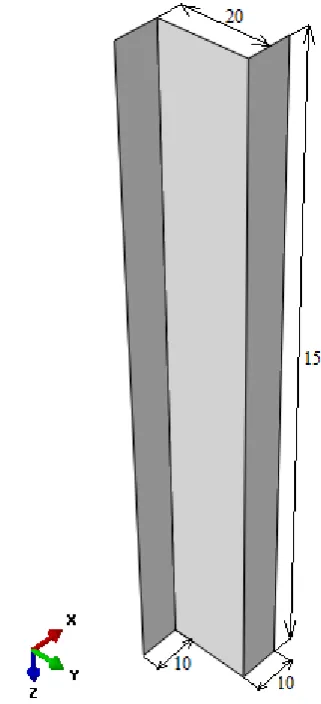
Poisson’s ratio of 0.32, the Kirchhoff’s modu -lus of 4.18 GPa, compression strength in the direction of fiber 1.531 GPa and perpendicular to the fiber 0214 GPa. Mechanical characteris -tics determined through experimental methods helped further definition of the FEM model [2]. The design of the thin-walled Z-shaped cross-section was presented in Figure 1.
The numerical model has been prepared us -ing the FEM software - ABAQUS® [1]. Variable parameters within the framework of the analyzes was only the configuration of the composite lay -ers . Within the operation, four different cases of arrangement of layers of the laminate were examined, [0/90/0/90]s, [90/0/90/0]s, [45/-45/0/90]s and [90/0/-45/45]s. In the context of numerical calculations, only the first and, at the same time, the most likely to obtain a mode of buckling for each configuration of the laminate layers was determined. Numerical presentation of all the tested configurations layers alignment of the laminate were shown in Figure 2.
METHODOLOGY OF THE RESEARCH
Numerical studies were restricted to the deter -mination of the first form of buckling, obtainable in the most accurate way to the actual experimen -tal research. The ability of design the properties of stiffness of the thin-walled composite profiles is relevant to proper operations of structures. Due to the occurrence of complex numerical analysis in the study of stability loss, FEM calculations were carried out based on the method of Newton-Raphson, acting iterative algorithm for determin -ing the approximate values of roots of the func -tion describing the problem [26].
Possibility of influencing the formation of the elastic properties of composite structures is significant in order of proper handling of the objects, particularly when it is necessary to use thin-walled profiles depending specifically on the intended use. The analysis of critical state involved visualization of the first form of buck -ling element. The purpose of the study of criti -cal state based on the finite element method was to determine the critical load, under which buckling occurs. The effect of changes in the
layers of the laminate on the carrying capacity of thin-walled composite structures and buck -ling mode were studied. Boundary conditions of the models prepared for the finite element models calculations were defined considering the articulated attachment of the lower and up -per edges of the profiles. The movement under load of the upper edges of the structure, was con-ducted uniformly over the entire length of the model together with a progressive increase in the level defined by the unitary load. The following figure (Fig. 3) shows defined boundary condi -tions with a unitary load in the example of the model and at the length of extrusion the profile at 150 mm.
The load of the model had been associated with the application of the unitary force to the up-per edges, in order to determine the critical force under with the buckling structure operates. The solution of eigenvalue problem in terms of the critical work of the model was associated with clearly defined process of discretization of the numerical element. The discretization process was based on the use of eight-node S8R elements, characteristic for coating models having the 6 de -Fig. 2. Cases of the configurations of the fibers laminate: 1) [0/90/0/90]s, 2) [90/0/90/0]s,
grees of freedom in the nodes, with reduced inte -gration, which are described by the squared func-tion of shape. The reduced integrafunc-tion technique is associated with the removal of false forms of the
deformation occurring in the calculation of higher order polynomial, in order to obtain average of correct results, under the condition of the stress-displacement occurring at nodes [26]. The follow -ing figure (Fig. 4) shows the form of the generated finite element mesh in the tested structure.
For the conducted discretization of the numer -ical model, 1500 mesh elements with 4691 nodes was obtained. On the basis of the properly pre -pared numerical models initial FEM analysis was
Fig. 3. The boundary conditions of the numerical model
Fig. 4. Discrete model of the thin-walled composite structure
conducted in order to obtain the critical conditions from buckling, for each configuration of the fibers. The next stage was to determine the critical force within the studied numerical models.
THE RESULTS OF NUMERICAL ANALYSIS
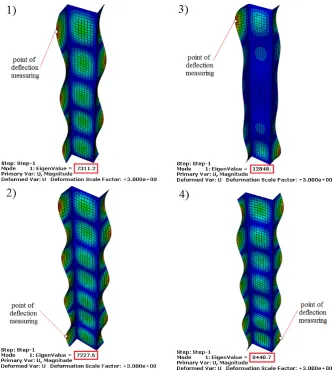
On the basis of the properly defined aspects of buckling process, first forms of loss of stability occurring in composite structures were presented. The value of critical forces and the points of mea -surement of profile’s deflection, depending on the configuration of the layers of the laminate were shown in Figure 5.
Based on the combined results, it is evi -dent that the buckling mode varies depending on configuration of layers alignment. An additional result followed directly from the analysis was the critical force obtain for each case. Critical forces are the most important parameter possible to ob -tain in the context of the critical state of thin-walled structures. A higher level of critical load indicates higher stiffness characteristics of the structure, while the lower level enhanced energy-intensive properties. The following table (Table 1) summa -rizes the results of critical loads and the number of
half-waves adequate for each of the used configu -ration of arrangement of the layers of the laminate.
CONCLUSIONS
The paper presented the issues of stability of the working thin-walled profiles subjected to axial compression. The study based on the finite element method showed the impact of changes in configuration of layers in the laminate on criti -cal force and buckling forms of the structure. The level of increased performance and reliability of thin-walled structures is possible by the control of the layer system. Depending on the requirements, there is the ability to design the properties of the thin-walled composite structure so that they are more rigid and energy-intensive.
Based on the study the following conclusions were formed:
1. The change in configuration alignment in lay -ers of the laminate has an impact on critical loads and the mode of buckling.
2. Via the variable configuration of the fiber in laminate, it is possible to obtain operating characteristics corresponding to the stiffer or more energy-absorbing structures.
Table 1. Summary of the results of numerical calculations for each layer configuration
[0/90/0/90]s [90/0/90/0]s [45/-45/0/90]s [90/0/-45/45]s
Half-waves 5 7 6 7
Critical force 7311,2 [N] 7227,6 [N] 12848 [N] 8440,7 [N]
3. Buckling mode obtained in the study takes the same form of deformation for profiles of dif -ferent heights.
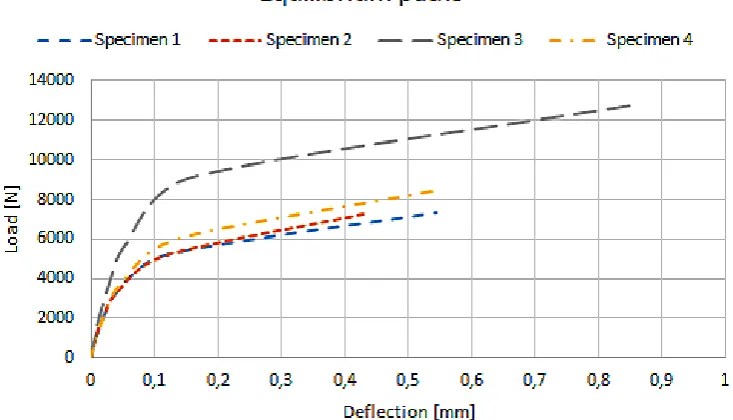
4. The course of equilibrium paths in critical states determines the state of load-bearing ca -pacity of structures.
The obtained FEM results show possibilities of in-depth study of deformation states and as -sessment of the correct operation range of thin-walled profiles in terms of the critical load. Nu -merical analysis based on advanced simulation software, are a powerful tool enabling the study of the state of load capacity and material effort occurring in thwalled structures under the in-fluence of properly defined boundary conditions. Further research will be related to the assessment of structures in post-critical state and determina -tion of potential areas of destruc-tion under the in-fluence of overloads affecting the structures.
REFERENCES
1. Abaqus HTML Documentation.
2. Dębski H.: Badania numeryczne i doświadczalne stateczności i nośności kompozytowych słupów cienkościennych poddanych ściskaniu. Zeszyty naukowe nr 1161, Wydawnictwo Politechniki Łódzkiej, Łódź, 2013.
3. Dębski H.: Experimental investigation post-buck -ling behaviour of composite column with top-hat cross section. Eksploatacja i Niezawodnosc – Maintenance and Reliability (2013); 2: 106-110. 4. Dębski H, Koszałka G, Ferdynus M.: Application
of fem in the analysis of the structure of a trailer supporting frame with variable operation param -eters. Eksploatacja i Niezawodnosc – Maintenance and Reliability (2012); 14 (2): 107–114.
5. Dębski H., Teter A., Kubiak T., Samborski S.: Local buckling, post-buckling and collapse of thin-walled channel section composite columns subjected to quasi-static compression. Composite Structures (2016); 136: 593-601.
6. Falkowicz K., Ferdynus M., Dębski H.: Numeri -cal analysis of compressed plates with a cut-out operating in the geometrically nonlinear range. Eksploatacja i Niezawodność – Maintenance and Reliability (2015); 17(2): 222-227.
7. Falkowicz K., Mazurek P., Rozylo P., Wysmul -ski P., Smagow-ski P.: Experimental and numerical analysis of the compression of a thin-walled com -posite plate. Advances in Science and Technology, Research Journal (2016); 10(31): 177-184.
8. Ferdynus M.: An energy absorber in the form of a
thin-walled column with square cross-section and dimples. Eksploatacja i Niezawodność – Mainte -nance and Reliability (2013); 15(3): 253-258. 9. Koiter W.T.: Elastic stability and post-buckling be
-havior. In Proceedings of the Symposium on Non-linear Problems. Wisconsin: Univ. of Wisconsin Press (1963); 257- 275.
10. Kołakowski Z., Teter A.: Load carrying capacity of functionally graded columns with open cross-sec -tions under static compression. Composite Struc -tures (2015); 129: 1-7.
11. Kopecki T., Mazurek P.: Numerical representation of post-critical deformations in the processes of de -termining stress distributions in closed multi-seg -ment thin-walled aircraft load-bearing structures. Eksploatacja i Niezawodnosc – Maintenance and Reliability (2014); 16(1): 164-169.
12. Kopecki T., Mazurek P.: Problems of numerical bifurcation reproducing in postcritical deformation states of aircraft structures. Journal of Theoretical and Applied Mechanics (2013); 51(4): 969-977. 13. Królak M. and Mania R.J.: Statics, dynamics and
stability of structures. Stability of thin-walled plate structures. Series of monographs. Łodz: Technical University of Lodz, (2011).
14. Lonkwic P., Rozylo P.: Theoretical and experimen -tal analysis of loading impact from the progressive gear on the lift braking distance with the use of the free fall method. Advances in Science and Tech -nology Research Journal, 10 (30), 2016, 103-109. 15. Lonkwic P., Rozylo P., Dębski H.: Numerical and
experimental analysis of the progressive gear body with the use of finite-element method. Eksploatacja i Niezawodnosc – Maintenance and Reliability (2015); 17(4): 544-550.
16. Mania R.J., Kołakowski Z., Bienias J., Jakubczak P., Majerski K.: Comparative study of FML profiles buckling and post-buckling behavior under axial loading. Composite Structures (2015); 134: 216-225. 17. Ritchie D., Rhodes J.: Buckling and post-buckling
behaviour of plates with holes. The Aeronautical Quarterly (1975); 26(4): 281-296.
18. Rozylo P.: Optimization of I-section profile de sign by the finite element method. Advances in Science and Technology, Research Journal, 10 (29), 2016, 52-56. 19. Rozylo P., Wrzesinska K.: Numerical analysis of
the behavior of compressed thin-walled elements with holes. Advances in Science and Technology, Research Journal (2016); 10(31): 199-206.
20. Rudawska A., Debski H., Experimental and numerical analysis of adhesively bonded aluminium alloy sheets joints. Maintenance and Reliability, 1, 2011, 4-10. 21. Samborski S.: Numerical analysis of the DCB test
Composite Structures (2016), 152, 477-487. 22. Shanmugam N.E.: Openings in Thin-walled
Steel Structures. Thin-Walled Structures (1997); 28(3/4): 355-372.
23. Teter A., Dębski H., Samborski S.: On buckling collapse and failure analysis of thin-walled com -posite lipped-channel columns subjected to uni -axial compression. Thin-Walled Structures (2014); 85: 324-331.
24. Thompson J.M.T., Hunt G.W.: General theory of elastic stability. New York: Wiley, 1973.
25. Wysmulski P., Dębski H., Rozylo P., Falkowicz K.: A study of stability and post-critical behaviour of thin-walled composite profiles under compression. Eksploatacja i Niezawodnosc - Maintenance and Reliability, 18 (4), 2016, 632-637.
![Fig. 2. Cases of the configurations of the fibers laminate: 1) [0/90/0/90]s, 2) [90/0/90/0]s, 3) [45/-45/0/90]s, 4) [90/0/-45/45]s](https://thumb-us.123doks.com/thumbv2/123dok_us/8808032.1775636/3.595.77.519.70.381/fig-cases-configurations-fibers-laminate-s-s-s.webp)