Published online July 10, 2013 (http://www.sciencepublishinggroup.com/j/ajpa) doi: 10.11648/j.ajpa.20130101.15
Study of radiation in spherical media using moment
method
T. Sghaier
Dammam University,Kingdom of Saudi Arabia
Email address:
To cite this article:
T. Sghaier. Study of Radiation in Spherical Media Using Moment Method. American Journal of Physics and Applications. Vol. 1, No. 1, 2013, pp. 25-32. doi: 10.11648/j.ajpa.20130101.15
Abstract:
A moment technique is presented to improve the performance of the discrete ordinates method when solving the radiation problems in spherical media. In this approach the angular derivative term of the discretized 1-D radiative transfer equation is derived from an expansion of the radiative intensity on the basis of angular moments. The set of resulting differential equations, obtained by the application of the SN method associated to moment method, is numericallysolved using the boundary value problem with the finite difference algorithm. Results are presented for the different independent parameters. Numerical results obtained using the moment approximation compare well with the benchmark approximate solutions. Moreover, the new technique can easily be applied to higher-order SN calculations.
Keywords:
RTE, Spherical Medium, Angular Derivative Term, DOM, Moment Method1. Introduction
In practical engineering problems, radiative transfer in participating media appears in many applications such as combusting systems, furnaces and reactor nuclear theory. Many of these systems can be considered as spherical enclosure. Therefore, it is desirable to have an accurate and reliable model for solving the radiative transfer equation for this geometry which contain, absorbing, emitting and scattering medium. A number of studies interested in resolving the radiative transfer equation in such media have been conducted. These works included various numerical techniques: integral transformation techniques [1,2], spherical harmonics method [3], Galerkin method [4-5] and others [6-7].
The discrete ordinates method has also been used in solving the radiative transfer equation in spherical media[ 8 ].This method enjoys great popularity owing to its accuracy and to its compatibility with other techniques; Sghaier et al [9] and Trabelsi et al [10] developed a discrete ordinates method associated with the finite Legendre transform. Recently, Aouled-Dlala et al [11] used the finite chebyshev transform to treat the angular derivative term of the discretized one-dimensional radiative transfer equation. Kim et al[12]used the combined finite volume and discrete ordinates method to investigate radiative heat transfer between two concentric spheres and
Li et al [13] developed a Chebyshev collocation spectral method for coupled radiation and conduction in a concentric spherical participating medium. Very recently, Mishra et al [14] used a lattice Boltzmann and modified discrete ordinates method to study radiative transport in a spherical medium with and without conduction.
In order to apply the discrete ordinates method, it is necessary to approximate the angular derivative term appearing in the radiative transfer equation in spherical coordinates. This term is generally approximated by a classical finite differencing scheme [15].
gray media but its extension to any absorption coefficient based non gray model is straightforward.
2. Analysis
The radiative transfer equation through an absorbing, emitting and isotropically scattering spherical shell medium is
( )
(
)
( )
( )
( )
2 2
2
1
1 2
1
1
, 1 , ,
( , ') ', R and -1 1. 2
b
r I r I r I r
r r
r
I T r I r d r R
µ µ µ µ β µ
µ σ
χ −+ µ µ µ
∂ + ∂ − +
∂ ∂
= +
∫
< < ≤ ≤ +(1)
The above equation is subject to the following boundary conditions
(
)
(
)
1(
)
1, 1 b,1 2 1 1 0 1, ' ' ', 0
I R µ =εI + −ε
∫
I R −µ µ µd µ> , (2a)(
)
(
)
1(
)
2 2 ,1 2 2
0
, b 2 1 , ' ' ', 0
I R µ =ε I + −ε
∫
I R µ µ µd µ< , (2b)In Eqs.(1), (2a) and (2b), r is the space radial variable, µ is the cosine of the angle between the direction s of the radiation intensity I r
( )
,µ and the positive r-axis. χ σ, andβ are the absorption, scattering and extinction coefficients, respectively, which are related byβ χ σ= + .
The blackbody radiation is related to the temperature
( )
T r in the medium through
( )
2 4
b
n T r
I σ
π
= ,
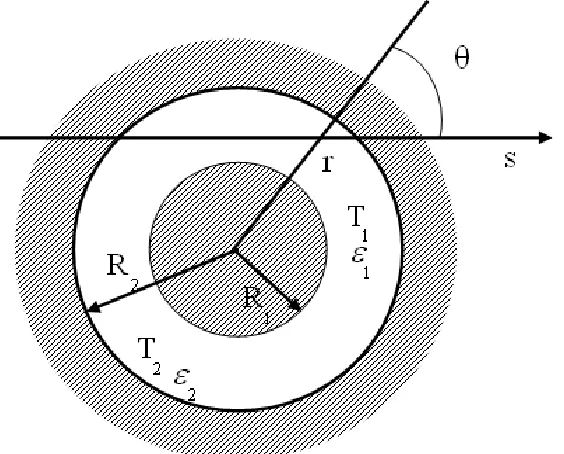
where n denotes the refractive index and σ the Stefan Boltzmann constant. In the boundary conditions given by Eqs (2a) and (2b), ε is the isotropic emissivity of the opaque boundaries. The subscripts 1 and 2 refer to the boundaries at r=R1 and r=R2 respectively. The geometry and coordinates for the hollow sphere are shown in Fig. 1.
Fig 1. Hollow sphere geometry and notations.
2.1. Differencing Scheme
The discrete form of the radiative transfer equation is obtained by evaluating Eq. (1) at each of the discrete
(
)
(
( )
)
2 2 ' ' 2 ' 1 1 1 2 m M mm m b m m
m
r I I I I T r w I
r r
r µ µ
µ µ β χ σ
µ = =
∂ + ∂ − + = +
∂ ∂
∑
(3)The discrete ordinate representation of the boundary conditions, Eqs. (2a) and (2b) is given by
m',
1 1 ,1 1 ' ' '
' 1 , 0
( ) 2(1 ) 0
M
m b m m m m
m
I R I w I
µ
ε
ε
µ
µ
= <
= + −
∑
> (4a)m',
2 2 ,2 2 ' ' m'
' 1 , 0
( ) 2(1 ) 0
M
m b m m m
m
I R I w I
µ
ε
ε
µ
µ
= >
= + −
∑
< (4b)where subscripts m and m' refer to discrete directions, M is the total number of these directions. If a standard
difference scheme is used, the discrete form of the term involving the angular derivative term is written
(
2)
1/ 2 1/ 2 1/ 2 1/ 21
m
m m m m
m I I I w µ µ α α µ
µ = + + − −
−
∂ − ≈
∂ , (5)
whereIm+1/ 2 and Im−1/ 2 are the angular intensities in the directions m+1/2 and m-1/2. The constants αm+1/ 2 and
1/ 2 m
α − only depend on the differencing scheme and
therefore they may be determined by examining the case of an isotropic intensity field as described in Ref. [15]. As far as the curved geometries are concerned, the differencing scheme introduces two angular variables; Im+1/ 2 andIm−1/ 2. They must be determined at each space position r. For this purpose, the standard diamond difference approximation is used to relate the Im+1/ 2 andIm−1/ 2, namely
[
1/ 2 1/ 2]
1 2
m m m
I = I + +I − .
In the calculation of the average angular intensityIm, we need the starter intensityI1/ 2. For spherical geometry, it is obtained from the solution of the transfer equation in slab geometry with starter direction cosineµ= −1. We develop in what follows an alternative technique based on angular moment equations. .The results from both approaches will be compared.
2.2. Moment Method
We develop a new approach to approximate the angular derivative term:
2
( , ) (1 ) ( , )
D r µ µ I r µ
µ
∂
= −
∂ (6)
We start by defining the k-th order moment of D(r,µ)
1 1
( ) ( , ) 0
k k
D r =
∫
−+ D r µ µ µd k≥ , (7)The application of the angular moment technique to the angular derivative term, denoted D r( , )µ yields
( )
( )
1 1 1
k 1 1
1 ( , ) 1 , 1 ,
k k
D r µ µ µd k I r µ µ dµ k I r µ µ dµ
+ + + + −
− = − − −
∫
∫
∫
. (8)The moments of the radiative intensity represent a generalized incident radiation, which for the case n=0, n=1 and n=2 reduces the usual definition of the incident radiation, radiative flux and the radiation pressure. The obtained higher moments of the radiative intensity are then
expressed in term of the incident radiation, the net radiative flux and the radiation pressure using the generalized eddington approximation (16).
In order to obtain the angular derivative term, the integrals over direction are replaced by the discrete form
1 1 1 ( , ) ( , ) M m m m
f r µ µd w f r µ
+
− ≅
∑
=∫
, (9)where the wm are the quadrature weights associated with the directions µm. Thus Eq. (8) is approximated by
1 1
1 1 1
M M M
k k k
m m m m m m m m m
m m m
w D µ k w I µ + k w I µ −
= = =
= −
Now, the angular derivative terms Dm are obtained from Eq. (12) written for k=1, M-1. Thus, this system is closed by using the obvious relation
1 0 M m m m w D = ≅
∑
. (13)Thus the unknowns Dm are the solution of a linear algebraic system: A d = b, with the matrix A given by
A=
1 1 1
1 2
1 1 1
1 2
1 1 . . 1 . . . . . . . . . . . .
. .
M
M M M
M
µ µ µ
µ − µ − µ −
(14)
and the vector d and b given by
d= 1 1 2 2 . . M M w D w D w D
, b=
2 1 1 0 . . .
( 1) ( 1)
M M
M M
m m m m m m
m m
M w I µ M w I µ −
= = − − −
∑
∑
(15)The angular derivative terms Dm are then given by
1 1
1
( )
M
m mk k
j m
D A B
w −
=
=
∑
, (16)
where
1 1
' ' ' ' ' '
' 1 ' 1
M M
k k
k m m m m m m
m m
B k w I µ + k w I µ −
= =
=
∑
−∑
,
k≥1, (17)
and
( )
1 mkA− is the set of components
( )
1A− , A−1 the inverse of the matrix which is given by
( )
0 1 1 kk M m
m M
A µ ≤ ≤ −
≤ ≤
= . It is called the transpose Vandermonde
matrix.
The new discrete ordinates representation of Eq. (1), for a finite number of discrete ordinates may be written
( )
(
)
1
' '
1 ' 1
1 1
( ) ( ) , m 1,M
2
M M
m
m mk k m b m m
j m
m
rI A B I I T r w I
r r r w
µ − β χ σ
= =
∂ + + = + =
∂
∑
∑
(18)and the discrete ordinates representation of the boundary conditions is given by Eqs.(4a, 4b)
Once the directional intensitiesImare known, the radiative heat flux qr
( )
r and the incident radiation energy( )
G r in the medium are determined from their definitions as
( )
1 1
1
( ) 2 , 2
M
r m m m
m
q r π + I r µ µ µd π µ w I
− =
=
∫
=∑
, (19a)( )
1( )
1
1
2 , 2
M m m m
G r π + I r µ µd π w I
− =
=
∫
=∑
. (19b)Equations (18) and (4a, 4b) provide the complete mathematical formulation for the radiation problem in a dimensional spherical medium. A numerical technique, namely the boundary value problem with finite difference
3. Results and Discussion
In table1, we give the numerical values of r2 q* (r) for a radiation problem between two concentric spheres with diffusely emitting and reflecting boundaries subject to pure radiative transfer. Results obtained from the new technique denoted by MOM-DOM have been compared with that of kim et al [12], Jia et al [7], Sghaier et al [9], standard discrete ordinates method, denoted by DOM [11] and those of Mishara et al [14].For the standard discrete ordinates method, the coefficient αm+1/ 2 and αm−1/ 2 are calculated following the procedure as described by Modest [ 16 ]. We present results for r1*=0.5,
τ
2 =1 and for various combinations of the boundary emissivities ε1andε2 and for different values of outer sphere temperature θ2. MOMresults show an excellent comparison.
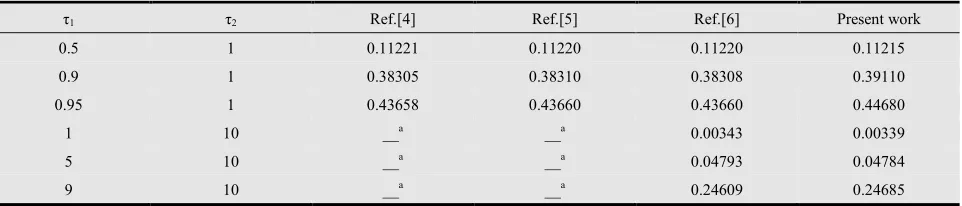
In table 2, we present the numerical values of moment of
order 1( 1
1
( , )
I r
µ
udµ
+−
∫
) for a purely radiation problem with
black boundaries, inner sphere temperature θ1=1 and outer
sphere temperature θ2=0, and for different optical thickness
of inner and outer sphere τ1=βR1 and τ2=βR2 respectively. Results are compared with those of Viskanta et al, Jia et al and Abulwafa et al. The MOM results compare well with those available in literature [4, 5, 6].
An increase in optical thicknessτ2 =βR2, the medium becomes more denser. The net radiative heat flux decreases in the medium as shown in Fig.2.
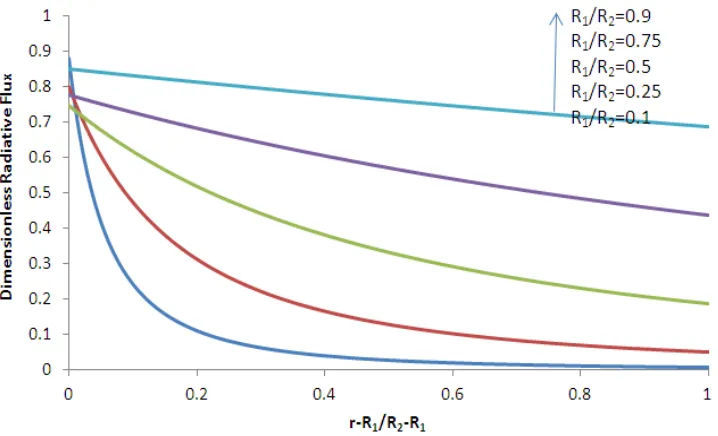
For the optical thickness τ2 =2,θ2 =0.5 and for black boundaries, the effects of the ratio R1/R2 on the radiative
heat flux is shown in Fig.3. With an increase in the ratio R1/R2, the medium tends to planar one and the radiative
heat flux becomes constant.
Fig.4 shows the effect of the outer sphere temperature θ2
on the radiative heat flux distribution in the medium. When the outer sphere becomes hot, the net radiatif heat flux changes sign and becomes negative.
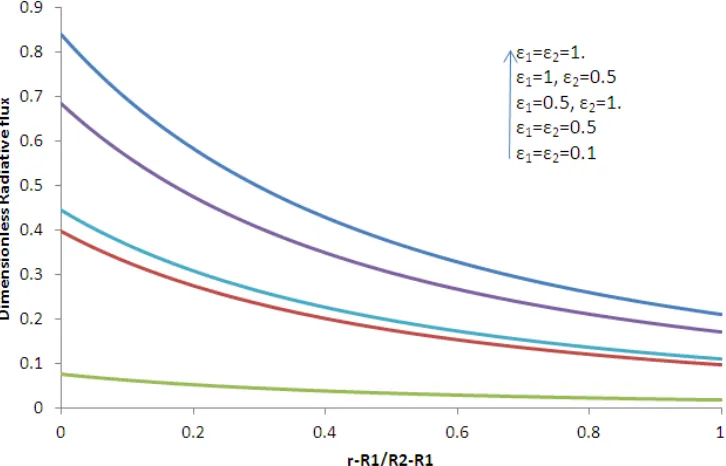
In Fig.5, we study the effect of emissivity of the inner and outer sphere on the radiative heat flux distribution in the medium. For this study, τ2 =1,θ2 =0.5and R1/R2=0.5.
It 'is observed when the hot inner sphere is more reflecting, the net radiative heat flux in the medium becomes less.
4. Conclusion
An analysis of a radiation problem in one dimensional absorbing, emitting and isotropically scattering hollow spherical medium is investigated. The angular derivative term appearing in this geometry is approximated by making use of a new approach called MOM-DOM approximation. This leads to an accurate expression for the angular derivative term. The set of differential equations is solved using the boundary value problem with finite difference algorithm. The accuracy of the new technique has been verified by comparison with benchmark approximate solutions.
Table 1. Values of r2q(r) for various combinations of
1
ε and ε2 ε2 with r1*=0.5, Θ2=0.5 and τ2 =1
.
1
ε ε2 Θ2
2
* r*
r q
DOM[11]
2
* r*
r q
FLT[9]
2
* r*
r q
MOM-DOM
2
* r*
r q
Galerkin[4] Method
2
* r*
r q
FVM[12]
2
* r*
r q
MDOM[14]
1 1 0.5 0.21733 0.21733 0.21030 0.21038 0.20827 0.20820
0.5 1 0.5 0.11312 0.11312 0.11160 0.1108 0.11027 0.11022
1 0.5 0.5 0.17281 0.17281 0.17127 0.1718 0.17038 0.17000
0.5 0.5 0.5 0.09977 0.09977 0.09966 0.0991 0.09866 0.09849
1 1 2 - 3.47938 - 3.47938 -3.36480 - 3.36557 -3.33625 -3.37597
0.5 1 2 -1.79980 -1.79980 -1.7623 -1.77357 -1.76643 -1.78700
1 0.5 2 -2.8160 -2.8160 -2.77656 - 2.74880 -2.72926 -2.75610
0.5 0.5 2 -1.61580 -1.61580 -1.59463 -1.58604 -1.58034 -1.59690
Table 2. The net radiative heat flux with transparent boundaries, isotropic incidence at the inner surface and ω=1.0.
τ1 τ2 Ref.[4] Ref.[5] Ref.[6] Present work
0.5 1 0.11221 0.11220 0.11220 0.11215
0.9 1 0.38305 0.38310 0.38308 0.39110
0.95 1 0.43658 0.43660 0.43660 0.44680
1 10 __a __a 0.00343 0.00339
5 10 __a __a 0.04793 0.04784
Fig 2. Effect of the optical thickness τ2 on the dimensionless radiative flux with ε1=ε2=1, θ2=0.5 and R1/R2=0.5.
Fig 4. Effect of the boundary temperature θ 2 on the dimensionless radiative flux with ε1=ε2=1, τ2=2 and R1/R2=0.5.
Fig 5. Effect of the surfaces emissivity on the dimensionless radiative flux with θ2=0.5, τ2=1 and R1/R2=0.5.
References
[1] G. C. Pomraning, C. E. Siewert, On the integral form of the equation of transfer for a homogeneous spheres. JQSRT1982; 28:503-6
[2] C. E. Siewert, J. R Thomas, On coupled conductive radiative heat-transfer problems in a sphere. JQSRT 1991; 46:63-72
[3] Hsin-sen Chu, Weng Ling-Chia, Tsen. Combined conduction and radiation in absorbing, emitting and
isotropically-scattering concentric spherical media. JQSRT 1991;46:251-7.
[4] G. Jia, Y. Yener, JW. Cipolla, Radiation between two concentric spheres separated by participating medium. JQSRT 1991;46:11-9.
[5] E. M. Abulwafa, Radiative-transfer in a linearly-anisotropic spherical medium. JQSRT 1993;49:165-75.
[7] S. T. Thynell, M. N. Ozisik Radiation transfer in an isotropically scattering homogeneous solid sphere. JQSRT; 1989; 33:187-96.
[8] J. R. Tsai, M. N. Ozisik, F. J. Santarelli, Radiation in spherical symmetry with anisotropic scattering and variable properties. JQSRT 1989;42:187-96.
[9] T. Sghaier, M. S. Sifaoui, A. Soufiani, Study of radiation in spherical media using discrete ordinates method associated with the finite Legendre transform JQRST 2000; 64:339-51.
[10] H. Trabelsi, T. Sghaier, M. S. Sifaoui, A theoretical study of radiation between spheres using a modified discrete ordinates method associated with Legendre transform. JQSRT 2005; 415-28.
[11] N. Aouled-Dlala, T. Sghaier, E. Seddiki, Numerical solution of conductive and radiative heat transfer in concentric spherical and cylindrical medium. JQSRT 2007; 443-57.
[12] M. Y. Kim, J. H. Cho, S. W. Baek, Radiative heat transfer between two concentric spheres separated by a two phase
mixture of non gray particules using the modified discrete ordinates method. JQSRT; 2008;1607-1621.
[13] B. W. Li, Y. S. Sun, S. W. Zhang DW SW. Chebyshev collocation spectral methods for coupled radiation and conduction in concentric spherical partipating medium. Journal of Heat Transfer 2009; vol 131.
[14] S C. Mishra, C. H. Krishna, M. Y. Kim, Lattice Boltzmann method and modifiede discrete ordinates method applied to radiative transport in a spherical medium with and without conduction. Numerical Heat Transfer Part A,58,852-81,2010.
[15] M. F. Modest, Radiative heat transfer, 2nd, Academic, SanDiego, CA3; 2003.
[16] K. Sen, S. J. Wilson, Generalised eddington approximation for radiative transfer problems in spherically symmetric moving media. Astrophysics and space science 2003; 203- 227-40.