This article is published under the terms of the Creative Commons Attribution License 4.0 Author(s) retain the copyright of this article. Publication rights with Alkhaer Publications. Published at: http://www.ijsciences.com/pub/issue/2016-03/
DOI: 10.18483/ijSci.994; Online ISSN: 2305-3925; Print ISSN: 2410-4477
Yao Hui Wang(Correspondence)
[email protected]
Ghrelin Affects Certain Forms of Learning and
Memory in both Rats and Mice
Yao Hui Wang
1
1Department of Physiology, Medical College of Qingdao University, Qingdao, Shandong 266071, China
Abstract: Ghrelin is an recently discovered peptide hormones that play opposite roles in the food intake, body-weight control and energy homeostasis in both human and rodents. Beyond its appetite-control function, increasing evidence has shown that ghrelin affects multiple advanced activities in the central nervous system, including memory and emotion. However, the possible actions of ghrelin in those important brain regions are largely unknown. In this study, we micro-infused ghrelin into the lateral amygdala (LA) or area CA1 of the dorsal hippocampus (CA1) and investigated the immediate effects of those two peptide hormones on cognitive and affective behaviors. We found that the micro infusion of ghrelin into the LA or the CA1 interfered with certain types of learning and memory in both rats and mice. Our data thus suggested that ghrelin affects learning and memory.
Keywords: Ghrelin;GHS-R1a;Amygdala;Hippocampus;Memory
Introduction:
Ghrelin is an octanoylated, 28-amino acid orexigenic peptide which is the only identified endogenous ligand of growth hormone secretagogue receptor 1a (GHS-R1a) (Kojima et al., 1999; Sato et al., 2005). Ghrelin was synthesized peripherally in the stomach and centrally in the hypothalamus (Kojima et al., 1999; Sato et al., 2005; Goebel et al., 2009a). Particularly, it was recently reported that the majority of gastric X/A-like endo-crine cells producing nesfatin-1 also express and release ghrelin (Stengel et al., 2010). As peptide hormones, ghrelinand nesfatin-1 act inversely in the hypothalamus to control food intake and body weight. Ghrelin is well established to stimulate food intake in humans and various animal species by central and peripheral mechanisms (Howard et al., 1996; Kojima et al., 1999; Tschop et al., 2000; Mitchell et al., 2001).Besides in the hypothalamic pathways regulating food intake and energy homeostasis, ghrelin/GHS-R1a is also expressed in numerous extra-hypothalamic
http://www.ijSciences.com
Volume 5
–
March 2016 (03
)
165
2012). In human studies, serum ghrelin levels were recently shown to be negatively correlated with declarative memory in elderly adults (Spitznagel et al., 2010). Also, ghrelin seemed to impair rather than promote procedural memory consolidation (Dresler et al., 2010). Despite all those discrepancies, it is clear that central ghrelin and GHS-R1a signaling regulates cognitive and affective behavior, although the precise mechanisms underlying those processes are not certain yet.
It is well known that both hippocampus and the amygdala play critical roles in control of the cognitive and affective behaviors. Hippocampus is a crucial structure for the process of certain types of memory such as the episodic and spatial memory, and emotional responses as well (Silva et al., 1998; Frankland et al., 2004; Zhou et al., 2013). Amygdala is one of the key brain structures implicated in the acquisition and storage of multiple types of aversive and emotional memory (LeDoux, 2000; McGaugh, 2002; Ehrlich et al., 2009; Zhou et al., 2009). Thus, to investigate the actions of ghrelin and nesfatin-1 in those important brain regions involved in emotion, learning and memory, we infused ghrelin or nesfatin-1 into the CA1 region of the mice hippocampus (CA1) and the lateral amygdala (LA) of rats. The effects of ghrelin and nesfatin-1 on cognitive and affective behaviors were then assessed in parallel with behavioral paradigms including Morris water maze (MWM), open field, elevated plus maze and conditioned taste aversion (CTA). The main reason for the use of both mice and rats instead of single animal species is to test whether the modulatory effects of ghrelin and nesfatin-1 on behaviors are universal to different animal species. The aim of this study is to discovery ghrelin on certain forms of learning and memory that depend on different neural networks.
Results
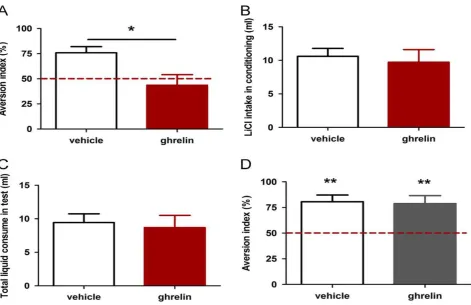
Intra-LA infusion of ghrelin blocked CTA in rats
In our CTA training paradigm, 150 mM LiCl solution was used to establish the aversive memory since drinking LiCl induces nausea response in rats,
meanwhile its salty taste makes the animal acquiring avoidance to another similar salty solution, for example 50 mM NaCl. Our previous studies have demon-strated that NMDA receptor or AMPA receptor activation in the LA are required for the acquisition and expression of such type of aversive memory respectively (Song et al., 2013), indicating that the LA is an important structure for CTA memory processing. Thus, we infused ghrelin and nesfatin-1 into the LA before training and used this behavioral paradigm to compare their effect on the formation of the aversive memory to taste.
http://www.ijSciences.com
Volume 5
–
March 2016 (03
)
166
w/v), 24 h after com-pleting the above experiments. In the new CTA to glycine, i.p. injection of 0.15 M LiCl (2% body weight) induced malaise. Obviously, two groups of rats acquired identical CTA to glycine, the new conditioned stimulus (Fig. 1D), indicating that the basolateral complex of amygdala was not damaged or silenced by cannulation or ghrelin. Therefore, the effect of ghrelin on CTA acquisition is possibly due to the specific interruption of CS-US association in the LA by certain mechanisms.
Next, we checked the possible effect of nesfatin-1 on
CTA acquisition with the same behavioral paradigm. Twenty minutes before training, experimental rats received bilateral infusion of either 2.4 ng, 48 ng or 240 ng nesfatin-1 into the LA, respectively. The control animals received the same volume of saline injection (0.5 μl per side). The drug doses used was chosen based on previous reports showing that icv injection of nesfatin-1 (48 ng or 240 ng) suppressed food intake (Oh et al., 2006) and increased anxiety in the rat (Merali et al., 2008).
http://www.ijSciences.com
Volume 5
–
March 2016 (03
)
167
¼16.3, po0.0001, Bonferroni post test, npo0.05 or nnpo0.01 means significant difference compared to other quadrants. n¼7 for each group. (D) The number of platform crossing was also same for two groups. Two-way repeated measure ANOVA, significant quadrant F(3, 42) ¼19.9, po0.0001, Bonferroni post test, nnpo0.01 or nnnpo0.001 means significant difference compared to other locations. n¼7 for each group. All data are shown as mean7SEM.
Discussion
Many of the feeding hormones, for example insulin, leptin, ghrelin, etc, have effects on learning, memory, attention, and other aspects of cognition (Diano et al., 2006; Paz-Filho et al., 2008; Stranahan et al., 2008), probably due to the fact that feeding requires certain cognitive aspects like decision mak-ing. Ghrelin is recently discovered peptide hormones that can cross the blood–brain barrier (BBB) to exert their CNS effects. Interestingly, ghrelin play opposite roles in food intake, body-weight control and energy homeostasis in both human and rodents. Therefore, we were interested to know whether these two peptide hormones played correlative roles in modulating memory and emotion. With intra-nucleus micro infusion and a battery of behavioral analyses, we examined the effect of ghrelin on cognition and emotion in both rats and mice. Our results showed that intra-CA1 (intra-LA) infusion of ghrelin blocks the acquisition of hippocampus-dependent spatial memory (amygdala-dependent aversive memory).
Consistent with our previous findings (Song et al., 2013), we provided more evidence here that ghrelin blocks memory formation. Ghrelin's blockage on memory processes seems to be a general phenomenon since it acts in different brain regions and different animal species. Although many previous studies have shown that ghrelin enhances memory processes (Carlini et al., 2002, 2004; Diano et al., 2006; Davis et al., 2011), memory impairments induced by ghrelin admin-istration have been reported recently in chicken, rodent and human studies (Carvajal et al., 2009; Dresler et al., 2010; Spitznagel et al., 2010; Albarran-Zeckler et al., 2012). The experimental procedure, the sensitivity of the behavioral paradigms, the genetic background and the age of animals may account for some of the discrepancies among different
studies. Noticeably, we administrated a smaller amount of ghrelin compared to others (Carlini et al., 2004; Toth et al., 2008; Alvarez-Crespo et al., 2012; Goshadrou and Ronaghi, 2012). In addition, we infused ghrelin into the specific brain regions (LA and CA1) instead of ip or icv injection used by previous studies (Carlini et al., 2002; Diano et al., 2006; Carlini et al., 2008; Hansson et al., 2011).
Not only affected learning and memory, previous studies demonstrated that ghrelin caused complicated, even contro-versial effects on emotional responses including anxiety and depression (Asakawa et al., 2001; Carlini et al., 2002, 2004; Kanehisa et al., 2006; Lutter et al., 2008), which could have big.
References:
1) Albarran-Zeckler RG, Brantley AF, Smith RG (2012) Growth hormone secretagogue receptor (GHS-R1a) knockout mice exhibit improved spatial memory and deficits in contextual memory. Behav Brain Res 232:13-19.
2) Alvarez-Crespo M, Skibicka KP, Farkas I, Molnar CS, Egecioglu E, Hrabovszky E, Liposits Z, Dickson SL (2012) The amygdala as a neurobiological target for ghrelin in rats: neuroanatomical, electrophysiological and behavioral evidence. PLoS One 7:e46321.
3) Andrews ZB (2011) The extra-hypothalamic actions of ghrelin on neuronal function. Trends Neurosci 34:31-40.
4) Armbruster BN, Li X, Pausch MH, Herlitze S, Roth BL (2007) Evolving the lock to fit the key to create a family of G protein-coupled receptors potently activated by an inert ligand. Proc Natl Acad Sci USA 104:5163–5168.
5) Carlini VP, Martini AC, Schioth HB, Ruiz RD, Fiol de Cuneo M, de Barioglio SR (2008) Decreased memory for novel object recognition in chronically food-restricted mice is reversed by acute ghrelin administration. Neuroscience 153:929-934. 6) Carlini VP, Monzon ME, Varas MM, Cragnolini AB, Schioth
http://www.ijSciences.com
Volume 5
–
March 2016 (03
)
168
anxiety-like behavior and memory retention in rats. Biochem Biophys Res Commun 299:739-743.
7) Carlini VP, Perez MF, Salde E, Schioth HB, Ramirez OA, de Barioglio SR (2010) Ghrelin induced memory facilitation implicates nitric oxide synthase activation and decrease in the threshold to promote LTP in hippocampal dentate gyrus. Physiol Behav 101:117-123.
8) Carlini VP, Varas MM, Cragnolini AB, Schioth HB, Scimonelli TN, de Barioglio SR (2004) Differential role of the hippocampus, amygdala, and dorsal raphe nucleus in regulating feeding, memory, and anxiety-like behavioral responses to ghrelin. Biochem Biophys Res Commun 313:635-641. 9) Carvajal P, Carlini VP, Schioth HB, de Barioglio SR,
Salvatierra NA (2009) Central ghrelin increases anxiety in the Open Field test and impairs retention memory in a passive avoidance task in neonatal chicks. Neurobiol Learn Mem 91:402-407.
10) Chen JP, Lin C, Xu CP, Zhang XY, Fu M, Deng YP, Wei Y, Wu M (2001) Molecular therapy with recombinant antisense c-myc adenovirus for human gastric carcinoma cells in vitro and in vivo. J Gastroenterol Hepatol 16:22-28.
11) Cowley MA, Smith RG, Diano S, Tschop M, Pronchuk N, Grove KL, Strasburger CJ, Bidlingmaier M, Esterman M, Heiman ML, Garcia-Segura LM, Nillni EA, Mendez P, Low MJ, Sotonyi P, Friedman JM, Liu H, Pinto S, Colmers WF, Cone RD, Horvath TL (2003) The distribution and mechanism of action of ghrelin in the CNS demonstrates a novel hypothalamic circuit regulating energy homeostasis. Neuron 37:649-661.
12) Davis JF, Choi DL, Clegg DJ, Benoit SC (2011) Signaling through the ghrelin receptor modulates hippocampal function and meal anticipation in mice. Physiol Behav 103:39-43. 13) Diano S, Farr SA, Benoit SC, McNay EC, da Silva I, Horvath B,