Copyright © 2016 by Academic Publishing House Researcher
Published in the Russian Federation
European Journal of Economic Studies
Has been issued since 2012. ISSN: 2304-9669
E-ISSN: 2305-6282
Vol. 16, Is. 2, pp. 302-308, 2016
DOI: 10.13187/es.2016.16.302
www.ejournal2.com
Articles and Statements
UDC 331.556.2:316.7:332.1
Forced Migration and Socio-Cultural Development of Regions of Ukraine: Strategic Focus
Mariana Bil a , *
a State Institution «Institute of regional research named after M.I. Dolishniy of the NAS of
Ukraine», Ukraine
Abstract
The theoretical substantiation of priorities of socio-cultural development of regions of Ukraine in conditions of high dynamics of internal migration in the article was made. The tendencies of forced migration from the eastern regions of Ukraine were analyzed. The necessity and the main approaches to the formation of strategies of socio-cultural development of Ukraine's regions in case of high population migration activity were proved. Typology of the concept of social and cultural acceptance of migrants to the host society in the context of acculturation opportunities and acceptable level of multiculturalism was proposed. The essence of socio-cultural development of the region according to conditions of high migration activity rate and its extreme scenarios was determined. Basic socio-cultural norms of the host society that outline integration plane of migrants were characterized. Conceptual priorities of socio-cultural development of regions of Ukraine according to the conditions of high population migration activity, covering sustainability of social and cultural norms of nation consolidation character, the perception of migrants at the host society as propulsion, potential development, level of social cohesion, and ensuring their integration potential were highlighted. Nation-consolidating socio-cultural norms-archetypes of Ukrainian society were described. Priorities for social and socio-cultural development of regions of Ukraine under conditions of high migration activity were proposed.
Keywords: forced migration, internally displaced person, migration activity, social and
cultural development of the region, host society, nation-consolidating rules-archetypes, acculturation.
1. Introduction
Events of Revolution of Dignity and territorial integrity conflict gained new opportunities for self-assertion and development for Ukrainian nation. New horizons for international economic cooperation and possibilities for integral social and cultural development became available for our state. Nowadays Ukrainians are going through a period of acute unity. Ukrainian culture and
* Corresponding author
traditions popularization in case of implementation of strategically prudent public policy can overcome old ideological stereotypes and conflicts between the inhabitants of the eastern and western regions of Ukraine, create new shared values as a necessary basis of social identity of Ukrainians (Sadova, Risna, 2015: 62).
One of the most negative consequences of crisis events at the south and east of Ukraine is the huge number of internally displaced persons (IDPs) who need as a basic social protection as more effective measures to integrate their potential into host societies. European countries face a similar problem, as they have to take a significant number of refugees and to ensure not only their social protection, but also integration into the host societies, which differ greatly according to their socio-cultural norms. A high level of forced migration is in Ukraine, but only inner citizens, actualized the need for further regional development according to the principles of social and national unity. So scientific study of strategic priorities of socio-cultural development of regions of Ukraine in conditions of high dynamics of internal migration is very important nowadays.
2. Materials and Methods
The sources of this articles is theoretical and methodological provisions which developed by scientists in the study of migration, cultural and strategic regional development. To achieve the objectives in article used such methods as logic and system analysis, generalization and systematization, statistical and graphical methods. An informational basis of this article constituted valid regulatory acts in the regulation of migration, including forced, official statistics and studies of other scientists.
3. Discussion
The current situation in Ukraine demonstrates the absolute unwillingness of society and government to respond to crisis calls and ensure their regulation. The Law of Ukraine "About the rights and freedoms of internally displaced persons" was adopted only after half a year after the aggravation of the situation (10.20.2014). The Law "About the rights and freedoms of citizens and legal regime in the temporarily occupied territory of Ukraine" (04.15.2014), which defined the legal status of temporarily occupied territories, was adopted rather earlier. The Law of Ukraine "About creation of free economic zone "Crimea" and the peculiarities of the economic activity at the temporarily occupied territory of Ukraine" (08.12.2014) regulates the legal basis of relations between subjects on occupied territory.
0 200000 400000 600000 800000 1000000 1200000 1400000 1600000
July 201
4
Augu st 2
014
Sept embe
r 201 4
Oct ober
201 4
Nov em
ber 2 014
Dec em
ber 2 014
Janu ary
2015
Febr uary
201 5
Mar ch 2
015 April
201 5
May 201
5
June 201
5
July 201
5
Augu st 2
015
Sept embe
r 201 5
p
e
rs
o
n
s
0 0,5 1 1,5 2 2,5 3
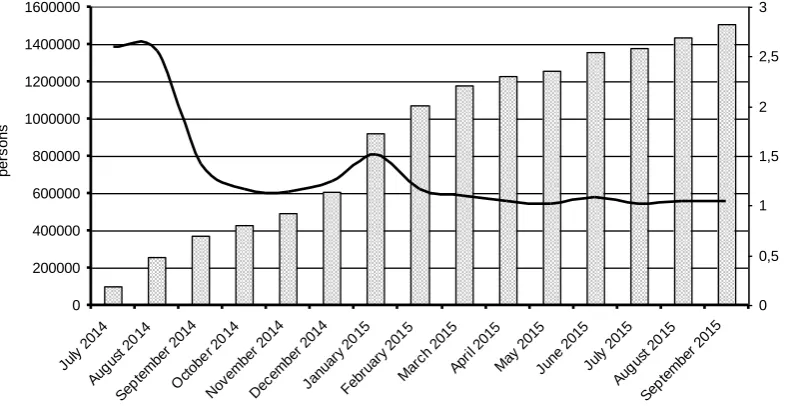
Fig. 1. Dynamics of registered IDPs in Ukraine, 2014-2015
Source: (Ukraine. Internally Displaced People. Internal Displacement Map UNHCR, 2016).
number of registered IDPs, acts of forced migration "officially" cover about 3 % of population of Ukraine. Whether we are talking about the entire population of the conflict territories, including occupied Crimea Republic, almost 19 % of the country fell into a plane of territorial conflicts. Disproportionate is another distinct trend of forced displacement in Ukraine – more than 80 % of all IDPs remain in five regions and the capital of the country.
Fig. 1 shows dynamics of the amount of registered IDPs in Ukraine, which proves its continuing growth despite the current "freeze" of the conflict in the east (on the main axis - amount of registered IDPs, on support axis - growth rate).
4. Results
Thus, many Ukrainian regions became host-environments for IDPs. Ukrainian society still remains on the stage of just establishment of socio-cultural principles. Current situation determines the urgent need for realization of the strategies of socio-cultural development of the regions due to high dynamics of internal migration. It is very important to change the attitude to migrants while implementation of those strategies. That is caused not only by difficult situation in the country, but also by global trends of rapid growth of spatial mobility of population. The key points of perception of migrants at the host society should be the following:
1) a migrant is a driver of development in case of effective use of its intellectual and labor potential, business motivation and social activity;
2) a migrant is a potential for development in case of improvement of population demographic reproduction measures, opportunities for self-sufficiency despite all paternalistic expectations, social infrastructure development taking into consideration all additional with the additional commitments;
3) a migrant is a link of social cohesion in case of tolerant relationship between resident population and migrants, human equality, preservation of ethnic and cultural identity.
Fig. 2. Typology of concepts of social and cultural acceptance of migrants
Source: (Ryndzak, 2014: 377).
Building regional strategies of socio-cultural development under conditions of high dynamics of internal migration can be realized b different approaches: demosituational – consideration of demographic load of migrants on permanent population; migratiological – definition of migration profile of the region with a holistic vision of socio-economic conditions of migration and possible future trends, regional migration policy (Socio-cultural consequences of migration processes, 2014: 97-98); socioeconomic – determination of common situation and opportunities for development of the region in current and strategic perspective; cultural – evaluation of the development level of cultural environment, society integrity; integral – definition of cross-border, inter-regional cooperation in the regulation of migration, movement of labor; (ultra)liberal – lack of holistic
Integration
concept
ACC
ULT
URA
T
IO
N
MULTICULTURALISM
Assimilation
concept
Segregation
concept
Marginalization
concept
Closed socio-cultural environment where migrants must fully
accept existing
standards
Conservative socio-cultural environment
where migrants face with intolerance to their specific features
Purposes of migrants’ values acculturation in developed socio-cultural
environment
Reasonable values acculturation of migrants and the host
socio-cultural environment; centralized – lack of regional peculiarity of socio-cultural development due to national vision of values and standards; modern – crucial transition to new standards of regional development with an innovative vision of social, economic and cultural priorities.
It is important for the regions of Ukraine to develop those socio-cultural standards that meet their historical, socio-economic, geopolitical, ethnographic peculiarities. At the same time it should be proved the level of acculturation of socio-cultural environment to the characteristics of migrants (acculturation process as a result of interference of cultures, perception of people of one nationality culture of another ethnic group (Kravtsiv et al., 2009: 7). Fig. 2 presents the basic concepts types of socio-cultural acceptance of migrants who follow the practice of segregation, assimilation, marginalization and integration.
Formation of strategies of socio-cultural development of regions of Ukraine under conditions of high dynamics of internal migration requires their specification according to territorial characteristics. Socio-cultural development processes take place in the spatial dimension of society and culture, providing the invention of a certain order of contents in the course of human interaction with the universe, as well as structuring her own inner world (Kravchenko, 2010: 4). Socio-cultural development of the region under conditions of high population migration activity involves sustainability and transformation of socio-cultural norms of the host society during the acculturation at different institutional levels – individual, social groups, organizations and society. The processes of socio-cultural development under conditions of high migration activity of the population can experience significant deformations. That’s why such processes should be supported within regulated socio-cultural norms (principles, standards), which reveal linguistic, religious, behavioral (ethics, interpersonal interactions morality, responsibility), personal (manner and lifestyle), ethnic (traditions, customs), cultural (creativity), consumer (costs of meeting spiritual needs) features. These socio-cultural principles in Ukrainian society are poorly developed (or rather artificially affected by political speculation), as a result, the situation of the IDPs integration capacity is uncontrolled and rather determines the ability of Ukrainian society form a coherent socio-cultural space by shock scenario (Fig. 3).
Fig. 3. Extreme scenarios of socio-cultural development of Ukrainian society in case of massive
forced migrations Source: the author.
Consequently, it is crucial for regions of Ukraine to define strategic priorities of socio-cultural development taking into consideration migration factor. They should be based on conceptual nation-consolidating principles, but at the same time, they should also permit specification of potential integration of IDPs into different social systems. According to Ukrainian scientists, under conditions of geopolitical destabilization migration policy is used by national public entities under the slogan of national-territorial recovery (Balanyuk, 2009: 3). Similarly, the current situation in Ukraine makes it possible to provide a national and territorial recovery, but only in case of effective migration policy, which should be based on strategic priorities of socio-cultural development.
Formation of strategies of socio-cultural development can be carried out by different approaches and their combination. We focus on demosituational, socioeconomic and migratiological approaches. If we want to specify conceptual priorities of socio-cultural development of regions of Ukraine under conditions of high migration activity rate, we should
Basic socio-cultural points of host society
Religion
LINGUISTIC
Personal
Ethnic
Cultural
Consumer Behavioral
Socio-cultural space deformation with
unreasonable multiculturalism, which
creates auspicious conditions for social
cohesion loss and further – territorial
integrity loss
Forming an integral socio-cultural space
with established national and
socio-consolidating standards, promotion of new
ideology of migrants perception on the basis
of effective mechanisms for integration of
their potential
or the –
admit sustainability of socio-cultural norms-archetypes of nation-consolidating nature (archetypes – fixed collective unconscious cultural stereotypes that affect behavior and human history (Afonin, Martynov, 2013: 193):
- Linguistic – Ukrainian language with official status with the preservation of the linguistic rights of national minorities; promoting the Ukrainian language at all levels, particularly in the media, culture and art; unacceptability of forced implementation of Ukrainian language in areas with uncertain socio-cultural norms, however gradual promotion through the media, culture and art;
- Religion – Christianity should have the priority to the creation of conditions for exercising the right and freedom of religion, but with strict control of religious organizations under the law and compliance with educational activities to the cultural norms of the Ukrainian society;
- Behavioral – promotion the idea of good at interpersonal interactions, focus on etalons, standards of conduct, equality, justice, honesty, duty, responsibility, values human life and health;
- Personal – way and style of life according to the established tradition of nepotism, family-oriented, procreation;
- Ethnic – priority of conservation and restoration of national traditions and customs with regard to the rights of national minorities; unacceptability of forced implementation of national traditions and customs in areas with uncertain socio-cultural norms, however gradual advocacy through the media, culture and art;
- Cultural – the possibility of public activity, creativity and other types of non-standard activities within existing legislation;
- Consumer – the possibility of consumption of goods and services, designed to meet the needs of intangible, including cultural institutions.
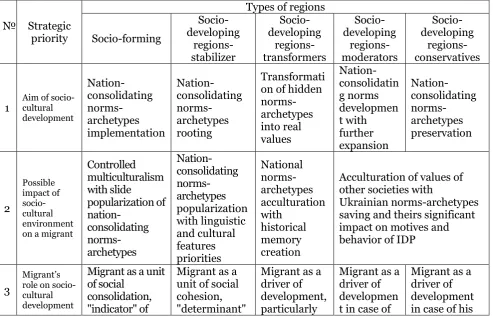
Mentioned above conceptual bases of social and cultural development of regions of Ukraine should be provided for any spatial type. However, different regions require specific priorities of socio-cultural development – according to demographic load of IDPs on resident population, strategic development priorities, general migration situation (Table 1).
Table 1. Special priorities of socio-cultural development of regions of Ukraine in terms of high
migration activity
№
Strategic priority
Types of regions
Socio-forming Socio-developing regions-stabilizer Socio-developing regions-transformers Socio-developing regions-moderators Socio-developing regions-conservatives
1 Aim of socio-cultural development Nation-consolidating norms-archetypes implementation Nation-consolidating norms-archetypes rooting Transformati on of hidden norms-archetypes into real values Nation-consolidatin g norms developmen t with further expansion Nation-consolidating norms-archetypes preservation 2 Possible impact of socio-cultural environment on a migrant
Controlled multiculturalism with slide popularization of nation-consolidating norms-archetypes Nation-consolidating norms-archetypes popularization with linguistic and cultural features priorities National norms-archetypes acculturation with historical memory creation
Acculturation of values of other societies with
Ukrainian norms-archetypes saving and theirs significant impact on motives and behavior of IDP
3
Migrant’s role on socio-cultural development
Migrant as a unit of social
consolidation, "indicator" of
Migrant as a unit of social cohesion, "determinant"
Migrant as a driver of development, particularly
Migrant as a driver of developmen t in case of
level of
co-assistance of increasing of patriotism level
historical and cultural potential mobilization
his effective
integration adaptation to specific socio-cultural environment
4 Priorities of IDP potential involvement
Socially important spheres of the development of social
infrastructure
Science and education sector, IT sector, development of social infrastructure
Innovative industrial sectors, tourism, recreation, culture and art
Innovative service sectors, development of social infrastructure
Self-employment, business, cultural and artistic activities
5
Priorities of social defense of IDP
Maximal social defense with a sense of
involvement to Ukrainian society
Social defense with
strengthening possibility of self-development (training, retraining) and realization labor and education rights
Strengthening of possibilities of self-development, long-term integration
Selective approach for long-term integration stimulation Source: the author.
5. Conclusion
Defining strategic priorities of socio-cultural development of regions of Ukraine under conditions of high migration activity of the population allowed to distinguish different types of areas according to the level of implementation socio-cultural principles and ability to balance the existing situation in the country:
1) socioforming regions. Such areas are usually close to zones of military conflict in Ukraine, where society faced with the problem of political opposition and national territorial uncertainty. Strategy of socioformating is extremely necessary for these areas. It does not involve radical cultural transformation on the early stages, but focuses on implementing nation-formating norms-archetypes. Social defense of IDPs together with their fillings of accessory to Ukrainian society should be the most significant factor of society consolidation;
2) sociodeveloping regions-stabilizers. They usually border with zones of military conflict and receive a large number of migrants with the status of IDPs. Stabilizing socio-cultural development strategy is the most appropriate for such topical areas. It should exterminate people certainty in national identity, enhance the sense of patriotism and objective perception of the situation. The main goal of social and cultural impact on IDPs is popularization of nation-consolidating standards-archetypes with linguistic and cultural characteristics. Social defense priorities should differentiate according to satisfaction of basic needs of IDPs to promote their self-development, training, etc;
3) socio-developing regions-transformers. Such areas usually are historical cultural centers that would perform the function of national unity, but for various reasons were unable to instill the appropriate signs. Therefore, transformative strategy of socio-cultural development should be implemented for regions with a significant historical and cultural potential. The strategy should ensure transformation of hidden national rules-archetypes, stored in insufficient quantities of settlements, into real nation-consolidating values, and reinforce historical memory;
5) developed regions-conservatives. The conservative status of the region at socio-cultural sphere means its deep historical and socio-cultural tradition, which limits acculturation possibilities and multiculturalism environment formation. Conservative strategy of socio-cultural development is acceptable for regions with specific geopolitical, landscape, historical and cultural characteristics that form nation-consolidating rules-archetypes. These regions complicate the integration capabilities of potential IDPs in a holistic socio-cultural environment, as they require faster adaptation of IDPs’ potential integration in these complete socio-cultural environment. Integration of potential of IDPs at such specific areas is possible with a selective approach provided by their adoption of traditional standards-archetypes.
Proposed types of strategies of socio-cultural development can adapt to different societies depending on their level of social cohesion and migration profile. The practical significance of the study is being at necessity of implementation of its results while realization of humanitarian policy of Ukraine together with the new concept of migration tool, which aim is protection of a person-migrant in the modern conditions of high level of spatial mobility.
References
Afonin, Martynov, 2013 - Afonin E., Martynov A. (2013). Archetype and societal: the interaction and mutual influence: Public Administration. Theory and Practice, Spec. number., pp. 193-200.
Balanyuk, 2009 - Balanyuk D. (2009). Migration Policy Strategy in the period of national state-building: Ph.D in Political Science. Thesis for obtaining scientific degree, Odessa, pp. 20.
Kravchenko, 2010 - Kravchenko O. (2010). National cultural space as identity model.
Bulletin of Kharkiv State Academy of Culture, 31, pp. 4-11.
Kravtsiv et al., 2009 - Kravtsiv et al. (2009). Migration phenomena and processes: concepts, methods, facts: Directory; Institute of Regional Research of NAS of Ukraine, Lviv, pp. 228.
Ryndzak, 2014 - Ryndzak O. (2014). Adaptation of Migrants to Host Societies: Theoretical Aspects: Wirtschaft und Management: Probleme der Wissenschaf und Praxis: Sammelwerk der Wissenschaftlichen Artikel. 1, Nurnberg, Deutschland, pp. 375-379.
Sadova, Risna, 2015 - Sadova U., Risna R. (2015). Re-emigration as a mechanism of social policy for internally displaced persons in Ukraine. Regional Economics, 2, Lviv, pp. 55-64.
Socio-cultural consequences of migration processes, 2014 - Socio-cultural consequences of migration processes (2014). Scientific report under control of Prof. U. Sadova; Institute of Regional Research of NAS of Ukraine, Lviv, pp: 276.