International Journal of Scientific Research and Engineering Development-– Volume 2 Issue 5, September 2019 Available at www.ijsred.com
ISSN : 2581-7175 ©IJSRED:All Rights are Reserved Page 453
One Dimensional Wavelet Based Quality-Assured ECG
Compression System using Low Power Spiht Decoder
Subhananthi.C
[1], C.N.Marimuthu-Professor&Dean
[2]Department of Electronics and Communication Engineering, NandhaEngineering College, Erode
[1]
[email protected], [2][email protected]
Abstract:
This paper introduce a hardware-oriented SPIHT decoding algorithm in electrocardiogram. Low-power hardware architecture is developed to implement a real-time, high-performance and low-cost ECG. SPIHT employs more sophisticated coding and which exploits the properties of the wavelet transformed to increase its efficiency. However, current SPIHT coding structures are intended for picture/video handling. These structures require a lot of memory just as muddled arranging calculations, which both require tedious undertakings and are unsatisfactory for portable ECG applications. In light of our recently changed SPIHT coding work, which utilized banners and check bits to decrease memory prerequisites and coding unpredictability by combining three inquiry forms into one stage. Hence, to accomplish the on-going plan objective for portable ECG applications, in this paper, we initially present an equipment situated SPIHT translating calculation that is reasonable for deciphering the recently introduced SPIHT coding work. In like manner, a fitting low-control equipment engineering is created to execute an on-going elite and minimal effort SPIHT VLSI plan for our proposed decoder calculation, which is suitable for portable ECG application. To design Real-time, cost and power-efficient one-dimension (1-D) wavelet-based quality-assured electrocardiograph (ECG) compression systems using Set Partitioning in Hierarchical Trees (SPIHT) decoder design.
Index Terms— ECG, SPIHT Decoder, Mobile Health,
I. INTRODUCTION
As mobile Health application requests for cell phones keep on expanding, how to join social insurance with cell phones is one of the most significant and testing mobile Health research concentrates right now. Among these applications, ECG signal estimation is one of the head and rising mobile Health applications. Also, the human heart is a three-dimensional structure whose development procedure can quantify distinctive current sign at countless estimation points, which are indicated as leads. The ECG needs to record the multi-lead estimation data [1, 2]. This recoded multi-lead ECG data is gotten by means of the biosensors on the patient's body, and the recorded data should be transmitted to the
capacity gadget by a remote transmitter from a remote body territory arrange (WBAN) [3-8]. Be that as it may, the estimation mirrors the condition of the heartbeat on the grounds that the ECG signal investigation is a non-intrusive assessment strategy. The ECG data can help specialists in diagnosing the patient's heart circumstance and can relieve the danger of a finding mistake. Meanwhile, the fantastic ECG signal quality can be gotten if the recoded ECG estimation information isn't packed; tragically, the uncompressed coding approach prompts a lot of sign data that must be transmitted and put away, which causes inordinate power dispersal that comprises of a wide scope of information computational power and transmission control. The methodology without information pressure isn't conductive to usage on extra room restricted and vitality constrained cell phones for mobile Health applications.A
International Journal of Scientific Research and Engineering Development-– Volume 2 Issue 5, September 2019 Available at www.ijsred.com
ISSN : 2581-7175 ©IJSRED:All Rights are Reserved Page 454 pipeline engineering of the non-detachable calculation
dependent on the improved 2-D discrete periodized wavelet change (DPWT) just as the non-distinguishable calculation dependent on the homeomorphic high-pass channel and the 2-D administrator. Connection calculation was proposed in [9]. This engineering was intended to diminish the quantity of increase tasks and the multifaceted nature of the limit information preparing to accomplish immaculate recreation. Since the 1-D DWT needs to process flat and vertical data all the while, the equipment cost and equipment multifaceted nature are very high, which is horrible to VLSI usage [1, 11-12, 10]. Likewise, the unpredictable equipment configuration is additionally joined by higher power utilization, which isn't reasonable for mobile Health applications on power-constrained cell phones. In this manner, a 1-D wavelet-based ECG information pressure with quality affirmation was proposed in [11]. The presented pressure framework accomplishes better pressure execution and ECG coding quality. Be that as it may, the vitality of the DWT is gathered in the lower recurrence band, and every disintegration coefficient can be additionally upgraded with SPIHT coding to improve the wavelet-based ECG pressure proficiency.
Therefore, the cutting edge best in class VLSI executions of wavelet-based picture/video/ECG information pressure are centered on the 1-D wavelet-based topology with the SPIHT coding plan [11, 12]. Kim et al. [11] proposes a 1-D 64×1 SPIHT equipment configuration conspire that utilizations parallelism and pipeline booking to accomplish a successful equipment usage. This epic plan alters the regular rundown based lossless SPIHT coding calculation [10] to make it conceivable to assess the bit-stream length of each go before interpreting to accomplish a high-throughput SPIHT structure. Be that as it may, the 1-D wavelet-based information pressure configuration stresses the improvement of the equipment throughput by utilizing the equipment parallelism conspires. In any case, it was as yet dependent on the rundown based coding topology and along these lines experiences the coding quality corruption, which may cause misdiagnoses by specialists because of the poor coding-quality execution. In the
interim, it is inadmissible for quality-on-request ECG information pressure. An epic coding-status-register-document based SPIHT coding plan [7] was proposed as of late to explain the drawback of the VLSI usage of the rundown based methodology, and the proposed lossless SPIHT coding configuration is proper for mobile Health 1-D wavelet-based ECG information pressure. Be that as it may, [6] didn't make reference to a comparing SPIHT translating execution to totally acknowledge 1-D wavelet-based ECG pressure with quality confirmation for the proposed SPIHT encoder structure. What's more, none of the cutting edge SPIHT decoder plan writing has principally centered on coding-status-register-document based SPIHT coding plan [6] for wavelet-based ECG pressure by DWT-SPIHT coding plan, this is the focal point of the examination work introduced in this paper. To tackle the previously mentioned issue, we propose a savvy and power-effective SPIHT decoder calculation and equipment engineering that is reasonable to the coding-status-register-document based SPIHT encoder plan [6] over the deciphering side for a mobile Health 1-D wavelet-based ECG pressure framework with quality affirmation.
The remainder of this paper is masterminded as pursues. Area II quickly surveys and examines the earlier SPIHT coding works. Area III presents and subtleties our proposed SPIHT unraveling calculation and presents the recreation results. The apt equipment design of our proposed SPIHT translating strategy and the usage results are examined in Section IV. The end is displayed in Section V.
II. RELATED SPIHT WORKS
The cutting edge SPIHT coding plans that are fitting for quality–unassured/ – guaranteed wavelet-based picture/video/ECG information pressure frameworks by DWT-SPIHT coding plan in mobile Health applications are quickly looked into, examined, and presented in this segment.
A. SPIHT Coding for Quality-unassured Data
International Journal of Scientific Research and Engineering Development-– Volume 2 Issue 5, September 2019 Available at www.ijsred.com
ISSN : 2581-7175 ©IJSRED:All Rights are Reserved Page 455 The SPIHT coding is a huge research point in the
plan of superior wavelet-based information pressure frameworks. The best in class SPIHT plans [2, 11, 12] have been proposed in the writing. These plans can be isolated into two classifications: list-based SPIHT structure and non-list-based SPIHT plan. The rundown based SPIHT coding plan [2, 11, 12] requires two strategies for arranging and refinement dependent on utilizing 3 goes to encourage the two procedures. The rundown based SPIHT coding plan requires a lot of information stockpiling and a lot of calculation for the arranging and refinement process, bringing about high equipment intricacy and low execution. In this manner, these structures embrace the equipment
Engineering reordering and arranging methods to accomplish equipment speed upgrades however penance the SPIHT coding quality; subsequently, these plans are unseemly for quality-on-request ECG pressure and are reasonable for video/picture pressure. Rather than rundown based SPIHT plan, non-list-based SPIHT encoder plans [10] have been proposed. In any case, non-list-based SPIHT expands the cradle size along the decay layer of the wavelet change and the picture size, which are unsatisfactory for expense and power-constrained cell phones.
B. SPIHT Coding for Quality-guaranteed Data
Compression
The previously mentioned SPIHT structures utilize the conventional rundown based and non-list-based SPIHT encoding calculations. This improves the multifaceted nature of SPIHT plans and gives better pressure
execution than wavelet-based picture and video information pressure frameworks. Be that as it may, these techniques still experience the ill effects of coding-quality debasement and expanded equipment costs, making them unusable for constant portable wavelet-put together quality-with respect to request ECG pressure frameworks
III. PROPOSED ONE DIMENSIONAL WAVELET BASED QUALITY ASSURED ECG
Not at all like past SPIHT structures that apply the traditional list-based SPIHT calculation [12], a novel coding-productive and equipment satisfactory SPIHT plan for 1-D wearable wavelet-put together quality-with respect to request ECG pressure frameworks was presented in [12] and is appeared in Figure. 1. The execution results uncover its elite, low power, also, great VLSI productivity. In Figure.1, the encoding side (laid out in purple), all together, comprises of the three capacity squares of DWT, quantization, and lossless SPIHT. In the meantime, the lossless SPIHT coding structure can be executed utilizing [12] and its relating nitty gritty SPIHT encoding plan is represented as pursues. To begin with, the inputs [ ] of the lossless SPIHT encoder [12] are an arrangement of coefficients after a 1-D n-point DWT and quantization process; at that point, the got quantized coefficients [ ] are allocated to bit planes. Next, the quantized coefficients [ ] in the bit planes can be partitioned into two segments: the sign segment, [ ], and the extent segment
International Journal of Scientific Research and Engineering Development-– Volume 2 Issue 5, September 2019 Available at www.ijsred.com
ISSN : 2581-7175 ©IJSRED:All Rights are Reserved Page 456 The coding plan in [6] presents two sorts of equipment
well-disposed register documents for the recording of coefficient sizes, to be specific, the coding registration document (CCBF) and the coding status records (CSF). The CCBF records whether there are huge coefficients in each layer bit plane. On the off chance that there is a huge coefficient, the comparing CCBF area is set to legitimate low (i.e., "0"); something else, the default coherent high (i.e., "1") is kept up. On the other hand, CSF records the bit-plane coding status of each layer hub. In the event that there is a status showing that somewhat plane hub has been yield, at that point the comparing CSF area is set to coherent high; generally, the default sensible low is kept up. For 1-D × 1 DWT applications, the two kinds of register records can be additionally separated into sort an (i.e., TACCBF and TACSF) and type B (i.e., TBCCBF and TBCSF). The characterized type-A register document is utilized to record the posterity coefficients of each layer coding hub in the bit plane, and the size of each record is roughly ⁄2 bits. Additionally, the sort B register document set is utilized to record the relative coefficients of each layer coding hub in the bit plane and requires around ⁄4 bits. The two sorts of register documents are then arranged with a lot of N-bit sign register documents (SCSF), which are utilized to record the indication of each layer coding hub in the bit plane. At long last, each layer coding result [ ] is joined to comprise the last piece stream [ ] , and a 1-D rapid SPIHT coding configuration would thus be able to be figured it out. Thusly, from this coding procedure, the SPIHT coding calculation proposed by [12] requires around (2.5 × N)- bit register records and a (11 × N)- bit-plane cradle for 1-D × 1 DWT. Contrasted with the best in class SPIHT coding structures [2, 11, 12], [6] gives an extensive decrease in the measure of register utilization. of the best in class SPIHT coding structures being founded on the idea driving ordinary SPIHT coding calculations joined by arranging and refinement forms, the technique in [12] just needs to record the data of each layer coding and update the coding status to improve the parallelism of the equipment engineering and hence incredibly increment the coding speed.
IV. PROPOSED SPIHT DECODER ALGORITHM
The complete SPIHT unraveling calculation system is given by Algorithm Dec, and the general CPE SPIHT deciphering procedure is delineated and outlined as follows in the succession unraveling instatement pass (DIP), coding status and bit-stream unraveling pass (CSBSDP) and lossless unraveling yield pass (LDOP).
For 1-D 1024 × 1 DWT applications, the two kinds of register records can be additionally separated into sort An (i.e., TACCBF and TACSF) and type B (i.e., TBCCBF and TBCSF). The characterized type-A register document is utilized to record the posterity coefficients of each layer coding hub in the bit plane, and the size of each record is around ⁄2 bits. So also, the sort B register document set is utilized to record the relative coefficients of each layer coding hub in the bit plane and requires around ⁄4 bits. The two kinds of register records are then gathered with a lot of N-bit sign register records (SCSF), which are utilized to record the indication of each layer coding hub in the bit plane. At long last, each layer coding result [ ] is consolidated to establish the last piece stream [ ] , and a 1-D rapid SPIHT coding configuration would thus be able to be figured it out. Thus, from this coding procedure, the SPIHT coding calculation proposed by [19] requires roughly (2.5 × N)- bit register records and a (11 × N)- bit-plane support for 1-D × 1 DWT. Contrasted with the best in class SPIHT coding structures [2, 11, 12,], [12] gives an extensive decrease in the measure of register utilization. of the best in class SPIHT coding structures being founded on the idea driving regular SPIHT coding calculations [10] joined by arranging and refinement forms, the technique in [12] just needs to record the data of each layer coding and update the coding status to improve the parallelism of the equipment design and subsequently incredibly increment the coding speed.
International Journal of Scientific Research and Engineering Development-– Volume 2 Issue 5, September 2019 Available at www.ijsred.com
ISSN : 2581-7175 ©IJSRED:All Rights are Reserved Page 457 segment is characterized as the Coding-Status
Introduction Pass (CSIP) and is devoted to instating the coding status of the SCSF, TACSF, and TBCSF. As appeared in Fig. 2, the TACSF what's more, TBCSF are likewise ( ⁄2)- bit and ( ⁄4)- bit banner registers, alongside the N-bit banner register of the SCSF. The instatement settings of the SCSF, TACSF, and TBCSF are every one of the ones. The disentangling status banners of TACSF ( ⁄2) to TACSF (0) and TBCSF ( ⁄4) to TBCSF (0) are utilized to separately demonstrate whether or not the posterity and relatives of the decoded hubs have been resolved. Besides, the sign coding status document of SCSF (N) to SCSF (0) are utilized to demonstrate if the decoded hub's sign piece is resolved or not. Another segment, which is characterized as the bit-plane limit count pass that uses the bit-plane threshold capacity of ( ) = 2log2 ( | |)− , which is altered by [12], is utilized to assign every edge of the sub-disentangling layer for all l-th unraveling layer use.
Stage 2) CSBSDP is the subsequent disentangling go to process and update the coding status of the SCSF, TACSF, and TBCSF for the sign of the recently refreshed coding-status data over the current decoded edge. Moreover, the information bit-stream [ ] is successively decoded into the sign information [ ] and the greatness information [ ]. In like manner, yield each sub-layer unraveling two-root arrangement of { [0], (0), [1], (1)}, which pursues the current decoded the l-th bit-stream [ ] as Algorithm Dec does a short time later. The sign capacity ( ) equivalents to [ ] if [ ] and SCSF[n] are individually equivalent to one. Something else, no sign data should be yield.
Stage 3) The last disentangling pass is LDOP, which is utilized to deal with the last unraveling bit-stream yield C[ ]. The past stage 2 is repeated until the ( ) is equivalent to 0, which shows
that the disentangling procedure is finished. At that point, the l layer bit-stream
Figure.2 displays the total square graph of our proposed SPIHT translating structure, which incorporates the 4 coding units of the coding-status introduction unit (CSIU), the bit-plane limit estimation unit (BPTCU), the coding-status and bit-stream unraveling unit (CSBSDU), and the lossless interpreting yield unit (LDOU). The CSIU and BPTCU are utilized to understand the capacity of the previously mentioned stage 1 in the past segment. In the meantime, the CSBSDU and LDOU are utilized to understand the elements of stage 2 and stage 3 in the past area, individually. The itemized equipment activities of our proposed SPIHT decoder configuration are clarify as pursues. To start with, the translating square gets the information bit-stream [ ] from the yield of the SPIHT encoder plan [12] and appropriately sends it to the BPTCU. In the meantime, for the planning balance thought, we appoint the CSIU to be situated in a similar preparing stage. In which, the BPTCU and CSIU are utilized to figure each translating layer limit and introduce the coding status documents of the SCSF, TACSF, and TBCSF, separately
International Journal of Scientific Research and Engineering Development-– Volume 2 Issue 5, September 2019 Available at www.ijsred.com
ISSN : 2581-7175 ©IJSRED:All Rights are Reserved Page 458 From that point forward, the comparing introduced
coding status documents and the ℎ sub-layer bit-stream are sent to the CSBSDU. In the CSBSDU, the interpreting principle is applied by Algorithm Dec. to create the total ℎ sub-layer translating bit-stream and update the three coding status documents. The equipment execution in the CSBSDU is just a single limited state machine (FSM) for disentangling status control, alongside a few comparators and shifters. At long last, the disentangling bit stream is successively contribution to the LDOU, which stores the brief two root information { [0], (0), [1], (1)} and the bit-stream information { [ ]} into the inward on-chip support in which the cradle size is 1.38 KB, and it yields the last disentangling bit-stream [ ].
V. SIMULATION RESULTS
A. Low Power SPIHT Decoder Hardware Architecture
Implementation Result
The VLSI execution of the proposed SPIHT translating calculation was presented in this segment,
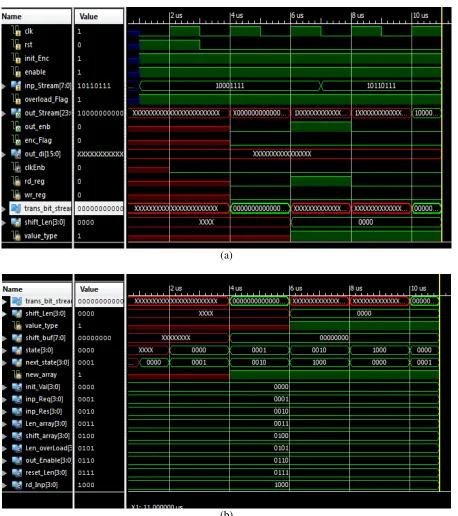
which at the same time takes the coding quality, preparing velocity, and handling power into record. The proposed decoder configuration is committed and assigned to decipher the cutting edge registration and status register-document based SPIHT encoding structure [19], which is sufficient for wavelet-put together quality-with respect to request ECG information pressure frameworks. This is not normal for the cutting edge SPIHT decoder structures that disentangle the rundown based methodology [2, 11, 12] , which require an arranging and refinement process that outcomes in a mind boggling equipment engineering and in this way are not appropriate for wearable/versatile ECG applications. In the first place, we examine the interpreting calculation proposed in this paper and plan a relating reasonable VLSI equipment design. At that point, a superior and low-control SPIHT deciphering equipment engineering is recovered. In the long run, we accomplish a continuous ease and low-control SPIHT decoder by utilizing an ideal and straightforward equipment situated VLSI design. Figure.3 and Figure 4 shows simulation result of proposed SPIHT Decoder.
International Journal of Scientific Research and Engineering Development-– Volume 2 Issue 5, September 2019 Available at www.ijsred.com
ISSN : 2581-7175 ©IJSRED:All Rights are Reserved Page 459 (a)
(b)
Figure.4(a)&(b) Simulation Result of Proposed SPIHT Decoder
B. Performance of SPIHT Decoder
The proposed VLSI equipment engineering of the SPIHT decoder was executed utilizing the Verilog equipment depiction language (Verilog HDL), checked utilizing the VCS compiler given by Synopsys, and
International Journal of Scientific Research and Engineering Development-– Volume 2 Issue 5, September 2019 Available at www.ijsred.com
ISSN : 2581-7175 ©IJSRED:All Rights are Reserved Page 460 SPIHT decoder configuration, as appeared in Table I, the
proposed structure for the 316 sections of the 1024 × 1 ECG information utilizing heart arrhythmia databases is able to do better execution brings about terms of the working pace, control utilization, and equipment costs. The proposed SPIHT decoder configuration can address a coding square size of 1024 × 1 and has the greatest stirring recurrence up to 434 MHz. In the interim, the normal disentangling force and VLSI equipment cost were 25.4 µW and 134.2k door tallies, individually
Table1. Performance with the state-of-the-art SPIHT Decoder Design
Design TCSVT TM’16 Proposed
Design
1D/2D Application
2D image 1D Image
1D ECG
Block Size of SPIHT Decoding
4×4 64×1 1024×1
Process (nm) 130 130 90
Gate count(kilo gates)
14.5 68.8 134.242
Max. Operating Frequency(MHz)
110 167 434
Normalized operating Frequency(MHz)
159 246 434
Power (µW) - - 25.4
VI. CONCLUSION
This paper displays a superior, low-control, low-zone SPIHT VLSI structure, which is applied to a 1-D wavelet-based ECG information pressure framework. The proposed SPIHT configuration joins the calculation and equipment engineering co-structure. The SPIHT
configuration abbreviates the translating time and keeps up the coding quality (as appeared by the product recreation results) while actualizing the 1-D wavelet-based quality-on-request ECG information pressure framework. Be that as it may, the proposed lossless SPIHT decoder configuration indicates rapid, low-control utilization and low territory structure in the VLSI equipment usage. The commitments of this paper are two-crease. To begin with, we propose and build up the SPIHT translating calculation and the VLSI equipment engineering plan for speed what's more, control effective lossless SPIHT coding use. Second, we execute the SPIHT interpreting VLSI structure, and the trial results uncover that this plan is suitable for the mobile Health wavelet-based quality-guaranteed ECG pressure framework.
REFERENCES
[1] E. P. Widiyanto, S. M. Isa, M. I. Tawakal, M. N. Kurniawan, W. Jatmiko, and P. Mursanto, "An ECG 12-lead hardware with SPIHT compressing scheme," in 2013 International Conference on Advanced Computer Science and Information Systems (ICACSIS), 2013, pp. 167-172.
[2] V. P. Rachim and W. Y. Chung, "Wearable Noncontact Armband for Mobile ECG Monitoring System," IEEE Transactions on Biomedical Circuits and Systems, vol. 10, pp. 1112-1118, 2016.
[3] Y. Jin and H. J. Lee, "A Block-Based Pass-Parallel SPIHT Algorithm," IEEE Transactions on Circuits and Systems for Video Technology, vol. 22, pp. 1064-1075, 2012.
[4] C. T. Ku, H. S. Wang, K. C. Hung, and Y. S. Hung, "A Novel ECG Data Compression Method Based on Nonrecursive Discrete Periodized Wavelet Transform," IEEE Transactions on Biomedical Engineering, vol. 53, pp. 2577-2583, 2006.
International Journal of Scientific Research and Engineering Development-– Volume 2 Issue 5, September 2019 Available at www.ijsred.com
ISSN : 2581-7175 ©IJSRED:All Rights are Reserved Page 461 [6] S. M. E. Sahraeian and E. Fatemizadeh,
"Wavelet-Based 2-D ECG Data Compression Method Using SPIHT and VQ Coding," in EUROCON 2007 - The International Conference on "Computer as a Tool", 2007, pp. 133-137.
[7] S. Nayebi, M. H. Miranbeigi, and A. M. Nasrabadi, "An improved method for 2-D ECG compression based on SPIHT algorithm," in 2008 30th Annual International Conference of the IEEE Engineering in Medicine and Biology Society, 2008, pp. 2952-2955.
[8] H. King-Chu, H. Yao-Shan, and H. Yu-Jung, "A nonseparable VLSI architecture for two-dimensional discrete periodized wavelet transform," IEEE Transactions on Very Large Scale Integration (VLSI) Systems, vol. 9, pp. 565-576, 2001.
[9] A. S. Al-Fahoum, "Quality assessment of ECG compression techniques using a wavelet-based diagnostic measure," IEEE Transactions on Information Technology in Biomedicine, vol. 10, pp. 182-191, 2006.
[10] G. Xu, J. Han, Y. Zou, and X. Zeng, "A 1.5-D Multi-Channel EEG Compression Algorithm Based on NLSPIHT," IEEE Signal Processing Letters, vol. 22, pp. 1118-1122, 2015.
[11] S. Kim, D. Lee, J. S. Kim, and H. J. Lee, "A High-Throughput Hardware Design of a One-Dimensional SPIHT Algorithm," IEEE Transactions on Multimedia, vol. 18, pp. 392-404, 2016.